REVIEW 5 major objections 5 minor 2 cited by
A single family of scalarized Einstein-Euler-Heisenberg black holes exists for all q>0 with M=1/2, μ=0.3, α=1, but every member is thermodynamically disfavored and dynamically unstable under radial scalar perturbations.
Reviewed by Pith at T0; open to challenge. T0 means a machine referee read the full paper against a public rubric. the ladder, T0–T4 →
A single branch of scalarized Einstein-Euler-Heisenberg black holes is constructed numerically, found to be thermodynamically disfavored and dynamically unstable for all magnetic charges.
T0 review reviewed 2026-08-05 challenge →
load-bearing objection A plausible new family of scalarized EEH black holes with a clean thermodynamic story; the headline instability claim is only as solid as an unproved decoupling step in Section 4. the 5 major comments →
Negative potential-induced scalarization in the Einstein-Euler-Heisenberg black hole
The pith
A machine-rendered reading of the paper's core claim, the machinery that carries it, and where it could break.
The reading
Core claim
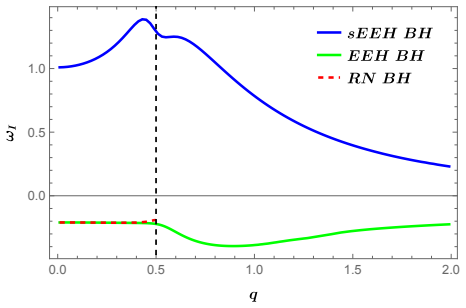
In the Einstein-Euler-Heisenberg-scalar theory with potential V=-4α²φ⁶, the full field equations admit a single branch of asymptotically flat, spherically symmetric scalarized black holes labelled by the magnetic charge q>0, once M=1/2, μ=0.3, α=1 are fixed. The scalar field decays as qs/r at infinity, and qs(q) is nearly constant for q<1/2 then grows markedly for q>1/2, which the authors read as primary hair below 1/2 and secondary hair above it. Thermodynamically, the scalarized solutions have lower entropy aH<ãH than the bald EEH black hole at the same q, so they are not the preferred phase. Dynamically, solving the l=0 scalar perturbation on the numerical background gives quasinormal fre
What carries the argument
The central object is the negative sextic scalar potential V(φ)=-4α²φ⁶ in the Einstein-Euler-Heisenberg-scalar action, which allows a nontrivial scalar profile on a magnetically charged EEH background while keeping the scalar equation minimally coupled. The single-horizon condition μ>0.019 (here μ=0.3) removes charge bounds and lets q exceed the extremal ratio, so the branch covers the overcharging regime. The argument's stability analysis runs through a Schrödinger-type master equation for the radial scalar perturbation with potential VsEEH, obtained after a decoupling of the two metric perturbations H0 and H1, and quasinormal frequencies computed by the pseudo-spectral method with ingoing/
Load-bearing premise
The calculation of instability relies on the claim that the two metric perturbations H0 and H1 decouple from the scalar perturbation, leaving a single master equation; this decoupling is asserted rather than derived in the paper, and if it fails the computed quasinormal-mode frequencies may not describe the true radial stability.
What would settle it
Solve the full system of coupled l=0 perturbations (H0, H1, δφ) without assuming decoupling, and check for exponentially growing modes; if the coupled system shows no mode with Im ω>0 for some q>0, or if the decoupled and coupled spectra differ, the claimed universal instability collapses.
If this is right
- For all q>0 the scalarized branch fails both stability tests reported: lower entropy than the bald solution and positive imaginary QNM frequency, so no member is a viable endpoint of scalarization.
- The switch in the q-dependence of the scalar charge at q=1/2, if generic, sharpens the distinction between primary and secondary hair in nonlinear electrodynamics.
- Since ωI stays positive even into the overcharged regime q>1, the instability covers exactly the region where EEH black holes are most exotic, limiting their observable use.
- The bald EEH black hole's stability under scalar perturbations implies the negative potential, not a tachyonic mode, is what enables hair formation here.
- A potential well in VsEEH is not enough to diagnose instability; the paper's QNM computation is what fixes the sign of ωI.
Where Pith is reading between the lines
- If the H0/H1 decoupling holds, the uniform ωI>0 result suggests any initially scalarized EEH black hole would shed its hair and relax to the bald solution, so astrophysically one would expect to see only bald EEH configurations.
- The negative energy density and entropy ordering may be linked: the same φ⁶ term that sources hair also lowers the entropy, implying the scalarization is thermodynamically uphill; this could be tested by computing free energy differences along the branch.
- Applying the same negative potential to other nonlinear electrodynamics, such as Born-Infeld, would test whether unstable hair is a generic feature of negative-potential scalarization or particular to the EEH structure.
Editorial analysis
A structured set of objections, weighed in public.
Referee Report
Summary. The paper studies scalarized black holes in an Einstein-Euler-Heisenberg-scalar theory with a negative scalar potential V(φ)=-4α²φ⁶. After establishing that the bald EEH black hole has a single horizon for μ>0.019 at M=1/2, the authors solve the full static, spherically symmetric field equations and report a single branch of hairy (sEEH) solutions for all q>0, with fixed M=0.5, μ=0.3, α=1. They compare temperature, entropy, mass function, and energy density of the hairy branch with the bald EEH and Reissner-Nordström solutions, and interpret the q-dependence of the scalar charge as showing a transition from 'primary' to 'secondary' hair. They then perform a radial (l=0) scalar perturbation analysis and compute quasinormal-mode frequencies, reporting ω_I>0 for all q>0 and concluding that the sEEH branch is dynamically unstable. The abstract frames the work as negative-potential-induced scalarization in the overcharging regime.
Significance. If the central claims are correct, the paper provides a concrete, relatively simple example of black-hole scalar hair in a theory with nonlinear electrodynamics and an overcharging single-horizon regime, which is a useful addition to the scalarization literature. The exact treatment of the magnetic potential, the explicit bald-limit consistency check for the effective potential, and the direct computation of QNM frequencies are strengths: they make the central statements falsifiable in principle. However, the paper's main dynamical conclusion rests on a decoupling assertion that is not derived, and the numerical results are presented without convergence tests or code/data. The advertised primary/secondary scalar-charge classification is also not established by the evidence shown. These issues are localizable and, in my view, fixable within the scope of a revision.
major comments (5)
- [Sec. 4, Eqs. (31)-(35)] The reduction from the linearized Einstein-scalar system to the single master equation (33) is asserted without derivation. After the ansatz (31), the text states that H0(t,r) and H1(t,r) 'become redundant via a decoupling procedure', but for l=0 the scalar perturbation equation contains metric-perturbation terms such as δg^{rr} φ0'' and first-order connection terms involving φ0'; eliminating H0 and H1 requires use of the linearized Hamiltonian and momentum constraints. The consistency check below Eq. (35) only recovers the bald limit δ=φ=0 and therefore cannot validate the elimination in the hairy background. Since the central instability claim (ω_I>0 for all q>0, Fig. 9) relies directly on Eq. (33), a full derivation of the master equation, or a coupled perturbative calculation, is required.
- [Secs. 3-4, Figs. 6 and 9] The numerical results are not independently verifiable as presented. The shooting method used to solve Eqs. (21)-(23) and the pseudo-spectral method used for the QNM calculation are described only by references; no grid sizes, spectral truncation orders, domain truncation radii, boundary-condition implementation, tolerance, or convergence tests are reported, and no code or data are provided. The claims of a single branch for all q>0, the quantitative values of q_s(q) in Fig. 6, and the sign/magnitude of ω_I(q) in Fig. 9 therefore lack the numerical accountability expected for a paper whose central results are numerical.
- [Sec. 3, Fig. 6; Sec. 5; Abstract] The classification of the scalar hair as 'primary' for q<1/2 and 'secondary' for q>1/2 is not supported by the evidence. For fixed M, q_s(q) is a single-valued monotonic function of q, so q_s is not an independent integration parameter; 'varies only slightly' is a quantitative statement, not a criterion for primary charge. The paper itself notes in Sec. 5 that 'It would be interesting to examine more precisely in future whether the scalar charge is truly primary or not'. The abstract nevertheless states the primary/secondary behavior as a result, which overstates the finding.
- [Sec. 5, first paragraph] The text contains an apparent contradiction: it says 'The onset scalarization does not occur for this black hole because it remains stable under scalar perturbations. However, the introduction of a negative potential can trigger scalarization.' If the bald EEH solution is stable against scalar perturbations (as shown in Sec. 2), there is no tachyonic instability that would dynamically drive the system towards the hairy branch; the constructed hairy family is a separate solution branch, not the endpoint of a scalarization instability. The paper should clarify what is meant by 'trigger scalarization' and by the title's 'negative potential-induced scalarization', otherwise the mechanism is overstated.
- [Sec. 3, Eq. (29) and Fig. 5] The statement that the sEEH black holes are 'not thermodynamically favored' is based only on the entropy inequality a_H < a_H at fixed M and q. This is insufficient without specifying the ensemble and comparing a suitable free energy or Euclidean on-shell action, since the two branches have different temperatures and the hairy branch carries an additional scalar charge. The abstract's thermodynamic conclusion should either be made conditional on a stated ensemble or supported by a free-energy calculation.
minor comments (5)
- [Sec. 5] Typographical errors: 'remians' should be 'remains'; 's-model' should be 's-mode'. In Sec. 3, 'black hols' should be 'black holes'.
- [Sec. 2 and Fig. 1] The text lists example values μ=0.001, 0.01, 0.19, and 0.3, while the abstract states μ_max=0.019 and the caption says three roots exist only for μ≲0.019. If the bottom-left panel corresponds to μ=0.19, it would be in the single-horizon regime, contradicting the caption. Please clarify whether 0.19 is a typo for 0.019.
- [Sec. 4, Eq. (35)] The notation in Eq. (35) should be stated more explicitly: N, δ, and φ denote the sEEH background fields, and the r-dependence of VsEEH should be indicated. The consistency check to VEEH is useful; it would be even more helpful to write the intermediate expression for the bald limit to make the factor 3.6q^4/(5r^8) in Eq. (18) transparent.
- [Sec. 3, Figs. 3 and 4] The caption of Fig. 4 says negative regions appear for q=2 (EEH) and q=1,2 (sEEH), but the text in Sec. 3 states 'q ≳ 1'; this should be made consistent. Also, the asymptotic behavior of δ(r) in Fig. 3 (right) is discussed but the figure is hard to read because the curves nearly coincide; a log or zoomed plot would help.
- [General] The paper should cite or define what is meant by 'primary' and 'secondary' scalar charge, since these terms are used in the abstract and conclusion but are not formally defined in the text.
Circularity Check
No circular reduction found: the sEEH background, thermodynamics, and QNM results are computed from the stated field equations; self-citations are motivational only, and the flagged decoupling gap in Sec. 4 is an omitted proof, not a circular step.
full rationale
The central claims of the paper — existence of the single sEEH branch, entropy/temperature ordering, the q_s(q) behavior, and ωI>0 for all q>0 — are outputs of solving the stated field equations (21)–(23) and the linearized perturbation system with V(φ)=-4α²φ⁶, µ=0.3, α=1, M=0.5. The negative potential is an explicit ansatz imported from the authors' prior work [25] (Chew & Myung, with coauthor Myung), but it is presented as a model choice, not as a first-principles derivation, and it is not a fitted parameter renamed as a prediction. The self-citations ([25] for the potential form, [28] for the inner-horizon no-go theorem) are non-load-bearing: removing them would not alter the numerical construction, and the paper does not invoke them as uniqueness theorems that force its results. The only substantive weakness is in Sec. 4, where the reduction of the coupled perturbations to the single master equation (33) is asserted via 'become redundant via a decoupling procedure' with no derivation or constraint equations shown; if that elimination is incorrect, the computed QNM imaginary parts in Fig. 9 could change. However, a missing derivation is a correctness risk, not a circular reduction: Eq. (33) is not equal to an input by construction, and the consistency check below Eq. (35) only reproduces the bald limit and cannot by itself manufacture the hairy potential. No prediction in the paper reduces to its own input by definition, by fitting, or by a load-bearing self-citation chain. Thus the circularity score is low, reflecting only the presence of minor non-load-bearing self-citations.
Axiom & Free-Parameter Ledger
free parameters (3)
- α (scalar coupling in V = -4α²φ⁶) =
1
- µ (Euler-Heisenberg parameter) =
0.3
- M (ADM mass) =
1/2
axioms (3)
- domain assumption The EEH action (1) is the correct effective action for gravity coupled to one-loop QED
- domain assumption The scalar potential V(φ) = -4α²φ⁶ is a viable model for negative-potential scalarization
- ad hoc to paper The l=0 radial perturbation decouples into a single master equation
Cite this review
Pith. "Pith review of Negative potential-induced scalarization in the Einstein-Euler-Heisenberg black hole." pith.science (2026). https://pith.science/paper/VUITYYXD
@misc{pith2026250816083,
  author       = {Pith},
  title        = {Pith review of: Negative potential-induced scalarization in the Einstein-Euler-Heisenberg black hole},
  year         = {2026},
  howpublished = {\url{https://pith.science/paper/VUITYYXD}},
  note         = {Machine review of arXiv:2508.16083}
}
abstract
We investigate a negative potential-induced scalarization of the Einstein-Euler-Heisenberg (EEH) black hole in the EEH-scalar (EEHS) theory, characterized by mass $M$, Euler-Heisenberg parameter $\mu$, and magnetic charge $q$. Within this framework, the charge $q$ can exceed the extremal bound $q/M > 1$, and a single event horizon is maintained provided the parameter $\mu$ exceeds the $\mu_{\text{max}} = 0.019$, with the ADM mass fixed at $M = 1/2$. We obtain a single branch of scalarized EEH (sEEH) black holes for $q > 0$ which is considered as the simplest model for scalarization of EEH black holes. We found that this class of hairy black holes is not thermodynamically favored, and their quasinormal modes indicate they are dynamically unstable. An interesting feature is that when $q < 1/2$, the scalar charge varies only slightly with $q$ for a fixed mass. In contrast, for $q>1/2$, the scalar charge increases more rapidly as $q$ increases. This distinct behavior suggests that the scalar charge exhibits the characteristics of a primary charge for $q < 1/2$, and of a secondary charge for $q > 1/2$. This finding reveals notable features of hairy black holes in EEH theory, specifically in the overcharging regime.
Figures


Forward citations
Cited by 2 Pith papers
-
Charge-dependent scalarization of Einstein- Euler-Heisenberg black holes
Charge-dependent scalarization of EEH black holes yields stable scalarized branches for 0<q<1.115 with positive α and for q>1.115 with negative α.
-
Scalarization of Einstein-Euler-Heisenberg black hole with multiple horizons
Stable, positive-mass scalarized EEH black holes exist only in an intermediate primary-scalar-charge window for low/cold horizons and above a lower bound for hot horizons.
Reference graph
Works this paper leans on
-
[1]
W. Israel, Phys. Rev. 164 (1967), 1776-1779 doi:10.1103/PhysRev.164.1776
-
[2]
W. Israel, Commun. Math. Phys. 8 (1968), 245-260 doi:10.1007/BF01645859
-
[3]
R. Ruffini and J. A. Wheeler, Phys. Today 24, no. 1, 30 (1971). doi:10.1063/1.3022513
-
[4]
J. D. Bekenstein, Phys. Rev. Lett. 28 (1972), 452-455 doi:10.1103/PhysRevLett.28.452
-
[5]
J. D. Bekenstein, Phys. Rev. D 51 (1995) no.12, R6608 doi:10.1103/PhysRevD.51.R6608
-
[6]
C. A. R. Herdeiro and E. Radu, Int. J. Mod. Phys. D 24, no. 09, 1542014 (2015) doi:10.1142/S0218271815420146 [arXiv:1504.08209 [gr-qc]]
Pith/arXiv arXiv 2015
-
[7]
M. S. Volkov, doi:10.1142/9789813226609 0184 [arXiv:1601.08230 [gr-qc]]
-
[8]
D. D. Doneva and S. S. Yazadjiev, Phys. Rev. Lett. 120, no. 13, 131103 (2018) doi:10.1103/PhysRevLett.120.131103 [arXiv:1711.01187 [gr-qc]]
Pith/arXiv arXiv 2018
-
[9]
H. O. Silva, J. Sakstein, L. Gualtieri, T. P. Sotiriou and E. Berti, Phys. Rev. Lett. 120 (2018) no.13, 131104 doi:10.1103/PhysRevLett.120.131104 [arXiv:1711.02080 [gr-qc]]
Pith/arXiv arXiv 2018
-
[10]
G. Antoniou, A. Bakopoulos and P. Kanti, Phys. Rev. Lett. 120, no. 13, 131102 (2018) doi:10.1103/PhysRevLett.120.131102 [arXiv:1711.03390 [hep-th]]. 17
Pith/arXiv arXiv 2018
-
[11]
Hairy Black Holes by Spontaneous Symmetry Breaking
B. Latosh and M. Park, Phys. Rev. D 110 (2024) no.2, 024012 doi:10.1103/PhysRevD.110.024012 [arXiv:2305.19814 [hep-th]]
work page internal anchor Pith review Pith/arXiv arXiv 2024
-
[12]
C. A. R. Herdeiro, E. Radu, N. Sanchis-Gual and J. A. Font, Phys. Rev. Lett. 121, no. 10, 101102 (2018) doi:10.1103/PhysRevLett.121.101102 [arXiv:1806.05190 [gr-qc]]
Pith/arXiv arXiv 2018
-
[13]
Y. H. Hyun, B. Latosh and M. Park, JHEP 08 (2024), 163 doi:10.1007/JHEP08(2024)163 [arXiv:2405.08769 [hep-th]]
work page internal anchor Pith review Pith/arXiv arXiv 2024
-
[14]
W. Heisenberg and H. Euler, Z. Phys. 98 (1936) no.11-12, 714-732 doi:10.1007/BF01343663 [arXiv:physics/0605038 [physics]]
Pith/arXiv arXiv 1936
-
[15]
H. Yajima and T. Tamaki, Phys. Rev. D 63, 064007 (2001) doi:10.1103/PhysRevD.63.064007 [arXiv:gr-qc/0005016 [gr-qc]]
Pith/arXiv arXiv 2001
-
[16]
V. E. Hubeny, Phys. Rev. D 59 (1999), 064013 doi:10.1103/PhysRevD.59.064013 [arXiv:gr-qc/9808043 [gr-qc]]
work page internal anchor Pith review Pith/arXiv arXiv 1999
-
[17]
Overcharging magnetized black holes at linear order and the weak cosmic censorship conjecture
C. Liu and S. Gao, Phys. Rev. D 101 (2020) no.12, 124067 doi:10.1103/PhysRevD.101.124067 [arXiv:2003.12999 [gr-qc]]
work page internal anchor Pith review Pith/arXiv arXiv 2020
-
[18]
M. R. Alipour, S. Noori Gashti, B. Pourhassan and ˙I. Sakallı, [arXiv:2504.03453 [gr- qc]]
work page internal anchor Pith review Pith/arXiv arXiv
-
[19]
The Weak Gravity Conjecture, Overcharged Shells and Gravitational Traps
A. Kehagias, K. D. Kokkotas, A. Riotto, J. Taskas and G. Tringas, Class. Quant. Grav. 41 (2024) no.7, 075007 doi:10.1088/1361-6382/ad28f9 [arXiv:2305.07915 [hep-th]]
work page internal anchor Pith review Pith/arXiv arXiv 2024
-
[20]
S. Shaymatov and B. Ahmedov, Gen. Rel. Grav.55 (2023) no.2, 36 doi:10.1007/s10714- 023-03082-y [arXiv:2301.08569 [gr-qc]]
work page internal anchor Pith review Pith/arXiv arXiv 2023
-
[21]
G. Brodin, M. Marklund and L. Stenflo, Phys. Rev. Lett. 87 (2001), 171801 doi:10.1103/PhysRevLett.87.171801 [arXiv:physics/0108022 [physics.class-ph]]
Pith/arXiv arXiv 2001
-
[22]
A. Allahyari, M. Khodadi, S. Vagnozzi and D. F. Mota, JCAP 02 (2020), 003 doi:10.1088/1475-7516/2020/02/003 [arXiv:1912.08231 [gr-qc]]
Pith/arXiv arXiv 2020
-
[23]
S. I. Kruglov, Mod. Phys. Lett. A 35 (2020) no.35, 2050291 doi:10.1142/S0217732320502910 [arXiv:2009.07657 [gr-qc]]. 18
Pith/arXiv arXiv 2020
-
[24]
T. Karakasis, G. Koutsoumbas, A. Machattou and E. Papantonopoulos, Phys. Rev. D 106 (2022) no.10, 104006 doi:10.1103/PhysRevD.106.104006 [arXiv:2207.13146 [gr- qc]]
Pith/arXiv arXiv 2022
-
[25]
X. Y. Chew and Y. S. Myung, Phys. Rev. D 110 (2024) no.4, 044011 doi:10.1103/PhysRevD.110.044011 [arXiv:2405.04921 [gr-qc]]
Pith/arXiv arXiv 2024
-
[26]
D. Amaro and A. Mac ´ ıas, Phys. Rev. D 102, no.10, 104054 (2020) doi:10.1103/PhysRevD.102.104054
-
[27]
N. Bret´ on and L. A. L´ opez, Phys. Rev. D 104, no.2, 024064 (2021) doi:10.1103/PhysRevD.104.024064 [arXiv:2105.12283 [gr-qc]]
Pith/arXiv arXiv 2021
- [28]
-
[29]
Z. Luo and J. Li, Chin. Phys. C 46, no.8, 085107 (2022) doi:10.1088/1674-1137/ac6574
-
[30]
G. Dotti and R. J. Gleiser, Class. Quant. Grav. 22, L1 (2005) doi:10.1088/0264- 9381/22/1/L01 [arXiv:gr-qc/0409005 [gr-qc]]
Pith/arXiv arXiv 2005
-
[31]
A. Jansen, Eur. Phys. J. Plus 132 (2017) no.12, 546 doi:10.1140/epjp/i2017-11825-9 [arXiv:1709.09178 [gr-qc]]
Pith/arXiv arXiv 2017
-
[32]
F. Javed, Phys. Dark Univ. 44 (2024), 101450 doi:10.1016/j.dark.2024.101450
-
[33]
D. P. Sorokin, Fortsch. Phys. 70 (2022) no.7-8, 2200092 doi:10.1002/prop.202200092 [arXiv:2112.12118 [hep-th]]. 19
Pith/arXiv arXiv 2022
This paper was first reviewed by deepseek-v4-flash on August 5, 2026.
discussion (0)
Sign in with ORCID, Apple, or X to comment. Anyone can read and Pith papers without signing in.