REVIEW 4 major objections 4 minor 1 cited by
Properties of the magnetic universe with positive cosmological constant
T0 review · 4 major / 4 minor · reviewed 2026-08-05 · deepseek-v4-flash
Pith's one-line read For a positive cosmological constant, the Melvin magnetic universe becomes a compact, conical two-sphere over flat spacetime, with a round Freund-Rubin sphere as a critical limit.
desk verdict Solid qualitative analysis of the Lambda>0 Melvin regime; the one weak section is the Freund–Rubin limit, which needs a real derivation but is not fatal. read the letter →
The pith
A machine-rendered reading of the paper's core claim, the machinery that carries it, and where it could break.
The reading
What carries the argument
The load-bearing object is the metric function f(r) = ν/rd−3 − r2/ℓ2 − β2/r2(d−3) and its two positive roots λ and r0. The interval between the roots is the compact r-direction, and the combination βℓ compared with the critical value η = √[(d−1)/(d−3)] λd−2 decides whether the conical singularity at r0 is a deficit or an excess. The Freund-Rubin limit is obtained by the simultaneous scaling r = λε(x+b), r0 = λ + 2εb, ψ = (b/ε)φ, which sends the interval to a round sphere while keeping the flux finite. The solution itself is obtained by a double Wick rotation of the planar charged black hole, which is why f(r) appears in a Reissner-Nordström-like form.
What would settle it
Compute the constant C from the factorization P(r) and test whether b2C = λ^{2(d−3)} admits a positive real b; then substitute the ε→0 limiting metric and gauge potential into the Einstein-Maxwell equations. If the limiting fields do not satisfy the equations, or if no such b exists, the Freund-Rubin limit claim collapses.
Extended reading notes
Core claim
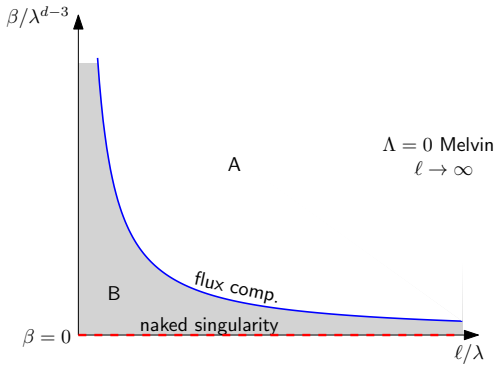
In the coordinates used here, the metric takes the form ds2 = (r2/λ2)ηab dxa dxb + dr2/f(r) + f(r)dψ2, with f(r) = ν/rd−3 − r2/ℓ2 − β2/r2(d−3) and ℓ2 = (d−1)(d−2)/(2Λ). Choosing ν so that r = λ is a root, the Lorentzian region lies between two positive roots λ and r0; hence the (r,ψ) section is a topological sphere, not an infinite cylinder. After fixing the ψ periodicity to remove the conical singularity at r = λ, the other pole has conical deficit if βℓ > √[(d−1)/(d−3)] λd−2 and conical excess if βℓ is below that value. Taking r0 → λ while rescaling r and ψ yields R^{1,d−3} × S2 with a two-form flux F = q dx ∧ dφ, the Freund-Rubin compactification. The flux through constant-r circles is co
Load-bearing premise
The claimed Freund-Rubin limit rests on an unverified consistency condition: a limiting constant C from the root factorization must combine with the chosen length scale b to give the correct sphere radius, and the gauge choice must be compatible, but the paper never computes C or substitutes the limiting metric into the field equations.
Editorial extensions
If this is right
- For Λ > 0 the Melvin cross-section is finite: no magnetic solenoid of arbitrarily large radius can be embedded, because the space closes into a sphere.
- The sign of βℓ − η sets the type of conical singularity, so the model has two geometrically distinct phases separated by the round-sphere flux compactification.
- When the cosmological constant is switched off (ℓ → ∞), the standard d-dimensional Melvin universe is recovered as the compact sphere decompactifies.
- The magnetic flux through the smooth pole is locally that of a uniform field, while the total flux on the compact sphere behaves as roughly 1/β for strong fields.
- Geodesic motion is confined: all orbits are bounded, and the circular orbit radii match the known Λ = 0 values in the decompactification limit.
Reading between the lines
- If the critical limit is exact, the Λ > 0 Melvin solution is a one-parameter conical deformation of a Freund-Rubin compactification, so varying βℓ near η should continuously change the Kaluza-Klein spectrum and the stability properties of the compact sphere; the paper does not perform this spectral analysis.
- The same double-Wick-rotation construction with spherical or hyperbolic planar horizons would likely yield S2 × dS or hyperbolic analogues, which are braneworld-type backgrounds; the paper only notes this extension.
- The conical singularity at one pole could be interpreted as a thin brane sourcing the geometry, in which case the flux and the conical deficit or excess would determine a brane tension; the paper leaves thermodynamics of such a brane unexplored.
Editorial analysis
A structured set of objections, weighed in public.
Referee Report
Summary. The paper studies the d-dimensional Einstein-Maxwell Melvin-type solution with positive cosmological constant, written in Reissner-Nordström-like coordinates. It establishes the coordinate equivalence to Astorino's form, analyzes the domain of the radial coordinate between two roots of f(r), computes the conical singularity structure of the (r,ψ) section, derives the magnetic flux through circles, and studies timelike and null geodesics. A central advertised result is that a particular double-root limit r0→λ yields a Freund–Rubin-type flux compactification R^{1,d-3}×S². The remaining analysis is largely standard and self-contained, with explicit formulas for the flux and geodesic potentials.
Significance. If the Freund–Rubin limit is properly established, the paper provides a new exact link between the Λ>0 Melvin spacetime and flux compactification, alongside a systematic account of the geometry, flux, and geodesics. The paper is transparent about its parameters (β, ℓ, λ), uses explicit coordinate transformations, and recovers known Λ=0 and AdS-Melvin limits. However, the flux-compactification limit in Sec. 2.3 is currently asserted rather than demonstrated; this is the main load-bearing claim advertised in the abstract and conclusion. The rest of the paper is competent and should be publishable once that derivation is supplied or corrected.
major comments (4)
- [Sec. 2.3, Eq. (2.16b)] The limiting gauge potential is not derived correctly as printed. In (2.16b) the magnetic parameter β has been replaced by ε; with the stated χ0 and ψ=(b/ε)φ, the limit gives a constant or divergent A, not q x dφ. If instead one uses β, the expansion with r=λ+ε(x+b) produces A ∝ (x+b)dφ after the leading constant is cancelled, not q x dφ. Please correct the expansion and specify the coordinate shift/gauge choice that yields (2.17b).
- [Sec. 2.3, Eq. (2.17a)] The claimed round S² metric is missing the b² factor in the dφ² term. From the limiting form of (2.16a) with ψ=(b/ε)φ, the second term becomes (b²−x²)dφ² under the stated condition b²C/λ^{2(d−3)}=1, not (1−x²/b²)dφ². The printed metric is not the round sphere of radius b and would not solve (2.2) with F=q dx∧dφ. Please correct Eq. (2.17a) and verify the resulting sphere normalization.
- [Sec. 2.3] The constant C is never computed, and the compatibility of the condition b²C/λ^{2(d−3)}=1 with the critical relation βℓ=η is not checked. Since λ is already fixed by βℓ=η via Eq. (3.7), the second condition is an additional constraint; the paper should show it is satisfiable and determine b in terms of ℓ and Λ. The limiting metric and field are also never substituted into the Einstein–Maxwell equations (2.2). Please supply these steps, or state explicitly that the limit is only formal.
- [Sec. 3.2, after Eq. (3.12)] The statement that Case A (βℓ>η) gives a conical deficit and Case B (βℓ<η) gives a conical excess is asserted with 'it can be shown' but no proof is given for general d. This is a central qualitative claim of the paper. Please provide a derivation, even a short one, of the inequality |f'(r0)|<|f'(λ)| for Case A and its reverse for Case B.
minor comments (4)
- [Fig. 1 caption] The caption says 'Case B is the shaded region βℓ>√((d−1)/(d−3)) λ^{d−4}'; the inequality should be βℓ<η. The text and figure indicate the opposite.
- [Sec. 4, text around Eq. (4.3)] The sentence 'This case contains the limit ℓ→0 to Λ=0' should read ℓ→∞, since Λ=0 corresponds to ℓ∝Λ^{-1/2}→∞.
- [Sec. 3.3, text near the end] The sentence 'In the limit β→∞, f diverges at zero' should read β→0; the paragraph is discussing the vanishing-field limit.
- [Sec. 2.3, Eq. (2.15)] The scaling r=λε(x+b) appears dimensionally inconsistent and likely should be r=λ+ε(x+b) (as the subsequent formulas suggest). Please correct the displayed equation and define the dimensions of x and b explicitly.
Circularity Check
No significant circularity: the analysis is a self-contained study of a known exact solution; self-citations are contextual rather than load-bearing.
full rationale
The paper's central derivation chain is self-contained. It starts from the standard planar-horizon Reissner-Nordström solution (2.3), applies the explicit Wick rotations (2.4) to obtain the magnetic solution (2.5), and states that the result directly solves the Einstein-Maxwell equations (2.2). The subsequent geometry, flux, and geodesic analyses are computed from this metric with no fitted parameters or data-dependent predictions. The only self-citation that could look load-bearing is Ref. [34] for the conical-deficit/excess classification in Sec. 3.2, but the paper also derives the ratios γλ and γ0 in Eqs. (3.10)-(3.12) and provides numerical plots (Fig. 4), so the citation is supplementary rather than the sole support. The Freund-Rubin limit in Sec. 2.3 is an explicit coordinate rescaling of the known solution; while the paper does not substitute the limiting metric and field back into (2.2) and leaves the constant C implicit, that is a technical gap in the limit argument, not a case where the output is assumed in the input. No fitted parameter is renamed as a prediction, and no uniqueness theorem is imported to force the chosen ansatz. Therefore no significant circularity is present.
Assumptions & free parameters
free parameters (3)
- ell
- beta
- lambda
assumptions (5)
- domain assumption The Einstein-Maxwell equations (2.2) are the correct field equations for action (2.1)
- standard math A double Wick rotation of a solution yields another solution
- standard math Descartes' rule of signs applies to P(r) to guarantee at most two positive roots
- ad hoc to paper The limiting procedure in Sec. 2.3 (r0 -> lambda with epsilon scaling) yields a valid solution
- domain assumption The spacetime is taken to be smooth except at the conical singularities, which are regularized by choosing Delta psi
Cite this review
Pith. "Pith review of Properties of the magnetic universe with positive cosmological constant." pith.science (2026). https://pith.science/paper/JBNDCBIC
@misc{pith2026250901374,
  author       = {Pith},
  title        = {Pith review of: Properties of the magnetic universe with positive cosmological constant},
  year         = {2026},
  howpublished = {\url{https://pith.science/paper/JBNDCBIC}},
  note         = {Machine review of arXiv:2509.01374}
}
abstract
The properties of the Melvin-type spacetime with a positive cosmological constant $\Lambda$ in $d$-dimensional Einstein--Maxwell gravity is studied. The solution is parametrised in terms of the `de Sitter radius' $\ell\propto\Lambda^{-1/2}$ and the magnetic field parameter $\beta$, and they are warped products of the form $\mathbb{R}^{1,d-3}\times S^2$, where $\mathbb{R}^{1,d-3}$ is the $(d-2)$-dimensional Minkowski spacetime and $S^2$ is topologically a two-sphere which contains a conical singularity, whose nature depends on the product $\beta\ell$. In the limit $\ell\rightarrow\infty$, the $S^2$ decompactifies and the $d$-dimensional Melvin universe is recovered. The Freund--Rubin-type flux compactification model is shown to be another particular limit of this solution. We also calculate the flux and geodesics in this spacetime.
Figures


Figures from the paper (5 more)


Forward citations
Cited by 1 Pith paper
-
Magnetising de Sitter and Anti-de Sitter spacetimes
A Harrison-type map plus fluid rescaling produces spherical Melvin analogues of dS and AdS that reduce to ordinary (A)dS when the magnetic field vanishes.
Reference graph
Works this paper leans on
-
[32]
M. Astorino, Charging axisymmetric space-times with cosmological const ant, JHEP 06 (2012) 086, [ arXiv:1205.6998]
arXiv 2012
-
[34]
Lim, Electric or magnetic universe with a cosmological constant , Phys
Y.-K. Lim, Electric or magnetic universe with a cosmological constant , Phys. Rev. D 98 (2018), no. 8 084022, [ arXiv:1807.07199]. 26
arXiv 2018
-
[1]
J. A. Wheeler, Geons, Phys. Rev. 97 (1955) 511–536
work page 1955
-
[2]
M. A. Melvin, Pure magnetic and electric geons , Phys. Lett. 8 (1964) 65–70
1964
-
[3]
W. B. Bonnor, Static Magnetic Fields in General Relativity , Proc. Phys. Soc. A 67 (1954) 225–232
work page 1954
-
[4]
Misra and L
M. Misra and L. Radhakrishna, Some electromagnetic fields of cylindrical symmetry , in Proc. Natl. Inst. Sci. India, Pt. A , vol. 28, Banaras Hindu Univ., India, 1962
1962
-
[5]
Cosmic Solenoids: Minimal Cross-Section and Generalized Flux Quantization
A. Davidson and D. Karasik, Cosmic solenoids: Minimal cross-section and generalized flux quantization , Phys. Rev. D 60 (1999) 045002, [ gr-qc/9901002]
work page Pith review arXiv 1999
-
[6]
M. ˇZofka and J. Langer, Relativistic solenoids, Czech. J. Phys. 55 (2005) 157–165, [gr-qc/0502112]
work page Pith review arXiv 2005
Show all 45 references
-
[7]
Lim, Solenoid Configurations and Gravitational Free Energy of the AdS–Melvin Spacetime, Entropy 23 (2021), no
Y.-K. Lim, Solenoid Configurations and Gravitational Free Energy of the AdS–Melvin Spacetime, Entropy 23 (2021), no. 11 1477, [ arXiv:2111.05484]
2021 arXiv
-
[8]
Kastor and J
D. Kastor and J. Traschen, Geometry of AdS-Melvin Spacetimes , Class. Quant. Grav. 38 (2021), no. 4 045016, [ arXiv:2009.14771]. 24
2021 arXiv
-
[9]
M. A. Melvin, Dynamics of Cylindrical Electromagnetic Universes , Phys. Rev. 139 (1965) B225–B243
1965
-
[10]
M. A. Melvin and J. S. Wallingford, Orbits in a magnetic universe , J. Math. Phys. 7 (1966) 333–340
1966
-
[11]
K. S. Thorne, Absolute Stability of Melvin ’s Magnetic Universe , Phys. Rev. 139 (1965) B244
1965
-
[12]
Havrdov´ a and P
L. Havrdov´ a and P. Krtouˇ s,Melvin universe as a limit of the C-metric , Gen. Rel. Grav. 39 (2007) 291–296, [ gr-qc/0611092]
2007 arXiv
-
[13]
Ortaggio, Higher dimensional black holes in external magnetic fields , JHEP 05 (2005) 048, [ gr-qc/0410048]
M. Ortaggio, Higher dimensional black holes in external magnetic fields , JHEP 05 (2005) 048, [ gr-qc/0410048]
2005 arXiv
-
[14]
Bini and B
D. Bini and B. Mashhoon, Static and dynamic Melvin universes , Phys. Rev. D 105 (2022), no. 12 124012, [ arXiv:2202.02033]
2022 arXiv
-
[15]
A. A. Golubtsova and V. D. Ivashchuk, On multidimensional analogs of Melvin ’s solution for classical series of Lie algebras , Grav. Cosmol. 15 (2009) 144–147, [ arXiv:1009.3667]
2009 arXiv
-
[16]
S. V. Bolokhov and V. D. Ivashchuk, On generalized Melvin solutions for Lie algebras of rank 3 , J. Phys. Conf. Ser. 1390 (2019), no. 1 012093
2019
-
[17]
S. V. Bolokhov and V. D. Ivashchuk, On generalized Melvin solutions for Lie algebras of rank 4 , Eur. Phys. J. Plus 136 (2021), no. 2 225, [ arXiv:1912.08083]
2021 arXiv
-
[18]
Vesel´ y and M
J. Vesel´ y and M. ˇZofka, Cylindrical spacetimes due to radial magnetic fields , Phys. Rev. D 103 (2021), no. 2 024048, [ arXiv:2104.01557]
2021 arXiv
-
[19]
Vesel´ y,Exact spacetimes and their physical properties
J. Vesel´ y,Exact spacetimes and their physical properties . PhD thesis, Charles U., Prague (main), 2022
2022
-
[20]
Cardoso and J
V. Cardoso and J. Nat´ ario, An exact solution describing a scalar counterpart to the Schwarzschild-Melvin Universe , arXiv:2410.02851
-
[21]
Biˇ c´ ak, V
J. Biˇ c´ ak, V. Karas, and T. Ledvinka,Black holes and magnetic fields , IAU Symp. 238 (2007) 139–144, [ astro-ph/0610841]
2007 arXiv
-
[22]
Jafari, Magnetic Fields in Accretion Disks: A Review , arXiv:1904.09677
A. Jafari, Magnetic Fields in Accretion Disks: A Review , arXiv:1904.09677. 25
1904 arXiv
-
[23]
F. J. Ernst, Black holes in a magnetic universe , J. Math. Phys. 17 (1976), no. 1 54–56
1976
-
[24]
Thompson and R
C. Thompson and R. C. Duncan, The Soft gamma repeaters as very strongly magnetized neutron stars - 1. Radiative mechanism for outbursts , Mon. Not. Roy. Astron. Soc. 275 (1995) 255–300
1995
-
[25]
R. F. Archibald, V. M. Kaspi, C. Y. Ng, K. N. Gourgouliato s, D. Tsang, P. Scholz, A. P. Beardmore, N. Gehrels, and J. A. Kennea, An Anti-Glitch in a Magnetar , Nature 497 (2013) 591–593, [ arXiv:1305.6894]
2013 arXiv
-
[26]
J. D. Barrow, R. Maartens, and C. G. Tsagas, Cosmology with inhomogeneous magnetic fields, Phys. Rept. 449 (2007) 131–171, [ astro-ph/0611537]
2007 arXiv
-
[27]
Durrer and A
R. Durrer and A. Neronov, Cosmological Magnetic Fields: Their Generation, Evolution and Observation , Astron. Astrophys. Rev. 21 (2013) 62, [ arXiv:1303.7121]
2013 arXiv
-
[28]
C. G. Tsagas and P. Mavrogiannis, Melvin’s ‘magnetic universe’, the role of the magnetic tension and the implications for gravitational collapse , Class. Quant. Grav. 38 (2021), no. 19 195020, [ arXiv:2011.08245]
2021 arXiv
-
[29]
Padmanabhan, Cosmological constant: The Weight of the vacuum , Phys
T. Padmanabhan, Cosmological constant: The Weight of the vacuum , Phys. Rept. 380 (2003) 235–320, [ hep-th/0212290]
2003 arXiv
-
[30]
P. J. E. Peebles and B. Ratra, The Cosmological Constant and Dark Energy , Rev. Mod. Phys. 75 (2003) 559–606, [ astro-ph/0207347]
2003 arXiv
-
[31]
Li, X.-D
M. Li, X.-D. Li, S. Wang, and Y. Wang, Dark Energy: A Brief Review , Front. Phys. (Beijing) 8 (2013) 828–846, [ arXiv:1209.0922]
2013 arXiv
-
[33]
ˇZofka, Bonnor-Melvin universe with a cosmological constant , Phys
M. ˇZofka, Bonnor-Melvin universe with a cosmological constant , Phys. Rev. D 99 (2019), no. 4 044058, [ arXiv:1903.08563]
2019 arXiv
-
[35]
Bouzenada, A
A. Bouzenada, A. Boumali, and F. Ahmed, Dynamics of spin-0 (particles-antiparticles) in Bonnor-Melvin cosmological space-time using the Generali zed Feshbach-Villars transformation, Nucl. Phys. B 1007 (2024) 116682, [ arXiv:2404.10791]
2024 arXiv
-
[36]
L. B. Castro, A. E. Obispo, and A. G. Jir´ on, Charged scalar bosons in a Bonnor–Melvin- Λ universe at conical approximation , Eur. Phys. J. C 84 (2024), no. 5 536, [arXiv:2405.09471]
2024 arXiv
-
[37]
Ahmed, N
F. Ahmed, N. Candemir, and A. Bouzenada, Fermionic fields in a four-dimensional Λ Bonnor–Melvin space–time, Theor. Math. Phys. 222 (2025), no. 1 170–182, [arXiv:2503.06675]
2025 arXiv
-
[38]
P. G. O. Freund and M. A. Rubin, Dynamics of Dimensional Reduction , Phys. Lett. B 97 (1980) 233–235
1980
-
[39]
Randall and R
L. Randall and R. Sundrum, A Large mass hierarchy from a small extra dimension , Phys. Rev. Lett. 83 (1999) 3370–3373, [ hep-ph/9905221]
1999 arXiv
-
[40]
Randall and R
L. Randall and R. Sundrum, An Alternative to compactification , Phys. Rev. Lett. 83 (1999) 4690–4693, [ hep-th/9906064]
1999 arXiv
-
[41]
Bousso, O
R. Bousso, O. DeWolfe, and R. C. Myers, Unbounded entropy in space-times with positive cosmological constant, Found. Phys. 33 (2003) 297–321, [ hep-th/0205080]
2003 arXiv
-
[42]
G. T. Horowitz and R. C. Myers, The AdS / CFT correspondence and a new positive energy conjecture for general relativity , Phys. Rev. D 59 (1998) 026005, [ hep-th/9808079]
1998 arXiv
-
[43]
Mukohyama, Y
S. Mukohyama, Y. Sendouda, H. Yoshiguchi, and S. Kinosh ita, Warped flux compactification and brane gravity , JCAP 07 (2005) 013, [ hep-th/0506050]
2005 arXiv
-
[44]
Kinoshita, S
S. Kinoshita, S. Mukohyama, and Y. Sendouda, Stability of a de Sitter brane in a six-dimensional braneworld, in 16th Workshop on General Relativity and Gravitation , pp. 184–187, 2006
2006
-
[45]
Kinoshita, Y
S. Kinoshita, Y. Sendouda, and S. Mukohyama, Instability of de Sitter brane and horizon entropy in 6D braneworld , JCAP 05 (2007) 018, [ hep-th/0703271]. 27
2007 arXiv
Reviewed August 5, 2026 · model on record in the stance chip above.
Discussion (0). Continue with ORCID to comment.