REVIEW 4 major objections 5 minor 5 cited by
EHT shadow measurements place a bound on the hair parameter of a rotating Horndeski black hole, a step toward testing whether black holes in this modified-gravity theory look different from Kerr black holes.
Reviewed by Pith at T0; open to challenge. T0 means a machine referee read the full paper against a public rubric. the ladder, T0–T4 →
For a rotating Horndeski black hole, the hair parameter h shrinks and deforms the shadow, and EHT shadow sizes allow but do not uniquely confirm a non-zero h.
T0 review reviewed 2026-08-05 challenge →
load-bearing objection Useful shadow image catalog for a Kerr-like Horndeski metric, but the EHT 'confirmation' is unsupported—metric validity is unverified and the constraint section has unit and overclaim problems. the 4 major comments →
Probing Horndeski Gravity via Kerr Black Hole: Insights from Thin Accretion Disks and Shadows with EHT Observations
The pith
A machine-rendered reading of the paper's core claim, the machinery that carries it, and where it could break.
The reading
Core claim
The central claim is that the hair parameter h of the rotating Horndeski black hole leaves a measurable imprint on strong-field images, and that existing EHT observations already constrain it. For fixed spin, increasing h moves the shadow from a near-circle toward a 'D' shape, shrinks the photon ring, and shifts the shadow contour to the right; decreasing h does the opposite. Under thin-disk illumination, h changes the size of the inner shadow, the lensing bands, and the redshift pattern, with the effects reversed between prograde and retrograde flows. Using the observed shadow angular diameters of M87* and Sgr A*, the paper states that h stays inside the 1σ–2σ confidence intervals, thereby
What carries the argument
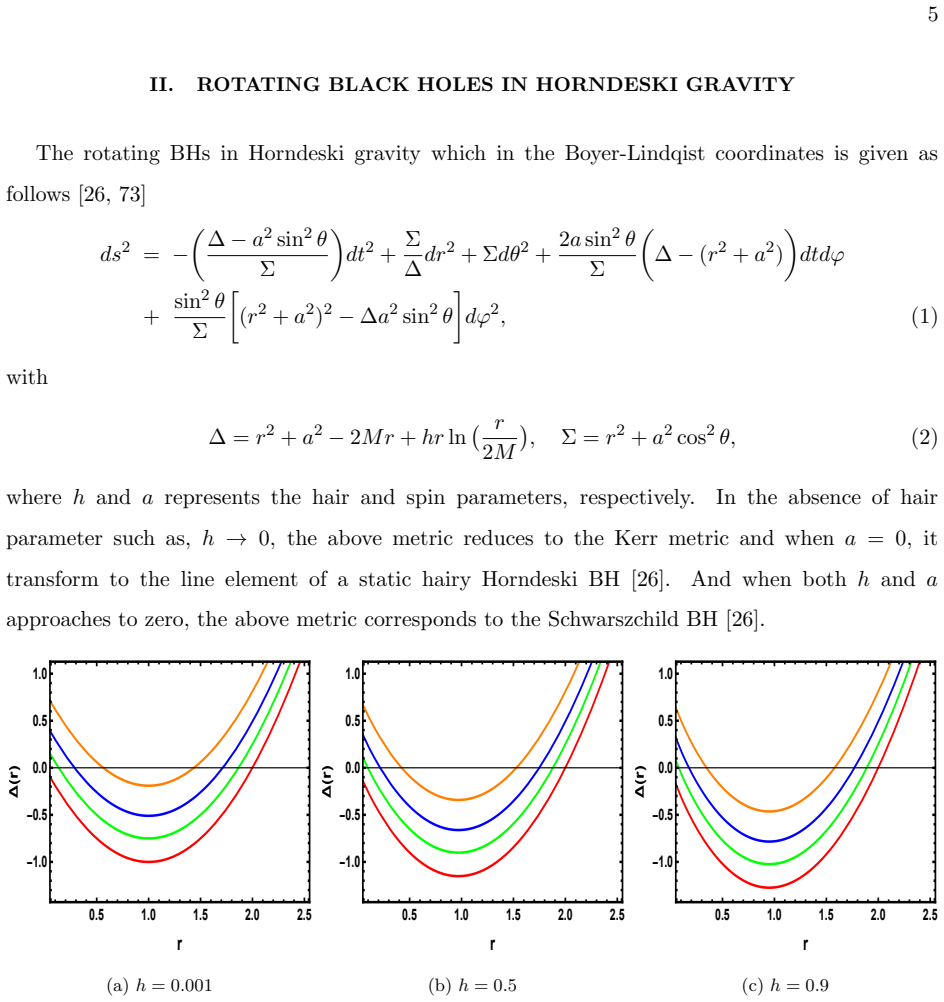
The engine of the analysis is the Boyer-Lindquist-style metric of Eq. (1), with Δ = r^2 + a^2 − 2Mr + h r ln(r/2M), which adds a logarithmic hair term to the Kerr spacetime. On that geometry the paper runs null geodesic ray tracing through a fisheye camera projection, and for disk images combines a Keplerian-plus-plunging thin-disk emission model with redshift factors and a horizon-to-disk intensity integral. The observables that lead to EHT constraints are the shadow radius R_d and circularity deviation δ_d, converted to angular diameter via Eq. (22).
Load-bearing premise
The metric in Eqs. (1)–(2) is an exact rotating black hole solution of Horndeski gravity, something the paper takes from Refs. [26, 73] rather than verifying; if it is only a Kerr-like construction, the shadow images and EHT bounds do not describe Horndeski gravity.
What would settle it
Substitute the metric (1)–(2) into the Horndeski field equations and compute the residual; a nonzero residual means the metric is not a solution and the constraints are void. Observationally, measure the shadow angular diameter and asymmetry of Sgr A* at percent-level precision: the predicted h-dependence separates from spin because h changes diameter while spin mostly changes asymmetry.
If this is right
- If h is nonzero and inside the EHT band, the M87* and Sgr A* shadows are compatible with a one-parameter Horndeski deformation of Kerr, and shadow angular diameter becomes the cleanest probe of that deformation.
- Larger h implies smaller, more D-shaped shadows with a smaller photon-ring radius, so future higher-resolution images could separate h from spin by morphology.
- The redshift and lensing-band maps differ measurably between prograde and retrograde accretion flows; matching those patterns to accretion models can reduce parameter degeneracies.
- The same angular-diameter conversion can be applied to any future black hole shadow measurement, making the constraint scheme reusable.
Where Pith is reading between the lines
- The phrase 'confirming the validity of Horndeski gravity' is stronger than what the calculation establishes: the EHT comparison bounds one parameter in one metric family, not the full theory.
- If the metric were independently verified to solve the Horndeski field equations, the same ray-tracing pipeline could predict polarized images and jet emission, offering independent tests of h.
- The D-shape deformation is the most distinctive geometric signature; a targeted measurement of shadow asymmetry at a few percent precision could either detect h or push its upper bound below current values.
Editorial analysis
A structured set of objections, weighed in public.
Referee Report
Summary. The manuscript studies a rotating, Kerr-like metric labeled as a Horndeski-gravity black hole, with line element (1) and Δ(r) = r² + a² − 2Mr + h r ln(r/2M) in Eq. (2). Using Hamilton–Jacobi separability and a fisheye-camera/backward ray-tracing pipeline, it computes shadow contours, photon-region impact parameters, and the Hioki–Maeda observables R_d and δ_d. It then produces images for two illumination models: a celestial sphere and a geometrically thin accretion disk, including prograde/retrograde flows, redshift maps, and lensing bands. Section V compares predicted shadow angular diameters with EHT measurements of M87* and Sgr A* and claims constraints on the hair parameter h, with the abstract and conclusion stating that the results confirm the validity of Horndeski gravity.
Significance. If the metric in Eqs. (1)–(2) were proven to be an exact rotating solution of Horndeski gravity, the paper would provide a broad phenomenological survey of shadow and accretion-disk images for a non-Kerr hair parameter, plus a first EHT-based constraint on that parameter. The imaging pipeline follows standard references and the qualitative trends (dependence of shadow size, photon ring, and lensing bands on h and a) are coherent. However, the physical interpretation as a test of Horndeski theory is entirely contingent on the exact-solution status of the metric, which is not established in the manuscript. In addition, the EHT constraint section contains a unit/conversion error, an incorrect M87* mass/distance, and an undefined relationship between R_d as plotted and R_d as used in Eq. (22). These issues currently block the advertised conclusion.
major comments (4)
- [Sec. II, Eqs. (1)–(2)] The metric is presented as a rotating Horndeski black hole by citing Refs. [26,73], but the paper never verifies that (1)–(2) solve the Horndeski field equations, and it does not specify the Horndeski action or scalar-field profile. A Kerr-like metric with a deformed Δ is not automatically a solution of a scalar-tensor theory; the logarithmic term is characteristic of Newman–Janis-generated Kerr-like seeds. Since every subsequent result — geodesics, photon region, shadow, disk images, and EHT constraints — depends on this metric, the interpretation as a Horndeski test is unsupported. Please provide an explicit field-equation check (or a reference that contains the derivation, including the scalar field configuration) for nonzero a and h. If the metric is only a Kerr-like ansatz, state this and revise the claims accordingly.
- [Sec. V, Eq. (22)] As printed, Eq. (22) is dimensionally incorrect: the conversion factor from (M/M_sun)(1 kpc/D_obs) to microarcseconds is 9.87098×10⁻⁶, not 9.87098, so the predicted angular diameters are too large by a factor of 10⁶. The section also quotes the M87* mass as (6.5±0.7)×10⁶ M_sun and the distance as 16.8 kpc; the commonly adopted values are (6.5±0.7)×10⁹ M_sun and 16.8 Mpc. These errors make Fig. 13 and the quoted allowed h intervals unreproducible. Use the correct conversion factor, correct mass/distance values, and recompute Fig. 13.
- [Sec. II / Fig. 3 and Sec. V] The shadow radius R_d plotted in Fig. 3 is ≈0.05, while the shadow contours in Fig. 2 have radii ≈5M. The manuscript does not define the units of R_d. If Fig. 3 reports an angular radius at r_obs = 100 (≈5/100 rad), then it cannot be substituted into Eq. (22), which requires a shadow radius in units of M. This ambiguity is load-bearing because Eq. (22) and Fig. 13 depend on R_d. Please define R_d consistently and either recompute the EHT comparison with the correct R_d (in units of M) or use the appropriate angular formula.
- [Abstract and Sec. V] The statement that EHT observations 'confirm the validity of Horndeski gravity' is not supported by the analysis. Consistency of the predicted shadow diameter with the 1σ/2σ EHT band for some h interval is a necessary but very weak test; the Kerr metric itself also fits these diameter measurements. The paper performs no model comparison, no marginalization over spin, inclination, mass, and distance systematics, and no full image/shape comparison. The conclusion should be weakened to: under the assumption that (1)–(2) is an exact Horndeski solution, EHT shadows place constraints on h.
minor comments (5)
- [Throughout] Typos and grammatical errors: 'Schwarszchild' (Sec. II), 'space-dragging' for frame-dragging, 'The red-shift factors' for redshift, and repeated 'the the'. A careful language edit is needed.
- [Sec. IV, Fig. 5] The text says Fig. 5 is computed with θ_obs = 80°, but the caption states θ_obs = 70°. Please correct the inconsistency.
- [Sec. IV, Table I] The text states that g_max decreases with increasing a and increases with increasing h, but the table shows the opposite trend: for fixed h, g_max grows with a, and for fixed a, g_max decreases with h. Either the table or the text is mislabeled.
- [Sec. V] The distance to M87* is quoted as 16.8 kpc; the accepted value is 16.8 Mpc. This is not just a typo in the EHT analysis and must be corrected along with the mass quoted.
- [References] Several references are arXiv preprints or self-citations; some may be appropriate, but Refs. [26,73] should be checked carefully to confirm whether they actually prove that the metric (1)–(2) is an exact Horndeski solution.
Circularity Check
No significant circularity: EHT constraints are an independent parameter-estimation exercise; heavy self-citation is methodological, not load-bearing.
full rationale
The paper's central advertised result is a constraint on the hair parameter h of the rotating Horndeski black hole from EHT angular-diameter measurements of M87* and Sgr A*. This is not circular: the shadow radius R_d is computed from the assumed metric (Eqs. 1-2) via null geodesics, the angular diameter is obtained from Eq. (22), and the result is compared with externally measured EHT values. No EHT data are used as input to determine h before the comparison; the paper scans h and reads off the allowed range from the 1-sigma and 2-sigma bands. Thus the 'prediction' is not equivalent to a fitted input by construction. The metric itself is imported from Refs. [26,73] rather than re-derived from Horndeski field equations; that is a real correctness/verification risk, but it is not a circularity because those references are external to the present authors and the paper does not define Horndeski gravity in terms of the shadow quantities it later predicts. Numerous self-citations (e.g., Refs. [44,45,55,57,69,72]) appear, but they support the imaging methodology and prior similar studies, not the specific conclusion that EHT data confirm Horndeski gravity. The final sentence 'confirming the validity of Horndeski gravity' is an overinterpretation of a parameter constraint, but overinterpretation is not circular reasoning. No step reduces to its own input by definition or by a self-citation chain, so the circularity score is low.
Axiom & Free-Parameter Ledger
free parameters (4)
- hair parameter h =
not fitted; scanned from 0.001 to 3.1 and loosely bounded by EHT at fixed a=0.5
- spin parameter a =
0.5 fixed for EHT constraints; 0.001 to 0.9 in images
- observer inclination theta_obs =
70 or 80 degrees depending on figure
- emissivity coefficients rho_1, rho_2 =
-1/2, -2
axioms (5)
- domain assumption The metric in Eqs. (1)-(2) is an exact rotating solution of Horndeski gravity.
- domain assumption The modified metric admits the same Hamilton-Jacobi separability and Carter constant as Kerr.
- domain assumption The accretion disk is geometrically and optically thin, equatorial, geodesic, and split into ISCO and plunging regions.
- domain assumption The EHT-reported masses, distances, and shadow diameters are correct inputs.
- ad hoc to paper The angular diameter formula Eq. (22) correctly converts R_d to microarcseconds.
Cite this review
Pith. "Pith review of Probing Horndeski Gravity via Kerr Black Hole: Insights from Thin Accretion Disks and Shadows with EHT Observations." pith.science (2026). https://pith.science/paper/ZZ4T6PQO
@misc{pith2026250905803,
  author       = {Pith},
  title        = {Pith review of: Probing Horndeski Gravity via Kerr Black Hole: Insights from Thin Accretion Disks and Shadows with EHT Observations},
  year         = {2026},
  howpublished = {\url{https://pith.science/paper/ZZ4T6PQO}},
  note         = {Machine review of arXiv:2509.05803}
}
abstract
In this study, we have considered the Kerr-like black hole (BH) model in Horndeski gravity and analyse the visual characteristics of shadow images under two illumination models, such as a celestial light source and a thin accretion disk. To capture the BH shadow images, we utilise a recent fisheye camera model and ray-tracing procedures. In this view, we carefully addressed the influence of the spin parameter $a$ and the hair parameter $h$ on the BH shadow images. The results indicate that for smaller values of $h$, the BH shadow contours shift noticeably towards the right side of the screen, while for larger values of $h$, the nearly circular shadow gradually deforms into a ``D'' shape profile. For a celestial light source, the larger values of $h$ lead to a reduction in the corresponding radius of the photon ring, while the space-dragging effect becomes more pronounced with increasing $a$. We further discuss the distinctive characteristics of images observed in both prograde and retrograde accretion disk scenarios. The results reveal that variations in $h$ significantly affect both the inner shadow and the resulting Einstein ring. Subsequently, we also discussed the distinct features of red-shift configurations on the disk for both direct and lensed images, which are closely related to the accretion flow and the relevant parameters. We also attempt to use the recent observational data from M$87^{\ast}$ and Sgr $A^{\ast}$ and constrain the hair parameter $h$, confirming the validity of Horndeski gravity.
Figures


Forward citations
Cited by 5 Pith papers
-
Reshaping the inner shadow of a Kerr black hole by a torn accretion disk
Torn accretion disks around Kerr black holes erode the inner shadow and create bifurcated, crescent, and multi-ring shadow features driven by sub-disk discontinuities and outer tilt angle.
-
Reshaping the inner shadow of a Kerr black hole by a torn accretion disk
Torn accretion disks around Kerr black holes erode the inner shadow and produce bifurcated, crescent, and multi-order ring morphologies hard to obtain with standard equatorial disks.
-
Probing Lorentz-violating effects via precession and accretion disk images of a rotating bumblebee black hole
Lorentz violation in a rotating bumblebee black hole suppresses Lense-Thirring precession, increases periastron precession, shrinks the inner shadow, and enhances the lensed ring while leaving the critical curve nearl...
-
Imaging and Polarimetric Signatures of Konoplya-Zhidenko Black Holes with Various Thick Disk
Horizon-scale synchrotron images and polarization maps of Konoplya-Zhidenko black holes with thick disks show expanded photon rings, darker centers, and viewing-angle-dependent asymmetries that vary with the deformati...
-
Optical images of Kerr-Sen black hole illuminated by thick accretion disks
Increasing charge Q shrinks photon rings and central shadows in Kerr-Sen black hole images while spin creates brightness asymmetry; polarization patterns follow lensing and frame dragging.
Reference graph
Works this paper leans on
-
[1]
Einstein, Sitzungsberichte der Preussischen Akademie der Wissenschaften zu Berlin1915, 844 (1915)
A. Einstein, Sitzungsberichte der Preussischen Akademie der Wissenschaften zu Berlin1915, 844 (1915)
work page 1915
-
[2]
P. Bull, Y. Akrami, J. Adamek, et al., Phys. Dark Univ.12, 56 (2016)
work page 2016
- [3]
-
[4]
Jordan, Schwerkraft und Weltall, Vieweg (Braunschweig) (1955)
P. Jordan, Schwerkraft und Weltall, Vieweg (Braunschweig) (1955)
1955
- [5]
-
[6]
G. W. Horndeski, Int. J. Theor. Phys.10, 363 (1974)
1974
-
[7]
Lovelock, J
D. Lovelock, J. Math. Phys.12, 498 (1971)
1971
-
[8]
Y. P. Hu, et al., Phys. Rev. D100, 084004 (2019)
work page 2019
-
[10]
Y. G. Miao and Z. M. Xu, Eur. Phys. J. C76, 638 (2016)
work page 2016
-
[11]
X. M. Kuang and E. Papantonopoulos, J. High Energy Phys.08, 161 (2016)
work page 2016
- [12]
-
[13]
X. H. Feng and H. S. Liu, Eur. Phys. J. C79, 40 (2019)
work page 2019
-
[14]
X. J. Gao, et al., Eur. Phys. J. C83, 1052 (2023)
work page 2023
- [15]
- [16]
- [17]
-
[18]
T. P. Sotiriou and S. Y. Zhou, Phys. Rev. Lett.112, 251102 (2014)
work page 2014
-
[19]
E. Babichev, C. Charmousis and A. Lehbel, Class. Quant. Grav.33, 154002 (2016)
work page 2016
- [20]
- [21]
-
[22]
J. B. Achour and H. Liu, Phys. Rev. D99, 064042 (2019)
work page 2019
- [23]
-
[24]
S. E. P. Bergliaffa, et al., arXiv:2107.07839
-
[25]
X. J. Wang, et al., Phys. Rev. D107, 124052 (2023)
work page 2023
-
[26]
M. Heydari-Fard, M. Heydari-Fard and N. Riazi, Astrophys. Space Sci.369, 96 (2024)
work page 2024
-
[27]
B. P. Abbott et al. [LIGO Scientific and Virgo], Phys. Rev. Lett.116, 241103 (2016)
work page 2016
-
[28]
B. P. Abbott et al. [LIGO Scientific and Virgo], Phys. Rev. Lett.116, 061102 (2016)
work page 2016
-
[29]
Akiyama et al., Astrophys
K. Akiyama et al., Astrophys. J. Lett.875, L1 (2019)
2019
-
[30]
Akiyama et al., Astrophys
K. Akiyama et al., Astrophys. J. Lett.930, L12 (2022)
2022
- [31]
- [32]
-
[33]
Akiyama et al., Astrophys
K. Akiyama et al., Astrophys. J. Lett.964, L25 (2024)
2024
- [34]
-
[35]
J. L. Synge, Mon. Not. Roy. Astron. Soc.131, 463 (1966)
1966
-
[36]
J. M. Bardeen, In Black Holes (Les Astres Occlus); C. Dewitt, B. S. Dewitt, Eds, Gordon and Breach, New York, USA, 215 (1973)
work page 1973
-
[37]
Falcke, F
H. Falcke, F. Melia and E. Agol, Astrophys. J. Lett.528, L13 (2000)
2000
-
[38]
J. P. Luminet, Astron. Astrophys.75, 228 (1979)
1979
- [39]
- [40]
- [41]
- [42]
- [43]
-
[44]
X. X. Zeng, M. I. Aslam and R. Saleem, Eur. Phys. J. C83, 129 (2023)
work page 2023
-
[45]
X. X. Zeng and H. Q. Zhang, Eur. Phys. J. C80, 1058 (2020)
work page 2020
-
[46]
M. I. Aslam and R. Saleem, Eur. Phys. J. C84, 37 (2024)
work page 2024
-
[47]
Hashimoto, S
K. Hashimoto, S. Kinoshita and K. Murata, Phys. Rev. D101, 066018 (2020)
2020
-
[48]
X. Y. Hu, M. I. Aslam and R. Saleem et al., J. Cosmol. Astropart. Phys.2023, 013 (2023). 27
work page 2023
-
[49]
M. I. Aslam, X. X. Zeng and R. Saleem et al., Chin. Phys. C48, 115101 (2024)
work page 2024
-
[50]
X. X. Zeng, M. I. Aslam and R. Saleem et al., Eur. Phys. J. C851 (2025)
work page 2025
-
[51]
P. V. P. Cunha, C. A. R. Herdeiro and E. Radu et al., Phys. Rev. Lett.115, 211102 (2015)
work page 2015
- [52]
-
[53]
S. E. Gralla, D. E. Holz and R. M. Wald, Phys. Rev. D100, 024018 (2019)
work page 2019
-
[54]
C. Y. Yang, M. I. Aslam and X. X. Zeng, et al., J. High Energy Astrophys.46, 100345 (2025)
work page 2025
-
[55]
X. X. Zeng, C. Y. Yang and M. I. Aslam, et al., arXiv:2505.07063 (Accepted for publication in JCAP)
-
[56]
G. P. Li, H. B. Zheng and K. J. He, et al., Eur. Phys. J. C85, 249 (2025)
work page 2025
-
[57]
K. J. He, C. Y. Yang and X. X. Zeng, arXiv:2501.06778
-
[58]
K. J. He., H. Ye and X. X. Zeng, et al., Chin. Phys. C (2025)
work page 2025
-
[59]
Y. Meng, X. J. Wang and Y. Z. Li et al., Eur. Phys. J. C85, 627 (2025)
work page 2025
- [60]
-
[61]
Y. Chen, P. Wang, H. Wu and H. Yang, J. Cosmol. Astropart. Phys.04, 032 (2024)
work page 2024
-
[62]
X. Qin, S. Chen and Z. Zhang et al., Astrophys. J.938, 2 (2022)
work page 2022
-
[63]
T. C. Lee, Z. Hu and M. Guo et al., Phys. Rev. D108, 024008 (2023)
work page 2023
- [64]
-
[65]
X. Qin, S. B. Chen and J. L. Jing, Eur. Phys. J. C82, 784 (2022)
work page 2022
- [66]
-
[67]
S. Guo, P. Wang and K. J. He, et al., arXiv:2504.11890
work page internal anchor Pith review Pith/arXiv arXiv
-
[68]
K. J. He, G. P. Li and C. Y. Yang et al., arXiv:2502.16623
-
[69]
X. X. Zeng, C. Y. Yang and Y. X. Huang et al., arXiv:2501.13764
-
[70]
J. L. Rosa and D. Rubiera-Garcia, Phys. Rev. D106, 084004 (2022)
work page 2022
-
[71]
J. L. Rosa, C. F. B. Macedo and D. Rubiera-Garcia, Phys. Rev. D108, 044021 (2023)
work page 2023
-
[72]
X. X. Zeng, H. Ye and K. J. He, et al., arXiv:2507.11583
-
[73]
R. K. Walia, S. D. Maharaj and S. G. Ghosh, Eur. Phys. J. C82, 547 (2022)
work page 2022
-
[74]
Chandrasekhar,The Mathematical Theory of Black Holes, Oxford University Press (1998)
S. Chandrasekhar,The Mathematical Theory of Black Holes, Oxford University Press (1998)
work page 1998
-
[75]
Z. Hu, Z. Zhong and P. C. Li et al., Phys. Rev. D103, 044057 (2021)
work page 2021
-
[76]
X. Wang, Z. Zhao and X. X. Zeng, Phys. Rev. D111, 084054 (2025)
work page 2025
- [77]
-
[78]
crescent-shaped
and the size of the inner shadow appears as a “D” shape in each panel. In order to observe the influence of hair parameterh, we fixed the rotation parameteraand vary the values ofhfrom left to right as 0.001,0.1,0.5,0.9. Whereas from top to bottom, the intensity maps illustrates the impact of theaon the images of BH shadows. From these images, it is notic...
-
[79]
Perlick and O
V. Perlick and O. Y. Tsupko, Phys. Rept.947, 1 (2022)
2022
- [80]
- [81]
This paper was first reviewed by deepseek-v4-flash on August 5, 2026.
discussion (0)
Sign in with ORCID, Apple, or X to comment. Anyone can read and Pith papers without signing in.