Imaging and Polarimetric Signatures of Konoplya-Zhidenko Black Holes with Various Thick Disk
Pith reviewed 2026-05-18 06:08 UTC · model grok-4.3
The pith
Thick accretion disks around Konoplya-Zhidenko black holes produce expanded photon rings and distinct polarization patterns that depend on spacetime deformation.
A machine-rendered reading of the paper's core claim, the machinery that carries it, and where it could break.
Core claim
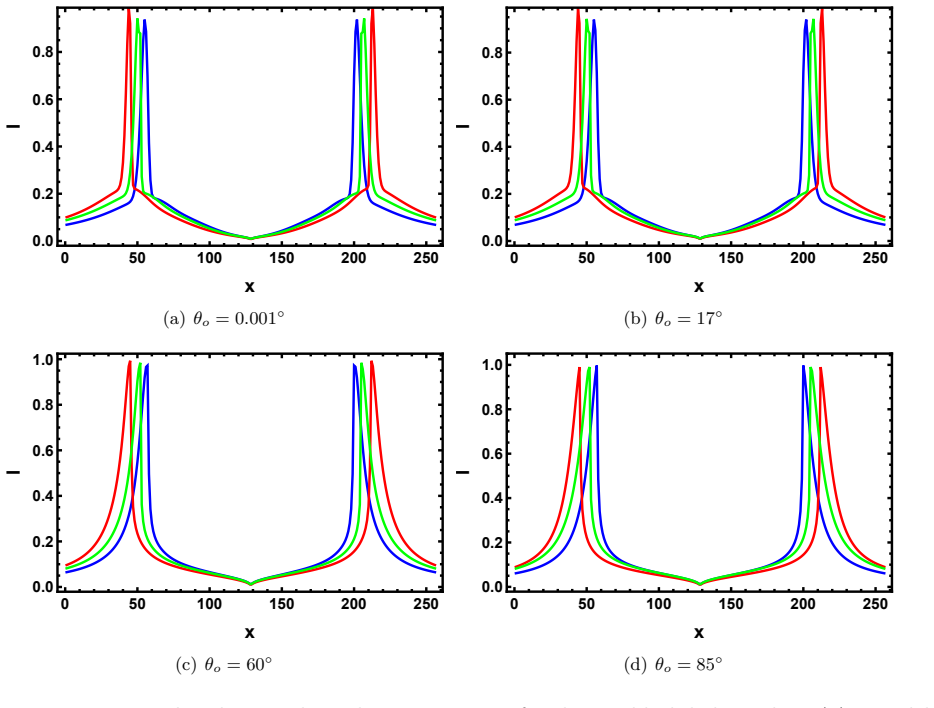
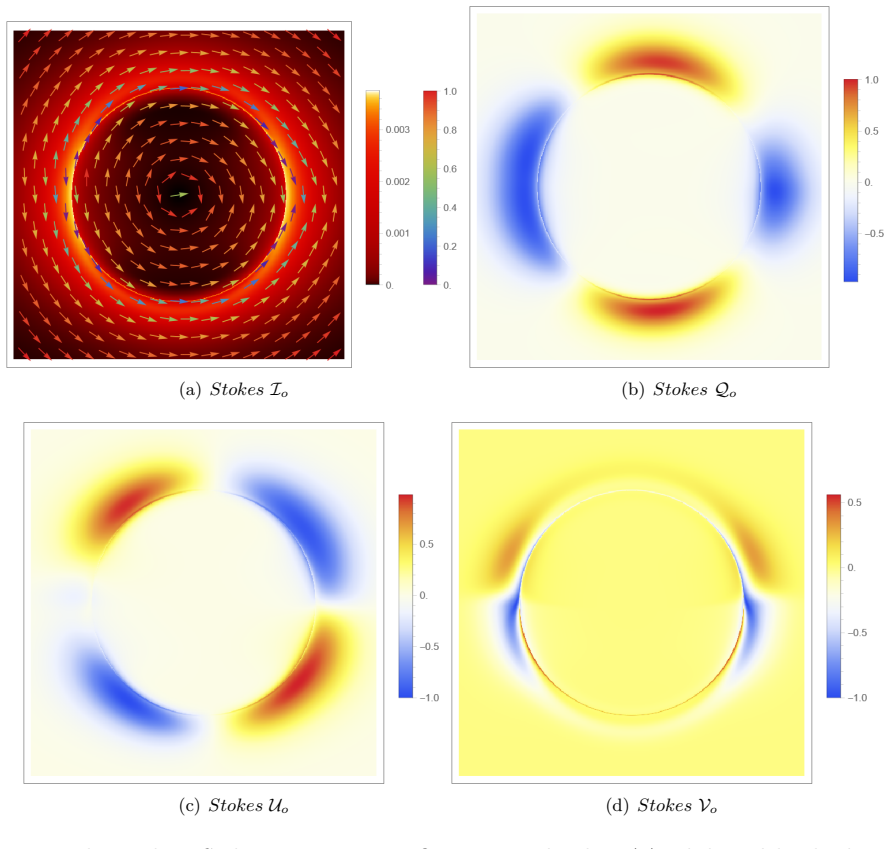
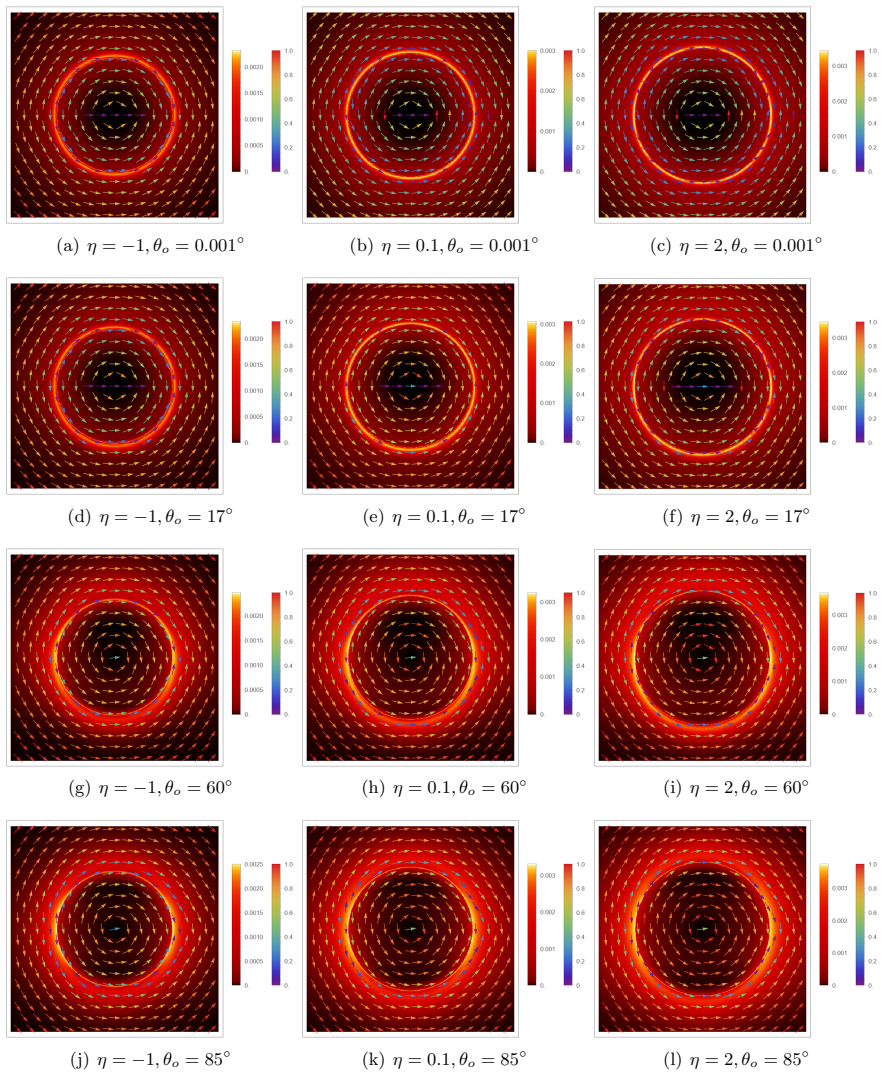
Adopting a phenomenological radiatively inefficient accretion flow model and an analytical ballistic approximation accretion flow model, general relativistic radiative transfer of thermal synchrotron emission shows that the photon ring and central dark region expand with increasing deformation parameter in Konoplya-Zhidenko spacetimes, the ballistic model yields narrower rings and darker centers, and polarization patterns follow the brightness distribution while changing systematically with observer inclination and deformation to encode spacetime structure.
What carries the argument
General relativistic radiative transfer applied to phenomenological RIAF and analytical BAAF thick accretion flow models inside the Konoplya-Zhidenko metric, whose single deformation parameter alters the spacetime geometry away from Kerr.
If this is right
- Photon ring size and central brightness depression both increase with larger deformation parameter in the RIAF model.
- The BAAF model produces narrower photon rings and more pronounced central darkness than the RIAF model.
- Brightness asymmetries appear at high observer inclinations and depend on flow dynamics and emission anisotropy.
- Polarization vectors align with brightness features and vary with deformation parameter and viewing angle.
- These image and polarization differences depend on observing frequency.
Where Pith is reading between the lines
- Joint analysis of intensity and polarization from future observations could help separate spacetime deformation effects from uncertainties in the accretion flow structure.
- The same approach might be applied to existing Event Horizon Telescope data on Sgr A* or M87* to place limits on possible Konoplya-Zhidenko-type deviations.
- Including non-thermal electrons or ordered magnetic fields in the models could produce additional testable polarization features.
- Comparison with thin-disk calculations would clarify how disk thickness affects the visibility of near-horizon spacetime signatures.
Load-bearing premise
The two chosen accretion flow models accurately represent the density, velocity, and temperature structure of real thick accretion flows around Konoplya-Zhidenko black holes.
What would settle it
A high-resolution polarimetric image at millimeter wavelengths of a supermassive black hole that shows no enlargement of the photon ring or no systematic shift in central darkness and polarization when the deformation parameter is increased would falsify the predicted signatures.
Figures



read the original abstract
We investigate the imaging properties of spherically symmetric Konoplya-Zhidenko (KZ) black holes surrounded by geometrically thick accretion flows, adopting a phenomenological radiatively inefficient accretion flow (RIAF) model and an analytical ballistic approximation accretion flow (BAAF) model. General relativistic radiative transfer is employed to compute synchrotron emission from thermal electrons and generate horizon-scale images. For the RIAF model, we analyze the dependence of image morphology on the deformation parameter, observing frequency, and flow dynamics. The photon ring and central dark region expand with increasing deformation parameter, with brightness asymmetries arising at high inclinations and depending on flow dynamics and emission anisotropy. The BAAF disk produces narrower rings and darker centers, while polarization patterns trace the brightness distribution and vary with viewing angle and deformation, revealing spacetime structure. These results demonstrate that intensity and polarization in thick-disk models provide probes of KZ black holes and near-horizon accretion physics.
Editorial analysis
A structured set of objections, weighed in public.
Referee Report
Summary. The manuscript investigates the horizon-scale imaging and polarimetric signatures of spherically symmetric Konoplya-Zhidenko black holes surrounded by geometrically thick accretion flows. It adopts two phenomenological models (radiatively inefficient accretion flow and ballistic approximation accretion flow), performs general relativistic radiative transfer of thermal synchrotron emission, and reports that the photon ring and central dark region expand with increasing deformation parameter, that brightness asymmetries arise at high inclinations depending on flow dynamics, that the BAAF model yields narrower rings and darker centers, and that polarization patterns trace the brightness distribution while varying with viewing angle and deformation parameter. The central claim is that intensity and polarization in these thick-disk models provide probes of KZ black holes and near-horizon accretion physics.
Significance. If the results hold, the work illustrates how thick-disk models can produce observable differences in ring size, central darkness, and polarization that depend on the deformation parameter, thereby contributing to parametrized tests of strong-field gravity with black-hole imaging. The dual use of RIAF and BAAF models permits a limited comparison of flow assumptions, and the emphasis on polarization adds a potentially useful observable beyond total intensity.
major comments (1)
- Abstract (paragraph describing the two flow models): The RIAF and BAAF models are imported from the Kerr/Schwarzschild literature and imposed on the KZ background with density, velocity, and temperature profiles fixed independently of the deformation parameter. No re-derivation of the radial density power-law index, electron temperature, or velocity field from the modified geodesic or hydrostatic equilibrium equations is performed. This assumption is load-bearing for the claim that reported changes in photon-ring size, central darkness, and polarization are driven by the spacetime deformation rather than the assumed accretion structure; similar morphological shifts could be reproduced by modest adjustments to the RIAF radial-velocity exponent or BAAF impact-parameter cutoff even at zero deformation parameter.
minor comments (1)
- Abstract: The reported trends are described qualitatively without quantitative metrics, error bars, or explicit comparisons to the Schwarzschild limit (deformation parameter = 0), which would help assess the magnitude and robustness of the morphology changes.
Simulated Author's Rebuttal
We thank the referee for their careful reading of the manuscript and for raising this important point about our modeling assumptions. We address the comment in detail below and have revised the manuscript to clarify the phenomenological nature of the flow models while preserving the focus on spacetime effects.
read point-by-point responses
-
Referee: Abstract (paragraph describing the two flow models): The RIAF and BAAF models are imported from the Kerr/Schwarzschild literature and imposed on the KZ background with density, velocity, and temperature profiles fixed independently of the deformation parameter. No re-derivation of the radial density power-law index, electron temperature, or velocity field from the modified geodesic or hydrostatic equilibrium equations is performed. This assumption is load-bearing for the claim that reported changes in photon-ring size, central darkness, and polarization are driven by the spacetime deformation rather than the assumed accretion structure; similar morphological shifts could be reproduced by modest adjustments to the RIAF radial-velocity exponent or BAAF impact-parameter cutoff even at zero deformation parameter.
Authors: We appreciate the referee highlighting the phenomenological character of the adopted accretion models. The RIAF and BAAF prescriptions are deliberately taken from the standard Kerr/Schwarzschild literature and applied with fixed density, velocity, and temperature profiles to the KZ spacetime. This choice isolates the influence of the metric deformation on null geodesics, gravitational lensing, and the resulting synchrotron images and polarization maps. By holding the flow parameters constant, any systematic changes in photon-ring size, central darkness, or polarization patterns can be attributed to modifications in the spacetime geometry rather than to adjustments in the accretion structure. We acknowledge that a fully self-consistent solution of the flow equations in the deformed metric would be desirable for future work. To address the referee's concern that similar morphological shifts might arise from flow-parameter variations alone, we have performed supplementary calculations at zero deformation parameter by varying the RIAF radial-velocity exponent and the BAAF impact-parameter cutoff; these variations do not reproduce the same monotonic expansion of the photon ring or the specific polarization trends observed with increasing deformation. In the revised manuscript we have added explicit statements in Section 2 and the abstract clarifying that the models are phenomenological and fixed independently of the deformation parameter, and we have included a short discussion of this limitation together with the results of the parameter-variation tests. These additions make the assumptions transparent without altering the central conclusions. revision: partial
Circularity Check
No significant circularity; forward modeling of images in fixed phenomenological flows.
full rationale
The paper performs standard GRRT calculations of synchrotron images and polarization for two imported phenomenological accretion models (RIAF and BAAF) placed in the Konoplya-Zhidenko metric family. Image morphology, ring size, and polarization are computed outputs that depend on the deformation parameter as an input; no equation in the provided text defines a target observable as a fit to itself or renames a fitted parameter as a prediction. The flow density, velocity, and temperature profiles are adopted as external assumptions rather than derived from the KZ geodesics or hydrostatic equilibrium within the paper, but this is an explicit modeling choice, not a self-referential reduction. The central claim that intensity and polarization can probe KZ black holes therefore rests on independent numerical transfer rather than on any load-bearing self-citation or definitional loop.
Axiom & Free-Parameter Ledger
free parameters (1)
- deformation parameter
axioms (1)
- domain assumption General relativistic radiative transfer remains valid for the KZ metric family
Lean theorems connected to this paper
-
IndisputableMonolith/Foundation/AlexanderDuality.leanalexander_duality_circle_linking unclear?
unclearRelation between the paper passage and the cited Recognition theorem.
We investigate the imaging properties of spherically symmetric Konoplya-Zhidenko (KZ) black holes surrounded by geometrically thick accretion flows, adopting a phenomenological radiatively inefficient accretion flow (RIAF) model and an analytical ballistic approximation accretion flow (BAAF) model.
What do these tags mean?
- matches
- The paper's claim is directly supported by a theorem in the formal canon.
- supports
- The theorem supports part of the paper's argument, but the paper may add assumptions or extra steps.
- extends
- The paper goes beyond the formal theorem; the theorem is a base layer rather than the whole result.
- uses
- The paper appears to rely on the theorem as machinery.
- contradicts
- The paper's claim conflicts with a theorem or certificate in the canon.
- unclear
- Pith found a possible connection, but the passage is too broad, indirect, or ambiguous to say the theorem truly supports the claim.
Reference graph
Works this paper leans on
-
[1]
A new analytical model of magnetofluids surrounding rotating black holes,
Y. Hou, Z. Zhang, M. Guo, and B. Chen, “A new analytical model of magnetofluids surrounding rotating black holes,” JCAP02(2024) 030,arXiv:2309.13304 [gr-qc]
-
[2]
Imaging thick accretion disks and jets surrounding black holes,
Z. Zhang, Y. Hou, M. Guo, and B. Chen, “Imaging thick accretion disks and jets surrounding black holes,” JCAP05(2024) 032,arXiv:2401.14794 [astro-ph.HE]
-
[3]
Optical images of the Kerr–Sen black hole and thin accretion disk,
P. Wang, S. Guo, L.-F. Li, Z.-F. Mai, B.-F. Wu, W.-H. Deng, and Q.-Q. Jiang, “Optical images of the Kerr–Sen black hole and thin accretion disk,” Eur. Phys. J. C85no. 7, (2025) 747, arXiv:2507.17217 [gr-qc]
-
[4]
Near-horizon polarized images of rotating hairy Horndeski black holes,
C. Chen, Q. Pan, and J. Jing, “Near-horizon polarized images of rotating hairy Horndeski black holes,”arXiv:2509.12526 [gr-qc]
-
[5]
Imaging characteristics of Frolov black holes under different accretion models,
J.-S. Li, S. Guo, Y.-X. Huang, Q.-Q. Jiang, and K. Lin, “Imaging characteristics of Frolov black holes under different accretion models,” Eur. Phys. J. C85no. 10, (2025) 1125
work page 2025
-
[6]
Image of a Kerr-Melvin black hole with a thin accretion disk,
Y. Hou, Z. Zhang, H. Yan, M. Guo, and B. Chen, “Image of a Kerr-Melvin black hole with a thin accretion disk,” Phys. Rev. D106no. 6, (2022) 064058,arXiv:2206.13744 [gr-qc]
-
[7]
The Confrontation between General Relativity and Experiment
C. M. Will, “The Confrontation between General Relativity and Experiment,” Living Rev. Rel. 17(2014) 4,arXiv:1403.7377 [gr-qc]
work page internal anchor Pith review Pith/arXiv arXiv 2014
-
[8]
Detection of gravitational waves from black holes: Is there a window for alternative theories?
R. Konoplya and A. Zhidenko, “Detection of gravitational waves from black holes: Is there a window for alternative theories?,” Phys. Lett. B756(2016) 350–353,arXiv:1602.04738 [gr-qc]
work page internal anchor Pith review Pith/arXiv arXiv 2016
-
[9]
General parametrization of axisymmetric black holes in metric theories of gravity
R. Konoplya, L. Rezzolla, and A. Zhidenko, “General parametrization of axisymmetric black holes in metric theories of gravity,” Phys. Rev. D93no. 6, (2016) 064015,arXiv:1602.02378 [gr-qc]
work page internal anchor Pith review Pith/arXiv arXiv 2016
-
[10]
C. Bambi and S. Nampalliwar, “Quasi-periodic oscillations as a tool for testing the Kerr metric: A comparison with gravitational waves and iron line,” EPL116no. 3, (2016) 30006, arXiv:1604.02643 [gr-qc]
work page internal anchor Pith review Pith/arXiv arXiv 2016
-
[11]
Testing the Kerr metric with the iron line and the KRZ parametrization
Y. Ni, J. Jiang, and C. Bambi, “Testing the Kerr metric with the iron line and the KRZ parametrization,” JCAP09(2016) 014,arXiv:1607.04893 [gr-qc]
work page internal anchor Pith review Pith/arXiv arXiv 2016
-
[12]
A. Razzaq, R. Rahim, B. Majeed, and J. Rayimbaev, “Particle dynamics in non-rotating Konoplya and Zhidenko black hole immersed in an external uniform magnetic field,” Eur. Phys. J. Plus138no. 3, (2023) 208. 31
work page 2023
-
[13]
Strong gravitational lensing by a Konoplya-Zhidenko rotating non-Kerr compact object
S. Wang, S. Chen, and J. Jing, “Strong gravitational lensing by a Konoplya-Zhidenko rotating non-Kerr compact object,” JCAP11(2016) 020,arXiv:1609.00802 [gr-qc]
work page internal anchor Pith review Pith/arXiv arXiv 2016
-
[14]
Shadow casted by a Konoplya-Zhidenko rotating non-Kerr black hole
M. Wang, S. Chen, and J. Jing, “Shadow casted by a Konoplya-Zhidenko rotating non-Kerr black hole,” JCAP10(2017) 051,arXiv:1707.09451 [gr-qc]
work page internal anchor Pith review Pith/arXiv arXiv 2017
-
[15]
X. He, T. Xu, Y. Yu, A. Karamat, R. Babar, and R. Ali, “Deflection angle evolution with plasma medium and without plasma medium in a parameterized black hole,” Annals Phys.451 (2023) 169247,arXiv:2303.09856 [gr-qc]
-
[16]
Superradiance in Kerr-like black holes,
E. Franzin, S. Liberati, and M. Oi, “Superradiance in Kerr-like black holes,” Phys. Rev. D103 no. 10, (2021) 104034,arXiv:2102.03152 [gr-qc]
-
[17]
Testing alternative theories of gravity by fitting the hot-spot data of Sgr A*,
M. Shahzadi, M. Koloˇ s, Z. Stuchl´ ık, and Y. Habib, “Testing alternative theories of gravity by fitting the hot-spot data of Sgr A*,” Eur. Phys. J. C82no. 5, (2022) 407,arXiv:2201.04442 [gr-qc]
-
[18]
General relativistic viscous accretion flow around Konoplya-Zhidenko black hole,
S. Patra, B. R. Majhi, and S. Das, “General relativistic viscous accretion flow around Konoplya-Zhidenko black hole,” JHEAp44(2024) 371–380,arXiv:2407.07968 [astro-ph.HE]
-
[19]
Magnetic reconnection and energy extraction from a Konoplya–Zhidenko rotating non-Kerr black hole,
F. Long, S. Wang, S. Chen, and J. Jing, “Magnetic reconnection and energy extraction from a Konoplya–Zhidenko rotating non-Kerr black hole,” Eur. Phys. J. C85no. 1, (2025) 26, arXiv:2409.11942 [gr-qc]
-
[20]
K.-J. He, C.-Y. Yang, and X.-X. Zeng, “Optical appearance of the Konoplya-Zhidenko rotating non-Kerr black hole surrounded by a thin accretion disk,”arXiv:2501.06778 [astro-ph.HE]
-
[21]
A ring-like accretion structure in M87 connecting its black hole and jet,
R.-S. Lu et al., “A ring-like accretion structure in M87 connecting its black hole and jet,” Nature616no. 7958, (2023) 686–690,arXiv:2304.13252 [astro-ph.HE]. [27]Event Horizon TelescopeCollaboration, K. Akiyama et al., “First M87 Event Horizon Telescope Results. V. Physical Origin of the Asymmetric Ring,” Astrophys. J. Lett.875no. 1, (2019) L5,arXiv:1906...
-
[22]
Image of a spherical black hole with thin accretion disk,
J. P. Luminet, “Image of a spherical black hole with thin accretion disk,” Astron. Astrophys.75 (1979) 228–235
work page 1979
-
[23]
Observational features of the Bardeen-boson star with thin disk accretion,
C.-Y. Yang, H. Ye, and X.-X. Zeng, “Observational features of the Bardeen-boson star with thin disk accretion,”arXiv:2509.17535 [gr-qc]. 32
-
[24]
X.-X. Zeng, C.-Y. Yang, M. I. Aslam, and R. Saleem, “Probing Horndeski Gravity via Kerr Black Hole: Insights from Thin Accretion Disks and Shadows with EHT Observations,” arXiv:2509.05803 [gr-qc]
-
[25]
X.-X. Zeng, G.-P. Li, and K.-J. He, “The shadows and observational appearance of a noncommutative black hole surrounded by various profiles of accretions,” Nucl. Phys. B974 (2022) 115639,arXiv:2106.14478 [hep-th]
-
[26]
Observing the Inner Shadow of a Black Hole: A Direct View of the Event Horizon,
A. Chael, M. D. Johnson, and A. Lupsasca, “Observing the Inner Shadow of a Black Hole: A Direct View of the Event Horizon,” Astrophys. J.918no. 1, (2021) 6,arXiv:2106.00683 [astro-ph.HE]
-
[27]
Shadows and optical appearance of black bounces illuminated by a thin accretion disk,
M. Guerrero, G. J. Olmo, D. Rubiera-Garcia, and D. S.-C. G´ omez, “Shadows and optical appearance of black bounces illuminated by a thin accretion disk,” JCAP08(2021) 036, arXiv:2105.15073 [gr-qc]
-
[28]
Optical appearance of Einstein-Æther black hole surrounded by thin disk,
H.-M. Wang, Z.-C. Lin, and S.-W. Wei, “Optical appearance of Einstein-Æther black hole surrounded by thin disk,” Nucl. Phys. B985(2022) 116026,arXiv:2205.13174 [gr-qc]
-
[29]
Black hole image encoding quantum gravity information,
C. Zhang, Y. Ma, and J. Yang, “Black hole image encoding quantum gravity information,” Phys. Rev. D108no. 10, (2023) 104004,arXiv:2302.02800 [gr-qc]
-
[30]
Images from disk and spherical accretions of hairy Schwarzschild black holes,
Y. Meng, X.-M. Kuang, X.-J. Wang, B. Wang, and J.-P. Wu, “Images from disk and spherical accretions of hairy Schwarzschild black holes,” Phys. Rev. D108no. 6, (2023) 064013, arXiv:2306.10459 [gr-qc]. [37]Event Horizon TelescopeCollaboration, K. Akiyama et al., “First Sagittarius A* Event Horizon Telescope Results. V. Testing Astrophysical Models of the Ga...
-
[31]
The Spectral Energy Distributions of Low-Luminosity Active Galactic Nuclei
L. C. Ho, “The spectral energy distributions of low-luminosity active galactic nuclei,” Astrophys. J.516(1999) 672–682,arXiv:astro-ph/9905012
work page internal anchor Pith review Pith/arXiv arXiv 1999
-
[32]
Advection-Dominated Accretion: A Self-Similar Solution
R. Narayan and I.-s. Yi, “Advection dominated accretion: A Selfsimilar solution,” Astrophys. J. Lett.428(1994) L13,arXiv:astro-ph/9403052
work page internal anchor Pith review Pith/arXiv arXiv 1994
-
[33]
Foundations of Black Hole Accretion Disk Theory
M. A. Abramowicz and P. C. Fragile, “Foundations of Black Hole Accretion Disk Theory,” Living Rev. Rel.16(2013) 1,arXiv:1104.5499 [astro-ph.HE]
work page internal anchor Pith review Pith/arXiv arXiv 2013
-
[34]
Nonthermal Electrons in Radiatively Inefficient Accretion Flow Models of Sagittarius A*
F. Yuan, E. Quataert, and R. Narayan, “Nonthermal electrons in radiatively inefficient accretion flow models of Sagittarius A*,” Astrophys. J.598(2003) 301–312,arXiv:astro-ph/0304125. 33
work page internal anchor Pith review Pith/arXiv arXiv 2003
-
[35]
A. E. Broderick and A. Loeb, “Frequency-dependent shift in the image centroid of the black hole at the galactic center as a test of general relativity,” Astrophys. J. Lett.636(2006) L109–L112,arXiv:astro-ph/0508386
work page internal anchor Pith review Pith/arXiv arXiv 2006
-
[36]
Imaging the Black Hole Silhouette of M87: Implications for Jet Formation and Black Hole Spin
A. Broderick and A. Loeb, “Imaging the Black Hole Silhouette of M87: Implications for Jet Formation and Black Hole Spin,” Astrophys. J.697(2009) 1164–1179,arXiv:0812.0366 [astro-ph]
work page internal anchor Pith review Pith/arXiv arXiv 2009
-
[38]
The Effects of Accretion Flow Dynamics on the Black Hole Shadow of Sagittarius A$^{*}$
H.-Y. Pu, K. Akiyama, and K. Asada, “The Effects of Accretion Flow Dynamics on the Black Hole Shadow of Sagittarius A ∗,” Astrophys. J.831no. 1, (2016) 4,arXiv:1608.03035 [astro-ph.HE]
work page internal anchor Pith review Pith/arXiv arXiv 2016
-
[39]
Probing the innermost accretion flow geometry of Sgr A* with Event Horizon Telescope
H.-Y. Pu and A. E. Broderick, “Probing the innermost accretion flow geometry of Sgr A* with Event Horizon Telescope,” Astrophys. J.863(2018) 148,arXiv:1807.01817 [astro-ph.HE]
work page internal anchor Pith review Pith/arXiv arXiv 2018
-
[40]
H.-X. Jiang, C. Liu, I. K. Dihingia, Y. Mizuno, H. Xu, T. Zhu, and Q. Wu, “Shadows of loop quantum black holes: semi-analytical simulations of loop quantum gravity effects on Sagittarius A* and M87*,” JCAP01(2024) 059,arXiv:2312.04288 [gr-qc]
-
[41]
Semi-analytic studies of accretion disk and magnetic field geometry in M87*,
Saurabh, M. Wielgus, A. Tursunov, A. P. Lobanov, and R. Emami, “Semi-analytic studies of accretion disk and magnetic field geometry in M87*,”arXiv:2508.11760 [astro-ph.HE]
-
[42]
H. Yin, S. Chen, and J. Jing, “Bright ring features and polarization structures in Kerr-Sen black hole images illuminated by radiatively inefficient accretion flows,”arXiv:2507.03857 [gr-qc]
-
[43]
2014, ARA&A, 52, 529, doi: 10.1146/annurev-astro-082812-141003
F. Yuan and R. Narayan, “Hot Accretion Flows Around Black Holes,” Ann. Rev. Astron. Astrophys.52(2014) 529–588,arXiv:1401.0586 [astro-ph.HE]
work page internal anchor Pith review Pith/arXiv arXiv 2014
-
[44]
Estimating the Parameters of Sgr A*'s Accretion Flow Via Millimeter VLBI
A. E. Broderick, V. L. Fish, S. S. Doeleman, and A. Loeb, “Estimating the Parameters of Sgr A*’s Accretion Flow Via Millimeter VLBI,” Astrophys. J.697(2009) 45–54,arXiv:0809.4490 [astro-ph]
work page internal anchor Pith review Pith/arXiv arXiv 2009
-
[45]
Radiative Models of Sgr A* from GRMHD Simulations
M. Mo´ scibrodzka, C. F. Gammie, J. C. Dolence, H. Shiokawa, and P. K. Leung, “Radiative Models of SGR A* from GRMHD Simulations,” ApJ706no. 1, (Nov., 2009) 497–507, arXiv:0909.5431 [astro-ph.HE]
work page internal anchor Pith review Pith/arXiv arXiv 2009
-
[46]
A. Razzaq and R. Rahim, “Particle dynamics in non-rotating Konoplya and Zhidenko black hole immersed in an external uniform magnetic field,”arXiv:2204.04195 [gr-qc]. 34
-
[47]
Covariant Magnetoionic Theory II: Radiative Transfer
A. Broderick and R. Blandford, “Covariant magnetoionic theory. 2. Radiative transfer,” Mon. Not. Roy. Astron. Soc.349(2004) 994,arXiv:astro-ph/0311360
work page internal anchor Pith review Pith/arXiv arXiv 2004
-
[48]
Coport: a new public code for polarized radiative transfer in a covariant framework,
J. Huang, L. Zheng, M. Guo, and B. Chen, “Coport: a new public code for polarized radiative transfer in a covariant framework,” JCAP11(2024) 054,arXiv:2407.10431 [astro-ph.HE]
-
[49]
A public code for general relativistic, polarised radiative transfer around spinning black holes
J. Dexter, “A public code for general relativistic, polarised radiative transfer around spinning black holes,” Mon. Not. Roy. Astron. Soc.462no. 1, (2016) 115–136,arXiv:1602.03184 [astro-ph.HE]
work page internal anchor Pith review Pith/arXiv arXiv 2016
-
[50]
D. B. Melrose, Plasma astrophysics: Nonthermal processes in diffuse magnetized plasmas. Volume 1 - The emission, absorption and transfer of waves in plasmas. 1980
work page 1980
-
[51]
A Formalism for Covariant Polarized Radiative Transport by Ray Tracing,
C. F. Gammie and P. K. Leung, “A Formalism for Covariant Polarized Radiative Transport by Ray Tracing,” ApJ752no. 2, (June, 2012) 123
work page 2012
-
[52]
A. E. Broderick, V. L. Fish, S. S. Doeleman, and A. Loeb, “Evidence for Low Black Hole Spin and Physically Motivated Accretion Models from Millimeter-VLBI Observations of Sagittarius A*,” ApJ735no. 2, (July, 2011) 110,arXiv:1011.2770 [astro-ph.HE]
work page internal anchor Pith review Pith/arXiv arXiv 2011
-
[53]
Verification of Radiative Transfer Schemes for the EHT,
R. Gold et al., “Verification of Radiative Transfer Schemes for the EHT,” Astrophys. J.897 no. 2, (2020) 148
work page 2020
-
[54]
Harmony in Electrons: Cyclotron and Synchrotron Emission by Thermal Electrons in a Magnetic Field
R. Mahadevan, R. Narayan, and I. Yi, “Harmony in electrons: Cyclotron and synchrotron emission by thermal electrons in a magnetic field,” Astrophys. J.465(1996) 327, arXiv:astro-ph/9601073
work page internal anchor Pith review Pith/arXiv arXiv 1996
-
[55]
Relativistic Magnetohydrodynamical Effects of Plasma Accreting Into a Black Hole,
R. Ruffini and J. R. Wilson, “Relativistic Magnetohydrodynamical Effects of Plasma Accreting Into a Black Hole,” Phys. Rev. D12(1975) 2959
work page 1975
-
[56]
Electromagnetic extractions of energy from Kerr black holes,
R. D. Blandford and R. L. Znajek, “Electromagnetic extractions of energy from Kerr black holes,” Mon. Not. Roy. Astron. Soc.179(1977) 433–456. 35
work page 1977
discussion (0)
Sign in with ORCID, Apple, or X to comment. Anyone can read and Pith papers without signing in.