REVIEW 2 major objections 6 minor 2 cited by
Two logarithmic f(Q) gravity models fit the latest cosmological data with nearly identical expansion histories, yet they predict opposite changes in the strength of gravity and in gravitational-wave damping at late times.
Reviewed by Pith at T0; open to challenge. T0 means a machine referee read the full paper against a public rubric. the ladder, T0–T4 →
Two new logarithmic f(Q) gravity models fit current cosmological data and predict contrasting, testable deviations in the effective gravitational coupling and gravitational-wave damping.
T0 review reviewed 2026-08-05 challenge →
load-bearing objection New log f(Q) models give opposite, testable predictions for Geff and GW damping, but those predictions rest on a quasi-static treatment of a strongly coupled theory, and the abstract misstates which model is phantom-like. the 2 major comments →
Constraints on Logarithmic Model Extensions of Symmetric Teleparallel Gravity
The pith
A machine-rendered reading of the paper's core claim, the machinery that carries it, and where it could break.
The reading
Core claim
Within symmetric teleparallel gravity in the coincident-gauge coordinate choice Q = 6H², the paper introduces gLog, f(Q) = Q − Γ ln(E² + ξ), and iLog, f(Q) = Q − Γ / ln(E² + ξ), with E = H/H0 and Γ fixed by the flatness condition so each family has one free parameter ξ beyond ΛCDM. Bayesian fits show that ξ = 0 is excluded at more than 3σ and that the allowed models have nearly identical expansion histories to each other and to ΛCDM (H0 ≈ 69 km/s/Mpc, Ωm0 ≈ 0.30). The central result is the perturbative split: from the same background posteriors, the effective gravitational coupling today is μ0 ≈ 1.034 for iLog and μ0 ≈ 0.964 for gLog, so gravitational strength rises by ~3–4% in one model and
What carries the argument
The load-bearing objects are the non-metricity scalar Q (set to 6H² in the chosen connection) and the two model functions with the rescaling parameter ξ: f(Q) = Q − Γ ln(E² + ξ) for gLog and f(Q) = Q − Γ / ln(E² + ξ) for iLog, with Γ fixed by the flatness/closure condition, and F denoting the non-linear part of f. From these functions the paper derives the effective gravitational coupling μ = 1/(1 + F_Q), the gravitational-wave damping parameter ν = 12 Hdot F_QQ / (1 + F_Q), and the dark-energy equation of state wde. The ξ parameter does the decisive work: it lets the two models share nearly the same background expansion while driving μ and ν in opposite directions, and it removes the teleol
Load-bearing premise
The load-bearing premise is that the hidden degrees of freedom acknowledged to reappear at higher orders in every f(Q) model do not affect the sub-horizon scales used in the quasi-static growth and gravitational-wave equations; if they do, the predicted opposite 3–4% shifts in gravitational strength and the opposite GW damping signs would not be reliable.
What would settle it
Measure the redshift dependence of the effective gravitational coupling μ(z) at z < 1 with percent-level precision—through combined galaxy clustering and weak lensing, or through growth-rate data—and measure the gravitational-wave amplitude-damping parameter ν via standard-siren luminosity distances. If both remain consistent with general relativity (μ = 1, ν = 0) at the percent level, the gLog and iLog predictions fail together; if the deviation has a positive sign in μ, iLog survives and gLog is excluded, while the opposite sign would favor gLog.
If this is right
- The simple Log model with ξ=0 is excluded at more than 3σ, so any viable logarithmic f(Q) model needs the free normalization parameter ξ rather than the bare Q/Q0 form.
- Because μ and ν are fixed by the background fits alone, current data already produce sign-definite, percent-level predictions for gravity's strength and gravitational-wave damping at z < 3.
- RSD growth data do not yet discriminate between gLog and iLog; future measurements of growth, weak lensing, and gravitational-wave standard sirens should be able to tell the two models apart.
- If the predictions hold, f(Q) geometry can mimic an evolving dark-energy fluid: gLog gives late-time phantom behavior and iLog gives quintessence-like late-time behavior, both consistent with the DESI DR2 dark-energy hints.
- The 3–4% deviations occur only at z ≲ 3, after big-bang nucleosynthesis and recombination, so the models do not disturb early-universe physics or existing CMB constraints.
Where Pith is reading between the lines
- If the acknowledged strong-coupling hidden degrees of freedom leak into the quasi-static regime, the specific μ ≈ 1.034 and μ ≈ 0.964 values are forecasts for the cosmological branch only; a UV completion could change their size and even their sign.
- The ξ-rescaling trick is general: applying the same argument shift to exponential or power-law f(Q) forms should generate other background-degenerate pairs with tunable perturbative signs, a useful design strategy for future modified-gravity surveys.
- Combining standard-siren luminosity distances, which constrain the integrated ν, with RSD or lensing growth, which constrains μ, should break the gLog/iLog degeneracy; a future null detection of both deviations at the percent level would favor ΛCDM over both models.
Editorial analysis
A structured set of objections, weighed in public.
Referee Report
Summary. This paper constrains logarithmic extensions of f(Q) gravity against recent cosmological data. It introduces two models, gLog and iLog, whose background dynamics are nearly degenerate, and uses DESI DR2 BAO, Pantheon+ SNe, Planck Hrec/rd priors, and a compilation of RSD fσ8 data to constrain their parameters. The paper's central claim is that, despite the background degeneracy, the two models make complementary, testable predictions for the effective gravitational coupling μ and the gravitational-wave damping parameter ν: gLog gives μ0 ≈ 0.964 and ν0 > 0, while iLog gives μ0 ≈ 1.034 and ν0 < 0 (Table III, Fig. 5). The dark-energy equation of state and deceleration parameter are also derived, with gLog showing a phantom-like late-time behavior.
Significance. If the perturbative predictions are robust, the paper offers a useful illustration of how two modified-gravity models with nearly identical background histories can be distinguished through structure-growth and gravitational-wave observations. The background equations are derived cleanly, the analytic expressions for the models are explicit, and the Bayesian analysis uses standard public datasets, which are strengths. The paper also clearly acknowledges the well-known strong-coupling issue in f(Q) gravity. However, the paper's novelty rests precisely on the μ and ν predictions, and these are the least secure parts of the framework because they rely on linear quasi-static perturbation theory in a theory whose scalar sector is strongly coupled. The statistical analysis is otherwise standard, but the reported significance of some claims needs to be checked.
major comments (2)
- [Sec. I, Sec. II.2, Eqs. (21), (25), (46); Table III, Fig. 5] The central perturbative predictions are obtained from the quasi-static linear expressions μ = 1/f_Q and ν = 12ḢF_QQ/f_Q, inserted into the growth equation. The paper itself states (Sec. I) that all f(Q) models are strongly coupled at the fundamental level and that hidden degrees of freedom reappear at higher orders in perturbation theory. A linear-order stability check on the cosmological branch does not resolve this: the obstruction is a strong-coupling pathology of the scalar sector, not a background or linear instability, and the quasi-static growth equation is precisely a linear-order subhorizon observable. The paper should either estimate the strong-coupling scale and argue that it lies above the scales probed by the RSD and GW observations, or explicitly frame μ and ν as formal tree-level quantities in a truncated EFT and soften the claim that these are robust testable prediction
- [Abstract vs Sec. V.1 and Table III] The abstract states that the inverse Logarithmic (iLog) model accommodates a phantom-like dark-energy equation of state at late times, consistent with DESI DR2. However, Table III gives wde0 ≈ −0.995 for iLog (quintessence-like, wde0 > −1), and Sec. V.1 explicitly says that gLog is phantom at late times (wde0 ≈ −1.012) while iLog is phantom at z ≳ 1.5. This is an internal contradiction in a headline result. Please correct the abstract and any related summary text to attribute the late-time phantom behavior to gLog, or present the results consistently.
minor comments (6)
- [Eq. (24)] The chain of equalities in Eq. (24) appears to use H for both the conformal Hubble parameter in ν and the cosmic Hubble parameter in Q = 6H^2. The intermediate equality is not correct if the same symbol is used throughout; please clarify the notation. The final expression (25) is presumably the intended one.
- [Sec. IV] The text describes the DESY5 SNe sample, but no subsequent analysis uses it; the data combinations in Tables II and III use Pantheon+ only. Either remove the DESY5 description or present the corresponding results.
- [Sec. V, Table II] The text says that ξ = 0 is excluded at 'more than ∼3σ C.L.', while Table II reports a 95% lower limit log10 ξ > 0.918. A 95% one-sided limit corresponds to roughly 2σ, not 3σ. Please state the confidence level consistently and avoid overstating the significance.
- [Sec. V.1, near Fig. 3] The sentence 'indicating mild hints of phantom crossing at lower redshifts' is immediately followed by 'does not indicate any phantom crossing'. This is self-contradictory; please clarify the intended statement.
- [Acknowledgments] The JSPS grant number 'JP12345678' appears to be a placeholder and should be replaced with the actual grant number.
- [References] References [9] and [10] are the same paper (Beltrán Jiménez et al., Universe 5, 173 (2019)). They should be merged or distinguished.
Circularity Check
No significant circularity: the μ/ν predictions are genuine model outputs from background-fitted parameters, and the gLog/iLog complementarity is an explicitly stated ansatz property rather than a hidden circular reduction.
full rationale
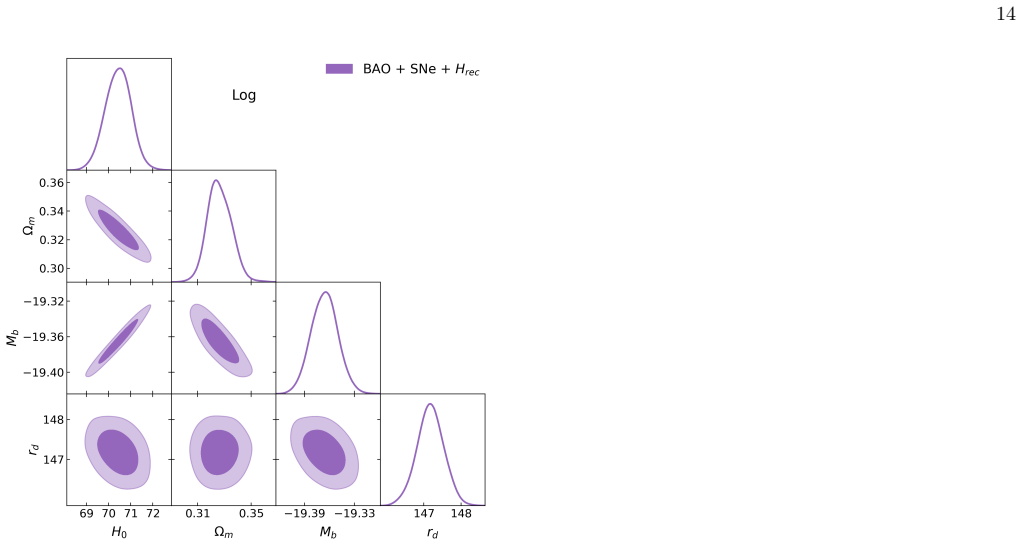
The paper's derivation chain is self-contained for the purposes of a circularity check. Model parameters (Ωm0, H0, ξ, rd, σ8) are constrained with DESI BAO, Pantheon+, Planck priors, and RSD fσ8 data. The perturbative quantities μ = 1/f_Q (Eq. 21) and ν = 12 Hdot F_QQ/f_Q (Eq. 25) are then computed from the same f(Q) action and the fitted background evolution. These are model outputs, not quantities fitted to the same observables: no μ or ν measurement enters the likelihood, and the RSD likelihood uses fσ8 rather than μ itself. The fact that μ and ν are functions of background-fitted parameters is the normal status of a model prediction, not a fitted-input-called-prediction reduction. The 'complementary' sign difference between gLog and iLog is not derived from data; the Introduction explicitly states that the iLog model 'is designed to yield perturbative behavior opposite to that of gLog case.' That is an ansatz property, and the paper presents it as a testable prediction rather than as validation from the target data. The acknowledged strong-coupling obstruction (Sec. I, citing [69–71]) is a real physical limitation on the quasi-static linear equations, but it is a correctness/truncation risk, not circularity: the perturbation equations are not assumed because of the conclusions drawn. No load-bearing self-citations were found; author-involved references such as [80], [86], and [91] are standard external parameterizations and methods. Score 0 is therefore appropriate.
Axiom & Free-Parameter Ledger
free parameters (6)
- ξ (log10 ξ) =
gLog: >0.918 (68% lower limit, log10 scale); iLog: 1.09+0.34-0.56 (68%) for DESI+Pan+rd
- Ωm0 =
0.3039 ± 0.0079 (gLog, DESI+Pan+rd)
- H0 =
68.79 ± 0.50 (gLog, DESI+Pan+rd)
- Mb =
-19.400 ± 0.014
- rd =
147.24 ± 0.31
- σ8 =
0.740 ± 0.023 (gLog, with RSD)
axioms (6)
- domain assumption Coordinate choice Q = 6H^2
- domain assumption Coincident gauge (vanishing affine connection)
- domain assumption Quasi-static approximation for scalar perturbations
- domain assumption Stability of the cosmological branch despite strong coupling
- domain assumption Flatness of the universe
- domain assumption Planck 2018 priors on rd and Hrec
Cite this review
Pith. "Pith review of Constraints on Logarithmic Model Extensions of Symmetric Teleparallel Gravity." pith.science (2026). https://pith.science/paper/DBZOCO5E
@misc{pith2026250821054,
  author       = {Pith},
  title        = {Pith review of: Constraints on Logarithmic Model Extensions of Symmetric Teleparallel Gravity},
  year         = {2026},
  howpublished = {\url{https://pith.science/paper/DBZOCO5E}},
  note         = {Machine review of arXiv:2508.21054}
}
abstract
We address various cosmological phenomenologies in the symmetric teleparallel framework both in background and perturbation such as cosmic expansion, gravitational coupling constant, gravitational waves propagation. Focusing on logarithmic extensions of $f(Q)$ models, we performed Bayesian analysis using the most-recent cosmological data, DESI DR2, Pantheon+. We also utilized a compilation of redshift space distortions ($f \sigma_8$) dataset to constrain the growth of structures in each of the models modulated by the effective gravitational coupling. We find that our extended Logarithmic $f(Q)$ models are well-constrained by the current cosmological data and are able to describe the late-time cosmic acceleration. The inverse Logarithmic model we introduce is also able to accommodate a phantom-like dark energy equation of state at late times, which is consistent with the recent DESI DR2 observations. We report explicitly predictions for the effective gravitational coupling ($\mu$), and the amplitude damping parameter of gravitational wave ($\nu$) solely based on the background data, which can be tested against future observations. While the two Log-based extensions we have introduced here perform equivalently on the background level, they provide contrasting predictions for the evolution of effective Gravitational constant and propagation of gravitational waves, which should be constrained against the future perturbation data.
Figures


Forward citations
Cited by 2 Pith papers
-
Dynamical Dark Energy or Modified Gravity? Signatures in Gravitational Wave Propagation
Reconstructing the dark energy density from DESI BAO and DESyr5 supernovae, then recasting it as f(Q) gravity, predicts a low-redshift gravitational wave damping ν≈0.18 (≳2σ from GR) only for the DESyr5 dataset.
-
Polytropic $f(Q)$ cosmology and its implications for the $H_0$ tension
Polytropic f(Q) cosmology with power-law f(Q) produces exact solutions whose Bayesian fits to data yield a specific status for the H0 tension.
Reference graph
Works this paper leans on
-
[1]
N. Aghanim et al. (Planck), Astron. Astrophys. 641, A1 (2020), arXiv:1807.06205 [astro-ph.CO]
Pith/arXiv arXiv 2020
-
[2]
P. A. R. Ade et al. (Planck), Astron. Astrophys. 594, A13 (2016), arXiv:1502.01589 [astro-ph.CO]
Pith/arXiv arXiv 2016
-
[3]
M. Abdul Karim et al. (DESI), (2025), arXiv:2503.14738 [astro-ph.CO]
Pith/arXiv arXiv 2025
-
[4]
D. Scolnic et al., Astrophys. J. 938, 113 (2022), arXiv:2112.03863 [astro-ph.CO]
Pith/arXiv arXiv 2022
-
[5]
S. Alam et al. (BOSS), Mon. Not. Roy. Astron. Soc. 470, 2617 (2017), arXiv:1607.03155 [astro-ph.CO]
Pith/arXiv arXiv 2017
-
[6]
E. Di Valentino et al. (CosmoVerse Network), Phys. Dark Univ. 49, 101965 (2025), arXiv:2504.01669 [astro- ph.CO]
Pith/arXiv arXiv 2025
-
[7]
L. Perivolaropoulos, Phys. Rev. D 110, 123518 (2024), arXiv:2408.11031 [astro-ph.CO]
Pith/arXiv arXiv 2024
-
[8]
L. Perivolaropoulos and F. Skara, New Astron. Rev. 95, 101659 (2022), arXiv:2105.05208 [astro-ph.CO]
Pith/arXiv arXiv 2022
-
[10]
J. Beltr´ an Jim´ enez, L. Heisenberg, and T. S. Koivisto, Universe 5, 173 (2019), arXiv:1903.06830 [hep-th]
Pith/arXiv arXiv 2019
-
[11]
J. M. Nester and H.-J. Yo, Chin. J. Phys.37, 113 (1999), arXiv:gr-qc/9809049
Pith/arXiv arXiv 1999
-
[12]
S. Bahamonde, K. F. Dialektopoulos, C. Escamilla- Rivera, G. Farrugia, V. Gakis, M. Hendry, M. Hohmann, J. Levi Said, J. Mifsud, and 12 E. Di Valentino, Rept. Prog. Phys. 86, 026901 (2023), arXiv:2106.13793 [gr-qc]
Pith/arXiv arXiv 2023
-
[13]
J. Beltr´ an Jim´ enez, L. Heisenberg, T. S. Koivisto, and S. Pekar, Phys. Rev. D 101, 103507 (2020), arXiv:1906.10027 [gr-qc]
Pith/arXiv arXiv 2020
-
[14]
A. De Felice and S. Tsujikawa, Living Rev. Rel. 13, 3 (2010), arXiv:1002.4928 [gr-qc]
Pith/arXiv arXiv 2010
-
[15]
J. Ferreira, T. Barreiro, J. Mimoso, and N. J. Nunes, Phys. Rev. D 105, 123531 (2022), arXiv:2203.13788 [astro-ph.CO]
Pith/arXiv arXiv 2022
-
[16]
Ferreira, (2023), arXiv:2303.12674 [astro-ph.CO]
J. Ferreira, (2023), arXiv:2303.12674 [astro-ph.CO]
Pith/arXiv arXiv 2023
-
[17]
F. K. Anagnostopoulos, V. Gakis, E. N. Saridakis, and S. Basilakos, Eur. Phys. J. C 83, 58 (2023), arXiv:2205.11445 [gr-qc]
Pith/arXiv arXiv 2023
-
[18]
Y. Yang, X. Ren, B. Wang, Y.-F. Cai, and E. N. Sari- dakis, Mon. Not. Roy. Astron. Soc. 533, 2232 (2024), arXiv:2404.12140 [astro-ph.CO]
Pith/arXiv arXiv 2024
-
[19]
G. N. Gadbail and P. K. Sahoo, Chin. J. Phys. 89, 1754 (2024), arXiv:2405.01594 [gr-qc]
Pith/arXiv arXiv 2024
-
[20]
X. Su, D. He, and Y. Zhang, Eur. Phys. J. C 85, 358 (2025), arXiv:2408.03725 [gr-qc]
Pith/arXiv arXiv 2025
-
[21]
G. N. Gadbail, S. Mandal, and P. K. Sahoo, Astrophys. J. 972, 174 (2024), arXiv:2404.13095 [gr-qc]
Pith/arXiv arXiv 2024
-
[22]
D. Mhamdi, F. Bargach, S. Dahmani, A. Bouali, and T. Ouali, Phys. Lett. B 859, 139113 (2024), arXiv:2410.10480 [gr-qc]
Pith/arXiv arXiv 2024
-
[23]
I. R. Vasquez and A. Oliveros, Gen. Rel. Grav. 57, 67 (2025), arXiv:2501.12585 [gr-qc]
Pith/arXiv arXiv 2025
- [24]
-
[25]
B. C. Roy, A. Beesham, and B. C. Paul, (2025), arXiv:2504.15680 [gr-qc]
Pith/arXiv arXiv 2025
-
[26]
C. G. Boiza, M. Petronikolou, M. Bouhmadi-L´ opez, and E. N. Saridakis, (2025), arXiv:2505.18264 [astro- ph.CO]
arXiv 2025
-
[27]
N. Frusciante, Phys. Rev. D 103, 044021 (2021), arXiv:2101.09242 [astro-ph.CO]
Pith/arXiv arXiv 2021
-
[28]
V. K. Bhardwaj, P. Garg, and S. Prakash, Astrophys. Space Sci. 369, 50 (2024)
2024
-
[29]
S. Sahlu, ´A. de la Cruz-Dombriz, and A. Abebe, Mon. Not. Roy. Astron. Soc. 539, 690 (2025), arXiv:2405.07361 [gr-qc]
Pith/arXiv arXiv 2025
-
[30]
O. Enkhili, S. Dahmani, D. Mhamdi, T. Ouali, and A. Errahmani, Eur. Phys. J. C 84, 806 (2024), arXiv:2407.12236 [gr-qc]
Pith/arXiv arXiv 2024
-
[31]
A. Kolhatkar, S. S. Mishra, and P. K. Sahoo, Eur. Phys. J. C 84, 888 (2024), arXiv:2409.01538 [gr-qc]
Pith/arXiv arXiv 2024
-
[32]
Z. Sakr and L. Schey, JCAP 10, 052 (2024), arXiv:2405.03627 [astro-ph.CO]
Pith/arXiv arXiv 2024
-
[33]
Q. Wang, X. Ren, Y.-F. Cai, W. Luo, and E. N. Sari- dakis, Astrophys. J. 974, 7 (2024), arXiv:2406.00242 [astro-ph.CO]
Pith/arXiv arXiv 2024
-
[34]
A. Paliathanasis, Phys. Dark Univ. 49, 101993 (2025), arXiv:2504.11132 [gr-qc]
arXiv 2025
-
[35]
R. D’Agostino and R. C. Nunes, Phys. Rev. D 106, 124053 (2022), arXiv:2210.11935 [gr-qc]
Pith/arXiv arXiv 2022
-
[36]
J. A. N´ ajera, C. A. Alvarado, and C. Escamilla- Rivera, Mon. Not. Roy. Astron. Soc. 524, 5280 (2023), arXiv:2304.12601 [gr-qc]
Pith/arXiv arXiv 2023
-
[37]
F. K. Anagnostopoulos, S. Basilakos, and E. N. Saridakis, Phys. Lett. B 822, 136634 (2021), arXiv:2104.15123 [gr-qc]
Pith/arXiv arXiv 2021
-
[38]
T. B. Gon¸ calves, L. Atayde, and N. Frusciante, Phys. Rev. D 109, 084003 (2024), arXiv:2404.01742 [gr-qc]
Pith/arXiv arXiv 2024
-
[39]
L. Jarv and L. Pati, Phys. Rev. D 109, 064069 (2024), arXiv:2309.04262 [gr-qc]
Pith/arXiv arXiv 2024
-
[40]
S. Bahamonde and L. J¨ arv, Eur. Phys. J. C 82, 963 (2022), arXiv:2208.01872 [gr-qc]
Pith/arXiv arXiv 2022
-
[41]
L. Heisenberg, Phys. Rept. 1066, 1 (2024), arXiv:2309.15958 [gr-qc]
Pith/arXiv arXiv 2024
-
[42]
N. Aghanim et al. (Planck), Astron. Astrophys. 641, A6 (2020), [Erratum: Astron.Astrophys. 652, C4 (2021)], arXiv:1807.06209 [astro-ph.CO]
Pith/arXiv arXiv 2020
-
[43]
S. Nesseris, G. Pantazis, and L. Perivolaropoulos, Phys. Rev. D 96, 023542 (2017), arXiv:1703.10538 [astro- ph.CO]
Pith/arXiv arXiv 2017
-
[44]
A. Kar, S. Sadhukhan, and U. Debnath, Mod. Phys. Lett. A 37, 2250183 (2022), arXiv:2109.10906 [gr-qc]
Pith/arXiv arXiv 2022
-
[45]
S. Capozziello and R. D’Agostino, Phys. Lett. B 832, 137229 (2022), arXiv:2204.01015 [gr-qc]
Pith/arXiv arXiv 2022
-
[46]
G. N. Gadbail, S. Mandal, and P. K. Sahoo, Phys. Lett. B 835, 137509 (2022), arXiv:2210.09237 [gr-qc]
Pith/arXiv arXiv 2022
-
[47]
G. N. Gadbail, S. Arora, and P. K. Sahoo, Phys. Lett. B 838, 137710 (2023), arXiv:2301.08876 [gr-qc]
Pith/arXiv arXiv 2023
-
[48]
D. M. Naik, N. S. Kavya, L. Sudharani, and V. Venkate- sha, Eur. Phys. J. C 83, 840 (2023)
2023
-
[49]
I. Mahmood, H. Sohail, A. Ditta, S. H. Shekh, and A. K. Yadav, Int. J. Geom. Meth. Mod. Phys. 21, 2450204 (2024), arXiv:2311.16527 [gr-qc]
Pith/arXiv arXiv 2024
-
[50]
G. N. Gadbail, A. De, and P. K. Sahoo, Eur. Phys. J. C 83, 1099 (2023), arXiv:2312.02492 [gr-qc]
Pith/arXiv arXiv 2023
-
[51]
A. Z. Kaczmarek, Nucl. Phys. B 1007, 116677 (2024), arXiv:2401.04084 [gr-qc]
Pith/arXiv arXiv 2024
-
[52]
A. Z. Kaczmarek, J. L. Rosa, and D. Szcz¸ e´ sniak, Eur. Phys. J. C 85, 203 (2025), arXiv:2410.00707 [gr-qc]
Pith/arXiv arXiv 2025
-
[53]
G. N. Gadbail, S. Mandal, P. K. Sahoo, and K. Bamba, Phys. Lett. B 860, 139232 (2025), arXiv:2411.00051 [gr- qc]
Pith/arXiv arXiv 2025
-
[54]
El Ouardi, A
R. El Ouardi, A. Bouali, S. Dahmani, A. Errahmani, and T. Ouali, Phys. Lett. B 863, 139374 (2025)
2025
-
[55]
A. K. Yadav, S. R. Bhoyar, M. C. Dhabe, S. H. Shekh, and N. Ahmad, JHEAp 43, 114 (2024)
2024
-
[56]
D. Saha, M. Chakrabortty, and A. K. Sanyal, Universe 10, 44 (2024), arXiv:2401.11226 [gr-qc]
Pith/arXiv arXiv 2024
-
[57]
F. Esposito, S. Carloni, R. Cianci, and S. Vignolo, Phys. Rev. D 105, 084061 (2022), arXiv:2107.14522 [gr- qc]
Pith/arXiv arXiv 2022
-
[58]
J. Kang, Phys. Dark Univ. 31, 100784 (2021), arXiv:2102.04232 [astro-ph.CO]
Pith/arXiv arXiv 2021
-
[59]
I. S. Albuquerque and N. Frusciante, Phys. Dark Univ. 35, 100980 (2022), arXiv:2202.04637 [astro-ph.CO]
Pith/arXiv arXiv 2022
- [60]
-
[61]
S. Basilakos, A. Paliathanasis, and E. N. Saridakis, Phys. Lett. B 868, 139658 (2025), arXiv:2503.19864 [gr- qc]
Pith/arXiv arXiv 2025
-
[62]
Late-time cosmology with phantom dark-energy in $f(Q)$ gravity
A. Lymperis, JCAP 11, 018 (2022), arXiv:2207.10997 [gr-qc]
work page internal anchor Pith review Pith/arXiv arXiv 2022
-
[63]
S. A. Narawade and B. Mishra, Annalen Phys. 535, 2200626 (2023), arXiv:2211.09701 [gr-qc]
Pith/arXiv arXiv 2023
-
[64]
S. Arora and P. K. Sahoo, Annalen Phys. 534, 2200233 (2022), arXiv:2206.05110 [gr-qc]
Pith/arXiv arXiv 2022
-
[65]
K. Hu, T. Katsuragawa, and T. Qiu, Phys. Rev. D 106, 044025 (2022), arXiv:2204.12826 [gr-qc]
Pith/arXiv arXiv 2022
-
[66]
F. D’Ambrosio, L. Heisenberg, and S. Zentarra, Fortsch. Phys. 71, 2300185 (2023), arXiv:2308.02250 13 [gr-qc]
Pith/arXiv arXiv 2023
-
[67]
K. Tomonari and S. Bahamonde, Eur. Phys. J. C 84, 349 (2024), [Erratum: Eur.Phys.J.C 84, 508 (2024)], arXiv:2308.06469 [gr-qc]
Pith/arXiv arXiv 2024
- [68]
-
[69]
D. A. Gomes, J. Beltr´ an Jim´ enez, A. J. Cano, and T. S. Koivisto, Phys. Rev. Lett. 132, 141401 (2024), arXiv:2311.04201 [gr-qc]
Pith/arXiv arXiv 2024
-
[70]
Moreover, a possible ghost-free class of symmetric teleparallel the- ories based on a symmetry under transverse diffeomor- phisms has recently been proposed [71]
show that for the simple connection set (which we adopt here) exhibit stable behaviour throughout all evo- lutionary epochs in the GR regime, and the general con- ditions for the physically viable f(Q) models. Moreover, a possible ghost-free class of symmetric teleparallel the- ories based on a symmetry under transverse diffeomor- phisms has recently been...
2018
-
[71]
M.-J. Guzm´ an, L. J¨ arv, and L. Pati, Phys. Rev. D110, 124013 (2024), arXiv:2406.11621 [gr-qc]
Pith/arXiv arXiv 2024
-
[72]
A. G. Bello-Morales, J. Beltr´ an Jim´ enez, A. Jim´ enez Cano, T. S. Koivisto, and A. L. Maroto, JHEP 12, 146 (2024), arXiv:2406.19355 [gr-qc]
Pith/arXiv arXiv 2024
- [73]
-
[74]
W. Khyllep, J. Dutta, E. N. Saridakis, and K. Yesmakhanova, Phys. Rev. D 107, 044022 (2023), arXiv:2207.02610 [gr-qc]
Pith/arXiv arXiv 2023
-
[75]
S. A. Narawade, L. Pati, B. Mishra, and S. K. Tripathy, Phys. Dark Univ. 36, 101020 (2022), arXiv:2203.14121 [gr-qc]
Pith/arXiv arXiv 2022
-
[76]
Revisiting Coincident GR in Internal STEGR Formulation
K. Tomonari, T. Katsuragawa, and S. Nojiri, (2025), arXiv:2506.22158 [gr-qc]
work page internal anchor Pith review Pith/arXiv arXiv 2025
-
[77]
S. R. Green and R. M. Wald, Class. Quant. Grav. 31, 234003 (2014), arXiv:1407.8084 [gr-qc]
Pith/arXiv arXiv 2014
-
[78]
We assume that the matter, i.e., baryons and CDMis pressureless (pm = 0) dust
-
[79]
J. Beltr´ an Jim´ enez, L. Heisenberg, and T. Koivisto, Phys. Rev. D 98, 044048 (2018), arXiv:1710.03116 [gr- qc]
Pith/arXiv arXiv 2018
-
[80]
L. Amendola, M. Kunz, and D. Sapone, JCAP 04, 013 (2008), arXiv:0704.2421 [astro-ph]
Pith/arXiv arXiv 2008
-
[81]
A. Nishizawa, Phys. Rev. D 97, 104037 (2018), arXiv:1710.04825 [gr-qc]
Pith/arXiv arXiv 2018
This paper was first reviewed by deepseek-v4-flash on August 5, 2026.
discussion (0)
Sign in with ORCID, Apple, or X to comment. Anyone can read and Pith papers without signing in.