REVIEW 4 major objections 5 minor 16 cited by
This paper claims that if the newly discovered system Ursa Major III is a galaxy dominated by dark matter, ultra-light dark matter must be heavier than 8×10^-18 eV, and that earlier perturbative bounds on the particle mass were conservative
Reviewed by Pith at T0; open to challenge. T0 means a machine referee read the full paper against a public rubric. the ladder, T0–T4 →
If Ursa Major III/UNIONS 1 is a galaxy, ultra-light dark matter particles must be heavier than 8 x 10^-18 eV, the strongest such bound.
T0 review reviewed 2026-08-05 challenge →
load-bearing objection A genuinely useful update on ULDM bounds, with a sharp new limit from Ursa Major III that is honest about its main condition: the object must really be a dark-matter-dominated galaxy. the 4 major comments →
Updated bounds on ultra-light dark matter from the tiniest galaxies
The pith
A machine-rendered reading of the paper's core claim, the machinery that carries it, and where it could break.
The reading
Core claim
The central claim is that the observed kinematics of the smallest dark-matter-dominated systems place a robust lower limit on the mass of ultra-light dark matter, and that the current best limit comes from Ursa Major III/UNIONS 1. The authors first validate that their perturbative heating-rate method gives a conservative bound by comparing it against fully nonlinear Schrödinger-Poisson simulations: heating is always stronger in the full simulations, due to fluctuations of the central soliton. They then show that tidal stripping does not suppress heating for observed ultrafaint dwarfs because their tidal radii far exceed both their stellar sizes and the de Broglie wavelength, and that self-in
What carries the argument
The central mechanism is dynamical heating of stars by wave-interference density fluctuations of fuzzy dark matter: granules with coherence length ℏ/(mσ_v) and coherence time ℏ/(mσ_v^2) produce gravitational perturbations that heat stellar orbits, with the strongest effect in the smallest galaxies. The argument carries through two tools: the perturbative heating-rate calculation used in earlier work, and full Schrödinger-Poisson simulations that include the dense central soliton whose fluctuations enhance the heating; the paper shows the perturbative estimate is always smaller, making it conservative. The new bound is driven by the observed properties of Ursa Major III/UNIONS 1, a candidate
Load-bearing premise
The headline bound assumes Ursa Major III/UNIONS 1 is a dark-matter-dominated galaxy rather than a tidally shredded star cluster; the paper argues against the cluster scenario but does not conclusively refute it, and it also assumes that heating rates measured at a particle mass of 10^-22 eV scale unchanged with the de Broglie wavelength to the masses actually constrained.
What would settle it
Measure the velocity dispersion of Ursa Major III with multi-epoch spectroscopy: if removing binaries and outliers drops the true dispersion below the value needed to support the system against stellar self-gravity, the dark-matter-dominated interpretation and the 8×10^-18 eV bound would both collapse.
If this is right
- If the bound holds, ultra-light dark matter with particle mass below 8×10^-18 eV cannot constitute all of the dark matter, ruling out the entire previously considered 'fuzzy' mass range of about 10^-22 to 10^-20 eV.
- For masses above the bound, ultra-light dark matter produces no detectable deviations from cold dark matter in the linear power spectrum on observable scales (k < 10^3 h/Mpc), making wave-interference signatures in small-scale structure effectively unobservable.
- Terrestrial and laboratory searches for axion-like dark matter below m ≈ 10^-17 eV would appear to be low-priority if Ursa Major III is confirmed as a dark-matter-dominated galaxy.
- More precise measurements of Ursa Major III's size and velocity dispersion, and use of full Schrödinger-Poisson simulations instead of the perturbative method, would be expected to strengthen the lower bound considerably.
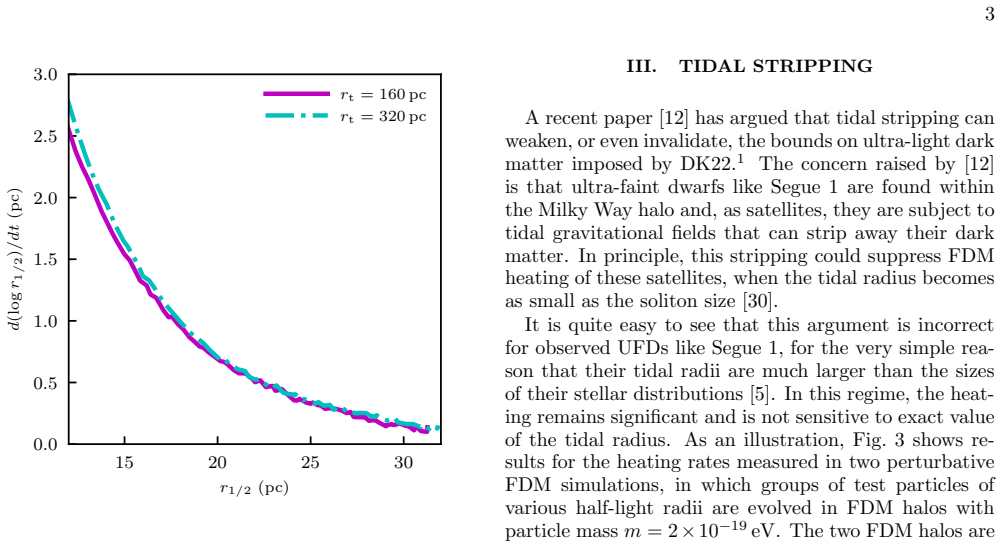
- The perturbative bounds from Segue 1 and Segue 2 remain valid despite tidal-stripping concerns, because tidal stripping cannot suppress wave interference when the tidal radius is much larger than the coherence length and the galaxy size.
Where Pith is reading between the lines
- If future observations show that Ursa Major III is instead a tidally shredded star cluster, the headline bound would likely revert to the earlier Segue 1/Segue 2 limit near 3×10^-19 eV; the paper argues against the cluster scenario on survival and stream grounds, but the decisive evidence is not yet in hand.
- The simulation comparison was run at a single particle mass (10^-22 eV) and scaled to other masses by the de Broglie wavelength; confirming this scaling with simulations at masses near 10^-17 eV would directly test the claim that the conservative bound remains conservative at the masses actually constrained.
- Other candidate micro-galaxies found in the same imaging surveys could be combined with Ursa Major III in a joint likelihood, potentially pushing the bound toward 10^-17 eV even before more precise data on Ursa Major III arrive.
- Because full simulations give stronger heating, a future reanalysis using them may exclude masses above 8×10^-18 eV, potentially closing much of the remaining parameter space that direct axion-detection experiments are designed to probe.
Editorial analysis
A structured set of objections, weighed in public.
Referee Report
Summary. The paper revisits lower bounds on the mass of ultra-light dark matter (FDM) from ultra-faint dwarf galaxies. It first compares the linear-perturbation heating calculation of Dalal & Kravtsov (2022) with full nonlinear Schrödinger–Poisson simulations at m = 10^-22 eV, finding that the nonlinear heating rate is larger, and concludes that the perturbative bounds are conservative. It then argues that tidal stripping does not weaken the bounds and that DM self-interactions cannot evade them because of large-scale-structure constraints. The central new result is a 95% lower limit m > 8 × 10^-18 eV derived from the micro-galaxy candidate Ursa Major III/UNIONS 1, explicitly conditional on that object being a dark-matter-dominated galaxy.
Significance. If the result holds, this paper would strengthen the lower bound on the ultralight DM mass by more than an order of magnitude relative to previous work, ruling out an additional portion of the fuzzy-DM parameter space and sharpening the implications for laboratory searches. The paper also performs a useful direct comparison of perturbative and full nonlinear FDM heating, addresses two proposed loopholes (tidal stripping and self-interactions), and is careful to state the conditionality of the headline bound. The main strengths are the explicit use of an independent full Schrödinger–Poisson simulation code (AxiREPO) for the comparison and the clear identification of the assumptions entering the new bound. However, the central numerical claim and the 'conservative' interpretation rest on assumptions that are not fully demonstrated, as detailed below.
major comments (4)
- [Section V, Eq. (6), Figure 6] The headline bound m > 8 × 10^-18 eV rests entirely on the classification of Ursa Major III/UNIONS 1 as a dark-matter-dominated galaxy. The paper itself notes that the velocity dispersion σv = (1.9 ± 1.4) km/s is sensitive to outlier rejection and single-epoch spectroscopy, and the competing tidally shredded cluster scenario of Devlin et al. (2025) is argued against but not conclusively excluded. If UMa3 is not a galaxy, the bound reverts to the earlier ~3 × 10^-19 eV limit. Because this is the central new numerical claim, the manuscript should either present the cluster scenario as an explicit alternate route to the bound or provide a quantitative assessment of the probability that UMa3 is a galaxy. As written, the abstract and discussion claim 'strengthen by over an order of magnitude' is too strong.
- [Section II, Figure 2] The claim that nonlinear FDM heating is always stronger than perturbative heating—and hence that the perturbative bounds are conservative—is based on a single simulation at m = 10^-22 eV, using one halo realization, no resolution/convergence tests, and no error bars. The extrapolation of the heating ratio to the masses actually constrained (m ≳ 10^-18 eV) is assumed via de Broglie scaling but not tested. Since this comparison underpins the 'conservative' interpretation of the final bound, the authors should provide at least one test at a different mass or a quantitative scaling argument showing that the ratio of nonlinear to perturbative heating remains >1 over the relevant range.
- [Section IV, Eq. (5)] The self-interaction exclusion argument relies on the adopted limit that the linear power spectrum cannot deviate from ΛCDM by more than a factor of 10 for k ≤ 30 h Mpc^-1. This threshold is not derived or tested for sensitivity; a weaker observational limit would allow some quartic couplings satisfying Eq. (3) for the relevant galaxies. The paper also restricts to linear-regime constraints and explicitly excludes oscillon formation. The conclusion that self-interactions 'cannot change' the bounds is therefore stronger than what is demonstrated. Please quantify how the allowed coupling region—and the resulting bound on m—depends on the assumed power-spectrum tolerance.
- [Section V, Eq. (6)] The derivation of the final bound uses the perturbative heating method from the authors' earlier work, but the paper does not provide the actual model for d r1/2/dt or the integration procedure used to obtain T(m, r1/2, vc). The sentence 'Using shorter simulations, we measure the growth rate...' is ambiguous because it does not specify whether these are full SP runs or the perturbative simulations. Without this detail, the central numerical result is not reproducible. Please state explicitly the functional form of the heating rate and the calibration procedure, or provide reference to an equation in DK22 with the relevant expression.
minor comments (5)
- [Section III] The phrase 'all masses below m < 10^-19 eV' is redundant and ambiguous; it should read 'all masses m < 10^-19 eV' or 'all masses below 10^-19 eV'.
- [Section V, Eq. (6)] The integration notation is a little unclear: the lower limit σmin for the σv integral is not defined. Please specify it explicitly, for example as the value below which the Gaussian prior is effectively zero or the physical lower bound from the stellar velocity dispersion measurement.
- [Figure 6] The axis labels switch between 1/m_FDM and m_FDM with units in parentheses; this is confusing. Please use a single, clearly labeled x-axis quantity, e.g. log10(m/eV).
- [Section II] Figure 2 would be clearer if the full nonlinear and perturbative curves were distinguished by linestyle or color consistently across the three panels, and if the initial transient period mentioned in the text were indicated on the time axis.
- [Section IV] In Eq. (3), after restoring ℏ and c, it would be helpful to state the numerical value of the coefficient in cgs units so that the condition can be directly compared with Eq. (5).
Circularity Check
No significant circularity; central derivation is self-contained and validated against independent simulations.
full rationale
The paper's derivation chain is not circular. The headline bound in Sec. V does not fit the mass m to the data; it uses the observed r1/2 and sigma_v as Gaussian priors in Eq. (6), computes the FDM heating time T(m, r1/2, vc) from simulations, and asks whether T exceeds 10 Gyr. The bound is explicitly conditional on Ursa Major III being a DM-dominated galaxy, a limitation the paper flags. The perturbative heating method from DK22 and Dalal et al. (2021) is load-bearing, but it is independently validated in Sec. II against full nonlinear Schroedinger-Poisson simulations using AxiREPO, which show that perturbative heating is weaker than full nonlinear heating; hence any bound derived from it is conservative rather than forced by construction. The extrapolation of the simulation comparison from m=10^-22 eV to other masses via de Broglie scaling is a stated physical assumption, not an input-equivalent reduction. The Sec. IV self-interaction argument cites a power-spectrum bound partly from a coauthor (Dekker & Kravtsov 2025), but this is an ancillary robustness check grounded in observed UFD central densities, not in the present paper's fitted values. No equation defines the target result into its inputs, no fitted parameter is renamed a prediction, and no uniqueness claim is imported from self-citation. The paper's own caveats about UMa3 classification, single-epoch spectroscopy, and outlier sensitivity are honest uncertainties, not circular steps.
Axiom & Free-Parameter Ledger
free parameters (4)
- Linear power-spectrum tolerance factor =
10
- Fiducial radius r_fid for Ursa Major III potential =
4 pc
- Simulation DM mass m_sim for full SP runs =
1e-22 eV
- Mass prior exponent =
-2
axioms (6)
- domain assumption Schrödinger-Poisson evolution with periodic boundaries plus an absorbing sponge describes FDM halo formation and evolution.
- domain assumption Stellar self-gravity is negligible and stars can be modeled as massless test particles.
- domain assumption FDM heating rates measured at m = 10^-22 eV scale to other masses when radii are scaled by the de Broglie wavelength.
- domain assumption Linear perturbation theory in Eq. (4) describes early-universe self-interacting ULDM, and the observed power spectrum must not deviate from CDM by more than a factor of 10 on k <= 30 h/Mpc.
- domain assumption Ursa Major III/UNIONS 1 is a dark-matter-dominated galaxy rather than a disrupted star cluster.
- domain assumption The inner halo potential of Ursa Major III is a cuspy NFW r^-1 profile with the virial relation sigma_v^2 approximately v_c^2(r_fid) r_1/2 / (3 r_fid).
Cite this review
Pith. "Pith review of Updated bounds on ultra-light dark matter from the tiniest galaxies." pith.science (2026). https://pith.science/paper/SZM5UV3S
@misc{pith2026250902781,
  author       = {Pith},
  title        = {Pith review of: Updated bounds on ultra-light dark matter from the tiniest galaxies},
  year         = {2026},
  howpublished = {\url{https://pith.science/paper/SZM5UV3S}},
  note         = {Machine review of arXiv:2509.02781}
}
abstract
The particle mass of dark matter (DM) was previously constrained using kinematics of ultra-faint dwarf galaxies to $m > 3 \times 10^{-19}\,\mathrm{eV}$. This constraint, which excludes the "fuzzy" range of ultra-light dark matter from comprising all of the DM, relies on an estimate of the heating rate from fuzzy dark matter (FDM) wave interference using linear perturbation theory. Here, we compare the results of this perturbative calculation to full Schr\"odinger-Poisson simulations of the evolution of star particles in FDM halos. This comparison confirms theoretical expectations that FDM heating is stronger in fully nonlinear simulations due to the formation of a dense central soliton whose fluctuations enhance gravitational perturbations, and that bounds on the DM particle mass using this perturbative method are indeed conservative. We also show that these bounds are not affected by possible tidal stripping, since for dwarf satellites like Segue 1, the tidal radius is much larger than the observed size of the galaxy. We further show that the constraints on the mass cannot be evaded by invoking DM self-interactions, due to constraints on the self-interaction from large-scale structure. Lastly, we show that if the recently discovered system Ursa Major III/UNIONS I is a galaxy, the observed properties of this object strengthen the lower bound on the DM mass by over an order of magnitude, to $m > 8 \times 10^{-18}\,\mathrm{eV}$, at 95% confidence. This constraint could further be strengthened considerably by more precise measurements of the size and velocity dispersion of this and other similar galaxies, and by using full Schr\"odinger-Poisson simulations.
Figures



Forward citations
Cited by 16 Pith papers
-
Neutrino-Antineutrino Conversion from Ultralight Vector Dark Matter
Majorana neutrinos convert to antineutrinos in ultralight vector dark matter backgrounds coupled to lepton number, enabling supernova neutrino detectors to probe gauge couplings as small as 10^{-32} for masses around ...
-
Stone Skipping Black Holes in Ultralight Dark Matter Solitons
Black holes in ultralight dark matter solitons undergo quasi-periodic stone-skipping orbits driven by soliton dipole excitations, modifying inspiral dynamics when the black hole is much lighter than the soliton.
-
Growth of Structure in Multi-species Wave Dark Matter
Derives the power spectrum evolution and cross-spectra for arbitrary multi-species wave and particle dark matter, incorporating free-streaming, Jeans scales, and intrinsic fluctuations.
-
Searching for signatures of fuzzy dark matter in cosmic filament profiles
Galaxy distributions around SDSS filaments are consistent with no periodicity and exclude A > 0.16 λ0 + 0.18 (0.2–2 Mpc) at 3σ in a simple cosine model of fuzzy-dark-matter interference.
-
Cosmo-SPINN: Fuzzy Dark Matter Simulations with Physics-Informed Generative Networks
Physics-informed generative U-Nets evolve and super-resolve fuzzy dark matter fields under Schrödinger–Poisson constraints with far less supervised data than pure data-driven baselines.
-
Payne4GAIN: NLTE Corrections for Red Giants in Milky Way Mapper using H-Band Neural Network Emulators
Applying NLTE physics to APOGEE H-band spectra shifts red-giant abundances by ~0.1 dex for Al, Mn, and Ti; the paper provides a 360k-star correction catalog.
-
Stone Skipping Black Holes in Ultralight Dark Matter Solitons
A dipole (lopsided) oscillation of the soliton, not ordinary drag, drives stone-skipping black-hole orbits, and the effect behaves like a forced resonant oscillator.
-
The Keck/DEIMOS Stellar Archive: I. Uniform Velocities and Metallicities for 78 Milky Way Dwarf Galaxies and Globular Clusters
A homogeneous catalog of velocities, CaT metallicities, and memberships for 22,339 stars in 78 Milky Way satellites, with a 1.1 km/s velocity error floor.
-
Ultralight Dark Matter from the Edge of Field Space
A scalar with hard field-space boundaries — a 'wallion' — is a viable ultralight dark-matter candidate whose exponentially small, radiatively stable mass and saturated relic density at large misalignment also suppress...
-
Halo mass functions in mixed cold and fuzzy dark matter models
Simulations show fuzzy dark matter fraction up to 0.3 suppresses low-mass halos in mixed DM models, and a redshift- and fraction-dependent suppression function maps CDM HMFs to MDM HMFs within 0.1-0.2 dex accuracy for z=1-4.
-
The Atacama Cosmology Telescope: Probing new signatures of ultralight axions with gravitational lensing
New upper limits on ultralight axion dark matter fraction (<1.5% at 10^{-26} eV, <9% at 10^{-25} eV at 95% CL) from combined CMB lensing data, plus marginal 2.1σ preference at 10^{-24.5} eV driven by few points.
-
Constraints on Self-Interacting Fuzzy Dark Matter from the Stellar Kinematics of the Dwarf Galaxy Leo II
Using Jeans analysis of Leo II stellar kinematics, the paper constrains the fuzzy dark matter mass m_a and self-interaction parameter f_a, finding 95% CL lower limits on m_a in the (1-10)×10^{-22} eV range for |f_a^{-...
-
Tidal Heating of Stellar Clusters in Fuzzy Dark Matter Halos
Simulations reveal tidal heating dominates stellar cluster evolution in low-mass fuzzy dark matter halos, suppressed by reduced soliton mass and tidal stripping, so halo structure must be modeled to constrain the fuzz...
-
Fuzzy Dark Matter and the Impact of Core--Halo Diversity on Its Particle Mass Constraints
Allowing diversity in the core–halo relation of fuzzy dark matter opens up a low particle-mass window around 10^-22 eV alongside the previously favored 10^-20 eV range.
-
Evolution of Compact Stellar Systems in Ultralight Dark Matter Halos: Dependence on Stellar and Dark Matter Parameters
Simulations find metal-richer compact stellar systems resist disruption better in ULDM halos, with tidal fields altering stability and heating strengthening at higher particle masses when system size is much smaller t...
-
Parametric Resonance and Backreaction Effects in Magnetogenesis from Ultralight Dark Matter
A narrow parametric resonance channel exists in axion-DM magnetogenesis, but its claimed dominance at very small couplings is undermined by unchecked expansion damping.
Reference graph
Works this paper leans on
-
[1]
Arvanitaki, S
A. Arvanitaki, S. Dimopoulos, S. Dubovsky, N. Kaloper, and J. March-Russell, Phys. Rev. D 81, 123530 (2010)
2010
-
[2]
L. Hui, Annu. Rev. Astron. Astrophys. 59, 10.1146/annurev-astro-120920-010024 (2021), arXiv:2101.11735 [astro-ph.CO]
Pith/arXiv arXiv 2021
-
[3]
R. Hanbury Brown and R. G. Twiss, Philosophical Mag- azine 45, 663 (1954)
work page 1954
-
[4]
N. Dalal, M. Galanis, C. Gammie, S. E. Gralla, and N. Murray, Phys. Rev. D 109, 123029 (2024), arXiv:2403.15903 [astro-ph.CO]
Pith/arXiv arXiv 2024
-
[5]
J. D. Simon, Annu. Rev. Astron. Astrophys. 57, 375 (2019), arXiv:1901.05465 [astro-ph.GA]
Pith/arXiv arXiv 2019
-
[6]
and Segue 2 [7], have been used to constrain the DM particle mass to m > 3 × 10⁻¹⁹ eV ([8], hereafter DK22). This constraint excludes the entire “fuzzy” range of ULDM, 10 −22 eV < m <10−20 eV [2, 9] from being all of the DM, and is completely insensitive to uncer- tainties in baryonic physics, such as supernova feedback, the galaxy–halo connection, etc., ...
Pith/arXiv arXiv 2025
-
[7]
J. D. Simon, M. Geha, Q. E. Minor, G. D. Martinez, E. N. Kirby, J. S. Bullock, M. Kaplinghat, L. E. Strigari, B. Willman, P. I. Choi, E. J. Tollerud, and J. Wolf, Astro- phys. J. 733, 46 (2011), arXiv:1007.4198 [astro-ph.GA]
Pith/arXiv arXiv 2011
-
[8]
E. N. Kirby, M. Boylan-Kolchin, J. G. Cohen, M. Geha, J. S. Bullock, and M. Kaplinghat, Astrophys. J. 770, 16 (2013), arXiv:1304.6080 [astro-ph.CO]
work page internal anchor Pith review Pith/arXiv arXiv 2013
-
[9]
N. Dalal and A. Kravtsov, Phys. Rev. D 106, 063517 (2022), arXiv:2203.05750 [astro-ph.CO]
Pith/arXiv arXiv 2022
-
[10]
W. Hu, R. Barkana, and A. Gruzinov, Phys. Rev. Lett. 85, 1158 (2000), arXiv:astro-ph/0003365 [astro-ph]
Pith/arXiv arXiv 2000
-
[12]
Don't cross the streams: caustics from Fuzzy Dark Matter
N. Dalal, J. Bovy, L. Hui, and X. Li, J. Cosmology As- tropart. Phys. 2021, 076 (2021), arXiv:2011.13141 [astro- 9 ph.CO]
work page internal anchor Pith review Pith/arXiv arXiv 2021
-
[13]
Y.-M. Yang, Z.-C. Zhang, X.-J. Bi, and P.-F. Yin, arXiv:2507.01686 [astro-ph.CO] (2025), preprint
Pith/arXiv arXiv 2025
-
[14]
C. Capanelli, W. Hu, and E. McDonough, arXiv:2503.21865 [astro-ph.CO] (2025), preprint
Pith/arXiv arXiv 2025
-
[15]
S. E. T. Smith, W. Cerny, C. R. Hayes, F. Ses- tito, J. Jensen, A. W. McConnachie, M. Geha, J. F. Navarro, T. S. Li, J.-C. Cuillandre, R. Errani, K. Cham- bers, S. Gwyn, F. Hammer, M. J. Hudson, E. Mag- nier, and N. Martin, Astrophys. J. 961, 92 (2024), arXiv:2311.10147 [astro-ph.GA]
Pith/arXiv arXiv 2024
-
[16]
J. D. Simon, T. S. Li, A. P. Ji, A. B. Pace, T. T. Hansen, W. Cerny, I. Escala, S. E. Koposov, A. Drlica-Wagner, S. Mau, and E. N. Kirby, Astrophys. J. 976, 256 (2024), arXiv:2410.08276 [astro-ph.GA]
work page internal anchor Pith review Pith/arXiv arXiv 2024
-
[17]
Ursa Major III/UNIONS 1: the darkest galaxy ever discovered?
R. Errani, J. F. Navarro, S. E. T. Smith, and A. W. McConnachie, Astrophys. J. 965, 20 (2024), arXiv:2311.10134 [astro-ph.GA]
work page internal anchor Pith review Pith/arXiv arXiv 2024
-
[18]
Y. Oshima, H. Fujimoto, J. Kume, S. Morisaki, K. Nagano, T. Fujita, I. Obata, A. Nishizawa, Y. Michimura, and M. Ando, Phys. Rev. D 108, 072005 (2023), arXiv:2303.03594 [hep-ex]
Pith/arXiv arXiv 2023
-
[19]
J. F. Bourhill, E. C. I. Paterson, M. Goryachev, and M. E. Tobar, Phys. Rev. D 108, 052014 (2023), arXiv:2208.01640 [hep-ph]
Pith/arXiv arXiv 2023
-
[20]
E. A. Shaw, M. P. Ross, C. A. Hagedorn, E. G. Adel- berger, and J. H. Gundlach, Phys. Rev. D 105, 042007 (2022), arXiv:2109.08822 [astro-ph.CO]
Pith/arXiv arXiv 2022
-
[21]
I. Schulthess, E. Chanel, A. Fratangelo, A. Gottstein, A. Gsponer, Z. Hodge, C. Pistillo, D. Ries, T. Soldner, J. Thorne, and F. M. Piegsa, Phys. Rev. Lett. 129, 191801 (2022), arXiv:2204.01454 [hep-ex]
arXiv 2022
-
[22]
C. Abel, N. J. Ayres, G. Ban, et al. , Phys. Rev. X 7, 041034 (2017), arXiv:1708.06367 [hep-ph]
Pith/arXiv arXiv 2017
-
[23]
M. Fan, B. Nima, A. Radak, G. Alonso- ´Alvarez, and A. Vutha, arXiv:2410.02218 [physics.atom-ph] (2024), preprint
arXiv 2024
-
[24]
L. Badurina, D. Blas, J. Ellis, and S. A. R. Ellis, arXiv:2507.17825 [hep-ph] (2025), preprint
Pith/arXiv arXiv 2025
-
[25]
S. May and V. Springel, Mon. Not. R. Astron. Soc. 506, 2603 (2021), arXiv:2101.01828 [astro-ph.CO]
Pith/arXiv arXiv 2021
-
[26]
S. May and V. Springel, Mon. Not. R. Astron. Soc. 524, 4256 (2023), arXiv:2209.14886 [astro-ph.CO]
Pith/arXiv arXiv 2023
-
[27]
F. S. Guzm´ an and L. A. Ure˜ na-L´ opez, Phys. Rev. D69, 124033 (2004), arXiv:gr-qc/0404014 [gr-qc]
Pith/arXiv arXiv 2004
-
[28]
B. Schwabe, J. C. Niemeyer, and J. F. Engels, Phys. Rev. D 94, 043513 (2016), arXiv:1606.05151 [astro- ph.CO]
Pith/arXiv arXiv 2016
-
[29]
J. F. Navarro, C. S. Frenk, and S. D. M. White, Astro- phys. J. 490, 493 (1997), arXiv:astro-ph/9611107 [astro- ph]
Pith/arXiv arXiv 1997
-
[30]
L. M. Widrow and N. Kaiser, Astrophys. J. Lett. 416, L71 (1993)
work page 1993
-
[31]
H.-Y. Schive, T. Chiueh, and T. Broadhurst, Phys. Rev. Lett. 124, 201301 (2020), arXiv:1912.09483 [astro-ph.GA]
Pith/arXiv arXiv 2020
-
[32]
E. O. Nadler, A. Drlica-Wagner, K. Bechtol, et al. , Phys. Rev. Lett. 126, 091101 (2021), arXiv:2008.00022 [astro-ph.CO]
Pith/arXiv arXiv 2021
-
[33]
G. Iorio, F. Fraternali, C. Nipoti, E. Di Teodoro, J. I. Read, and G. Battaglia, Mon. Not. R. Astron. Soc. 466, 4159 (2017), arXiv:1611.03865 [astro-ph.GA]
Pith/arXiv arXiv 2017
-
[34]
Kinematic and metallicity properties od the Aquarius dwarf galaxy from FORS2 MXU spectroscopy
L. Hermosa Mu˜ noz, S. Taibi, G. Battaglia, G. Io- rio, M. Rejkuba, R. Leaman, A. A. Cole, M. Irwin, P. Jablonka, N. Kacharov, A. McConnachie, E. Starken- burg, and E. Tolstoy, Astron. Astrophys. 634, A10 (2020), arXiv:1911.13081 [astro-ph.GA]
work page internal anchor Pith review Pith/arXiv arXiv 2020
-
[35]
The infall of dwarf satellite galaxies are influenced by their host's massive accretions
R. D’Souza and E. F. Bell, Mon. Not. R. Astron. Soc. 504, 5270 (2021), arXiv:2104.13249 [astro-ph.GA]
work page internal anchor Pith review Pith/arXiv arXiv 2021
-
[36]
B. F. Griffen, A. P. Ji, G. A. Dooley, F. A. G´ omez, M. Vo- gelsberger, B. W. O’Shea, and A. Frebel, Astrophys. J. 818, 10 (2016), arXiv:1509.01255 [astro-ph.GA]
work page internal anchor Pith review Pith/arXiv arXiv 2016
-
[37]
GRUMPY: a simple framework for realistic forward-modelling of dwarf galaxies
A. Kravtsov and V. Manwadkar, Mon. Not. R. As- tron. Soc. 514, 2667 (2022), arXiv:2106.09724 [astro- ph.GA]
work page internal anchor Pith review Pith/arXiv arXiv 2022
-
[38]
Forward-modelling the Luminosity, Distance, and Size distributions of the Milky Way Satellites
V. Manwadkar and A. V. Kravtsov, Mon. Not. R. As- tron. Soc. 516, 3944 (2022), arXiv:2112.04511 [astro- ph.GA]
work page internal anchor Pith review Pith/arXiv arXiv 2022
-
[39]
J. D. Simon, Astrophys. J. 863, 89 (2018), arXiv:1804.10230 [astro-ph.GA]
work page internal anchor Pith review Pith/arXiv arXiv 2018
-
[40]
A. Arvanitaki, J. Huang, and K. Van Tilburg, Phys. Rev. D 91, 015015 (2015), arXiv:1405.2925 [hep- ph]
Pith/arXiv arXiv 2015
-
[41]
V. Irˇ siˇ c, M. Viel, M. G. Haehnelt, J. S. Bolton, M. Mo- laro, E. Puchwein, E. Boera, G. D. Becker, P. Gaik- wad, L. C. Keating, and G. Kulkarni, Phys. Rev. D 109, 043511 (2024), arXiv:2309.04533 [astro-ph.CO]
Pith/arXiv arXiv 2024
-
[42]
I. Esteban, A. H. G. Peter, and S. Y. Kim, Phys. Rev. D 110, 123013 (2024), arXiv:2306.04674 [astro-ph.CO]
Pith/arXiv arXiv 2024
-
[43]
Constraints on blue and red tilted primordial power spectra using dwarf galaxy properties
A. Dekker and A. Kravtsov, Phys. Rev. D 111, 063516 (2025), arXiv:2407.04198 [astro-ph.CO]
work page internal anchor Pith review Pith/arXiv arXiv 2025
-
[44]
A. Arvanitaki, S. Dimopoulos, M. Galanis, L. Lehner, J. O. Thompson, and K. Van Tilburg, Phys. Rev. D 101, 083014 (2020), arXiv:1909.11665 [astro-ph.CO]
Pith/arXiv arXiv 2020
-
[45]
Reevaluating UMa3/U1: star cluster or the smallest known galaxy?
S. Devlin, H. Baumgardt, and S. M. Sweet, Mon. Not. R. Astron. Soc. 539, 2485 (2025), arXiv:2504.21301 [astro-ph.GA]
work page internal anchor Pith review Pith/arXiv arXiv 2025
-
[46]
J. J. Webb and J. Bovy, Mon. Not. R. Astron. Soc. 485, 5929 (2019), arXiv:1811.07022 [astro-ph.GA]
work page internal anchor Pith review Pith/arXiv arXiv 2019
-
[47]
M. T. Gialluca, R. P. Naidu, and A. Bonaca, Astro- phys. J. Lett. 911, L32 (2021), arXiv:2011.12963 [astro- ph.GA]
work page internal anchor Pith review Pith/arXiv arXiv 2021
-
[48]
C. J. Grillmair and O. Dionatos, Astrophys. J. Lett. 643, L17 (2006), arXiv:astro-ph/0604332 [astro-ph]
Pith/arXiv arXiv 2006
-
[49]
V. Belokurov and A. Kravtsov, Mon. Not. R. Astron. Soc. 528, 3198 (2024), arXiv:2309.15902 [astro-ph.GA]
Pith/arXiv arXiv 2024
-
[50]
M. C. Galassi, J. Davies, J. Theiler, B. Gough, G. Jung- man, P. Alken, M. Booth, F. Rossi, and R. Ulerich, GNU Scientific Library (Network Theory, Ltd., 2019)
work page 2019
- [51]
-
[52]
Efficient Spherical Harmonic Transforms aimed at pseudo-spectral numerical simulations
N. Schaeffer, Geochemistry, Geophysics, Geosystems 14, 751 (2013), arXiv:1202.6522 [physics.comp-ph]
work page internal anchor Pith review Pith/arXiv arXiv 2013
-
[53]
S. Van Der Walt, S. C. Colbert, and G. Varoquaux, ArXiv:1102.1523 , 1 (2011)
Pith/arXiv arXiv 2011
- [54]
-
[55]
J. D. Hunter, Computing In Science & Engineering 9, 90 (2007)
2007
This paper was first reviewed by deepseek-v4-flash on August 5, 2026.
discussion (0)
Sign in with ORCID, Apple, or X to comment. Anyone can read and Pith papers without signing in.