REVIEW 3 major objections 4 minor 1 cited by
Bulk Viscosity of Two-Flavor Color Superconducting Quark Matter in Neutron Star Mergers
T0 review · 3 major / 4 minor · reviewed 2026-08-07 · deepseek-v4-flash
Pith's one-line read Doubling the vector coupling of 2SC quark matter changes its bulk viscosity and damping timescale by factors of 3 to 20, driven mainly by the equation-of-state susceptibility, and the damping closely matches nucleonic matter.
desk verdict Useful parameter scan for 2SC bulk viscosity, but the light-quark Urca rates violate detailed balance and need fixing before the absolute numbers are trusted. read the letter →
The pith
A machine-rendered reading of the paper's core claim, the machinery that carries it, and where it could break.
The reading
What carries the argument
The argument runs on the classic resonant formula $\zeta = (C^2/A)\,\gamma/(\omega^2 + \gamma^2)$, in which $\gamma = \lambda A$ is the total Urca equilibration rate and the susceptibilities $A$ and $C$ measure how the $\beta$-disequilibrium chemical potential $\mu_\Delta = \delta\mu_d - \delta\mu_u - \delta\mu_e$ responds to changes in the up-quark fraction and in baryon density. The load-bearing object is $C$: it encodes how the repulsive vector interaction shifts the quark chemical potentials through the $\omega$ and $\phi$ mean fields and thereby changes the matter's response to compression, and the paper shows that this susceptibility — not the weak matrix elements — is the main source of the factor-of-3-to-20 sensitivity to $G_V$. The reaction side is carried by the semi-leptonic direct Urca processes, whose rates scale as $T^5$ for the light-quark $d$-channel (because all three participating fermions are ultrarelativistic, so the reaction is only opened by thermal smearing of Fermi surfaces) and as $T^4$ for the strange-quark channel, which stays kinematically open with roughly 70 MeV of available energy. The fast non-leptonic equilibration of $d$ and $s$ reduces the dynamics to the single chemical imbalance $\mu_\Delta$.
What would settle it
Compute the neutrino mean free path in 2SC quark matter at $4n_0$–$7n_0$ and $T = 1$–$10$ MeV using the same NJL equation of state: if that path is shorter than the quark-core radius, the free-streaming assumption fails and the quoted bulk viscosities are too large. Alternatively, a post-merger gravitational-wave signal whose measured damping timescale falls well outside the factor-of-3-to-20 band spanned by $G_V/G_S = 0.6$–$1.2$ would show that something other than the vector coupling controls the dissipation.
Extended reading notes
Core claim
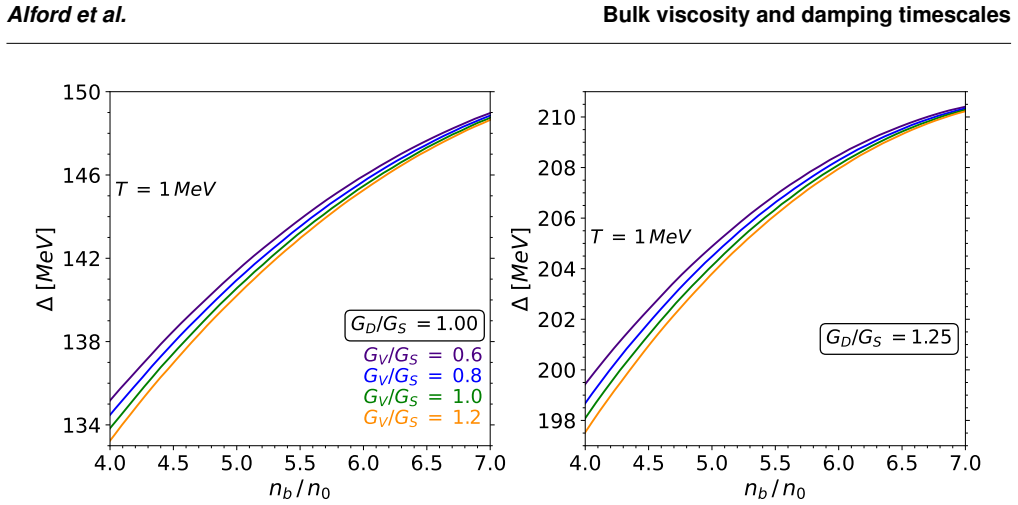
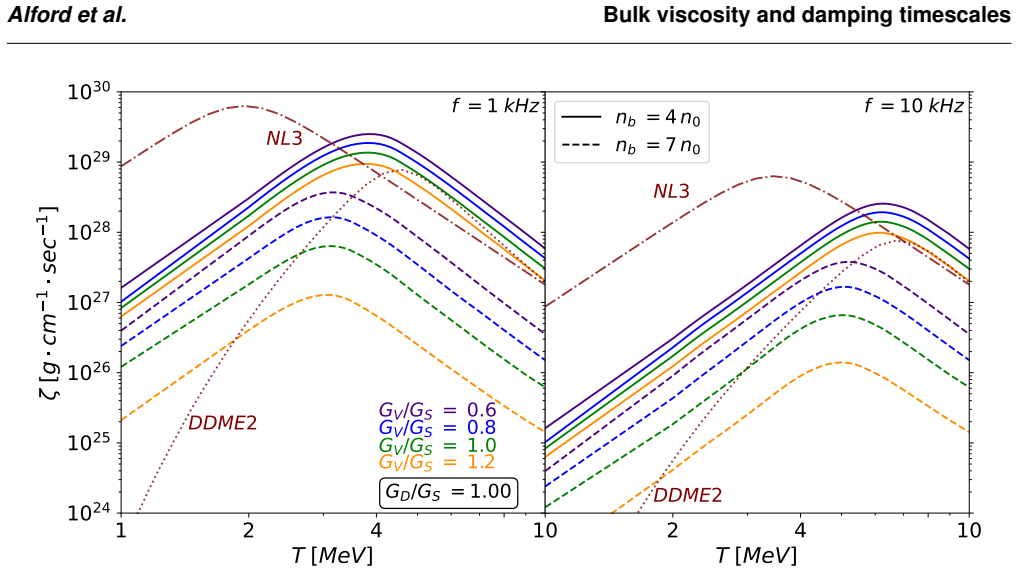
The central claim is that in neutrino-transparent 2SC quark matter the bulk viscosity and its damping timescale are governed by the static susceptibilities of the equation of state rather than by the Urca rates themselves, and that these quantities are strongly sensitive to the vector coupling. Over baryon densities $4n_0$–$7n_0$ and temperatures 1–10 MeV, changing $G_V/G_S$ from 0.6 to 1.2 alters $\zeta$ and $\tau$ by factors of 3 to 20; the paper attributes this primarily to the $\beta$-disequilibrium–baryon-density susceptibility $C$ of Eq. (74), with the modifications to the weak-interaction rates playing a secondary role. Because the 2SC pairing gap far exceeds the temperature, the red and green light quarks are frozen out, and the physics is carried by blue-color up and down quarks together with strange quarks undergoing the direct Urca reactions $d \to u + e^- + \bar{\nu}_e$, $u + e^- \to d + \nu_e$, $s \to u + e^- + \bar{\nu}_e$, and $u + e^- \to s + \nu_e$, with the fast non-leptonic process $u + d \leftrightarrow u + s$ keeping $\mu_d = \mu_s$ at all times. The companion claim is that the resulting bulk viscosity and damping times closely resemble those of neutrino-transparent nucleonic matter, which the authors take to mean that bulk viscous damping will not easily distinguish 2SC quark matter from nuclear matter in merger remnants.
Load-bearing premise
The results assume that neutrinos escape freely from the quark matter at temperatures up to 10 MeV and that the matter is in the 2SC phase with its large pairing gap; if neutrinos were trapped instead, the weak reactions would slow and the bulk viscosity would be significantly smaller, and the paper notes that the onset of trapping depends on the model adopted.
Editorial extensions
If this is right
- Damping timescales of a few milliseconds to a few hundred milliseconds match the short-term evolution of a post-merger remnant, so bulk viscosity from quark Urca processes can be a leading dissipation mechanism in hybrid stars with 2SC cores.
- Over 1–10 MeV, 2SC and nucleonic matter damp density oscillations at nearly the same rate, so a gravitational-wave damping measurement alone is unlikely to reveal whether the remnant contains quark matter.
- Doubling the vector coupling changes $\zeta$ and $\tau$ by factors of 3–20 at $4n_0$–$7n_0$, so the unconstrained $G_V$ sets the dominant model uncertainty in predicting merger dissipation from quark cores.
- The diquark coupling has little effect (at most about a factor of two even at $7n_0$) because the pairing gap far exceeds the temperature and simply removes the red-green quarks from the reactions.
- Below about 0.1 MeV a second, non-leptonic bulk-viscosity peak appears in quark matter that is absent in nuclear matter, offering a low-temperature discriminator between the phases.
Reading between the lines
- A measured post-merger damping timescale at densities near $4n_0$–$7n_0$ could effectively pin down $G_V$, since each value of the vector coupling within $0.6$–$1.2$ times $G_S$ predicts a distinct damping band; conversely, without fixing this coupling, simulations cannot claim predictive dissipation from quark cores.
- Because the vector coupling also shifts the equation-of-state pressure, the same uncertainty should show up in tidal deformability during inspiral, so combining inspiral and post-merger gravitational-wave data could constrain $G_V$ and test the 2SC scenario simultaneously.
- The crossover between the $T^5$ light-quark and $T^4$ strange-quark Urca channels places the bulk-viscosity resonance near $T \approx 3$–$6$ MeV for kHz oscillations; computing bulk viscosity with other quark models (bag models, perturbative or holographic QCD) at these temperatures would test whether that resonance temperature is a robust feature.
Editorial analysis
A structured set of objections, weighed in public.
Referee Report
Summary. This paper computes the bulk viscosity and associated damping timescales of neutrino-transparent two-flavor color-superconducting (2SC) quark matter in neutron star merger conditions, using an SU(3) NJL model with vector and diquark couplings and a 't Hooft term. The authors derive weak-interaction Urca rates for unpaired blue light quarks and strange quarks, construct a linear-response bulk viscosity formula, and scan the ratio G_V/G_S from 0.6 to 1.2 and G_D/G_S from 1 to 1.25. Their main quantitative finding is that varying the vector coupling by a factor of 2 changes the bulk viscosity and damping timescale by a factor of 3-20 at densities 4n0-7n0, and that this sensitivity comes primarily from the static susceptibility C rather than from the weak rates. They also conclude that the bulk viscosity of 2SC quark matter closely resembles that of nucleonic matter, making it difficult to distinguish the two by bulk viscous dissipation alone.
Significance. The paper addresses a timely and observationally relevant question: whether bulk viscous dissipation in a possible quark core of a neutron star merger remnant can leave a distinct imprint on gravitational waves. The bulk-viscosity formalism in Sec. 4 is a clean linear-response construction, with the susceptibilities A and C computed from the model equation of state rather than fitted to the target viscosity. The parametric study of G_V and G_D is systematic, and the comparison with nucleonic-matter results from Ref. [18] provides a useful baseline. If the central numerical results are correct, the finding that 2SC matter is hard to distinguish from nucleonic matter via bulk viscosity is important for interpreting future post-merger observations. The paper is also transparent about its main limitations, notably the neutrino-transparency assumption and the model dependence of competing phases such as gapless 2SC.
major comments (3)
- [Sec. 3, Eqs. (38)-(43)] The manuscript should either verify that the numerical rates satisfy Gamma_{d->u e nu-bar}(0) = Gamma_{u e->d nu}(0) and explain why the forward-rate derivative is negligible, or revise the analytic derivation so that the vanishing of the forward rate is not stated as a general result without noting that it is a singular limit of the massless approximation.
- [Sec. 5.2 and Sec. 6, Eqs. (72)-(74)] Please add a table or figure showing A, C, and C^2/A as functions of n_b for the four values of G_V used in the paper, together with the corresponding gamma at the resonance temperature.
- [Sec. 1 and Sec. 6] Consider adding a caveat to the abstract or conclusions that the quoted damping timescales apply only in the neutrino-transparent temperature/density window assumed throughout.
minor comments (4)
- [Sec. 3, text near Eq. (38)] This will prevent a misreading that the manuscript is claiming a fundamental violation of detailed balance.
- [Fig. 6 caption] The same labels appear in the text and should be defined at first use.
- [Sec. 5.2, paragraph on temperature scaling] This will make the claimed deviation from the T^{-4.5} scaling testable.
- [Eq. (42)] This is a presentation issue but would help the reader track the sign conventions in Eqs. (51) and (72).
Circularity Check
No significant circularity: bulk viscosity is derived from rate equations and EoS susceptibilities, not fitted; headline sensitivity is a parametric scan.
full rationale
The central derivation is self-contained. The bulk viscosity in Eq. (72) follows from the weak-reaction rate equations (53)-(56), with the susceptibility prefactor C^2/A computed from the NJL equation of state (Eqs. (73)-(74)), and the relaxation rate gamma = lambda A built from the computed Urca coefficients lambda_d and lambda_s (Eqs. (42), (45)). No parameter is adjusted to reproduce a target viscosity: the varied couplings G_V and G_D are scanned inputs, so the factor-3-20 sensitivity statement is a parametric variation result, not a prediction tuned to data. The comparison to nucleonic matter from Ref. [18] is an external benchmark, and the methodological reference to Ref. [17] is for integration technique, not a load-bearing unverified premise. The paper's self-citations to [22] and [36] provide context and prior treatment of the same phase, but the present calculation recomputes the rates, susceptibilities, and viscosity rather than importing them as inputs. The possible detailed-balance inconsistency between the vanishing forward rate in Eq. (38) and the nonzero reverse rate in Eq. (41) is a physical correctness concern about the rate coefficient lambda_d, not a circularity: it does not make the output equivalent to an input by definition. Under the hard rules, self-citation without load-bearing reduction to an unverified premise is not circularity, so the appropriate finding is a low score of 1 reflecting only the modest self-citation footprint.
Assumptions & free parameters
free parameters (3)
- GV/GS (vector coupling ratio) =
0.6, 0.8, 1.0, 1.2 (scanned)
- GD/GS (diquark coupling ratio) =
1.0 and 1.25
- B* (effective bag constant) =
0
assumptions (5)
- domain assumption NJL model in mean-field approximation, with parameters fitted to vacuum meson properties (Ref. [64]), describes quark matter at densities 4-7 n0.
- domain assumption Matter is neutrino-transparent for T <= 10 MeV at merger-core densities.
- domain assumption The 2SC phase is realized, with red-green u-d quarks fully gapped (T << Delta), so only blue light quarks and strange quarks of all colors carry the Urca reactions.
- domain assumption The non-leptonic reaction d + u -> s + u maintains mu_s = mu_d instantaneously on kHz timescales, reducing the system to a single out-of-beta-equilibrium variable.
- domain assumption Vector mean fields couple equally to u and d quarks (no isovector channel), giving Delta u = 0; the d-decay rate then vanishes at leading order in the ultrarelativistic limit.
Cite this review
Pith. "Pith review of Bulk Viscosity of Two-Flavor Color Superconducting Quark Matter in Neutron Star Mergers." pith.science (2026). https://pith.science/paper/SW46CTRN
@misc{pith2026250608144,
  author       = {Pith},
  title        = {Pith review of: Bulk Viscosity of Two-Flavor Color Superconducting Quark Matter in Neutron Star Mergers},
  year         = {2026},
  howpublished = {\url{https://pith.science/paper/SW46CTRN}},
  note         = {Machine review of arXiv:2506.08144}
}
read the original abstract
This work investigates the bulk viscosity of warm, dense, neutrino-transparent, color-superconducting quark matter, where damping of density oscillations in the kHz frequency range arises from weak-interaction-driven direct Urca processes involving quarks. We study the two-flavor red-green paired color-superconducting (2SC) phase, while allowing for the presence of unpaired strange quarks and blue color light quarks of all flavors. Our calculations are based on the SU(3) Nambu-Jona-Lasinio (NJL) model, extended to include both vector interactions and the `t Hooft determinant term. The primary focus is on how variations in the NJL Lagrangian parameters -- specifically, the diquark and vector coupling strengths -- affect both the static properties of quark matter, such as its equation of state and composition, and its dynamical behavior, including bulk viscosity and associated damping timescales. We find that the bulk viscosity and corresponding damping timescale can change by more than an order of magnitude upon varying the vector coupling by a factor of two at high densities and by a lesser degree at lower densities. This sensitivity primarily arises from the susceptibility of 2SC matter, with a smaller contribution from modifications to the weak interaction rates. In comparison, changes in the diquark coupling have a more limited impact. The damping of density oscillations in 2SC matter is similar quantitatively to nucleonic matter and can be a leading mechanism of dissipation in merging hybrid stars containing color superconducting cores. -
Figures


Figures from the paper (6 more)



Forward citations
Cited by 1 Pith paper
-
Neutrino absorption in two-flavor color-superconducting quark matter
In 2SC quark matter, neutrino absorption is dominated by strange-quark capture at low temperature, and a degenerate neutrino gas at electron lepton fraction 0.1 has a mean free path of meters or less.
Reference graph
Works this paper leans on
-
[22]
Bulk viscosity of two-color superconducting quark matter in neutron star mergers.Phys
Alford M, Harutyunyan A, Sedrakian A, Tsiopelas S. Bulk viscosity of two-color superconducting quark matter in neutron star mergers.Phys. Rev. D110(2024) L061303. doi:10.1103/PhysRevD.110. L061303
-
[18]
Bulk viscosity from Urca processes: n p e µ matter in the neutrino-transparent regime.Phys
Alford M, Harutyunyan A, Sedrakian A. Bulk viscosity from Urca processes: n p e µ matter in the neutrino-transparent regime.Phys. Rev. D108(2023) 083019. doi:10.1103/PhysRevD.108.083019
-
[1]
Gw170817: Observation of gravitational waves from a binary neutron star inspiral.Phys
The LIGO Scientific Collaboration, The Virgo Collaboration. Gw170817: Observation of gravitational waves from a binary neutron star inspiral.Phys. Rev. Lett.119(2017) 161101. doi:10.1103/ PhysRevLett.119.161101
work page 2017
-
[2]
Binary Neutron Star Mergers.Living Rev
Faber JA, Rasio FA. Binary Neutron Star Mergers.Living Rev. Rel.15(2012) 8. doi:10.12942/ lrr-2012-8
work page 2012
-
[3]
Binary neutron-star mergers: a review of Einstein’s richest laboratory.Rept
Baiotti L, Rezzolla L. Binary neutron-star mergers: a review of Einstein’s richest laboratory.Rept. Prog. Phys.80(2017) 096901. doi:10.1088/1361-6633/aa67bb
-
[4]
Baiotti L. Gravitational waves from neutron star mergers and their relation to the nuclear equation of state.Progress in Particle and Nuclear Physics109(2019) 103714. doi:10.1016/j.ppnp.2019.103714
-
[5]
Identifying a First-Order Phase Transition in Neutron-Star Mergers through Gravitational Waves.Phys
Bauswein A, Bastian NUF, Blaschke DB, Chatziioannou K, Clark JA, Fischer T, et al. Identifying a First-Order Phase Transition in Neutron-Star Mergers through Gravitational Waves.Phys. Rev. Lett. 122(2019) 061102. doi:10.1103/PhysRevLett.122.061102
-
[6]
Radice D, Bernuzzi S. Ab-initio General-relativistic Neutrino-radiation Hydrodynamics Simulations of Long-lived Neutron Star Merger Remnants to Neutrino Cooling Timescales.Astrophys. J.959 (2023) 46. doi:10.3847/1538-4357/ad0235
Show all 74 references
-
[7]
Turbulence modelling in neutron star merger simulations.Liv
Radice D, Hawke I. Turbulence modelling in neutron star merger simulations.Liv. Rev. Comput. Astrophys.10(2024) 1. doi:10.1007/s41115-023-00019-9
2024 doi
-
[8]
Viscous Dissipation and Heat Conduction in Binary Neutron-Star Mergers.Phys
Alford MG, Bovard L, Hanauske M, Rezzolla L, Schwenzer K. Viscous Dissipation and Heat Conduction in Binary Neutron-Star Mergers.Phys. Rev. Lett.120(2018) 041101. doi:10.1103/ PhysRevLett.120.041101
2018
-
[9]
Electrical conductivity of a warm neutron star crust in magnetic fields
Harutyunyan A, Sedrakian A. Electrical conductivity of a warm neutron star crust in magnetic fields. Phys. Rev. C94(2016) 025805. doi:10.1103/PhysRevC.94.025805
2016 doi
-
[10]
Reaction rates and transport in neutron stars.Astrophys
Schmitt A, Shternin P. Reaction rates and transport in neutron stars.Astrophys. Space Sci. Libr .457 (2018) 455–574. doi:10.1007/978-3-319-97616-7 9
2018 doi
-
[11]
Electrical resistivity and Hall effect in binary neutron star mergers.European Physical Journal A54(2018) 191
Harutyunyan A, Nathanail A, Rezzolla L, Sedrakian A. Electrical resistivity and Hall effect in binary neutron star mergers.European Physical Journal A54(2018) 191. doi:10.1140/epja/i2018-12624-1
2018 doi
-
[12]
Thermal Conductivity and Thermal Hall Effect in Dense Electron-Ion Plasma.Particles7(2024) 967–983
Harutyunyan A, Sedrakian A. Thermal Conductivity and Thermal Hall Effect in Dense Electron-Ion Plasma.Particles7(2024) 967–983. doi:10.3390/particles7040059
2024 doi
-
[13]
Electrical conductivity of a warm neutron star crust in magnetic fields: Neutron-drip regime.Phys
Harutyunyan A, Sedrakian A, Gevorgyan NT, Hayrapetyan MV . Electrical conductivity of a warm neutron star crust in magnetic fields: Neutron-drip regime.Phys. Rev. C109(2024) 055804. doi:10. 1103/PhysRevC.109.055804
2024
-
[14]
Damping of density oscillations in neutrino-transparent nuclear matter
Alford MG, Harris SP. Damping of density oscillations in neutrino-transparent nuclear matter. Phys. Rev. C100(2019) 035803. doi:10.1103/PhysRevC.100.035803. Frontiers 25 Alford et al.Bulk viscosity and damping timescales
2019 doi
-
[15]
Bulk Viscous Damping of Density Oscillations in Neutron Star Mergers.Particles3(2020) 500–517
Alford M, Harutyunyan A, Sedrakian A. Bulk Viscous Damping of Density Oscillations in Neutron Star Mergers.Particles3(2020) 500–517. doi:10.3390/particles3020034
2020 doi
-
[16]
Beta Equilibrium Under Neutron Star Merger Conditions
Alford MG, Haber A, Harris SP, Zhang Z. Beta Equilibrium Under Neutron Star Merger Conditions. Universe7(2021) 399. doi:10.3390/universe7110399
2021 doi
-
[17]
Bulk viscosity from Urca processes: npe µ matter in the neutrino-trapped regime.Phys
Alford M, Harutyunyan A, Sedrakian A. Bulk viscosity from Urca processes: npe µ matter in the neutrino-trapped regime.Phys. Rev. D104(2021) 103027. doi:10.1103/PhysRevD.104.103027
2021 doi
-
[19]
Strangeness-changing rates and hyperonic bulk viscosity in neutron star mergers
Alford MG, Haber A. Strangeness-changing rates and hyperonic bulk viscosity in neutron star mergers. Phys. Rev. C103(2021) 045810. doi:10.1103/PhysRevC.103.045810
2021 doi
-
[20]
Estimate for the Bulk Viscosity of Strongly Coupled Quark Matter Using Perturbative QCD and Holography.Phys
Cruz Rojas J, Gorda T, Hoyos C, Jokela N, J ¨arvinen M, Kurkela A, et al. Estimate for the Bulk Viscosity of Strongly Coupled Quark Matter Using Perturbative QCD and Holography.Phys. Rev. Lett. 133(2024) 071901. doi:10.1103/PhysRevLett.133.071901
2024 doi
-
[21]
Damping of density oscillations from bulk viscosity in quark matter.Phys
Hern´andez JL, Manuel C, Tolos L. Damping of density oscillations from bulk viscosity in quark matter.Phys. Rev. D109(2024) 123022. doi:10.1103/PhysRevD.109.123022
2024 doi
-
[23]
Bulk viscosity of baryonic matter with trapped neutrinos
Alford M, Harutyunyan A, Sedrakian A. Bulk viscosity of baryonic matter with trapped neutrinos. Phys. Rev. D100(2019) 103021. doi:10.1103/PhysRevD.100.103021
2019 doi
-
[24]
Projecting the likely importance of weak-interaction-driven bulk viscosity in neutron s tar mergers.Mon
Most ER, Harris SP, Plumberg C, Alford MG, Noronha J, Noronha-Hostler J, et al. Projecting the likely importance of weak-interaction-driven bulk viscosity in neutron s tar mergers.Mon. Not. RAS 509(2022) 1096–1108. doi:10.1093/mnras/stab2793
2022 doi
-
[25]
Formulating bulk viscosity for neutron star simulations.Phys
Celora T, Hawke I, Hammond PC, Andersson N, Comer GL. Formulating bulk viscosity for neutron star simulations.Phys. Rev. D105(2022) 103016. doi:10.1103/PhysRevD.105.103016
2022 doi
-
[26]
Impact of Bulk Viscosity on the Postmerger Gravitational-Wave Signal from Merging Neutron Stars.Phys
Chabanov M, Rezzolla L. Impact of Bulk Viscosity on the Postmerger Gravitational-Wave Signal from Merging Neutron Stars.Phys. Rev. Lett.134(2025) 071402. doi:10.1103/PhysRevLett.134.071402
2025 doi
-
[27]
Numerical modeling of bulk viscosity in neutron stars.Phys
Chabanov M, Rezzolla L. Numerical modeling of bulk viscosity in neutron stars.Phys. Rev. D111 (2025) 044074. doi:10.1103/PhysRevD.111.044074
2025 doi
-
[28]
Thermal aspects of neutron star mergers.Phys
Hammond P, Hawke I, Andersson N. Thermal aspects of neutron star mergers.Phys. Rev. D104 (2021) 103006. doi:10.1103/PhysRevD.104.103006
2021 doi
-
[29]
A new moment-based general-relativistic neutrino-radiation transport code: Methods and first applications to neutron star mergers.Mon
Radice D, Bernuzzi S, Perego A, Haas R. A new moment-based general-relativistic neutrino-radiation transport code: Methods and first applications to neutron star mergers.Mon. Not. RAS512(2022) 1499–1521. doi:10.1093/mnras/stac589
2022 doi
-
[30]
Simulating bulk viscosity in neutron stars
Camelio G, Gavassino L, Antonelli M, Bernuzzi S, Haskell B. Simulating bulk viscosity in neutron stars. I. Formalism.Phys. Rev. D107(2023) 103031. doi:10.1103/PhysRevD.107.103031
2023 doi
-
[32]
Probing internal dissipative processes of neutron stars with gravitational waves during the inspiral of neutron star binaries.Phys
Ripley JL, Hegade K R A, Yunes N. Probing internal dissipative processes of neutron stars with gravitational waves during the inspiral of neutron star binaries.Phys. Rev. D108(2023) 103037. doi:10.1103/PhysRevD.108.103037
2023 doi
-
[33]
Tidal heating in binary inspiral of strange quark stars.arXiv e-prints(2025) arXiv:2504.07659
Ghosh S, Hern´andez JL, Keshari Pradhan B, Manuel C, Chatterjee D, Tolos L. Tidal heating in binary inspiral of strange quark stars.arXiv e-prints(2025) arXiv:2504.07659. doi:10.48550/arXiv.2504. 07659. Frontiers 26 Alford et al.Bulk viscosity and damping timescales
2025 doi
-
[34]
Bulk viscosity of strange quark matter, damping of quark star vibration, and the maximum rotation rate of pulsars.Phys
Madsen J. Bulk viscosity of strange quark matter, damping of quark star vibration, and the maximum rotation rate of pulsars.Phys. Rev. D46(1992) 3290–3295. doi:10.1103/PhysRevD.46.3290
1992 doi
-
[35]
Bulk viscosity in hybrid stars.Phys
Drago A, Lavagno A, Pagliara G. Bulk viscosity in hybrid stars.Phys. Rev. D71(2005) 103004. doi:10.1103/PhysRevD.71.103004
2005 doi
-
[36]
Bulk viscosity in 2SC quark matter.J
Alford MG, Schmitt A. Bulk viscosity in 2SC quark matter.J. Phys.G34(2007) 67–102. doi:10. 1088/0954-3899/34/1/005
2007
-
[37]
Neutrino emissivity and bulk viscosity of iso-CSL quark matter in neutron stars
Blaschke DB, Berdermann J. Neutrino emissivity and bulk viscosity of iso-CSL quark matter in neutron stars. Colangelo P, Creanza D, de Fazio F, Fini RA, Nappi E, editors,QCDatWORK 2007: International Workshop on Quantum Chromodynamics: Theory and Experiment(AIP) (2007), Americ...
2007 doi
-
[38]
Bulk viscosity of spin-one color superconductors with two quark flavors.Phys
Sa’d BA, Shovkovy IA, Rischke DH. Bulk viscosity of spin-one color superconductors with two quark flavors.Phys. Rev. D75(2007) 065016. doi:10.1103/PhysRevD.75.065016
2007 doi
-
[39]
Bulk viscosity of strange quark matter: Urca versus non-leptonic processes.Phys
Sa’d BA, Shovkovy IA, Rischke DH. Bulk viscosity of strange quark matter: Urca versus non-leptonic processes.Phys. Rev. D75(2007) 125004. doi:10.1103/PhysRevD.75.125004
2007 doi
-
[40]
Anisotropic hydrodynamics, bulk viscosities, and r-modes of strange quark stars with strong magnetic fields.Phys
Huang XG, Huang M, Rischke DH, Sedrakian A. Anisotropic hydrodynamics, bulk viscosities, and r-modes of strange quark stars with strong magnetic fields.Phys. Rev. D81(2010) 045015. doi:10.1103/PhysRevD.81.045015
2010 doi
-
[41]
non-leptonic weak processes in spin-one color superconducting quark matter.Phys
Wang X, Malekzadeh H, Shovkovy IA. non-leptonic weak processes in spin-one color superconducting quark matter.Phys. Rev. D81(2010) 045021. doi:10.1103/PhysRevD.81.045021
2010 doi
-
[42]
Bulk viscosity of spin-one color superconducting strange quark matter
Wang X, Shovkovy IA. Bulk viscosity of spin-one color superconducting strange quark matter. Phys. Rev. D82(2010) 085007. doi:10.1103/PhysRevD.82.085007
2010 doi
-
[43]
Neutrino propagation in color superconducting quark matter.Phys
Carter GW, Reddy S. Neutrino propagation in color superconducting quark matter.Phys. Rev. D62 (2000) 103002. doi:10.1103/PhysRevD.62.103002
2000 doi
-
[44]
Diffusion of neutrinos in proto-neutron star matter with quarks
Steiner AW, Prakash M, Lattimer JM. Diffusion of neutrinos in proto-neutron star matter with quarks. Physics Letters B509(2001) 10–18. doi:10.1016/S0370-2693(01)00434-8
2001 doi
-
[45]
Neutrino diffusive transport in hot quark matter: A detailed analysis
Colvero GC, Lugones G. Neutrino diffusive transport in hot quark matter: A detailed analysis. Phys. Rev. C89(2014) 055803. doi:10.1103/PhysRevC.89.055803
2014 doi
-
[46]
Composition and stability of hybrid stars with hyperons and quark color- superconductivity.A&A539(2012) A16
Bonanno L, Sedrakian A. Composition and stability of hybrid stars with hyperons and quark color- superconductivity.A&A539(2012) A16
2012
-
[47]
Quarkyonic matter and neutron stars.Phys
McLerran L, Reddy S. Quarkyonic matter and neutron stars.Phys. Rev. Lett.122(2019) 122701. doi:10.1103/PhysRevLett.122.122701
2019 doi
-
[48]
Treating quarks within neutron stars.Phys
Han S, Mamun MAA, Lalit S, Constantinou C, Prakash M. Treating quarks within neutron stars.Phys. Rev. D100(2019) 103022. doi:10.1103/PhysRevD.100.103022
2019 doi
-
[49]
Holographic quarkyonic matter.Journal of High Energy Physics2020(2020)
Kovensky N, Schmitt A. Holographic quarkyonic matter.Journal of High Energy Physics2020(2020)
2020
- [50]
-
[51]
Momentum shell in quarkyonic matter from explicit duality: A dual model for cold, dense qcd.Phys
Fujimoto Y , Kojo T, McLerran LD. Momentum shell in quarkyonic matter from explicit duality: A dual model for cold, dense qcd.Phys. Rev. Lett.132(2024) 112701. doi:10.1103/PhysRevLett.132.112701
2024 doi
-
[52]
Quark saturation in the qcd phase diagram.Phys
Bluhm M, Fujimoto Y , McLerran L, Nahrgang M. Quark saturation in the qcd phase diagram.Phys. Rev. C111(2025) 044914. doi:10.1103/PhysRevC.111.044914
2025 doi
-
[53]
Inhomogeneous chiral symmetry breaking in dense neutron-star matter
Buballa M, Carignano S. Inhomogeneous chiral symmetry breaking in dense neutron-star matter. European Physical Journal A52(2016) 57. doi:10.1140/epja/i2016-16057-6. Frontiers 27 Alford et al.Bulk viscosity and damping timescales
2016 doi
-
[54]
Brazovskii–dyugaev effect on the inhomogeneous chiral transition in quark matter.Progress of Theoretical and Experimental Physics2016(2016) 043D02
Karasawa S, Lee TG, Tatsumi T. Brazovskii–dyugaev effect on the inhomogeneous chiral transition in quark matter.Progress of Theoretical and Experimental Physics2016(2016) 043D02. doi:10.1093/ ptep/ptw025
2016
-
[55]
Chiral crystallization in an external magnetic background: Chiral spiral versus real kink crystal.Phys
Abuki H. Chiral crystallization in an external magnetic background: Chiral spiral versus real kink crystal.Phys. Rev. D98(2018) 054006. doi:10.1103/PhysRevD.98.054006
2018 doi
-
[56]
Magnetic dual chiral density wave: A candidate quark matter phase for the interior of neutron stars.Universe7(2021)
Ferrer EJ, de la Incera V . Magnetic dual chiral density wave: A candidate quark matter phase for the interior of neutron stars.Universe7(2021). doi:10.3390/universe7120458
2021 doi
-
[57]
Chiral symmetry breaking and phase diagram of dual chiral density wave in a rotating quark matter.Phys
Tabatabaee Mehr SMA. Chiral symmetry breaking and phase diagram of dual chiral density wave in a rotating quark matter.Phys. Rev. D108(2023) 094042. doi:10.1103/PhysRevD.108.094042
2023 doi
-
[58]
New tool to detect inhomogeneous chiral-symmetry breaking.Phys
Motta TF, Bernhardt J, Buballa M, Fischer CS. New tool to detect inhomogeneous chiral-symmetry breaking.Phys. Rev. D111(2025) 074030. doi:10.1103/PhysRevD.111.074030
2025 doi
-
[59]
Chiral transition and U(1)A symmetry restoration from lattice QCD using domain wall fermions.Phys
Bazavov A, Bhattacharya T, Buchoff MI, Cheng M, Christ NH, Ding HT, et al. Chiral transition and U(1)A symmetry restoration from lattice QCD using domain wall fermions.Phys. Rev. D86(2012) 094503. doi:10.1103/PhysRevD.86.094503
2012 doi
-
[60]
Axial U(1) symmetry near the pseudocritical temperature in Nf = 2 + 1 lattice QCD with chiral fermions.PoSLA TTICE2023 (2024) 185
Aoki S, Aoki Y , Fukaya H, Hashimoto S, Kanamori I, Kaneko T, et al. Axial U(1) symmetry near the pseudocritical temperature in Nf = 2 + 1 lattice QCD with chiral fermions.PoSLA TTICE2023 (2024) 185. doi:10.22323/1.453.0185
2024 doi
-
[61]
The role of the ua(1) breaking term in dynamical chiral symmetry breaking of chiral effective theories.Progress of Theoretical and Experimental Physics 2021(2021) 093D02
Kono S, Jido D, Kuroda Y , Harada M. The role of the ua(1) breaking term in dynamical chiral symmetry breaking of chiral effective theories.Progress of Theoretical and Experimental Physics 2021(2021) 093D02. doi:10.1093/ptep/ptab084
2021 doi
-
[62]
Inhomogeneous chiral condensates in three-flavor quark matter.Phys
Carignano S, Buballa M. Inhomogeneous chiral condensates in three-flavor quark matter.Phys. Rev. D101(2020) 014026. doi:10.1103/PhysRevD.101.014026
2020 doi
-
[63]
Impacts of the U (1)A anomaly on nuclear and neutron star equation of state based on a parity doublet model.Phys
Gao B, Minamikawa T, Kojo T, Harada M. Impacts of the U (1)A anomaly on nuclear and neutron star equation of state based on a parity doublet model.Phys. Rev. C106(2022) 065205. doi:10.1103/ PhysRevC.106.065205
2022
-
[64]
Hadronization in the su(3) nambu–jona-lasinio model.Phys
Rehberg P, Klevansky SP, H¨ufner J. Hadronization in the su(3) nambu–jona-lasinio model.Phys. Rev. C53(1996) 410–429. doi:10.1103/PhysRevC.53.410
1996 doi
-
[66]
Color superconductivity in dense quark matter
Alford MG, Schmitt A, Rajagopal K, Sch ¨afer T. Color superconductivity in dense quark matter. Reviews of Modern Physics80(2008) 1455–1515. doi:10.1103/RevModPhys.80.1455
2008 doi
-
[67]
Phase diagram of neutral quark matter: Self-consistent treatment of quark masses.Phys
R¨uster SB, Werth V , Buballa M, Shovkovy IA, Rischke DH. Phase diagram of neutral quark matter: Self-consistent treatment of quark masses.Phys. Rev. D72(2005) 034004. doi:10.1103/PhysRevD. 72.034004
2005 doi
-
[68]
Phase diagram of three-flavor quark matter under compact star constraints.Phys
Blaschke D, Fredriksson S, Grigorian H, ¨Oztas ¸AM, Sandin F. Phase diagram of three-flavor quark matter under compact star constraints.Phys. Rev. D72(2005) 065020. doi:10.1103/PhysRevD.72. 065020
2005 doi
-
[69]
Phase diagram of neutral quark matter in nonlocal chiral quark models.Phys
G´omez Dumm D, Blaschke DB, Grunfeld AG, Scoccola NN. Phase diagram of neutral quark matter in nonlocal chiral quark models.Phys. Rev. D73(2006) 114019. doi:10.1103/PhysRevD.73.114019
2006 doi
-
[70]
Equilibrium composition and neutrino emissivity of interacting quark matter in neutron stars.ApJ267(1983) 358–370
Duncan RC, Shapiro SL, Wasserman I. Equilibrium composition and neutrino emissivity of interacting quark matter in neutron stars.ApJ267(1983) 358–370. doi:10.1086/160875
1983 doi
-
[71]
Neutrino emissivity of interacting quark matter in neutron stars
Duncan RC, Wasserman I, Shapiro SL. Neutrino emissivity of interacting quark matter in neutron stars. II - Finite neutrino momentum effects.ApJ278(1984) 806–812. doi:10.1086/161850. Frontiers 28 Alford et al.Bulk viscosity and damping timescales
1984 doi
-
[72]
Beta Decay in Quark Stars.Phys
Burrows A. Beta Decay in Quark Stars.Phys. Rev. Lett.44(1980) 1640–1643. doi:10.1103/ PhysRevLett.44.1640
1980
-
[73]
Rate of the weak reaction s+u→u+d in quark matter.Phys
Madsen J. Rate of the weak reaction s+u→u+d in quark matter.Phys. Rev. D47(1993) 325–330. doi:10.1103/PhysRevD.47.325
1993 doi
-
[74]
Bulk viscosity of neutron-star matter.Phys
Jones PB. Bulk viscosity of neutron-star matter.Phys. Rev. D64(2001) 084003. doi:10.1103/ PhysRevD.64.084003
2001
-
[75]
Direct Urca neutrino rate in color superconducting quark matter.Phys
Jaikumar P, Roberts CD, Sedrakian A. Direct Urca neutrino rate in color superconducting quark matter.Phys. Rev. C73(2006) 042801. doi:10.1103/PhysRevC.73.042801. Frontiers 29
2006 doi
-
[112]
doi:10.1007/JHEP09(2020)112
2020 doi
Reviewed August 7, 2026 · model on record in the stance chip above.
Discussion (0). Sign in to comment.