REVIEW 2 major objections 4 minor 3 cited by
Lattice study of correlators of chromoelectric fields for heavy quarkonium dynamics in the quark-gluon plasma
T0 review · 2 major / 4 minor · reviewed 2026-08-07 · deepseek-v4-flash
Pith's one-line read For the first time on the lattice, the adjoint chromoelectric correlators that control quarkonium transport are shown to be Casimir rescalings of the fundamental chromoelectric correlator.
desk verdict First lattice calculation of adjoint chromoelectric correlators with a clean Casimir-scaling result; the main caveat is the assumed linear zero-flow-time extrapolation for the adjoint correlators. read the letter →
The pith
A machine-rendered reading of the paper's core claim, the machinery that carries it, and where it could break.
The reading
What carries the argument
The central objects are Euclidean correlators of two chromoelectric fields connected by adjoint temporal Wilson lines: $G_E$ for singlet-octet transitions, $G_E^{\rm oct}$ for octet-octet transitions, and $G_E^{\rm sym}$ for the diffusion of an adjoint heavy color source. The load-bearing identity is the leading-order proportionality of the adjoint correlators to the fundamental chromoelectric correlator with Casimir coefficients, and the paper tests whether that proportionality survives nonperturbatively, finding that it does. The calculational machinery is gradient flow for noise reduction and renormalization, tree-level improvement against the leading-order $f(\tau)$, a continuum extrapolation linear in $1/N_\tau^2$, and a zero-flow-time extrapolation assumed linear in the flow time.
What would settle it
Repeat the measurement at a third temperature with fixed $\sqrt{8\tau_F}/\tau$ values extending to smaller flow time and include a quadratic term in $\tau_F$ in the zero-flow-time fit; if the extrapolated ratio $G_E^{\rm oct}/G_E^{\rm fund}$ leaves $5/4$ (or $G_E^{\rm sym}/G_E^{\rm fund}$ leaves $C_A/C_F$) by more than the quoted errors, the Casimir-scaling claim fails.
Extended reading notes
Core claim
The paper's central claim is that nonperturbative adjoint chromoelectric correlators obey the same Casimir proportionality that holds at leading order. After continuum and zero-flow-time extrapolations, $G_E^{\rm oct}(\tau) = (5/4)\,G_E^{\rm fund}(\tau)$ and $G_E^{\rm sym}(\tau) = (C_A/C_F)\,G_E^{\rm fund}(\tau)$ within errors at both temperatures. The paper reads this as evidence that the adjoint correlators carry no new shape information beyond the fundamental correlator, so quarkonium transport coefficients from these channels are fixed color rescalings of the heavy-quark momentum diffusion coefficient. For the non-symmetric correlator $G_E$, the paper establishes a practical renormalization by removing the adjoint Wilson-line divergence through the Polyakov-loop matching and checks the result with a multilevel calculation and with next-to-leading-order perturbation theory at $T=10^4 T_c$.
Load-bearing premise
The zero-flow-time extrapolation assumes a linear dependence of the adjoint correlators on the flow time, a behavior verified for the fundamental correlator at next-to-leading order but not calculated here for the adjoint correlators; a nonlinear flow-time shape in the extrapolation window would shift the renormalized correlators and the claimed Casimir ratios.
Editorial extensions
If this is right
- Once the fundamental heavy-quark momentum diffusion coefficient is known, the octet and adjoint quarkonium diffusion coefficients follow from $\kappa^{\rm oct} = \frac{5}{4}\,\kappa^{\rm fund}$ and $\kappa^{\rm sym} = \frac{C_A}{C_F}\,\kappa^{\rm fund}$, with no separate spectral-function analysis for the adjoint channels.
- Lattice computations of quarkonium transport need only produce the fundamental chromoelectric correlator; the symmetric adjoint channels add no independent shape information.
- At $10^4 T_c$ the adjoint correlators agree with next-to-leading-order perturbation theory, which validates the renormalization and extrapolation procedures in the high-temperature regime.
- The Polyakov-loop matching that removes the adjoint Wilson-line divergence gives a recipe for renormalizing other finite-temperature Wilson-line correlators.
Reading between the lines
- Testable extension: the same comparison at $SU(N_c)$ with $N_c>3$ or with dynamical fermions would tell whether the Casimir proportionality is a general color-algebra fact or an accident of the quenched SU(3) ensembles studied.
- A next-to-leading-order computation of the adjoint correlators' flow-time dependence would replace the assumed linear zero-flow-time extrapolation with a calculated shape; until then the paper's extrapolation rests on an analogy with the fundamental correlator.
- The residual normalization offset between gradient-flow and multilevel results for $G_E$ (about $0.74$ at $1.5 T_c$ and $0.90$ at $10^4 T_c$) points to the missing nonperturbative renormalization constant of the electric field in the multilevel scheme; computing that constant would remove the last free scale in the cross-check.
- If the proportionality persists, the open-quantum-system equations used for quarkonium suppression in heavy-ion collisions could be driven by a single independent diffusion input, simplifying the phenomenology.
Editorial analysis
A structured set of objections, weighed in public.
Referee Report
Summary. This paper presents the first lattice calculation of adjoint-representation chromoelectric correlators in quenched SU(3) gauge theory at T = 1.5 Tc and T = 10^4 Tc. The correlators G_E, G_oct, and G_sym are computed using gradient flow for noise reduction and renormalization, supplemented by multilevel calculations for G_E. The main claim is that after continuum and zero-flow-time extrapolations, G_oct and G_sym are proportional to the previously computed fundamental chromoelectric correlator G_fund, with the leading-order Casimir ratios 5/4 and C_A/C_F respectively. The non-symmetric correlator G_E is renormalized by matching the flowed adjoint Polyakov loop to its renormalized value and is compared with NLO perturbation theory at high temperature.
Significance. If the central claim holds, the paper provides the first nonperturbative determination of the adjoint chromoelectric correlators needed for quarkonium transport, and it implies that the octet quarkonium and adjoint heavy-quark diffusion coefficients are simple rescalings of the fundamental heavy-quark diffusion coefficient. The paper has genuine strengths: the LO Casimir ratios are derived analytically and are not fitted to the lattice data; the continuum extrapolation systematics are studied with several ansatze; tree-level improvement is applied; and the renormalization of G_E through the Polyakov loop is a useful new ingredient. The main weakness is that the zero-flow-time extrapolation of the adjoint correlators is assumed linear without a dedicated adjoint calculation or a quantitative sensitivity study, and the proportionality claim is supported only by visual comparison rather than a statistical test of the ratio.
major comments (2)
- [Section IV A, zero-flow-time extrapolation and Figs. 3-4] The central Casimir-scaling claim rests on a linear ansatz in the flow time tau_F for G_oct and G_sym. The only justification given is that the fundamental correlator behaves linearly at NLO and that "it is plausible to assume a similar behavior in tau_F." Since the adjoint correlators have different color contractions and Wilson-line self-energy structures, their leading flow-time dependence need not be proportional to f(tau). If the adjoint slopes are not proportional to f(tau), the zero-flow-time extrapolation introduces a tau-dependent shift, and the apparent proportionality in Fig. 4 could be an extrapolation artifact. The authors should either provide an adjoint NLO flow-time calculation or quantify the systematic uncertainty by varying the fit ansatz and the tau_F window and showing that the extracted ratios remain consistent within errors.
- [Section IV A, Fig. 4] The conclusion that G_oct = (5/4) G_fund and G_sym = (C_A/C_F) G_fund nonperturbatively is based on visual overlap of separately extrapolated correlators. Because G_fund and the adjoint correlators are measured on the same configurations, a quantitative test of the ratio with propagated correlations should be provided, for example a fit of the ratio R_oct(tau) = G_oct(tau)/G_fund(tau) to a constant with a reported chi^2. As it stands, the comparison after independent extrapolations cannot distinguish a true constant ratio from a flow-time extrapolation artifact.
minor comments (4)
- [Section II A, Eq. (4)] The summation in Eq. (4) is written as 3X i=3, which appears to be a typo for i=1; please correct it.
- [Section IV A, concluding paragraph] The sentence "All three correlators have the same shape at both temperatures" is overbroad because G_E is not compared with G_fund in Fig. 4. Please clarify that the statement applies to G_oct and G_sym, or provide the analogous comparison for G_E.
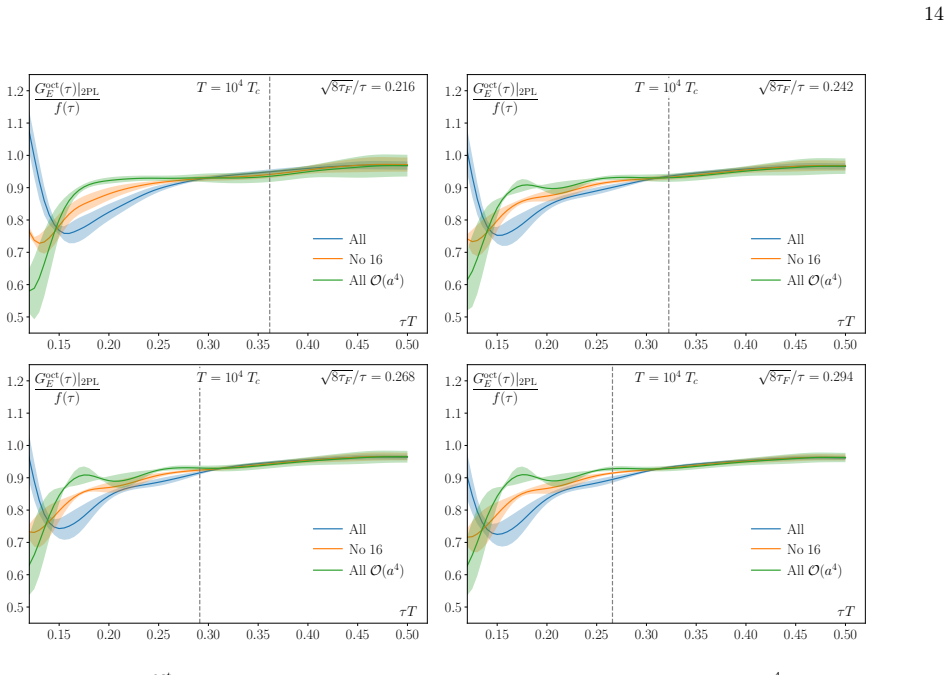
- [Section IV B and Fig. 8] The multilevel comparison for G_E requires overall normalization constants 0.74 at 1.5 Tc and 0.90 at 10^4 Tc. This is attributed to tadpole renormalization, but the uncertainty of this normalization is not propagated into any extracted quantity; a brief statement on how this affects the quoted G_E results would be useful.
- [Throughout] There are several minor typographical issues, including "the gluon fiels" in the Introduction, a missing space in "withN= 3for SU(3)" after Eq. (31), and inconsistent placement of the reference marker in the caption of Fig. 20. A careful proofread is recommended.
Circularity Check
No significant circularity: the adjoint-correlator results are independent lattice measurements compared with analytically derived LO Casimir ratios, and the linear zero-flow-time ansatz is a stated systematic assumption, not a circular reduction.
full rationale
The paper's central claim is that the adjoint chromoelectric correlators Goct and Gsym have the same nonperturbative shape as the fundamental correlator Gfund, with the ratios fixed by the leading-order Casimir factors. The proportionality constants in Eqs. (29)-(31) are obtained analytically from the definitions of the correlators using Fierz identities, with no free parameters fitted to the lattice data. The nonperturbative statement is an empirical comparison between independently measured lattice correlators: Goct and Gsym are computed here with gradient flow and multi-level methods, followed by continuum and zero-flow-time extrapolations, and then compared with Gfund taken from Ref. [27], a separate lattice calculation. No parameter is adjusted to enforce the scaling; the tree-level improvement in Eq. (32) removes lattice artifacts using the known tree-level lattice correlator and cannot imprint the continuum shape f(tau) onto the nonperturbative data. The zero-flow-time extrapolation assumes linearity for the adjoint correlators based on the NLO behavior of the fundamental correlator in Ref. [42]; this is acknowledged in the text as a plausible assumption rather than a derived result, and it is a systematic uncertainty, not a reduction of the conclusion to its inputs by construction. The renormalization of the non-symmetric correlator uses the renormalized Polyakov loop from Ref. [43], and the NLO comparison at high temperature uses Ref. [44]; both are external inputs or cross-checks rather than premises that logically force the Casimir-scaling conclusion. Self-citations to Ref. [27] and Ref. [44] exist, but those cited results are independently published, externally falsifiable lattice and perturbative calculations, and they are not used to define the measured adjoint correlators into existence. Therefore the derivation chain is self-contained for the central claim, and no circular step is exhibited.
Assumptions & free parameters
free parameters (2)
- Multilevel comparison normalization constant at T=1.5 T_c =
0.74
- Multilevel comparison normalization constant at T=10^4 T_c =
0.90
assumptions (5)
- domain assumption Gradient flow renormalizes chromoelectric field insertions, so taking the zero-flow-time limit after continuum extrapolation yields the renormalized continuum correlator.
- ad hoc to paper The adjoint correlators G_E^oct, G_E^sym, and G_E depend linearly on flow time tau_F in the extrapolation window.
- domain assumption The Wilson line divergence in G_E is e^(delta m tau), with delta m extracted from the adjoint Polyakov loop through L8^r = e^(delta m/T) L8(tau_F).
- domain assumption Quenched SU(3) gauge theory captures the relevant physics for quarkonium dynamics in the deconfined medium.
- domain assumption The fundamental correlator G_E^fund from Ref. [27] is a valid external benchmark for the Casimir scaling comparison.
Cite this review
Pith. "Pith review of Lattice study of correlators of chromoelectric fields for heavy quarkonium dynamics in the quark-gluon plasma." pith.science (2026). https://pith.science/paper/TFYOT7KL
@misc{pith2026250516603,
  author       = {Pith},
  title        = {Pith review of: Lattice study of correlators of chromoelectric fields for heavy quarkonium dynamics in the quark-gluon plasma},
  year         = {2026},
  howpublished = {\url{https://pith.science/paper/TFYOT7KL}},
  note         = {Machine review of arXiv:2505.16603}
}
read the original abstract
We perform a lattice calculation of the correlators of two chromoelectric fields in the adjoint representation connected by adjoint Wilson lines at non-zero temperature. These correlators arise in the study of quarkonium dynamics and of adjoint heavy quark diffusion in deconfined matter. We work in SU(3) gauge theory using either gradient flow or multi-level algorithms for noise reduction, and discuss the renormalization of the correlators on the lattice. We find that a Casimir factor rescaling relates the adjoint correlators corresponding to the diffusion of an adjoint heavy quark and the octet-octet quarkonium transitions to the chromoelectric correlator in the fundamental representation describing the diffusion of a heavy quark.
Figures


Figures from the paper (13 more)




Forward citations
Cited by 3 Pith papers
-
Lattice study of spin interactions between heavy quarks in the quark-gluon plasma
The spin-dependent heavy-quark potential in the quark-gluon plasma is complex, with a channel-dependent imaginary part first extracted from lattice QCD.
-
Lattice study of correlators for quarkonium decay
Lattice QCD results show the color electric correlator relevant for quarkonium decay is not symmetric about τT=1/2 and agrees with NLO perturbation theory at T=10^4 Tc.
-
Adjoint chromoelectric correlators for heavy quarkonium diffusion
First lattice measurement of adjoint chromoelectric correlators shows they scale with the fundamental heavy-quark diffusion correlator by the perturbative factors 5/4 and 9/4.
Reference graph
Works this paper leans on
-
[1]
J/ψSuppression by Quark- Gluon Plasma Formation,
T. Matsui and H. Satz, “J/ψSuppression by Quark- Gluon Plasma Formation,” Phys. Lett. B178, 416–422 (1986)
work page 1986
-
[2]
Heavy-flavor production and medium properties in high-energy nuclear collisions - What next?
G. Aartset al., “Heavy-flavor production and medium properties in high-energy nuclear collisions - What next?” Eur.Phys.J.A53,93(2017),arXiv:1612.08032[nucl-th]
arXiv 2017
-
[3]
Heavy flavors under extreme conditions in high energy nuclear collisions,
Jiaxing Zhao, Kai Zhou, Shile Chen, and Pengfei Zhuang, “Heavy flavors under extreme conditions in high energy nuclear collisions,” Prog. Part. Nucl. Phys.114, 103801 (2020), arXiv:2005.08277 [nucl-th]
arXiv 2020
-
[4]
Comparative study of quarkonium transport in hot QCD matter,
A. Andronicet al., “Comparative study of quarkonium transport in hot QCD matter,” Eur. Phys. J. A60, 88 (2024), arXiv:2402.04366 [nucl-th]
arXiv 2024
-
[5]
QCD and Strongly Coupled Gauge Theories: Challenges and Perspectives,
N. Brambillaet al., “QCD and Strongly Coupled Gauge Theories: Challenges and Perspectives,” Eur. Phys. J. C 74, 2981 (2014), arXiv:1404.3723 [hep-ph]
arXiv 2014
-
[6]
Effective Field Theories for Heavy Quarko- nium,
Nora Brambilla, Antonio Pineda, Joan Soto, and Anto- nio Vairo, “Effective Field Theories for Heavy Quarko- nium,” Rev. Mod. Phys.77, 1423 (2005), arXiv:hep- ph/0410047
-
[7]
Static quark-antiquark pairs at fi- nite temperature,
Nora Brambilla, Jacopo Ghiglieri, Antonio Vairo, and Peter Petreczky, “Static quark-antiquark pairs at fi- nite temperature,” Phys. Rev. D78, 014017 (2008), arXiv:0804.0993 [hep-ph]
arXiv 2008
-
[8]
Heavy Quarkonium in a weakly-coupled quark-gluon plasma below the melting temperature
Nora Brambilla, Miguel Angel Escobedo, Jacopo Ghiglieri, Joan Soto, and Antonio Vairo, “Heavy Quarkonium in a weakly-coupled quark-gluon plasma be- low the melting temperature,” JHEP09, 038 (2010), arXiv:1007.4156 [hep-ph]
work page Pith review arXiv 2010
Show all 49 references
-
[9]
Non- relativistic bound states at finite temperature (II): the muonic hydrogen,
Miguel Angel Escobedo and Joan Soto, “Non- relativistic bound states at finite temperature (II): the muonic hydrogen,” Phys. Rev. A82, 042506 (2010), arXiv:1008.0254 [hep-ph]
2010 arXiv
-
[10]
Thermal quarkonium mass shift from Eu- clidean correlators,
Alexander M. Eller, Jacopo Ghiglieri, and Guy D. Moore, “Thermal quarkonium mass shift from Eu- clidean correlators,” Phys. Rev.D99, 094042 (2019), arXiv:1903.08064 [hep-ph]
2019 arXiv
-
[11]
Quarkonium suppression in heavy-ion collisions: an open quantum system approach,
Nora Brambilla, Miguel A. Escobedo, Joan Soto, and Antonio Vairo, “Quarkonium suppression in heavy-ion collisions: an open quantum system approach,” Phys. Rev.D96, 034021 (2017), arXiv:1612.07248 [hep-ph]
2017 arXiv
-
[12]
Heavy quarkonium suppression in a fire- ball,
Nora Brambilla, Miguel A. Escobedo, Joan Soto, and Antonio Vairo, “Heavy quarkonium suppression in a fire- ball,” Phys. Rev.D97, 074009 (2018), arXiv:1711.04515 [hep-ph]
2018 arXiv
-
[13]
Transport coefficients from in medium quarkonium dynamics,
Nora Brambilla, Miguel A. Escobedo, Antonio Vairo, and Peter Vander Griend, “Transport coefficients from in medium quarkonium dynamics,” Phys. Rev.D100, 054025 (2019), arXiv:1903.08063 [hep-ph]
2019 arXiv
-
[14]
Quarkonium Semi- classical Transport in Quark-Gluon Plasma: Factoriza- tion and Quantum Correction,
Xiaojun Yao and Thomas Mehen, “Quarkonium Semi- classical Transport in Quark-Gluon Plasma: Factoriza- tion and Quantum Correction,” JHEP02, 062 (2021), arXiv:2009.02408 [hep-ph]
2021 arXiv
-
[15]
Real time quarkonium transport coefficients in open quantum sys- tems from Euclidean QCD,
Bruno Scheihing-Hitschfeld and Xiaojun Yao, “Real time quarkonium transport coefficients in open quantum sys- tems from Euclidean QCD,” Phys. Rev. D108, 054024 (2023), [Erratum: Phys.Rev.D 109, 099902 (2024)], arXiv:2306.13127 [hep-ph]
2023 arXiv
-
[16]
Non-Abelian electric field correlator at NLO for dark matter relic abun- dance and quarkonium transport,
Tobias Binder, Kyohei Mukaida, Bruno Scheihing- Hitschfeld, and Xiaojun Yao, “Non-Abelian electric field correlator at NLO for dark matter relic abun- dance and quarkonium transport,” JHEP01, 137 (2022), arXiv:2107.03945 [hep-ph]
2022 arXiv
-
[17]
Bottomonium suppression from the three-loop QCD potential,
Nora Brambilla, Tom Magorsch, Michael Strickland, An- tonio Vairo, and Peter Vander Griend, “Bottomonium suppression from the three-loop QCD potential,” Phys. Rev. D109, 114016 (2024), arXiv:2403.15545 [hep-ph]
2024 arXiv
-
[18]
Heavy quarkonium dynamics at next-to-leading order in the binding energy over temper- ature,
Nora Brambilla, Miguel Ángel Escobedo, Ajaharul Islam, Michael Strickland, Anurag Tiwari, Antonio Vairo, and Peter Vander Griend, “Heavy quarkonium dynamics at next-to-leading order in the binding energy over temper- ature,” JHEP08, 303 (2022), arXiv:2205.10289 [hep-ph]
2022
-
[19]
Quarkonium propagation in the quark–gluon plasma,
Rishi Sharma, “Quarkonium propagation in the quark–gluon plasma,” Eur. Phys. J. ST230, 697–718 (2021), arXiv:2101.04268 [hep-ph]
2021 arXiv
-
[20]
Properties and uses of the Wilson flow in lattice QCD,
Martin Lüscher, “Properties and uses of the Wilson flow in lattice QCD,” JHEP08, 071 (2010), [Erratum: JHEP 03, 092 (2014)], arXiv:1006.4518 [hep-lat]
2010 arXiv
-
[21]
Locality and exponen- tial error reduction in numerical lattice gauge theory,
Martin Lüscher and Peter Weisz, “Locality and exponen- tial error reduction in numerical lattice gauge theory,” JHEP09, 010 (2001), arXiv:hep-lat/0108014 [hep-lat]
2001 arXiv
-
[22]
Hadrons with a heavy color adjoint particle,
M. Foster and C. Michael (UKQCD), “Hadrons with a heavy color adjoint particle,” Phys. Rev. D59, 094509 (1999), arXiv:hep-lat/9811010
1999 arXiv
-
[23]
Heavy Quark Momentum Diffusion Coefficient from Lattice QCD,
Debasish Banerjee, Saumen Datta, Rajiv Gavai, and Pushan Majumdar, “Heavy Quark Momentum Diffusion Coefficient from Lattice QCD,” Phys. Rev.D85, 014510 (2012), arXiv:1109.5738 [hep-lat]
2012 arXiv
-
[24]
Nonperturbative estimate of the heavy quark momentum diffusion coefficient,
A. Francis, O. Kaczmarek, M. Laine, T. Neuhaus, and H. Ohno, “Nonperturbative estimate of the heavy quark momentum diffusion coefficient,” Phys. Rev.D92, 116003 (2015), arXiv:1508.04543 [hep-lat]
2015 arXiv
-
[25]
Lattice QCD constraints on the heavy quark diffusion coefficient,
Nora Brambilla, Viljami Leino, Peter Petreczky, and Antonio Vairo, “Lattice QCD constraints on the heavy quark diffusion coefficient,” Phys. Rev. D102, 074503 (2020), arXiv:2007.10078 [hep-lat]
2020 arXiv
-
[26]
Heavy quark momentum diffusion from the lattice us- ing gradient flow,
Luis Altenkort, Alexander M. Eller, Olaf Kaczmarek, Lukas Mazur, Guy D. Moore, and Hai-Tao Shu, “Heavy quark momentum diffusion from the lattice us- ing gradient flow,” Phys. Rev. D103, 014511 (2021), arXiv:2009.13553 [hep-lat]
2021 arXiv
-
[27]
Heavy quark diffu- sion coefficient with gradient flow,
Nora Brambilla, Viljami Leino, Julian Mayer-Steudte, and Peter Petreczky (TUMQCD), “Heavy quark diffu- sion coefficient with gradient flow,” Phys. Rev. D107, 054508 (2023), arXiv:2206.02861 [hep-lat]
2023 arXiv
-
[28]
Heavy Quark Diffusion from 2+1 Flavor Lattice QCD with 320 MeV Pion Mass,
Luis Altenkort, Olaf Kaczmarek, Rasmus Larsen, Swa- gato Mukherjee, Peter Petreczky, Hai-Tao Shu, and Simon Stendebach (HotQCD), “Heavy Quark Diffusion from 2+1 Flavor Lattice QCD with 320 MeV Pion Mass,” Phys. Rev. Lett.130, 231902 (2023), arXiv:2302.08501 [hep-lat]
2023 arXiv
-
[29]
Heavy quark diffusion in strongly coupled N=4 Yang-Mills,
Jorge Casalderrey-Solana and Derek Teaney, “Heavy quark diffusion in strongly coupled N=4 Yang-Mills,” Phys. Rev. D74, 085012 (2006), arXiv:hep-ph/0605199
2006 arXiv
-
[30]
A Way to estimate the heavy quark thermalization rate from the lattice,
Simon Caron-Huot, Mikko Laine, and Guy D. Moore, “A Way to estimate the heavy quark thermalization rate from the lattice,” JHEP04, 053 (2009), arXiv:0901.1195 [hep-lat]
2009 arXiv
-
[31]
Anatomy of quarkonium transport coeffi- cients,
Nora Brambilla, Miguel Angel Escobedo, Ajaharul Is- lam, Michael Strickland, Antonio Vairo, and Peter Van- der Griend, “Anatomy of quarkonium transport coeffi- cients,” TUM-EFT 191/24, FERMILAB-PUB-24-0451- 19 T
-
[32]
Highly improved lattice field strength tensor,
Sundance O. Bilson-Thompson, Derek B. Leinweber, and Anthony G. Williams, “Highly improved lattice field strength tensor,” Annals Phys.304, 1–21 (2003), arXiv:hep-lat/0203008
2003 arXiv
-
[33]
Infinite N phase tran- sitions in continuum Wilson loop operators,
R. Narayanan and H. Neuberger, “Infinite N phase tran- sitions in continuum Wilson loop operators,” JHEP03, 064 (2006), arXiv:hep-th/0601210
2006 arXiv
-
[34]
Trivializing maps, the Wilson flow and the HMC algorithm,
Martin Lüscher, “Trivializing maps, the Wilson flow and the HMC algorithm,” Commun. Math. Phys.293, 899– 919 (2010), arXiv:0907.5491 [hep-lat]
2010 arXiv
-
[35]
Static force from generalized Wil- son loops on the lattice using the gradient flow,
Nora Brambilla, Viljami Leino, Julian Mayer-Steudte, and Antonio Vairo, “Static force from generalized Wil- son loops on the lattice using the gradient flow,” Phys. Rev. D109, 114517 (2024), arXiv:2312.17231 [hep-lat]
2024 arXiv
-
[36]
Perturbative analysis of the gradient flow in non-abelian gauge theories,
Martin Lüscher and Peter Weisz, “Perturbative analysis of the gradient flow in non-abelian gauge theories,” JHEP 02, 051 (2011), arXiv:1101.0963 [hep-th]
2011 arXiv
-
[37]
http://physics.utah.edu/∼detar/milc.html,
“http://physics.utah.edu/∼detar/milc.html,”
-
[38]
Confinement of Quarks,
Kenneth G. Wilson, “Confinement of Quarks,” Phys. Rev. D10, 2445–2459 (1974)
1974
-
[39]
Critical point and scale setting in SU(3) plasma: An update,
A. Francis, O. Kaczmarek, M. Laine, T. Neuhaus, and H. Ohno, “Critical point and scale setting in SU(3) plasma: An update,” Phys. Rev.D91, 096002 (2015), arXiv:1503.05652 [hep-lat]
2015 arXiv
-
[40]
The gradient flow coupling in the Schrödinger Functional,
Patrick Fritzsch and Alberto Ramos, “The gradient flow coupling in the Schrödinger Functional,” JHEP10, 008 (2013), arXiv:1301.4388 [hep-lat]
2013 arXiv
-
[41]
Efficient integra- tion of gradient flow in lattice gauge theory and proper- ties of low-storage commutator-free Lie group methods,
Alexei Bazavov and Thomas Chuna, “Efficient integra- tion of gradient flow in lattice gauge theory and proper- ties of low-storage commutator-free Lie group methods,” (2021), arXiv:2101.05320 [hep-lat]
2021 arXiv
-
[42]
QCD field-strength correlators on a Polyakov loop with gradient flow at next-to-leading order,
David de la Cruz, Alexander M. Eller, and Guy D. Moore, “QCD field-strength correlators on a Polyakov loop with gradient flow at next-to-leading order,” Phys. Rev. D110, 094057 (2024), arXiv:2410.01578 [hep-ph]
2024 arXiv
-
[43]
Renormalized Polyakov loops in many representations,
Sourendu Gupta, Kay Huebner, and Olaf Kaczmarek, “Renormalized Polyakov loops in many representations,” Phys. Rev. D77, 034503 (2008), arXiv:0711.2251 [hep- lat]
2008 arXiv
-
[44]
The chromolectric adjoint correlators in Euclidean space to next-to-leading order,
Nora Brambilla, Panayiotis Panayiotou, Saga Säppi, and Antonio Vairo, “The chromolectric adjoint correlators in Euclidean space to next-to-leading order,” TUM-EFT 190/24
-
[45]
New predictions for inclu- sive heavy quarkonium P wave decays,
Nora Brambilla, Dolors Eiras, Antonio Pineda, Joan Soto, and Antonio Vairo, “New predictions for inclu- sive heavy quarkonium P wave decays,” Phys. Rev. Lett. 88, 012003 (2002), arXiv:hep-ph/0109130
2002 arXiv
-
[46]
Inclusive decays of heavy quarkonium to light particles,
Nora Brambilla, Dolors Eiras, Antonio Pineda, Joan Soto, and Antonio Vairo, “Inclusive decays of heavy quarkonium to light particles,” Phys. Rev. D67, 034018 (2003), arXiv:hep-ph/0208019
2003 arXiv
-
[47]
Decay and electromagnetic production of strongly coupled quarkonia in pNRQCD,
Nora Brambilla, Hee Sok Chung, Daniel Müller, and Antonio Vairo, “Decay and electromagnetic production of strongly coupled quarkonia in pNRQCD,” JHEP04, 095 (2020), arXiv:2002.07462 [hep-ph]
2020 arXiv
-
[48]
Symmetries of baryons and mesons,
Murray Gell-Mann, “Symmetries of baryons and mesons,” Phys. Rev.125, 1067–1084 (1962)
1962
-
[49]
Computation of the relation between the bare lattice coupling and the MS coupling in SU(N) gauge theories to two loops,
Martin Lüscher and Peter Weisz, “Computation of the relation between the bare lattice coupling and the MS coupling in SU(N) gauge theories to two loops,” Nucl. Phys. B452, 234–260 (1995), arXiv:hep-lat/9505011
1995 arXiv
Reviewed August 7, 2026 · model on record in the stance chip above.
Discussion (0). Sign in to comment.