REVIEW 5 major objections 3 minor 76 references
Machine learning orbital-free density functional theory: taming quantum shell effects in deformed nuclei
T0 review · 5 major / 3 minor · reviewed 2026-08-10 · deepseek-v4-flash
Pith's one-line read A kernel-ridge-regression orbital-free functional reproduces the deformed ground state and potential energy curve of 20Ne.
desk verdict A credible proof-of-principle that an ML-trained orbital-free EDF can reproduce deformed minima in light nuclei; the main caveats are the narrow test set and the untested derivative. read the letter →
The pith
A machine-rendered reading of the paper's core claim, the machinery that carries it, and where it could break.
The reading
What carries the argument
The engine of the construction is the kernel ridge regression map from density to kinetic-plus-spin-orbit energy, $E^\mathrm{ML}_{\mathrm{kin+so}}[\rho]=\sum_i \omega_i K(\rho_i,\rho)$, where $K$ is a Gaussian kernel with width $\sigma$ and the weights solve $\boldsymbol{\omega}=(K+\lambda I)^{-1}\mathbf{E}$. Its functional derivative with respect to the density provides the gradient for self-consistent minimization, so the Kohn-Sham orbitals are bypassed entirely. The density is represented on an axial grid of 1128 discrete points, and the training densities are generated by solving Schrödinger equations with random spherical and quadrupole external potentials plus a spin-orbit potential built from a preliminary density. Together with the density-dependent Skyrme interaction (SkP), the learned term forms the total orbital-free functional, and constrained runs add an augmented-Lagrangian penalty to hold the quadrupole moment while tracing potential energy curves.
What would settle it
Train or reuse the same construction on a deformed nucleus outside the training pair, such as 24Mg, and compare the self-consistent $\beta_2$ and potential energy curve with Kohn-Sham results. A disagreement in the deformed minimum would show that the random-potential training family does not cover the densities that real nuclei produce.
Extended reading notes
Core claim
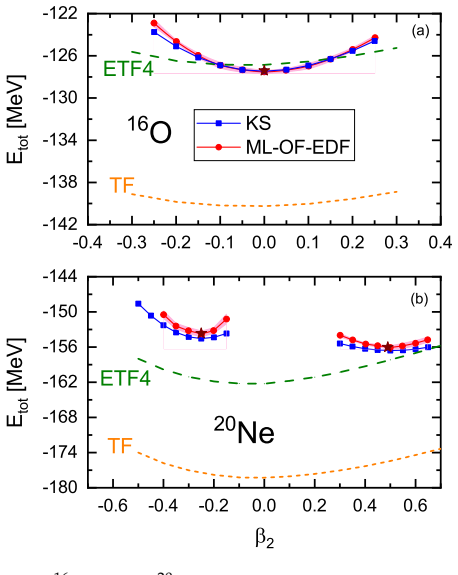
The central claim is that shell and deformation effects in nuclei can be described without ever constructing single-particle orbitals. The authors implement this by learning the density-to-energy map for the kinetic plus spin-orbit part, $E^\mathrm{ML}_{\mathrm{kin+so}}[\rho]=\sum_i \omega_i K(\rho_i,\rho)$, with a Gaussian kernel over discretized axial densities, while the interaction part is taken from the Skyrme functional SkP. The training data come from 24,000 Schrödinger equation solutions under randomly parameterized spherical and quadrupole mean fields, split into 20,000 training, 2,000 validation, and 2,000 test samples. Self-consistent minimization of the resulting functional for 20Ne yields a quadrupole deformation $\beta_2=0.49$ against the Kohn-Sham value 0.48, a root-mean-square radius 3.05 fm against 3.02 fm, and a total energy −156.02 MeV against −156.58 MeV; the constrained calculation reproduces the Kohn-Sham potential energy curve including the deformed minima, and the density profiles capture the spatial fluctuations associated with shell effects.
Load-bearing premise
The load-bearing premise is that densities produced by the randomly parameterized external potentials cover the density manifold of real self-consistent nuclei, so the learned kinetic-plus-spin-orbit map remains accurate when the functional is minimized with the Skyrme interaction; only 16O and 20Ne are tested.
Editorial extensions
If this is right
- Nuclear orbital-free DFT can describe deformed ground states, not just spherical ones, without solving Kohn-Sham equations.
- Potential energy curves and shape-isomeric minima become accessible from a density-only functional.
- The learned functional captures the spatial density fluctuations that correspond to quantum shell effects, which Thomas-Fermi-type functionals miss.
- The Hohenberg-Kohn theorem gains a practical nuclear implementation, opening quantitative orbital-free studies beyond spherical nuclei.
Reading between the lines
- If the functional transfers to neighboring nuclei, the same protocol could generate orbital-free mass or radius tables without Kohn-Sham iterations; testing that would require training over a larger mass range.
- The result weakens the common argument that shell effects are intrinsically single-particle effects, since the learned functional captures them from density fluctuations alone.
- A natural stress test is the region around $\beta_2=0$ in 20Ne, where the authors note Kohn-Sham struggles without pairing; an orbital-free description of that region could reveal whether the learned functional implicitly encodes pairing-like correlations.
Editorial analysis
A structured set of objections, weighed in public.
Referee Report
Summary. This paper proposes to construct an orbital-free nuclear energy density functional by using kernel ridge regression (KRR) to learn the sum of kinetic and spin-orbit energies as a functional of the nucleon density. The KRR model is trained on 24,000 densities and energies generated by solving Schrödinger equations with randomly parameterized external potentials for A=16 and A=20, and is then minimized self-consistently to obtain ground states and constrained potential energy curves for 16O and 20Ne. The authors report that the resulting orbital-free approach reproduces the Kohn-Sham quadrupole deformations, rms radii, total energies, and density profiles, including the deformed minimum of 20Ne, and they claim in the abstract and summary that this is the first fully orbital-free EDF to account for shell effects in deformed nuclei.
Significance. The result, if confirmed by broader tests, is a significant proof-of-principle: it shows that an explicit orbital-free functional can describe a deformed nucleus without introducing Kohn-Sham orbitals, which has been a longstanding challenge. The paper's main strengths are the clear construction of the KRR map with a density-space kernel, the use of a large training set generated from random potentials, and the implementation of self-consistent gradient-descent minimization including constrained calculations with an augmented Lagrangian. The reported agreement with Kohn-Sham for the two test nuclei is encouraging. However, the present validation covers only two N=Z light nuclei, both with mass numbers contained in the training set, and the functional derivative is not independently benchmarked; these are important caveats that limit the strength of the central claim. The paper does not release code or data, only availability upon request, which further hampers independent verification.
major comments (5)
- [Eq. (S11), Fig. 1, Table 1] The self-consistent minimization in Section S3 uses the functional derivative of the KRR model, Eq. (S11), but the reported validation in Fig. 1 concerns rms errors of predicted energies on the validation and test sets, not errors of the derivative. The derivative is the quantity that drives the gradient descent in Eq. (S12) and determines the stationary density and the constrained potential energy curves. A small systematic bias in the derivative can displace the energy minimum even when the energy surface at the training densities is accurately reproduced. The standard deviations in Table 1 reflect sensitivity to 100 random initial densities, not the model error of the derivative at the self-consistent densities. I request an explicit benchmark of the functional derivative against the exact Kohn-Sham potential for the test-set densities, or an equivalent demonstration that derivative errors are small enough not to shift the ground-state density and PEC beyond the reported statistical uncertainties.
- [Methods S1, Table 1] The KRR functional is trained exclusively on densities generated for A=16 and A=20 (Methods S1), and the paper reports ground-state and PEC results only for these same two nuclei. Thus the statement in the abstract and summary that this is the first fully orbital-free EDF to tame shell effects in deformed nuclei is supported by only one deformed nucleus, 20Ne, and by interpolation within the trained mass window. To substantiate the claim of a general orbital-free functional, at least one deformed nucleus outside the training set (e.g., 24Mg or 28Si) should be tested without retraining, or the training set should be shown to include densities that are sufficiently diverse to make the A=16/A=20 restriction inconsequential. If the method requires retraining for each nucleus, the scope of the claim should be narrowed accordingly.
- [Paragraph after Fig. 2] The authors state that Kohn-Sham calculations cannot converge near β2=0 for 20Ne due to degeneracies, and that this phenomenon is 'accurately captured' by the ML orbital-free approach. Since no Kohn-Sham reference is available in this region, there is no benchmark for the ML PEC at β2=0. The agreement at the deformed minima is good, but the barrier height and the shape of the curve near β2=0 are predictions of the learned functional, not validated results. The paper should either provide a benchmark from a different method (e.g., a Hartree-Fock-Bogoliubov calculation with pairing) or present this region as a prediction with a clear caveat, rather than as part of the demonstrated accuracy.
- [Methods S1, Eq. (5)] The training densities are generated by random external potentials with rms radii restricted to an empirical band [0.8 A^{1/3}, 1.2 A^{1/3}] (Methods S1). The self-consistent densities of 16O and 20Ne under the Skyrme interaction are likely inside this band, but the paper does not quantify the proximity of the target densities to the training distribution. KRR is an interpolation method, and the reported accuracy may reflect that the target densities lie inside the training hull rather than a physical generalization. I ask for a quantitative analysis of the distance, in the kernel metric of Eq. (5), between the self-consistent densities and the training set, and for a discussion of how the results depend on the random potential parameter ranges.
- [Eq. (2), Eq. (3)] The learned functional EML_{kin+so}[ρ] represents the kinetic plus spin-orbit energy as a functional of the total density alone. In the Skyrme EDF, the spin-orbit energy depends on the spin-orbit density J (second line of Eq. (2)), which is not generally a unique functional of the total density for arbitrary spin-orbit potentials. The paper does not address this formal issue; if the ρ → (Ekin+Eso) map is not universal, the trained functional may not transfer to nuclei or densities with different spin-orbit structure. At minimum, a discussion of the conditions under which this map is well-defined (e.g., time-reversal invariant, even-even N=Z systems) is needed.
minor comments (3)
- [Eq. (5)] The distance ||ρ(r)-ρ'(r)|| in Eq. (5) is not defined explicitly; please state that it is the L2 norm over the discrete mesh and specify how the density vectorization is performed, as this is needed for reproducibility.
- [Section S3.2] The text mentions that c.m. correction energies and Coulomb energies are included, but does not specify the formulas or parameter values used; provide these details for reproducibility.
- [Abstract and Summary] The phrase 'inaugural instance' is used twice in prominent places; consider using a more conventional phrase such as 'first demonstration' for clarity and style.
Circularity Check
No circularity: the learned kinetic+spin-orbit functional is fitted to random-potential densities and tested against self-consistent Skyrme/Kohn-Sham densities, so the benchmark is external to the training labels.
full rationale
The central construction is a kernel ridge regression map from density to kinetic+spin-orbit energy, Eq. (3), with weights fixed by Eq. (4) using energies obtained from Schrödinger equations with randomly generated external potentials (Methods S1). The resulting orbital-free functional, Eq. (6), is then minimized self-consistently, and the ground-state properties and potential energy curves are compared with Kohn-Sham results. No claim in the paper reduces, by construction, to the training labels: the target densities are the minimizers of the fitted functional, not training densities, and the reported Kohn-Sham benchmark energies are not used as fitting targets. The two self-citations (Ref. 70, for the combined-Gaussian potential ansatz and the adaptive functional derivative stabilization method) supply numerical machinery, not the physical result, and the central comparison with Kohn-Sham is externally defined. The main limitations—two test nuclei, same A as training, no released code or data—are generalization concerns rather than circularity. Therefore no step satisfies the quota: there is no equation that is equivalent to its input by definition, no fitted parameter renamed as a prediction, and no load-bearing self-citation chain.
Assumptions & free parameters
free parameters (3)
- KRR regularizer λ =
2.19e-6
- KRR kernel width σ =
1.86 fm^-2
- Mean-potential random parameter ranges =
see Methods S1 (12 ranges)
assumptions (4)
- domain assumption Hohenberg-Kohn theorem guarantees the total energy is a functional of density alone
- domain assumption The Skyrme SkP density-only interaction energy E'_int[ρ] can be combined with the learned kinetic+spin-orbit term to form the exact functional
- domain assumption The KRR model trained on Schrödinger solutions in random external potentials approximates the universal kinetic+spin-orbit density functional at the self-consistent nuclear densities
- domain assumption Densities are axially symmetric, ρ(r⊥,z)
Cite this review
Pith. "Pith review of Machine learning orbital-free density functional theory: taming quantum shell effects in deformed nuclei." pith.science (2026). https://pith.science/paper/6MPYEZID
@misc{pith2026241220739,
  author       = {Pith},
  title        = {Pith review of: Machine learning orbital-free density functional theory: taming quantum shell effects in deformed nuclei},
  year         = {2026},
  howpublished = {\url{https://pith.science/paper/6MPYEZID}},
  note         = {Machine review of arXiv:2412.20739}
}
abstract
Accurate description of deformed atomic nuclei by the orbital-free density functional theory has been a longstanding textbook challenge, due to the difficulty in accounting for the intricate quantum shell effects that are present in such systems. Orbital-free density functional theory is, in principle, capable of describing all effects of nuclear systems, as guaranteed by the Hohenberg-Kohn theorem. However, from a microscopic perspective, shell and deformation effects are believed to be intrinsically connected to single-orbital structures, posing a significant challenge for orbital-free approaches. Here, we develop a machine learning approach to the orbital-free density functional theory, which is capable of achieving a high level of accuracy in describing the ground-state properties and potential energy curves for both spherical $^{16}$O and deformed $^{20}$Ne nuclei. This is the inaugural instance where a fully orbital-free energy density functional has succeeded in taming the complex shell effects in deformed nuclei. It demonstrates that the orbital-free energy density functional, which is directly based on the Hohenberg-Kohn theorem, is not only a theoretical concept but also a practical one for nuclear systems.
Figures


Reference graph
Works this paper leans on
- [2]
- [3]
-
[4]
Brack, M., Guet, C. & Hakansson, H.-B. Selfconsistent semiclassical description of average nuclear properties—a link between microscopic and macroscopic models. Phys. Rep. 123, 275–364 (1985)
work page 1985
-
[5]
Centelles, M., Schuck, P . & Vi ˜ nas, X. Thomas–Fermi theory f or atomic nuclei revisited. Ann. Phys. 322, 363 (2007)
work page 2007
-
[6]
Col ` o, G. & Hagino, K. Orbital-free density functional theo ry: Differences and similarities between electronic and nuclear systems. Prog. Theor. Exp. Phys. 2023, 103D01 (2023)
work page 2023
-
[7]
Centelles, M., Pi, M., Vinas, X., Garcias, F . & Barranco, M. S elf-consistent extended thomas-fermi calculations in nuclei. Nucl. Phys. A 510, 397–416 (1990)
work page 1990
-
[8]
Dutta, A., Arcoragi, J.-P ., Pearson, J., Behrman, R. & T onde ur, F . Thomas-fermi approach to nuclear mass formula: (i). spherical nuclei. Nucl. Phys. A 458, 77–94 (1986)
work page 1986
-
[9]
Aboussir, Y ., Pearson, J., Dutta, A. & T ondeur, F . Nuclear ma ss formula via an approximation to the hartree—fock method. Atom. Data Nucl. Data T ables 61, 127 – 176 (1995)
work page 1995
Show all 76 references
-
[10]
Brack, M. et al. Funny hills: The shell-correction approach to nuclear shel l effects and its applications to the fission process. Rev. Mod. Phys. 44, 320–405 (1972)
1972
-
[11]
& Pauli, H
Brack, M. & Pauli, H. On strutinsky’s averaging method. Nucl. Phys. A 207, 401–424 (1973)
1973
-
[12]
Shell effects in nuclear masses and deformation energies
Strutinsky , V . Shell effects in nuclear masses and deformation energies. Nucl. Phys. A 95, 420–442 (1967)
1967
-
[13]
“shells” in deformed nuclei
Strutinsky , V . “shells” in deformed nuclei. Nucl. Phys. A 122, 1–33 (1968)
1968
-
[14]
& Quentin, P
Brack, M. & Quentin, P . Self-consistent average density matrices and the strutinsky energy theorem. Phys. Lett. B 56, 421–423 (1975)
1975
-
[15]
& Treiner, J
Bohigas, O., Campi, X., Krivine, H. & Treiner, J. Extensions of the thomas-fermi approximation for finite nuclei. Phys. Lett. B 64, 381–385 (1976)
1976
-
[16]
& Brack, M
Chu, Y ., Jennings, B. & Brack, M. Nuclear binding energies and liquid drop parameters in the extended thomas- fermi approximation. Phys. Lett. B 68, 407–411 (1977)
1977
-
[17]
Carleo, G. et al. Machine learning and the physical sciences. Rev. Mod. Phys. 91, 045002 (2019)
2019
-
[18]
Boehnlein, A. et al. Colloquium: Machine learning in nuclear physics. Rev. Mod. Phys. 94, 031003 (2022)
2022
-
[19]
He, W . et al. Machine learning in nuclear physics at low and intermediate energies. Sci. China-Phys. Mech. Astron. 66, 282001 (2023)
2023
-
[20]
Niu, Z. M. et al. Radial basis function approach in nuclear mass predictions . Phys. Rev. C 88, 024325 (2013)
2013
-
[21]
& Prosper, H
Utama, R., Piekarewicz, J. & Prosper, H. B. Nuclear mass pred ictions for the crustal composition of neutron stars: A bayesian neural network approach. Phys. Rev. C 93, 014311 (2016)
2016
-
[22]
Niu, Z. M. & Liang, H. Z. Nuclear mass predictions based on bay esian neural network approach with pairing and shell effects. Phys. Lett. B 778, 48 – 53 (2018)
2018
-
[23]
C., Nazarewicz, W
Neufcourt, L., Cao, Y . C., Nazarewicz, W . & Viens, F . Bayesia n approach to model-based extrapolation of nuclear observables. Phys. Rev. C 98, 034318 (2018)
2018
-
[24]
& Barton, C
Pastore, A., Neill, D., Powell, H., Medler, K. & Barton, C. Im pact of statistical uncertainties on the composition of the outer crust of a neutron star. Phys. Rev. C 101, 035804 (2020)
2020
-
[25]
Wu, X. H. & Zhao, P . W . Predicting nuclear masses with the kern el ridge regression. Phys. Rev. C 101, 051301 (R) (2020)
2020
-
[26]
H., Guo, L
Wu, X. H., Guo, L. H. & Zhao, P . W . Nuclear masses in extended kernel ridge regression with odd-even effects. Phys. Lett. B 819, 136387 (2021). 11/14
2021
-
[27]
H., Lu, Y
Wu, X. H., Lu, Y . Y . & Zhao, P . W . Multi-task learning on nuclea r masses and separation energies with the kernel ridge regression. Phys. Lett. B 834, 137394 (2022)
2022
-
[28]
Niu, Z. M. & Liang, H. Z. Nuclear mass predictions with machin e learning reaching the accuracy required by r-process studies. Phys. Rev. C 106, L021303 (2022)
2022
-
[29]
Akkoyun, S., Bayram, T., Kara, S. O. & Sinan, A. An artificial n eural network application on nuclear charge radii. J. Phys. G-Nucl. Part. Phys. 40, 055106 (2013)
2013
-
[30]
& Piekarewicz, J
Utama, R., Chen, W .-C. & Piekarewicz, J. Nuclear charge radi i: density functional theory meets bayesian neural networks. J. Phys. G-Nucl. Part. Phys. 43 (2016)
2016
-
[31]
Ma, Y . et al. Predictions of nuclear charge radii and physical interpret ations based on the naive bayesian probability classifier. Phys. Rev. C 101, 014304 (2020)
2020
-
[32]
L., Sagawa, H
Wu, D., Bai, C. L., Sagawa, H. & Zhang, H. Q. Calculation of nuc lear charge radii with a trained feed-forward neural network. Phys. Rev. C 102, 054323 (2020)
2020
-
[33]
& Zhang, Z.-H
Ma, J.-Q. & Zhang, Z.-H. Improved phenomenological nuclear charge radius formulae with kernel ridge regression. Chin. Phys. C 46, 074105 (2022)
2022
-
[34]
& Geng, L.-S
Dong, X.-X., An, R., Lu, J.-X. & Geng, L.-S. Nuclear charge ra dii in bayesian neural networks revisited. Phys. Lett. B 838, 137726 (2023)
2023
-
[35]
M., Liang, H
Niu, Z. M., Liang, H. Z., Sun, B. H., Long, W . H. & Niu, Y . F . Pred ictions of nuclear β-decay half-lives with machine learning and their impact on r-process nucleosynthesis. Phys. Rev. C 99, 064307 (2019)
2019
-
[36]
E., Nunes, F
Lovell, A. E., Nunes, F . M., Catacora-Rios, M. & King, G. B. Re cent advances in the quantification of uncertain- ties in reaction theory . J. Phys. G-Nucl. Part. Phys. 48, 014001 (2020)
2020
-
[37]
L., Sagawa, H., Nishimura, S
Wu, D., Bai, C. L., Sagawa, H., Nishimura, S. & Zhang, H. Q. β-delayed one-neutron emission probabilities within a neural network model. Phys. Rev. C 104, 054303 (2021)
2021
-
[38]
Saxena, G., Sharma, P . K. & Saxena, P . Modified empirical form ulas and machine learning for al pha-decay systematics. J. Phys. G-Nucl. Part. Phys. 48, 055103 (2021)
2021
-
[39]
Neudecker, D. et al. Informing nuclear physics via machine learning methods wit h differential and integral experiments. Phys. Rev. C 104, 034611 (2021)
2021
-
[40]
W ang, X., Zhu, L. & Su, J. Modeling complex networks of nuclea r reaction data for probing their discovery processes. Chin. Phys. C 45, 124103 (2021)
2021
-
[41]
X., Wu, X
Huang, T. X., Wu, X. H. & Zhao, P . W . Application of kernel ridg e regression in predicting neutron-capture reaction cross-sections. Commun. Theor. Phys. 74, 095302 (2022)
2022
-
[42]
G., Hagen, G
Jiang, W . G., Hagen, G. & Papenbrock, T. Extrapolation of nuc lear structure observables with artificial neural networks. Phys. Rev. C 100, 054326 (2019)
2019
-
[43]
& Penon, A
Lasseri, R.-D., Regnier, D., Ebran, J.-P . & Penon, A. T amingnuclear complexity with a committee of multilayer neural networks. Phys. Rev. Lett. 124, 162502 (2020)
2020
-
[44]
Nonparametric bayesian approach to extrapolation problems in configuration interaction methods
Y oshida, S. Nonparametric bayesian approach to extrapolation problems in configuration interaction methods. Phys. Rev. C 102, 024305 (2020)
2020
-
[45]
W ang, X., Zhu, L. & Su, J. Providing physics guidance in bayes ian neural networks from the input layer: The case of giant dipole resonance predictions. Phys. Rev. C 104, 034317 (2021)
2021
-
[46]
& Niu, Y
Bai, J., Niu, Z., Sun, B. & Niu, Y . The description of giant dip ole resonance key parameters with multitask neural networks. Phys. Lett. B 815, 136147 (2021)
2021
-
[47]
& Viens, F
Neufcourt, L., Cao, Y ., Nazarewicz, W ., Olsen, E. & Viens, F . Neutron drip line in the ca region from bayesian model averaging. Phys. Rev. Lett. 122, 062502 (2019)
2019
-
[48]
Neufcourt, L. et al. Quantified limits of the nuclear landscape. Phys. Rev. C 101, 044307 (2020)
2020
-
[49]
& Qiang, Y
W ang, Z.-A., Pei, J., Liu, Y . & Qiang, Y . Bayesian evaluation of incomplete fission yields. Phys. Rev. Lett. 123, 122501 (2019)
2019
-
[50]
E., Mohan, A
Lovell, A. E., Mohan, A. T. & T alou, P . Quantifying uncertainties on fission fragment mass yields with mixture density networks. J. Phys. G-Nucl. Part. Phys. 47, 114001 (2020). 12/14
2020
-
[51]
Qiao, C. Y . et al. Bayesian evaluation of charge yields of fission fragments of 239U. Phys. Rev. C 103, 034621 (2021)
2021
-
[52]
& Rios, A
Keeble, J. & Rios, A. Machine learning the deuteron. Phys. Lett. B 809, 135743 (2020)
2020
-
[53]
& Rocco, N
Adams, C., Carleo, G., Lovato, A. & Rocco, N. V ariational mon te carlo calculations of a ≤ 4 nuclei with an artificial neural-network correlator ansatz. Phys. Rev. Lett. 127, 022502 (2021)
2021
-
[54]
& Rocco, N
Lovato, A., Adams, C., Carleo, G. & Rocco, N. Hidden-nucleons neural-network quantum states for the nuclear many-body problem. Phys. Rev. Res. 4, 043178 (2022)
2022
-
[55]
& Zhao, P
Y ang, Y . & Zhao, P . A consistent description of the relativis tic effects and three-body interactions in atomic nuclei. Phys. Lett. B 835, 137587 (2022)
2022
-
[56]
Y ang, Y . L. & Zhao, P . W . Deep-neural-network approach to sol ving the ab initio nuclear structure problem. Phys. Rev. C 107, 034320 (2023)
2023
-
[57]
& Pederiva , F
Rigo, M., Hall, B., Hjorth-Jensen, M., Lovato, A. & Pederiva , F . Solving the nuclear pairing model with neural network quantum states. Phys. Rev. E 107, 025310 (2023)
2023
-
[58]
& Burke, K
Pederson, R., Kalita, B. & Burke, K. Machine learning and den sity functional theory . Nature Reviews Physics 4, 357–358 (2022)
2022
-
[59]
Huang, B., von Rudorff, G. F . & von Lilienfeld, O. A. The centr al role of density functional theory in the ai age. Science 381, 170–175 (2023)
2023
-
[60]
C., Rupp, M., Hansen, K., M ¨ uller, K.-R
Snyder, J. C., Rupp, M., Hansen, K., M ¨ uller, K.-R. & Burke, K . Finding density functionals with machine learning. Phys. Rev. Lett. 108, 253002 (2012)
2012
-
[61]
By-passing the kohn-sham equations with machine learning
Brockherde, F .et al. By-passing the kohn-sham equations with machine learning. Nat. Commun. 8, 872 (2017)
2017
-
[62]
& Sugino, O
Nagai, R., Akashi, R. & Sugino, O. Completing density functional theory by machine learning hidden messages from molecules. npj Computational Materials 6, 43 (2020)
2020
-
[63]
E., M ¨ uller, K.-R
Bogojeski, M., V ogt-Maranto, L., Tuckerman, M. E., M ¨ uller, K.-R. & Burke, K. Quantum chemical accuracy from density functional approximations via machine learni ng. Nat. Commun. 11, 5223 (2020)
2020
-
[64]
R., Carleo, G
Moreno, J. R., Carleo, G. & Georges, A. Deep learning the hohe nberg-kohn maps of density functional theory . Phys. Rev. Lett. 125, 076402 (2020)
2020
-
[65]
Li, L. et al. Kohn-sham equations as regularizer: Building prior knowle dge into machine-learned physics. Phys. Rev. Lett. 126, 036401 (2021)
2021
-
[66]
Kirkpatrick, J. et al. Pushing the frontiers of density functionals by solving the fractional electron problem. Science 374, 1385–1389 (2021)
2021
-
[67]
Margraf, J. T. & Reuter, K. Pure non-local machine-learned d ensity functional theory for electron correlation. Nat. Commun. 12, 1–7 (2021)
2021
-
[68]
Ma, H., Narayanaswamy , A., Riley , P . & Li, L. Evolving symbol ic density functionals. Science Advances 8, eabq0279 (2022)
2022
-
[69]
Bai, Y ., V ogt-Maranto, L., Tuckerman, M. E. & Glover, W . J. Ma chine learning the hohenberg-kohn map for molecular excited states. Nat. commun. 13, 7044 (2022)
2022
-
[70]
H., Ren, Z
Wu, X. H., Ren, Z. X. & Zhao, P . W . Nuclear energy density funct ionals from machine learning. Phys. Rev. C 105, L031303 (2022)
2022
-
[71]
& Y oshida, K
Hizawa, N., Hagino, K. & Y oshida, K. Analysis of a skyrme ener gy density functional with deep learning. Phys. Rev. C 108, 034311 (2023)
2023
-
[72]
Hartree-fock calculations with skyrme’s int eraction
V autherin, D. Hartree-fock calculations with skyrme’s int eraction. ii. axially deformed nuclei. Phys. Rev. C 7, 296–316 (1973)
1973
-
[73]
Lee, S.-J. et al. Relativistic hartree calculations for axially deformed nu clei. Phys. Rev. Lett. 57, 2916–2919 (1986). URL https://link.aps.org/doi/10.1103/PhysRevLett.57.2916
1986 doi
-
[74]
& Boguta, J
Pannert, W ., Ring, P . & Boguta, J. Relativistic mean-field th eory and nuclear deformation. Phys. Rev. Lett. 59, 2420–2422 (1987). URL https://link.aps.org/doi/10.1103/PhysRevLett.59.2420
1987 doi
-
[75]
& Treiner, J
Dobaczewski, J., Flocard, H. & Treiner, J. Hartree-fock-bo golyubov description of nuclei near the neutron-drip line. Nucl. Phys. A 422, 103–139 (1984). 13/14
1984
-
[76]
National Nuclear Data Center (NNDC), https://www.nndc.bn l.gov/ URL https://www.nndc.bnl.gov/
-
[77]
& Nazarewicz, W
Staszczak, A., Stoitsov , M., Baran, A. & Nazarewicz, W . Augmented lagrangian method for constrained nuclear density functional theory . Eur. Phys. J. A 46, 85–90 (2010). 14/14
2010
Reviewed August 10, 2026 · model on record in the stance chip above.
Discussion (0). Continue with ORCID to comment.