pith. sign in

physics.chem-ph

Chemical Physics

Experimental, computational, and theoretical physics of atoms, molecules, and clusters - Classical and quantum description of states, processes, and dynamics; spectroscopy, electronic structure, conformations, reactions, interactions, and phases. Chemical thermodynamics. Disperse systems. High pressure chemistry. Solid state chemistry. Surface and interface chemistry.

5
physics.chem-ph 2026-05-13 2 theorems

BN doping makes naphthalene Dewar isomerization asymmetric

by Michael Bühler, Merle I. S. Röhr

Asymmetric Planar-to-Dewar Isomerisation in BN-Doped Naphthalene: Mechanistic Implications for Molecular Solar Thermal Storage

A transient boron-carbon contact stabilizes an intermediate and places the transition near a nonradiative funnel for solar energy storage.

abstract click to expand
The planar to Dewar valence isomerisation of 4a,8a-azaboranaphthalene (BN$_\text{Naph}$), a $\pi$ extended BN-doped analogue of azaborine, is investigated to evaluate how BN incorporation reshapes the minimum energy pathway on the ground state. This process is, for example, relevant in the context of molecular solar thermal (MOST) energy storage, where absorbed sunlight is converted into chemical energy through reversible photoisomerisation. Structures and vertical excitations were computed using DFT and TD-DFT, minimum energy pathways were mapped with nudged elastic band (NEB) calculations, and pathway energetics were refined with state averaged XMS-CASPT2. In addition, azaborine was examined as a comparison system, with particular emphasis on whether substituents at nitrogen and boron promote Dewar formation. The effect of BN doping on the system was analysed in detail. Compared with the carbon analogue, the conversion pathway becomes asymmetric with a metastable intermediate stabilized by a transient boron to carbon contact. The transition structure closely resembles an S$_0$/S$_1$ conical intersection, which is consistent with a vibrationally activated nonradiative funnel. For tuning MOST properties, screening of single substituents across the whole molecule reveals predominantly red shifted S$_1$ energies together with increased oscillator strengths and indicates that appropriate substitution can improve Dewar formation in azaborine derivatives.
0
4
physics.chem-ph 2026-05-12 2 theorems

Constrained neural models clone density functionals self-consistently

by Sara Navarro-Rodríguez, Alec Wills +3 more

Constraint-aware functional cloning for stable and transferable machine-learned density functional theory

Molecular-only training data enables accurate reproduction of lattice constants and bulk moduli across metallic, covalent, ionic, oxide, and

Figure from the paper full image
abstract click to expand
We study a simple but useful test for neural exchange-correlation (XC) functionals: can a neural model reproduce an established XC functional when it is used self-consistently? We call this test functional cloning. The model is trained at the GGA level to reproduce a known semilocal functional, using either a constrained or an unconstrained architecture. The motivation is that an XC functional is not used on a fixed input. In a Kohn-Sham self-consistent-field calculation it contributes to the potential, and the resulting density is part of the outcome of the same calculation. A good pointwise fit to sampled density descriptors is therefore not by itself enough. Because the target functional is known, the error can be measured directly. We compare the clones on sampled descriptors, molecular total energies, energy differences, transfer between PySCF and SIESTA, and equations of state for crystalline solids. The constrained models reproduce the reference functional more accurately in molecular self-consistent calculations. They also give better initial parameters for later optimization against correlated molecular energies. An additional observation is that the constrained architecture already gives a reasonable solid-state baseline before cloning, as seen from randomly initialized constrained models. Clones trained only on molecular densities transfer well to solids, reproducing reference lattice constants and bulk moduli across metallic, covalent, ionic, oxide, and layered systems. Cross-code tests show that energy differences are relatively robust, while total energies depend strongly on whether the cloning descriptors come from all-electron or pseudopotential densities. These results make functional cloning a useful diagnostic before full self-consistent training of neural XC functionals.
0
4
physics.chem-ph 2026-05-12 2 theorems

Ranking model halves determinants needed for chemical accuracy

by Wan Nie, Songwei Liu +3 more

Learning to Rank for Selected Configuration Interaction

Treating determinant selection as pairwise ranking lets the method reach target accuracy with 55 percent fewer terms than classification or

Figure from the paper full image
abstract click to expand
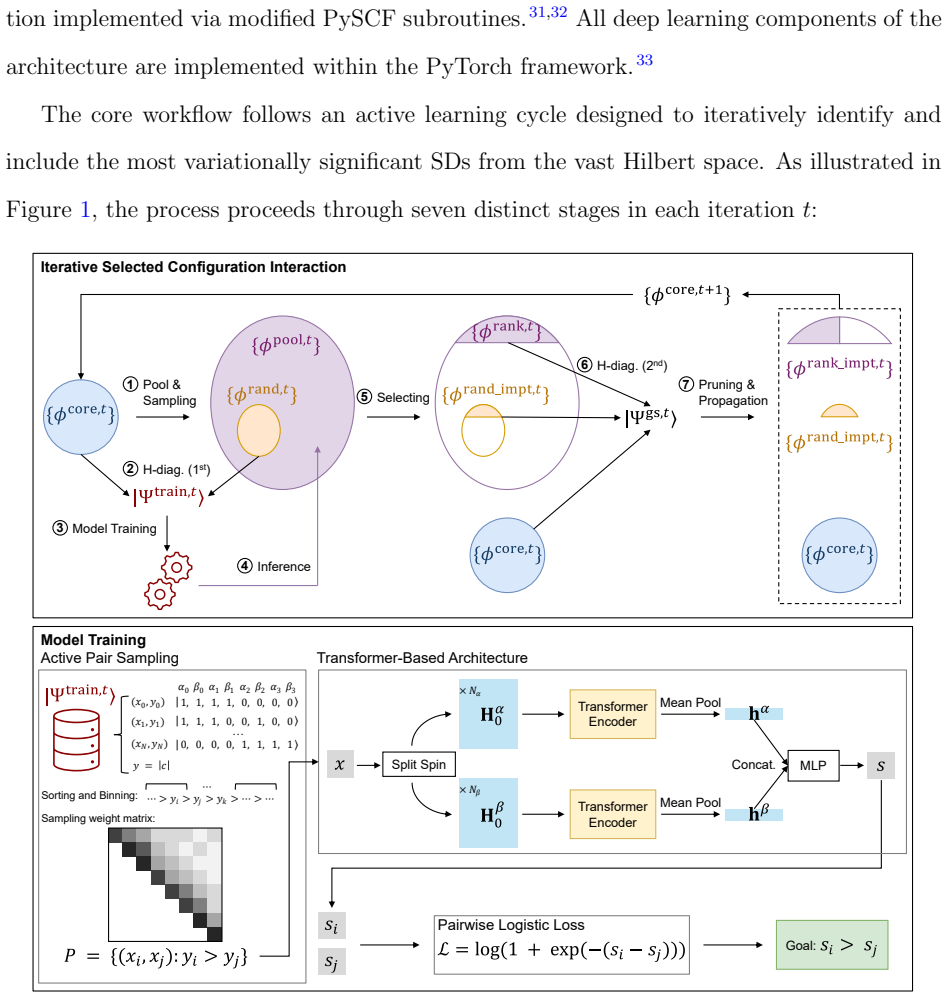
The accurate description of electron correlation is a central challenge in computational chemistry, with selected configuration interaction (SCI) emerging as a powerful tool to approach the full CI limit. While recent machine learning (ML) integrations have accelerated determinant selection, existing regression and classification approaches suffer from a fundamental objective-loss mismatch: they evaluate the importance of determinants in isolation without explicitly accounting for their relative importance ranking. Here, we introduce ranking configuration interaction (RCI), a novel ML-supported SCI framework that reframes determinant selection as a pairwise ranking problem. Building upon a Transformer-based architecture to capture complex, non-local orbital dependencies, RCI progressively optimizes the partial ordering of determinants. By doing so, RCI aligns the training objective more closely with the intrinsic ranking nature of SCI. Extensive benchmarks across both plane-wave and Gaussian basis sets, including the molecules N$_2$, CO, H$_2$O, NH$_3$, and C$_2$, demonstrate the substantial efficiency of RCI. Compared to previously reported classification baselines, RCI consistently accelerates convergence-reducing overall computational time by 23% to over 50% depending on the system, and requiring only 55% of the determinant count in representative cases such as N$_2$ and CO. Furthermore, RCI exhibits robust performance and reaches chemical accuracy on the highly challenging iron-sulfur using only 12% of the full CI space. Notably, RCI outperforms recent regression-based SCI methods by delivering either further 15% improvement in accuracy at comparable determinant counts, or 15% gain in compactness at similar accuracy. This pairwise learning-to-rank model provides a lightweight and modular plugin that can be seamlessly incorporated into other supervised-learning frameworks.
0
2
physics.chem-ph 2026-05-15 2 theorems

Dataset supplies 260k conical-intersection structures for ML

by Jiahui Zhang, Yifei Zhu +4 more

A quantum chemistry dataset containing ground-state and conical-intersection structures of 260k molecules

Ground-state and intersection geometries from OM2/MRCI calculations for molecules up to ten heavy atoms enable data-driven photochemistry

Figure from the paper full image
abstract click to expand
Conical intersections play central roles in photoinduced reactions. However, comprehensive conical-intersection datasets that could advance our understanding of excited-state reaction processes remain scarce. To address this gap, we constructed a quantum chemistry dataset containing ground-state and conical-intersection structures of small molecules (up to ten heavy atoms: C, N, O, F). Ground-state geometries were optimized at the semi-empirical OM2 level, with single-point energies calculated at the OM2/MRCI level. Conical-intersection geometries and energies were also computed at the OM2/MRCI level. This dataset is designed to enable a deep integration of photochemistry with machine learning, bridging the gap between photochemical insight and data-driven approaches.
0
2
physics.chem-ph 2025-07-01 Recognition

TDA matches full TDDFT for transition-metal core spectra

by Muhammed A. Dada, Sarah Pak +3 more

Quantifying the impact of the Tamm-Dancoff approximation on the computed spectra of transition-metal systems

De-excitation terms become negligible at K- and L-edge energies, so the cheaper Hermitian approximation is accurate.

abstract click to expand
The Tamm-Dancoff Approximation (TDA) offers a computationally efficient alternative to full linear-response Time-Dependent Density Functional Theory (TDDFT) for calculating electronic excited states, particularly in large molecular systems. By neglecting the coupling between excitation and de-excitation channels, TDA simplifies the TDDFT response equations into a Hermitian form. This not only reduces computational cost but also eliminates numerical instabilities that can arise in the full non-Hermitian formalism. While TDA has been widely explored for valence excitations, its reliability for transition metal complexes and core-level spectroscopies remains largely untested. In this work, we address this gap by systematically comparing TDA and full TDDFT results for a series of transition metal species, focusing on absorption spectra across the UV-Vis, metal K-edges, and L-edges. Our results show that, for core-level excitations, TDA yields excitation energies and oscillator strengths nearly indistinguishable from those obtained with full TDDFT. This agreement is attributed to the negligible contribution of de-excitation amplitudes at high excitation energies, indicating that the omitted coupling terms play an insignificant role in these spectral regimes. These findings validate the accuracy and robustness of TDA in core-level spectra simulations and support its broader application in studies involving transition metal systems.
0
4
physics.chem-ph 2026-04-23 8 theorems

One golden-ratio curve organizes four periodic-table trends at once

by Jonathan Washburn, Megan Simons +1 more

A Noble-Gas-Centered Coordinate for Within-Period Atomic Property Trends

Distance to the nearest noble gas, fed into a single cosh function, reproduces IE, EA, hardness, and electronegativity across periods 2–6.

abstract click to expand
We introduce a single dimensionless landscape function $J_{\rm chem}(\rho) = \cosh(\rho \ln \varphi) - 1$, $\varphi = (1+\sqrt{5})/2$, on the noble-gas-centred coordinate $\rho = d/L_p \in [0,1)$, and show that it organizes four central atomic observables: first ionization energy \IE$_1$, electron affinity EA, Mulliken electronegativity $\chi_M$, and Pearson chemical hardness $\eta$, on one periodic-table axis. The outward step $\Delta J_{\rm chem}^{+}$ delivers IE$_1$; the inward gap $\Delta J_{\rm chem}^{-} = J_{\rm chem}(1) - J_{\rm chem}(\rho)$ delivers EA and $\eta$; $\chi_M$ follows by Mulliken's identity. Three results establish the empirical content. (i) The within-period IE$_1$ envelope reproduces the full noble-gas-to-alkali ordering across periods 2--6: of 34 atoms compiled across periods 2-4, 26 lie on the predicted monotone descent and the 8 upward deviations occur exactly at the textbook anomaly sites $\{p^3, d^5, f^7, s^2, d^{10}\}$. (ii) Two golden-ratio identities, ${\rm IE}_1(G_p)/{\rm IE}_1(G_{p+1}) \approx \varphi^{1/4}$ on three heavy noble-gas pairs and ${\rm IE}_1(\text{halogen})/{\rm IE}_1(\text{alkali}) \approx \varphi^2$ on four within-period pairs, agree with NIST data to MAD $\approx 1\%$ and $\approx 5\%$, respectively. (iii) The shared kernel $\Delta J_{\rm chem}^{-}$ provides single-parameter analytical fits to EA across periods 4--6 (MAE $0.3$--$0.4$~eV), to Pearson hardness $\eta$ across periods 2--4 (MAE $\sim 1$~eV on noble-gas maxima up to $10.8$~eV), and to Mulliken $\chi_M$ across a 15-atom four-class benchmark ($R^2 = 0.73$). \edit{At the period-averaged scale level, the shared-kernel relation ${\rm EA}/\eta \approx C^{(p)}_{\mathrm{EA}}/C^{(p)}_{\eta}$ is supported on period-4 NIST data: the empirical nine-atom mean $\overline{{\rm EA}/\eta} = 0.180$ agrees with the predicted constant $0.182$ to better than $1\%$, although individual-atom scatter ($\sigma \approx 0.13$) is much larger.
0
1
physics.chem-ph 2026-05-12 3 theorems

Perturbative CCSD makes AFQMC size-extensive without infrared divergence

by Yichi Zhang, Ankit Mahajan +2 more

Size Extensive Auxiliary-Field Quantum Monte Carlo with Perturbative Coupled Cluster Trial Wavefunction

Tests on molecules and the uniform electron gas show additive energies and finite per-particle energies in the thermodynamic limit, unlikeCC

Figure from the paper full image
abstract click to expand
In this work, we develop a size extensive Auxiliary-Field Quantum Monte Carlo (AFQMC) approach that scales as $O(N^5)$ for local energy evaluation by treating the Coupled Cluster Singles and Doubles (CCSD) trial wavefunctions perturbatively. Comprehensive numerical examinations, spanning from main-group molecules to $3d$ transition metal complexes, demonstrate that this perturbative treatment introduces negligible bias. For small systems, our method achieves an accuracy and level of noise comparable to AFQMC with configuration interaction singles and doubles (CISD) trial wavefunctions while outperforming CCSD(T). This size extensivity offers a decisive advantage for large systems, as suggested by the ground state energies of non-interacting monomers and one-dimensional atomic chains. Finally, the numerical simulations of the uniform electron gas (UEG) provide evidence that, unlike the CCSD(T) method, our new approach does not suffer from infrared divergence in the thermodynamic limit (TDL).
0
1
physics.chem-ph 2026-05-13 Recognition

Relativistic multireference theory gets spin-orbit splittings under 7% error

by Zijun Zhao, Francesco A. Evangelista

One-Step Relativistic Driven Similarity Renormalization Group Multireference Perturbation Theory

X2C-DSRG-MRPT2 handles strong correlation and heavy elements efficiently for routine use in molecular systems.

Figure from the paper full image
abstract click to expand
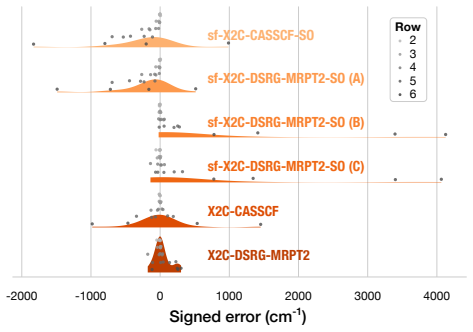
We present an efficient implementation of a one-step relativistic second-order multireference perturbation theory based on the multireference driven similarity renormalization group (MR-DSRG) using the exact two-component (X2C) Hamiltonian, which we denote X2C-DSRG-MRPT2. We show that the X2C-DSRG-MRPT2 method can accurately capture spin--orbit coupling (SOC) effects in the electronic structure of strongly correlated systems containing elements across the periodic table. We further demonstrate that the X2C-DSRG-MRPT2 method, through its variational treatment of SOC effects, can yield spin--orbit splittings with mean absolute percentage errors consistently below 7% with respect to experimental values for systems containing up to sixth row elements. With its modest computational scaling (fifth power in system size) and high accuracy, X2C-DSRG-MRPT2 provides a promising avenue for the routine treatment of relativistic effects in strongly correlated molecular systems.
0
1
physics.chem-ph 2026-05-13 Recognition

Collinear phase-cycling isolates background-free two-quantum spectra

by Ajay Jayachandran, Stefan Mueller +2 more

Background-free measurement of exciton-exciton annihilation by two-quantum fluorescence-detected pump-probe spectroscopy

Post-processing removes incoherent mixing to reveal exciton annihilation dynamics in squaraine systems.

Figure from the paper full image
abstract click to expand
We introduce two-quantum (2Q) fluorescence-detected pump-probe (F-PP) spectroscopy as a tool to probe ultrafast multiparticle interactions in many-body systems. We describe a pulse-shaper-based fully collinear setup utilizing phase cycling to capture the 2Q F-PP signal simultaneously with the one-quantum (1Q) F-PP signal. Thus, we investigate the dynamics of energy transfer and diffusion-limited annihilation. We apply a data post-processing strategy to isolate excited-state dynamics from spurious background. The technique is applied to a squaraine heterodimer and a squaraine copolymer to demonstrate the removal of so-called incoherent mixing that generally plagues action-detected nonlinear spectroscopy on multichromophoric systems. Specifically, we show that this approach is not only applicable to 1Q but also to 2Q F-PP signals, eliminating incoherent mixing contributions as well as other "parasitic" signals that result from pulse-overlap ambiguities. As a result, we retrieve background-free spectral and dynamical information of doubly excited electronic states.
0

browse all of physics.chem-ph → full archive · search · sub-categories