Weakly nonlinear SPDEs converge to KPZ on the whole line
A stochastic heat kernel argument extends KPZ universality to non-equilibrium initial data in infinite volume
· “KPZ equation from a class of nonlinear SPDEs in infinite volume”
Mathematical Physics
Articles in this category focus on areas of research that illustrate the application of mathematics to problems in physics, develop mathematical methods for such applications, or provide mathematically rigorous formulations of existing physical theories. Submissions to math-ph should be of interest to both physically oriented mathematicians and mathematically oriented physicists; submissions which are primarily of interest to theoretical physicists or to mathematicians should probably be directed to the respective physics/math categories
sort pith recommended most recent
A stochastic heat kernel argument extends KPZ universality to non-equilibrium initial data in infinite volume
· “KPZ equation from a class of nonlinear SPDEs in infinite volume”
The genus-g analogue of the KLT double-copy relations, with numerical checks at genus two.
Lecture notes derive Penrose and super-Penrose transforms for conserved, scalar, and generic operators.
· “Lectures on the Spinor and Twistor Formalism in 3D Conformal Field Theory”
The new R-matrix covers every irreducible representation of sl_3, not just the symmetric ones.
The modified Mathieu and doubly confluent Heun equations emerge from Painlevé III3 and III1, yielding the dual gauge period.
· “From Painlev\'e equations to {cal N}=2 susy gauge theories: prolegomena”
For 2d CFT degenerate operators, forbidden singularities dissolve and minimal models emerge from resummation.
· “On the 1/c expansion in 2d CFTs with degenerate operators”

A Cartan-style construction unifies a global duality group and a local gauge group into one curvature hierarchy.
· “Gauged Extended Field Theory and Generalised Cartan Geometry”
A review extends the growing interior volume to charged, rotating, higher-dimensional and f(R) black holes.

A one-time calculation can hand any optimizer the loss value at every stationary point.

Borel-Laplace and alien calculus show CFT blocks I1 and I2 encode each other's large-c trans-series and monodromy.
· “Resurgence for large c expansion in Coulomb gas formalism”

Quantizing with a deformed-fuzzy-sphere Lie derivative turns matrix Chern-Simons droplets into effective gauge theories.
· “Microscopic field theories of the quantum skyrmion Hall effect”
Proof puts the localization length at order W² for one-dimensional random band matrices, matching the predicted transition.
An 18-element pair built from the magic-square system cannot be told apart by quantum strategies in the nonbasis game.
Competing next-nearest-neighbour coupling makes the decisive eigenvalue exponentially small; Borel-Padé fixes its prefactor and sign.

Full delocalization, universal eigenvalue statistics and quantum ergodicity follow from new resolvent laws.

Beyond a Thouless time, kicked many-body spectra reproduce COE, CUE, and CSE form factors to second order.

The planar calculus once limited to bipartite knots extends to all knots through one universal algebraic formula.

A complete geometric solution for the square root of the threetangle covers the whole Bloch sphere.
· “The exact convex roof for GHZ-W mixtures for three qubits and beyond”

Inverse neural-net analysis exposes a temporary interaction; refitting the equation restores its conservation law.

They solve the recursion and yield the coefficient of every Virasoro monomial.
A polarization-aware radiative transfer scheme shows an azimuth-averaged beam gives the same temperature as the full collimated beam.

The volume of a ball of interaction range R sets the radius of the zero-free disk.
· “Simple analyticity criteria for repulsive multi-body potentials”
Only constants survive in the symmetric transverse part; geodesics match autoparallels only in special cases.
The same bootstrap that yields Yang-Mills on flat space fixes U(N) as the only allowed noncommutative gauge group.
· “On a non-geometric approach to noncommutative gauge theories”
Explicit checkable tests yield new collapsing levels and isomorphisms like W_{-12}(E6,2A2) ≅ L_{-2}(G2).
New real-space RG yields n^{-1/2} cluster tails and superprocess limits in all high-effective-dimension regimes.
· “Critical long-range percolation I: High effective dimension”

Meromorphic isomonodromic and KP-minimal-model constructions are explicitly identified, giving new Hamiltonians.
Effective central charge exposes a violation of the expected Chern-Simons relation in some Brieskorn spheres.
Each curve is seeded by a bound state of one matrix Schrödinger or Dirac operator, matching bulk-edge correspondence.
· “Edge states in square lattice media and their deformations”

Abstract promises global results and tacking paths; the submitted full text contains none of them.
A proven rank match up to ℓ=8 suggests the operator set is complete at all loop orders.
· “D-ideal of generic mass banana integrals in dimensional regularization”
As the Hubble rate falls, full and averaged systems converge to the same late-time attractors in nine interacting Bianchi I models.
Three explicit L∞ algebras realize the BV bracket on local functionals for any compatible Q.
Decay rates from bounces and from resonant states become one and the same boundary value problem.

Complete non-Hermitian Ricci-flat metrics exist on non-spin simply connected 4-manifolds for every n≥1.

The result extends quasi-adiabatic evolution to infinite lattices and makes Goldstone's theorem a corollary.
· “Automorphic equivalence within gapped phases of infinitely extended fermion systems”
Whitening makes them scale-free with unbiased gradients, giving machine learning a unit-invariant loss family.
· “From Kinetic Theory to AI: a Rediscovery of High-Dimensional Divergences and Their Properties”

Three deterministic steps replace score estimation and noise: push points apart, add a uniform point, run the inverse map.

Light-scalar noise could rescue inflation models whose weak couplings would otherwise never reheat the universe.
· “Fluctuations in Hill's equation parameters and application to cosmic reheating”

A nontrivial H^4(G,U(1)) class forbids any trivially gapped symmetric ground state.
· “Anomaly diagnosis via symmetry restriction in two-dimensional lattice systems”

A two-layer circuit of hash-based phase gates and shuffles matches Haar randomness exponentially faster than prior ensembles.

The standard action and the restricted boundary-compatible action yield the same expectation values on Σ × I.
The number 8eδ² decides: below its inverse, strong solutions exist; above it, existence can fail.
· “The Cauchy Problem for Symmetric Hyperbolic Systems with Nonlocal Potentials”
A new Lie algebra isomorphism solves the quadratic Redfield equation exactly for non-Gaussian states.
· “Gaussian Open Quantum Dynamics and Isomorphism to Superconformal Symmetry”

Eliminating the auxiliary field leaves exactly the torsion-free, Hamiltonian, and momentum constraints.
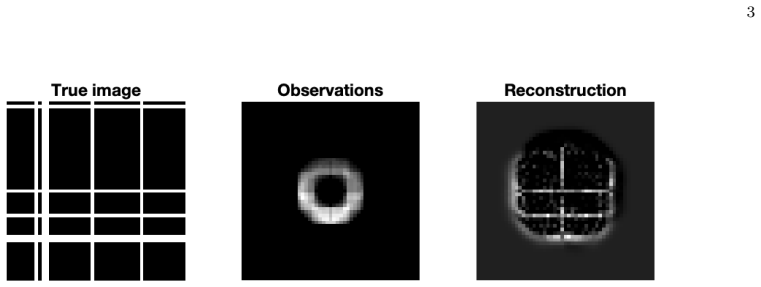
A tomography proof shows the shell of initial gravitational perturbations is stably recoverable from ISW observations.
· “Reconstruction of the observable universe from the integrated Sachs-Wolfe effect”
It fixes how much dissipation a one-dimensional sandpile can absorb before losing criticality.
· “Random walks in a field of soft traps and criticality for the dissipative Abelian Sandpile Model”
Chebyshev-based neural PDE solvers keep their learning kernel structured, and that structure tracks their error drops.

For cyclic circuits, one observable splits the reachable algebra into K copies for log K extra qubits.
Consistency, asymptotic normality, and exponential error bounds — and it feeds optimal voting weights.
· “Reconstruction of the Probability Measure and the Coupling Parameters in a Curie-Weiss Model”
Pairwise-distance conjugation turns multiple SLE null vector equations into the Calogero-Moser Hamiltonian.
· “Multiple chordal SLE(kappa) and quantum Calogero-Moser system”

First published values in 6−ε dimensions, extending known five-loop results.

Exact full counting statistics interpolate from single-file Mainardi-Wright at pure reflection to Gaussian at pure transmission.
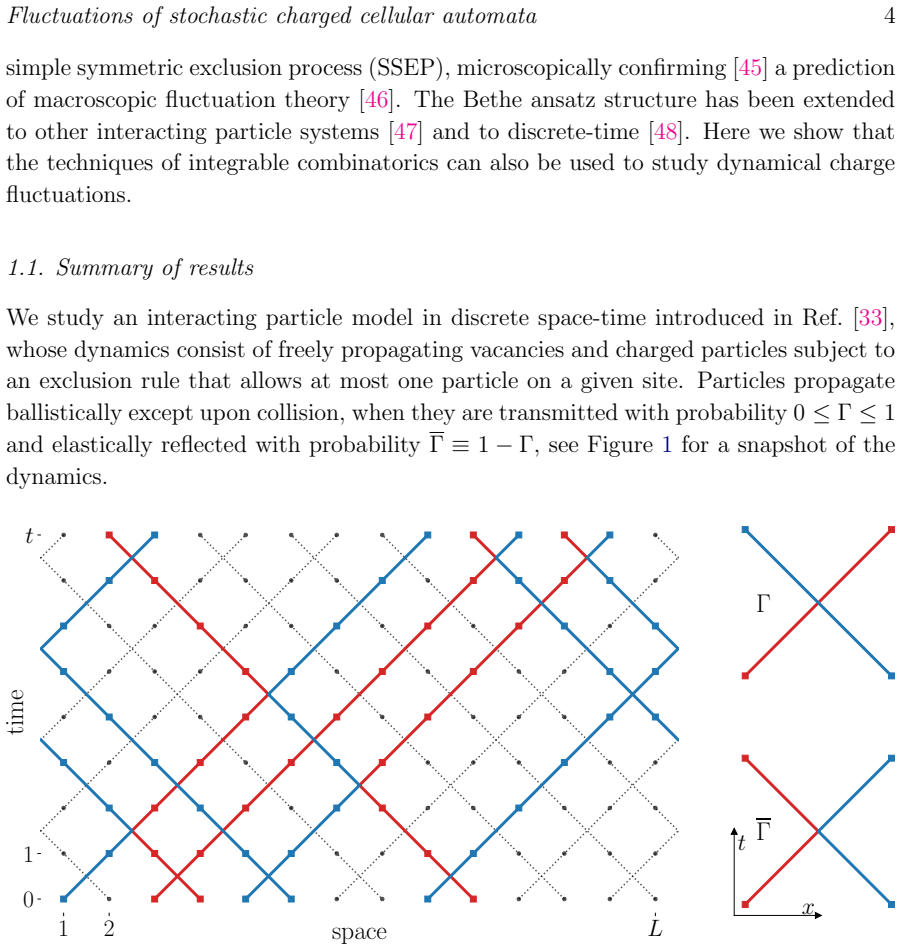
Global solutions and an invariant measure make the non-commutative quantum field theory rigorous for all couplings.
· “Stochastic quantization of λ φ₂⁴- theory in 2-d Moyal space”
Same backpropagation trick that works for depolarizing noise now covers realistic amplitude damping.

Four solar-system tests force the new terms between 10^-9 and 10^-4.
· “Black hole with global monopole charge in self-interacting Kalb-Ramond field”

A rational conformal map fixed by one quartic root gives the equilibrium measure and leading energy in the pre-critical phase.
· “Properties of the one-component Coulomb gas on a sphere with two macroscopic external charges”

A matrix-cocycle calculation gives the exact heating phase boundary and Lyapunov exponent for driven critical systems.
· “Phase Transitions in Quasi-Periodically Driven Quantum Critical Systems: Analytical Results”

A circle-based model of blackbody radiation predicts dimmer, narrower, redshifted spectra as curvature grows.

Above band width $N^{1/2+\varepsilon}$, bulk eigenvectors spread out and the local eigenvalue statistics are GUE.

A reduction chain from 3×3 Lax matrices recovers the Adler-Yamilov map and new integrable birational YB maps.
· “Reductions and degenerate limits of Yang-Baxter maps with 3times 3 Lax matrices”
A spherical-harmonic split turns 3D Dirac stability checks into one-dimensional radial problems.
· “On spectral stability of one- and bi-frequency solitary waves in Soler model in (3+1)D”
Idempotents, spinor bases, matrix reps, and norms for every real and complex algebra, extending a 1998 computation.
· “Clifford geometric algebra: Real and complex spinor data tables”
If right, the AB effect follows from topology of the punctured plane, not a coil outside the electron's reach.
An explicit analytic series for the charged scalar correlator, with QNM dispersions and superconducting Tc.
· “Exact low-temperature Green's functions in AdS/CFT: From Heun to confluent Heun”

A normalized reduced-operator objective wins on layer and time-origin perturbations and stays competitive on noise.
· “Reduced-order modeling for electromagnetic inverse problems: a layered medium benchmark”

A weak local law yields Gaussian eigenvalue counts and delocalized bulk eigenvectors.
· “Weak local law and delocalization for the Sachdev-Ye-Kitaev model”
Strong directed movement can destabilize a non-reactive equilibrium even when diffusion alone predicts no patterns.
· “Pattern formation: reactivity is not necessary for chemotaxis--driven instabilities”

A small type summary preserves the whole noise model in O(log n) memory; universal state recovery still needs every trajectory.
· “Task-Dependent Syndrome Memory in Quantum Sensing and State Recovery”

A bijective skin-and-core splitting gives every term of topological recursion a direct combinatorial meaning; no analytic assumptions needed
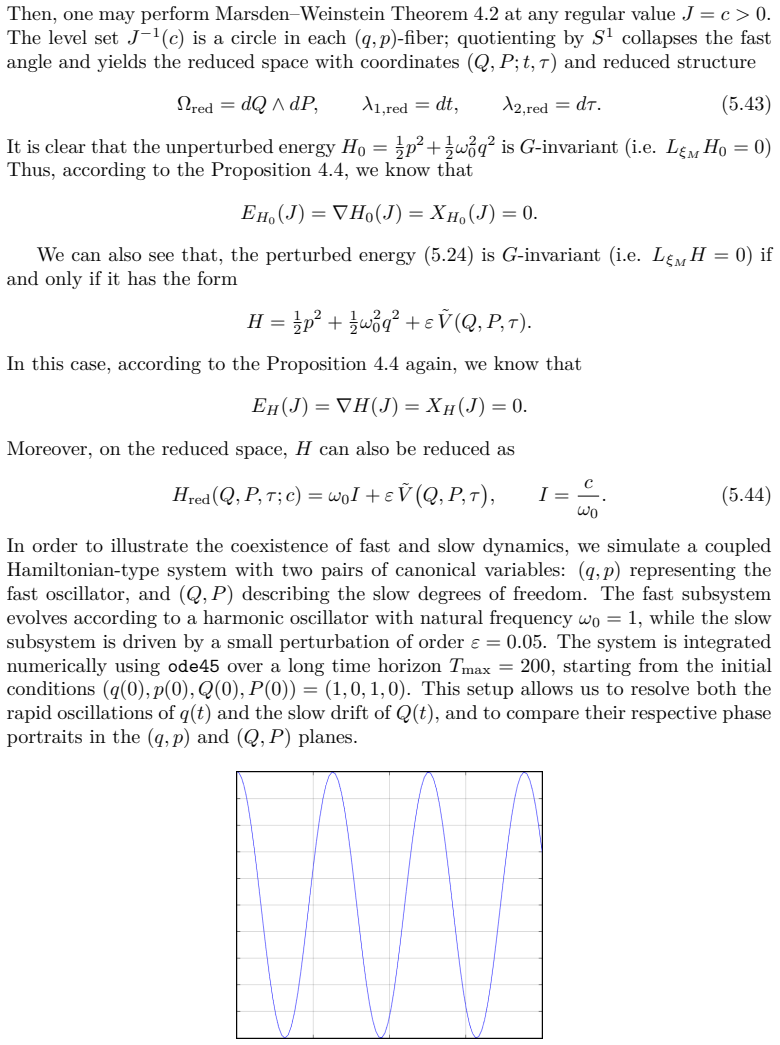
q-cosymplectic manifolds make multi-time dynamics integrable and reducible, with fast-slow clocks as a test case.
Exact formulas extend the beta=4 Pfaffian machinery to every even-square beta.
· “Hyperpfaffian Correlations for Beta-Ensembles: Beta an Even Square Integer”

The theorem in any dimension: instantons and their on-shell action are fixed by vanishing energy-momentum.
· “Soliton Surfaces and the Geometry of Integrable Deformations of the mathbb{CP}^(N-1) Model”
A periodic Feynman–Kitaev clock turns shift-register Floquet states into zero-energy eigenstates with maximal block entropy.

The boundary of a random crystal plateau shows cube-root fluctuations with an Airy-function limit law.

A capacitance operator links continuous and discrete solitons with O(δ) error, opening the way to gap and defect solitons.
The a-contraction method with a shock-strength weight gives stability for u_t + (u^p)_x = u_xx when 2 ≤ p ≤ 4.
· “L²-contraction and asymptotic stability of large shock for scalar viscous conservation laws”
Truncating at N modes gives Jacobi-elliptic stationary solutions plus a checkable error for time evolution.
· “Solving the nonlinear Klein-Gordon equation: semianalytical Galerkin method”

For spin chains with or without disorder, one large local coupling shrinks the Lieb-Robinson amplitude to 1/Δ.
· “Logarithmic lightcones in the multiparticle Anderson model with sparse interactions”

Pairing the two Teukolsky scalars works for every rotation below extremality—a step toward evaporation models.
· “The Teukolsky scalar as a gateway for quantizing gravity on rotating black holes”