REVIEW 4 major objections 4 minor 49 references
A purely geometrical Aharonov-Bohm effect
T0 review · 4 major / 4 minor · reviewed 2026-08-11 · deepseek-v4-flash
Pith's one-line read Quantizing a free particle on a punctured plane yields the Aharonov-Bohm gauge field from topology alone, with no external solenoid.
desk verdict A real ACIQ derivation of an AB-like vector potential on the punctured plane, but the flux is set by a free weight parameter and the example violates the paper's own symmetry condition. read the letter →
The pith
A machine-rendered reading of the paper's core claim, the machinery that carries it, and where it could break.
The reading
What carries the argument
The central machinery is affine covariant integral quantization (ACIQ), applied on the similitude group $\mathrm{SIM}(2)$, whose elements act on the punctured plane by translations, rotations, and dilations. ACIQ starts from a weight function $\varpi(q,p)$, or equivalently a positive operator $M_\varpi$, and forms the transported family $M_\varpi(q,p) = U(q,p) M_\varpi U^\dagger(q,p)$ under the unitary affine representation; the resolution of the identity $\int d^2q\,d^2p\, M_\varpi(q,p)/c_{M_\varpi} = \mathbf{1}$ turns any classical phase-space function $f$ into an operator $\mathrm{Op}^\varpi_f$. The load-bearing identity is the completion of the square in Eq. (V.3), which rewrites the quantized kinetic energy $\mathrm{Op}^\varpi_{p^2}$ as $(P - qA^\varpi(Q))^2 + K^\varpi/Q^2$; this identity exposes the affine vector potential $A^\varpi$ and the scalar potential $K^\varpi/Q^2$. The specific choice of $\varpi$ localized near the identity, Eq. (IV.23), with angular phase $\alpha(\arg q)=e^{i\mu\arg q}$, is what makes $A^\varpi$ nonvanishing and sets the flux $\Phi^\varpi_0 = 2\pi\hbar\mu/q$.
What would settle it
Quantize $p^2/2m$ on $\mathbb{R}^2_*$ with the same ACIQ construction but with the explicitly admissible real weight (IV.23) without the $e^{i\mu\arg q}$ factor. The topology is unchanged, yet Eq. (V.11) gives $\Phi^{\varpi}_0=0$ and the vector potential disappears; if that calculation is correct, the AB gauge field in this framework depends on the freely chosen weight, not on the puncture alone.
Extended reading notes
Core claim
Working with the similitude group $\mathrm{SIM}(2) = (\mathbb{R}^*_+ \times SO(2)) \ltimes \mathbb{R}^2 \simeq \mathbb{C}^* \ltimes \mathbb{C}$ as the phase space of the punctured plane, the paper quantizes the free-particle kinetic energy $p^2/2m$ through affine covariant integral quantization. For a weight function $\varpi(q,p)$ of the form (IV.23) with phase factor $\alpha(\arg q) = e^{i\mu\arg q}$, the resulting operator is $(P - q A^{\varpi}(Q))^2 + K^{\varpi}/Q^2$, where the vector potential has components $A^{\varpi}_{x_1} = -(\Phi^{\varpi}_0/2\pi)\,Q_2/Q^2$ and $A^{\varpi}_{x_2} = (\Phi^{\varpi}_0/2\pi)\,Q_1/Q^2$, the same functional form as the AB potential of an infinitesimally thin infinite solenoid. The emergent flux is $\Phi^{\varpi}_0 = -i(2\pi\hbar/q)\,\partial_2 \ln\Omega(1) = 2\pi\hbar\mu/q$ for the chosen phase, and taking $\mu \in \mathbb{Z}$ makes the weight $2\pi$-periodic in $\arg q$ and quantizes the flux in units of $h/q$. The scalar coefficient $K^{\varpi} = 2\hbar^2\nu^2$ for the explicit weight is positive and can be made arbitrarily large, giving a repulsive $1/Q^2$ barrier and ensuring essential self-adjointness of the Hamiltonian. On these grounds the paper claims that the AB gauge field emerges from the topological constraint and affine symmetry of the punctured plane rather than from an externally applied classical gauge field.
Load-bearing premise
The load-bearing premise is that the quantization weight $\varpi(q,p)$ takes the admissible localized form with angular phase $e^{i\mu\arg q}$; the value of $\mu$ is a free parameter, so if a different admissible weight is used the emergent vector potential can change or vanish, and the topology of the punctured plane alone does not fix the flux.
Editorial extensions
If this is right
- The AB vector potential would become an emergent object: quantizing a free particle on $\mathbb{R}^2_*$ with affine symmetry is enough to produce the same gauge field, so the interference shift should arise without an external solenoid.
- The Hamiltonian automatically includes a repulsive $1/Q^2$ scalar potential that keeps wave functions away from the punctured origin and can be tuned through the weight function to make the kinetic operator essentially self-adjoint.
- Requiring the quantization weight to be $2\pi$-periodic in the angular variable (choosing $\mu\in\mathbb{Z}$) quantizes the emergent flux in multiples of $h/q$, reproducing Dirac flux quantization through the choice of weight rather than through single-valuedness of the wave function.
- The same ACIQ structure previously gave a repulsive scalar potential on the half-line; the new result shows that the rotation and dilation structure of $\mathrm{SIM}(2)$ also generates a vector potential of the AB form.
Reading between the lines
- A consequence the authors leave implicit: because the flux is proportional to the free parameter $\mu$, ACIQ does not by itself predict the value of the AB flux; an independent physical principle is needed to fix $\mu$.
- If the derivation extends to $\mathbb{R}^3 \setminus \{0\}$, the same angular phase mechanism could produce a monopole-type vector potential; the paper lists this as a future direction but does not develop it.
- A testable extension would be to compute the interference phase for two admissible weights with the same topology but different $\alpha$; a weight-dependent phase would show that the emergent geometric AB effect is distinguishable from the conventional solenoid AB field.
Editorial analysis
A structured set of objections, weighed in public.
Referee Report
Summary. The paper applies affine covariant integral quantization (ACIQ) to quantum mechanics on the punctured plane, whose phase space is identified with the similitude group SIM(2). By quantizing the free-particle momentum and kinetic energy, the authors obtain an effective operator of the form (P - qA)^2 + K/Q^2, where A has the same functional form as the Aharonov-Bohm (AB) vector potential of an infinite solenoid, with flux Phi = 2*pi*hbar*mu/q. They interpret this as evidence that the AB effect emerges from the topological constraint imposed by the impenetrable coil rather than from an external classical gauge field. The paper reviews the ACIQ formalism, derives the operator expressions (IV.27)-(IV.28), introduces the affine vector and scalar potentials, and discusses their semiclassical portraits and implications.
Significance. If fully established, the central claim would be conceptually striking: a quantization procedure on a punctured plane generating an AB-type vector potential purely from the topology and the SIM(2) symmetry, together with an explicitly computed repulsive scalar potential. The algebraic derivation leading to Eq. (V.3) is detailed and appears internally consistent, and the paper makes good use of the previously developed ACIQ framework, providing closed-form formulas for the weight-dependent potentials. These are genuine strengths: the manuscript offers a concrete, checkable operator-level construction. However, the 'purely geometrical' claim in the title and abstract is not supported by the present text, because the magnitude of the emergent flux is fixed by a free parameter mu in the quantization weight, and the specific example that produces nonzero flux appears to violate the paper's own symmetry condition (IV.5). The value of the work lies more in exhibiting a family of AB-type vector potentials within ACIQ than in establishing a unique topological derivation.
major comments (4)
- [IV, Eq. (IV.5) and Eqs. (IV.23)-(IV.25)] The nonzero-flux example is not admissible under the stated symmetry condition. Evaluating (IV.5) at p=0 gives alpha(theta) = alpha(-theta); with alpha(theta) = exp(i mu theta), this forces mu = 0. Hence the example used to obtain Phi_0^varpi = 2*pi*hbar*mu/q in (V.12) contradicts the paper's own assumption (IV.24). Either the symmetry condition (IV.5) is misprinted, in which case the corrected condition and the admissibility of the example must be stated, or the main example falls outside the admitted class. As written, the derivation of a nonzero affine flux is internally inconsistent.
- [V, Eqs. (V.9)-(V.12)] The 'emergent' flux is determined by the free parameter mu introduced in the weight (IV.25), not by the topology of the punctured plane. The sentence 'if we choose mu = n in Z' in Section V makes this explicit. Without a physical or representation-theoretic principle that fixes mu, the construction yields a weight-dependent family of AB-type potentials, and the claim that the AB gauge field emerges purely from geometry is not supported. This is a load-bearing point for the paper's central thesis.
- [V, Eq. (V.3) and condition (V.6)] The reduction to the exact AB form (V.7)-(V.8) relies on the condition partial_1 ln Omega(1) = -2 stated in (V.6). Although this condition happens to be satisfied by the particular weight (IV.23), the general operator (V.2) contains an additional partial_1 ln Omega term in the off-diagonal part of the vector potential, as seen by comparing (V.3)-(V.5) with (V.6)-(V.8). The paper presents (V.6) as an ad hoc condition without discussing how the result depends on it; the claim that ACIQ produces the AB vector potential is therefore only established for a restricted class of weights, not as a general consequence of the method.
- [VI] The paper acknowledges in the concluding section that the induced scalar potential can prevent the electron from reaching the singularity and may suppress the standard AB interference. This caveat is central to the physical interpretation: if the scalar barrier is strong, the model may not reproduce the interference pattern of the AB effect. The paper defers a quantitative analysis to future work, leaving the physical relevance of the derived vector potential uncertain.
minor comments (4)
- [IV, Eq. (IV.4)] The phrase 'with Tr{U(q,p)M_varpi} denoting the complex conjugation of the expression' is unclear; please clarify the notation and state explicitly whether the inversion formula involves a complex conjugate.
- [V, Eq. (V.3)] The 'fictive charge' q introduced in Eq. (V.3) is never physically motivated; since the flux Phi_0^varpi in (V.10)-(V.12) depends on 1/q, the comparison with the physical AB flux requires some discussion of the meaning and possible values of q.
- [General] There are numerous typographical and formatting issues, such as missing spaces in the conclusion paragraph and inconsistent superscript/subscript notation in Appendix D; these should be corrected in a final version.
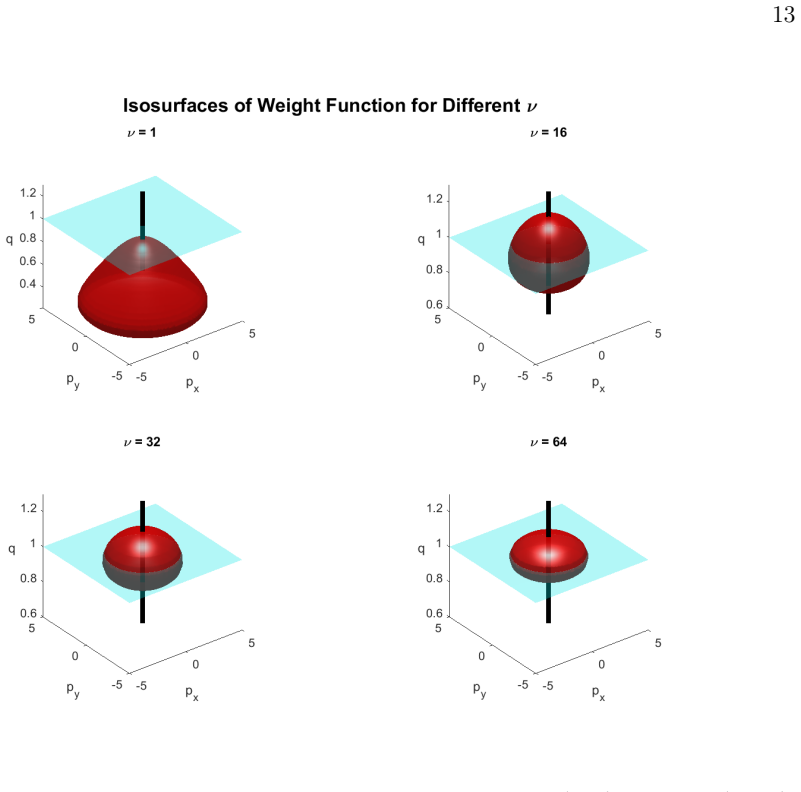
- [Figure 1] The caption says the function is normalized by its maximum modulus, but the contour and color representation is not fully described; please specify the plotted quantity, the normalization, and the meaning of the isovalue contour level.
Circularity Check
The 'emergent' AB flux is the free phase derivative α′(0) of the arbitrarily chosen weight; the result is put in by hand, not derived from topology.
-
self definitional
[Section V, Eqs. (V.11)-(V.12), with input from Section IV, Eqs. (IV.23)-(IV.25)]
"With the choice (IV.24), leading to the function Ω in (IV.26), the condition (V.6) is satisfied, and the resulting flux is given by: Φϖ0 = −i 2πℏ/q α′(0) . (V.11) With the more specific choice (IV.25) the flux takes the form Φϖ0 = 2πℏµ/q . (V.12)"
Equation (IV.25) inserts the free constant µ into the quantization weight through α(arg q)=exp(iµ arg q). Equations (V.11)-(V.12) then return the flux as 2πℏµ/q. No equation in the paper determines µ from the punctured-plane topology; the later statement 'if we choose µ = n ∈ Z' is an additional choice, not a consequence of the geometry. Thus the affine vector potential (V.7)-(V.8) is not emergent but is the logarithmic derivative of the arbitrarily chosen ϖ: Aϖ is, by construction, a functional of Ω, and Ω is fixed by the chosen α. Moreover, the stated admissibility condition (IV.5)/(IV.24) requires α(θ)=α(−θ), which exp(iµθ) obeys only for µ=0; so the nonzero-flux example contradicts the paper's own assumptions.
full rationale
The algebraic derivation leading to Eq. (V.3), i.e. the operator identity (P−qAϖ)²+Kϖ/Q², is internally consistent given the ACIQ formalism. The circularity is in the physical interpretation of Aϖ as an emergent, topological Aharonov-Bohm field. The vector potential (V.4) is defined in terms of logarithmic derivatives of Ω(1), and Ω(1) is itself computed from the freely chosen weight function ϖ in (IV.23). The flux formula (V.11) reduces exactly to α′(0), and with the specific ansatz α(θ)=exp(iµθ) the flux is simply 2πℏµ/q (V.12). The parameter µ is not fixed by any property of the punctured plane; it is an input to the quantization weight. Hence the 'derived' AB potential is equivalent, by construction, to the phase winding that was already put into α. The self-citations to [17,18] for the ACIQ framework are not themselves circular, since the framework is developed independently, but they do not rescue the main claim: the emergence claim would require that the flux be forced by the topology, whereas the paper's own equations show it is forced by the choice of ϖ. Additionally, the example used to obtain nonzero flux violates the stated symmetry condition (IV.24) for µ≠0, underscoring that the result is not robust. Score 8 reflects that the central 'purely geometrical' claim reduces by construction to an arbitrary ansatz.
Assumptions & free parameters
free parameters (4)
- mu (phase of weight function alpha) =
not fixed; mu in Z for flux quantization
- nu (localization parameter) =
not fixed; can be made arbitrarily large
- sigma (momentum width) =
3.5 in Figure 1
- q (fictive charge) =
unspecified
assumptions (4)
- domain assumption The phase space of a particle on the punctured plane R2* is the similitude group SIM(2) = (R+* x SO(2)) semidirect R2.
- domain assumption The weight function varpi satisfies Assumption 1 (smoothness, tempered distribution, bounded self-adjoint M_varpi) and the normalization Tr M_varpi = 1.
- ad hoc to paper The condition partial_1 ln Omega(1) = -2 is imposed on the weight.
- domain assumption The free Hamiltonian on the punctured plane is H0 = p^2 / 2m.
Cite this review
Pith. "Pith review of A purely geometrical Aharonov-Bohm effect." pith.science (2026). https://pith.science/paper/JLMYM7VV
@misc{pith2026241213919,
  author       = {Pith},
  title        = {Pith review of: A purely geometrical Aharonov-Bohm effect},
  year         = {2026},
  howpublished = {\url{https://pith.science/paper/JLMYM7VV}},
  note         = {Machine review of arXiv:2412.13919}
}
read the original abstract
We present an application of the affine covariant integral quantization (ACIQ) (Adv. Oper. Theory, 5, 2020; Adv. Oper. Theory, 7, 2022) to quantum mechanics on the punctured plane. The associated four-dimensional phase space is identified with the similitude group SIM(2), which comprises translations, rotations, and dilations of the plane. Due to the topology of the punctured plane, our quantization procedure gives rise to an affine vector potential. This potential can be interpreted as the Aharonov-Bohm (AB) gauge field produced by an infinite solenoid. This observation supports a reinterpretation of the AB effect: it emerges from the topological constraint imposed by the impenetrable coil rather than from an externally applied classical gauge field. In addition to this gauge structure, ACIQ also generates a repulsive, centrifugal-like scalar potential, a feature already encountered when applying ACIQ to motion on the half-line, whose phase space is the open half-plane. These results provide a new perspective on the AB effect, highlighting the central roles of topology and symmetry in quantum mechanics.
Figures
Reference graph
Works this paper leans on
-
[1]
Separable functions: 18
-
[2]
Position dependent functions 19
-
[3]
Monomial functions in momentum coordinates 19 C. Quantization with rank-one density operator 21 D. Formulae 23 References 24 I. INTRODUCTION The Aharonov-Bohm (AB) effect is a cornerstone of quantum mechanics, illustrating how topology influences physical observables [1]. Despite experimental verification, its deeper im- plications, especially concerning ...
-
[4]
We consider a finite magnetic fluxΦ0, which remains dependent on n, J and a, even asa approaches zero. The corresponding Hamiltonian is H0(x, p) = 1 2m p − q Asol 2 = p2 2m − q m Φ0 2πx2 x ∧ p + 1 2m qΦ0 2π 2 1 x2 , x = ∥x∥ . (II.4) Here (x, p) denotes a pair of canonical variables. Due to the presence of the infinitely thin solenoid, the origin of the pl...
-
[5]
(III.6) It results that e1q = q for all q, e2e2 = −e1, and so e2q = e2(q1, q2) = ( −q2, q1). One thus should avoid the confusion between this “imaginary”e2 and the “i” appearing in the canonical quantization p 7→ P = −i∇∇∇, where ∇∇∇ = ( ∂/∂q 1, ∂/∂q2) (reminder that we set ℏ = 1). The Euclidean inner product is equally denoted byRe(q∗q′) or q · q′. Consi...
-
[6]
Tr(Mϖ) = 1 2π Z R2∗ d2x bϖp(1, −x) = 1 2π Ω−2(1) = 1
Hence, the condition (IV.7) can be also written as a condition on the functionΩ−2. Tr(Mϖ) = 1 2π Z R2∗ d2x bϖp(1, −x) = 1 2π Ω−2(1) = 1 . (IV.22) Let us give the following example of a functionϖ which complies with conditions (IV.4), (IV.7), (IV.15), and (IV.17). It is a function well-localised about the affine identity(1, 0) in Γ: ϖ(q, p) = e2ν q e−ν(q+1...
-
[7]
f (q, p) = p Opϖ p = P + i Q∗ 2 + ∇∇∇Ω(1) Ω(1) . (IV.27)
-
[8]
f (q, p) = p 2 Opϖ p 2 = P2 + 2i Q∗ 2 + ∇∇∇Ω(1) Ω(1) · P − 1 Q2 4 + 4e1 · ∇∇∇Ω(1) Ω(1) + △Ω(1) Ω(1) , (IV.28) where ∇∇∇Ω(1) and △Ω(1) are given by ∇∇∇Ω(1) = Z R2∗ d2x x2 ∇∇∇q bϖp (q, x)|q=1 , △Ω(1) = Z R2∗ d2x x2 △q bϖp (q, x)|q=1 . 13 FIG. 1. Phase-space representation of the quantization weight functionϖ(q, p) defined in (IV.23), shown for angle0 rad an...
work page 2021
Show all 49 references
-
[9]
Separable functions: f (q, p) ≡ u(q) v(p) The formula (IV.19) simplifies to Aϖ u(q)v(p)(x, x′) = 1 cMϖ ˆv(x′ − x) x2 x′2 bϖp x x′ , −. ∗af fu (x) , (B.1) where • the 2D-affine convolution product∗af fon the multiplicative groupR2 ∗ = R+ ∗ ×SO(2) is defined by (f1 ∗af ff2)(x) =...
-
[10]
Note the particular cases:
Position dependent functions f (q, p) ≡ u(q) The expression (B.1) then yields the multiplication operator Opϖ u(q)ϕ (x) = 1 cMϖ (w ∗af fu)(x)ϕ(x) , (B.3) where w(x) = 2π bϖp(1, −x). Note the particular cases:
-
[11]
Then we have Opϖ qβ = 2π cMϖ Z R2∗ d2y y2+β bϖp(1, −y) Qβ = Ωβ(1) Ω(1) Qβ
u(q) is a simple power ofq, say u(q) = qβ. Then we have Opϖ qβ = 2π cMϖ Z R2∗ d2y y2+β bϖp(1, −y) Qβ = Ωβ(1) Ω(1) Qβ . (B.4)
-
[12]
For the special case of Ω(2,0,1)(1) = 0 Ω(2,1,0)(1) = cM ϖ 2π , our matrix is the unit matrix1 2
u(q) = q stands for the classical vector position in the plane, Opϖ q = 2π cMϖ Ω(2,1,0)(1) Ω (2,0,1)(1) −Ω(2,0,1)(1) Ω (2,1,0)(1) Q1 Q2 , (B.5) where we have generalized the notation (IV.21) for the following integrals Ωβ,ν1,ν2(u) := Z R2∗ d2y yβ+2 bϖp (u, −y) y...
-
[13]
∗af fu (x)
Monomial functions in momentum coordinates f (q, p) ≡ u(q) pn i 3 Monomial functions in momentum coordinates 20 Aϖ u(q) pn i (x, x′) = in 2π ccMϖ x2 x′2 δ(x′ 3−i − x3−i) δ(ni) x′ i (x′ i − xi) x2 x′2 bϖp x x′ , −. ∗af fu (x) . (B.8) Applying the corresponding operator onϕ ∈ C ...
-
[14]
(B.10) Here (∇∇∇ bϖp)(1, −·) := ∂ ∂q1 bϖp)(q, −·), ∂ ∂q2 bϖp)(q, −· q=1
f (q, p) = u(q)p Opϖ u(q)p = 2π cMϖ ( bϖp(1, −·) ∗af fu)(Q) P+ + 4πi cMϖ 1 Q∗ ( bϖp(1, −·) ∗af fu)(Q) + 2πi cMϖ 1 Q∗ ((∇∇∇ bϖp)(1, −·) ∗af fu)(Q) . (B.10) Here (∇∇∇ bϖp)(1, −·) := ∂ ∂q1 bϖp)(q, −·), ∂ ∂q2 bϖp)(q, −· q=1 . More generally and from now on, the gradient vector∇∇∇F...
-
[15]
f (q, p) = p Then the previous one simplifies to the quantum momentum: Opϖ p = P + i Q∗ 2 + ∇∇∇Ω(1) Ω(1) . (B.11)
-
[16]
(B.9) yields the quantum kinetic energy (up to the usual factor1/2m): Opϖ p 2 = P2 + 2i Q∗ 2 + ∇∇∇Ω(1) Ω(1) · P − 1 Q2 4 + 4e1 · ∇∇∇Ω(1) Ω(1) + △Ω(1) Ω(1) , (B.12)
f (q, p) = p 2 Eq. (B.9) yields the quantum kinetic energy (up to the usual factor1/2m): Opϖ p 2 = P2 + 2i Q∗ 2 + ∇∇∇Ω(1) Ω(1) · P − 1 Q2 4 + 4e1 · ∇∇∇Ω(1) Ω(1) + △Ω(1) Ω(1) , (B.12)
-
[17]
f (q, p) = q · p = q1p1 + q2p2 (generator of dilations in the plane) By using(B.6), we get: Opϖ q·p = 2π cMϖ Ω(2,1,0)(1)(Q · P + 2i) − Ω(2,0,1)Q ∧ P +i(e1 · ∇∇∇Ω(2,1,0)(1) − e2 · ∇∇∇Ω(2,0,1)(1)) . (B.13)
-
[18]
(B.14) 21 Simplified expressions for the above formulas are always possible with a suitable choice of the function ϖ
f (q, p) = q ∧ p = q1p2 − q2p1 (angular momentum) The result is given in terms of the integrals (B.6) as Opϖ q×p = 2π cMϖ Ω(2,1,0)(1)Q ∧ P + Ω(2,0,1)(1)(Q · P + 2i) +i(e1 · ∇∇∇Ω(2,0,1)(1) + e2 · ∇∇∇Ω(2,1,0)(1)) . (B.14) 21 Simplified expressions for the above formulas are alwa...
-
[19]
Aharonov and D
Y. Aharonov and D. Bohm, Significance of Electromagnetic Potentials in the Quantum Theory, Phys. Rev. A115 (1959) 485
1959
-
[20]
Aharonov, E
Y. Aharonov, E. Cohen and D. Rohrlich, Nonlocality of the Aharonov-Bohm effect,Phys. Rev. A 93 (2016) 042110
2016
-
[21]
I. L. Paiva, P. R. Dieguez, R. M. Anglo and E. Cohen, Coherence and realism in the Aharonov- Bohm effect,Phys. Rev. A107 (2023) 032213
2023
-
[22]
Strocchi and A
F. Strocchi and A. S. Wightman, Proof of the charge superselection rule in local relativistic quantum field theory,J. Math. Phys.15 (1974) 2198 - 2224
1974
-
[23]
B. S. DeWitt, Quantum Theory without Electromagnetic Potentials,Phys. Rev. 125 (1962) 2189
1962
-
[24]
Bohm and J
D. Bohm and J. Hiley, Aharanov-Bohm effect,Nuovo Cimento A52 (1979) 295-308
1979
-
[25]
Tonomura et al., Observation of Aharonov-Bohm Effect by Electron Holography,Phys
A. Tonomura et al., Observation of Aharonov-Bohm Effect by Electron Holography,Phys. Rev. Lett.48 (1983) 1443. 25
1983
-
[26]
Schmüdgen, On the Heisenberg Commutation Relation II,Publ
K. Schmüdgen, On the Heisenberg Commutation Relation II,Publ. RIMS, Kyoto Univ 19 (1983) 601-671
1983
-
[27]
Schmüdgen, Unbounded Self-adjoint Operators on Hilbert Space, Springer Dordrecht Hei- delberg New York London (2012)
K. Schmüdgen, Unbounded Self-adjoint Operators on Hilbert Space, Springer Dordrecht Hei- delberg New York London (2012)
2012
-
[28]
Ohnuki and S
Y. Ohnuki and S. Kitakado, Fundamental algebra for quantum mechanics onSD and gauge potentials, J. Math. Phys.34 (1993) 2827 - 2851
1993
-
[29]
N. P. Landsman and N. Linden, Superselection rules from Dirac and BRST quantisation of constrained systems,Nucl. Phys. B371 (1991) 415-433
1991
-
[30]
N.Ogawa, QuantumMechanicalEmbeddingofSpinningParticleandInducedSpin-connection, Mod. Phys. Lett. A12 (1997) 1583-1588
1997
-
[31]
Ohnuki, Irreducible representations of fundamental algebra for quantum mechanics onSD and gauge potentials,Proc
Y. Ohnuki, Irreducible representations of fundamental algebra for quantum mechanics onSD and gauge potentials,Proc. Sym. in Sci.8 (1995) 415-431
1995
-
[32]
Ohnuki,Proc
Y. Ohnuki,Proc. of CCI Int. Colloquium on Group Theoretical Methods in Physics, (ed. by H. D. Doebner et al.) World Scientific 406 (1997)
1997
-
[33]
McMullan and I
D. McMullan and I. Tsutsui, BPST instanton and spin from inequivalent quantizations,Mod. Phys. lett. B320 (1994) 287 - 293
1994
-
[34]
McMullan and I
D. McMullan and I. Tsutsui, On the Emergence of Gauge Structures and Generalized Spin when Quantizing on a Coset Space,Ann. Phys.237 (1994) 269 - 321
1994
-
[35]
Gazeau, T
J.-P. Gazeau, T. Koide, and R. Murenzi, 2-D covariant affine integral quantization(s),Adv. Oper. Theory5 (2020) 901-935
2020
-
[36]
Gazeau, T
J.-P. Gazeau, T. Koide, and R. Murenzi, Correction to: 2-D covariant affine integral quanti- zation(s), Adv. Oper. Theory7 (2022) 1-4
2022
-
[37]
Bergeron, J.-P
H. Bergeron, J.-P. Gazeau, P. Małkiewicz, and P. Peter, New class of exact coherent states: Enhanced quantization of motion on the half line,Phys. Rev. D109 (2024) 023516
2024
-
[38]
C. R. Almeida, H. Bergeron, J.-P. Gazeau, and A. C. Scardua, Three examples of quantum dynamics on the half-line with smooth bouncing,Ann. Phys.392 (2018) 206
2018
-
[39]
Duflo and C
M. Duflo and C. C. Moore, On the regular representation of a nonunimodular locally compact group, J. Funct. Anal.21 (1976) 209-243
1976
-
[40]
J.-M.Lévy-Leblond, Nonrelativisticparticlesandwaveequations, Comm. Math. Phys.6(1967) 286-311
1967
-
[41]
Lévy-Leblond, The pedagogical role and epistemological significance of group theory in quantum mechanics,Riv
J.-M. Lévy-Leblond, The pedagogical role and epistemological significance of group theory in quantum mechanics,Riv. Nuovo Cimento4 (1974) 99-143. 26
1974
-
[42]
Gazeau, T
J.-P. Gazeau, T. Koide and R. Murenzi, More quantum repulsive effect in rotating frame,EPL 118 (2017) 50004
2017
-
[43]
Reed and B
M. Reed and B. Simon,Methods of Modern Mathematical Physics, II. Fourier Analysis, Self- Adjointness Volume 2, Academic Press, New York, 1975
1975
-
[44]
Kowalski, K
K. Kowalski, K. Podlaski, and J. Rembieliński, Quantum mechanics of a free particle on a plane with an extracted point,Phys. Rev. A66 (2002) 032118
2002
-
[45]
Asch and P
J. Asch and P. Šťovíček, On the dynamics created by a time-dependent Ahoronov-Bohm flux, Rep. Math. Phys.59 (2007) 299
2007
-
[46]
J. F. Carinena, J.M. Gracia-Bondia, F. Lizzi, G. Marmo, and P. Vitale, Star-product in the presence of a monopole,Phys. Lett. A374 (2010) 3614-3618
2010
-
[47]
Cardona, Geometric Quantization: The Magnetic Monopole Case and Quantum Hall Effect, Mathematics Department Universidad de los Andes, Bogota, Colombia
A. Cardona, Geometric Quantization: The Magnetic Monopole Case and Quantum Hall Effect, Mathematics Department Universidad de los Andes, Bogota, Colombia
-
[48]
D.Lynden-BellandM.Nouri-Zonoz, Classicalmonopoles: Newton, NUT space, gravomagnetic lensing, and atomic spectraRev. Mod. Phys.70 (1998) 427-446
1998
-
[49]
Ohnuki,Aharonov-Bohm effect, Frontier in Physics edited by Y
Y. Ohnuki,Aharonov-Bohm effect, Frontier in Physics edited by Y. Otsuki (Kyouritsu, Tokyo,
Reviewed August 11, 2026 · model on record in the stance chip above.
Discussion (0). Continue with ORCID to comment.