REVIEW 4 major objections 6 minor 31 references
Each conformal block appears in the Stokes phenomenon of the other, with exact formulas, and z-monodromy is fixed by alien calculus in the Borel plane.
Reviewed by Pith at T0; open to challenge. T0 means a machine referee read the full paper against a public rubric. the ladder, T0–T4 →
The two conformal blocks of the phi21 four-point function are each other's Stokes corrections in the large-C expansion, and their z-monodromy is governed by alien calculus in the Borel plane.
T0 review reviewed 2026-08-05 challenge →
load-bearing objection A genuinely useful paper that makes the resurgent relation between the two phi21 conformal blocks explicit and checkable in Coulomb gas language; the central Stokes formulas hold up, but Lemma 3.1 is load-bearing and only sketched. the 4 major comments →
Resurgence for large $c$ expansion in Coulomb gas formalism
The pith
A machine-rendered reading of the paper's core claim, the machinery that carries it, and where it could break.
The reading
Core claim
The central claim is that I1(C,z)=∫_1^∞ Q^C dw and I2(C,z)=∫_0^z Q^C dw, with Q=w(w−1)(w−z), are not independent asymptotic objects. After writing each as a Laplace transform of a Borel germ—I2=Q_−^C L_0 Ψ(Q_−e^{−ζ}) and I1=Q_+^C (e^{−2πiC}/(1−e^{−2πiC})) L_{π/2+ε} Φ(Q_+e^{−ζ})—the paper computes all alien derivatives of the two germs and finds, in particular, Δ^+_{ζ^+_m} Ψ(Q_−e^{−ζ}) = Φ(Q_+e^{−ζ}). Consequently, crossing the Stokes ray with Im C<0, I2 is exactly Q_−^C (1+e^{−2πiC})/(1−e^{−2πiC}) L_{π/2+ε} Ψ(Q_−e^{−ζ}) + I1(C,z) (Theorem 3.5, eq. (60)), while I1's Stokes jump is expressed through I2 with the prefactors sin(2πC)/sin(3πC) and −sin(πC)/sin(3πC) (eq. (68)). The paper further es
What carries the argument
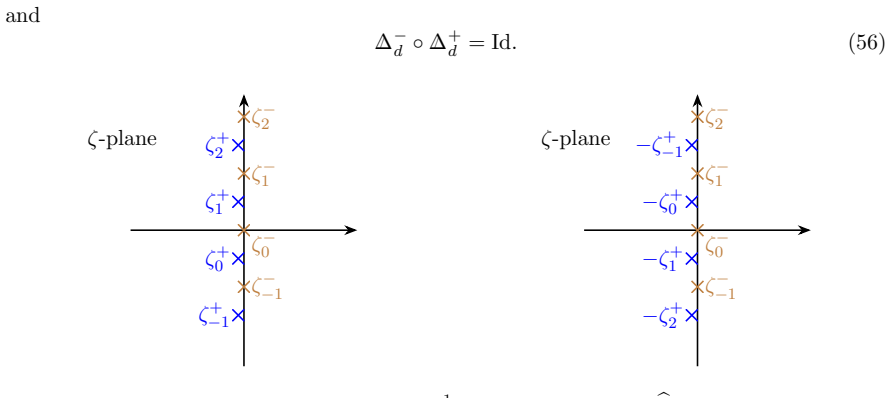
The machinery is a Borel–Laplace representation of the contour integrals I1 and I2 in the variable C. The three roots w0, w1, w2 of Q=w(w−1)(w−z) define two Borel germs: Ψ(Q)=Q·(2w1−w0−w2)/((w0−w1)(w0−w2)(w1−w2)) and Φ(Q)=Q·(w1+w2−2w0)/((w0−w1)(w0−w2)(w1−w2)). After substituting Q=Q_±e^{−ζ}, these become bψ(ζ) and bφ(ζ), whose only singularities are claimed to be integrable double branches on the two lattices ζ^−_m=2πim and ζ^+_m=−log(Q_+/Q_−)+2πim (with a mirrored lattice for bφ). The alien derivative Δ^+_ω measures the difference between two analytic continuations around a singularity, and the Stokes automorphism sums all lattice contributions; the paper's core computation is that the alie
Load-bearing premise
The load-bearing premise is Lemma 3.1: the Borel germs bψ and bφ have exactly the listed singular points—the two lattices {2πim} and {−log(Q_+/Q_−)+2πim}, plus the mirrored lattice for bφ—and each is an integrable double branch. All alien values, both Stokes formulas, and the monodromy matrices follow from this inventory; an extra singularity or a non-integrable branch would add terms everywhere.
What would settle it
Compute the Borel transform of the 1/C expansion of I2 at z=1/2 to high order and scan the Borel ζ-plane: Lemma 3.1 predicts singularities only at iπZ, all of square-root type. A singularity at any other point, or a logarithmic (non-integrable) branch at any lattice point, would invalidate formulas (60) and (68). Alternatively, numerically continue the hypergeometric expression for I2 around z=1 and compare with the monodromy matrix of Prop. 4.1; a mismatch in any matrix entry would localize the failure.
If this is right
- The large-C expansion of I2 is incomplete without I1: the full trans-series (61) contains three towers of terms, two of which are self-corrections of I2 and one of which is exactly the I1 tower.
- Starting from the perturbative series of either block, Borel resummation along the imaginary direction reconstructs the other block's non-perturbative contribution.
- The z-monodromy of (I1,I2) is determined by alien calculus in the Borel plane: Prop. 4.1 gives exact 2×2 monodromy matrices around z=0 and z=1, computable purely from how the Borel singular lattice moves.
- The duality bψ(ζ,1−z)=−bφ(ζ,z) converts crossing symmetry into a sign flip of the Borel germ, so the full four-point function can be organized as a trans-series respecting z→1−z.
- The same Coulomb-gas framework admits extensions to higher-point functions with more general degenerate operators, making Borel–Laplace analysis plus alien calculus a general resummation scheme for conformal-block data.
Where Pith is reading between the lines
- An immediate corollary not spelled out in the paper is a computational bootstrap: if one conformal block is known to high order, the Stokes formulas give the other block's trans-series with the same z-dependent coefficients, without independent computation of the second block.
- For polynomials Q(w) of degree five or higher, closed root formulas do not exist, so the explicit w_i construction stops; the paper's saddle-point/WKB remarks suggest that the alien lattice may be governed by the critical values Q_± rather than root formulas, so the same mutual-Stokes mechanism could survive in generalized integrals ∫_Γ Q^C dw.
- One testable consequence of the singularity inventory is that in unitary or Liouville-type regimes, if additional Borel singular points appear, the exact relations (60) and (68) would acquire extra terms; the framework predicts which monodromy matrix entries would then be corrected.
- The monodromy–alien calculus link, read as parametric resurgence, implies that the BPZ equation viewed as a Schrödinger equation with 1/C as the Planck constant should have WKB Stokes graphs whose crossing data match (60) and (68); verifying this would connect two independent resummation traditions.
Editorial analysis
A structured set of objections, weighed in public.
Referee Report
Summary. The paper studies the large-C expansion of the two Coulomb-gas conformal blocks I1(C,z) and I2(C,z) for the four-point function of degenerate fields phi_{2,1}. It rewrites the cubic-root solutions w_i(Q,z), obtains exact Borel-Laplace representations of I1 and I2 (Propositions 2.1 and 2.2), identifies the Borel singularities, and computes alien derivatives of the Borel germs. The central results are the Stokes formulas (60) and (68), in which I1 appears as a Stokes correction to I2 and vice versa, a z -> 1-z duality of the Borel germs (Proposition 3.1), and a derivation of z=0,1 monodromy from motion of Borel singularities (Lemma 4.3, Proposition 4.1). Independent checks are provided via hypergeometric identities and numerical coefficient comparisons.
Significance. If the Borel-plane analysis is made fully rigorous, the paper provides a concrete, well-illustrated example of resurgence and parametric resurgence in 2D CFT, connecting the Coulomb gas integral representation to Stokes phenomena and z-monodromy. The explicit verification against hypergeometric identities, e.g. (63), (69), (70), and the numerical coefficient comparisons in Fig. 3 and Remark 3.6 are genuine strengths. The paper is a useful complement to Refs. [18,20] and a potential entry point for readers interested in co-equational resurgence. The conceptual claim that resurgence 'discovers' new conformal blocks is heuristic: both blocks are present from the beginning, and the main result is a structural relation between known objects rather than a prediction of new operator content.
major comments (4)
- [Section 3, Lemma 3.1 (Eqs. (43)-(44))] The exact and complete singularity inventory for bpsi and bphi is load-bearing for the alien calculus, but its proof is only sketched. Lemma 2.2 proves the integrable double-branch behavior for the specific germ H=(w1-w0)^{-1}(w1-w2)^{-1} at Q+; Lemma 3.1 extends this to the rational combinations Psi and Phi at both Q+ and Q- by saying 'mimicking the analysis'. Since the alien values in Lemma 3.2, equation (48), and hence equations (60), (68), and Lemma 4.3 depend on there being no additional singular points and on the leading (Q-Q_pm)^{1/2} behavior, the authors should provide computations for Psi at Q- and Phi at Q+ and Q- analogous to equations (27)-(30), including a demonstration that the relevant denominators do not vanish away from the critical values. An extra pole or a different leading power would change the factor 2 in (48) and the Stokes coefficients. This is the main gap in a
- [Section 3.1, Lemma 3.8 and Eq. (68)] The reverse alien derivatives in (65) are said to be obtained by inverting the Stokes automorphism Delta/+ via equation (56), but the inversion is not displayed. Because the final Stokes formula (68) for I1 depends on the m mod 3 structure and on the prefactors sin(2pi C)/sin(3pi C) and sin(pi C)/sin(3pi C), the derivation of the individual Delta^-_omega coefficients should be given, either by a direct computation or by an explicit inversion of the generating-function identity. The hypergeometric identity (69) is a useful external check, but it does not replace the missing derivation within the alien-calculus framework.
- [Sections 2.2 and 3.2, branch choices] The Borel-Laplace representations (35) and the Stokes formulas (60) and (68) involve phases such as e^{pm 2pi i C}, e^{pi i C}, and powers Q_+^C, Q_-^C, but the branch conventions are not fixed before they are used. The 'canonical choice' (77) appears only in Section 3.2, after the main Stokes formulas have been stated. Please state the branch choices for log Q_+ and log Q_- and for Q^C along the relevant contours from the outset, and verify that all prefactors are consistent with those choices and with the analytic continuation in z used in Section 4.
- [Abstract and Introduction] The paper repeatedly says that resurgence 'enables us to discover other internal operators (conformal blocks)'. In the body, both I1 and I2 are introduced as known integrals at the beginning, and the Stokes formula (60) is checked against the known hypergeometric identity (63). The result is a valuable structural connection, but the 'discovery' language overstates the novelty and should be qualified, e.g. by saying that resurgence reproduces and relates known conformal blocks in this explicit example.
minor comments (6)
- [Section 3 heading] Typo: 'Alien culculus' should be 'Alien calculus'.
- [Figure 4 caption] Typo: 'locaeed' should be 'located'.
- [Lemma 3.8, Eq. (65)] The indexing of the last case, 'else (m >= 0)', should be checked; in particular, the m=0 entry appears to be included in the 'else' branch but this is not explicitly stated.
- [Remark 3.9] The phrase 'formula (3.9)' likely refers to equation (68) of this version; please correct the cross-reference.
- [Appendix A, Lemma A.1 proof] Minor typo: 'The Let y = arccos(x)' should read 'Let y = arccos(x)'.
- [Eq. (15)] The word 'possibly' is appropriate, but it should be reconciled with the definitive singularity inventory claimed in Lemma 3.1; the reader should know which singularities are excluded and why.
Circularity Check
No significant circularity: the Stokes and monodromy results are derived from Borel-plane monodromy of the explicit roots w_i, with hypergeometric identities used only as external cross-checks.
full rationale
The paper's central derivation chain is not circular. Propositions 2.1 and 2.2 obtain the Borel-Laplace representations (20) and (35) by direct contour rewriting of the defining integrals, using the explicit Cardano roots w_i (12) and the analytic continuation of arccos (Lemma A.2). The load-bearing alien values in Lemma 3.2, such as Δ_{ζ+_m} bψ = bφ and Δ_{ζ−_m} bψ = 2 bψ, are computed from the branch monodromy of w_i (equations (16)-(18) and (49)-(50)), not assumed from the Stokes relations being proved. Theorem 3.5 (60) and eq. (68) then follow by applying the symbolic Stokes automorphism (51)-(56); the appearance of I1 in the Stokes discontinuity of I2 is an algebraic consequence of the computed alien derivative plus the Laplace representation of I1, not a restatement of the definition of I1. The hypergeometric identities (63) and (69) are used only as external cross-checks in Remarks 3.7 and 3.9, not as inputs to the derivation. No fitted parameter is renamed as a prediction. The only load-bearing point with terse proof is Lemma 3.1's extension of the complete integrable singularity lattice to Φ and to Ψ at Q_- via 'mimicking the analysis' of Lemma 2.2; this is a rigor/completeness concern that could affect correctness if the singularity inventory were incomplete, but it is an unproven assertion about the same germs, not a circular reduction to the target result. The one self-citation, [30], supports a technical homotopy/vector-field step in Lemma 4.3 and is not load-bearing for the main claim. Hence no circularity is present.
Axiom & Free-Parameter Ledger
axioms (5)
- domain assumption Coulomb gas integrals I1(C,z) = integral_1^infty Q^C dw and I2(C,z) = integral_0^z Q^C dw are the conformal blocks of the phi21 four-point function in the channels of internal operators phi11 and phi31
- standard math Borel-Laplace and resurgence machinery: singular points of the Borel germs are integrable double-branch, alien derivatives are computed as analytic-continuation differences, and Stokes automorphisms satisfy L_{d-epsilon} = L_{d+epsilon} composed with Delta-plus_d
- ad hoc to paper The singular set of the Borel germs bpsi and bphi is exactly {zeta_m^- = 2pi i m} union {zeta_m^+ = -log(Q+/Q-) + 2pi i m} (resp. shifted set), all integrable double-branch
- ad hoc to paper Branch choices Q_+^C(1-z) = e^{pi i C} Q_-^C(z) and Q_-^C(1-z) = e^{-pi i C} Q_+^C(z) (eq (77))
- domain assumption Analytic continuation in z beyond a neighborhood of 1/2 preserves the stated singularity structure and the Stokes formulas
Cite this review
Pith. "Pith review of Resurgence for large $c$ expansion in Coulomb gas formalism." pith.science (2026). https://pith.science/paper/C732EZWF
@misc{pith2026250819059,
  author       = {Pith},
  title        = {Pith review of: Resurgence for large $c$ expansion in Coulomb gas formalism},
  year         = {2026},
  howpublished = {\url{https://pith.science/paper/C732EZWF}},
  note         = {Machine review of arXiv:2508.19059}
}
abstract
We develop a resurgence analysis for large central charge (large $C$) expansions in two-dimensional CFTs using the Coulomb gas formalism. Through the exact Borel-Laplace representations of the conformal blocks $I_1(C,z)$ and $I_2(C,z)$ associated with the four-point correlation function $ \langle \phi_{2,1}(0)\phi_{2,1}(z,\bar{z})\phi_{2,1}(1)\phi_{2,1}(\infty)\rangle$, we demonstrate that $I_1(C,z)$ participates in the Stokes phenomenon of $I_2(C,z)$ (and vice versa), and establish that monodromy in $z$ arises from alien calculus in the Borel plane variable $\zeta$ (Borel dual to $C$). From a given conformal block, resurgence theory thus enables us to discover other internal operators (conformal blocks). This approach establishes a non-perturbative connection between conformal blocks, shedding light on the resurgence phenomena in more general quantum field theories.
Figures




Reference graph
Works this paper leans on
-
[1]
Beisert et al., Review of AdS/CFT Integrability: An Overview , Lett
N. Beisert et al., Review of AdS/CFT Integrability: An Overview , Lett. Math. Phys. 99 (2012) 3–32, [ 1012.3982]
Pith/arXiv arXiv 2012
-
[2]
Pestun et al., Localization techniques in quantum field theories , J
V. Pestun et al., Localization techniques in quantum field theories , J. Phys. A 50 (2017) 440301, [1608.02952]
Pith/arXiv arXiv 2017
-
[3]
J. M. Maldacena, The Large N limit of superconformal field theories and supergravity , Adv. Theor. Math. Phys. 2 (1998) 231–252, [ hep-th/9711200]
Pith/arXiv arXiv 1998
-
[4]
Ecalle, Les fonctions r´ esurgentes
J. Ecalle, Les fonctions r´ esurgentes. Tome I, vol. 5 of Publications Math´ ematiques d’Orsay 81 [Mathematical Publications of Orsay 81] . Universit´ e de Paris-Sud, D´ epartement de Math´ ematiques, Orsay, 1981
work page 1981
-
[5]
Ecalle, Les fonctions r´ esurgentes
J. Ecalle, Les fonctions r´ esurgentes. Tome II, vol. 6 of Publications Math´ ematiques d’Orsay 81 [Mathematical Publications of Orsay 81] . Universit´ e de Paris-Sud, D´ epartement de Math´ ematiques, Orsay, 1981
work page 1981
-
[6]
Ecalle, Les fonctions r´ esurgentes
J. Ecalle, Les fonctions r´ esurgentes. Tome III, vol. 5 of Publications Math´ ematiques d’Orsay 85 [Mathematical Publications of Orsay 85] . Universit´ e de Paris-Sud, D´ epartement de Math´ ematiques, Orsay, 1985
work page 1985
-
[7]
F. J. Dyson, Divergence of perturbation theory in quantum electrodynamics , Phys. Rev. 85 (1952) 631–632. 24
work page 1952
-
[8]
J.-C. L. Guillou and J. Zinn-Justin, Large-order behaviour of perturbation theory. North-Holland : Sole distributors in USA and Canada Elsevier Science Pub. Co., 1990
work page 1990
-
[9]
M. Mari˜ no,Lectures on non-perturbative effects in large N gauge theories, matrix models and strings , Fortsch. Phys. 62 (2014) 455–540, [ 1206.6272]
Pith/arXiv arXiv 2014
-
[10]
Dorigoni, An Introduction to Resurgence, Trans-Series and Alien Calculus , Annals Phys
D. Dorigoni, An Introduction to Resurgence, Trans-Series and Alien Calculus , Annals Phys. 409 (2019) 167914, [ 1411.3585]
Pith/arXiv arXiv 2019
-
[11]
I. Aniceto, G. Basar and R. Schiappa, A Primer on Resurgent Transseries and Their Asymptotics, Phys. Rept. 809 (2019) 1–135, [ 1802.10441]
Pith/arXiv arXiv 2019
-
[12]
P. Di Francesco, P. Mathieu and D. Senechal, Conformal Field Theory . Graduate Texts in Contemporary Physics. Springer-Verlag, New York, 1997, 10.1007/978-1-4612-2256-9
-
[13]
A. A. Belavin, A. M. Polyakov and A. B. Zamolodchikov, Infinite Conformal Symmetry in Two-Dimensional Quantum Field Theory , Nucl. Phys. B 241 (1984) 333–380
work page 1984
-
[14]
D. Harlow, J. Maltz and E. Witten, Analytic Continuation of Liouville Theory , JHEP 12 (2011) 071, [ 1108.4417]
Pith/arXiv arXiv 2011
-
[15]
H. Dorn and H. J. Otto, Two and three point functions in Liouville theory , Nucl. Phys. B 429 (1994) 375–388, [ hep-th/9403141]
Pith/arXiv arXiv 1994
-
[16]
A. B. Zamolodchikov and A. B. Zamolodchikov, Structure constants and conformal bootstrap in Liouville field theory , Nucl. Phys. B 477 (1996) 577–605, [hep-th/9506136]
Pith/arXiv arXiv 1996
-
[17]
Resurgence in Liouville Theory
N. Benjamin, S. Collier, A. Maloney and V. Meruliya, Resurgence in Liouville theory , JHEP 01 (2025) 038, [ 2408.14574]
work page internal anchor Pith review Pith/arXiv arXiv 2025
-
[18]
Resurgence, Conformal Blocks, and the Sum over Geometries in Quantum Gravity
N. Benjamin, S. Collier, A. Maloney and V. Meruliya, Resurgence, conformal blocks, and the sum over geometries in quantum gravity , JHEP 05 (2023) 166, [ 2302.12851]
work page internal anchor Pith review Pith/arXiv arXiv 2023
-
[19]
M. V. Berry and C. J. Howls, Hyperasymptotics for integrals with saddles — Proceedings of the Royal Society of London. Series A: Mathematical and Physical Sciences, Proc. Roy. Soc. Lond. A V olume 434(1991) 657–675
work page 1991
-
[20]
On the $1/c$ expansion in $2d$ CFTs with degenerate operators
A. Bissi, N. Dondi, A. Piazza, T. Reis and M. Serone, On the 1/c expansion in 2d CFTs with degenerate operators , JHEP 03 (2025) 092, [ 2412.04387]
work page internal anchor Pith review Pith/arXiv arXiv 2025
-
[21]
V. S. Dotsenko and V. A. Fateev, Conformal Algebra and Multipoint Correlation Functions in Two-Dimensional Statistical Models , Nucl. Phys. B 240 (1984) 312
work page 1984
-
[22]
V. S. Dotsenko and V. A. Fateev, Four Point Correlation Functions and the Operator Algebra in the Two-Dimensional Conformal Invariant Theories with the Central Charge c < 1, Nucl. Phys. B 251 (1985) 691–734
1985
- [23]
-
[24]
J. Ecalle, Weighted products and parametric resurgence, Analyse algebrique des perturbations singulieres. I (1994)
work page 1994
-
[25]
T. Aoki, T. Takahashi and M. Tanda, The hypergeometric function, the confluent hypergeometric function and WKB solutions , Journal of the Mathematical Society of Japan 73 (2021) 1019 – 1062
work page 2021
-
[26]
R. W. D. Nickalls, A new approach to solving the cubic: Cardan ’s solution revealed , The Mathematical Gazette 77 (1993) 354 – 359
work page 1993
-
[27]
C. Mitschi and D. Sauzin, Divergent series, summability and resurgence. I , vol. 2153 of Lecture Notes in Mathematics . Springer, [Cham], 2016, 10.1007/978-3-319-28736-2
-
[28]
Sauzin, Resurgent functions and splitting problems , RIMS Kokyuroku 1493 (2005)
D. Sauzin, Resurgent functions and splitting problems , RIMS Kokyuroku 1493 (2005)
work page 2005
-
[29]
N. M. Temme, Asymptotic Methods for Integrals . WORLD SCIENTIFIC, 2014, 10.1142/9195
doi:10.1142/9195 2014
-
[30]
Y. Li, D. Sauzin and S. Sun, On the Moyal Star Product of Resurgent Series , Annales de l’Institut Fourier 73 (2023) 1987–2027
work page 2023
-
[31]
’t Hooft, Can We Make Sense Out of Quantum Chromodynamics? , Subnucl
G. ’t Hooft, Can We Make Sense Out of Quantum Chromodynamics? , Subnucl. Ser. 15 (1979) 943. 26
work page 1979
This paper was first reviewed by deepseek-v4-flash on August 5, 2026.
discussion (0)
Sign in with ORCID, Apple, or X to comment. Anyone can read and Pith papers without signing in.