REVIEW 2 major objections 5 minor 1 cited by
The limiting law of the Discrete Gaussian level lines
T0 review · 2 major / 5 minor · reviewed 2026-08-05 · deepseek-v4-flash
Pith's one-line read The paper proves that the top level-lines of the (2+1)d Discrete Gaussian model above a hard floor have N^{1/3} fluctuations, with rescale limits given by independent Ferrari-Spohn diffusions.
desk verdict A major paper that plausibly resolves the LMS16 conjecture and proves the Ferrari-Spohn limit law for ZGFF level-lines, but the lower bound leans on an explicitly flagged, unproved extension of a depinning theorem. read the letter →
The pith
A machine-rendered reading of the paper's core claim, the machinery that carries it, and where it could break.
The reading
What carries the argument
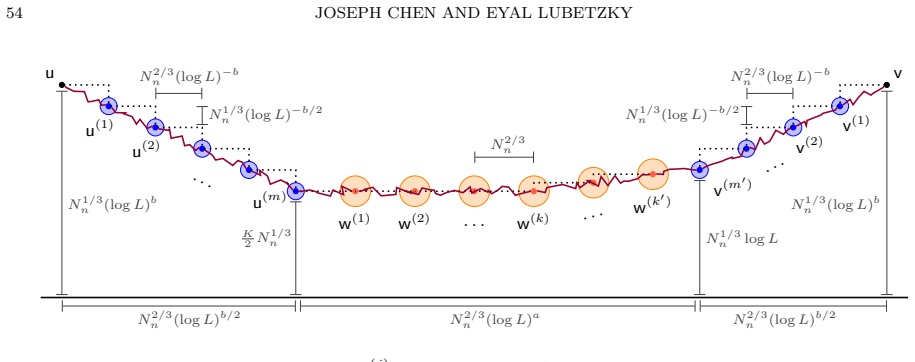
The argument is carried by a polymer representation of level-lines: a level-line is surrounded by a labeled disagreement polymer, a maximal connected component of dual bonds where neighboring heights differ, whose law is written via cluster expansion as an area-tilted polymer. Ornstein-Zernike theory, cone-points, and irreducible components turn this polymer into a two-dimensional random walk on cone-points with an area tilt, and the Ferrari-Spohn diffusion appears as the rescaling limit of that area-tilted random walk.
What would settle it
Simulate the ZGFF at large beta for non-exceptional side-lengths L, extract the top level-line, and compare the empirical distribution of N^{-1/3} rho(t N^{2/3}) at the center of the side interval with the stationary FS_sigma law. If the fluctuation exponent deviates from 1/3, or the centered marginal fails to match the squared-Airy stationary density, the central claim is wrong; a second check is whether the level-line separation N_{n+1}/N_n decays at the predicted rate exp(-Theta(sqrt(beta log L / log log L))).
Extended reading notes
Core claim
Theorem 1.1: fix beta large and take the ZGFF on an L x L box above a floor with zero boundary conditions, for side-lengths L outside an explicit exceptional set of zero logarithmic density. Let H(L) be the height where the single-site probability under the no-floor measure first drops below 5 beta / L, and let N = 1 / bpi_infty(phi_o = H), which is L^{1-o(1)}. The distance rho(x) from an interval of length N^{2/3} centered on the bottom side up to the top macroscopic level-line, rescaled as Y_0(t) = N^{-1/3} rho(t N^{2/3}), converges weakly to the stationary Ferrari-Spohn diffusion FS_sigma on [-1,1]. The same statement holds jointly for the top m level-lines, with independent FS diffusions
Load-bearing premise
The proof assumes that the depinning theorem for flat-boundary polymers extends to the disagreement-polymer model with a wiggly or random boundary; this extension is stated rather than proved, and the lower-bound half of the main theorem relies on it.
Editorial extensions
If this is right
- Confirms the LMS16 conjecture that the top level-line of the ZGFF fluctuates on scale L^{1/3+o(1)}.
- Recovers the exact limiting law: the rescaled top level-line is the stationary Ferrari-Spohn diffusion, with Airy-function marginals.
- Establishes that any finite number of top level-lines are asymptotically independent Ferrari-Spohn diffusions, due to a strong separation of scales between lines.
- Extends the same limit law to the full |grad phi|^p family for every fixed p>1, marking the p=1 (solid-on-solid) case as the exceptional one.
- Shows that the fluctuation scale is exactly L^{1/3} for infinitely many side-lengths and o(L^{1/3}) for infinitely many others, controlled by the bounds on N.
Reading between the lines
- The scale separation proved here suggests that the p=1 (SOS) case fails to have a product of FS limits not by a technical gap but because its level-lines all sit at the same scale; the conjectured correlated line ensemble is the natural contrast case.
- Near the corners, the same framework points to fluctuations of order L^{1/2}, as the paper notes; a direct simulation of level-line endpoints near corners could test whether the exponent is indeed 1/2 rather than 1/3.
- A concrete numerical check of the central claim: simulate the ZGFF at large beta for non-exceptional L, record the top level-line distance at the center of the side interval, and compare the empirical law of N^{-1/3} rho(0) with the FS_sigma stationary density proportional to the squared Airy first eigenfunction.
- If the asserted extension of flat-boundary depinning to wiggly boundaries fails, the lower bound in Section 6 would need a new mechanism; the stochastic-domination asymmetry between upper and lower bounds makes that extension the point to scrutinize.
Editorial analysis
A structured set of objections, weighed in public.
Referee Report
Summary. The paper studies the low-temperature (2+1)-dimensional Discrete Gaussian / integer-valued Gaussian free field in an L x L box above a hard floor, for side lengths outside an explicit exceptional set B. With H(L) defined from single-site probabilities and N_n as the reciprocal single-site probability of height H-n, it claims that the top m level-lines, rescaled horizontally by N_n^{2/3} and vertically by N_n^{1/3}, converge weakly to a product of independent stationary Ferrari--Spohn diffusions. The proof is a long reduction: a cluster expansion for disagreement polymers (Section 2), refined large-deviation estimates (Theorem 2.5), an Ornstein--Zernike analysis including existence and convexity of the surface tension (Section 3), Wulff-shape growth (Section 4), and upper and lower stochastic-domination bounds (Sections 5 and 6) that are matched against the known Ferrari--Spohn convergence for area-tilted random walks. The paper further extends the statement to all |\nabla\phi|^p models with p>1.
Significance. If the claims hold, this is a major result: it confirms the conjecture of Lubetzky--Martinelli--Sly on the L^{1/3+o(1)} level-line fluctuations and, more strongly, identifies the exact Ferrari--Spohn scaling limit for the top level-line of the ZGFF above a floor. It also gives the first exact level-line limit for a (2+1)-dimensional |\nabla\phi|^p model away from the SOS case, and proves asymptotic independence of finitely many level-lines. The definitions of N_n and sigma_n are model-derived rather than fitted: N_n is a reciprocal single-site probability and sigma_n is the variance of an effective Ornstein--Zernike random-walk increment. The paper is very ambitious and contains a substantial amount of novel technical machinery. The upper-bound chain and the Ornstein--Zernike/cluster-expansion parts are developed in detail. The main weakness is that the lower bound depends on an extension of the depinning theorem of [27] to disagreement polymers in a wiggly domain, and that extension is asserted rather than proved.
major comments (2)
- [Section 6, Corollary 6.4; also Section 5, Proposition 5.9] The lower bound in Theorem 6.1 reduces the problem to the comparison bZn_{Q,Q}(A,B | G⊓) = (1+o(1)) bZn_{H+,H+}(A,B), stated as Corollary 6.4. This is load-bearing: it is used to transfer the no-area depinning/repulsion estimates and then, via the area-tilt argument around Eq. (5.8), to obtain the stochastic-domination-from-below by FS_{sigma_n}. The proof of Corollary 6.4, however, rests on an asserted extension of [27, Theorem 2] from Ising polymers in a half-plane with a flat boundary to disagreement polymers in the domain Q, whose top and side boundaries are only wiggly approximations of a rectangle. The text says the proof of [27] 'is more robust and allows for more complicated geometries', but no derivation is given. The disagreement polymers here are connected sets of dual bonds with integer labels and enclosed regions D_i, and the increment measure of the associated effective ran
- [Section 6, proof of Corollary 6.4 and Theorem 6.1] The proof of Corollary 6.4 also uses a reduction from G⊓ to the unconditioned measure via [26, Theorem 5.3] and Proposition 5.9. The sentence around Eq. (6.3) says that if the domain restriction only forced cone-points to be nonnegative, then convergence to a Brownian excursion would make the event G⊓ have probability o(1). But the object whose cone-points are controlled is the disagreement polymer, and the equivalence between the cone-point process of the disagreement polymer and the effective 2D random walk has only been sketched through the Ornstein--Zernike results of Section 3. If the [27]-type depinning extension is not available, this step is also unsupported. The lower-bound proof thus has two linked missing pieces: the flat-boundary depinning transfer and the wiggly-domain comparison. Both need to be supplied before Theorem 1.1's lower bound can be regarded as proved.
minor comments (5)
- [Remark 1.2] The sentence 'yet they are o(L^{-1/3}) for infinitely many other values of L' appears to be a typo: the scale is N^{1/3}=L^{1/3-o(1)}, so it should read o(L^{1/3}), not o(L^{-1/3}).
- [Theorem 1.1 and Definition 3.20] Theorem 1.1 says 'for a fixed sigma > 0', but the matching statements in Theorems 5.1 and 6.1 use the model-dependent sigma_n from Definition 3.20. The introduction should state explicitly that the limiting diffusion is FS_{sigma_n} and that sigma_n is the constant defined in Section 3, not an arbitrary fixed parameter.
- [Theorem 4.4 and Eq. (1.2)] Equation (1.2) defines H(L) using bπ∞(φ_o = h), while the statement of Theorem 4.4 and the text around it use bπ∞(φ_o ≥ h) and N_n = 1/bπ∞(φ_o ≥ H-n). These are asymptotically close given Eq. (2.3), but the notation should be made consistent.
- [Figure 3 caption] The caption writes 'N_n^{(p)} ≍ 1/bπ^{(p)}∞(φ_o = L)'; the argument of bπ should be a height h, not the box side L. This looks like a typographical error.
- [Appendix references] Lemmas 4.7 and 6.2 are each postponed to 'Appendix B'. If the appendices are not included in the submitted version, the proofs of those two geometric reduction lemmas are missing; they should be part of the manuscript.
Circularity Check
No significant circularity; the Ferrari–Spohn law comes from an external random-walk convergence result, and N_n and σ_n are model-defined. The main caveat is an asserted extension of [27] depinning to disagreement polymers, which is a correctness gap, not a circular step.
full rationale
The claimed Ferrari–Spohn limit is not built into the model's definitions. FSσ is defined in Eq. (1.3) via the Airy function independently of the ZGFF, while the scales N_n (Eq. (1.5)) and σ_n (Definition 3.20) are defined from the model's single-site probabilities and from the variance of the effective random walk under the polymer measure P^{h_n}_y. Neither parameter is fitted to the limiting diffusion. The proof reduces the level-line law to an area-tilted 2D random walk and then invokes the external convergence result [25] for that walk; Sections 5 and 6 provide matching stochastic-domination upper and lower bounds, so the FS law is not assumed at any step. Self-citations are present ([35] for the plateau theorem and possibly [7]/[25] for the random-walk and SOS inputs), but they are prior proved results used as tools, not a chain that defines the conclusion. The manuscript itself flags the one substantive gap: the extension of [27, Theorem 2] from Ising polymers to disagreement polymers is asserted, not proved, in the paragraph beginning 'Forgetting the area term for now...' and in Corollary 6.4, and the closing paragraph of Section 6 concedes: 'our proof relies strongly on the depinning proved in [27], and it is unclear how to extend those results to the case of a wiggly boundary.' This is a missing proof / robustness claim, not a circularity: the depinning estimate is a technical tool, not the target law, and the failure mode would be an unproved bound rather than an identity between input and output. Similarly, Proposition 5.9 imports [27, Prop. 13] for disagreement polymers with the same caveat. No equation exhibits a fitted parameter renamed as a prediction, and no definition makes the target law equivalent to the inputs by construction. The derivation is therefore self-contained up to the cited external random-walk limit, with the depinning-extension gap affecting correctness risk but not circularity.
Assumptions & free parameters
assumptions (6)
- domain assumption Large deviation estimates for the infinite-volume ZGFF (Eqs. (2.3)-(2.4)): bpi_infty(phi_o=h) = exp(-2 pi beta h^2/log h + O(h^2/log^2 h)) and the ratio bound.
- standard math Existence, analyticity and strict convexity of the surface tension tau_{beta,n} for disagreement polymers (Prop 3.12).
- ad hoc to paper Depinning theorem for polymers in a half-space ([27, Thm 2]) extends to disagreement polymers with area-tilts.
- standard math Area-tilted 2D random walk bridges conditioned to stay above a floor converge to Ferrari-Spohn diffusion ([25, Sec. 6]).
- standard math Random walk estimates from [26] (Thm 5.10) on hitting probabilities for nonnegative 2D random walks.
- standard math FKG inequality and Peierls bounds for the ZGFF.
Cite this review
Pith. "Pith review of The limiting law of the Discrete Gaussian level lines." pith.science (2026). https://pith.science/paper/QH6CDELK
@misc{pith2026250904333,
  author       = {Pith},
  title        = {Pith review of: The limiting law of the Discrete Gaussian level lines},
  year         = {2026},
  howpublished = {\url{https://pith.science/paper/QH6CDELK}},
  note         = {Machine review of arXiv:2509.04333}
}
abstract
Consider the $(2+1)$D Discrete Gaussian (ZGFF, integer-valued Gaussian free field) model in an $L\times L$ box above a hard floor. Bricmont, El-Mellouki and Fr\"ohlich (1986) established that, at low enough temperature, this random surface exhibits entropic repulsion: the floor propels the average height to be poly-logarithmic in $L$. The second author, Martinelli and Sly (2016) showed that, for all but exceptional values of $L$, the surface has a plateau whose height concentrates on an explicit integer $H(L)$, and fills nearly the full square. It was conjectured there that the boundary of this plateau -- the top level-line of the surface -- should have random fluctuations of $L^{1/3+o(1)}$. We confirm this conjecture of [LMS16] and further recover the limiting law of the top level-line: there exists an explicit sequence $N=L^{1-o(1)}$ such that the distance of the top level-line from $I$, the interval of length $N^{2/3}$ centered along the side boundary, converges, after rescaling it by $N^{1/3}$ and the width of the interval by $N^{2/3}$, to a Ferrari--Spohn diffusion. In particular, the level-line fluctuations at, say, the center of $I$, have a limit law involving the Airy function rescaled by $N^{1/3}$. This gives the first example of one of the $(2+1)$D $|\nabla \phi|^p$ models (approximating 3D Ising and crystal formation) where a Ferrari--Spohn limit law of its level-lines is confirmed (ZGFF is the case $p=2$). More generally, we find the joint limit law of any finite number of top level-lines: rescaling their distances from the side boundary, each by its $(N_n^{2/3},N_n^{1/3})$, yields a product of Ferrari--Spohn laws. These new results extend to the full universality class of $|\nabla\phi|^p$ models for any fixed $p>1$.
Figures


Figures from the paper (6 more)



Forward citations
Cited by 1 Pith paper
-
The limit shape and emergence of the Discrete Gaussian level lines
Top level lines in the Discrete Gaussian model converge globally to deterministic shapes with Wulff corners; macroscopic h-level lines emerge discontinuously in a window of width at most L^{1/2+o(1)}.
Reference graph
Works this paper leans on
- [25]
- [27]
-
[1]
M. Basu Roy Chowdhury, P. Caputo, and S. Ganguly. Characterizing Gibbs states for area-tilted Brownian lines. Ann. Probab. To appear
-
[2]
R. Bauerschmidt, J. Park, and P.-F. c. Rodriguez. The Discrete Gaussian model, I. Renormalisation group flow at high temperature. Ann. Probab., 52(4):1253–1359, 2024
work page 2024
-
[3]
R. Bauerschmidt, J. Park, and P.-F. c. Rodriguez. The discrete Gaussian model, II. Infinite-volume scaling limit at high temperature. Ann. Probab., 52(4):1360–1398, 2024
work page 2024
-
[4]
R. Brandenberger and C. E. Wayne. Decay of correlations in surface models. J. Statist. Phys. , 27(3):425–440, 1982
work page 1982
-
[5]
J. Bricmont, A. El Mellouki, and J. Fr¨ ohlich. Random surfaces in statistical mechanics: roughening, rounding, wetting,. . .. J. Statist. Phys. , 42(5-6):743–798, 1986
work page 1986
-
[6]
W. K. Burton, N. Cabrera, and F. C. Frank. The growth of crystals and the equilibrium structure of their surfaces. Philos. Trans. Roy. Soc. London Ser. A , 243:299–358, 1951
work page 1951
Show all 43 references
-
[7]
Caddeo, Y
P. Caddeo, Y. H. Kim, and E. Lubetzky. On level line fluctuations of SOS surfaces above a wall. Forum Math. Sigma, 12:Paper No. e91, 59, 2024
2024
-
[8]
Campanino, D
M. Campanino, D. Ioffe, and Y. Velenik. Ornstein-Zernike theory for finite range Ising models above Tc. Probab. Theory Related Fields, 125(3):305–349, 2003
2003
-
[9]
Caputo and S
P. Caputo and S. Ganguly. Uniqueness, mixing, and optimal tails for Brownian line ensembles with geometric area tilt. Probab. Math. Phys. , 6(1):195–239, 2025
2025
-
[10]
Caputo, D
P. Caputo, D. Ioffe, and V. Wachtel. Confinement of Brownian polymers under geometric area tilts. Electron. J. Probab., 24:Paper No. 37, 21, 2019. 74 JOSEPH CHEN AND EYAL LUBETZKY
2019
-
[11]
Caputo, D
P. Caputo, D. Ioffe, and V. Wachtel. Tightness and line ensembles for Brownian polymers under geometric area tilts. In Statistical mechanics of classical and disordered systems, volume 293 of Springer Proc. Math. Stat., pages 241–266. Springer, Cham, 2019
2019
-
[12]
Caputo, E
P. Caputo, E. Lubetzky, F. Martinelli, A. Sly, and F. L. Toninelli. The shape of the (2 + 1) D SOS surface above a wall. C. R. Math. Acad. Sci. Paris , 350(13-14):703–706, 2012
2012
-
[13]
Caputo, E
P. Caputo, E. Lubetzky, F. Martinelli, A. Sly, and F. L. Toninelli. Dynamics of (2 + 1)-dimensional SOS surfaces above a wall: Slow mixing induced by entropic repulsion. Ann. Probab., 42(4):1516–1589, 2014
2014
-
[14]
Caputo, E
P. Caputo, E. Lubetzky, F. Martinelli, A. Sly, and F. L. Toninelli. Scaling limit and cube-root fluctuations in SOS surfaces above a wall. J. Eur. Math. Soc. (JEMS) , 18(5):931–995, 2016
2016
-
[15]
S. T. Chui and J. D. Weeks. Phase transition in the two-dimensional coulomb gas, and the interfacial roughening transition. Phys. Rev. B , 14:4978–4982, Dec 1976
1976
-
[16]
Dembo, E
A. Dembo, E. Lubetzky, and O. Zeitouni. On the limiting law of line ensembles of Brownian polymers with geometric area tilts. Ann. Inst. Henri Poincar´ e Probab. Stat., 60(1):113–125, 2024
2024
-
[17]
Dobrushin, R
R. Dobrushin, R. Koteck´ y, and S. Shlosman. Wulff construction , volume 104 of Translations of Mathemati- cal Monographs. American Mathematical Society, Providence, RI, 1992. A global shape from local interaction, Translated from the Russian by the authors
1992
-
[18]
P. L. Ferrari and H. Spohn. Constrained Brownian motion: fluctuations away from circular and parabolic barriers. Ann. Probab., 33(4):1302–1325, 2005
2005
-
[19]
Fr¨ ohlich and T
J. Fr¨ ohlich and T. Spencer. Kosterlitz-Thouless transition in the two-dimensional plane rotator and Coulomb gas. Phys. Rev. Lett. , 46(15):1006–1009, 1981
1981
-
[20]
Fr¨ ohlich and T
J. Fr¨ ohlich and T. Spencer. The Kosterlitz-Thouless transition in two-dimensional abelian spin systems and the Coulomb gas. Comm. Math. Phys. , 81(4):527–602, 1981
1981
-
[21]
Gheissari and E
R. Gheissari and E. Lubetzky. Approximate domain Markov property for rigid Ising interfaces. J. Stat. Phys. , 190(5):99, 2023
2023
-
[22]
Greenberg and D
L. Greenberg and D. Ioffe. On an invariance principle for phase separation lines. Ann. Inst. H. Poincar´ e Probab. Statist., 41(5):871–885, 2005
2005
-
[23]
Grimmett
G. Grimmett. The random-cluster model, volume 333 of Grundlehren der mathematischen Wissenschaften [Fun- damental Principles of Mathematical Sciences] . Springer-Verlag, Berlin, 2006
2006
-
[24]
Hegde, Y
M. Hegde, Y. H. Kim, and C. Serio. Scaling limit and tail bounds for a random walk model of SOS level lines,
-
[26]
Ioffe, S
D. Ioffe, S. Ott, Y. Velenik, and V. Wachtel. Invariance principle for a Potts interface along a wall. J. Stat. Phys., 180(1-6):832–861, 2020
2020
-
[28]
Ioffe, S
D. Ioffe, S. Shlosman, and Y. Velenik. An invariance principle to Ferrari-Spohn diffusions. Comm. Math. Phys. , 336(2):905–932, 2015
2015
-
[29]
Ioffe and Y
D. Ioffe and Y. Velenik. Ballistic phase of self-interacting random walks. In Analysis and stochastics of growth processes and interface models, pages 55–79. Oxford Univ. Press, Oxford, 2008
2008
-
[30]
J. M. Kosterlitz. Kosterlitz–thouless physics: a review of key issues. Reports on Progress in Physics, 79(2):026001, jan 2016
2016
-
[31]
Koteck´ y and D
R. Koteck´ y and D. Preiss. Cluster expansion for abstract polymer models.Comm. Math. Phys. , 103(3):491–498, 1986
1986
-
[32]
P. Lammers. A dichotomy theory for height functions, 2022. Preprint, arXiv:2211.14365
2022 arXiv
-
[33]
Lammers and S
P. Lammers and S. Ott. Delocalisation and absolute-value-FKG in the Solid-On-Solid model. Probab. Theory Related Fields, 188(1-2):63–87, 2024
2024
-
[34]
Laslier and E
B. Laslier and E. Lubetzky. Tilted Solid-On-Solid is liquid: scaling limit of SOS with a potential on a slope,
-
[35]
Lubetzky, F
E. Lubetzky, F. Martinelli, and A. Sly. Harmonic pinnacles in the discrete Gaussian model. Comm. Math. Phys. , 344(3):673–717, 2016
2016
-
[36]
Martinelli and F
F. Martinelli and F. L. Toninelli. On the mixing time of the 2D stochastic Ising model with “plus” boundary conditions at low temperature. Comm. Math. Phys. , 296(1):175–213, 2010
2010
-
[37]
Ott and F
S. Ott and F. Schweiger. Quantitative delocalization for Solid-On-Solid models at high temperature and arbitrary tilt, 2025. Preprint, arxiv:2505.16804
2025 arXiv
-
[38]
V. Richter. Multi-dimensional local limit theorems for large deviations. Theory of Probability & Its Applications , 3(1):100–106, 1958
1958
-
[39]
C. Serio. Scaling limit for line ensembles of random walks with geometric area tilts. Electron. J. Probab., 28:Paper No. 124, 14, 2023. THE LIMITING LA W OF THE DISCRETE GAUSSIAN LEVEL-LINES 75
2023
-
[40]
Sheffield
S. Sheffield. Random surfaces. Ast´ erisque, (304):vi+175, 2005
2005
-
[41]
J. Villain. Theory of one- and two-dimensional magnets with an easy magnetization plane. II. The planar, classical, two-dimensional magnet. Journal de Physique , 36(6):581–590, 1975. J. Chen Courant Institute, New York University, 251 Mercer Street, New York, NY 10012, USA. Em...
1975
-
[2024]
Preprint, arXiv:2409.08745
-
[2025]
Preprint, arXiv:2502.10384
Reviewed August 5, 2026 · model on record in the stance chip above.
Discussion (0). Continue with ORCID to comment.