REVIEW 3 major objections 4 minor 50 references
Edge states in square lattice media and their deformations
T0 review · 3 major / 4 minor · reviewed 2026-08-05 · deepseek-v4-flash
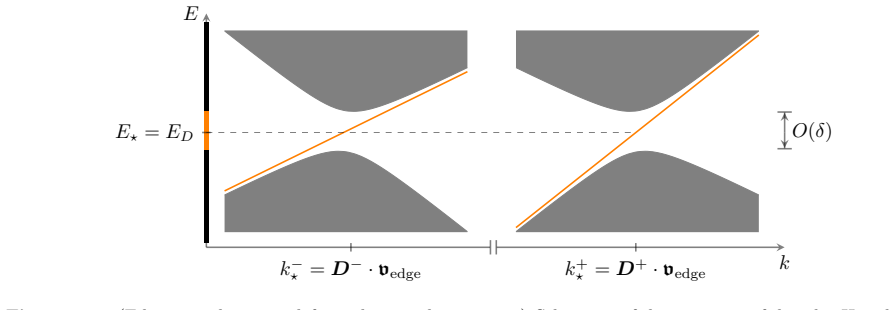
Pith's one-line read Two edge-state curves traverse the band gap of square-lattice edge media; each is seeded by an explicit effective operator that describes its bifurcation from the bulk degeneracy.
desk verdict A careful and useful asymptotic derivation of effective edge Hamiltonians for square and deformed square lattices, with an honest but load-bearing gap: the claimed exact eigenvalue curves rest on an unverified spectral no-fold condition. read the letter →
The pith
A machine-rendered reading of the paper's core claim, the machinery that carries it, and where it could break.
The reading
What carries the argument
The carrying mechanism is the two-scale asymptotic expansion of solutions to the edge eigenvalue problem in powers of $\delta$. At leading order, an edge state is a slowly varying envelope modulation of the degenerate Floquet-Bloch modes at $(E_\star, k_\star)$, with envelope amplitude living on the transverse coordinate $X = \delta K_2\cdot x$. Solvability of the order-$\delta^2$ equation (square case) or order-$\delta$ equation (deformed case) in the hierarchy is equivalent to an eigenvalue problem for the effective edge Hamiltonian acting on that envelope in $L^2(\mathbb{R};\mathbb{C}^2)$: $S(\kappa)$ for quadratic degeneracies, $\mathcal{D}_\pm(\kappa)$ for conical degeneracies, with $P_
What would settle it
Verify the spectral no-fold condition for the concrete potential, magnetic term, and tilt used in the Section 8 simulations by computing the band structure of $H_{\rm bulk}$ along the direction $K_2$ away from the degeneracy: if some band crosses energy $E_\star$ at a quasimomentum away from $k_\star$, the quasimode energies of Theorems 6.1 and 6.5 need not be eigenvalues, and the two curves could lie in essential spectrum. Alternatively, for the effective operator $S(0)$, choose a smooth domain wall $\chi$ with $\int_{\mathbb{R}}(\chi^2-1) > 0$ and slow transition; Theorem 7.5 predicts no gap
Extended reading notes
Core claim
The paper's central claim is that, for both undeformed and deformed square-lattice media, the edge Hamiltonian has for small $\delta$ two discrete eigenvalue branches traversing the common band gap near the bulk degeneracy, consistent with bulk-edge correspondence. These branches are seeded by the discrete spectra of effective edge Hamiltonians: a matrix Schrödinger operator $S(\kappa)$ for quadratic degeneracies, and a pair of Dirac operators $\mathcal{D}_\pm(\kappa)$ for conical degeneracies, whose eigenvalue curves give the blow-up of the full edge-state curves. The paper supports this with a multiple-scale construction of quasimodes and with numerical simulations.
Load-bearing premise
The unperturbed bulk band structure must satisfy a 'spectral no-fold condition' — the dispersion surfaces must not fold over the degeneracy energy away from the degeneracy point — so that a genuine spectral gap exists; the paper requires this condition but does not verify it for any example.
Editorial extensions
If this is right
- Each gap-traversing curve seen in the full edge spectrum near the degeneracy is labelled by a bound state of an explicit one-dimensional effective operator: the symmetric pair of eigenvalues $\Omega_\pm = \pm\Omega$ of $S(0)$ in the square-lattice case, and the zero-energy bound states of $\mathcal{D}_\pm(0)$ in the deformed case.
- The spectral flow of the effective families $\kappa \mapsto S(\kappa)$ and $\kappa \mapsto \mathcal{D}_\pm(\kappa)$ equals the difference of bulk Chern numbers ($\pm 2$ in total), so the multiple-scale analysis gives a constructive route to the bulk-edge correspondence: the topology is carried by the effective operators rather than by an index-theoretic argument alone.
- A direct variational criterion decides whether the gap eigenvalues exist: Proposition 7.7 reduces the question to finding a negative direction for the quadratic form of $L = S(0)^2 - \vartheta^2$, and Theorem 7.5 makes this checkable through the sign of $\int_{\mathbb{R}}(\chi^2-1)$; steep domain walls also work even when the sign condition fails (Theorem 7.6).
- The edge states are localized transverse to the edge on the $O(\delta^{-1})$ domain-wall scale and oscillate on the O(1) lattice scale, with energies $E = E_\star + \delta^2\Omega(\kappa)$ in the square case and $E = E_\star + \delta\Omega(\kappa)$ in the deformed case.
Reading between the lines
- The paper stops short of verifying the spectral no-fold condition for any concrete potential, so the rigorous status of the two curves as true discrete eigenvalues remains conditional; a natural next step is to check the condition numerically for the specific $V$, $A$, and tilt used in the Section 8 simulations, since a failure could push the quasimode energies into essential spectrum.
- Reading the two cases together suggests a deformation plateau: as the tilt parameter grows from zero, the single matrix-Schrödinger description should continuously break into two Dirac descriptions, so one might look for an interpolating family of effective Hamiltonians bridging $S(\kappa)$ and $\mathcal{D}_\pm(\kappa)$ — a bridge the authors identify as subtle because of the different $\delta$-sc
- The variational route of Proposition 7.7 turns the existence of gap eigenvalues into a sign condition on the domain wall; extended to the full edge Hamiltonian, it predicts that domain walls with $\int(\chi^2-1) \geq 0$ and slow transition can push the edge states into the bands, a tendency the paper's own numerics already hint at.
- The gap-traversal (spectral flow) rather than mere existence of curves is the topological signature: for a topologically trivial interpolation with $\chi \to +1$ at both infinities the effective operators show non-traversing curves and zero flow, so the two-curve count is tied to the domain wall's sign change.
Editorial analysis
A structured set of objections, weighed in public.
Referee Report
Summary. The paper studies two-dimensional Schrödinger edge Hamiltonians H^δ_edge that slowly interpolate, across a rational line defect, between two bulk Hamiltonians H^{±,δ}_bulk obtained from a square-lattice potential by a small time-reversal-breaking magnetic perturbation. In the undeformed square lattice case the unperturbed bulk spectrum has a quadratic band degeneracy; under a linear deformation it splits into a pair of Dirac points. The authors derive two-scale asymptotic expansions of edge-state quasimodes near these degeneracies, obtaining an effective matrix Schrödinger operator S(κ) in the quadratic case and two Dirac operators D^±(κ) in the conical case. They give solvability conditions for the formal hierarchy (Propositions 6.3, 6.4, 6.6), prove some spectral results for the effective operators at κ=0, and present finite-strip numerical simulations displaying two gap-traversing edge curves for the full operator. The paper claims that these curves are seeded by the discrete spectra of the effective Hamiltonians and that the behavior is consistent with the bulk-edge correspondence principle.
Significance. If the approximate-to-exact step were completed, the paper would provide a constructive, quantitative account of topological edge states in square-lattice and deformed square-lattice media, complementing index-theoretic treatments of the bulk-edge correspondence. The formal multiple-scale hierarchy is carefully derived, with explicit solvability conditions and effective Hamiltonians whose parameters are expressed in terms of the degenerate Floquet–Bloch eigenspaces. There is also genuine spectral analysis of the effective operators: Propositions 7.2 and 7.11 characterize essential spectra, Theorems 7.5–7.6 establish pairs of gap eigenvalues of S(0) under stated hypotheses, and Proposition 7.13 gives zero-energy bound states for D^±(0). The numerical section provides useful qualitative confirmation. However, the paper’s central spectral claim about the full edge Hamiltonian is not proven: the step from quasimodes to exact eigenvalues is deferred to an unverified 'spectral no-fold condition'.
major comments (3)
- [Section 6.4.1; Theorems 6.1 and 6.5] The paper’s central claim—that the bulk band gap is traversed by two discrete eigenvalue curves of H^δ_edge—is not established. Theorem 6.1 constructs an 'approximate solution' and Theorem 6.5 states that (6.19) 'has solutions', but the proofs supply only a formal two-scale expansion and no resolvent or remainder estimate. Section 6.4.1 explicitly states that converting the quasimode (6.32) into an exact eigenpair requires a 'spectral no-fold condition' on the unperturbed band structure, and that this condition 'must be verified separately.' No verification is provided for the potentials, deformations, or edges used in Section 8. This is load-bearing: for fixed parallel quasimomentum k, the essential spectrum of H^δ_edge is the union over transverse quasimomenta q of the L^2_{kK_1+qK_2}(R^2/Λ) spectra of the bulk operators; a local L^2_k(R^2/Λ) band gap at (E_⋆, k_⋆) does not imply an L^
- [Theorem 6.5 and its proof; Section 6.2] Theorem 6.5 is stated as giving actual solutions of (6.19) with expansions (6.21)–(6.22), yet the proof terminates at the leading-order solvability condition of Proposition 6.6; no O(δ^2) remainder estimate, closed resolvent argument, or convergence theorem is given. This is precisely the step that requires the missing spectral no-fold condition discussed in Section 6.4.1. In addition, part 2 of the theorem switches the effective Hamiltonian to D^−(κ) while the expansion (6.22) still uses the Φ^{D+} basis; the authors should either restate the basis or give the symmetry argument that justifies this replacement. The theorem should be reformulated as a quasimode statement unless the exact-eigenvalue proof is supplied.
- [Sections 7.1–7.2] The paper asserts that the effective Hamiltonians S(κ) and D^±(κ) have gap-traversing eigenvalue curves, but the rigorous results prove only local information. Theorems 7.5 and 7.6 establish the existence of two eigenvalues of S(0) at κ=0 under stated hypotheses; Proposition 7.8 computes the slopes of the eigenvalue curves at κ=0. No argument is given that these curves persist for all κ ∈ R, remain in the spectral gap, and connect the two essential-spectrum components. Similarly, for D^±(κ), Proposition 7.14 gives only a local Taylor expansion of the curve through zero energy, and Proposition 7.15 treats a special subclass with linear curves. Since the global gap-traversing curves are the link between the effective Hamiltonians and the full edge-state diagrams, their existence is load-bearing. If the authors rely on topological spectral-flow results from [2,3,45], this dependence should
minor comments (4)
- [Section 4.3.2] Typo: 'traverse the the k ↦ L^2_k(R^2/Zv_1) band gap' should read 'traverse the ... band gap.'
- [Theorem 6.5 and Figure 7.4] In Theorem 6.5(b) the basis in (6.22) should be reconciled with the D^− effective Hamiltonian; in the caption of Figure 7.4 both panels are labelled D^−(κ), but one is clearly intended to be D^+(κ).
- [Section 8.1.2] The finite-strip computation imposes Dirichlet conditions at x_1=±30 and then discards 'spurious' boundary-localized eigenstates. The paper should state how these branches were identified and how many were discarded, and ideally include a domain-width convergence check to show that the retained gap curves are stable.
- [Section 7.1 notation] In Section 7 the M superscripts on α_ℓ, ϑ are suppressed without a reminder after they were used in Section 6; a one-line note would avoid confusion between effective Hamiltonian parameters and those in (6.2).
Circularity Check
No significant circularity: the effective edge Hamiltonians are derived from bulk band data by a multiple-scale expansion, not fitted to edge spectra.
full rationale
The derivation chain is self-contained. The effective edge Hamiltonians S(κ) and D±(κ) are obtained from the solvability conditions of the multiple-scale hierarchy (Propositions 6.3, 6.4, 6.6): their coefficients (α, γ, ϑ) are computed from Floquet–Bloch eigenfunctions and bulk perturbation parameters, and the quasimode energies are then expressed in terms of eigenvalues of these effective operators. No parameter is fitted to the edge-state eigenvalue curves; the numerical simulations in Section 8 are comparisons, not fitting steps. The deformed-square-lattice input (existence and structure of Dirac points) is imported from [7], a prior paper by two of the present authors, but that is a published, parameter-free derivation with stated assumptions and is therefore independent support, not a circular invocation. Similarly, the use of quadratic-degeneracy results from [36,37] and the cited bulk-edge correspondence [12] rests on external proofs. The one genuine gap in the paper is explicitly acknowledged in Section 6.4.1: the passage from quasimodes to true edge eigenvalues requires a 'spectral no-fold condition' that 'must be verified separately' and is not verified for any example. This is a correctness or open-problem caveat about unproven discreteness of the quasimode energies, not a circularity: the effective Hamiltonians are not defined in terms of the edge-state curves they predict, and no claimed prediction reduces by construction to an input.
Assumptions & free parameters
free parameters (4)
- effective matrix Schrödinger parameters (α0, α1, α2, ϑ) =
1, 1, 1, 1
- effective Dirac parameters (a0, a1, a2, b2, c) =
0.3, 1, 1, 1, 0.5
- numerical potential bump amplitude and width =
-150, 1/4
- domain wall steepness in full simulations =
tanh(10X)
assumptions (6)
- standard math Floquet-Bloch decomposition and band gap definitions
- domain assumption Quadratic band degeneracy structure Q1-Q5 for square lattice potentials
- domain assumption Conical degeneracy structure D1-D4 for generic linear deformations
- domain assumption Bulk-edge correspondence principle: spectral flow equals difference of Chern numbers
- domain assumption Spectral no-fold condition
- domain assumption Domain wall functions χ(X) with χ^2→1 sufficiently rapidly
Cite this review
Pith. "Pith review of Edge states in square lattice media and their deformations." pith.science (2026). https://pith.science/paper/RV3HBVKE
@misc{pith2026250809352,
  author       = {Pith},
  title        = {Pith review of: Edge states in square lattice media and their deformations},
  year         = {2026},
  howpublished = {\url{https://pith.science/paper/RV3HBVKE}},
  note         = {Machine review of arXiv:2508.09352}
}
read the original abstract
Edge states are time-harmonic solutions of conservative wave systems which are plane wave-like parallel to and localized transverse to an interface between two bulk media. We study a class of 2D edge Hamiltonians modeling a medium which slowly interpolates between periodic bulk media via a domain wall across a "rational" line defect. We consider the cases of (1) periodic bulk media having the symmetries of a square lattice, and (2) linear deformations of such media. Our bulk Hamiltonians break time-reversal symmetry due to perturbation by a magnetic term, which opens a band gap about the band structure degeneracies of the unperturbed bulk Hamiltonian. In case (1), these are quadratic band degeneracies; in case (2), they are pairs of conical degeneracies. We demonstrate that this band gap is traversed by two distinct edge state curves, consistent with the bulk-edge correspondence principle of topological physics. Blow-ups of these curves near the bulk band degeneracies are described by effective (homogenized) edge Hamiltonians derived via multiple-scale analysis which control the bifurcation of edge states. In case (1), the bifurcation is governed by a matrix Schr\"{o}dinger operator; in case (2), it is governed by a pair of Dirac operators. We present analytical results and numerical simulations for both the full 2D edge Hamiltonian spectral problem and the spectra of effective edge Hamiltonians.
Figures


Figures from the paper (9 more)


Reference graph
Works this paper leans on
-
[1]
M. J. Ablowitz and J. T. Cole. Discrete approximation of topologically protected modes in magneto-optical media. Physical Review A , 101(2):023811, 2020
work page 2020
-
[2]
G. Bal. Topological invariants for interface modes. Commun. in PDE, 47(8), 1636–1679. , 47:1636, 2022
work page 2022
-
[3]
G. Bal. Topological charge conservation for continuous insulators. J. Math. Phys. , 64:031508, 2023
work page 2023
-
[4]
B.A. Bernevig and T.L. Hughes. Topological Insulators and Topological Superconductors. Princeton University Press, 2013. 46
work page 2013
-
[5]
M. Cassier and M. I. Weinstein. High contrast elliptic operators in honeycomb structures. Multiscale Model. Simul., 19(4):1784–1856, 2021
work page 2021
-
[6]
J. Chaban. Band structure degeneracies and edge states in square lattice media and their deformations. PhD thesis, Columbia University, 2025. In preparation
work page 2025
-
[7]
J. Chaban and M. I. Weinstein. Instability of quadratic band degeneracies and the emergence of Dirac points. SIAM J. Math. Anal. , 57(2):1892–1938, 2025
work page 1938
-
[8]
Y. D. Chong, X.-G. Wen, and M. Soljaˇ ci´ c. Effective theory of quadratic degeneracies.Phys. Rev. B , 77(23):235125, 2008
work page 2008
Show all 50 references
-
[9]
N. Doll, H. Schulz-Baldes, and N. Waterstraat. Spectral flow: A functional analytic and index-theoretic approach. De Gruyter, 2023
2023
-
[10]
A. Drouot. The bulk edge correspondence for continuous honeycomb lattices. Commun. PDE , 44(12):1406–1430, 2019
2019
-
[11]
A. Drouot. The bulk-edge correspondence for continuous dislocated systems. Annales de l’Institut Fourier, 71:1185–1239, 2021
2021
-
[12]
A. Drouot. Microlocal analysis of the bulk-edge correspondence. Commun. Math. Phys. , 383:2069–2112, 2021
-
[13]
A. Drouot. Ubiquity of conical points in topological insulators. Journal de l’ ´Ecole polytechnique – Math´ ematiques, 8(23):507–532, 2021
2021
-
[14]
Drouot, C
A. Drouot, C. L. Fefferman, and M. I. Weinstein. Defect modes for dislocated periodic media. Communications in Mathematical Physics , 377(3):1637–1680, 2020
2020
-
[15]
Drouot and C
A. Drouot and C. Lyman. Band spectrum singularities for Schr¨ odinger operators. https://arxiv.org/abs/2410.02092, 2024
2024 arXiv
-
[16]
Drouot and M
A. Drouot and M. I. Weinstein. Edge states and the valley Hall effect. Advances in Mathematics , 368:107142, 2020
2020
-
[17]
M. Eastham. Spectral Theory of Periodic Differential Equations . Hafner Press, 1974
1974
-
[18]
Elbau and G
P. Elbau and G. M. Graf. Equality of bulk and edge Hall conductances revisted. Comm. Math. Phys. , 229:415–432, 2002
2002
-
[19]
Elgart, G
A. Elgart, G. M. Graf, and J. H. Schenker. Equality of the bulk and the edge Hall conductances in a mobility gap. Comm. Math. Phys. , 259:185–221, 2005
2005
-
[20]
C. L. Fefferman, J. P. Lee-Thorp, and M. I. Weinstein. Topologically protected states in one-dimensional continuous systems and Dirac points. Proceedings of the National Academy of Sciences, page 07391, 2014
2014
-
[21]
C. L. Fefferman, J. P. Lee-Thorp, and M. I. Weinstein. Bifurcations of edge states – topologically protected and non-protected – in continuous 2d honeycomb structures. 2D Mater. , 3:014008, 2016
2016
-
[22]
C. L. Fefferman, J. P. Lee-Thorp, and M. I. Weinstein. Edge states in honeycomb structures. Annals of PDE , 2(12), 2016
2016
-
[23]
C. L. Fefferman, J. P. Lee-Thorp, and M. I. Weinstein. Topologically protected states in one-dimensional systems. Memoirs of the American Mathematical Society , 247(1173), 2017
2017
-
[24]
C. L. Fefferman and M. I. Weinstein. Honeycomb lattice potentials and Dirac points. Journal of the American Mathematical Society, 25(4):1169–1220, 2012
2012
-
[25]
C. L. Fefferman and M. I. Weinstein. Wave packets in honeycomb lattice structures and two-dimensional Dirac equations. Commun. Math. Phys. , 326:251–286, 2014. 47
2014
-
[26]
Fruchart and D
M. Fruchart and D. Carpentier. An introduction to topological insulators. Comptes Rendus. Physique , 14(9-10):779–815, 2013
2013
-
[27]
A. K. Geim and K. S. Novoselov. The rise of graphene. Nature materials, 6(3):183–191, 2007
2007
-
[28]
G. M. Graf and M. Porta. Bulk-edge correspondence for two-dimensional topological insulators. Comm. Math. Phys. , 324(3):851–895, 2012
2012
-
[29]
F. D. M. Haldane and S. Raghu. Possible realization of directional optical waveguides in photonic crystals with broken time-reversal symmetry. Phys. Rev. Lett. , 100:013904, 2008
2008
-
[30]
M. Z. Hasan and C. L. Kane. Colloquium: Topological Insulators. Reviews of Modern Physics , 82:3045, 2010
2010
-
[31]
Hatsugai
Y. Hatsugai. The Chern number and edge states in the integer quantum hall effect. Phys. Rev. Lett. , 71:3697–3700, 1993
1993
-
[32]
Jackiw and C
R. Jackiw and C. Rebbi. Solitons with fermion number 1/2. Phys. Rev. D , 13:3398–3409, 1976
1976
-
[33]
C. L. Kane and E. J. Mele. Z2 topological order and the quantum spin Hall efect. Phys. Rev. Lett. , 95:146802, 2005
2005
-
[34]
C. L. Kane and E. J. Mele. Quantum spin hall effect in graphene. Physical Review Letters, 95(22):226801, 2005
2005
-
[35]
T. Kato. Perturbation theory for linear operators , volume 132. springer, 1995
1995
-
[36]
R. T. Keller, J. L. Marzuola, B. Osting, and M. I. Weinstein. Spectral band degeneracies of π 2 -rotationally invariant periodic Schr¨ odinger operators.Multiscale Modeling & Simulation , 16(4):1684–1731, 2018
2018
-
[37]
R. T. Keller, J. L. Marzuola, B. Osting, and M. I. Weinstein. Erratum: Spectral band degeneracies of π 2 -rotationally invariant periodic schr¨ odinger operators.Multiscale Modeling & Simulation , 18:1371–1373, 2020
2020
-
[38]
P. A. Kuchment. Floquet Theory for Partial Differential Equations , volume 60. Birkhauser, Basel, 2012
2012
-
[39]
P. A. Kuchment. An overview of periodic elliptic operators. Bulletin of the American Mathematical Society, 53(3):343–414, 2016
2016
-
[40]
J. P. Lee-Thorp, M. I. Weinstein, and Y. Zhu. Elliptic operators with honeycomb symmetry: Dirac points, edge states and applications to photonic graphene. Archive Rat. Mech. Anal. , 232:1–63, 2019
2019
-
[41]
Ozawa, H
T. Ozawa, H. M. Price, A. Amo, N. Goldman, M. Hafezi, L. Lu, M. C. Rechtsman, D. Schuster, J. Simon, O. Zilberberg, and I. Carusotto. Topological photonics. Rev. Mod. Phys. , 91:015006, 2019
2019
-
[42]
Paulose, B
J. Paulose, B. G. Chen, and V. Vitelli. Topological modes bound to dislocations in mechanical metamaterials. Nat. Phys. , 11:153–156, 2015
2015
-
[43]
Prodan and H
E. Prodan and H. Schulz-Baldes. Boundary Invariants for Complex Topological Insulators: From K-Theory to Physics . Springer-Verlag, Berlin, 2016
2016
-
[44]
Qiu and H
J. Qiu and H. Zhang. A mathematical theory of integer quantum Hall effect in photonics. arXiv preprint arXiv:2405.17200, 2024
2024 arXiv
-
[45]
Quinn and G
S. Quinn and G. Bal. Approximations of interface topological invariants. SIAM J. Math. Anal. , 56, 2024
2024
-
[46]
Raghu and F
S. Raghu and F. D. M. Haldane. Analogs of quantum-Hall-effect edge states in photonic crystals. Phys. Rev. A , 78(3):033834, 2008. 48
2008
-
[47]
Reed and B
M. Reed and B. Simon. Methods of Modern Mathematical Physics , volume 4. Elsevier, 1978
1978
-
[48]
D. J. Thouless, M. Kohmoto, M. P. Nightgale, and M. Den Nijs. Quantized hall conductance in a two-dimensional periodic potential. Phys. Rev. Lett. , 49:405, 1982
1982
-
[49]
G. Volovik. The universe in a helium droplet. International Series of Monographs on Physics , 2009
2009
-
[50]
Z. Wang, Y. D. Chong, J. D. Joannopoulos, and M. Soljaˇ ci´ c. Reflection-free one-way edge modes in a gyromagnetic photonic crystal. Phys. Rev. Lett. , 100:013905, 2008. 49
2008
Reviewed August 5, 2026 · model on record in the stance chip above.
Discussion (0). Continue with ORCID to comment.