ML screens 4,575 electrolytes
Fine-tuned neural potential plus structural descriptors cut per-candidate evaluation from days to minutes.
Materials Science
Techniques, synthesis, characterization, structure. Structural phase transitions, mechanical properties, phonons. Defects, adsorbates, interfaces
sort pith recommended most recent
Fine-tuned neural potential plus structural descriptors cut per-candidate evaluation from days to minutes.
Microwatts of green plus milliwatts of near-infrared cut charge-prep error from ~30% to ~5% in shallow diamond sensors.

Perpendicular LiF/Li2O seams block electrons; parallel seams accelerate electron flow.
It works for Mohr-Coulomb, Drucker-Prager, and any linear strength surface without re-derivation.

A naturally oxidized Fe3GeTe2 layer gives a gate-tunable 1.4 kOe exchange bias and voltage-controlled magnetic writing.
The signal comes from collinear magnetic order, not from a field-induced magnetization.
· “Anomalous Spectroscopical Effects in an Antiferromagnetic Semiconductor”

When circuits get complex or data is sparse, training on ln(I) instead of I keeps PINNs accurate.

Twenty new candidates for magnetopiezoelectric and spin-orbit-free spin Hall effects.

The surface reaction keeps the nanoparticles fluorescent and adds an anchor for PEG and biomolecule conjugation.
· “Thiolation and PEGylation of silicon carbide nanoparticle”

A 100 MHz DMI term quantitatively reproduces the measured drop, vanish, and partial recovery of ODMR with magnetic field.
· “Spin dependent fluorescence mediated by anti-symmetric exchange in triplet exciton pairs”

Coordination, atomic radii, and cohesive energy replace DFT and machine learning—accuracy about 5 kJ/mol.
· “Analytic model for grain-boundary segregation ener-gies in metal polycrystal”

Graphite contacts and hBN encapsulation expose the intrinsic effect, backed by shift-current calculations.
· “Unveiling intrinsic bulk photovoltaic effect in atomically thin ReS2”
Accurate nonlocal functionals become practical for large-scale simulations with accuracy nearly unchanged.

Raman measurements tie phonon shifts to magnetic order above 300 K in Fe3GaTe2, a first for van der Waals magnets.

A computational search maps 50 iron-nitride phases, with hardness up to five times iron's and no brittle compounds.
· “The Fe-N system: crystal structure prediction, phase stability, and mechanical properties”
Simultaneous Mg and Si K-edge fits show near-total depletion of both elements into dust, while total abundances stay solar.

The Dirac equation predicts ±1/(2m²c²) for spin-up and spin-down bands, a term the Schrödinger-Pauli equation misses.
· “Time inversion symmetry in the Dirac and Schr\"odinger-Pauli theories”
Recording a full diffraction pattern for every tilt lets users discard directions corrupted by dynamical diffraction.
· “Sequential tilting 4D-STEM for improved momentum-resolved STEM field mapping”

Rotating the field splits resistivity into 2φ magnetic, 6φ crystal, and 3φ altermagnetic Hall parts.

Relaxing strain along one axis slows hot-carrier decay there, enabling polarization-selective picosecond optics.
· “Anisotropic Strain Relaxation-Induced Directional Ultrafast Carrier Dynamics in RuO2 Films”
Europium in ZnCdO quantum wells emits 616-nm light; 700 C annealing brightens it via defect-assisted energy transfer.

New calculation overturns the single-node explanation and predicts electron doping can quadruple the conductivity.

Weyl points near the Fermi level explain a two-stage Hall signal, a first for a noncentrosymmetric magnet.
· “Unconventional anomalous Hall effect in hexagonal polar magnet Y₃Co₈Sn₄”

A new regrowth process and Al2O3 passivation push beta-gallium-oxide RF transistors to record speeds with no current collapse.
· “High performance vacuum annealed beta-(AlxGa1-x)2O3/Ga2O3 HFET with f_T/f_MAX of 32/65 GHz”

The 51 meV redshift of NiO's M-edge shows the on-site Coulomb repulsion dropping ~100 meV in a few femtoseconds.
· “Correlations drive the attosecond response of strongly-correlated insulators”
Polymer-free peel preserves crystal quality, lifting flexible FETs to rigid-substrate performance.
Hysteresis, nonlinear transport, and a symmetry change point to a charge order that superconductivity normally hides.

Covalently anchored pyrene layers hold graphene in harsh baths and lift device yield to 99.7%.
· “Wafer-scale robust graphene electronics under industrial processing conditions”

A thermodynamically consistent entropy calculation reconciles the REOS3 and MH13 Jupiter adiabats.

With pattern motion removed, PCA and k-means compare two LaFeO3 growths quantitatively for the first time.

Analytic one-phonon theory and colloid simulations predict a striped, anisotropic moiré state instead of the usual hexagonal one.
· “Striped twisted state in the orientational epitaxy on quasicrystals”

The alloy's 0.36 nm decay length and high resistivity rule it out for cryogenic memory.
· “Comparison of NiFeCr and NiFe in ferromagnetic Josephson junctions”

Direct nano-ARPES images show reversible hole and electron doping in monolayer and bilayer flakes on glass.
· “Space Charge Doping Induced Band Modulation in Mono- and Bi-layer Graphene: a nano-ARPES study”

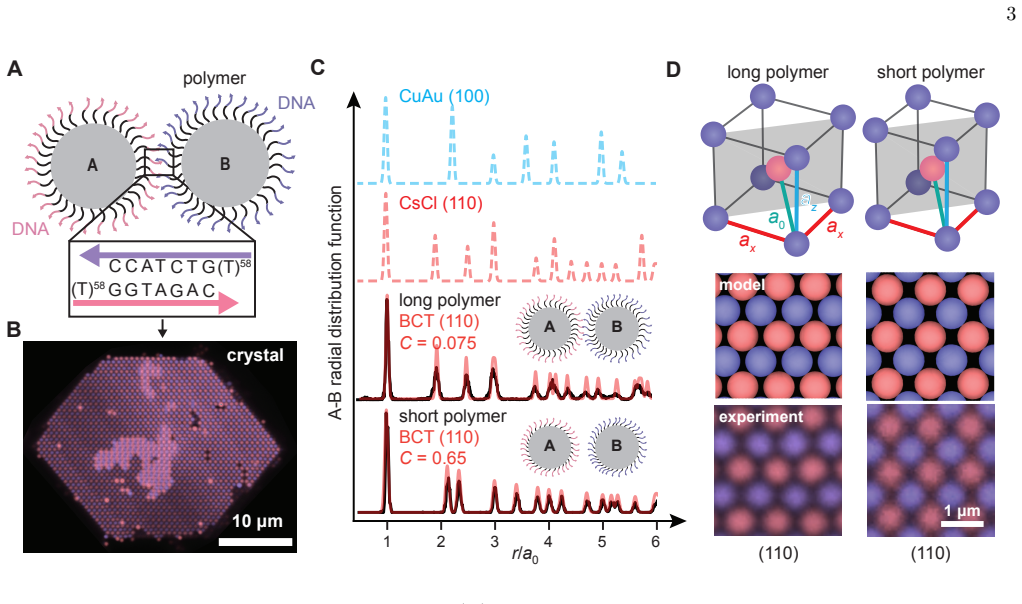
Polymer length and particle size shift the lattice between cesium-chloride and copper-gold forms.
A two-hour ethanol bath exfoliates graphite into micro-sized sheets with cleaner crystal order.

Browser-based tool spans silicon, perovskite, and organic cells with built-in tunneling, exciton, and ion-migration models.
· “SolarDesign: An Online Photovoltaic Device Simulation and Design Platform”

First-principles calculations put WB2 on the ductile side; CrB2 and MoB2 stay brittle.
Stronger grain-boundary trapping increases hydrogen flux, even when boundary and lattice diffusivity match.

Band folding at 1/3 a* and 0.28 b* creates Dirac cones and explains the 1/3 magnetization plateau.

A machine-learning surrogate plus MBAR reweighting keeps energies within 1 meV/atom of AIMD at a fraction of the cost.

Counting length-weighted shortest paths from loaded to opposite edge beats standard centrality on four lattice types.
Machine-learned tensors reproduce NMR spectra for silica, zeolites, and a phase transition.
· “Graph-neural-network predictions of solid-state NMR parameters from spherical tensor decomposition”

A phonon energy-sink mechanism explains why coercivity grows with temperature in chiral-coated magnets.

First-principles calculations show the altermagnetic metal's anomalous transport is set by the spin-axis orientation.
· “N\'eel vector-dependent anomalous transport in altermagnetic metal CrSb”

Two years of plant data let a neural network beat the 90-year-old Bogue equation used for cement quality control.
· “Industrial-scale Prediction of Cement Clinker Phases using Machine Learning”

The solution-processed CsPbBr3 film is built directly into a silicon nitride waveguide, no III-V bonding needed.
A topochemical Li-for-Mg swap preserves octahedral nitride layers, giving MgZrN2 and MgHfN2 with ~2.0 eV absorption.
· “Ion exchange synthesizes layered polymorphs of MgZrN₂ and MgHfN₂, two metastable semiconductors”

A DFT-to-QED calculation ties each atom's charge shift to a mass change, from near-free-electron to 10^-24 kg, and re-rates the bonds.
A modulated 1550-nm laser turns lock-in phase contrasts into 2D wavefront maps, simplifying magnon imaging.
· “Phase-resolving spin-wave microscopy using infrared strobe light”

Nanosecond path-integral runs see water break apart three times; classical and heavy-water runs never do.
· “Quantum Delocalization Enables Water Dissociation on Ru(0001)”

New calculations in BaCuF4, Ca3Mn2O7, and BiFeO3 point to electric-field control of altermagnets
· “Altermagnetic multiferroics and altermagnetoelectric effect”

Electronic excitations in ErTe3 are diffusive; static susceptibility grows at ordering wavevector as temperature drops.
· “Measurement of the dynamic charge susceptibility near the charge density wave transition in ErTe₃”

Two nickel forms share m = 0.011 over seven strain-rate decades; modeling predicts localized grain-boundary hotspots

Seed layers, adhesion, and contact geometry—not oxide thickness—control strain in 2D transistors.
· “Direct X-Ray Measurements of Strain in Monolayer MoS₂ from Capping Layers and Geometrical Features”

Adding $f=\gamma v^{\alpha}$ to Simmons' model reproduces Al/Al2O3/Al I-V curves and reveals the 137 K dissipation turnover.

First 4d AM6X6 kagome metal with a density wave; distortion lives on Lu-Sn chains, not the kagome plane.

The doubled-frequency current spikes at the spin-orbit splitting, with peak height set by the scattering time.
· “Resonant second harmonic generation in a two-dimensional electron system”

Atomic-scale imaging shows hafnium oxide nucleates on ambient carbon contamination, so air exposure steers ALD coating.
· “Resolving the Nucleation Stage in Atomic Layer Deposition of Hafnium Oxide on Graphene”

In a 1D elastoplastic bar, it finds the smallest additive fix keeping dissipation non-negative at every instant.
· “Solving the Dissipation Inequality not as a constitutive restriction”

3D X-ray tomography shows curved Co/Pd regions favor right-handed Néel walls, marking curvature as a spintronic design knob.

Twist angle, strain, and electric fields can now shape magnetic order, from skyrmions to spin liquids.

A 2-qubit Deutsch-Jozsa test suggests noise memory times, not just strength, set algorithm success.

Fitting particle-tracking data yields one number α that predicts the low-frequency loss modulus.

DFT maps the full water-splitting path on g-C3N4/TiO2-B; the bottleneck drops from 1.103 to 0.999 eV.
A new 'extreme compatibility' criterion brings compound twins into the low-hysteresis design space.
· “Revisiting the cofactor conditions: Elimination of transition layers in compound domains”

Compressive-sensing FDTR cuts imaging time 2-6 fold while keeping micrometer resolution and sub-15 percent error.
· “Thermal Property Microscopy with Compressive Sensing Frequency-Domain Thermoreflectance”

A frozen water film moves dry-rubbed particle masks to silicon, sapphire, or PDMS, for near-zero-reflection optics and T-cell activation.

Platelet 'linear complexions' on dislocations add a time barrier absent in classical precipitation, simulations show.
· “Enhanced strain rate sensitivity due to platelet linear complexions in Al-Cu”

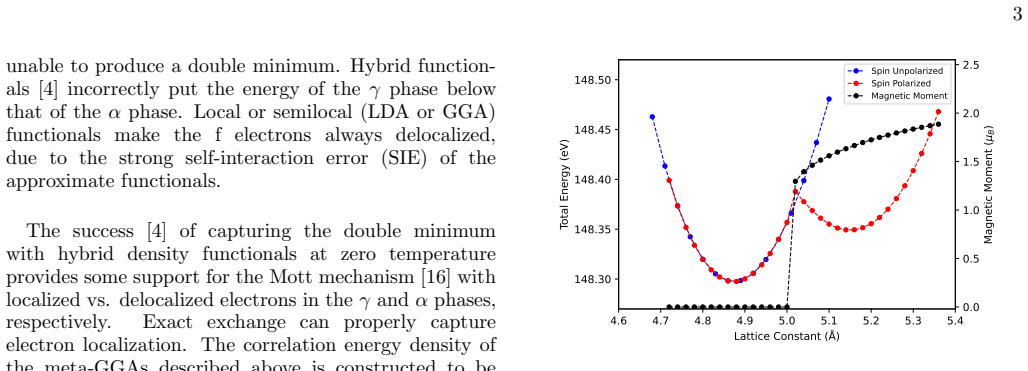
The LAK meta-GGA gets the lattice constants, magnetic jump, and volume collapse right without exact exchange.
Removing intermetallic heat raises ignition thresholds but not combustion temperatures, pointing to atomized powders as a scalable route.

Glass magnetism onsets near 80 K, superconductivity near 12 K, and the substrate tunes the gap.

A slab calculation finds a chiral p-wave surface gap, with vortex-core Majorana states and Tc near 20 K.
· “Phonon-mediated intrinsic topological superconductivity in Fermi arcs”

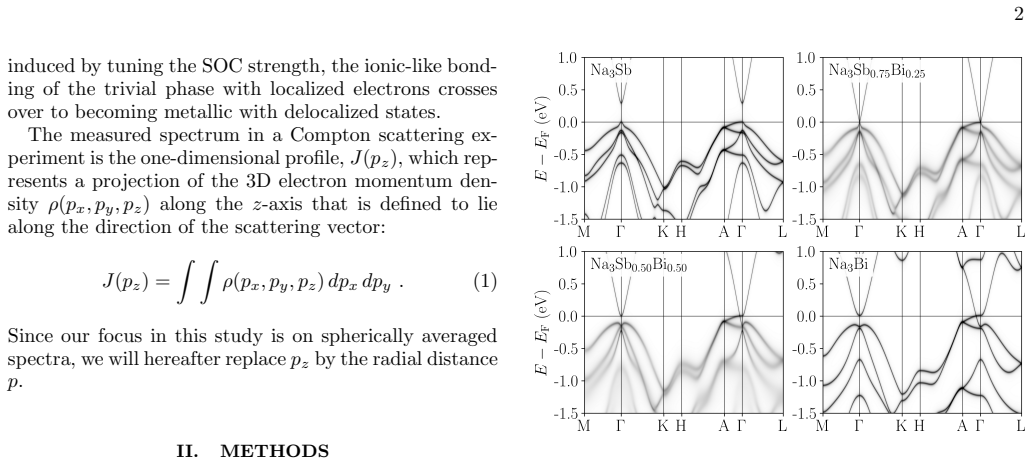
Compton profiles quantify the electron redistribution that closes the gap when Sb gives way to Bi.
Spin space groups and magnetic multipoles are not needed, the paper argues.

Replacing Rb with Cs deepens covalency, magnetic coupling, and emission dynamics in Nd sulfates

Poling the confined polymer also quadruples its pyroelectric response, pointing toward dual-source flexible harvesters.
Hundreds of the predicted transitions sit near room temperature and could drive solid-state cooling and thermal switches.

Tiny switching spots and a transmission-line layout beat the 9 MHz record; reset relaxation sets the ceiling.
· “VO₂ oscillator circuits optimized for ultrafast, 100 MHz-range operation”

Composition tuning across the FM/AFM boundary, not mean-field scaling, decides the cooling response near 10 K.
· “Anomalous magnetic response in the Au-Al-Gd 1/1 quasicrystal approximant”
Dielectric slow process matches terminal flow time in three alkyl halides, pointing to dipole-built chains.
· “Evidence for supramolecular dynamics of non-hydrogen bonding polar van der Waals liquids”
