pith. machine review for the scientific record. sign in

astro-ph.EP

Earth and Planetary Astrophysics

Interplanetary medium, planetary physics, planetary astrobiology, extrasolar planets, comets, asteroids, meteorites. Structure and formation of the solar system

0
astro-ph.EP 2026-05-15 2 theorems

C/O ratio and SiH4 mark ice line origins in sub-Neptune atmospheres

The Role of Formation Location in Shaping Sulfur-, Nitrogen-, and Carbon-Bearing Species in Super-Earth and Sub-Neptune Atmospheres

Magma ocean exchange depletes nitrogen but leaves formation traces in carbon and silicon species for young planets.
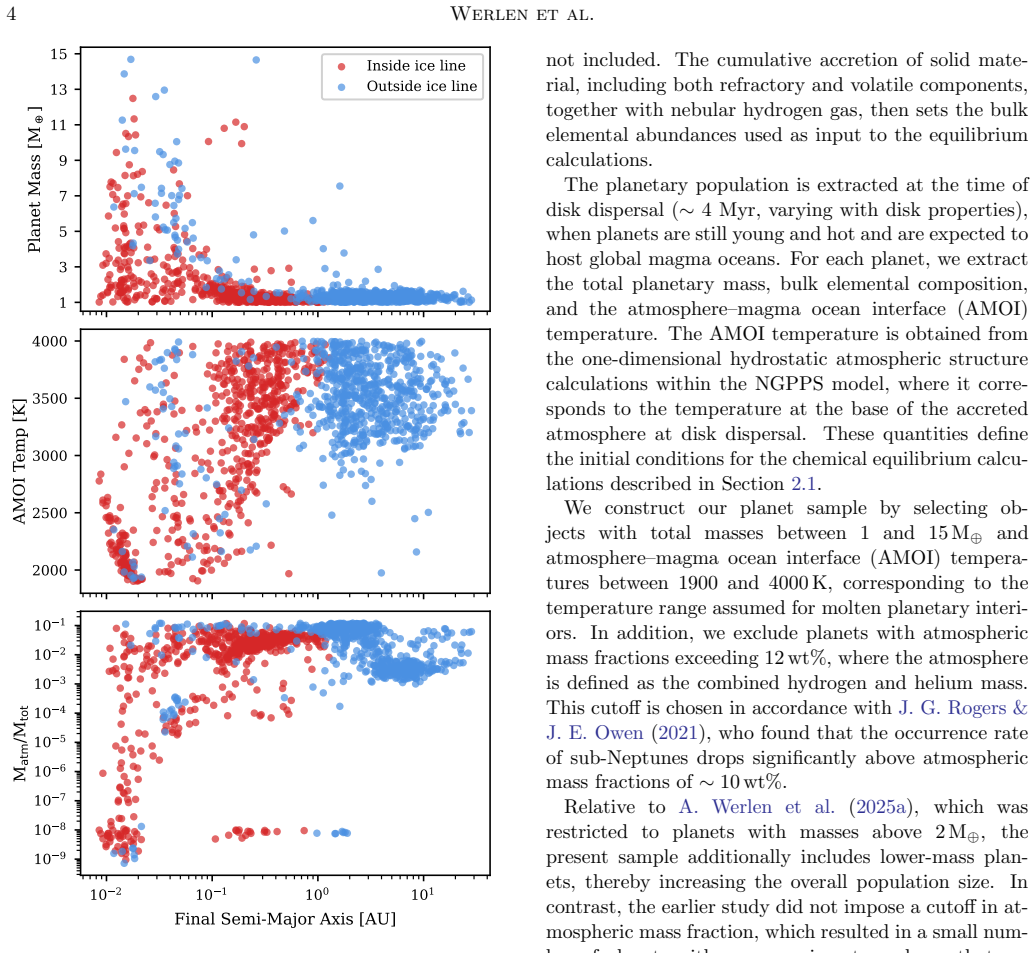
Figure from the paper full image
abstract click to expand
Atmospheric compositions of sub-Neptunes and super-Earths are often interpreted as tracers of formation location relative to volatile ice lines. However, prolonged magma oceans can chemically equilibrate with primordial atmospheres and modify accreted volatile signatures. In this study, we couple a synthetic planet population from the Bern Generation III formation model to an extended global chemical equilibrium framework including sulfur and nitrogen chemistry, and compare accreted and equilibrated compositions for $\sim$ 1200 young planets shortly after formation ($\sim$ 40 Myr) formed inside and outside the water ice line. We find that interior-atmosphere equilibration systematically alters elemental ratios and molecular abundances. The atmospheric C/O ratio shifts relative to the accreted state and remains systematically higher for planets formed outside the ice line. Nitrogen-bearing species NH$_3$, N$_2$ are strongly depleted through dissolution into the silicate melt, while minor amounts of HCN are produced, leading to low atmospheric nitrogen abundances. Sulfur-bearing species remain more abundant than nitrogen-bearing species; during equilibration, accreted H$_2$S partitions into the interior and small amounts of SO$_2$ form, but overall sulfur abundances depend only weakly on formation location. Silicon-bearing gases (SiH$_4$, SiO) are generated in substantial amounts, with narrower distributions for planets formed outside the ice line. We identify atmospheric C/O, SiH$_4$, and H$_2$O as potential indicators of formation location, while nitrogen depletion emerges as a generic outcome of magma ocean equilibration. Comparison with characterized sub-Neptunes such as TOI-270 d, K2-18 b, and GJ 3470 b shows broad consistency with oxygen-dominated, metal-rich atmospheres shaped by interior-atmosphere exchange.
0
0
astro-ph.EP 2026-05-15 Recognition

Common formulas underestimate disk millimeter emission by 10-15%

Millimeter dust continuum and polarization in protoplanetary disks with scattering: A slab model

Numerical slab calculations show that standard approximations bias inferred disk masses and temperatures high.

Figure from the paper full image
abstract click to expand
Millimeter continuum emission and self-scattering polarization from protoplanetary disks are widely used to constrain dust properties. Interpreting these observations requires practical prescriptions for the disk emission. However, only approximate formulae are available for the continuum emission, and no widely applicable formula has yet been established for the polarized emission. We aim (i) to assess the validity of commonly used analytic approximations for the (sub)millimeter continuum emission from protoplanetary disks, and (ii) to derive realistic prescriptions for the disk emission for both the continuum and the polarization. We numerically solve the radiative transfer equation in an isothermal, constant-density plane-parallel slab, including dust absorption, emission, and self-scattering with full Stokes parameters. We find that commonly used analytic approximations for the continuum emission are systematically about 10 to 15% lower than our numerical solutions. Consequently, SED analyses of (sub)millimeter observations that adopt these formulae are likely to overestimate the optical depth (and thus the disk mass) and the dust temperature, and underestimate the albedo (and thus altering the inferred constraints on grain size). We also provide empirical fitting formulae that reproduce our numerical results for the continuum emission and polarization fraction. These formulae will enable observational data analyses to be carried out more accurately and efficiently than with the conventional approaches. For the analysis of (sub)millimeter observations, we recommend using our new empirical formulae or interpolation of our numerical results, rather than commonly used approximations.
0
0
astro-ph.EP 2026-05-15 1 theorem

JWST spectrum of LTT 1445 A b shows no atmospheric features

JWST COMPASS Program: The 3--5ΞΌm transmission spectrum of LTT 1445 A b

Single-visit 3-5 micron data limit metallicity to at least 350 times solar when grey clouds sit deeper than 0.01 bar.

Figure from the paper full image
abstract click to expand
The search for an atmosphere on the closest rocky M dwarf planet, LTT 1445 A b, has been the subject of intense investigation from both the ground and space. Here, we present the first JWST transmission spectrum of LTT 1445 A b using a single visit spanning 3-5~$\mu$m using NIRSpec/G395H. We conduct two independent reductions of the data using both the Eureka! and ExoTiC-JEDI pipelines. Overall, we measure the NRS1 transit depths to a median precision of $\sim23$~ppm in 41 spectroscopic channels with uniform widths of 30 pixels ($\sim$ 0.02 $\mu$m), and the NRS2 transit depths to $\sim36$~ppm precision in 65 spectroscopic channels, also with uniform widths of 30 pixels. We rule out any statistically significant spectral features at this precision and place limits on atmospheric metallicity using a grid of chemical equilibrium models with grey opaque clouds. Using NIRSpec/G395H alone, we can place limits on the atmospheric metallicity of $\gtrsim350~\times$ Solar when the opaque pressure level is greater than 0.01~bars. We also conduct a combined analysis of JWST/NIRSpec and HST/WFC3 transmission data and find our atmospheric limits can be extended $\gtrsim500~\times$ Solar when considering both datasets. Future analyses both in transit and emission will uncover whether there are detectable atmospheric features.
0
0
astro-ph.EP 2026-05-15 Recognition

This paper introduces a Bayesian analysis framework that uses self-consistent climate…

A Climate-Constrained Bayesian Inverse Method for JWST Rocky Exoplanet Eclipse Spectra: A Case Study of LTT 1445A b

A climate-constrained Bayesian method shows LTT 1445A b requires no atmosphere to fit existing JWST data, with 2Οƒ upper limits of ≲1 bar…

abstract click to expand
Determining whether temperate rocky exoplanets orbiting M stars retain atmospheres is currently a central goal of exoplanet astronomy. To this end, the James Webb Space Telescope has begun searching for atmospheres on these worlds with MIRI secondary eclipse spectroscopy and photometry. Here, we develop a novel climate-constrained Bayesian inference framework that yields atmospheric pressure and composition constraints from these datasets, while accounting for planetary, stellar, and model uncertainties. Our approach fits observations with model spectra derived from self-consistent pressure-temperature profiles at radiative-convective equilibrium, thus maximizing the information extracted from the data and providing more robust inferences than retrievals that use parameterized pressure-temperature profiles. We demonstrate the framework on the existing MIRI LRS eclipse spectrum of LTT 1445A b (1.34 $R_\oplus$ and $T_{\mathrm{eq}} \approx 431$ K). An atmosphere does not need to be invoked to explain the data, meaning a bare rock model produces an adequate fit. If the planet has an atmosphere, the $2\sigma$ upper limits on surface partial pressures are $\lesssim 1$ bar for an optically thin gas like O$_2$, N$_2$ or CO, $\lesssim0.1$ bar for CO$_2$, $\lesssim 10^{-3}$ bar for H$_2$O, and $\lesssim 10^{-4}$ bar for SO$_2$. Scheduled MIRI F1500W observations could detect one of the thicker atmospheres permitted by the existing data (1 bar O$_2$ and 0.01 bar CO$_2$), if a precision of 20 ppm or better is achieved. This case study demonstrates that climate-constrained Bayesian inversion can turn rocky-planet eclipse spectra into the quantitative constraints necessary to test population-level atmospheric retention hypothesis, like the cosmic shoreline.
0
0
astro-ph.EP 2026-05-15 2 theorems

Cores let giant planets survive close tidal encounters

Where Do Hot Jupiters Come From? Revisiting Tidal Disruption and Ejection in High-Eccentricity Migration

Simulations show planets with 10-20 Earth-mass cores lose envelopes but avoid total destruction, expanding the path to hot Jupiters.

Figure from the paper full image
abstract click to expand
The origin of hot Jupiters remains a key open question. In the high-eccentricity migration scenario, traditional coreless models predict a strict tidal exclusion zone within $\sim 2.7$ tidal radii $r_\textrm{t}$, in which giant planets are either fully disrupted or ejected. We revisit this limit using three-dimensional hydrodynamic simulations of giant planets with realistic dense cores (10 - 20 $M_\oplus$). We find that even a few-percent-mass core fundamentally changes the outcome: \textbf{no total disruptions} occur within the previously suggested destruction zone ($\lesssim 2.7 \, r_\textrm{t}$). For deep encounters ($\lesssim 1.7 \, r_\textrm{t}$) planets suffer severe envelope stripping and are either progressively downsized to dense remnants or ejected after a few close encounters, possibly contributing to the free-floating planet population. In the intermediate regime ($ \sim 1.7 $--$2.0, r_\mathrm{t}$), planets experience significant partial mass loss over repeated encounters. For wider encounters ($ \gtrsim 2.0\, r_\mathrm{t} $), mass loss is minimal, allowing the planets gradually circularize into hot Jupiters. Furthermore, we show that for highly eccentric orbits ($e\gtrsim 0.9$), the change in specific orbital energy $ \Delta E_{\mathrm{orb}} $ depends primarily on periastron distance $ r_\mathrm{p} $ rather than semi-major axis $ a $. This enables us to extrapolate our fixed-$ a $ results across a broad ($a$, $e$) parameter space and identify a well-defined tidal ejection zone whose sharp boundaries converge asymptotically. Our results highlight the crucial role of planetary internal structure in high-eccentricity migration and suggest that the survival and transformation of core-bearing giant planets are far more common than previously thought.
0
0
astro-ph.EP 2026-05-15 Recognition

Proto-satellite collisions form new moons

Dynamical Evolution of V-Shaped Collision Debris

V-shaped debris in the a-e plane drives material back to the impact site for reaccretion rather than inward spreading.

Figure from the paper full image
abstract click to expand
Catastrophic collisions between proto-satellites have been proposed as a possible origin of Saturn's rings. This argument relies on the concept of the equivalent circular orbit. Here, we re-examine the post-impact dynamical evolution of collision debris using analytical arguments and $N$-body simulations with fragmentation. We focus on the long-term evolution of debris distributed in a broad V-shaped region in the $a$--$e$ plane, with two arms for particles sharing a common collision radius. Because particles on the two arms possess significantly different angular momenta, inter-arm collisions dominate the evolution and drive behavior fundamentally different from the simple circularization assumed in the equivalent circular orbit approach. As a result, the classical equivalent circular orbit concept cannot predict the long-term fate of collision debris. Both our analytical framework and $N$-body simulations show that, although some debris initially passes within the Roche limit on eccentric orbits, successive collisional evolution drives the particles approximately along the original V-shaped constraint curves toward the apex of the V-shape, i.e., the original collision radius. Instead of spreading inward to form a ring, the debris converges and reaccretes near the original collision location. We therefore conclude that catastrophic proto-satellite collisions do not produce massive Saturnian rings. Rather, the debris evolves toward reaccretion into a new generation of satellite-sized bodies near the impact radius. These results fundamentally revise the dynamical interpretation of collision-generated debris and establish a more general framework applicable beyond the Saturnian system, including other planetary ring systems and debris produced during planet formation.
0
0
astro-ph.EP 2026-05-14 1 theorem

Outgassing sustains thin atmospheres on TRAPPIST-1 planets

Coupled Photochemical-Climate Modeling of Plausible Tenuous Outgassed Atmospheres on the TRAPPIST-1 Planets

Constant water and CO2 release can counter high escape rates, yielding habitable conditions on d and e while matching JWST data.

Figure from the paper full image
abstract click to expand
Available JWST observations TRAPPIST-1 system have suggested that several of the planets are likely airless, or possess a very tenuous atmosphere. However, the high atmospheric escape rates expected for these planets suggest that any tenuous atmosphere must be replenished by constant outgassing, and past studies on modeling potential atmospheres for the planets have not widely considered surface pressures <1 bar. Here, we show that tenuous atmospheres on the TRAPPIST-1 planets are likely possible, supported by constant plausible rates of water and/or CO$_{2}$ outgassing against assumed high escape rates (up to ~10$^{30}$ s$^{-1}$). We use a coupled photochemical-climate model and sample from a broad phase space of outgassing, surface deposition, and top-of-atmosphere escape rates to test hundreds of atmospheres per planet. Critically, our model also allows surface pressure to vary based on the balance of sources and sinks. We find that 6 different compositional archetypes are generated via H$_{2}$O and/or CO$_{2}$ outgassing across our phase space, and atmospheres commonly fall between 10$^{-4}$ -- 1 bar. We find that potentially habitable surface environments are possible for TRAPPIST-1d and e at pressures between 0.05 -- 2 bar and 0.5 -- 1 bar, respectively. Where possible, we compare our models to JWST observational data for TRAPPIST-1b, c, d, and e; all atmospheres found in this study for these planets match available transmission data to <3$\sigma$. However, emission data are consistent with atmospheric outcomes constrained to thin O$_{2}$-dominated compositions for TRAPPIST-1b ($\lesssim$0.01 bars) and c ($\lesssim$0.2 bars), which may or may not contain trace SO$_{2}$.
0
0
astro-ph.EP 2026-05-14 2 theorems

Calibrated GWs shrink Moon elastic errors tenfold

Gravitational-wave Tomography of the Moon: Constraining Lunar Structure with Calibrated Gravitational Waves

Known strains from detector networks convert lunar seismic responses into tomographic constraints on internal moduli and density.

Figure from the paper full image
abstract click to expand
The recent success of gravitational-wave (GW) astronomy together with renewed plans for lunar geophysical instrumentation has revived interest in using the Moon as a resonant detector for mid-frequency (mHz-Hz) GWs. In realistic observational scenarios, the GW strain amplitude is expected to be constrained independently by networks of GW detectors, which motivates an inverse, \emph{tomographic} question: to what extent can measurements of the Moon's seismic response to known GWs be used to infer its internal structure? In this work, we develop a first-principles, perturbative framework that maps spherically symmetric perturbations of the elastic and density structure to measurable changes in observables, especially GW-driven modal amplitudes of the Moon. The formalism combines (i) a normal-mode representation of the elastic response, (ii) first-order perturbation theory for eigenvalues and eigenfunctions, and (iii) a linearized observation model that links frequency and amplitude observables to model parameters (bulk and shear moduli, density, and interface locations) and their perturbations. We show that the estimation errors of the Moon's elastic parameters can be reduced by about an order of magnitude with observations of calibrated GWs.
0
0
astro-ph.EP 2026-05-14

Mars dust storms create 100-1000 V/m electric fields in southern belts

Global evolution of electric fields during planet encircling dust storms on Mars

Global simulations show activity peaks in low-to-mid southern latitudes during planet-wide storms due to dust and turbulence.

Figure from the paper full image
abstract click to expand
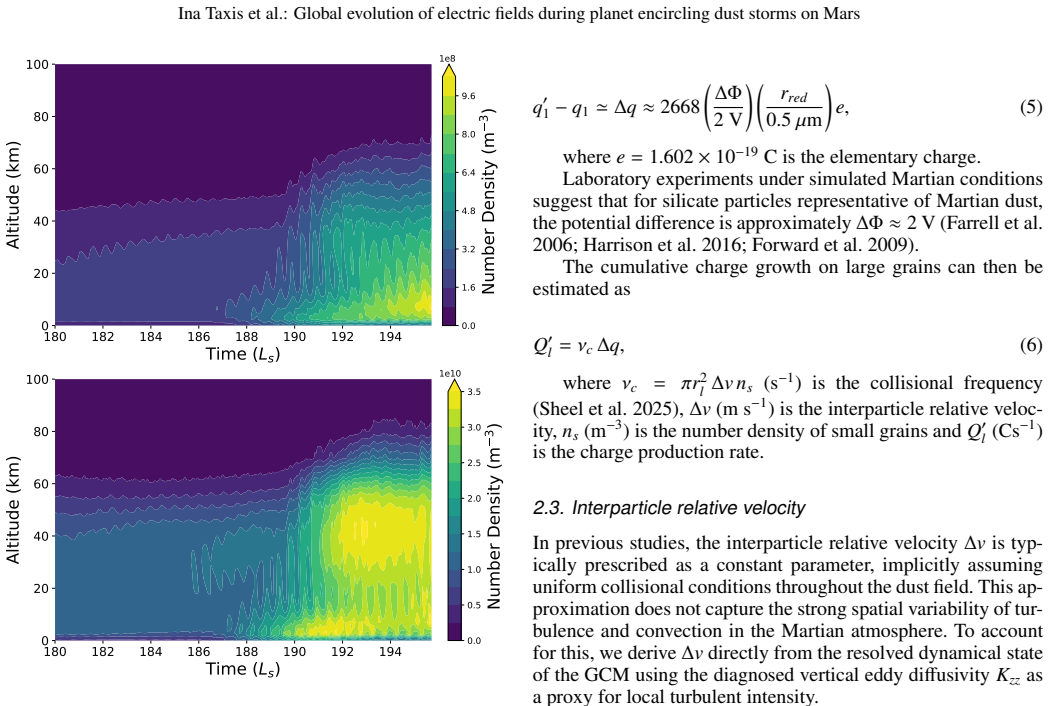
Planet-encircling dust storms fundamentally reshape Martian weather and the near-surface electrostatic environment. We investigate the generation and evolution of electric fields during global dust storms using bimodal dust size distributions from the NASA Ames Mars Global Climate Model, coupled with a triboelectric charging and electrostatic diagnostic scheme that links collisional charging to the local dynamical state of the atmosphere. Focusing on the dust-lifting and buildup phase and its subsequent evolution, we quantify the electric-field energy density and discharge characteristics, including onset thresholds, event frequency, and spatial clustering. The simulations reveal broad storm-active belts of enhanced electrification, with the most frequent threshold exceedances occurring in southern low-to-mid latitudes and secondary activity in northern low-to-mid latitudes. Modeled near-surface electric fields reach $10^{2}$--$10^{3}\ \mathrm{V\,m^{-1}}$ comparable to values inferred for smaller-scale dust phenomena. The results indicate that electric-field generation is controlled by the interplay between dust loading, turbulence-driven collisional activity, and conductivity-dependent charge relaxation, with diurnal conductivity variations strongly suppressing daytime electric-field buildup and most events remaining in the weak glow or Townsend discharge regime. While the model captures the large-scale distribution of electrically favorable conditions, the predicted spatial extent of activity likely represents an upper bound, as small-scale turbulent structures are not fully resolved. These results provide a quantitative framework to identify regions where electrostatic discharges are most likely during GDSs and to inform instrument design, power-system protection, and operations planning for future robotic and human missions.
0
0
astro-ph.EP 2026-05-14 2 theorems

Bessel kernel resolves convergence in 2D disc gravity simulations

Self-gravity in thin protoplanetary discs: 2. Numerical convergence solved and revealing the overestimation in mass of formed planets with softening

Small softening overestimates fragment masses by a factor of 2-3 while the new first-principles method produces bound planets at high resol

Figure from the paper full image
abstract click to expand
The Gravitational Instability (GI) is a leading theory for explaining early planet formation in massive discs. In the early 2010s, 3D SPH simulations of GI failed to converge, initially attributed to resolution-dependent viscosity but later appearing in 2D SPH and grid-based simulations, suggesting a numerical artifact inherent to the 2D approximation of gravity. Recently, we derived from first principles a much improved prescription for gravity in 2D discs (via a Bessel kernel). This prescription introduces a characteristic length below which gravity smoothly transitions from a 3D to a 2D scaling. This cannot be captured by standard smoothing length approaches, widely used in 2D simulations. We employ this new prescription to resolve the convergence issue of GI in 2D, and compare the outcomes of GI in runs using the Bessel kernel with those obtained using softening prescriptions at high resolution. We conducted numerical simulations with the FargoCPT code, where the Bessel prescription was implemented. The 2D Bessel formalism of gravity effectively resolves the convergence issues encountered in 2D simulations. When compared to simulations employing softened or unsoftened potentials, I observe that a small softening parameter tends to overestimate gravitational effects. This results in an artificially high number of fragments, leading to final fragment masses that are overestimated by a factor of 2-3. Conversely, employing large softening parameters inhibits gravitational effects. Although our analysis initially suggests that a softening parameter of 0.6 H might offer the best compromise, in reality, the resulting fragments fail to remain gravitationally bound-a behavior not observed when using the Bessel kernel. Our findings strongly suggest that the Bessel prescription should be adopted to ensure a consistent and accurate treatment of gravity in thin discs.
0
0
astro-ph.EP 2026-05-14 1 theorem

Halley fits 15 orbits into 1,151-year solar cycle

Comet 1P/Halley Completes 15 Orbits in 1,151 Years: Commensurability with the Solar System Quasi-Period and Evidence for Jupiter-Saturn Dynamical Coupling

1.43-degree residue is smallest of any planet or comet; Jupiter and Saturn forces cancel coherently over the cycle

Figure from the paper full image
abstract click to expand
I investigate whether comet 1P/Halley participates in the 1,151-year planetary quasi-period T* identified in a companion paper (Baiget Orts 2026a, arXiv:2604.03049). Using historical perihelion records spanning 2,225 years (30 apparitions, 239 BCE to 1986 CE), I find that Halley's mean orbital period P_bar = 76.713 yr satisfies T*/P_bar = 15.004, yielding an angular residue of +1.43 degrees -- the smallest of any Solar System body examined, including all seven planets that participate in T* (Mercury, Venus, Earth, Mars, Jupiter, Saturn, and Neptune; p = 0.009). No other Halley-type comet participates: all examined HTCs exhibit residues of 80--130 degrees, comparable to Uranus (108 degrees), the sole planetary non-participant. Four independent statistical tests establish that Jupiter and Saturn couple to Halley's orbital period through distinct mechanisms. Jupiter acts through phase-dependent modulation: its angular position at each perihelion predicts the period deviation (p = 0.027--0.04, three methods). Saturn acts through distance-amplitude modulation: closer approaches produce larger deviations regardless of sign (r = -0.496, p = 0.007), specific to Saturn's actual orbital phase (random-phase control p = 0.133). After 15 orbits, the cumulative period deviation is only 9.4% of the random-walk expectation -- direct evidence of coherent perturbation cancellation over one T* cycle. The orbit-to-orbit chaos (Lyapunov time ~70 yr) and the long-term mean stability are not contradictory: the same Jupiter-Saturn forces that cause individual-orbit variability cancel coherently over the T* baseline, anchoring the mean period at the millennium scale.
0
0
astro-ph.EP 2026-05-14 2 theorems

Spread in CO2 sticking energies extends gas in disks

Fizzy water ice in space: COβ‚‚ adsorption, binding energies and its fate in a protoplanetary disk

Bimodal binding on water ice keeps more CO2 gaseous at larger radii and shifts where the ice snowline appears.

Figure from the paper full image
abstract click to expand
CO2 is the third most abundant ice component found on dust grains in star-forming regions and a common ingredient of exoplanet atmospheres. Characterization of its adsorption properties on ices through the binding energy (BE) is essential for accurate astrochemical modelling and understanding chemical inheritance in planet formation. We aim to derive an accurate BE distribution of CO2 on water ices. Our goal is to understand the impact of the BE distribution on the abundance of gaseous and frozen CO2 in a generic protoplanetary disk and the spectral absorption features of frozen CO2. The ACO-FROST procedure is used for computing the BE distribution, where CO2 molecules are adsorbed on several sites of an amorphous water ice grain model. The BEs are computed using an ONIOM scheme. The BEs of CO2 follow a bimodal Gaussian distribution characterised by the following parameters: {\mu}1 = 1648K, {\sigma}1=229K, {\mu}2=2339K, {\sigma}2=274K.For each BE bin, the pre-exponential factor was estimated using two models and the Polanyi-Wigner relationship. Comparison with previous studies, both experimental and computational, show good agreement on the range of the BEs. The impact of the adsorption on water ice on the spectral features of CO2 molecule is evaluated. The coverage simulation shows the non-wetting properties of CO2 on the water ice surface. We discuss the impact of using a BE distribution and different pre-exponential factors to calculate the partitioning between the ice and gas in a generic protoplanetary disk. We confirm that the use of BE distribution to model the gas and ice fractionation in a protoplanetary disk causes the gas fraction to be significantly more extended. Furthermore, we show that the prefactor has a significant impact on where the snowline forms and on the final extent of the gas fraction in the disk.
0
0
astro-ph.EP 2026-05-13

Eta Tel disk gas has low C/O like solar system comets

Revisiting the ultraviolet spectroscopy of the eta Tel edge-on debris disk

Reanalysis finds the -1 km/s O I component is circumstellar with log C/O below -2.1, unlike carbon-rich disks around cooler stars.

Figure from the paper full image
abstract click to expand
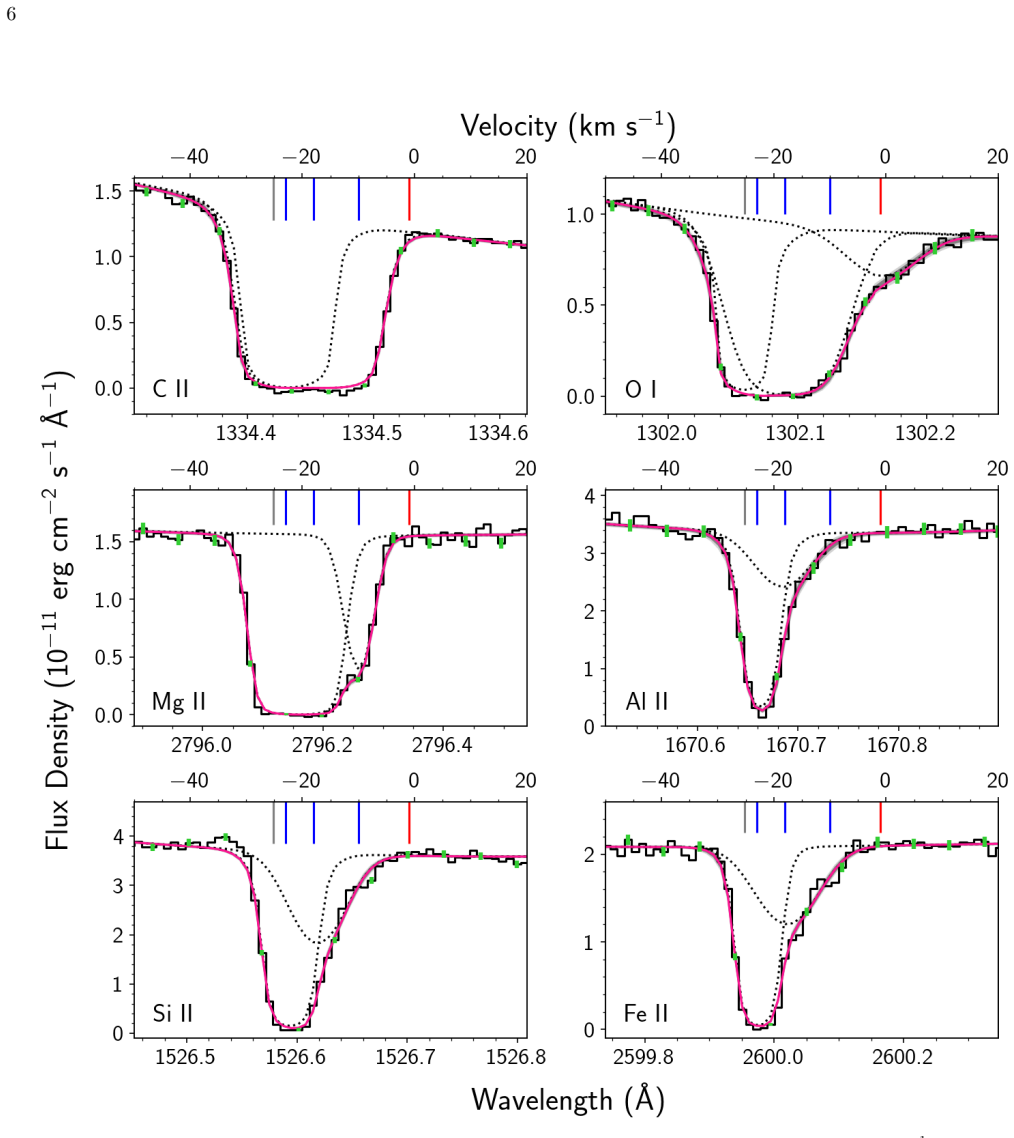
We revisit the ultraviolet absorption spectroscopy of the edge-on debris disk surrounding the A0V star $\eta$ Telescopii. Previous work found absorption components at four velocities ($\sim$ -23, -18, -10, -1 km s$^{-1}$), with the most blueshifted component (-23 km s$^{-1}$) interpreted as a likely disk wind. However, optical spectroscopy of $\eta$ Tel and other nearby stars in projection demonstrate that the -23 km s$^{-1}$ component is likely interstellar in origin. We find that there are three interstellar components toward this sight line (-23, -18, -10 km s$^{-1}$), but that the fourth component near -1 km s$^{-1}$, which was only detected in O I, is inconsistent with an interstellar origin and could be circumstellar. We place a 3-$\sigma$ upper limit on the C/O ratio of the -1 km s$^{-1}$ gas (log C/O $<$ -2.1), finding that it is consistent with Earth and solar system comet abundances. However, the abundance is inconsistent with the carbon-rich disks of $\beta$ Pic (A5V) and 49 Cet (A1V), probably because $\eta$ Tel (A0V) is a warmer star imposing greater levels of radiation pressure on carbon atoms in the disk. A low C/O ratio is also inconsistent with Herschel's [CII] detection toward $\eta$ Tel and may indicate that carbon gas is misaligned from the line of sight or variable in time.
0
0
astro-ph.EP 2026-05-13 2 theorems

Shocks dominate planet wave damping but cooling rivals them for small planets

Ξ±Ξ² q_th-mapping of planet-induced density wave damping in protoplanetary discs

Hydrodynamic runs map how nonlinear shocks, orbital-timescale cooling, and viscosity set angular momentum deposition across planet masses.

Figure from the paper full image
abstract click to expand
Planets embedded in protoplanetary discs are capable of creating a wide variety of substructures through gravitational interactions. This process is mediated through the excitation and damping of density waves which carry angular momentum across the disc. Therefore, to interpret observations of substructures, it is critical to understand the physical processes which lead to deposition of wave angular momentum to the disc fluid. In this study, we explore the relative efficiency of viscosity ($\alpha$), cooling ($\beta$), and non-linear wave evolution ($q_\mathrm{th}$) in damping planet-generated density waves. We run a large suite of hydrodynamic simulations varying viscosity, cooling timescale, and planetary mass, from which we extract radial profiles of wave angular momentum deposition. We quantify the efficiency of different wave damping mechanisms as a joint function of planetary mass, viscosity and cooling time. We find that nonlinear wave evolution leading to shock formation is typically the most important cause of angular momentum deposition, but that cooling on timescales comparable to local orbital time reaches similar levels of importance for low mass planets (sub-thermal, $q_\mathrm{th}<1$). On the contrary, linear wave damping due to viscosity is rather inefficient, requiring $\alpha \gtrsim 10^{-1.5}$ to noticeably affect damping of waves launched by thermal mass planets. Even for lowest mass planets considered ($q_\mathrm{th}=0.025$), viscosity affects wave damping only if $\alpha \gtrsim 10^{-2.9}$. Our findings could be applied to interpret observations of protoplanetary discs; they are also important for understanding wave propagation in other types of astrophysical discs.
0
0
astro-ph.EP 2026-05-13 2 theorems

Asteroid dust flux matches models at inner planets

Modeling and Analysis of Main-Belt Asteroidal Dust Flux and Velocity Distribution at Inner Planets

Low-eccentricity grains dominate arrivals while high-eccentricity grains drive the fastest impacts on Mercury, Venus and Mars.

Figure from the paper full image
abstract click to expand
Interplanetary dust in the inner solar system originates from multiple sources, including short-period comets and main-belt asteroids. In this work, we focus specifically on the dynamical evolution of asteroid-derived dust using N-body simulations that incorporates solar gravity, planetary perturbations, radiation pressure, Poynting-Robertson drag and solar wind forces. We quantify dust fluxes for Mars, Venus and Mercury across an important mass range, which are essential inputs for ablation process on Mars/Venus and for contributing in the impact process on Mercury. We have also derived impact velocity distributions and compared with existing literature. In addition, we examine how close-encounter velocities depend on the orbital elements linking dust energetics directly to the orbital architecture of the dust population. Our results show that the calibrated asteroidal flux agrees excellently with the scaled Gr\"un model for Mars (0.04 orders of magnitude offset) and Venus (0.09 orders), and with the M\"uller (2002) model for Mercury (0.04 orders). The velocity distributions reveal a decoupling between flux and impact velocity: low-eccentricity grains dominate the flux, while high-eccentricity grains control the high-velocity tail. These findings have direct implications covering: (i) For atmosphere-less bodies like Mercury, the high-velocity tail affects impact processes and exosphere generation; (ii) For Mars and Venus, the flux-dominated low-velocity population determines meteoroid ablation rates and metal layer formation; (iii) Our calibrated fluxes provide inputs for comparison with future observations from different missions and also, for modeling impact-driven surface modification across the inner solar system.
0
0
astro-ph.EP 2026-05-13 Recognition

W-Net spots asteroids in TESS data regardless of path

Trajectory-Agnostic Asteroid Detection in TESS with Deep Learning

Rotation augmentation on training cubes lets the model handle any speed and direction without the limits of shift-and-stack searches.

Figure from the paper full image
abstract click to expand
We present a novel method for extracting moving objects from TESS data using machine learning. Our approach uses two stacked 3D U-Nets with skip connections, which we call a W-Net, to filter background and identify pixels containing moving objects in TESS image time-series data. By augmenting the training data through rotation of the image cubes, our method is robust to differences in speed and direction of asteroids, requiring no assumptions for either parameter range which are typically required in "shift-and-stack" type algorithms. We also developed a novel method for learned data scaling that we call Adaptive Normalization, which allows the neural network to learn the ideal range and scaling distribution required for optimal data processing. We built a code for creating TESS training data with asteroid masks that served as the foundation of our effort (tess-asteroid-ml), which we publicly released for the benefit of the community. Our method is not limited to TESS, but applicable for implementation in other similar time-domain surveys, making it of particular interest for use with data from upcoming missions such as the Nancy Grace Roman Space Telescope and NEOSurveyor.
0
0
astro-ph.EP 2026-05-13 2 theorems

Dense super-Earth around K dwarf may upend formation theories

An Ultra-Short Period Super-Earth and a Sub-Neptune Orbiting the K dwarf TOI-4311

TOI-4311 b's high density, linked to the star's thick-disk position, implies planet formation varies with galactic environment.

Figure from the paper full image
abstract click to expand
We report the discovery and characterisation of the multi-planetary system around TOI-4311, a K dwarf kinematically between the Galactic thick disk and Hercules stream. TOI-4311 hosts an ultra-short-period super-Earth (P$\sim$0.99 d, $1.376\substack{+0.077\\-0.080}$ R$_\oplus$) and a longer period sub-Neptune (P$\sim$15 d, $2.47\substack{+0.12\\-0.11}$ R$_\oplus$) that was first detected in the TESS photometry. Using follow-up observations with CHEOPS and HARPS, we refine the planetary radius of both planets, derive the mass of planet b ($4.5\substack{+1.5\\-1.4}$ M$_\oplus$) and confirm the planetary nature of planet c. Intriguingly, a third periodic signal is clearly detected in our HARPS RVs that we cannot link to stellar activity. This signal could be attributed to a third planet (P$\sim$38 d, Msin(i)=$26.4\substack{+6.3\\-6.8}$ M$_\oplus$) in the system, however with the current photometric dataset we do not find a transit. Our dynamical analysis highlights that this potential outer planet would remain stable. Using the precise radius and mass for TOI-4311 b we model its interior structure and find that it is very dense given the host star's galactic kinematics and chemistry. Hence this system could challenge current formation theories and provide insights into planet formation across the galaxy.
0
0
astro-ph.EP 2026-05-13 1 theorem

Molten cores turn asteroid collisions into iron-rich rubble piles

Reaccumulation process after a catastrophic disruption event on a differentiated asteroid

Simulations show catastrophic impacts stretch core and mantle into uniform fragments that reaccumulate into metal-rich bodies.

Figure from the paper full image
abstract click to expand
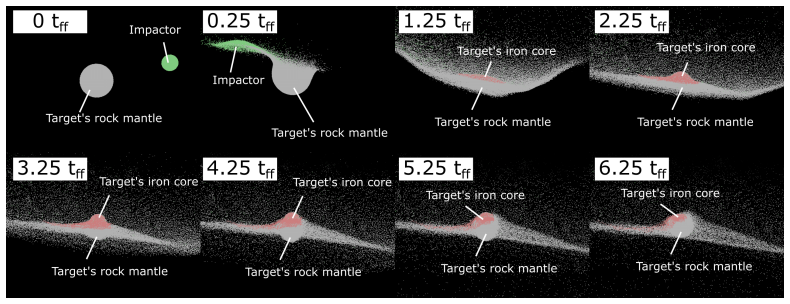
Rubble-pile asteroids can form through the self-gravitational reaccumulation of fragments produced during large-scale collisions. To investigate how differentiated bodies are disrupted and how iron-rich rubble piles may form, we performed smoothed particle hydrodynamics simulations of impacts between differentiated asteroids with molten or solidified interiors. Our results show that catastrophic disruption produces a sheet-like structure in which core and mantle materials are stretched and subsequently fragment under self-gravity. The resulting fragments exhibit nearly identical iron-rock mass ratios, indicating that catastrophic disruption naturally generates numerous compositionally similar fragments. The largest remnant formed in such events is therefore an iron-rich rubble pile assembled from these mixed fragments, whereas remnants formed through mantle stripping retain a layered structure with an iron core and rocky mantle. We further find that fragment production is sensitive to material strength and the equation of state: mantle strength reduces the number of small fragments, while core strength suppresses catastrophic disruption when the core is solid. These results imply that iron-rich rubble-pile asteroids can form only when the iron core is molten. Our findings provide a unified framework for the formation of metal-rich asteroids such as (16) Psyche and the (22) Kalliope system, and offer predictions for the surface and internal structure that the NASA Psyche mission may test.
0
0
astro-ph.EP 2026-05-13 2 theorems

Tidal models fix rotation states for six Kepler exoplanets

Simulation of the spin evolution of some selected exoplanets and inferences on their climate

Three are fast rotators for any eccentricity, one is trapped, and three need better eccentricity data to decide

Figure from the paper full image
abstract click to expand
In this work, using the simulator VPLanet, we analyze the spin evolution of some selected exoplanets due to the tidal interaction with their host star. For a rocky planet, two spin conditions are possible, the trapped rotation and the fast rotation, referring to the cases of achieved and non achieved tidal trapping, respectively. We focus on planets whose spin condition is not obvious, because no study is needed for planets which are undoubtedly fast rotators or undoubtedly trapped rotators; moreover, we consider only exoplanets that are interesting from an astrobiological perspective. The current spin conditions of the considered planets are hypothesized, taking into account the age of the host star. Inferences regarding planetary climate and habitability, which is defined by the possibility of stably sustaining the liquid water on the surface, are also discussed. Results of this work show that Kepler62f, Kepler1126c and Kepler1544b are expected to be fast rotators regardless of the orbital eccentricity; the spin condition of Kepler186f, Kepler62e, and Kepler442b cannot be determined without constraints on the eccentricity, which are currently unavailable; Kepler440b is expected to be tidally trapped.
0
0
astro-ph.EP 2026-05-13 2 theorems

H2 broadening data for CO2 lines now spans 200-1000 K

Measurements and predictions of H2 pressure-broadening coefficients of CO2 absorption lines for exoplanet atmosphere studies

Room-temperature measurements and simulations agree within 3 percent, giving the first reliable coefficients for modeling H2-rich exoplanet,

Figure from the paper full image
abstract click to expand
Accurate and comprehensive H2 pressure-induced broadening data for CO2 infrared lines over a wide temperature range are essential for modeling atmospheric opacity of exoplanets. However, available data are currently limited, some of which are affected by large uncertainties. In this work, H2 induced pressure-broadening and pressure-shift coefficients were determined at room temperature for the entire nu3 band of CO2 in the 4.3 micrometer spectral region using a high-resolution Fourier transform spectrometer. In addition, requantized molecular dynamics simulations of the CO2-H2 system were performed using an accurate intermolecular potential. These simulations provide theoretical predictions of H2-broadening coefficients for CO2 lines over a temperature range of 200-1000 K and for rotational quantum number up to J=120. The predicted results show very good agreement with the experimental data, with difference of less than 3%, well below the precision required for exoplanet atmosphere studies. This work provides the first accurate and comprehensive dataset of H2 broadening coefficients for CO2 lines, suitable for modeling of H2-rich exoplanetary atmospheres.
0
0
astro-ph.EP 2026-05-13 2 theorems

Hybrid model explains distant disk rings in V1094 Sco

A Hybrid Origin for the Multiple Ring-Gap Structures in the Large Protoplanetary Disk V1094 Sco: A Low-Mass Planet and Secular Gravitational Instability

A low-mass planet accounts for inner gaps while secular instability forms outer rings in this extended low-turbulence disk.

Figure from the paper full image
abstract click to expand
High spatial resolution observations reveal that some protoplanetary disks host multiple ring-gap pairs at large stellocentric radii, yet their physical origin remains unsettled. We present a multi-wavelength analysis of the V1094 Sco disk using Atacama Large Millimeter/submillimeter Array Band 6 continuum and $^{12}$CO and $^{13}$CO $J=2-1$ emission, together with a Very Large Telescope/SPHERE near-infrared scattered light image. The continuum image shows four narrow dust ring-gap pairs extending to exceptionally large radii ($r \sim 380$ au), while the CO isotopologues trace a spatially extended gas disk ($r \sim 760$ au) in Keplerian rotation. From the dust ring widths, we place conservative upper limits on the turbulent viscosity parameter, $\alpha \lesssim 10^{-3}$ and potentially $\lesssim 10^{-4}$, implying weak turbulence. The ensemble of gap widths and depths is inconsistent with a simple one-planet-per-gap interpretation. At $r \simeq 100$ au, a double gap and its scattered light counterpart are consistent with multi-gap excitation by a single low-mass companion of $(55 \pm 35)\,M_{\oplus}$. At $r \simeq 170-230$ au, the outer ring system shows regular spacing and no clear scattered light counterpart, indicating mechanisms that operate primarily at the disk midplane. These outer rings are quantitatively compatible with secular gravitational instability. V1094 Sco therefore supports a hybrid pathway in which weak turbulence in an extended disk allows secular gravitational instability to assemble long-lived midplane dust concentrations that can cradle planet formation beyond $\sim 100$ au, alongside planet-driven substructures at intermediate radii.
0
0
astro-ph.EP 2026-05-12 2 theorems

RV curvature suggests distant giant around 51 Pegasi

An Outer Giant Planet or Brown Dwarf in the 51 Pegasi System?

Non-detections from imaging and astrometry limit it to super-Jupiter or brown dwarf, but one instrument's drift may explain the entire trend

Figure from the paper full image
abstract click to expand
51 Pegasi harbors the first confirmed extrasolar planet orbiting a Sun-like star. Decades of continued radial velocity (RV) observations have since uncovered signatures of an additional distant companion in the system from a shallow radial acceleration. We present new constraints on the mass and separation of a potential outer companion based on a synthesis of RVs, absolute astrometry, and new high-contrast imaging. Our analysis combines 31 years of new and previously published RV measurements from the OHP/ELODIE, Lick/Hamilton, Keck/HIRES, and APF/Levy spectrographs; a $\sim$25-year baseline of absolute astrometry from Hipparcos and Gaia; and deep imaging from Keck/NIRC2 and HST/WFPC2. We find evidence for curvature in the RVs, which when combined with non-detections from imaging and astrometry point to a super-Jupiter at $\simeq$15--100 AU or brown dwarf companion at $\approx$20--170 AU. However, the inferred radial acceleration of the host star is driven primarily by the Lick/Hamilton dataset and its slope is consistent with long-term instrument drift, calling into question the nature of the long-period signal. If an outer companion is present, it could explain the origin of the inner hot Jupiter if 51 Peg b arrived at its current location through high-eccentricity migration. On the other hand, if the signal is spurious, the exceptional baseline rules out Jovian planets within $\sim$10 AU and most brown dwarfs within several tens of AU, implying that the system is devoid of massive companions. Continued RV and astrometric monitoring together with high-contrast imaging can be used to distinguish these scenarios.
0
0
astro-ph.EP 2026-05-12 2 theorems

6.2-Earth-mass planet found in habitable zone of active M-dwarf

Detection and Characterization of the Temperate Super-Earth Ross 318 b

Fifteen-year radial velocity baseline and TESS photometry confirm non-transiting Ross 318 b at 39.6-day period with 0.58 Earth flux.

Figure from the paper full image
abstract click to expand
Ross~318 is an M3.5V red dwarf exhibiting significant magnetic activity and a stellar rotation period of $\sim51.5$\,d. In this work we present a systematic re-analysis of radial velocities (RV) from CARMENES and decade-long HIRES observations, integrated with TESS space-based photometry. We identify a terrestrial-mass planet, Ross~318\,b, with an orbital period $P = (39.6299 \pm 0.29)$\,d and a minimum mass $M\sin i = (6.21 \pm 0.62)M_{\oplus}$. The dynamical nature of the signal is confirmed by its temporal coherence over a 15-year baseline and its achromaticity between visible and near-infrared channels. TESS photometry from Sectors 18, 19, 24, and 25 (218.6\,d total baseline, 66\,983 cadences) reveals no transit at $P = 39.63$\,d (FAP $> 10\%$, BLS). An injection-and-recovery test demonstrates that a $2200$\,ppm transit signal corresponding to a $1.74R_{\oplus}$ body would have been detected with Signal-to-Pink-Noise Ratio SPNR $> 12$, ruling out a transiting geometry with high confidence. The orbital inclination is constrained to $i < 88.5^\circ$. With an incident stellar flux $S_{eff} \approx 0.58\,S_\oplus$ and bolometric luminosity $L_* = (0.01478 \pm 0.00122)L_{\odot}$, Ross~318\,b falls within the Conservative Habitable Zone, making it one of the most interesting temperate Super-Earths orbiting an M-dwarf.
0
0
astro-ph.EP 2026-05-12 Recognition

Early Venus sunlight redistributed by season but orbit average stable

Seasonal Insolation Variability on Early Venus: Implications for Energy Budget

Atmospheric opacity likely set surface temperature more than changes in rotation or eccentricity, narrowing paths to a temperate past.

Figure from the paper full image
abstract click to expand
Venus and Earth are similar in bulk properties yet followed dramatically different climatic trajectories. Reconstructing Venus's climate evolution requires understanding how rotation, obliquity, eccentricity, and solar luminosity shaped incident energy and the atmospheric response. Here we present latitude-orbital phase maps of incident solar flux for Venus at the present epoch and at an age of 0.5 Gyr, when the Sun was fainter and Venus may have occupied a different dynamical state. We explore slow- and fast-rotator regimes, moderate obliquity (10deg), and elevated eccentricity (e=0.15-0.30), motivated by dynamical studies of plausible limits. To translate flux maps into climate-relevant quantities, we apply an idealized atmospheric energy-balance framework with global (0-D) and latitude-dependent (1-D) formulations calibrated to modern Venus. This framework defines a radiative relaxation timescale that links forcing variability to thermal response. The resulting diagnostics connect orbital forcing to surface energy balance and assess seasonal and orbital variability relative to Venus's extreme greenhouse state. Our results show that early Venus could experience substantial redistribution of insolation across latitude and orbital phase, but orbit-averaged incident flux varies only modestly across the explored parameter space, leaving atmospheric opacity as the dominant control on surface temperature. Insolation variations therefore act mainly as modulators rather than primary drivers of climate state, with their expression governed by the competition between forcing and radiative adjustment timescales. The insolation maps and response diagnostics provide boundary conditions for future 3-D climate simulations of early Venus, including regimes in which temperate surface conditions may have been sustained.
0
0
astro-ph.EP 2026-05-12 2 theorems

Alpha elements let giant planets form around iron-poor stars

A Uniform Determination of the Bulk Metallicities and Alpha Enrichments of Confirmed Exoplanet Systems with TRES

Subsolar-metallicity hosts are alpha-enhanced at high significance, suggesting compensation for low iron content.

Figure from the paper full image
abstract click to expand
We present a uniform spectroscopic characterization of 625 F, G, and K stars hosting 859 confirmed exoplanets using high-resolution archival optical spectra from the Tillinghast Reflector Echelle Spectrograph (TRES). We use the neural network spectral code uberMS, which combines spectra with broadband photometry to estimate precise and accurate stellar parameters. We determine stellar effective temperatures, surface gravities, radii, luminosities, projected rotational velocities, [Fe/H] abundances, and [$\alpha$/Fe] enrichments for most confirmed planet hosts observed by TRES. This uniform catalog can be used for a broad range of astrophysical studies, particularly to explore links between stellar [$\alpha$/Fe] and a suite of observed exoplanet properties. Combining our metallicity measurements with galactic kinematics, we identify 58 planet hosts that are likely members of the thick disk. We investigate the chemical environments of giant-planet formation by comparing the [$\alpha$/Fe] distributions of giant-planet host stars across different metallicity regimes. We find that subsolar metallicity giant-planet hosts are significantly enhanced in [$\alpha$/Fe] relative to Fe-rich giant-planet hosts and to the average Fe-poor field star, at high statistical significance. This suggests that enhanced $\alpha$-element abundances may partially compensate for low-Fe content and thus enable the formation of giant planets in metal-poor environments. We additionally compare the [$\alpha$/Fe] distributions of single- and multi-planet hosts and find modest evidence that $\alpha$-enhanced stars may preferentially host multi-planet systems. Finally, we recover previously observed trends between stellar metallicity and planetary eccentricity.
0
0
astro-ph.EP 2026-05-12 Recognition

N2 levels warm or cool Earth-like planets depending on CO2

Revisiting the greenhouse effect of non-greenhouse gases in the atmospheres of Earth-like planets

Background nitrogen alters water vapor amounts, producing lapse-rate and radiative warming that varies with carbon dioxide abundance.

Figure from the paper full image
abstract click to expand
Although non-greenhouse gases can vary substantially in abundance in Earth-like atmospheres, their climatic influences remain insufficiently understood. To investigate how such gases regulate climate, we vary the abundance of N$_2$ as a representative non-greenhouse component in one-dimensional N$_2$--CO$_2$--H$_2$O model atmospheres. Beyond pressure broadening of absorption lines and Rayleigh scattering emphasized in previous studies, our results show that changes in background N$_2$ pressure influence climate by modifying the amount of atmospheric H$_2$O, producing two effects: altering the thermodynamic lapse rate (H$_2$O-dilute warming) and changing the radiative contribution of H$_2$O to the greenhouse effect (H$_2$O-load warming). The resulting climate response to increasing N$_2$ depends on the CO$_2$ abundance. Under low CO$_2$ conditions, dilution of atmospheric H$_2$O leads to warming, whereas under high CO$_2$ conditions, increased H$_2$O loading also produces warming. At sufficiently high N$_2$ abundances, Rayleigh scattering induces cooling, an effect further amplified by the accompanying decrease in atmospheric H$_2$O. Under high CO$_2$ conditions, however, enhanced H$_2$O loading increases the absorption of stellar radiation and overwhelms the contribution of Rayleigh scattering, causing the cooling response to disappear. These results reveal multiple physical pathways through which non-greenhouse gases influence climate and provide a framework for understanding climate responses and habitability in diverse Earth-like atmospheres.
0
0
astro-ph.EP 2026-05-12 2 theorems

Minerals can mimic the red edge biosignature for exoplanet life

Mineral False Positives in the Search for Exoplanet Surface Biosignatures

Sulfides, tectosilicates and potassium ferrocyanide show sharp reflectance jumps near 700 nm, so atmospheric context may be needed to tell a

Figure from the paper full image
abstract click to expand
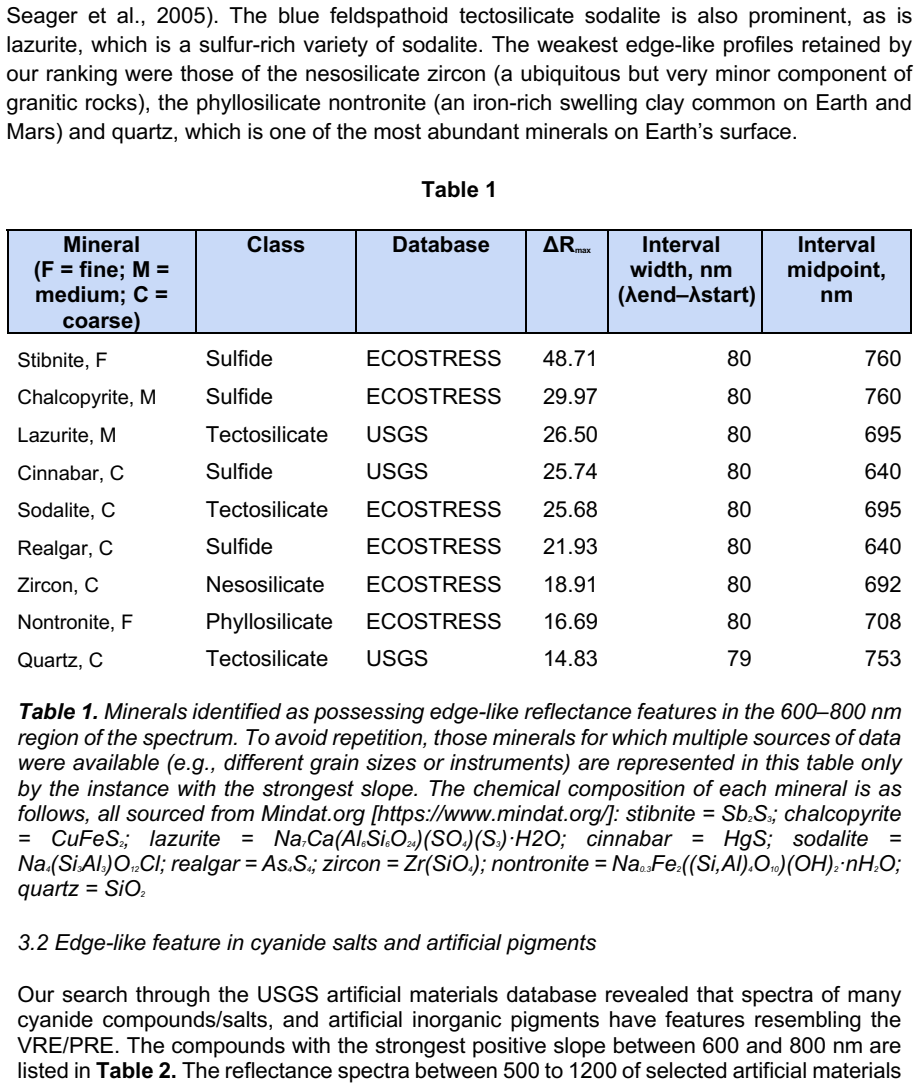
In the search for life in the cosmos, biopigments on exoplanet surfaces are a critical target. Such pigments have been detected in Earth's spectrum (by the Galileo spacecraft and in Earthshine) via the "vegetation" or "photosynthesis red edge" (VRE or PRE), a sharp, step-like increase in reflectance with increasing wavelength at ~700 nm. Future space telescopes like the Habitable Worlds Observatory (HWO) are designed to obtain disk-integrated spectra of Earth-like exoplanets in the visible-to-near-infrared to identify such features. However, there has been no systematic analysis of the occurrence of similar reflectance edges among minerals of non-biological origin. Here, we use existing databases of mineral reflectance spectra to explore the risk that minerals may present false positives in the search for biopigments on exoplanets. We find that several sulfide and tectosilicate minerals, as well as the prebiotically important cyanide salt, potassium ferrocyanide, have PRE-like features. We characterize these features in order to assess how they may be distinguished from biopigments. We conclude that the future evaluation of the biogenicity of PRE-like features in exoplanet reflectance spectra can be informed by the atmospheric context, but may require an assessment of the prior probability of non-biological and biological hypotheses about the surface materials of exoplanets.
0
0
astro-ph.EP 2026-05-12 Recognition

Two phase curve studies agree broadly but differ individually

Comparing Results from Two Uniform Phase Curve Surveys

Population results match while individual offsets vary and some parameters fail basic orbital checks.

Figure from the paper full image
abstract click to expand
We present a comparison of the two most recent and comprehensive Spitzer phase curve studies - Dang et al. (2025) and Swain et al. (2025) - which report analyses of the Spitzer 4.5 $\mu$m phase curves. The studies employ different approaches for correcting instrument systematics and they also use different approaches for selecting the optimal exoplanet system parameters. To evaluate the level of consistency between the two studies, we compared the constraints on the ratio of planet-to-star radii ($R_P/R_\star$), eclipse depth ($F_P/F_\star$), phase curve amplitude ($A$), and phase curve offset ($\phi$). We find that the two studies produce similar results at the population level although results for individual planets can vary, especially for phase curve offset values. We examined the difference of planet system parameters to see if inconsistencies in individual planet results were due to data reduction methods or system parameter choices. We also examined whether the system parameters used by both studies were consistent with Kepler's third law. During this comparison, we identified one case where stellar mass, planet semi-major axis, and orbital period did not follow Kepler's law even though the values were all compiled from the same publication. To assess whether this kind of discrepancy was recurrent, we recalculated the orbital periods using Kepler's third law and compared them with the values listed in the NASA Exoplanet Archive. Our detailed analysis of archival system parameters strongly suggests that testing reported/selected parameters for consistency with Kepler's third law is worthwhile.
0
0
astro-ph.EP 2026-05-12 Recognition

Photoevaporation clears compact discs from inside out

The dispersal of compact protoplanetary discs

Truncating mass loss at the outer radius switches dispersal direction and matches observed disc size trends

Figure from the paper full image
abstract click to expand
Compact protoplanetary discs are becoming increasingly prominent in observations. Their dispersal pathways may differ substantially from those of extended discs. We aim to quantify the role of the disc outer radius in internal photoevaporation, provide a simple scaling relation for compact discs, and test whether the resulting evolutionary tracks reproduce the observed inside-out clearing of young stellar populations. We performed radiation-hydrodynamic simulations of X-ray-driven photoevaporation for discs with different outer radii, and derived the dependence of the total mass-loss rate on the cut-off radius. We find that the surface mass-loss profiles are nearly independent of disc size, but their integrated wind rates are reduced according to the cumulative mass-loss rate distribution. We incorporated this scaling into disc population synthesis models. When the internal photoevaporation is applied only up to the cut-off radius compact discs evolve via inside-out clearing consistent with observational diagnostics, while when the cut-off radius is not considered, the disc spreading is hindered and the disc dispersal proceeds from the outside-in. The introduction of mild external photoevaporation present in nearby star forming regions cannot prevent the disc spreading when the cut-off radius prescription is included, but it can much better explain the evolution of disc radii as a function of time. Disc dispersal prescriptions must include the dependence on disc cut-off radius to capture the evolution of compact discs. The proposed scaling provides a simple, physically motivated correction that better predicts the growing observational evidence for compact discs and inside-out dispersal.
0
0
astro-ph.EP 2026-05-12 2 theorems

1882 comet fragments reveal pattern to predict future sungrazers

On the Problem of Prognostication of Bright Kreutz Sungrazers

A fixed second difference in the u_frg parameter across fragments provides an empirical method to forecast bright Kreutz comets over coming

abstract click to expand
Tidal fragmentation at perihelion and nontidal fragmentation elsewhere cause the orbital distribution of Kreutz sungrazers of all sizes to be extremely complicated and highly nonuniform. Among the features are (largely fortuitous) clusters of bright (naked-eye) objects and clumps of dwarf objects (often closely genetically related, as their detection primarily by the SOHO coronagraphs suggests) on the one hand; and both spectacular and less brilliant sibling sungrazers, whose perihelion times are scattered over centuries, on the other hand. Investigation of four fragment nuclei of the Great September Comet of 1882, the products of a perihelion breakup of the comet's original nucleus, showed that their orbital periods followed a distinct pattern, which likewise applied to other tidally split sungrazers and was characterized by a specific value of the second difference of parameter u_frg of neighboring fragments' centers of mass. The algorithm has a potential for the prognostication of bright Kreutz sungrazers over the rest of the 21st century and beyond. However, because of its as yet unverified empirical character, the utmost caution should be exercised when applying the procedure.
0
0
astro-ph.EP 2026-05-12 Recognition

15% lunar ejecta explain Moon crater asymmetry

Lunar ejecta as the missing piece to resolve the lunar cratering asymmetry

Simulations find returning ejecta strike the leading side 5.9 times more than the trailing side, closing the gap with observations.

Figure from the paper full image
abstract click to expand
The leading-trailing asymmetry in lunar crater distribution provides a critical record of inner solar system dynamics, yet the long-standing discrepancy between the observed higher asymmetry and lower theoretical predictions indicates a gap in our understanding of the impactor population. This paper hypothesizes that lunar impact ejecta, which can enter Earth-like orbits and return, constitute a previously unaccounted-for component. Through numerical simulations, we find that ~25% of escaped ejecta will re-impact the Earth-Moon system within 3 Myr, with about 1.2% striking the Moon. Crucially, these lunar impacts exhibit an extreme leading-trailing asymmetry with a ratio of 5.9. Our results indicate that lunar ejecta, if comprising ~15% of total impactors, can fully explain the observed asymmetry, leading to their recognition as active agents shaping the lunar impact record. This work provides new constraints for understanding the impact environment of the Earth-Moon system, with direct relevance to the interpretation of lunar geology, the transport of lunar material to Earth, and ongoing space exploration missions.
0
0
astro-ph.EP 2026-05-12 2 theorems

Formula gives eccentricity threshold for Neptune resonance capture

Numerical estimation of the capture ability of Neptunian mean motion resonances

Simulations show capture requires eccentricity above a threshold that rises with migration speed and distance, with efficiency falling withp

Figure from the paper full image
abstract click to expand
Resonant populations of trans-Neptunian objects serve as crucial dynamical archives for unraveling the early migratory history of the Solar System. A quantitative assessment of the capture efficiency into various mean motion resonances (MMRs) during migration is essential for understanding the origins of these populations, constraining migration parameters, and reconstructing of the primordial planetesimal disk. Using numerical simulations, this study systematically investigates the capture capability of exterior MMRs during Neptune's outward migration in a planar model. For a specific p:q MMR, the small bodies can be captured only when their eccentricities surpass a certain threshold, which increases with faster migration rates, greater distances of MMRs, and higher resonance orders. On the other hand, as long as a particle's eccentricity is suitable, its capture efficiency shows little dependence on the migration rate; instead, it mainly depends on the p value and heliocentric distance, decaying exponentially as either parameter increases. Based on our simulation results, we derive for the first time a simple empirical expression to calculate eccentricity threshold and the capture efficiency. This research provides a systematic quantitative framework for understanding capture into Neptunian MMRs during migration. Future integrations of more comprehensive observational data will facilitate a more precise reconstruction of the Solar System's early dynamical evolution.
0
0
astro-ph.EP 2026-05-11 Recognition

Three-point inverse method matches densities for over half of fireballs

Consistency between dynamical modeling and photometrically derived masses of fireballs

Sparse entry, peak-brightness and terminal observations reconstruct deceleration and mass-loss histories for most events

Figure from the paper full image
abstract click to expand
We present a three-point inverse solution for reconstructing meteoroid deceleration and mass-loss histories from sparse observations constrained only by the entry, peak-brightness, and terminal points. The method combines the $\alpha$-$\beta$ analytical formalism with a derivative-free global optimizer and a numerical inversion of the height-velocity relation, enabling the retrieval of physically consistent solutions even when full velocity profiles are unavailable. Applied to the 2017-2018 European Fireball Network (EN) catalog, the approach achieves an 88% convergence rate when fitting only height-velocity pairs, and 63% when terminal and initial masses are also imposed. 52% of mass-constrained solutions (34% overall) yield bulk densities consistent with their $PE$ classes, with higher strength emerging as the primary discriminator among events retaining coherent classifications when only 3 points are used as input data. Rapidly evolving high-energy, high-mass events show the largest incompatibility with the $\alpha$-$\beta$ model. The inversion produces a continuous bulk-density distribution spanning $\sim$300-4000 kg$\,$m$^{-3}$, in contrast to the discrete densities fixed by $PE$-based categories. The EN fireball dataset is now supplemented with self-consistent $\alpha$ and $\beta$ estimates.
0
0
astro-ph.EP 2026-05-11 2 theorems

Ice thickness variations on Enceladus create detectable magnetic signals

Exploring Enceladus's Interior Structure Using Electromagnetic Induction

The signals scale with ocean conductivity and could be measured by low-altitude orbiter or lander to bound salinity.

Figure from the paper full image
abstract click to expand
Electromagnetic (EM) sounding can constrain the electrical structure of Enceladus and, in turn, the salinity of its ocean and the porosity, fluid content, and thermal state of its hydrothermally active core. Here, we assess the feasibility of EM sounding at Enceladus using both global (orbiter) and local (lander) EM induction transfer functions. We provide a physical framework for modeling EM induction for 1-D and 3-D subsurface conductivity models and discuss how transfer functions can be estimated from global or local measurements of the magnetic and electric fields. We simulate 3-D induction effects arising from variations in ice-shell thickness. The magnitude of these effects in the magnetic field correlates with the ice-shell thickness at the surface and is strongly dependent on the ocean's conductivity. These magnetic variations, if observed, would favor a moderately to highly conductive ocean, providing lower bounds on salinity and volatile content. The absence of these effects indicates a thicker, more homogeneous ice shell and/or a lower-conductivity ocean. Given plausible magnitudes, a polar-orbiting mission with low-altitude measurements will be required to detect these effects. In summary, an orbiter will constrain global ocean conductivity using long-period induction and possibly map the ice thickness variations. The detailed EM sounding of both the hydrosphere and the core can be achieved by a lander-based broadband EM sounding at periods $\approx 10^1-10^5$ s to probe ocean salinity and thickness, as well as core properties including porosity, fluid content, and temperature.
0
0
astro-ph.EP 2026-05-11 2 theorems

Uruguay places 20 cameras to catch fireballs and recover meteorites

BOCOSUR: An all sky network for fireball detection in Uruguay

The BOCOSUR stations deliver five-arcminute positions and magnitude measurements for bright events across 180000 square kilometers.

Figure from the paper full image
abstract click to expand
Over the past couple of decades, several networks for the automatic detection of fireballs have been deployed. Their primary scientific goal is to facilitate the rapid recovery of meteorites, determine their pre-atmospheric orbits, and look for possible dynamic links with parent bodies. The Bocosur network is a contribution to the global deployment of automated fireball networks and to the increase of the number of recoverable meteorite falls. It is located in Uruguay, South America (Lat: -30$^{\circ}$ to -35$^{\circ}$). Its main scientific goal is the detection of fireballs of asteroidal origin, massive enough to produce meteorites, and also to inspire secondary-level students and teachers through their involvement in this citizen-science oriented project. The deployment of this network started in 2019, and was completed in March, 2023, when we installed 20 stations separated $\sim 120$ km, covering an area of $\sim 180,000$ km$^2$. During this period of time, one major technological upgrade was made when we migrated from a well-known camera to a higher-resolution, more sensitive system. We were able to build a completely autonomous system at an affordable cost that can be replicated in all the stations. A comparison between the astrometric and photometric performance of these two detection systems is reported. Also, a photometric methodology for estimating the brightness of very bright fireballs is presented and validated against the known magnitudes of Jupiter and the full Moon. We obtain mean residuals of the astrometric reduction of $\sim$5', and the discrepancy between the obtained brightness of Jupiter and the Moon average to 0.18 and 1.2 magnitudes, respectively. Results on the processing of a very bright (M$_{peak}\sim$-9.0 mag) fireball detected in four stations are also presented.
0
0
astro-ph.EP 2026-05-11 2 theorems

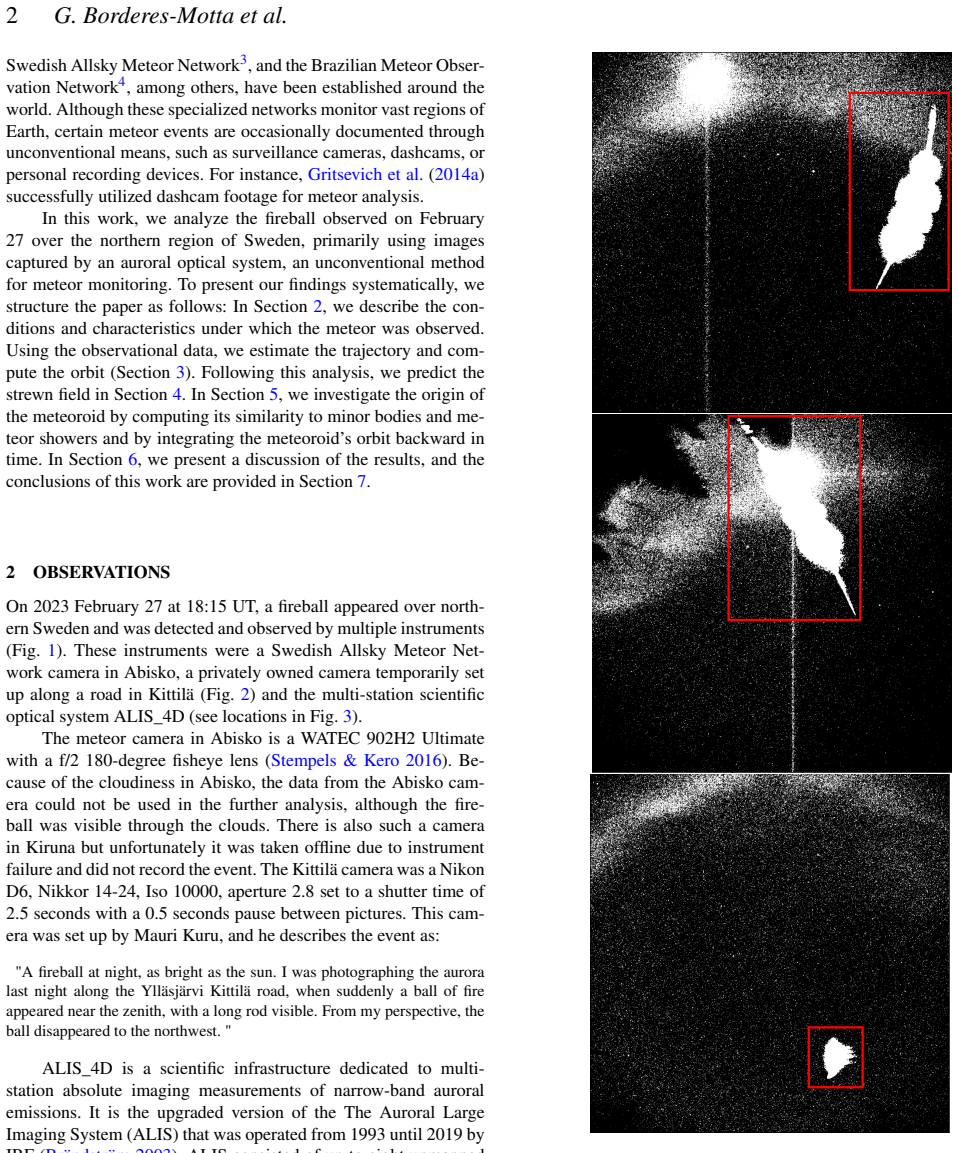
Swedish fireball originated from Apollo asteroid family

Observations of the 2023 February 27 fireball in northern Sweden using the auroral imaging system ALISβ‚„D

Auroral cameras captured the 2023 event and simulations show Earth close approaches placed the meteoroid on a collision course.

Figure from the paper full image
abstract click to expand
On 2023 February 27 at 18:15:55.77 UT, a bright fireball streaked across the sky above northern Sweden. The event offered a valuable opportunity to study the phenomenon using an optical system primarily designed for auroral studies, the Auroral Large Imaging System (ALIS_4D), that captured the event. In this study we show the capability of ALIS_4D to perform observations in support of meteor event analysis. We estimated the trajectory from the recorded data and computed the orbit. In addition, we investigated the origin of the meteoroid searching for its parent body. Fitting the analytical ablation model known as $\alpha$-$\beta$ to the trajectory as well as incorporating local wind-field data in Monte-Carlo dark-flight simulations, strewn-fields were computed and physical properties of the meteoroid were estimated. Trajectory analyses delineate a strewn field along the border between Kiruna and G\"allivare in northern Sweden. Our findings indicate that the meteoroid's parent body was likely an Apollo family object. We performed an orbital similarity analysis to identify candidate parent bodies of the fireball. Our simulations suggest that close approaches with Earth could have disrupted the meteoroid's orbit, placing it on a collision course.
0
0
astro-ph.EP 2026-05-11 2 theorems

New retrieval ties sub-Neptune spectra to magma composition

Coupling magma-ocean and atmospheres in spectral retrievals of sub-Neptunes

Coupling equilibrium models to Bayesian fits lets spectra constrain interior oxidation state and volatile content.

Figure from the paper full image
abstract click to expand
Recent high-precision atmospheric observations with JWST is enabling detailed characterization of sub-Neptune atmospheres and motivating efforts to understand and constrain their interiors. Theoretical studies suggest that sub-Neptunes possibly host hydrogen-dominated atmospheres that are chemically coupled with an underlying magma ocean. However, a quantitative retrieval framework directly linking atmospheric spectra to magma ocean properties has yet to be established. Here we introduce MELTYQ, a coupled magma-atmosphere retrieval framework that links transmission spectra to the oxidation state and volatile inventory of underlying magma oceans. MELTYQ combines a magma-atmosphere equilibrium model, which includes the solubility of H-/O-/C-/N-bearing species in the melt and redox reactions, with a Bayesian spectral retrieval scheme. Using simulated retrieval tests, we validate the approach and show that magma redox state and volatile content can be constrained under favorable observational conditions. As a proof of concept, we apply MELTYQ to JWST transmission spectra of the benchmark sub-Neptunes K2-18 b and TOI-270 d. We find that coupled magma-atmosphere retrievals are generally capable of reproducing the observed spectra of these planets. However, we identify several key limitations in the current framework. Specifically: more flexible free-retrieval approaches remain statistically preferred; the CO/CO$_2$ absorption feature near 4.5 $\mu$m for TOI-270 d is not fully captured; and a number of underlying model assumptions may not be strictly valid. Nevertheless, embedding coupled magma-atmosphere models directly within Bayesian retrievals enables quantitative assessment of degeneracies and sensitivities, establishing a pathway for directly connecting atmospheric spectra to magma composition in this underexplored exoplanet regime.
0
0
astro-ph.EP 2026-05-11 2 theorems

Bayesian method jointly infers brown dwarf map and geometry

Bayesian Doppler Imaging: Simultaneous Inference of Surface Maps and Geometric Parameters

Applied to Luhman 16B it recovers a mid-latitude dark region while constraining inclination to 61 degrees and rotation to 31 km/s with full-

Figure from the paper full image
abstract click to expand
We present a fully Bayesian, pixel-based Doppler imaging framework that enables the simultaneous inference of surface brightness maps and geometric parameters, including the inclination $i$ and equatorial rotation velocity $v_{\mathrm{rot}}$, from high-resolution spectral time series. We treat the inference as a Bayesian linear inverse problem conditioned on nonlinear geometric parameters. The surface map is modeled as a Gaussian Process prior over pixel intensities, introducing a characteristic spatial scale that sets the map resolution. This allows analytical marginalization of the linear coefficients and efficient sampling of the nonlinear parameters with Hamiltonian Monte Carlo. {Validation with synthetic data demonstrates that our method recovers the longitudes of large-scale surface inhomogeneities and constrains $v_{\mathrm{rot}}$ and $i$ under the adopted model assumptions, while also revealing the limited latitudinal sensitivity intrinsic to Doppler imaging.} We applied this framework to high-resolution VLT/CRIRES observations of the brown dwarf Luhman 16B. Our analysis reveals a large-scale dark region at mid-latitudes, consistent with previous studies but now with spatially resolved uncertainty estimates. Furthermore, we successfully constrained the geometric parameters without fixing \(v_{\mathrm{rot}}\sin i\) or $i$ to literature values, deriving an inclination of $i = 61.0_{-12.3}^{+14.3}$ degrees and an equatorial rotation velocity of $v_{\mathrm{rot}} = 31.2_{-3.1}^{+5.3}~\mathrm{km\,s^{-1}}$. These results indicate a radius broadly consistent with evolutionary models and suggest a possible spin-axis misalignment under the assumption of comparable equatorial rotation velocities for the two components. Our code is publicly available under the MIT license.
0
0
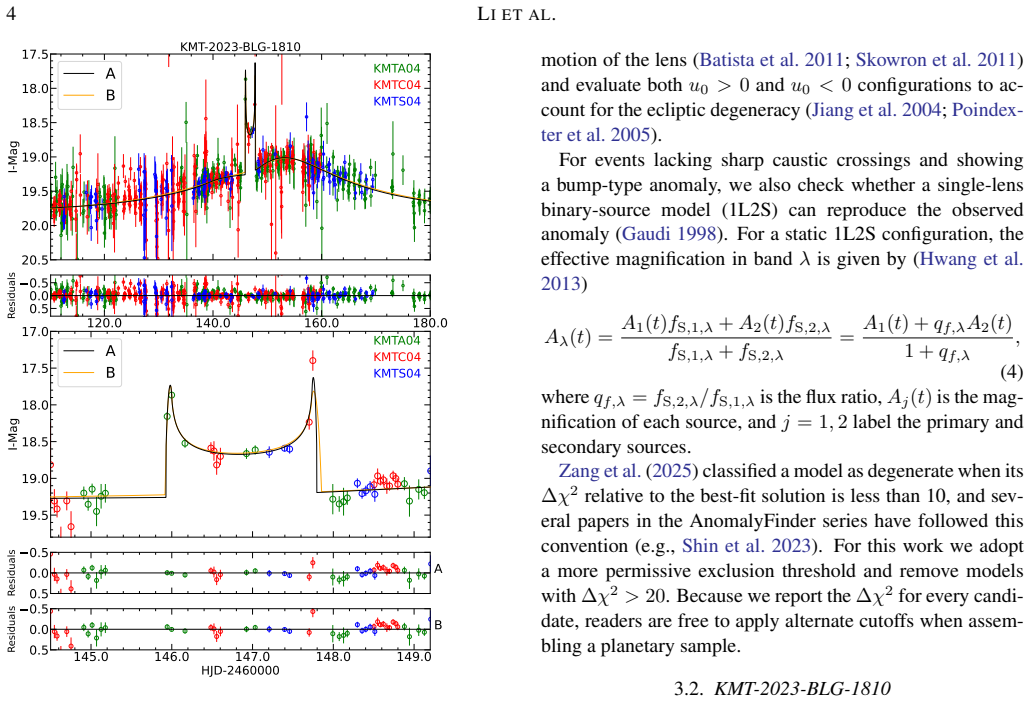
astro-ph.EP 2026-05-11 Recognition

MORIA pipeline cuts microlensing solutions in half with HST data

You Shall Not Pass (Without Modeling): High-Resolution Analysis of KMT-2019-BLG-0253 using MORIA

Analysis of KMT-2019-BLG-0253 yields host mass 0.65 solar masses and planet mass 7-9 Earth masses at 2.64 kpc

Figure from the paper full image
abstract click to expand
We present the Microlensing Object high-Resolution Imaging Analysis pipeline, or MORIA. This is an automated procedure to reduce high-resolution HST images of microlensing targets, build empirical point-spread function models from the data, and perform simultaneous multi-star PSF fitting to blended sources, lenses, and neighbor stars. We have developed and tested this pipeline using HST observations of the microlensing event KMT-2019-BLG-0253, where we determine a host mass of $M_{host} = 0.65 \pm 0.04M_{\odot}$. We have reduced the number of possible solutions for this target by a factor of two, with the remaining solution subject to the well-known close-wide degeneracy. We determine a planet mass of $m_{p} = 7.18 \pm 0.40 M_{\oplus}$ (close) or $m_{p} = 9.48 \pm 1.13 M_{\oplus}$ (wide), and distance to the lens system of $D_L= 2.64 \pm 0.22$ kpc. This work demonstrates the importance of using an automated high resolution imaging tool to inform light curve modeling for microlensing planets found during the upcoming Nancy Grace Roman Galactic Bulge Time Domain Survey (GBTDS).
0
0
astro-ph.EP 2026-05-11 Recognition

Ionization modeling aligns HAT-P-70b abundances closer to solar

HAT-P-70b through the Eyes of MAROON-X: Constraining Elemental Abundances of Metals and Insights on Atmosphere Dynamics

High-resolution spectra detect many metals and show that accounting for thermal ionization corrects most ratios toward solar values, with a

Figure from the paper full image
abstract click to expand
Ultra-hot Jupiters (UHJs) are exceptional laboratories for studying planetary atmospheres under extreme irradiation conditions. With close-in tidally locked orbits, these planets can have daysides hot enough for metals to be significantly ionized while still maintaining nightsides cold enough for refractory species to potentially condense. We present an analysis of the ultra-hot Jupiter HAT-P-70b taken with the MAROON-X high-resolution spectrograph. Using cross-correlations, we detect 14 neutral and singly ionized species, including Fe I, Fe II, Ti I, Ca I, Ca II, Cr I, Na I, V I, Mn I, Ni I, Mg I, Ba II, O I, and Sr I, with tentative evidence for H I, Co I, and K I. The absorption signals exhibit blueshifts on the order of a few $\mathrm{km\,s^{-1}}$, consistent with day-to-night winds. We further constrain relative abundances with atmospheric retrievals and demonstrate that some inferred elemental abundance ratios depend strongly on modeling assumptions. In particular, we show that a well-mixed retrieval approach neglecting ionization can strongly bias highly ionizable elements such as Ca and Ti. Accounting for the effects of equilibrium chemistry and thermal ionization generally results in inferred elemental abundance ratios that are closer to expectations for a solar-like composition, although not in all cases. Interestingly, we find a distinct nickel enrichment on HAT-P-70b, adding to the growing number of UHJ studies where the Ni abundance is seemingly enhanced. Our results underline the importance of considering physical and chemical atmospheric processes such as ionization when interpreting high-resolution transmission spectra of UHJs.
0
0
astro-ph.EP 2026-05-11 Recognition

Refractory ratios control sub-Neptune atmospheric C/O and metal content

A New Global Chemical Equilibrium Code: Refractory Element Signatures in Super-Earths and Sub-Neptunes

New equilibrium code shows Mg/Si and Fe/Si in the rocky interior alter carbon partitioning beyond water-budget effects

Figure from the paper full image
abstract click to expand
The atmospheres of super-Earths and sub-Neptunes can be strongly modified by chemical exchange with their molten interiors during long-lived magma ocean phases. Interpreting atmospheric observations requires fast models that self-consistently couple atmospheric chemistry to the composition of the planetary interior. We present an updated implementation of the global chemical equilibrium (GCE) framework from (Schlichting & Young 2022), which computes the equilibrium composition of a coupled metal-silicate-gas system. The numerical solver has been improved using a gradient-based optimizer, reducing the computational cost of solving the chemical network by more than two orders of magnitude and enabling large parameter studies. We apply the framework to a large synthetic population of planets and explore the imprint of bulk refractory composition of Mg, Si, and Fe on atmospheric properties. We consider planets with different masses, thermal states, and volatile inventories. We find that the atmospheric mass fraction and atmospheric metal mass fraction are primarily controlled by the temperature at the atmosphere-magma ocean interface and the planetary water budget, while the accreted hydrogen mass fraction plays a minor role because most hydrogen dissolves into the interior. For planets that accreted water, the refractory ratios Mg/Si and Fe/Si strongly influence carbon partitioning between the gas, silicate, and metal phases, producing large variations in atmospheric atmospheric metal mass fraction and C/O ratios. These results demonstrate that atmospheric compositions of sub-Neptunes depend sensitively on both the volatile inventory and the bulk composition of rocky material, providing new constraints for interpreting atmospheric observations. The new GCE code is open-source.
1 0
0
astro-ph.EP 2026-05-11 Recognition

Interstellar comet metals traced to carbonyl sublimation

Origin and evolution of NiI and FeI in the coma of the interstellar comet 3I/ATLAS throughout its trajectory

High post-perihelion rates and evolving Ni/Fe ratios in 3I/ATLAS are reproduced by direct sublimation of Ni(CO)4 and Fe(CO)5 from several cm

Figure from the paper full image
abstract click to expand
We present high-resolution UVES+VLT observations of neutral nickel and iron atoms in the coma of the interstellar comet 3I/ATLAS taken after perihelion. Metal emission was strong shortly after perihelion and persisted at large heliocentric distances. At $r_h \sim 2$ au the total metal production rate was found to be at least an order of magnitude larger than that of typical solar-system comets. Post-perihelion production rates exhibit pronounced asymmetry compared to the pre-perihelion behavior: production rates are higher after perihelion and decline more gradually with $r_h$, the difference being stronger for FeI. The NiI/FeI abundance ratio, initially anomalously large before perihelion, evolved toward values comparable to solar-system comets near 2 au, and shows a weaker $r_h$ dependence after perihelion. To interpret these results, we revisited and extended the carbonyl hypothesis in which FeI and NiI are produced by the rapid photodissociation of Fe(CO)$_5$ and Ni(CO)$_4$ vaporized from the nucleus. Fits that include direct sublimation of carbonyls reproduce the observed rates and the high NiI/FeI line ratio, which is determined by the higher volatility of Ni(CO)$_4$. Desorption of carbonyls from sublimating CO$_2$ and H$_2$O ices is found to be negligible. The temperature profiles needed to reproduce the observations were found to be shallower than the equilibrium $T \propto r_h^{-1/2}$ relation, suggesting that the sublimation could occur below the surface of the nucleus. Fits using temperature profiles from thermal models require sublimation from depths of several cm, especially post-perihelion. An additional transient heat source ($T \simeq$ 100-140~K), possibly linked to the amorphous-crystalline ice transition, is proposed to explain the early NiI excess before perihelion.
0
0
astro-ph.EP 2026-05-11 Recognition

KMTNet data confirms three planets from 2023 microlensing survey

Mass Production of 2023 KMTNet Microlensing Planets. III: Three Planets from the Subprime Field

Brings the 2023 total to 25 planets whose mass ratios match the 2016-2019 distribution.

Figure from the paper full image
abstract click to expand
To complete the analysis of the 2023 KMTNet subprime-field microlensing planetary events identified by its AlertFinder system, we present the analysis of six events, KMT-2023-BLG-(1810, 0084, 1118, 0584, 1697, 2218). We find that the first three events are securely confirmed as planetary, with inferred mass ratios of $\log q \sim -1.9$, $-2.0$, and $-2.6$, respectively. The remaining three events exhibit the well-known degeneracy between binary-lens/single-source (2L1S) and single-lens/binary-source (1L2S) models, and two of these also admit viable stellar binary solutions. A Bayesian analysis indicates that the companions in the confirmed planetary events are likely either super-Jupiters orbiting beyond the snow line of M- or K-dwarf hosts or, for two degenerate solutions of KMT-2023-BLG-1118, Saturn-mass planets orbiting late-type M dwarfs. To date, the 2023 KMTNet sample contains 25 unambiguous planetary events, and its mass-ratio distribution is consistent with that of the KMTNet planetary sample from 2016--2019.
0
0
astro-ph.EP 2026-05-08 2 theorems

Energy model predicts ice on TRAPPIST-1 e and f

Exploring TRAPPIST-1 Climate States with an Energy Balance Model

TRAPPIST-1 e shows partial ice cover and f stays fully frozen unless carbon dioxide partial pressure reaches one bar

Figure from the paper full image
abstract click to expand
This paper presents a version of the HEXTOR energy balance model that has been configured for the study of habitable terrestrial planets orbiting low-mass stars. The model is validated for rapidly-rotating Earth-like planets using latitudinal coordinates, which shows expected patterns of bistability. A tidally-locked coordinate transformation is then applied to the model, which is calibrated to match mean values of the minimum, average, and maximum surface temperatures from a general circulation model ensemble of TRAPPIST-1 e. This calibrated energy balance model is used to characterize the possible climate states of such a synchronously rotating planet across a parameter space of instellation and carbon dioxide partial pressure. These calculations suggest a state of partial ice cover for TRAPPIST-1 e and complete ice cover for TRAPPIST-1 f, unless carbon dioxide partial pressure is ~1 bar or greater. This approach demonstrates the capability of a simplified one-dimensional model to study the climates of terrestrial planets in synchronous rotation, which can help guide more complex models and observations toward the most promising targets of interest.
0
0
astro-ph.EP 2026-05-08 Recognition

Filter detects faint moving objects with low false positives

You Only Stack Once (YOSO): A Motion-Filtered, Deep-Learning Framework for Detecting Faint Moving Sources

YOSO recovers most known targets and finds new Solar System bodies in DEEP data by filtering trails at pixel level.

Figure from the paper full image
abstract click to expand
We present You Only Stack Once (YOSO), an automated pipeline designed to detect faint, slow-moving Solar System objects in wide-field astronomical surveys. The pipeline integrates a novel Gaussian Motion Filter (GMoF) that operates at the pixel level to enhance signal-to-noise for objects exhibiting a range of apparent rates of motion. Unlike conventional shift-and-stack methods, which rely on discrete velocity trials, GMoF amplifies trails while suppressing random noise and static background features. Applied to a subset of DEEP observations from the Dark Energy Camera, YOSO recovered 45 out of 73 previously detected objects, as well as 11 new TNOs. It also discovered 216 objects in the near Solar System. Although alternative shift-and-stack methods are sensitive to objects about 0.88 magnitudes fainter, YOSO's false positive rate is extremely low, since it detects only sources that exhibit a trail and are consistent with a point source when shifted at the right rate. We show how this method can be deployed on large surveys like LSST, and adapted for other domains that require motion-based signal enhancement, including exoplanet imaging through Angular Differential Imaging (ADI), and near-Earth object (NEO) detection for missions like NEO Surveyor. YOSO thus provides a versatile, scalable approach for extracting faint, motion-dependent signals in the era of data-intensive astronomy.
0
0
astro-ph.EP 2026-05-08 2 theorems

ALMA modeling shows varied millimetre dust heights across discs

Diverse dust vertical height and settling strength conditions in protoplanetary discs

Six inclined systems yield dust scale heights from under 0.1 au thick to several au extended, with settling strength differing between and,

Figure from the paper full image
abstract click to expand
The settling of dust particles plays a critical role in the growth and dynamics of dust grains. We performed a detailed modeling of the ALMA continuum substructures for six highly inclined protoplanetary discs using radiative transfer simulations, to constrain the vertical height of millimetre dust grains and the settling strength. Our modeling results are a very thin millimetre dust disc in T Cha ($\text{h}_{\text{dust}}<$ 0.1 au throughout the disc), a vertically extended dust disc in DoAr 25 ($\text{h}_{\text{dust}}$ of $\sim$ 4.7 au at 140 au) and tentatively a thin disc in MY Lup ($\text{h}_{\text{dust}}<$ 0.5 au at 70 au). From lower resolution observations we found a very thin disc for PDS 111 ($\text{h}_{\text{dust}}<$ 0.1 au throughout the disc) and a more vertically extended millimetre dust disc in V409 Tau ($\text{h}_{\text{dust}}$ of $\sim$ 1.3 au at 35 au). We could not measure the vertical height in the asymmetric disc of RY Lup. We also found that the input dust opacities are a source of degeneracy in our models. Our tentative results, assuming the Ricci dust opacities, point to a diverse settling strength in our sample and possible radial variations. We also compared the models that best fit the ALMA data with the SPHERE data to test if they can reproduce the vertical distribution of small dust grains. This comparison suggests that models that reproduce the dust density distribution in the midplane cannot reproduce the distribution of small dust grains in the upper layers, reinforcing the need for more complex models.
0
0
astro-ph.EP 2026-05-08 Recognition

Gaia DR3 spectra sort 14042 asteroids into 13 classes

Taxonomy of 14042 asteroids from Gaia DR3 reflectance spectra

Near-ultraviolet light helps split B and F types in the C-complex and spot G types, boosting the count of classified objects.

Figure from the paper full image
abstract click to expand
Asteroid reflectance spectra provide key constraints on surface composition. Gaia DR3 enables the study of 60,518 asteroids through NUV to visible reflectance spectra. We aim to classify asteroids using Gaia DR3 spectra and provide a homogeneous framework. Owing to systematics affecting Gaia DR3 data, direct comparison with previous taxonomies has to be taken with caution; thus, we developed a classification scheme tailored to Gaia and linked the resulting taxa to established classes. We selected the highest-quality spectra using Gaia DR3 quality flags and applied uncertainty thresholds to mitigate spectral artifacts, retaining over one-third of the original sample at the least noisy wavelength. To improve compositional discrimination, we included albedo, reducing the final sample to about one-fourth of its initial size. We then iteratively applied dimensionality reduction and clustering to identify the spectral taxa. We classified 14,042 asteroids into 13 taxonomic classes: A, B, C, D, E, F, G, K, L, M, P, S, and V, representing an increase of three compared to the number of objects classified in previous spectral classifications. The largest relative increase is found for the K class. The inclusion of NUV wavelengths allows the separation of B and F types within the C-complex and facilitates the identification of G types. The dynamical distribution follows expected trends, with Stypes dominating the inner and middle Main Belt, C-complex asteroids prevalent in the outer Main Belt, and D types beyond. We present a taxonomical classification of 14,042 asteroids based on Gaia DR3 reflectance spectra. NUV coverage is critical for disentangling primitive classes within the C-complex. Although artifacts in Gaia DR3 require caution when comparing median spectra with other datasets, this classification provides a robust reference for future Gaia releases, with larger observed samples.
0
0
astro-ph.EP 2026-05-08

New method maps Jupiter winds at five latitudes from Cassini data

Jovian Zonal Winds Revealed from Cassini/VIMS Observations

Pixel light-curve correlations yield vertical shear at the equator weaker than earlier estimates using two 2001 VIMS cubes.

Figure from the paper full image
abstract click to expand
Understanding Jupiter's zonal winds is crucial to unraveling the dynamics of its atmosphere. Over the last decades, multiple data sources and techniques have been used to study zonal winds in Jupiter. Here, we develop a correlation-based method for the near-infrared data from the Cassini spacecraft to investigate zonal winds at different altitudes. The new method uses Jupiter's rotation to scan the planet as it rotates, allowing retrieval of winds from the analysis of light-curves of specific pixels over the Jovian disc. The method allows the retrieval of winds at multiple wavelengths from the Cassini/VIMS spectral data despite the low spatial resolution and the non-uniform cadence of the data. By applying this method to two VIMS data cubes acquired on 15 January 2001 at 09:42 UT and 16 January 2001 at 03:22 UT, we reveal the zonal winds at five main latitudes using information from three different wavebands, as well as the wind vertical structure at the equator, showing significant vertical wind shear in the troposphere. The vertical wind shear we derived is weaker than as reported in previous studies, highlighting the intricate interactions among multiple dynamical processes in Jupiter's atmosphere and reflecting the complexity of its atmospheric circulation. Despite the uncertainty due to the low spatial/temporal resolution and non-uniform cadence of the Cassini/VIMS-IR spectral data, the new method established in this study maximizes the value of the Cassini/VIMS in understanding Jupiter's zonal winds. Further observations are essential to explore the underlying mechanisms in Jupiter's atmosphere.
0
0
astro-ph.EP 2026-05-07

Binary-planet resonances turn bistable above a quarter harmonic ratio

Resonant Hamiltonian Dynamics in the CR3BP: Bistability and Stochastic Resonance in Binary Planetary Systems

Averaged Hamiltonians show the second resonant term must exceed one-quarter the first for two stable wells to appear, opening the door to st

Figure from the paper full image
abstract click to expand
Context: The Circular Restricted Three-Body Problem provides a fundamental framework for understanding resonant dynamics in binary star systems. Aims: We develop a unified Hamiltonian formulation for mean-motion resonances that encompasses both circumstellar and circumbinary planetary orbits within the CR3BP. Unlike the Solar System case where the perturbing body is a planet of negligible mass, here the perturber (a stellar companion) has a non-negligible, finite mass, a crucial difference that we fully incorporate. Methods: Starting from the full Hamiltonian in each configuration, we perform canonical transformations to resonant action angle variables and derive reduced one-degree-of-freedom Hamiltonians through systematic averaging over the fast orbital motion. Leading-order scaling laws for the Fourier coefficients of the resonant perturbation are obtained, revealing their dependence on the binary mass ratio and the planet's orbital distance. Results: The resulting effective potential is shown to exhibit bistability under the well-defined condition |epsilon2/epsilon1| > 1/4, where epsilon1 and epsilon2 are the amplitudes of the first two resonant harmonics. This bistability creates the essential dynamical setting for stochastic resonance. Scaling laws for the Fourier coefficients are derived for both S-type and P-type configurations. Estimates for known binary-planet systems show that while currently observed systems lie below the bistability threshold, the theory predicts that extreme configurations (a/a_b <~ 1.5 for P-type, almost equal mass binary) could host bistable resonances accessible to future observations. Conclusions: This work provides a natural Hamiltonian framework for studying stochastic resonance in binary planetary systems, bridging analytical celestial mechanics and the nonlinear dynamics of exoplanetary systems subject to realistic perturbations.
0
0
astro-ph.EP 2026-05-07

Australian observatory confirms 40 exoplanets

Finding Alien Worlds in Queensland -- A Decade of MINERVA-Australis

MINERVA-Australis supplies the ground follow-up needed to validate TESS space telescope candidates in the southern sky.

Figure from the paper full image
abstract click to expand
Three decades ago, humanity entered the Exoplanet Era, with the discovery of the first planets orbiting other stars. Today, more than 6000 exoplanets are known - a tally recently bolstered by NASA's TESS spacecraft. Whilst TESS is an exceptional planet finding machine, dedicated follow-up observations from the ground are required to confirm the existence of the planets it discovers. To achieve this, we constructed the southern hemisphere's only dedicated exoplanet detection and characterisation facility, MINERVA-Australis, at the University of Southern Queensland's Mt Kent Observatory. Funded in 2015, MINERVA-Australis saw first light in 2018, in time for the launch of TESS. MINERVA-Australis has since been scouring the skies, working to confirm and characterise the incredible harvest of planets detected by TESS. To date, the facility has contributed to the discovery of 40 new exoplanets, and continued the legacy of radial velocity data from the Anglo-Australian Planet Search program.
0
0
astro-ph.EP 2026-05-07

Stellar stream position predicts planet retention

Life is But a Stream: The Distribution of Planetary Systems Along Stellar Streams and their Properties

Simulations reveal that stars at stream edges keep their planets while those at centers lose or alter them due to differing escape histories

Figure from the paper full image
abstract click to expand
The majority of discovered exoplanets have been observed orbiting field stars as opposed to within a star cluster. To determine whether the lack of observed exoplanets in star clusters is due to gravitational perturbations or observational limitations, we consider the possibility of studying exoplanets in stellar streams. We present the results of direct $N$-body simulations of planetary systems around stars that orbit within a star cluster. Our simulations demonstrate that stars with early cluster escape times tend to retain all their planets as they spend most of their time orbiting in the cluster's low-density outskirts. Alternatively, stars with later escape times can have a wide range of survival fractions as they are subjected to a range of local densities and encounter types. With respect to the stellar stream that forms as the result of the cluster's dissolution, stars near the edge of the stream are therefore more likely to have unperturbed planetary systems. Conversely, stars near the centre of the stream have a higher chance of having planets pushed to eccentric orbits, inclined orbits, or stripped from the system entirely. From our suite of simulations, we provide an estimate of the probability that a star will host a planet with a given initial semi-major axis $a_0$ based on the star's location along a stellar stream $\Delta \phi$.
0
0
astro-ph.EP 2026-05-07

Mass transfer from circumbinary disc enables giant planets in close binaries

A formation pathway for giant planets in S-type discs of {Ξ³}-Cephei-like compact binaries

Replenishment extends disc lifetime so planets can grow to several Jupiter masses despite truncation by the companion star.

Figure from the paper full image
abstract click to expand
Planet formation in close binary systems such as $\gamma$-Cephei is strongly challenged by the truncation of the circumprimary disc induced by the stellar companion, which limits the available reservoir of gas and solids. Recent hydrodynamical studies suggest that a long-lived circumbinary disc may replenish the circumprimary disc with gas and dust, extending its lifetime and potentially enabling giant planet formation. However, the long-term evolution of such systems under viscous accretion and X-ray photoevaporation, and their coupling with planet formation, remains largely unexplored. We investigate whether sustained mass inflow from a circumbinary reservoir can prolong the lifetime of circumprimary discs and facilitate gas giant formation in $\gamma$-Cephei-like binaries, even in the presence of strong photoevaporation. Using our code PLANETALP-B, we model the coupled evolution of gas, dust growth, and in-situ planet formation by pebble and gas accretion, including viscous accretion, X-ray photoevaporation, and continuous mass injection. Gas inflow can significantly extend the lifetime of the circumprimary disc, even under strong mass loss. When solids are also transferred, the lifetime of the solid disc increases, enhancing planetary growth. As a result, planets can reach several Jupiter masses, unlike scenarios without mass replenishment. We show that sustained mass transfer from a circumbinary disc can enable giant planet formation in $\gamma$-Cephei-like binaries, providing a viable pathway to overcome disc truncation, although its applicability to other systems remains to be tested with dedicated hydrodynamical simulations.
0
0
astro-ph.EP 2026-05-07

NUV transit of XO-3b is 30-70% deeper and 22 min late

The NUV transit of XO-3 b

The offset and extra depth point to an extended absorber, yet low mass-loss and wrong-direction bow-shock timing leave the mechanism unclear

Figure from the paper full image
abstract click to expand
Near-UV (NUV) measurements of exoplanet transits offer a means to probe atmospheric escape, cloud formation, and planetary magnetic fields. We examine a 2024 XMM-Newton Optical Monitor NUV observation of the transit of XO-3~b, a massive hot Jupiter on an eccentric orbit with a previously observed abnormally large NUV-absorbing atmosphere. We analyze this NUV data jointly with a concurrent ground-based optical observation and all TESS transit observations, and find a NUV transit depth of $R_{p,NUV}/R_{\star} = 0.1371^{+0.016}_{-0.019}$, which is 30-70% deeper than the optical transit. Although the optical transits do not show signs of transit timing variations, the transit center in the NUV is $22^{+13}_{-11}$ minutes late compared to the optical ephemeris. We investigate atmospheric escape as a potential explanation of the properties of this NUV transit by examining X-ray data from XMM-Newton, characterizing the X-ray luminosity of XO-3 for the first time and estimating an extremely small mass-loss rate of $\sim10^4$ g/s ($\sim10^{-19}$ M$_{\text{jup}}$/yr). Finally, we investigate the likelihood of an NUV-absorbent bow-shock by estimating the magnetic field of the planet. While such a mechanism is capable of producing NUV transit offsets on the order of tens of minutes, our analytic approximations predict an early rather than late transit, indicating a need for further magnetohydrodynamic simulations.
0
0
astro-ph.EP 2026-05-07

Winds quench nightside methane on hot Jupiter

Horizontal transport as a source of disequilibrium chemistry on the nightside of a hot exoplanet

JWST data on NGTS-10A b show day-to-night transport keeps the cooler hemisphere depleted in CH4.

abstract click to expand
Hot Jupiters have temperature gradients of several hundreds of degrees between their permanent day and nightsides. In equilibrium, the primary carbon reservoir is expected to transition from CO on the dayside to CH4 on the nightside. Theory predicts that the atmospheric circulation, characterised by km/s winds, can advect chemical species from the dayside to the nightside faster than the time needed for the CO-to-CH4 chemical reaction to reach equilibrium. However direct evidence of this process has, so far, remained elusive, partly because it is often degenerate with other processes, such as vertical mixing or non-stellar elemental abundances. Here, we present observational evidence for such day-to-night transport of chemical species by observing both the dayside and the nightside of the hot Jupiter NGTS-10A b with the JWST/NIRSpec instrument. We constrain the presence of H2O and CO with similar abundances on both the dayside and nightside. Our observations are compatible with a solar-composition atmosphere at chemical equilibrium on the dayside, but indicative of disequilibrium chemistry for the nightside as it is significantly depleted in CH4 compared to equilibrium chemistry predictions. We further show that the lack of CH4 on the planet's nightside cannot be attributed to non-solar elemental abundances or to vertical mixing mechanisms and must therefore be due to horizontal chemical quenching. Our study shows the fundamental role atmospheric transport plays in shaping the distribution of chemical species on exoplanet atmospheres.
0
0
astro-ph.EP 2026-05-07

New candidate at 14 AU and HΞ± spiral found in HD 142527 disk

Exploration of the inner region of the system HD 142527

High-contrast views of the inner region link companions to varying accretion and disk shaping.

Figure from the paper full image
abstract click to expand
HD 142527 is a well-studied intermediate-mass T Tauri star surrounded by a transitional disk with a large dust cavity, spiral structures, and an accreting low-mass companion. Despite extensive observations, the system's inner regions remain poorly understood, particularly regarding their influence on disk morphology and planet formation. This study aims to investigate the inner region of HD 142527 (<50 au) with high detection sensitivity thanks to dedicated postprocessing methods to search for undetected components and explore their potential role affecting the disk's structure and evolution. We analyze high-contrast imaging data obtained with VLT/SPHERE applying PACO and REXPACO algorithms, dedicated respectively to the detection of point-like sources and to the reconstruction of circumstellar disks with high reliability, while relying on both angular and spectral variations. We revisit the known companion HD 142527 B and update its photometry, astrometry and accretion rate estimates. Furthermore, we identify a new candidate companion (CC) at an angular separation of ~0.09" (~14 au), although it may also be a disk feature. Otherwise, it could be a young gas-giant planet or a brown dwarf with a mass of 15-50 $M_\rm{Jup}$. Additionally, we report the discovery of a tightly wound H$\alpha$ spiral feature in the inner disk, reconstructed for the first time by high contrast imaging. The spiral implies varying accretion dynamically linked to the known companion B and possibly to CC, suggesting ongoing interactions that influence the disk's structure. Our findings provide new insights into the complex interactions within the HD 142527 system, highlighting the role of multiple companions in driving disk asymmetries and facilitating planet formation. Future high-resolution observations and dynamical modeling will be essential to fully understand the system's architecture and evolution.
0
0
astro-ph.EP 2026-05-07

Mantle re-melting sets different structures for Earth and Mars

Earth and Mars interior structures set by re-melting of the first solid mantle

Partial melts dilute iron in Earth's magma ocean but not Mars', explaining the basal layer only on the smaller planet

Figure from the paper full image
abstract click to expand
Magma ocean crystallisation sets up the early structure and long-term evolution of terrestrial planets. Recent seismic evidence signals the presence of a silicate layer at the base of Mars' mantle. Magma-ocean crystallisation and subsequent overturn has been invoked as a hypothesis for this layer's origin. However, while a magma ocean existed in both Earth and Mars, there is no seismic evidence for a basal layer in present-day Earth. In this study, we apply a parameterized-convection model to study whether the effect of partial melting in the growing mantle on overlying magma ocean composition can explain this discrepancy. Melts from the mantle buffer the crystallising magma ocean, limiting progressive differentiation, iron enrichment and the density anomaly of the overturned layer. This buffering is more efficient for larger planets with more vigorous mantle convection and for planets that are originally less enriched in iron. Consequently, a shallow magma ocean is more iron enriched and denser on Mars than on Earth, providing an explanation for the Mars-Earth difference in present-day structure of the mantle. We also predict a dichotomy in terrestrial-exoplanet interior structures, with a population with small, stratified mantles and another with large, mostly-homogeneous mantles.
0
0
astro-ph.EP 2026-05-07

Asteroid 2022 OB5 rotates once every 1.54 minutes

Accessible does not mean exploitable: HiPERCAM reveals the ultra-fast rotation of 2022 OBβ‚…

High-cadence observations reveal why orbital accessibility does not guarantee practical exploitability for small near-Earth objects.

Figure from the paper full image
abstract click to expand
2022 OB$_5$ is a sub-10-metre Apollo-type near-Earth asteroid whose orbital configuration placed it among the most dynamically accessible small bodies in near-Earth space, motivating its selection as the target of the first commercial asteroid-prospecting mission. We present its first photometric characterisation, based on high-cadence simultaneous five-band $u_sg_sr_si_sz_s$ observations obtained with HiPERCAM at the 10.4-m Gran Telescopio Canarias (GTC). Analysis of the light curves yields a rotation period of $P_{\rm rot} = 1.542 \pm 0.001$ min, independently confirmed with observations taken by the Two-meter Twin Telescope, establishing 2022 OB$_5$ as an ultra-fast rotator. The reflectance spectrum derived from the simultaneous multiband photometry is featureless and moderately red, consistent with the X-complex. Despite its good orbital accessibility, the ultra-fast rotation of 2022 OB$_5$ poses severe practical challenges for any surface operation with current technology, regardless of compositional interest. This illustrates a population-level challenge: at the sizes and $\Delta v$ values most favourable for in-situ missions, fast rotation is the dominant spin state, and rotation period measurement is therefore an indispensable prerequisite for evaluating the resource potential of asteroid mission candidates.
0
0
astro-ph.EP 2026-05-07

Comets 67P and 103P keep steady composition across orbits

Activity and composition of periodic comets 67P/Churyumov-Gerasimenko and 103P/Hartley 2 at two different perihelion passages

No change in gas ratios or dust properties detected between passages even as activity falls for 103P and rises slightly for 67P.

Figure from the paper full image
abstract click to expand
Through photometry and spectroscopy, we studied the evolution of the activity and chemical composition of comet 67P during its 2025 and 2021 perihelion passages and of comet 103P during its 2010 and 2023 passages. For each comet, we aim to compare their behavior from one apparition to another. We used the TRAPPIST telescopes to monitor the comets using broadband and narrowband filters. From the broadband images, we produced light curves and computed color indices for each passage, and we derived the activity slopes. We used a Haser model to compute the production rates of five gaseous species (CN, C2, C3, OH, and NH) and derived the proxy parameter Afrho for dust activity. We also observed both comets in spectroscopy during their most recent apparition using the Himalayan Chandra Telescope and compared the spectroscopic data to our results obtained through photometry. For both comets, our analysis of coma colors does not reveal any significant change from one passage to the other, indicating that the properties of the released dust grains are similar. Our values of the color indices are consistent with the mean values for Jupiter-family comets. We measured a slight increase in the gas and dust activities of comet 67P between 2015 and 2021, probably due to the small change in the comet's orbit that led the perihelion distance to decrease from 1.24 au for the first apparition to 1.21 au for the second one. Regarding 103P, we unambiguously measured a decrease (of at least 50\%) in the gas and dust activities between 2010 and 2023, showing a different behavior for this young, active comet. We find a typical chemical composition for both comets and detect no variation of the C2-to-CN production rate ratios and dust-to-gas ratios from one passage to the other, indicating constant compositions, even if the level of activity has changed for 103P.
0
0
astro-ph.EP 2026-05-07 2 theorems

Neural net cuts stellar RV jitter to half

Mitigating stellar radial velocity jitter using orthogonal activity indices and a time-aware neural network

Trained on simulated line distortions, CANSTAR improves orbital fits for planets around active stars over Gaussian processes.

Figure from the paper full image
abstract click to expand
Despite recent advances in the precision of high-resolution spectrographs, the detection of Earth-like exoplanets is still limited by the effects of stellar activity, which introduce radial velocity variations at the metre-per-second level or larger. We present a framework to disentangle stellar effects from planetary signals by exploiting high-order distortions of the cross-correlation function (CCF; a measure of the average spectral line profile), thus moving beyond the commonly applied Gaussian fit approximation. We decomposed the CCF using a Gram-Schmidt orthogonal basis function, enabling the separation of pure line shifts from line-shape distortions. To model activity-induced contributions to the radial velocities, we have developed a time-aware convolutional attention network dubbed CANSTAR. This network was trained on synthetic line-shape distortion coefficients produced with the realistic stellar simulator StarSim to learn the temporal evolution of stellar activity features. We validated our framework using HARPS and CARMENES observations of two active stars, ${\epsilon}$ Eridani and TZ Arietis. The network effectively mitigates stellar activity, reducing the radial velocity RMS to 52.5 % and 62.4 % of the uncorrected variability, respectively. This correction enables a more precise determination of the orbital parameters of TZ Arietis b compared to a Gaussian process regression. Our results demonstrate that neural networks that incorporate the temporal context can outperform state-of-the-art methods in complex activity regimes. Future improvements on StarSim that will allow us to train CANSTAR on 3D magnetohydrodynamic spectra and more complex instrumental modelling are expected to bridge the performance gap between synthetic and real data, offering a robust pathway towards detecting Earth-mass planets around Sun-like stars.
0
0
astro-ph.EP 2026-05-07

Neural net trained on simulations cuts stellar RV jitter to half

Mitigating stellar radial velocity jitter using orthogonal activity indices and a time-aware neural network

CANSTAR model lowers radial velocity RMS to 52-62 percent of original levels in two active stars and sharpens planet orbit estimates

Figure from the paper full image
abstract click to expand
Despite recent advances in the precision of high-resolution spectrographs, the detection of Earth-like exoplanets is still limited by the effects of stellar activity, which introduce radial velocity variations at the metre-per-second level or larger. We present a framework to disentangle stellar effects from planetary signals by exploiting high-order distortions of the cross-correlation function (CCF; a measure of the average spectral line profile), thus moving beyond the commonly applied Gaussian fit approximation. We decomposed the CCF using a Gram-Schmidt orthogonal basis function, enabling the separation of pure line shifts from line-shape distortions. To model activity-induced contributions to the radial velocities, we have developed a time-aware convolutional attention network dubbed CANSTAR. This network was trained on synthetic line-shape distortion coefficients produced with the realistic stellar simulator StarSim to learn the temporal evolution of stellar activity features. We validated our framework using HARPS and CARMENES observations of two active stars, ${\epsilon}$ Eridani and TZ Arietis. The network effectively mitigates stellar activity, reducing the radial velocity RMS to 52.5 % and 62.4 % of the uncorrected variability, respectively. This correction enables a more precise determination of the orbital parameters of TZ Arietis b compared to a Gaussian process regression. Our results demonstrate that neural networks that incorporate the temporal context can outperform state-of-the-art methods in complex activity regimes. Future improvements on StarSim that will allow us to train CANSTAR on 3D magnetohydrodynamic spectra and more complex instrumental modelling are expected to bridge the performance gap between synthetic and real data, offering a robust pathway towards detecting Earth-mass planets around Sun-like stars.
0
0
astro-ph.EP 2026-05-07

Power-law scalings predict disk accretion rates without alpha

Beyond the Ξ± model: scaling the wind-driven accretion rate in protoplanetary disks using systematic non-ideal magnetohydrodynamical simulations

Non-ideal MHD runs show mass inflow depends on midplane beta, ambipolar Elsasser number, and active-layer thickness to within factor of two.

Figure from the paper full image
abstract click to expand
Magnetically driven mass accretion in protoplanetary disks plays a crucial role in understanding disk evolution and planet formation. However, the $\alpha$ prescription lacks a direct connection to physical processes, and no systematic scaling law yet exists for the accretion rate as a function of disk quantities. While local shearing-box simulations offer a powerful approach to analyzing accretion structure at low computational cost, they suffer from a problem: the toroidal magnetic field generated by Keplerian shear accumulates within the computational domain, disrupting a geometry consistent with global wind-driven accretion. In this study, we introduce the super-box-scale diffusion (SBD) scheme into non-ideal MHD shearing-box simulations. The SBD scheme continuously damps the horizontally averaged horizontal magnetic field components, thereby mitigating this problem and maintaining the field-line symmetry required for global wind-driven accretion for more than 500 orbital periods. Comparison with self-similar solutions supports the SBD method, with the vertical structure and plasma-beta dependence of the accretion rate agreeing to within 23--28\%. We then conduct a parameter survey of 46 cases using a magnetic diffusivity table constructed from ionization equilibrium calculations, covering disk radius, surface density, magnetic field strength, and dust-to-gas ratio. We find that the surface field-line pitch and mass accretion rate follow power-law scalings with the midplane plasma beta, an effective ambipolar Elsasser number, and the normalized thickness of the magnetically active layer. These relations reproduce the numerical results to within a factor of 2--3 across the explored parameter space and, in most cases, to within a factor of 2. They provide a framework for predicting the mass accretion rate from local disk physical quantities without invoking an $\alpha$ parameter.
0
0
astro-ph.EP 2026-05-07

Volcanic plumes reach low-pressure levels on rocky exoplanets

Modeling Volcanic Plume Heights Across Exoplanet Atmospheres: Insights from TRAPPIST-1

1D model adapted from Venus and Mars shows when eruptions on tidally heated worlds can loft gases to observable altitudes.

Figure from the paper full image
abstract click to expand
Explosive volcanic eruptions play a fundamental role in the evolution and observability of rocky exoplanets, serving as a key mechanism for injecting volatiles into planetary atmospheres and potentially modifying their climate and composition. This process may be particularly important for close-in exoplanets where tidal forcing can drive substantial internal heating, analogous to (but often exceeding) Io's volcanism. In this work, we adapt and extend a classic 1D volcanic plume model originally developed in IDL by Glaze and Baloga for Venus and Mars applications, and port it into a flexible, open Python framework suitable for exoplanet studies. The model explicitly couples vent thermodynamics, buoyant entrainment, and vertically varying static stability to predict plume rise, neutral-buoyancy height, and overshoot for a wide range of planetary and atmospheric conditions. We first benchmark the Python implementation against the original IDL code and analytic scaling laws to ensure adequate momentum budgets and strict mass conservation. We then apply the model to a suite of exoplanet-relevant background states, including CO2-rich atmospheres under strong irradiation and diverse surface conditions. A systematic sensitivity analysis explores how plume height depends on surface gravity, bulk atmospheric composition (and mean molecular weight), background temperature and stratification, vent overpressure, and volatile loading. We identify regions of parameter space where plumes routinely penetrate to low-pressure levels, maximizing their potential detectability in transmission or emission. These results provide a physically grounded framework for predicting whether and how volcanic emissions might be detected on rocky exoplanets, including-but not limited to-those experiencing strong tidal heating.
0
0
astro-ph.EP 2026-05-06 3 theorems

Climate states alter exposure times for exo-Earth biosignatures

Impact of Climate States and Seasons on Future Exo-Earth Observations

Icier worlds make O2 features easier to detect while high-obliquity seasons introduce measurable spectral shifts.

Figure from the paper full image
abstract click to expand
Many planetary parameters impact the climate state of Earth-like exoplanets and could vary significantly from those on Earth. However, some of these parameters may be impossible to observe, causing ambiguity in determining exoplanet climate and characterizing their atmospheric features. We explore how distinct planetary climate states impact their reflectance spectra to reduce uncertainty in the interpretation of future direct imaging observations, such as with the Habitable Worlds Observatory. We find that worlds with the same atmospheric composition but distinct climate states have notable differences in apparent albedos and feature detectability. An additional consequence is that the exposure time required to detect atmospheric features and biosignatures, such as O$_2$, will depend on climate state, with icier worlds being more favorable for biosignature detection while ice-limited worlds may be more habitable. We find that clouds improve the strength and detectability of atmospheric features in reflected light, especially for ice-limited low albedo worlds. We find temporal variation in the strength of spectra at different seasons on high obliquity worlds, causing the required time to resolve atmospheric features to vary between the equinoxes and solstices. This abiogenic seasonality could be detectable through repeated direct imaging observations and may help inform the planetary climate state, especially in combination with constraints on inclination and mass. Our work elevates the importance of astrometry performed concurrently with direct imaging for characterizing climate state and planetary habitability of exoplanets. Interpretation of future spectroscopic observations must also account for temporal variations created by obliquity when searching for biosignatures.
0
0
astro-ph.EP 2026-05-06 3 theorems

Hottest eccentric hot Jupiter found around young pulsating star

TOI-159 b: an eccentric hot-Jupiter planet around a young, pulsating Ξ³ Doradus star

TOI-159 b shows 0.24 eccentricity and 1900 K temperature, isolated at 13-sigma in combined velocity and transit data.

Figure from the paper full image
abstract click to expand
Fast-rotating hot stars are challenging targets for exoplanet searches due to rotational broadening and stellar variability. Moreover, hot stars often exhibit pulsations, an additional source of scatter in both photometric and spectroscopic series. Because of these challenges, such stars remain a relatively unexplored environment for planetary architecture and evolution studies. In this study, we present the confirmation and preliminary atmospheric characterisation of a giant planet orbiting a young ($\approx$ 150 Myr), pulsating $\gamma$ Doradus star. TOI-159 b ($P_{\rm orb} \simeq 3.7$ d, $R_{\rm p} \simeq 1.6~R_{\rm J}$, $M_{\rm p} \simeq 3.5 M_{\rm J}$) is an S-type planet in a close binary system and is the hottest ($T_{\rm eq} \simeq 1900$ K) hot Jupiter with a significant eccentricity ($e = 0.24 \pm 0.04$) ever detected. Our joint modelling of radial velocities (HARPS and CORALIE), transits (\textit{TESS}), and spectro-photometry (IMACS) allows us to detect its Keplerian signal at high significance ($13 \sigma$), place strong constraints on its eccentricity ($6 \sigma$), disentangle the stellar rotational modulation and pulsation periods, and generate a low-resolution transmission spectrum, on which we conduct an exploratory analysis to constrain the presence of a planetary atmosphere using combined star-planet retrievals. Whilst our spectrum appears to display some modulation, the data is too coarse to allow for any conclusive detections at this stage. Higher-resolution observations are needed to confirm or refute these features and, if genuine, determine whether they originate from contamination from the star or a planetary atmosphere.
0
0
astro-ph.EP 2026-05-06

Salinity and obliquity together boost cold exoplanet habitability

Synergistic Effects of Ocean Salinity and Planetary Obliquity Enhance Habitability of Cold Exo-Earths

Their joint action via ice-albedo feedback produces ice-free states where isolated changes would not, for planets with the same stellar flux

Figure from the paper full image
abstract click to expand
Past work has shown that ocean salinity and planetary obliquity both influence the climates of Earth-like exoplanets throughout the habitable zone of Sun-like stars. The effects of salinity and obliquity can be profound, with low vs. high salinity or obliquity resulting in distinct climate states in some scenarios. However, past work has considered salinity or obliquity in isolation and has not explored how each may modulate the effects of the other. We investigate how ocean salinity and planetary obliquity jointly impact climate and habitability using the ROCKE-3D coupled ocean-atmosphere general circulation model. We find that salinity and obliquity have a greater combined impact on planetary climate than the sum of their effects in isolation. This synergy between salinity and obliquity arises due to the ice-albedo feedback, producing distinct climate states that range from ice-free to globally glaciated while having same initial atmospheric conditions and receiving the same instellation. Consequently, ocean salinity and planetary obliquity can together lead to divergent habitability outcomes for otherwise identical planetary scenarios and initial conditions. Salinity and obliquity can jointly increase the planetary fractional habitability across oceans and continents, especially for cold exoplanets. Although neither ocean salinity nor planetary obliquity can be reliably predicted or observationally constrained, their synergistic effects must be considered in future studies of planetary climate and exoplanet observations, especially when characterizing planetary habitability.
0
0
astro-ph.EP 2026-05-06

GJ 1132 b likely lost its atmosphere to XUV radiation

The Range of Cumulative XUV Flux on GJ 1132 b

All models give at least 95% odds the planet received over 50 times Earth's cumulative XUV flux

Figure from the paper full image
abstract click to expand
We investigate the plausible history of the XUV luminosity evolution of the planet-hosting M4 star GJ 1132 (~0.2 solar masses) to infer the cumulative incident XUV flux intercepted by the short-period (~1.6 d) Earth-sized transiting planet GJ 1132 b. We include the dominant observational uncertainties, compare two quiescent XUV luminosity evolution models, and simulate the XUV luminosity evolution from flares based on TESS data and a re-analysis of Kepler stars. We find only 4 flares in GJ 1132's TESS 123 day lightcurve, which is relatively few for M dwarfs and, in conjunction with the ~125 day period, suggests that this star is many Gyr old. We find that all model permutations predict that the planet has at least a 95% chance of receiving more than 50 times as much XUV flux as modern Earth, confirming that this planet is a good candidate for permanent atmospheric loss. We also find that an empirical XUV model for M dwarfs predicts 2-3 times more total XUV flux than a commonly used solar twin model and that the empirical model's distribution is 2-3 times narrower. Flares contribute about 20% of the cumulative XUV flux on planet b, which, while modest, ensures the planet lies firmly on the atmosphere-free side of the "cosmic shoreline."
0
0
astro-ph.EP 2026-05-06

PALEOS is an open-source toolkit that unifies equations of state for iron

PALEOS: Multiphase Equations of State and Mass-Radius Relations for Exoplanet Interiors

PALEOS supplies a phase-aware, thermally consistent set of equations of state for iron, MgSiO3, and H2O that recovers Earth's radius to 0.3…

abstract click to expand
Modeling the interior of a rocky or water-rich exoplanet is a thermodynamic closure problem: every layer's density, temperature gradient, and phase must follow from an equation of state (EoS) that remains self-consistent across the pressure-temperature range from surface to core. Existing EoS span disciplines, use different formalisms, and rarely supply the full thermodynamic quantities needed by evolutionary models of interior phase transitions. We present PALEOS (Planetary Assemblage Layers: Equations of State), an open-source toolkit consolidating EoS for iron, magnesium silicate (MgSiO$_3$), and water (H$_2$O) into a unified, phase-aware, thermally responsive framework spanning 17 phases. PALEOS derives density, energy, entropy, heat capacities, thermal expansion, and the adiabatic gradient analytically via Maxwell relations, and is released as lookup tables on regular P-T grids. We validate it against the Preliminary Reference Earth Model, recovering Earth's radius to 0.3% and lower-mantle densities to 3%, and compute 17,900 mass-radius relations from 0.1 to 100 $M_\oplus$ for rocky (Fe + MgSiO$_3$) and water-rich (Earth-like core + H$_2$O envelope) compositions at 300-4000 K. Continuous solid-to-melt EoS let thermal expansion span the fully-solid to magma-ocean regime: the radius offset exceeds 1% above 1500 K and reaches 16% at 4000 K for low-mass silicate planets, comparable to composition degeneracy and transit-radius uncertainties. We demonstrate this on two ultrashort-period super-Earths, WASP-47 e and TOI-1807 b: each admits two purely rocky solutions indistinguishable in mass and radius but in radically different states, one fully solid with no dynamo, the other hosting a deep magma ocean and a liquid iron core capable of sustaining a magnetic field. Phase-aware, thermally resolved EoS are essential for translating astronomical observations into exoplanetary geophysics.
0
0
astro-ph.EP 2026-05-06

Public dataset simulates Ariel exoplanet spectra for pipeline testing

A public dataset of Ariel simulated observations for developing exoplanetary atmosphere data reduction pipelines

It supplies known ground truth plus a neural-network example to expose when machine-learning detrending breaks under new data distributions.

Figure from the paper full image
abstract click to expand
Detecting and characterising exoplanet atmospheres remains challenging because atmospheric signals can be comparable to residual noise and instrumental/astrophysical systematics. Spectral features span from a few ppm for small planets up to $\sim 10^3$ ppm for warm/hot giants, while high-quality JWST time-series spectroscopy typically reaches $\sim 10$--$50$ ppm (occasionally $\sim 100$--$200$ ppm in the presence of stellar variability or stronger systematics), making correlated noise across temporal and spectral dimensions a key limitation. With JWST delivering an increasing volume of high-precision transmission spectra, and Ariel set to extend this to a homogeneous survey of $\sim 10^3$ exoplanet atmospheres, robust benchmarking resources with known ground truth are essential to develop and validate data-driven (including ML-based) detrending approaches. As a major step towards this goal, we use ExoSim2 and TauREx to generate one of the most comprehensive public datasets based on the current payload design of the ESA Ariel mission, specifically intended to benchmark detrending algorithms. We also provide a deep neural network baseline for time-series reduction, and use it to highlight the limitations of ML based detrendng methods, i.e. the risks posed by dataset shift when observed distributions diverge from those of the training set, a scenario likely to arise in real observations. This dataset is featured in the Ariel Data Challenge 2024 on Kaggle and has been field-tested for robustness and simulation fidelity. By making these resources publicly available, we aim to support the community in developing, comparing, and stress-testing scalable and reliable methods for exoplanet transmission spectroscopy.
0
0
astro-ph.EP 2026-05-06

ROXs 12 star and companion show different carbon isotope ratios

The ESO SupJup Survey. X. A carbon isotope contrast in the young ROXs 12 system

12CO/13CO measured at 77 for the M0 host and 55 for the L0 companion in this young system

Figure from the paper full image
abstract click to expand
Emerging research suggests that elemental and isotopic ratios of exoplanet and brown dwarf atmospheres may serve as potential tracers of their formation pathways. The ESO SupJup Survey aims to shed light on this hypothesis, with a focus on the $^{12}$CO/$^{13}$CO ratio, by investigating the atmospheric composition of substellar companions and isolated brown dwarfs. In this work, we aim to characterize the atmospheres and determine the ratios of $^{12}$CO/$^{13}$CO of the Rho Ophiuchus X-ray source (ROXs) 12 system ($\sim$6Myrs), consisting of an M0 host with an L0 companion, as part of the ESO SupJup survey. Using high-resolution CRIRES+ K band spectra of these objects, we perform atmospheric retrieval analyses to derive their atmospheric properties, including the $^{12}$CO/$^{13}$CO ratio. Our retrieval framework is built on the radiative transfer code petitRADTRANS, with which we generate model spectra based on equilibrium chemistry tables computed with FastChem, coupled with the nested sampling algorithm PyMultiNest. We report the presence of H$_2$O, $^{12}$CO, $^{13}$CO, and HF in both the star and companion, with a tentative detection of H$_2^{18}$O in ROXs 12B. The $^{12}$CO/$^{13}$CO ratios of the two objects show a measurable, though not strongly significant, difference, namely $77\substack{+10 \\ -7}$ and $55\substack{+10 \\ -7}$ for ROXs 12A and B. We measure a C/O ratio of 0.54$\pm$0.01, while the C/O ratio of the star is not reliably constrained due to the absence of atomic oxygen lines in the K band. Furthermore, we retrieve moderate veiling in the host star of $r_k$=$0.17\substack{+0.02 \\ -0.03}$. Systems such as ROXs 12, in which both star and planet can be chemically and isotopically characterized, are crucial for constraining potential formation mechanisms of massive, wide-orbit super-Jupiters.
0
0
astro-ph.EP 2026-05-05

Gas causes small dust to drift outward in debris disks

The ALMA survey to Resolve exoKuiper belt Substructures (ARKS) XI: Gas-dust interactions and radial offsets between micron and millimetre-sized grains

Offsets between micron and millimeter grains arise from drift competing with collisions, depending on gas amount and optical depth.

Figure from the paper full image
abstract click to expand
The dust observed in debris disks is the result of a collisional cascade initiated from $\sim$ km-sized parent bodies. Using near-infrared to sub-millimeter observations, we can probe particle sizes spanning 2-3 orders of magnitude, and with sufficient angular resolution we can follow the dynamics of these dust particles. Observations taken as part of the ALMA ARKS program allowed for a detailed comparison with near-infrared scattered light observations, at unprecedented resolution. The comparison between the two wavelength regimes reveals that for most gas-bearing debris disks, the distribution of small dust grains peaks outward of the distribution of large dust grains. In this paper we investigate whether gas-dust interactions can explain such radial offsets. We perform numerical simulations and compute surface brightness profiles at several wavelengths to assess which parameters drive these radial offsets. We find that while larger gas masses lead to more efficient outward radial drift, the resulting radial offset strongly depends on the optical depth of the disk, as the drift efficiency directly competes with the particles' collisional lifetime. We also find that increasing the relative number of $\mu$m-sized dust grains usually yields a larger radial offset between scattered light and millimeter observations. Finally, we show that mid-infrared observations can complement near-infrared and sub-millimeter images, and we discuss the formation of secondary rings at near-infrared wavelengths. The angular resolution achieved by the ARKS program has opened a new avenue to study the dynamics of dust particles in debris disks, revealing unexpected differences between the appearance of the disks scattered light and thermal emission. We showed that gas-dust interactions can explain the observed radial offsets and provide pointers as to which parameters have the most significant impact.
0
0
astro-ph.EP 2026-05-05

Decades of study leave key giant planet questions unresolved

Outstanding Questions in Giant Planet Theory

Review flags puzzles in formation conditions, extreme interiors, and potential habitable moons for future data.

abstract click to expand
Giant planets have key role in shaping planetary systems. Their composition reveals information on the conditions at which planets form, and their interiors serve as natural laboratories to explore the behavior of materials at extreme conditions. They can also host large regular moons that can be habitable. In addition, outside the solar system, giant exoplanets remain the ideal planets for detection and characterization. However, despite decades of investigations, and much progress on both the theoretical and observational fonts, several key open questions remain unanswered. In this short review, I highlight a few open questions in the field with the hope that they can be addressed with future research and observational data.
0
0
astro-ph.EP 2026-05-05

Speckle modeling yields native-resolution retrievals for HD 19467 B

JWST high-contrast spectroscopy with speckle modelling: Atmospheric retrievals of the T dwarf companion HD 19467 B

Joint fit of residual stellar contamination and atmospheric model recovers molecular abundances and carbon isotopes across 2.87-5.2 microns.

Figure from the paper full image
abstract click to expand
High-contrast, medium-resolution spectroscopy with JWST can resolve molecular and isotopic features in cool substellar atmospheres, but for close-in companions the extracted spectra can be biased by wavelength-dependent residual stellar contamination. We assess the impact of residual speckles on atmospheric inference for the T dwarf companion HD 19467 B and compare the results to the field T dwarf 2MASS J0415-0935. We analyse JWST/NIRSpec G395H spectra ($2.87$--$5.2$$\mu$m; $R\sim2700$) and perform Bayesian atmospheric retrievals with petitRADTRANS coupled to nested sampling using ultranest. We use a flexible, parameterised pressure-temperature profile with free, constant-with-altitude molecular abundances. For HD 19467 B we fit the PSF-subtracted spectrum with a linear model that includes the atmospheric model and a set of speckle spectra from the integral field unit. We detect H$_2$O, CH$_4$, CO, CO$_2$, and NH$_3$ in both atmospheres and measure carbon isotopic ratios from CO isotopologues, finding $^{12}$C/$^{13}$C$=154^{+19}_{-17}$ for HD 19467 B and $^{12}$C/$^{13}$C$=85\pm5$ for 2MASS J0415-0935. Speckle contamination primarily affects the low-frequency spectral shape at $3.0$--$3.7$$\mu$m and can affect retrieved abundances if not accounted for. We obtain seemingly constrained posteriors for some additional species (e.g.\ SiO and H$_2$S) in some cases, but treat these as tentative because cross-correlation does not yield significant detections; PH$_3$ is not detected in either target. Joint fitting of the atmospheric spectrum and the speckle contamination enables native-resolution retrievals of the high-contrast companion HD 19467 B with JWST/NIRSpec without continuum subtraction. Over $2.87$--$5.2$$\mu$m, medium-resolution spectroscopy constrains elemental and isotopic composition; both objects exhibit near-solar metallicity and subsolar C/O ratios.
0
0
astro-ph.EP 2026-05-05

Sub-Neptunes shift from core-powered to photoevaporative winds

Characterizing the bolometric-photoevaporative transition in young sub-Neptunes with radiation-hydrodynamic simulations

Simulations show three escape regimes during contraction, with the switch depending on mass and XUV irradiation.

Figure from the paper full image
abstract click to expand
Hydrodynamic atmospheric escape plays a central role in shaping the demographics of small, close-in exoplanets. Two mechanisms have been proposed to drive mass loss: photoevaporation, powered by UV irradiation, and core-powered mass loss, in which a bolometrically heated wind is sustained by cooling from the planetary interior. Although each mechanism can independently reproduce observed exoplanet demographics, both likely operate simultaneously. To quantify their combined impact, we use AIOLOS, a hydrodynamic radiative transfer code, coupled to a planetary evolution model to self-consistently compute atmospheric escape and planetary evolution. We find that as a typical sub-Neptune contracts, it evolves through distinct escape regimes. The youngest, most inflated planets drive a core-powered, bolometrically heated wind because UV radiation cannot reach the bolometric sonic point. This is followed by a transitional regime shaped by both bolometric and UV heating. As radii decrease further, escape rates approach the purely photoevaporative energy limit. We derive analytic scalings for the transition between these regimes, showing that it occurs at smaller radii for lower-mass and more highly irradiated planets, where core-powered escape dominates. Coupling both processes enhances escape even in more massive, cooler sub-Neptunes. We present the first combined mass-loss rates for a range of planet masses and XUV luminosities and show that the thermal structure below the UV absorption radius -- set by atmospheric composition -- also affects escape rates. These results integrate core-powered and photoevaporative escape into a unified framework, demonstrating that a self-consistent treatment of atmospheric composition, escape, and evolution is essential for understanding small exoplanets.
0
0
astro-ph.EP 2026-05-05 3 theorems

Silicate grains bind water twice as tightly as ice

Astrochemical Inheritance of Terrestrial Planets Water from Local Wet Silicates

Calculations show this allows enough local water retention inside the snowline to explain Earth and other rocky planets' water without outer

Figure from the paper full image
abstract click to expand
The delivery of water to the inner Solar System rocky planets, including Earth, remains debated, as standard models assume that they formed from dry grains, inside the snowline of the protosolar nebula. However, a recent work showed that a not-negligible amount of water formed during the prestellar phase could have been retained by pebbles and planetesimals at the Earth's orbit in enough quantities to reproduce its water content. This study was based based on quantum mechanics (QM) calculations of the binding energy (BE) of water on amorphous ice and on a kinetic approach. Here, we present new QM calculations of the BE of water frozen on the surface of silicate grains, and show that it is on average about twice larger than that on the amorphous ice. The contribution of this first layer of frozen water increases the dust temperature at which frozen water can be retained. This provides a local source of water not only for the Earth, but also for the inner rocky planets. The predictions from our model are in agreement with the available estimates of water content in terrestrial planets. This suggests that water delivery from the outer Solar System may not be required.
0
0
astro-ph.EP 2026-05-05 2 theorems

Occultation shows thin atmosphere on 250-km TNO

The first detection of an atmosphere on a trans-Neptunian object beyond Pluto

The plutino 2002 XV93 displays 100-200 nanobars surface pressure, the first detection beyond Pluto and evidence that smaller icy worlds can

abstract click to expand
Trans-Neptunian objects (TNOs) in the outer Solar System are predominantly small, icy worlds long presumed to be atmosphereless except for the largest bodies. Until now, Pluto has been unique among TNOs in exhibiting a substantial atmosphere (nitrogen with trace methane and carbon monoxide) at microbar pressure levels. All other known TNOs, including ~ 1000-km-sized bodies such as Eris, Haumea, Makemake, and Quaoar, have shown no detectable atmospheres in stellar occultation observations, with surface pressure upper limits of order 1-100 nanobars. Here we report the first detection of an atmosphere around a TNO besides Pluto. A stellar occultation by the ~ 250-km-radius plutino (612533) 2002 XV93 on 10 January 2024 revealed a refractive signature, indicating the presence of a thin atmosphere. The derived surface pressure is 100-200 nanobars, i.e. approximately a hundred times lower than Pluto's and yet significantly above previous limits for other larger bodies. This discovery provides the first evidence that even a sub-1000-km TNO can retain an atmosphere, challenging current paradigms of volatile retention. Our findings indicate that a fraction of distant icy minor planets can exhibit atmospheres possibly caused by ongoing cryovolcanic activity or a recent impact event of a small icy object.
0
0
astro-ph.EP 2026-05-05 3 theorems

Eight mean tropical years differ across ecliptic longitudes

Mean tropical year length at arbitrary ecliptic longitude

Lengths for equinoxes and cross-quarter points vary by minutes; any fixed leap rule accumulates quadratic error to one day in about 57,000Β y

Figure from the paper full image
abstract click to expand
We compute the mean interval between successive returns of the apparent geocentric solar longitude $\lambda$ to a fixed value $L \in \{0^\circ, 45^\circ, 90^\circ, \ldots, 315^\circ\}$, averaged over a multi-millennium window; this gives eight ``mean years'' against which calendar leap rules can be tuned: four cardinal-point years (equinoxes and solstices); four cross-quarter years. The construction is built on Meeus's low-precision solar theory (Astronomical Algorithms, 2nd ed., 1998), itself a low-order truncation of Newcomb's Tables of the Sun, re-expanded around J2000.0. Where Meeus presents polynomial coefficients without justification, we draw on Smart's Textbook on Spherical Astronomy (6th ed., revised by Green, 1977) for the underlying derivations. Numerical accuracy is validated against the cardinal-point intervals tabulated in Meeus, More Mathematical Morsels, 2002. We close with a derivation of the secular drift equation, showing that, regardless of how well a leap rule is tuned, the slow shrinkage of the tropical year produces a quadratic cumulative error that reaches one day in $\sim$57,000 years for any fixed intercalation rule.
0
0
astro-ph.EP 2026-05-04 2 theorems

JWST spectrum shows mini-Neptune formed beyond ice line

JWST unveils a high mean molecular weight atmosphere for mini-Neptune TOI-1130b: Evidence for formation beyond the water ice line

Detections of water, CO2 and SO2 yield high metallicity and mean molecular weight consistent with ex-situ origin and migration

Figure from the paper full image
abstract click to expand
We present the combined JWST/NIRSpec G395H and NIRISS SOSS transmission spectrum of a warm mini-Neptune, TOI-1130b (3.66 R$_{\oplus}$, 19.8 M$_{\oplus}$, $T_{eq}\sim825$ K). It is part of a rare and unique multi-planet system TOI-1130, which hosts an inner mini-Neptune and an outer hot Jupiter locked in a 2:1 mean motion resonance. From the transmission spectrum of TOI-1130b we detect multiple molecules -- H$_2$O (7.5$\sigma$), CO$_2$ (3.3$\sigma$), and SO$_2$ (3.6$\sigma$), as well as a tentative detection of CH$_4$ ($\sim$2$\sigma$). We find a strong optical slope in the NIRISS/SOSS spectrum, which is consistent with TESS and CHEOPS transit depth measurements. From equilibrium chemistry retrievals we measure the atmospheric metallicity ($\log{Z/Z_{\odot}}=1.8^{+0.4}_{-0.3}$) and C/O ratio ($<$0.75 at 3$\sigma$ level confidence) and constrain the atmospheric mean molecular weight, $\mu$ = 5.5$^{+1.3}_{-0.8}$ amu. These constraints are consistent with self-consistent forward model grids. We detect no significant He I 1.083$\mu$m absorption signal and put a mass-loss rate upper limit of $10^{11}$g\s$^{-1}$. The volatile-rich high mean molecular weight atmosphere of TOI-1130b along with the `pebble-filtering' effect of the outer hot Jupiter supports the ex-situ formation scenario beyond the water ice line and subsequent migration, coherent with its present orbital architecture. A volatile-rich formation scenario could also potentially explain the location of TOI-1130b at the edge of the `radius cliff'. This result hints that the mini-Neptune population may not a homogeneous formation history; rather, volatile-rich ex-situ formation also contributes to its population.
0
0
astro-ph.EP 2026-05-04 2 theorems

Migrating super-Earths trigger dust rings that may form planetesimals

On the Dust Substructures Triggered by Two Super-Earths Migrating in Low-viscosity Disks

Simulations find a narrow ring between the planets and a broad multiple-ring zone outside where dust densities rise high enough for new plan

Figure from the paper full image
abstract click to expand
We investigate dust substructure formation induced by two super-Earths migrating in a low-viscosity disk with single-size dust grains selected from the submillimeter to centimeter range of sizes. The orbital evolution of planets takes place in the vicinity of the 2:1 commensurability, which allows to determine, in addition to the dust substructure properties, the dust impact on the rate of migration, the resonance capture, the libration overstability and the outcome of passage through the commensurability. Using two-dimensional two-fluid hydrodynamic simulations with dust feedback and dust diffusion taken into account, we identify two specific regions in the disk where the accumulation of dust particles is significant, leading to dust substructure formation with the dust-to-gas ratio values close to or even higher than 1 for large grains. The first region, with a narrow dust ring, is located between the planetary orbits and the second one, with a broad feature, evolving in time in a multiple ring substructure, is situated outside the orbit of the outer planet. Our results indicate that these two locations are favorable for planetesimal formation. We discuss the properties of the dust substructures formed in our simulations and outline possible consequences of their evolution for the observed architectures of multi-planetary systems.
0
0
astro-ph.EP 2026-05-04

This paper compares JWST/NIRISS spectroscopic phase curve data for the ultra-hot Jupiter…

The Days Drag On on WASP-121 b: Interpreting its NIRISS Spectroscopic Phase Curve with General Circulation Models

3D models overpredict WASP-121b emission by 12% versus JWST data, confirm strong drag and likely nightside clouds, but cannot reproduce the…

abstract click to expand
Ultra-hot Jupiters present extreme atmospheric phenomena not found in the Solar System. These planets' daysides experience strong temperature inversions, molecular species (including H2) dissociate, and magnetism disrupts their atmospheric circulation. On their nightsides H2 can recombine and clouds may form. Spectroscopic phase curves let us measure these spatially inhomogeneous conditions, which can then be interpreted with three-dimensional (3-D) models. In this work we compare the JWST/NIRISS spectroscopic phase curve of the ultra-hot Jupiter WASP-121 b to state-of-the-art 3-D models with varying modeling assumptions, including the aforementioned physical phenomena. We demonstrate the importance of accurately accounting for the planet's radius in comparison between data and models, as it changes the implied overall planetary emission. We find that the 3-D models predict planet emission $\sim$12% higher than observed, contributing to a continued tension between measured and predicted hot Jupiter albedos. We identify multiple pieces of evidence that confirm a strong source of drag operating in this planet's atmosphere. In addition, the nightside emission spectrum is devoid of strong absorption features, which may be best explained by nightside clouds. One feature of the dataset that is not matched by the 3-D models is a trend of increasing eastward phase offset with decreasing wavelength, for wavelengths shorter than $\sim$1.4 \textmu m. This result is not consistent with reflection from dayside clouds, nor can it be explained by removing atmospheric opacity sources. Our analysis highlights the complexities in generating 3-D models and interpreting observations of ultra-hot Jupiters in the JWST era.
0
0
astro-ph.EP 2026-05-04

Warm Neptune GJ 436 b shows no detectable atmospheric features

The atmosphere of the warm Neptune GJ 436 b probed with ESPRESSO

Two ESPRESSO transits yield only upper limits on atomic and molecular species, confirming a featureless optical spectrum.

Figure from the paper full image
abstract click to expand
Aims. We aim to identify the presence of atomic and molecular species in the upper atmosphere of the warm Neptune-sized transiting planet GJ 436 b, which has a radiative equilibrium temperature of 690 K and a mass of 25.4 Earth masses. Methods. Using transmission spectroscopy, we observed two full transits of GJ 436 b with the ESPRESSO spectrograph, covering the wavelength range from 3800 to 7880 Angstrom. We searched for traces of atomic (H I, Li I, Na I, Mg I, V I, Cr I, Fe I, and Fe II) and molecular (TiO, VO) species by directly detecting planetary absorption features and by cross-correlating the planetary spectrum with theoretical spectra computed for each investigated species. Results. Our analysis reveals no strong planetary detection for any of the species, consistent with a featureless optical spectrum. We derived upper limits by combining all ESPRESSO observations. Post-transit stellar flares were detected on both nights, primarily affecting chromospheric lines. A tentative Fe I signal appears in the first transit (S/N = 3.4 +/- 0.2) at a wind velocity of about -18.6 km/s, which is unexpectedly large for a cool planet. This weak signal is not present in the second transit and, combined with its low significance, suggests an origin in noise. In the less probable scenario where the feature is suppressed during the second transit by the higher stellar activity state, the T1 tentative signal peaks at 1300 K, which is above the equilibrium temperature of GJ 436 b. Ultimately, this result would imply a neutral iron abundance comparable to or exceeding that of the host star.
0

browse all of astro-ph.EP β†’ full archive Β· search Β· sub-categories