Recognition: unknown
Accessible does not mean exploitable: HiPERCAM reveals the ultra-fast rotation of 2022 OB₅
Pith reviewed 2026-05-08 16:37 UTC · model grok-4.3
The pith
The near-Earth asteroid 2022 OB5 rotates once every 1.54 minutes, making surface operations impractical with current technology despite its orbital accessibility.
A machine-rendered reading of the paper's core claim, the machinery that carries it, and where it could break.
Core claim
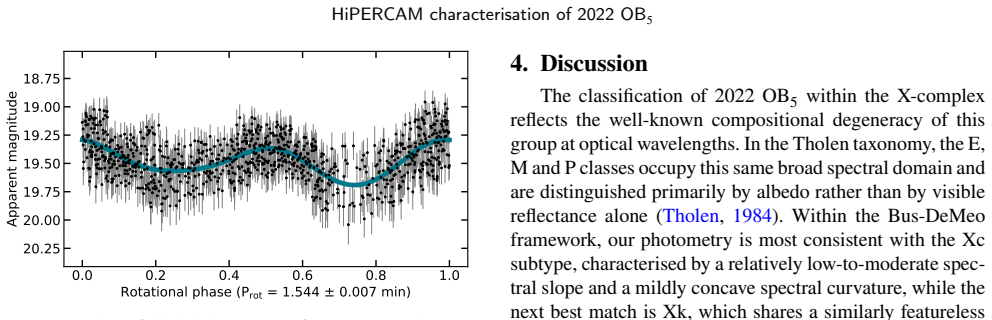
High-cadence simultaneous five-band photometry obtained with HiPERCAM at the 10.4-m Gran Telescopio Canarias yields light curves whose analysis gives a rotation period of 1.542 plus or minus 0.001 minutes for 2022 OB5. Independent confirmation comes from observations with the Two-meter Twin Telescope. The derived reflectance spectrum is featureless and moderately red, placing the asteroid in the X-complex. Despite the asteroid's favorable orbital accessibility, its ultra-fast rotation presents severe practical challenges for surface operations with existing technology, illustrating that fast spin dominates among small, low-delta-v objects.
What carries the argument
High-cadence simultaneous five-band u_sg_sr_si_sz_s photometry from HiPERCAM that produces light curves whose periodic analysis directly yields the rotation period.
If this is right
- At the sizes and delta-v values most favorable for in-situ missions, fast rotation is the dominant spin state among small asteroids.
- Rotation period measurement becomes an indispensable step in evaluating the resource potential of any asteroid mission candidate.
- Surface operations on 2022 OB5 remain impractical with current technology regardless of its compositional type.
- Similar fast-spin barriers are likely to apply to other dynamically accessible sub-10-metre near-Earth asteroids.
Where Pith is reading between the lines
- Mission planners may need to incorporate early spin-rate screening into target selection pipelines for small asteroids.
- The prevalence of fast rotators among accessible objects could reflect a size-dependent selection effect that favors rapid spin states.
- Longer-term monitoring might test whether 2022 OB5 exhibits any secondary periodic signals indicative of tumbling or binary structure.
Load-bearing premise
The observed brightness changes arise from the asteroid's own rotation rather than from shape irregularities, viewing geometry shifts, or other non-rotational effects.
What would settle it
A new set of photometric observations spanning several hours that shows no periodic signal at approximately 1.54 minutes or that reveals a distinctly different dominant period would falsify the reported rotation rate.
Figures




read the original abstract
2022 OB$_5$ is a sub-10-metre Apollo-type near-Earth asteroid whose orbital configuration placed it among the most dynamically accessible small bodies in near-Earth space, motivating its selection as the target of the first commercial asteroid-prospecting mission. We present its first photometric characterisation, based on high-cadence simultaneous five-band $u_sg_sr_si_sz_s$ observations obtained with HiPERCAM at the 10.4-m Gran Telescopio Canarias (GTC). Analysis of the light curves yields a rotation period of $P_{\rm rot} = 1.542 \pm 0.001$ min, independently confirmed with observations taken by the Two-meter Twin Telescope, establishing 2022 OB$_5$ as an ultra-fast rotator. The reflectance spectrum derived from the simultaneous multiband photometry is featureless and moderately red, consistent with the X-complex. Despite its good orbital accessibility, the ultra-fast rotation of 2022 OB$_5$ poses severe practical challenges for any surface operation with current technology, regardless of compositional interest. This illustrates a population-level challenge: at the sizes and $\Delta v$ values most favourable for in-situ missions, fast rotation is the dominant spin state, and rotation period measurement is therefore an indispensable prerequisite for evaluating the resource potential of asteroid mission candidates.
Editorial analysis
A structured set of objections, weighed in public.
Referee Report
Summary. The manuscript reports high-cadence simultaneous five-band (u_s g_s r_s i_s z_s) photometry of the sub-10 m Apollo-type NEA 2022 OB5 obtained with HiPERCAM on the 10.4-m GTC. Analysis of the light curves yields a rotation period P_rot = 1.542 ± 0.001 min, independently confirmed with Two-meter Twin Telescope observations. The reflectance spectrum is featureless and moderately red, consistent with the X-complex. The paper concludes that the ultra-fast rotation poses severe practical challenges for surface operations despite the asteroid's orbital accessibility, illustrating a broader population-level issue for small, low-Δv mission targets.
Significance. If the period measurement holds, the result provides a concrete example that orbital accessibility does not guarantee exploitability for small NEAs, with fast rotation emerging as the dominant spin state at the most favorable sizes and Δv values. The simultaneous multi-band data and independent confirmation from a second telescope are clear strengths that support the central observational claim and help rule out certain instrumental or color-dependent artifacts.
major comments (1)
- [§3] §3 (period analysis and light-curve modeling): The manuscript does not describe any detrending, synthetic light-curve modeling, or explicit tests for slow changes in solar phase angle and sub-Earth latitude over the multi-cycle observation arc. For a 1.54 min period, even a 30–60 min baseline includes measurable geometry evolution that can imprint low-frequency trends or aliases; without documented removal or robustness checks, this leaves open the possibility that the reported period is biased by non-rotational effects.
minor comments (2)
- [Abstract] The abstract states the final period and confirmation but omits the total observation duration or number of rotation cycles covered; adding this would help readers assess the geometry-change concern directly.
- [Figure 1] Figure 1 (light curves): the vertical scale and error bars are clear, but the time axis could be labeled in both minutes and rotation cycles for immediate visual context.
Simulated Author's Rebuttal
We thank the referee for their constructive and detailed review of our manuscript. The single major comment has prompted us to expand the description of our period analysis, and we have revised the paper to address the concern directly while preserving the core observational result.
read point-by-point responses
-
Referee: [§3] §3 (period analysis and light-curve modeling): The manuscript does not describe any detrending, synthetic light-curve modeling, or explicit tests for slow changes in solar phase angle and sub-Earth latitude over the multi-cycle observation arc. For a 1.54 min period, even a 30–60 min baseline includes measurable geometry evolution that can imprint low-frequency trends or aliases; without documented removal or robustness checks, this leaves open the possibility that the reported period is biased by non-rotational effects.
Authors: We thank the referee for highlighting this point. The original manuscript focused on the final period value and its independent confirmation but did not fully document the preprocessing and validation steps. The HiPERCAM light curves were in fact detrended with a first-order polynomial fit to remove any slow brightness trends arising from the ~0.5° change in solar phase angle and sub-Earth latitude over the 45-minute observing window. To address the referee’s concern explicitly, we have added a dedicated paragraph in §3 that describes this detrending, together with the results of synthetic light-curve tests. These tests injected the observed amplitude and period into model light curves that included the known geometric evolution, then recovered the input period after applying identical detrending; no bias or aliasing was introduced. The independent 1.542 min period obtained with the Two-meter Twin Telescope on a separate night further corroborates the result. The revised manuscript now includes these details and a short robustness discussion. revision: yes
Circularity Check
Direct empirical measurement with no circular derivation
full rationale
The paper derives the rotation period directly from new high-cadence multi-band light curves obtained with HiPERCAM and independently confirmed with TTT observations. No parameters are fitted to a data subset and then presented as a prediction of a related quantity; no self-citation chain supplies a load-bearing uniqueness theorem or ansatz; and the central result is not equivalent to its inputs by construction. The interpretive assumption that photometric variations arise from rotation is a standard modeling choice but does not reduce the reported period to a tautology or prior fit.
Axiom & Free-Parameter Ledger
free parameters (1)
- rotation period
axioms (1)
- domain assumption Photometric variability is dominated by the asteroid's rotation
Reference graph
Works this paper leans on
-
[1]
The Ninth Data Release of the Sloan Digital Sky M.R. Alarcon et al.:Preprint submitted to ElsevierPage 9 of 11 HiPERCAM characterisation of 2022 OB5 Survey: First Spectroscopic Data from the SDSS-III Baryon Oscillation Spectroscopic Survey. ApJS 203,
2022
-
[2]
doi:10.1088/0067-0049/203/2/21 , eid =
doi:10.1088/0067-0049/203/2/21, arXiv:1207.7137. Alarcon,M.R.,Licandro,J.,Serra-Ricart,M.,2026. Adedicatedsurveyof fast-rotatingnear-EarthasteroidswiththeTwo-meterTwinTelescope.I. Observational strategy and first results. A&A 707, A262. doi:10.1051/ 0004-6361/202558528,arXiv:2602.18562. Alarcon, M.R., Licandro, J., Serra-Ricart, M., Joven, E., Gaitan, V.,...
-
[3]
Scientific CMOS Sensors in Astronomy: IMX455 and IMX411. PASP 135, 055001. doi:10.1088/1538-3873/acd04a, arXiv:2302.03700. Barbee, B.W., Esposito, T., Piñon, Elfego, I., Hur-Diaz, S., Mink, R.G., Adamo,D.R.,2010. Acomprehensiveongoingsurveyofthenear-earth asteroidpopulationforhumanmissionaccessibility,in:AIAA/AASAs- trodynamics Specialist Conference, Amer...
-
[4]
In: 2018 AIAA Atmospheric Flight Mechanics Conference
doi:10.2514/6. 2010-8368. Beniyama, J., Sako, S., Ohsawa, R., Takita, S., Kobayashi, N., Okumura, S.i., Urakawa, S., Yoshikawa, M., Usui, F., Yoshida, F., Doi, M., Niino, Y., Shigeyama, T., Tanaka, M., Tominaga, N., Aoki, T., Arima, N., Arimatsu,K.,Kasuga,T.,Kondo,S.,Mori,Y.,Takahashi,H.,Watanabe, J.i.,
work page doi:10.2514/6 2010
-
[5]
Video observations of tiny near-Earth objects with Tomo-e Gozen. PASJ74,877–903. doi:10.1093/pasj/psac043,arXiv:2207.07071. Binzel,R.P.,DeMeo,F.E.,Turtelboom,E.V.,Bus,S.J.,Tokunaga,A.,Bur- bine, T.H., Lantz, C., Polishook, D., Carry, B., Morbidelli, A., Birlan, M.,Vernazza,P.,Burt,B.J.,Moskovitz,N.,Slivan,S.M.,Thomas,C.A., Rivkin,A.S.,Hicks,M.D.,Dunn,T.,R...
-
[6]
Compositional distributions and evolutionary processes for the near-Earth object population: Results from the MIT- Hawaii Near-Earth Object Spectroscopic Survey (MITHNEOS). Icarus 324, 41–76. doi:10.1016/j.icarus.2018.12.035,arXiv:2004.05090. Binzel, R.P., Rivkin, A.S., Stuart, J.S., Harris, A.W., Bus, S.J., Burbine, T.H.,
-
[7]
Observed spectral properties of near-Earth objects: results for population distribution, source regions, and space weathering pro- cesses. Icarus 170, 259–294. doi:10.1016/j.icarus.2004.04.004. Cannon,K.M.,Gialich,M.,Acain,J.,2023. Preciousandstructuralmetals on asteroids. Planet. Space Sci. 225, 105608. doi:10.1016/j.pss.2022. 105608. Carry, B.,
-
[8]
Density of asteroids. Planet. Space Sci. 73, 98–118. doi:10.1016/j.pss.2012.03.009,arXiv:1203.4336. Chambers, K.C., Magnier, E.A., Metcalfe, N., Flewelling, H.A., Huber, M.E., Waters, C.Z., Denneau, L., Draper, P.W., Farrow, D., Finkbeiner, D.P., Holmberg, C., Koppenhoefer, J., Price, P.A., Rest, A., Saglia, R.P.,Schlafly,E.F.,Smartt,S.J.,Sweeney,W.,Wains...
-
[9]
The Pan-STARRS1 Surveys. arXiv e-prints , arXiv:1612.05560doi:10.48550/arXiv.1612.05560,arXiv:1612.05560. DeMeo, F.E., Binzel, R.P., Slivan, S.M., Bus, S.J.,
work page internal anchor Pith review doi:10.48550/arxiv.1612.05560
-
[10]
An extension of the Bus asteroid taxonomy into the near-infrared. Icarus 202, 160–180. doi:10.1016/j.icarus.2009.02.005. DeMeo, F.E., Burt, B.J., Marsset, M., Polishook, D., Burbine, T.H., Carry, B., Binzel, R.P., Vernazza, P., Reddy, V., Tang, M., Thomas, C.A., Rivkin, A.S., Moskovitz, N.A., Slivan, S.M., Bus, S.J.,
-
[11]
Con- necting asteroids and meteorites with visible and near-infrared spec- troscopy. Icarus 380, 114971. doi:10.1016/j.icarus.2022.114971, arXiv:2202.13797. DeMeo, F.E., Carry, B.,
-
[12]
The taxonomic distribution of asteroids from multi-filter all-sky photometric surveys. Icarus 226, 723–741. doi:10.1016/j.icarus.2013.06.027,arXiv:1307.2424. Devogèle, M., Buzzi, L., Micheli, M., Cano, J.L., Conversi, L., Jehin, E., Ferrais, M., Ocaña, F., Föhring, D., Drury, C., Benkhaldoun, Z., Jenniskens, P.,
-
[13]
Aperture photometry on asteroid trails: Detection of the fastest-rotating near-Earth object. A&A 689, A211. doi:10.1051/ 0004-6361/202450263,arXiv:2404.04142. Devogèle,M.,Moskovitz,N.,Thirouin,A.,Gustaffson,A.,Magnuson,M., Thomas, C., Willman, M., Christensen, E., Person, M., Binzel, R., Pol- ishook,D.,DeMeo,F.,Hinkle,M.,Trilling,D.,Mommert,M.,Burt,B., Sk...
-
[14]
doi:10.3847/1538-3881/ab43dd,arXiv:1909.04788. Dhillon, V.S., Bezawada, N., Black, M., Dixon, S.D., Gamble, T., Gao, X., Henry, D.M., Kerry, P., Littlefair, S.P., Lunney, D.W., Marsh, T.R., Miller,C.,Parsons,S.G.,Ashley,R.P.,Breedt,E.,Brown,A.,Dyer,M.J., Green, M.J., Pelisoli, I., Sahman, D.I., Wild, J., Ives, D.J., Mehrgan, L., Stegmeier,J.,Dubbeldam,C.M...
-
[15]
HiPERCAM: a quintuple-beam, high-speed optical imager on the 10.4-m Gran Tele- scopio Canarias. MNRAS 507, 350–366. doi:10.1093/mnras/stab2130, arXiv:2107.10124. Elvis,M.,McDowell,J.,Hoffman,J.A.,Binzel,R.P.,2011. Ultra-lowdelta- v objects and the human exploration of asteroids. Planet. Space Sci. 59, 1408–1412. doi:10.1016/j.pss.2011.05.006,arXiv:1105.41...
-
[16]
, archivePrefix = "arXiv", eprint =
doi:10.3847/0004-637X/822/2/66,arXiv:1512.01214. Fornasier, S., Clark, B.E., Dotto, E.,
-
[17]
Spectroscopic survey of X- typeasteroids. Icarus214,131–146. doi:10.1016/j.icarus.2011.04.022, arXiv:1105.3380. Gaia Collaboration, Vallenari, A., Brown, A.G.A., Prusti, T., de Brui- jne, J.H.J., Arenou, F., Babusiaux, C., Biermann, M., Creevey, O.L., Ducourant, C., Evans, D.W., Eyer, L., Guerra, R., Hutton, A., Jordi, C., Klioner, S.A., Lammers, U.L., Li...
-
[18]
Summary of the content and survey properties. A&A 674, A1. doi:10.1051/0004-6361/202243940,arXiv:2208.00211. Granvik, M., Morbidelli, A., Jedicke, R., Bolin, B., Bottke, W.F., Beshore, E., Vokrouhlický, D., Nesvorný, D., Michel, P.,
-
[19]
doi:10.1016/j.icarus.2018.04.018 , eprint =
Debiased orbit andabsolute-magnitudedistributionsfornear-Earthobjects. Icarus312, 181–207. doi:10.1016/j.icarus.2018.04.018,arXiv:1804.10265. Harris,A.W.,D’Abramo,G.,2015. Thepopulationofnear-Earthasteroids. Icarus 257, 302–312. doi:10.1016/j.icarus.2015.05.004. Harris, A.W., Drube, L.,
-
[20]
How to Find Metal-rich Asteroids. ApJL 785, L4. doi:10.1088/2041-8205/785/1/L4,arXiv:1403.6346. Holmberg, J., Flynn, C., Portinari, L.,
-
[21]
The colours of the Sun. MNRAS 367, 449–453. doi:10.1111/j.1365-2966.2005.09998.x, arXiv:astro-ph/0511158. Holsapple,K.A.,2007. SpinlimitsofSolarSystembodies:Fromthesmall fast-rotatorsto2003EL61. Icarus187,500–509. doi:10.1016/j.icarus. 2006.08.012. Kargel, J.S.,
-
[22]
Metalliferous asteroids as potential sources of precious metals. J. Geophys. Res. 99, 21129–21142. doi:10.1029/94JE02141. King, D.L.,
-
[23]
Observa- tions of two superfast rotator NEAs: 2021 NY1 and 2022 AB
Licandro, J., Popescu, M., Tatsumi, E., Alarcon, M.R., Serra-Ricart, M., Medeiros,H.,Morate,D.,Tinaut-Ruano,F.,deLeón,J.,2023. Observa- tions of two superfast rotator NEAs: 2021 NY1 and 2022 AB. MNRAS 521, 3784–3792. doi:10.1093/mnras/stad708,arXiv:2303.05099. Lomb,N.R.,1976. Least-SquaresFrequencyAnalysisofUnequallySpaced Data. Ap&SS 39, 447–462. doi:10....
-
[24]
arXiv e-prints , arXiv:2603.15872doi:10.48550/arXiv.2603.15872,arXiv:2603.15872
NEO Colors from The Mission Accessible Near-Earth Object Survey (MANOS). arXiv e-prints , arXiv:2603.15872doi:10.48550/arXiv.2603.15872,arXiv:2603.15872. Perna, D., Barucci, M.A., Fulchignoni, M., Popescu, M., Belskaya, I., Fornasier, S., Doressoundiram, A., Lantz, C., Merlin, F.,
-
[25]
A spec- troscopic survey of the small near-Earth asteroid population: Peculiar taxonomic distribution and phase reddening. Planet. Space Sci. 157, 82–95. doi:10.1016/j.pss.2018.03.008,arXiv:1803.08953. Pravec, P., Harris, A.W., Kušnirák, P., Galád, A., Hornoch, K.,
-
[26]
Absolute magnitudes of asteroids and a revision of asteroid albedo estimates from WISE thermal observations. Icarus 221, 365–387. doi:10.1016/j.icarus.2012.07.026. Sánchez, P., Scheeres, D.J.,
-
[27]
The strength of regolith and rubble pile asteroids. Meteorit. Planet. Sci. 49, 788–811. doi:10.1111/maps.12293, arXiv:1306.1622. Scargle, J.D.,
-
[28]
Studies in astronomical time series analysis. II. Statisticalaspectsofspectralanalysisofunevenlyspaceddata. ApJ263, 835–853. doi:10.1086/160554. Scheeres, D.J., Hartzell, C.M., Sánchez, P., Swift, M.,
-
[29]
Scaling forces to asteroid surfaces: The role of cohesion. Icarus 210, 968–984. doi:10.1016/j.icarus.2010.07.009,arXiv:1002.2478. Schubert, P.J.,
-
[30]
Economical extraction of platinum from main belt asteroids. Advances in Space Research 75, 6132–6139. doi:10.1016/j. asr.2025.02.035. Snowden, C.,
work page doi:10.1016/j 2025
-
[31]
URL:https://www.astroforge.com/updates-collection/ odint-mission-debrief
Odin’t: A complete debrief of our deep space mission. URL:https://www.astroforge.com/updates-collection/ odint-mission-debrief. AstroForge, accessed 2026-03-21. Stellingwerf, R.F.,
2026
-
[32]
Period determination using phase dispersion minimization. ApJ 224, 953–960. doi:10.1086/156444. Thirouin, A., Moskovitz, N., Binzel, R.P., Christensen, E., DeMeo, F.E., Person, M.J., Polishook, D., Thomas, C.A., Trilling, D., Willman, M., Hinkle, M., Burt, B., Avner, D., Aceituno, F.J.,
-
[33]
doi:10.3847/0004-6256/152/6/163,arXiv:1607.03517. Tholen, D.J.,
-
[34]
Shapes, structures, and evolution of small bodies. Astrodynamics 5, 293–329. doi:10.1007/s42064-021-0128-7. M.R. Alarcon et al.:Preprint submitted to ElsevierPage 11 of 11
discussion (0)
Sign in with ORCID, Apple, or X to comment. Anyone can read and Pith papers without signing in.