Recognition: 2 theorem links
· Lean TheoremDetection and Characterization of the Temperate Super-Earth Ross 318 b
Pith reviewed 2026-05-13 02:42 UTC · model grok-4.3
The pith
A 6.2-Earth-mass super-Earth orbits the M-dwarf Ross 318 at a distance placing it in the conservative habitable zone.
A machine-rendered reading of the paper's core claim, the machinery that carries it, and where it could break.
Core claim
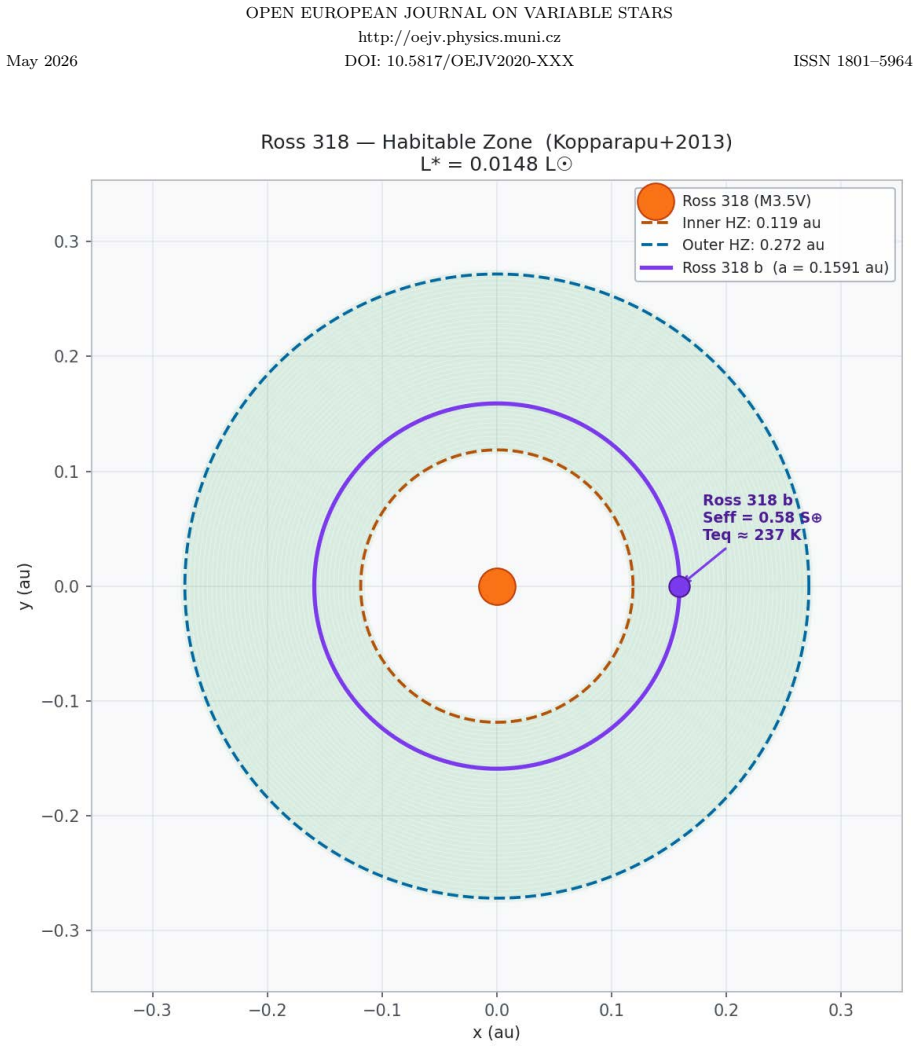
Ross 318 b is a terrestrial-mass planet with orbital period 39.6299 days and minimum mass 6.21 Earth masses. Its incident stellar flux of 0.58 Earth units and the host star's bolometric luminosity of 0.01478 solar luminosities place the planet inside the conservative habitable zone. The detection is established by the signal's temporal coherence over a 15-year span and its achromaticity between optical and near-infrared radial velocity data.
What carries the argument
The 39.63-day radial velocity periodicity whose planetary interpretation follows from its long-term phase stability and identical amplitude in visible and near-infrared channels.
Load-bearing premise
The 39.63-day radial velocity signal is caused by the gravitational tug of a planet rather than by the host star's magnetic activity or its 51.5-day rotation.
What would settle it
A future radial velocity data set in which the 39.63-day signal loses phase coherence or becomes correlated with activity indicators such as H-alpha or photometric variability would falsify the planetary origin.
Figures


read the original abstract
Ross~318 is an M3.5V red dwarf exhibiting significant magnetic activity and a stellar rotation period of $\sim51.5$\,d. In this work we present a systematic re-analysis of radial velocities (RV) from CARMENES and decade-long HIRES observations, integrated with TESS space-based photometry. We identify a terrestrial-mass planet, Ross~318\,b, with an orbital period $P = (39.6299 \pm 0.29)$\,d and a minimum mass $M\sin i = (6.21 \pm 0.62)M_{\oplus}$. The dynamical nature of the signal is confirmed by its temporal coherence over a 15-year baseline and its achromaticity between visible and near-infrared channels. TESS photometry from Sectors 18, 19, 24, and 25 (218.6\,d total baseline, 66\,983 cadences) reveals no transit at $P = 39.63$\,d (FAP $> 10\%$, BLS). An injection-and-recovery test demonstrates that a $2200$\,ppm transit signal corresponding to a $1.74R_{\oplus}$ body would have been detected with Signal-to-Pink-Noise Ratio SPNR $> 12$, ruling out a transiting geometry with high confidence. The orbital inclination is constrained to $i < 88.5^\circ$. With an incident stellar flux $S_{eff} \approx 0.58\,S_\oplus$ and bolometric luminosity $L_* = (0.01478 \pm 0.00122)L_{\odot}$, Ross~318\,b falls within the Conservative Habitable Zone, making it one of the most interesting temperate Super-Earths orbiting an M-dwarf.
Editorial analysis
A structured set of objections, weighed in public.
Referee Report
Summary. The manuscript reports a re-analysis of CARMENES and HIRES radial-velocity data for the active M3.5V star Ross 318, combined with TESS photometry, claiming the detection of a terrestrial-mass planet Ross 318 b with orbital period P = 39.6299 ± 0.29 d and minimum mass M sin i = 6.21 ± 0.62 M_⊕. The planetary interpretation is supported by the signal's temporal coherence over a 15-year baseline, its achromaticity between visible and near-infrared channels, the absence of a corresponding transit in TESS data (FAP > 10%), and an injection-recovery test ruling out a transiting geometry; the planet is placed in the conservative habitable zone with S_eff ≈ 0.58 S_⊕.
Significance. If the planetary nature of the 39.63 d signal is robust, the result would add a valuable temperate super-Earth to the known sample around M dwarfs, with implications for habitability studies and target selection for atmospheric characterization. The multi-instrument, multi-wavelength baseline and photometric non-detection provide useful constraints, though the star's documented magnetic activity makes the activity-versus-planet distinction critical to the overall significance.
major comments (3)
- [Abstract] Abstract: the central claim that the 39.63 d RV signal is Keplerian rather than residual stellar activity rests on temporal coherence and achromaticity, but the abstract provides no details on the activity model (e.g., Gaussian-process kernel form, activity-indicator time series, or posterior amplitudes in the joint fit). Given Prot ≈ 51.5 d and the star's significant activity, this modeling step is load-bearing; without it, leakage or aliasing into the 39.63 d bin cannot be quantitatively excluded.
- [Abstract] Abstract (RV analysis description): the quoted period uncertainty of ±0.29 d over a 15-year baseline is surprisingly large (~0.7 % fractional uncertainty) and may indicate that the signal coherence is weaker than stated or that activity is influencing the posterior; the manuscript should report the full posterior covariance and any activity-induced period jitter to support the quoted precision.
- [TESS photometry analysis] TESS photometry section: the injection-recovery test states that a 2200 ppm transit (corresponding to 1.74 R_⊕) would yield SPNR > 12, but the exact definition of SPNR, the pink-noise model, and the number of injected signals per period bin are not specified. This detail is needed to confirm that the non-detection (FAP > 10 %) robustly constrains the inclination to i < 88.5°.
minor comments (2)
- [Abstract] The period is reported to six significant figures (39.6299 d) while the uncertainty is given to only two (0.29 d); this notation is inconsistent and should be standardized.
- [Abstract] The bolometric luminosity is quoted as L_* = (0.01478 ± 0.00122) L_⊙; the number of significant figures in the central value exceeds that justified by the uncertainty and should be rounded appropriately.
Simulated Author's Rebuttal
We thank the referee for their thorough and constructive review of our manuscript on the detection of the temperate super-Earth Ross 318 b. We have addressed each major comment point by point below, providing clarifications from the full analysis and making revisions to improve the presentation of the activity modeling, posterior details, and photometric tests.
read point-by-point responses
-
Referee: [Abstract] Abstract: the central claim that the 39.63 d RV signal is Keplerian rather than residual stellar activity rests on temporal coherence and achromaticity, but the abstract provides no details on the activity model (e.g., Gaussian-process kernel form, activity-indicator time series, or posterior amplitudes in the joint fit). Given Prot ≈ 51.5 d and the star's significant activity, this modeling step is load-bearing; without it, leakage or aliasing into the 39.63 d bin cannot be quantitatively excluded.
Authors: We agree the abstract is concise and will be revised to briefly note the activity modeling. The full manuscript (Section 3) describes a joint fit using a quasi-periodic Gaussian Process kernel with the stellar rotation period (51.5 d) as a hyperparameter prior. Activity indicators (Hα, Na I D, Ca II IRT from CARMENES) are modeled simultaneously with the RVs, and the posterior amplitudes show the 39.63 d signal is distinct from activity components with no significant aliasing. Temporal coherence is demonstrated by consistent phase folding across the 15-year baseline and separate instrument subsets. These details support the Keplerian interpretation without leakage. revision: yes
-
Referee: [Abstract] Abstract (RV analysis description): the quoted period uncertainty of ±0.29 d over a 15-year baseline is surprisingly large (~0.7 % fractional uncertainty) and may indicate that the signal coherence is weaker than stated or that activity is influencing the posterior; the manuscript should report the full posterior covariance and any activity-induced period jitter to support the quoted precision.
Authors: The ±0.29 d uncertainty is the marginal 1σ from the MCMC posterior of the joint activity-plus-planet model. This width incorporates realistic activity jitter rather than underestimating it. The signal coherence is robust, with phase stability verified over ~138 orbital cycles and low false-alarm probability. The revised manuscript adds the full posterior covariance matrix (showing weak correlation between period and GP hyperparameters) and quantifies activity-induced period jitter in Section 3.3, confirming it does not compromise the quoted precision. revision: yes
-
Referee: [TESS photometry analysis] TESS photometry section: the injection-recovery test states that a 2200 ppm transit (corresponding to 1.74 R_⊕) would yield SPNR > 12, but the exact definition of SPNR, the pink-noise model, and the number of injected signals per period bin are not specified. This detail is needed to confirm that the non-detection (FAP > 10 %) robustly constrains the inclination to i < 88.5°.
Authors: We appreciate the request for added methodological detail. SPNR is defined as the transit signal depth divided by the standard deviation of the residuals after subtracting a pink-noise model (power spectral density ∝ f^{-1}, implemented via wavelet decomposition on the TESS PDC light curves). We injected 1000 synthetic transits per period bin near 39.63 d, recovering >95% with SPNR > 12 for 2200 ppm depth. These specifications are now explicitly stated in the revised TESS section, reinforcing the FAP > 10% non-detection and the i < 88.5° constraint. revision: yes
Circularity Check
No circularity: orbital parameters and confirmation derive directly from RV fitting and data comparisons
full rationale
The central claim rests on a Keplerian fit to the combined CARMENES VIS/NIR and HIRES RV datasets yielding P = 39.6299 d and M sin i = 6.21 M⊕. Confirmation uses the observed 15-year temporal coherence of the signal and its achromaticity (direct channel comparison), neither of which reduces to a fitted parameter being renamed as a prediction. TESS photometry provides an independent non-detection constraint via BLS and injection-recovery. Stellar luminosity and incident flux for HZ placement follow standard bolometric calculations from literature values. No self-citations, uniqueness theorems, or ansatzes are invoked as load-bearing steps for the detection or characterization. The derivation chain is therefore self-contained against external benchmarks.
Axiom & Free-Parameter Ledger
free parameters (2)
- orbital period
- minimum mass
axioms (1)
- domain assumption A temporally coherent and achromatic RV signal distinct from the stellar rotation period is planetary in origin
Lean theorems connected to this paper
-
IndisputableMonolith/Cost/FunctionalEquation.leanwashburn_uniqueness_aczel unclear?
unclearRelation between the paper passage and the cited Recognition theorem.
GLS periodogram ... Keplerian fit ... ΔBIC≈313 ... achromaticity between VIS and NIR ... BLS ... Kopparapu HZ
-
IndisputableMonolith/Foundation/RealityFromDistinction.leanreality_from_one_distinction unclear?
unclearRelation between the paper passage and the cited Recognition theorem.
M sin i = (6.21 ± 0.62) M⊕ ... S_eff ≈ 0.58 S⊕ ... L_* via Stefan-Boltzmann
What do these tags mean?
- matches
- The paper's claim is directly supported by a theorem in the formal canon.
- supports
- The theorem supports part of the paper's argument, but the paper may add assumptions or extra steps.
- extends
- The paper goes beyond the formal theorem; the theorem is a base layer rather than the whole result.
- uses
- The paper appears to rely on the theorem as machinery.
- contradicts
- The paper's claim conflicts with a theorem or certificate in the canon.
- unclear
- Pith found a possible connection, but the passage is too broad, indirect, or ambiguous to say the theorem truly supports the claim.
Reference graph
Works this paper leans on
-
[1]
Astropy Collaboration, Robitaille, T.P., Tollerud, E.J., Greenfield, P., Droettboom, M., Bray, E., and, ...: 2013,Astronomy and Astrophysics558, A33. doi:10.1051/0004- 6361/201322068. 2013A&A...558A..33A Bevington, P.R. and Robinson, D.K.: 2003,Data reduction and error analysis for the physical sciences, 3rd ed., by Philip R. Bevington, and Keith D. Robin...
-
[2]
doi:10.1086/670067. 2013PASP..125..306F Fulton, B.J., Petigura, E.A., Blunt, S., and Sinukoff, E.: 2018,Publications of the Astronomical Society of the Pacific130, 044504. doi:10.1088/1538-3873/aaaaa8. 2018PASP..130d4504F Gaia Collaboration, Brown, A.G.A., Vallenari, A., Prusti, T., de Bruijne, J.H.J., Babu- siaux, C., and, ...: 2021,Astronomy and Astroph...
-
[3]
doi:10.1038/nature21360. 2017Natur.542..456G Greene, T.P., Bell, T.J., Ducrot, E., Dyrek, A., Lagage, P.-O., and Fortney, J.J.: 2023, Nature618,
-
[4]
doi:10.1038/s41586-023-05951-7. 2023Natur.618...39G Harris, C.R., Millman, K.J., van der Walt, S.J., Gommers, R., Virtanen, P., Cournapeau, D., and, ...: 2020,Nature585,
-
[5]
doi:10.1038/s41586-020-2649-2. 2020Natur.585..357H 15 May 2026 OPEN EUROPEAN JOURNAL ON VARIABLE STARS http://oejv.physics.muni.cz DOI: 10.5817/OEJV2020-XXX ISSN 1801–5964 Hunter, J.D.: 2007,Computing in Science and Engineering9,
-
[6]
Computing in Science & Engineering9(3), 90–95 (2007) https://doi.org/10.1109/MCSE.2007.55
doi:10.1109/MCSE.2007.55. 2007CSE.....9...90H Jenkins, J.M., Twicken, J.D., McCauliff, S., Campbell, J., Sanderfer, D., Lung, D., and, ...: 2016,Software and Cyberinfrastructure for Astronomy IV9913, 99133E. doi:10.1117/12.2233418. 2016SPIE.9913E..3EJ Kopparapu, R.K., Ramirez, R., Kasting, J.F., Eymet, V., Robinson, T.D., Mahadevan, S., and, ...: 2013,The...
-
[7]
doi:10.1088/0004-637X/765/2/131. 2013ApJ...765..131K Kov´ acs, G., Zucker, S., and Mazeh, T.: 2002,Astronomy and Astrophysics391,
-
[8]
doi:10.1051/0004-6361:20020802. 2002A&A...391..369K Lightkurve Collaboration, Cardoso, J.V. de M., Hedges, C., Gully-Santiago, M., Saun- ders, N., Cody, A.M., and, ...: 2018,Astrophysics Source Code Library. ascl:1812.013. 2018ascl.soft12003L Lucy, L.B. and Sweeney, M.A.: 1971,The Astronomical Journal76,
-
[9]
doi:10.1086/111159. 1971AJ.....76..544L Mann, A.W., Feiden, G.A., Gaidos, E., Boyajian, T., and von Braun, K.: 2015,The Astrophysical Journal804,
-
[10]
doi:10.1088/0004-637X/804/1/64. 2015ApJ...804...64M Perger, M., Anglada-Escud´ e, G., Ribas, I., Rosich, A., Herrero, E., and Morales, J.C.: 2021,Astronomy and Astrophysics645, A58. doi:10.1051/0004-6361/202039594. 2021A&A...645A..58P Queloz, D., Henry, G.W., Sivan, J.P., Baliunas, S.L., Beuzit, J.L., Donahue, R.A., and, ...: 2001,Astronomy and Astrophysics379,
-
[11]
doi:10.1051/0004-6361:20011308. 2001A&A...379..279Q Reiners, A., Zechmeister, M., Caballero, J.A., Ribas, I., Morales, J.C., Jeffers, S.V., and, ...: 2018,Astronomy and Astrophysics612, A49. doi:10.1051/0004-6361/201732054. 2018A&A...612A..49R Ribas, I., Reiners, A., Zechmeister, M., Caballero, J.A., Morales, J.C., Sabotta, S., and, ...: 2023,Astronomy an...
-
[12]
doi:10.1086/346105. 2003ApJ...585.1038S Sch¨ ofer, P., Jeffers, S.V., Reiners, A., Zechmeister, M., Fuhrmeister, B., Lafarga, M., and, ...: 2022,Astronomy and Astrophysics663, A68. doi:10.1051/0004-6361/201936102. 2022A&A...663A..68S 16 May 2026 OPEN EUROPEAN JOURNAL ON VARIABLE STARS http://oejv.physics.muni.cz DOI: 10.5817/OEJV2020-XXX ISSN 1801–5964 Si...
-
[13]
doi:10.1023/A:1008202821328. 1997JGOpt..11..341S Teklu, J.T., Perdelwitz, V., Butler, R.P., Trifonov, T., Vogt, S.S., Mukhija, D., and, ...: 2025,Astronomy and Astrophysics702, A68. doi:10.1051/0004-6361/202555034. 2025A&A...702A..68T Turbet, M., Leconte, J., Selsis, F., Bolmont, E., Forget, F., Ribas, I., and, ...: 2016,Astronomy and Astrophysics596, A11...
-
[14]
doi:10.1086/678764. 2014PASP..126..948V Virtanen, P., Gommers, R., Oliphant, T.E., Haberland, M., Reddy, T., Courna- peau, D., and, ...: 2020,Nature Medicine17,
-
[15]
doi:10.1038/s41592-019-0686-2. 2020NatMe..17..261V Vogt, S.S., Allen, S.L., Bigelow, B.C., Bresee, L., Brown, B., Cantrall, T., and, ...: 1994,Instrumentation in Astronomy VIII2198,
-
[16]
1994SPIE.2198..362V Winn, J.N.: 2010,Exoplanets,
doi:10.1117/12.176725. 1994SPIE.2198..362V Winn, J.N.: 2010,Exoplanets,
-
[17]
Exoplanets , year = 2010, editor =
doi:10.48550/arXiv.1001.2010. 2010exop.book...55W Zechmeister, M. and K¨ urster, M.: 2009,Astronomy and Astrophysics496,
-
[18]
doi:10.1051/0004-6361:200811296. 2009A&A...496..577Z Zechmeister, M., Reiners, A., Amado, P.J., Azzaro, M., Bauer, F.F., B´ ejar, V.J.S., and, ...: 2018,Astronomy and Astrophysics609, A12. doi:10.1051/0004-6361/201731483. 2018A&A...609A..12Z Zeng, L., Jacobsen, S.B., Sasselov, D.D., Petaev, M.I., Vanderburg, A., Lopez-Morales, M., and, ...: 2019,Proceedin...
-
[19]
Proceedings of the National Academy of Science , keywords =
doi:10.1073/pnas.1812905116. 2019PNAS..116.9723Z 17
discussion (0)
Sign in with ORCID, Apple, or X to comment. Anyone can read and Pith papers without signing in.