Recognition: 2 theorem links
· Lean TheoremThe Role of Formation Location in Shaping Sulfur-, Nitrogen-, and Carbon-Bearing Species in Super-Earth and Sub-Neptune Atmospheres
Pith reviewed 2026-05-15 02:51 UTC · model grok-4.3
The pith
Formation location imprints on atmospheric C/O ratios and silicon species in super-Earths and sub-Neptunes even after magma ocean equilibration, with nitrogen depletion as a common result.
A machine-rendered reading of the paper's core claim, the machinery that carries it, and where it could break.
Core claim
Interior-atmosphere equilibration systematically alters elemental ratios and molecular abundances in the atmospheres of super-Earths and sub-Neptunes. The atmospheric C/O ratio shifts but remains systematically higher for planets formed outside the water ice line. Nitrogen-bearing species are strongly depleted through dissolution into the silicate melt, producing minor HCN and resulting in low atmospheric nitrogen. Sulfur-bearing species show weaker dependence on formation location overall. Silicon-bearing gases are generated substantially, with narrower distributions for outside-ice-line planets. Thus atmospheric C/O, SiH4, and H2O serve as potential indicators of formation location, while氮
What carries the argument
Coupling of a synthetic planet population to an extended global chemical equilibrium framework that incorporates sulfur and nitrogen chemistry, applied shortly after formation to planets formed inside and outside the water ice line.
If this is right
- Atmospheric C/O ratios stay higher for planets that formed outside the ice line.
- Nitrogen abundances drop to low levels for all planets due to equilibration.
- Silicon hydride SiH4 appears in notable quantities, especially with distinct patterns based on formation site.
- Sulfur species abundances depend only weakly on whether formation occurred inside or outside the ice line.
- Observed atmospheres of planets like TOI-270 d align with oxygen-rich compositions modified by interior exchange.
Where Pith is reading between the lines
- Observing SiH4 in exoplanet atmospheres could help distinguish formation locations more clearly than elemental ratios alone.
- The generic nitrogen depletion might account for the scarcity of nitrogen-bearing molecules in many measured sub-Neptune spectra.
- Applying similar models to older planetary systems could show whether these atmospheric signatures survive over billions of years.
- Accounting for potential kinetic limitations in future work might change the predicted strength of the depletions.
Load-bearing premise
The chemical equilibrium calculations and the synthetic planet population accurately represent the main processes without important kinetic barriers or overlooked reactions around 40 million years after formation.
What would settle it
Finding similar atmospheric nitrogen abundances in planets regardless of other indicators, or no systematic difference in C/O ratios correlated with formation location proxies, would challenge the conclusions.
Figures


read the original abstract
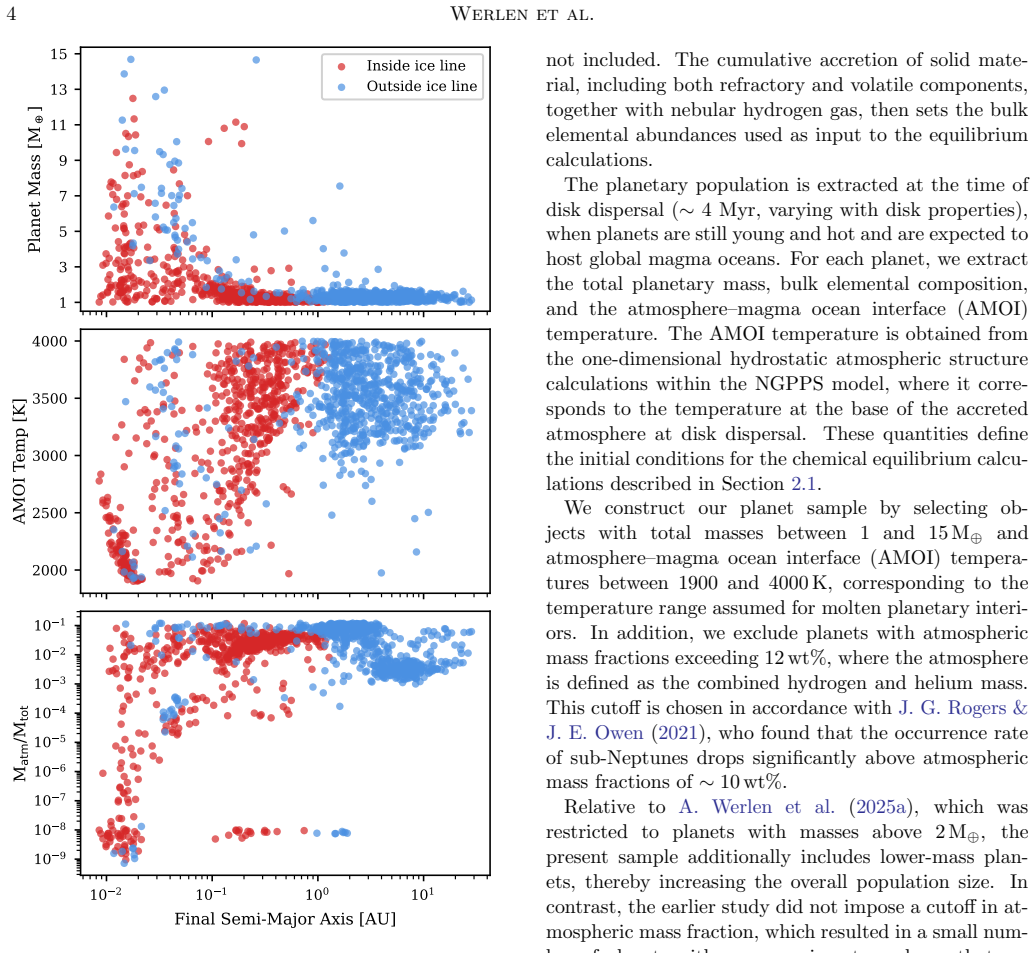
Atmospheric compositions of sub-Neptunes and super-Earths are often interpreted as tracers of formation location relative to volatile ice lines. However, prolonged magma oceans can chemically equilibrate with primordial atmospheres and modify accreted volatile signatures. In this study, we couple a synthetic planet population from the Bern Generation III formation model to an extended global chemical equilibrium framework including sulfur and nitrogen chemistry, and compare accreted and equilibrated compositions for $\sim$ 1200 young planets shortly after formation ($\sim$ 40 Myr) formed inside and outside the water ice line. We find that interior-atmosphere equilibration systematically alters elemental ratios and molecular abundances. The atmospheric C/O ratio shifts relative to the accreted state and remains systematically higher for planets formed outside the ice line. Nitrogen-bearing species NH$_3$, N$_2$ are strongly depleted through dissolution into the silicate melt, while minor amounts of HCN are produced, leading to low atmospheric nitrogen abundances. Sulfur-bearing species remain more abundant than nitrogen-bearing species; during equilibration, accreted H$_2$S partitions into the interior and small amounts of SO$_2$ form, but overall sulfur abundances depend only weakly on formation location. Silicon-bearing gases (SiH$_4$, SiO) are generated in substantial amounts, with narrower distributions for planets formed outside the ice line. We identify atmospheric C/O, SiH$_4$, and H$_2$O as potential indicators of formation location, while nitrogen depletion emerges as a generic outcome of magma ocean equilibration. Comparison with characterized sub-Neptunes such as TOI-270 d, K2-18 b, and GJ 3470 b shows broad consistency with oxygen-dominated, metal-rich atmospheres shaped by interior-atmosphere exchange.
Editorial analysis
A structured set of objections, weighed in public.
Referee Report
Summary. The paper couples the Bern Generation III synthetic planet population (~1200 planets at ~40 Myr) to an extended global chemical equilibrium framework that includes sulfur and nitrogen chemistry. It compares accreted versus post-equilibration atmospheric compositions for planets formed inside versus outside the water ice line, finding that magma-ocean equilibration systematically shifts the C/O ratio (remaining higher outside the ice line), strongly depletes NH3 and N2 via dissolution into the silicate melt while producing minor HCN, generates substantial SiH4 and SiO, and leaves sulfur abundances only weakly dependent on formation location. The authors identify atmospheric C/O, SiH4, and H2O as potential formation-location tracers and nitrogen depletion as a generic outcome, with qualitative consistency noted for TOI-270 d, K2-18 b, and GJ 3470 b.
Significance. If the equilibrium assumptions hold, the work supplies a statistically grounded link between formation models and observable molecular abundances, demonstrating how interior-atmosphere exchange can erase or modify primordial volatile signatures. The use of a large synthetic population and the explicit inclusion of S and N chemistry are strengths that could make C/O, SiH4, and H2O useful diagnostics for future JWST or Ariel observations of young sub-Neptunes.
major comments (2)
- [§2 and §3] §2 (chemical equilibrium framework) and §3 (results at 40 Myr): The central claims of generic nitrogen depletion and a systematic C/O contrast rest on the assumption of instantaneous global chemical equilibrium between the atmosphere and silicate melt. No kinetic timescale calculations or sensitivity tests are provided for the dissolution of NH3/N2 or the H2S-to-SO2 conversion relative to the magma-ocean cooling timescale; if these reactions are kinetically limited, the reported depletion patterns and formation-location tracers would not hold.
- [§4.2] §4.2 (indicator identification): The claim that C/O, SiH4, and H2O serve as formation-location indicators is load-bearing for the paper’s interpretive conclusions, yet the degree of overlap between the inside- and outside-ice-line distributions is not quantified (e.g., via Kolmogorov-Smirnov statistics or overlap fractions), making it unclear how diagnostic these quantities would be in practice.
minor comments (2)
- [Figures and §4.1] Figure captions and §4.1: The panels showing molecular abundance distributions would benefit from explicit labeling of the inside- versus outside-ice-line subsets and from reporting the median and 1σ ranges directly on the plots.
- [Abstract and §5] Abstract and §5: The statement of “broad consistency” with TOI-270 d, K2-18 b, and GJ 3470 b is qualitative; adding a short table of observed versus model abundances would clarify the level of agreement.
Simulated Author's Rebuttal
We thank the referee for their detailed and constructive report. We have carefully considered each comment and provide point-by-point responses below. We believe the revisions will strengthen the manuscript.
read point-by-point responses
-
Referee: [§2 and §3] §2 (chemical equilibrium framework) and §3 (results at 40 Myr): The central claims of generic nitrogen depletion and a systematic C/O contrast rest on the assumption of instantaneous global chemical equilibrium between the atmosphere and silicate melt. No kinetic timescale calculations or sensitivity tests are provided for the dissolution of NH3/N2 or the H2S-to-SO2 conversion relative to the magma-ocean cooling timescale; if these reactions are kinetically limited, the reported depletion patterns and formation-location tracers would not hold.
Authors: We agree that the assumption of instantaneous chemical equilibrium is central to our results and that kinetic effects could modify the outcomes. In the revised manuscript, we have expanded Section 2 to include a discussion of relevant timescales, citing laboratory studies on volatile dissolution in silicate melts that suggest equilibration can occur on timescales shorter than magma ocean cooling (typically 10^4 to 10^6 years). Additionally, we have performed a sensitivity analysis assuming reduced equilibration efficiency for nitrogen (50% and 10% of full equilibrium), which shows that the depletion of NH3 and N2 remains significant even under partial equilibration, although the magnitude decreases. We have updated the text to note this as a limitation and to qualify our conclusions accordingly. We have also added a brief mention of potential kinetic barriers for sulfur species. revision: partial
-
Referee: [§4.2] §4.2 (indicator identification): The claim that C/O, SiH4, and H2O serve as formation-location indicators is load-bearing for the paper’s interpretive conclusions, yet the degree of overlap between the inside- and outside-ice-line distributions is not quantified (e.g., via Kolmogorov-Smirnov statistics or overlap fractions), making it unclear how diagnostic these quantities would be in practice.
Authors: We thank the referee for pointing this out. To address this, we have added quantitative measures in the revised Section 4.2, including Kolmogorov-Smirnov tests for the distributions of C/O, SiH4, and H2O between the two populations. The tests indicate statistically significant differences (p-values < 0.001 for all three quantities). We also report overlap fractions: approximately 25% for C/O, 15% for SiH4, and 30% for H2O, suggesting they can serve as useful indicators with some caution for individual planets. These additions clarify the diagnostic potential and have been incorporated into the discussion of observational implications. revision: yes
Circularity Check
No circularity in derivation chain
full rationale
The paper's central results are obtained by coupling an external synthetic planet population from the Bern Generation III formation model to an extended global chemical equilibrium framework and computing outcomes for ~1200 planets. Atmospheric indicators such as C/O shifts, SiH4/H2O abundances, and nitrogen depletion emerge directly as simulation outputs from this coupling, without any parameters fitted inside the paper, self-definitional reductions, or load-bearing self-citations that collapse the claims to their own inputs. The derivation remains self-contained against the external models and data.
Axiom & Free-Parameter Ledger
axioms (2)
- domain assumption Chemical equilibrium is reached between atmosphere and silicate melt on timescales shorter than 40 Myr
- domain assumption The Bern Generation III population synthesis accurately represents formation locations relative to the water ice line
Lean theorems connected to this paper
-
IndisputableMonolith/Cost/FunctionalEquation.leanwashburn_uniqueness_aczel unclear?
unclearRelation between the paper passage and the cited Recognition theorem.
We couple a synthetic planet population from the Bern Generation III formation model to an extended global chemical equilibrium framework including sulfur and nitrogen chemistry
-
IndisputableMonolith/Foundation/AlphaCoordinateFixation.leanJ_uniquely_calibrated_via_higher_derivative unclear?
unclearRelation between the paper passage and the cited Recognition theorem.
Nitrogen-bearing species NH3, N2 are strongly depleted through dissolution into the silicate melt
What do these tags mean?
- matches
- The paper's claim is directly supported by a theorem in the formal canon.
- supports
- The theorem supports part of the paper's argument, but the paper may add assumptions or extra steps.
- extends
- The paper goes beyond the formal theorem; the theorem is a base layer rather than the whole result.
- uses
- The paper appears to rely on the theorem as machinery.
- contradicts
- The paper's claim conflicts with a theorem or certificate in the canon.
- unclear
- Pith found a possible connection, but the passage is too broad, indirect, or ambiguous to say the theorem truly supports the claim.
Reference graph
Works this paper leans on
-
[1]
2017, Geochemistry, 77, 227, doi: 10.1016/j.chemer.2017.01.007
Stroud, R. 2017, Geochemistry, 77, 227, doi: 10.1016/j.chemer.2017.01.007
-
[2]
Anderson, D. E., Bergin, E. A., Blake, G. A., et al. 2017, The Astrophysical Journal, 845, 13, doi: 10.3847/1538-4357/aa7da1
-
[3]
Asimow, P. D., & Ghiorso, M. S. 1998, American Mineralogist, 83, 1127, doi: 10.2138/am-1998-9-1022
-
[4]
P., Piet, H., Siebert, J., & Ryerson, F
Badro, J., Brodholt, J. P., Piet, H., Siebert, J., & Ryerson, F. J. 2015, Proceedings of the National Academy of Sciences, 112, 12310, doi: 10.1073/pnas.1505672112
-
[5]
E., Wolfgang, A., Teske, J., et al
Batalha, N. E., Wolfgang, A., Teske, J., et al. 2022, The Astronomical Journal, 165, 14, doi: 10.3847/1538-3881/ac9f45
-
[6]
G., Welbanks, L., Schlawin, E., et al
Beatty, T. G., Welbanks, L., Schlawin, E., et al. 2024, The Astrophysical Journal Letters, 970, L10, doi: 10.3847/2041-8213/ad55e9
-
[7]
Benneke, B., Roy, P.-A., Coulombe, L.-P., et al. 2024, JWST Reveals CH4, CO2, and H2O in a Metal-rich Miscible Atmosphere on a Two-Earth-Radius Exoplanet, arXiv, doi: 10.48550/arXiv.2403.03325
-
[8]
Bergin, E. A., Blake, G. A., Ciesla, F., Hirschmann, M. M., & Li, J. 2015, Proceedings of the National Academy of Sciences, 112, 8965, doi: 10.1073/pnas.1500954112
-
[9]
2021, Chemical Geology, 573, 120192, doi: 10.1016/j.chemgeo.2021.120192
Slodczyk, A. 2021, Chemical Geology, 573, 120192, doi: 10.1016/j.chemgeo.2021.120192
-
[10]
Blanchard, I., Rubie, D. C., Jennings, E. S., et al. 2022, Earth and Planetary Science Letters, 580, 117374, doi: 10.1016/j.epsl.2022.117374
-
[11]
Partitioning, Formation, and Evolution, arXiv, doi: 10.48550/arXiv.2411.16879
-
[12]
2024b, Nature Astronomy, 8, 463, doi: 10.1038/s41550-023-02183-7
Burn, R., Mordasini, C., Mishra, L., et al. 2024b, Nature Astronomy, 8, 463, doi: 10.1038/s41550-023-02183-7
-
[13]
Cadieux, C., Doyon, R., MacDonald, R. J., et al. 2024, The Astrophysical Journal Letters, 970, L2, doi: 10.3847/2041-8213/ad5afa
-
[14]
2026, Science Advances, 12, eady8018, doi: 10.1126/sciadv.ady8018
Calvo, L., Siebert, J., Huang, D., et al. 2026, Science Advances, 12, eady8018, doi: 10.1126/sciadv.ady8018
-
[15]
2023, Astronomy & Astrophysics, 674, A224, doi: 10.1051/0004-6361/202245763
Charnoz, S., Falco, A., Tremblin, P., et al. 2023, Astronomy & Astrophysics, 674, A224, doi: 10.1051/0004-6361/202245763
-
[16]
Cherubim, C., Wordsworth, R., Bower, D. J., et al. 2025, The Astrophysical Journal, 983, 97, doi: 10.3847/1538-4357/adbca9
-
[17]
2024, The Astrophysical Journal, 967, 139, doi: 10.3847/1538-4357/ad3e77
Cherubim, C., Wordsworth, R., Hu, R., & Shkolnik, E. 2024, The Astrophysical Journal, 967, 139, doi: 10.3847/1538-4357/ad3e77
-
[18]
Coleman, G. A. L., Papaloizou, J. C. B., & Nelson, R. P. 2017, Monthly Notices of the Royal Astronomical Society, 470, 3206, doi: 10.1093/mnras/stx1297
-
[19]
2026, A&A, 705, A25, doi: 10.1051/0004-6361/202452192
Constantinou, Savvas, Madhusudhan, Nikku, & Holmberg, M˚ ans. 2026, A&A, 705, A25, doi: 10.1051/0004-6361/202452192
-
[20]
Crossfield, I. J. M. 2023, ApJL, 952, L18, doi: 10.3847/2041-8213/ace35f
-
[21]
2024, ApJL, 968, L22, doi: 10.3847/2041-8213/ad5204
Damiano, M., Bello-Arufe, A., Yang, J., & Hu, R. 2024, The Astrophysical Journal Letters, 968, L22, doi: 10.3847/2041-8213/ad5204
-
[22]
Davenport, B., Kempton, E. M.-R., Nixon, M. C., et al. 2025, The Astrophysical Journal Letters, 984, L44, doi: 10.3847/2041-8213/adcd76
-
[23]
2021, The Astrophysical Journal Letters, 922, L4, doi: 10.3847/2041-8213/ac33af
Dorn, C., & Lichtenberg, T. 2021, The Astrophysical Journal Letters, 922, L4, doi: 10.3847/2041-8213/ac33af
-
[24]
2023, The European Physical Journal Plus, 138, 181, doi: 10.1140/epjp/s13360-023-03784-x 17
Emsenhuber, A., Mordasini, C., & Burn, R. 2023, The European Physical Journal Plus, 138, 181, doi: 10.1140/epjp/s13360-023-03784-x 17
-
[25]
2021a, Astronomy & Astrophysics, 656, A69, doi: 10.1051/0004-6361/202038553
Emsenhuber, A., Mordasini, C., Burn, R., et al. 2021a, Astronomy & Astrophysics, 656, A69, doi: 10.1051/0004-6361/202038553
-
[26]
2021b, Astronomy & Astrophysics, 656, A70, doi: 10.1051/0004-6361/202038863
Emsenhuber, A., Mordasini, C., Burn, R., et al. 2021b, Astronomy & Astrophysics, 656, A70, doi: 10.1051/0004-6361/202038863
-
[27]
2025, Astronomy & Astrophysics, 701, A296, doi: 10.1051/0004-6361/202555194
Felix, L., Kitzmann, D., Demory, B.-O., & Mordasini, C. 2025, Astronomy & Astrophysics, 701, A296, doi: 10.1051/0004-6361/202555194
-
[28]
A., Cottrell, E., Hauri, E., Lee, K
Fischer, R. A., Cottrell, E., Hauri, E., Lee, K. K. M., & Le Voyer, M. 2020, Proceedings of the National Academy of Sciences, 117, 8743, doi: 10.1073/pnas.1919930117
-
[29]
Ghiorso, M. S., & Sack, R. O. 1995, Contributions to Mineralogy and Petrology, 119, 197, doi: 10.1007/BF00307281
-
[30]
2026, Nature, 650, 60, doi: 10.1038/s41586-025-09970-4
Gilmore, T., & Stixrude, L. 2026, Nature, 650, 60, doi: 10.1038/s41586-025-09970-4
-
[31]
Ginzburg, S., Schlichting, H. E., & Sari, R. 2016, The Astrophysical Journal, 825, 29, doi: 10.3847/0004-637X/825/1/29
-
[32]
Gordon, T. A., Batalha, N. M., Batalha, N. E., et al. 2026, The Astronomical Journal, 171, 178, doi: 10.3847/1538-3881/ae3de9
-
[33]
Grimm, S. L., Steinmeyer, M.-L., Werlen, A., et al. 2026, A New Global Chemical Equilibrium Code: Refractory Element Signatures in Super-Earths and Sub-Neptunes, arXiv, doi: 10.48550/arXiv.2605.07833
work page internal anchor Pith review Pith/arXiv arXiv doi:10.48550/arxiv.2605.07833 2026
-
[34]
Hakim, K., Bower, D. J., Seidler, F. L., & Sossi, P. A. 2026, Monthly Notices of the Royal Astronomical Society, 546, stag133, doi: 10.1093/mnras/stag133
-
[35]
2004, Geophysical Research Letters, 31, doi: 10.1029/2003GL019380
Kikegawa, T. 2004, Geophysical Research Letters, 31, doi: 10.1029/2003GL019380
-
[36]
Hirschmann, M. M., Withers, A. C., Ardia, P., & Foley, N. T. 2012, Earth and Planetary Science Letters, 345-348, 38, doi: 10.1016/j.epsl.2012.06.031
-
[37]
2024, Astronomy & Astrophysics, 683, L2, doi: 10.1051/0004-6361/202348238
Holmberg, M., & Madhusudhan, N. 2024, Astronomy & Astrophysics, 683, L2, doi: 10.1051/0004-6361/202348238
-
[38]
W., Vazan, A., Chariton, S., Prakapenka, V
Horn, H. W., Vazan, A., Chariton, S., Prakapenka, V. B., & Shim, S.-H. 2025, Nature, 646, 1069, doi: 10.1038/s41586-025-09630-7
-
[39]
2021, The Astrophysical Journal Letters, 921, L8, doi: 10.3847/2041-8213/ac1f92
Hu, R., Damiano, M., Scheucher, M., et al. 2021, The Astrophysical Journal Letters, 921, L8, doi: 10.3847/2041-8213/ac1f92
-
[40]
Hu, R., Bello-Arufe, A., Tokadjian, A., et al. 2025, A water-rich interior in the temperate sub-Neptune K2-18 b revealed by JWST, arXiv, doi: 10.48550/arXiv.2507.12622
-
[41]
2025, The Astrophysical Journal, 987, 174, doi: 10.3847/1538-4357/add3fe
Ito, Y., Kimura, T., Ohno, K., Fujii, Y., & Ikoma, M. 2025, The Astrophysical Journal, 987, 174, doi: 10.3847/1538-4357/add3fe
-
[42]
Kempton, E. M.-R., Zhang, M., Bean, J. L., et al. 2023, Nature, 620, 67, doi: 10.1038/s41586-023-06159-5
-
[43]
S., Fegley Jr., B., Schaefer, L., & Ford, E
Kite, E. S., Fegley Jr., B., Schaefer, L., & Ford, E. B. 2020, The Astrophysical Journal, 891, 111, doi: 10.3847/1538-4357/ab6ffb
-
[44]
Kite, E. S., Jr, B. F., Schaefer, L., & Ford, E. B. 2019, The Astrophysical Journal Letters, 887, L33, doi: 10.3847/2041-8213/ab59d9
-
[45]
Koskinen, T. T., Harris, M. J., Yelle, R. V., & Lavvas, P. 2013, Icarus, 226, 1678, doi: 10.1016/j.icarus.2012.09.027
-
[46]
Koskinen, T. T., Lavvas, P., Harris, M. J., & Yelle, R. V. 2014, Philosophical transactions. Series A, Mathematical, physical, and engineering sciences, 372, 20130089, doi: 10.1098/rsta.2013.0089
-
[47]
Lee, E. J., & Chiang, E. 2015, The Astrophysical Journal, 811, 41, doi: 10.1088/0004-637X/811/1/41
-
[48]
Lee, E. K. H., Werlen, A., & Dorn, C. 2025, The Astrophysical Journal Letters, 990, L43, doi: 10.3847/2041-8213/adfe62
-
[49]
Li, Y., Voˇ cadlo, L., Sun, T., & Brodholt, J. P. 2020, Nature Geoscience, 13, 453, doi: 10.1038/s41561-020-0578-1
-
[50]
2021, The Astrophysical Journal Letters, 914, L4, doi: 10.3847/2041-8213/ac0146
Lichtenberg, T. 2021, The Astrophysical Journal Letters, 914, L4, doi: 10.3847/2041-8213/ac0146
-
[51]
Lichtenberg, T., Shorttle, O., Teske, J., & Kempton, E. M.-R. 2025, Science, 390, eads3660, doi: 10.1126/science.ads3360
-
[52]
Linstrom, P. 1997, NIST Chemistry WebBook, NIST Standard Reference Database 69, National Institute of Standards and Technology, doi: 10.18434/T4D303
-
[53]
2003, The Astrophysical Journal, 591, 1220, doi: 10.1086/375492
Lodders, K. 2003, The Astrophysical Journal, 591, 1220, doi: 10.1086/375492
-
[54]
Lopez, E. D., & Fortney, J. J. 2014, The Astrophysical Journal, 792, 1, doi: 10.1088/0004-637X/792/1/1
-
[55]
2024, Nature Astronomy, 8, 1399, doi: 10.1038/s41550-024-02347-z
Luo, H., Dorn, C., & Deng, J. 2024, Nature Astronomy, 8, 1399, doi: 10.1038/s41550-024-02347-z
-
[56]
Madhusudhan, N., Moses, J. I., Rigby, F., & Barrier, E. 2023a, Faraday Discussions, 245, 80, doi: 10.1039/D3FD00075C
-
[57]
2023b, The Astrophysical Journal Letters, 956, L13, doi: 10.3847/2041-8213/acf577
Madhusudhan, N., Sarkar, S., Constantinou, S., et al. 2023b, The Astrophysical Journal Letters, 956, L13, doi: 10.3847/2041-8213/acf577
-
[58]
Malik, M., Kitzmann, D., Mendon¸ ca, J. M., et al. 2019, The Astronomical Journal, 157, 170, doi: 10.3847/1538-3881/ab1084
-
[59]
Malik, M., Grosheintz, L., Mendon¸ ca, J. M., et al. 2017, The Astronomical Journal, 153, 56, doi: 10.3847/1538-3881/153/2/56 18Werlen et al
-
[60]
2014a, Astronomy & Astrophysics, 570, A35, doi: 10.1051/0004-6361/201322207
Benz, W. 2014a, Astronomy & Astrophysics, 570, A35, doi: 10.1051/0004-6361/201322207
-
[61]
2014b, Astronomy & Astrophysics, 570, A36, doi: 10.1051/0004-6361/201423431
Benz, W. 2014b, Astronomy & Astrophysics, 570, A36, doi: 10.1051/0004-6361/201423431
-
[62]
Miozzi, F., Shahar, A., Young, E. D., et al. 2025, Nature, doi: 10.1038/s41586-025-09816-z
-
[63]
Misener, W., & Schlichting, H. E. 2022, Monthly Notices of the Royal Astronomical Society, 514, 6025, doi: 10.1093/mnras/stac1732
-
[64]
Misener, W., Schlichting, H. E., & Young, E. D. 2023, Monthly Notices of the Royal Astronomical Society, 524, 981, doi: 10.1093/mnras/stad1910
-
[65]
2024, in AAS/Division for Planetary Sciences Meeting Abstracts, Vol
Moses, J., Tsai, S.-M., Fortney, J., et al. 2024, in AAS/Division for Planetary Sciences Meeting Abstracts, Vol. 56, AAS/Division for Planetary Sciences Meeting Abstracts, 308.06
work page 2024
-
[66]
Mukherjee, S., Schlawin, E., Bell, T. J., et al. 2025, The Astrophysical Journal Letters, 982, L39, doi: 10.3847/2041-8213/adba46
-
[67]
Nixon, M. C., Somers, R. S., Savel, A. B., et al. 2025, The Astrophysical Journal, 995, 95, doi: 10.3847/1538-4357/ae17c8
-
[68]
Ohno, K., Schlawin, E., Bell, T. J., et al. 2025, The Astrophysical Journal Letters, 979, L7, doi: 10.3847/2041-8213/ada02c
-
[69]
2022, ApJ, 937, 36, doi: 10.3847/1538-4357/ac8b11
Pacetti, E., Turrini, D., Schisano, E., et al. 2022, ApJ, 937, 36, doi: 10.3847/1538-4357/ac8b11
-
[70]
2024, The Astrophysical Journal Letters, 974, L10, doi: 10.3847/2041-8213/ad6f00
Piaulet-Ghorayeb, C., Benneke, B., Radica, M., et al. 2024, The Astrophysical Journal Letters, 974, L10, doi: 10.3847/2041-8213/ad6f00
-
[71]
E., Madhusudhan, N., Sarkar, S., et al
Rigby, F. E., Madhusudhan, N., Sarkar, S., et al. 2025, The Astrophysical Journal Letters, 995, L70, doi: 10.3847/2041-8213/ae247d
-
[72]
Rogers, J. G., & Owen, J. E. 2021, Monthly Notices of the Royal Astronomical Society, 503, 1526, doi: 10.1093/mnras/stab529
-
[73]
2025, Nature Astronomy, doi: 10.1038/s41550-025-02723-3 19
Roy, P.-A., Benneke, B., Fournier-Tondreau, M., et al. 2025, doi: 10.1038/s41550-025-02723-3
-
[74]
Schlawin, E., Ohno, K., Bell, T. J., et al. 2024, The Astrophysical Journal Letters, 974, L33, doi: 10.3847/2041-8213/ad7fef
-
[75]
Schlichting, H. E., & Young, E. D. 2022, The Planetary Science Journal, 3, 127, doi: 10.3847/PSJ/ac68e6
-
[76]
Schmidt, S. P., MacDonald, R. J., Tsai, S.-M., et al. 2025, The Astronomical Journal, 170, 298, doi: 10.3847/1538-3881/ae019a
-
[77]
2024, The Astrophysical Journal, 975, 14, doi: 10.3847/1538-4357/ad7461
Seo, C., Ito, Y., & Fujii, Y. 2024, The Astrophysical Journal, 975, 14, doi: 10.3847/1538-4357/ad7461
-
[78]
2022, A&A, 659, A28, doi: 10.1051/0004-6361/202142180
Shibata, S., Helled, R., & Ikoma, M. 2022, A&A, 659, A28, doi: 10.1051/0004-6361/202142180
-
[79]
Bower, D. J. 2024, The Astrophysical Journal Letters, 962, L8, doi: 10.3847/2041-8213/ad206e
- [80]
discussion (0)
Sign in with ORCID, Apple, or X to comment. Anyone can read and Pith papers without signing in.