Recognition: 2 theorem links
· Lean TheoremExploring Enceladus's Interior Structure Using Electromagnetic Induction
Pith reviewed 2026-05-12 02:12 UTC · model grok-4.3
The pith
Ice shell thickness variations on Enceladus produce magnetic field changes that depend strongly on ocean conductivity.
A machine-rendered reading of the paper's core claim, the machinery that carries it, and where it could break.
Core claim
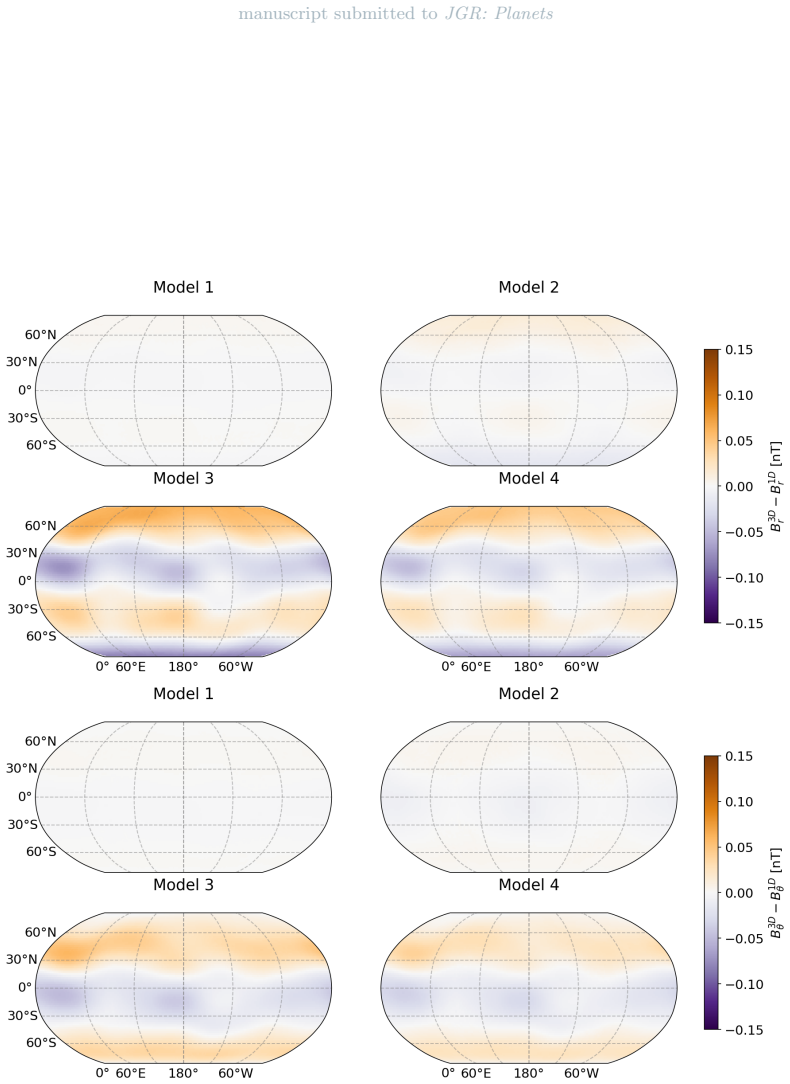
Three-dimensional electromagnetic induction effects from ice-shell thickness variations on Enceladus produce magnetic field perturbations whose magnitude correlates with local ice thickness and depends strongly on ocean conductivity. Detection of these perturbations would indicate a moderately to highly conductive ocean and thereby establish lower bounds on salinity and volatile content. Non-detection would instead be consistent with a thicker and more homogeneous ice shell or a lower-conductivity ocean. Global constraints on ocean conductivity are possible with long-period induction from orbit, while broadband local measurements from a lander at periods of roughly 10 to 100,000 seconds can
What carries the argument
Three-dimensional electromagnetic induction transfer functions applied to conductivity models that incorporate lateral ice-shell thickness variations.
If this is right
- Detection of the magnetic variations would favor a moderately to highly conductive ocean.
- Such detection would provide lower bounds on the ocean's salinity and volatile content.
- A polar orbiter at low altitude could detect the effects and map ice thickness variations.
- A lander could use broadband measurements to constrain ocean salinity, thickness, and core porosity and fluid content.
- Absence of the effects would indicate a thicker homogeneous ice shell or lower ocean conductivity.
Where Pith is reading between the lines
- The conductivity dependence implies that more saline oceans would produce stronger and more readily detectable magnetic signals.
- Combining global orbital data with local lander data would allow both broad conductivity constraints and detailed layered interior profiles.
- The same induction approach could in principle apply to other icy bodies whose shells vary in thickness.
Load-bearing premise
The modeled magnetic variations from ice thickness changes can be separated from other magnetic signals and noise in actual spacecraft measurements.
What would settle it
Low-altitude magnetic field measurements over Enceladus that show no systematic perturbations correlated with maps of ice shell thickness would show the modeled induction effects are not observable.
Figures




read the original abstract
Electromagnetic (EM) sounding can constrain the electrical structure of Enceladus and, in turn, the salinity of its ocean and the porosity, fluid content, and thermal state of its hydrothermally active core. Here, we assess the feasibility of EM sounding at Enceladus using both global (orbiter) and local (lander) EM induction transfer functions. We provide a physical framework for modeling EM induction for 1-D and 3-D subsurface conductivity models and discuss how transfer functions can be estimated from global or local measurements of the magnetic and electric fields. We simulate 3-D induction effects arising from variations in ice-shell thickness. The magnitude of these effects in the magnetic field correlates with the ice-shell thickness at the surface and is strongly dependent on the ocean's conductivity. These magnetic variations, if observed, would favor a moderately to highly conductive ocean, providing lower bounds on salinity and volatile content. The absence of these effects indicates a thicker, more homogeneous ice shell and/or a lower-conductivity ocean. Given plausible magnitudes, a polar-orbiting mission with low-altitude measurements will be required to detect these effects. In summary, an orbiter will constrain global ocean conductivity using long-period induction and possibly map the ice thickness variations. The detailed EM sounding of both the hydrosphere and the core can be achieved by a lander-based broadband EM sounding at periods $\approx 10^1-10^5$ s to probe ocean salinity and thickness, as well as core properties including porosity, fluid content, and temperature.
Editorial analysis
A structured set of objections, weighed in public.
Referee Report
Summary. The paper develops a physical framework for modeling electromagnetic induction responses at Enceladus using both 1-D and 3-D subsurface conductivity models. It simulates 3-D induction effects due to ice-shell thickness variations, shows that the resulting magnetic field perturbations correlate with surface ice thickness and ocean conductivity, and argues that detection of these signals by a low-altitude polar orbiter or lander would provide lower bounds on ocean salinity and volatile content while also constraining core properties.
Significance. If the modeled 3-D effects prove observable and separable from other signals, the work would establish a new remote-sensing technique for probing Enceladus's hydrosphere and core, complementing gravity, libration, and plume data. The forward-modeling approach avoids circularity by generating testable predictions rather than fitting existing observations.
major comments (3)
- [Abstract] Abstract and modeling framework section: the central feasibility claim—that the simulated magnetic variations are large enough to be detected and diagnostic of ocean conductivity—rests on the assertion that effects are 'plausible' and require only a low-altitude orbiter, yet no quantitative signal-to-noise ratios, instrument transfer functions, or comparisons against realistic noise sources (external field variability, spacecraft fields) are reported to support this inference.
- [3-D induction effects] Results on 3-D simulations: while the magnitude of magnetic effects is stated to correlate with ice-shell thickness and ocean conductivity, the manuscript provides no tabulated amplitudes, phase shifts, or transfer-function values at relevant periods (e.g., 10^1–10^5 s) that would allow readers to assess whether the signals exceed plausible measurement thresholds at orbital or lander altitudes.
- [Mission implications] Discussion of mission requirements: the recommendation for a polar-orbiting mission with low-altitude measurements is presented without synthetic data inversions or resolution tests that include realistic noise, leaving the claim that such measurements 'will be required' unsupported by the forward models alone.
minor comments (2)
- [Methods] Notation for transfer functions and conductivity profiles should be defined consistently between the 1-D analytic expressions and the 3-D numerical implementation.
- [Abstract] The abstract mentions 'global (orbiter) and local (lander) EM induction transfer functions' but does not clarify how local electric-field measurements would be combined with magnetic data in the presence of possible electrode noise.
Simulated Author's Rebuttal
We thank the referee for their constructive and detailed review. We agree that additional quantitative details on signal amplitudes and clearer justification for the mission implications will strengthen the paper. We address each major comment below and indicate the revisions to be made.
read point-by-point responses
-
Referee: [Abstract] Abstract and modeling framework section: the central feasibility claim—that the simulated magnetic variations are large enough to be detected and diagnostic of ocean conductivity—rests on the assertion that effects are 'plausible' and require only a low-altitude orbiter, yet no quantitative signal-to-noise ratios, instrument transfer functions, or comparisons against realistic noise sources (external field variability, spacecraft fields) are reported to support this inference.
Authors: We acknowledge the referee's point that the feasibility argument in the abstract relies on the modeled magnitudes being plausible without explicit SNR calculations. Our forward-modeling results show magnetic perturbations of order 0.1–several nT for conductive oceans, which we consider detectable at low altitude with typical planetary magnetometers. In the revised manuscript we will insert specific amplitude values from the simulations and add a short discussion of dominant noise sources (e.g., external field variability) and representative instrument sensitivities. A full end-to-end SNR analysis with transfer functions lies outside the scope of this framework paper but will be flagged as necessary future work. This constitutes a partial revision. revision: partial
-
Referee: [3-D induction effects] Results on 3-D simulations: while the magnitude of magnetic effects is stated to correlate with ice-shell thickness and ocean conductivity, the manuscript provides no tabulated amplitudes, phase shifts, or transfer-function values at relevant periods (e.g., 10^1–10^5 s) that would allow readers to assess whether the signals exceed plausible measurement thresholds at orbital or lander altitudes.
Authors: We agree that tabulated values would make the results more immediately usable. The 3-D simulations already contain the necessary data; we will add a new table in the revised manuscript that lists magnetic-field perturbation amplitudes and phase shifts for representative ice-thickness variations and ocean conductivities at periods spanning 10^1–10^5 s. This directly addresses the request and allows readers to evaluate signal strength against typical measurement thresholds. revision: yes
-
Referee: [Mission implications] Discussion of mission requirements: the recommendation for a polar-orbiting mission with low-altitude measurements is presented without synthetic data inversions or resolution tests that include realistic noise, leaving the claim that such measurements 'will be required' unsupported by the forward models alone.
Authors: The forward models demonstrate that the 3-D induction anomalies are spatially localized and decay rapidly with altitude, implying that low-altitude polar orbits are needed to resolve them. We accept that synthetic inversions with realistic noise would provide stronger quantitative support. In revision we will expand the discussion to explicitly link the modeled signal magnitudes and altitude dependence to the requirement for low-altitude measurements, and we will note that full resolution tests belong to subsequent mission-design studies. This is a partial revision. revision: partial
Circularity Check
No circularity: forward modeling of induction responses is self-contained
full rationale
The paper performs forward physical simulations of EM induction for given 1-D and 3-D conductivity structures (ice shell, ocean, core) using standard Maxwell equations and transfer-function definitions. No parameters are fitted to Enceladus observations; the claimed correlations between magnetic variations, ice thickness, and ocean conductivity are direct outputs of the modeled physics. No self-citations are invoked as load-bearing uniqueness theorems, no ansatz is smuggled, and no known empirical pattern is renamed as a new derivation. The feasibility discussion (need for low-altitude orbiter) is an engineering assessment, not a mathematical reduction to the inputs. The derivation chain is therefore independent of the target quantities.
Axiom & Free-Parameter Ledger
axioms (2)
- domain assumption Enceladus interior can be represented by layered 1-D and 3-D conductivity models with ice shell, ocean, and core.
- domain assumption Magnetic and electric field measurements can be obtained at low altitudes or on the surface with sufficient accuracy to detect induction signals.
Lean theorems connected to this paper
-
IndisputableMonolith/Foundation/RealityFromDistinction.leanreality_from_one_distinction unclear?
unclearRelation between the paper passage and the cited Recognition theorem.
We simulate 3-D induction effects arising from variations in ice-shell thickness... finite-element EM modelling approach adopted for the 3-D case
-
IndisputableMonolith/Cost/FunctionalEquation.leanwashburn_uniqueness_aczel unclear?
unclearRelation between the paper passage and the cited Recognition theorem.
The magnitude of these effects in the magnetic field correlates with the ice-shell thickness at the surface and is strongly dependent on the ocean's conductivity
What do these tags mean?
- matches
- The paper's claim is directly supported by a theorem in the formal canon.
- supports
- The theorem supports part of the paper's argument, but the paper may add assumptions or extra steps.
- extends
- The paper goes beyond the formal theorem; the theorem is a base layer rather than the whole result.
- uses
- The paper appears to rely on the theorem as machinery.
- contradicts
- The paper's claim conflicts with a theorem or certificate in the canon.
- unclear
- Pith found a possible connection, but the passage is too broad, indirect, or ambiguous to say the theorem truly supports the claim.
Reference graph
Works this paper leans on
-
[1]
Dorn, Marvin and Franke, Lukas and Figiel, Paul and Kareth, Sabine and Weidner, Eckhard and Held, Christoph and Petermann, Marcus , journal =. Measurement and modeling of the electrical conductivity of organic electrolyte solutions and their mixtures with compressed. 2024 , issn =. doi:10.1016/j.supflu.2024.106338 , publisher =
-
[2]
Zolotov, Mikhail Y. , journal =. An oceanic composition on early and today’s. 2007 , issn =. doi:10.1029/2007gl031234 , publisher =
-
[3]
and Yoshizaki, Motoko and Tachibana, Shogo and Sirono, Sin-iti , journal =
Sekine, Yasuhito and Shibuya, Takazo and Postberg, Frank and Hsu, Hsiang-Wen and Suzuki, Katsuhiko and Masaki, Yuka and Kuwatani, Tatsu and Mori, Megumi and Hong, Peng K. and Yoshizaki, Motoko and Tachibana, Shogo and Sirono, Sin-iti , journal =. High-temperature water–rock interactions and hydrothermal environments in the chondrite-like core of. 2015 , i...
-
[4]
Bouffard, Mathieu and Choblet, Gaël and Amit, Hagay and Tobie, Gabriel and. Nature Astronomy , title =. 2025 , issn =. doi:10.1038/s41550-025-02490-1 , publisher =
-
[5]
Glein, Christopher R and Postberg, Frank and Vance, Steve D , journal=. The geochemistry of. 2018 , publisher=
work page 2018
-
[6]
A salt-water reservoir as the source of a compositionally stratified plume on
Postberg, F and Schmidt, J and Hillier, J and Kempf, Sascha and Srama, Ralf , journal=. A salt-water reservoir as the source of a compositionally stratified plume on. 2011 , publisher=
work page 2011
-
[7]
How does salinity shape ocean circulation and ice geometry on
Kang, Wanying and Mittal, Tushar and Bire, Suyash and Campin, Jean-Michel and Marshall, John , journal=. How does salinity shape ocean circulation and ice geometry on. 2022 , publisher=
work page 2022
-
[8]
Influence of temperature on electrical conductivity on shaly sands , author=. Geophysics , volume=. 1992 , publisher=
work page 1992
-
[9]
Viscosity-dependent empirical formula for electrical conductivity of
Watanabe, Norihiro and Yamaya, Yusuke and Kitamura, Keigo and Mogi, Toru , journal=. Viscosity-dependent empirical formula for electrical conductivity of. 2021 , publisher=
work page 2021
-
[10]
Journal of Chemical & Engineering Data , volume=
Electrical conductivity of electrolytes found in natural waters from (5 to 90) C , author=. Journal of Chemical & Engineering Data , volume=. 2011 , publisher=
work page 2011
-
[11]
Powering prolonged hydrothermal activity inside
Choblet, Ga. Powering prolonged hydrothermal activity inside. Nature Astronomy , volume=. 2017 , publisher=
work page 2017
-
[12]
Kisv. Investigating the porosity of. Monthly Notices of the Royal Astronomical Society , volume=. 2023 , publisher=
work page 2023
-
[13]
Electrical conductivity of clayey rocks and soils:
Qi, Youzheng and Wu, Yuxin , journal=. Electrical conductivity of clayey rocks and soils:. 2022 , publisher=
work page 2022
-
[14]
High-temperature electrical and thermal properties of
Parthasarathy, G and Sharma, SR , journal=. High-temperature electrical and thermal properties of. 2004 , publisher=
work page 2004
-
[15]
Journal of applied Physics , volume=
A variational approach to the theory of the effective magnetic permeability of multiphase materials , author=. Journal of applied Physics , volume=. 1962 , publisher=
work page 1962
-
[16]
Report of the Expert Committee for the Large-class mission in
Martins, Z and Bunce, E and Grasset, O and Hamp, R and Jones, GH and Le Gall, A and others , journal=. Report of the Expert Committee for the Large-class mission in
-
[17]
Different Ice-shell Geometries on
Kang, Wanying , journal =. Different Ice-shell Geometries on. 2022 , issn =. doi:10.3847/1538-4357/ac779c , publisher =
-
[18]
Castillo‐Rogez, J. C. and Daswani, M. M. and Glein, C. R. and Vance, S. D. and Cochrane, C. J. , journal =. Contribution of Non‐Water Ices to Salinity and Electrical Conductivity in Ocean Worlds , year =. doi:10.1029/2021gl097256 , publisher =
-
[19]
Tajeddine, Radwan and Soderlund, Krista M. and Thomas, Peter C. and Helfenstein, Paul and Hedman, Matthew M. and Burns, Joseph A. and Schenk, Paul M. , journal =. True polar wander of. 2017 , issn =. doi:10.1016/j.icarus.2017.04.019 , publisher =
-
[20]
Icarus , title =. 2019 , issn =. doi:10.1016/j.icarus.2018.10.003 , publisher =
-
[21]
Phosphates reveal high. Icarus , volume =. 2025 , issn =. doi:https://doi.org/10.1016/j.icarus.2025.116717 , url =
-
[22]
Saur, Joachim and Duling, Stefan and Grayver, Alexander and Szalay, Jamey R , journal =. Analysis of. 2024 , number =. doi:10.3847/psj/ad8130 , publisher =
-
[23]
Particle entrainment and rotating convection in
Schoenfeld, Ashley M and Hawkins, Emily K and Soderlund, Krista M and Vance, Steven D and Leonard, Erin and Yin, An , journal=. Particle entrainment and rotating convection in. 2023 , publisher=
work page 2023
-
[24]
Ongoing hydrothermal activity within
Hsiang. Ongoing hydrothermal activity within. Nature , year =. doi:10.1038/nature14262 , url =
-
[25]
American Journal of Physics , volume=
Electromagnetics from a quasistatic perspective , author=. American Journal of Physics , volume=. 2007 , publisher=
work page 2007
-
[26]
Winch, DE and Ivers, DJ and Turner, JPR and Stening, RJ , journal=. 2005 , publisher=
work page 2005
-
[27]
Geophysical Journal International , publisher =
Kuvshinov, Alexey and Semenov, Alexey , title =. Geophysical Journal International , publisher =. doi:10.1111/j.1365-246x.2011.05349.x , number =
-
[28]
Geophysical Journal International , publisher =
Srivastava, SP , title =. Geophysical Journal International , publisher =. doi:10.1111/j.1365-246x.1966.tb03090.x , number =
-
[29]
doi:10.1190/1.9781560802068 , publisher =
Berdichevsky, Mark N and Dmitriev, Vladimir I , title =. doi:10.1190/1.9781560802068 , publisher =
-
[30]
Surveys in Geophysics , publisher =
Olsen, Nils , title =. Surveys in Geophysics , publisher =. doi:10.1023/A:1006611303582 , number =
-
[31]
Landolt-Bornstein, new-series , volume=
Magnetic and electric fields due to electromagnetic induction by external sources , author=. Landolt-Bornstein, new-series , volume=. 1985 , publisher=
work page 1985
- [32]
-
[33]
Unravelling the Electrical Conductivity of Earth and Planets , year =
Grayver, Alexander , journal =. Unravelling the Electrical Conductivity of Earth and Planets , year =. doi:10.1007/s10712-023-09813-9 , publisher =
-
[34]
Weidelt, Peter , title =. Z. Geophys. , year =. doi:10.1093/gji/35.1.379 , pages =
-
[35]
Grayver, A and Kuvshinov, A and Werthm. Time-Domain Modeling of Three-Dimensional Earth's and Planetary Electromagnetic Induction Effect in Ground and Satellite Observations , doi =. Journal of Geophysical Research: Space Physics , publisher =
-
[36]
Kuvshinov, Alexey and Grayver, Alexander and T. Probing. Earth, Planets and Space , publisher =. doi:10.1186/s40623-020-01341-9 , number =
-
[37]
Global electromagnetic induction constraints on transition-zone water content variations , author=. Nature , volume=. 2009 , publisher=
work page 2009
-
[38]
Magnetic signals from oceanic tides: new satellite observations and applications , year =
Grayver, Alexander and Finlay, Christopher C and Olsen, Nils , journal =. Magnetic signals from oceanic tides: new satellite observations and applications , year =. doi:10.1098/rsta.2024.0078 , publisher =
-
[39]
Munch, Federico D and Grayver, Alexander , journal =. Multi-scale imaging of. 2023 , pages =. doi:10.1016/j.epsl.2022.117939 , publisher =
-
[40]
Multi-scale electrical conductivity model of the contiguous
Munch, Federico D and Grayver, Alexander , journal=. Multi-scale electrical conductivity model of the contiguous. 2026 , publisher=
work page 2026
-
[41]
P. Mapping. Geophysical Journal International , volume=. 2014 , publisher=
work page 2014
- [42]
-
[43]
Space science reviews , volume=
Induced magnetic fields in solar system bodies , author=. Space science reviews , volume=. 2010 , publisher=
work page 2010
-
[44]
Grayver, Alexander and Kolev, Tzanio V , journal =. Large-scale. 2015 , number =. doi:10.1190/geo2015-0013.1 , publisher =
-
[45]
The deep lunar electrical conductivity profile:
Hood, LL and Herbert, F and Sonett, CP , journal=. The deep lunar electrical conductivity profile:. 1982 , publisher=
work page 1982
-
[46]
Electromagnetic induction in the
Sonett, CP , journal=. Electromagnetic induction in the. 1982 , publisher=
work page 1982
-
[47]
Styczinski, Marshall J and Cochrane, Corey Jonathan , journal=. 2024 , publisher=
work page 2024
-
[48]
Dougherty, Michele K and Cao, Hao and Khurana, Krishan K and Hunt, Gregory J and Provan, Gabrielle and Kellock, Stephen and Burton, Marcia E and Burk, Thomas A and Bunce, Emma J and Cowley, Stanley WH and others , journal=. 2018 , publisher=
work page 2018
-
[49]
Journal of Geophysical Research: Planets , volume=
The global conductivity structure of the lunar upper and midmantle , author=. Journal of Geophysical Research: Planets , volume=. 2021 , publisher=
work page 2021
-
[50]
Park, R. S. and Mastrodemos, N. and Jacobson, R. A. and Berne, A. and Vaughan, A. T. and Hemingway, D. J. and Leonard, E. J. and Castillo-Rogez, J. C. and Cockell, C. S. and Keane, J. T. and Konopliv, A. S. and Nimmo, F. and Riedel, J. E. and Simons, M. and Vance, S. , title =. Journal of Geophysical Research: Planets , volume =. doi:https://doi.org/10.10...
- [51]
-
[52]
Geophysical Journal International , publisher =
Grayver, A and van Driel, M and Kuvshinov, A , title =. Geophysical Journal International , publisher =. doi:10.1093/gji/ggz030 , number =
-
[53]
Geophysical Journal International , publisher =
Inversion of the satellite observations of the tidally induced magnetic field in terms of. Geophysical Journal International , publisher =. doi:10.1093/gji/ggac015 , number =
-
[54]
Science Advances , publisher =
Grayver, A and Schnepf, N and Kuvshinov, A and Sabaka, T and Manoj, C and Olsen, N , title =. Science Advances , publisher =. doi:10.1126/sciadv.1600798 , number =
-
[55]
Geophysical Journal International , publisher =
Sabaka, Terence J and Olsen, Nils and Tyler, Robert H and Kuvshinov, Alexey , title =. Geophysical Journal International , publisher =. doi:10.1093/gji/ggu493 , number =
-
[56]
Journal of Marine Research , volume=
Tidal prediction , author=. Journal of Marine Research , volume=. 2017 , publisher=
work page 2017
-
[57]
Magnetic field induced by convective flow in. Icarus , volume=. 2025 , publisher=
work page 2025
-
[58]
Zeng, Yaoxuan and Jansen, Malte F. , title =. 2021 , month =. doi:10.3847/PSJ/ac1114 , url =
-
[59]
Zonostrophic turbulence in the subsurface oceans of the
Cabanes, Simon and Gastine, Thomas and Fournier, Alexandre , journal=. Zonostrophic turbulence in the subsurface oceans of the. 2024 , publisher=
work page 2024
-
[60]
Enceladus's ice shell structure as a window on internal heat production , author=. Icarus , volume=. 2019 , publisher=
work page 2019
-
[61]
New global topography of Enceladus:. Icarus , volume =. 2024 , issn =. doi:https://doi.org/10.1016/j.icarus.2023.115827 , url =
-
[62]
Earth, Planets and Space , volume=
Sabaka, Terence J and T. Earth, Planets and Space , volume=. 2020 , publisher=
work page 2020
-
[63]
Feasibility of characterizing subsurface brines on
Grimm, Robert and Castillo-Rogez, Julie and Raymond, Carol and Poppe, Andrew R , journal=. Feasibility of characterizing subsurface brines on. 2021 , publisher=
work page 2021
-
[64]
The Radio & Plasma Wave Investigation (
Wahlund, J-E and Bergman, Jan ES and. The Radio & Plasma Wave Investigation (. Space Science Reviews , volume=. 2025 , publisher=
work page 2025
-
[65]
Earth, Planets and Space , volume=
The CHAOS-7 geomagnetic field model and observed changes in the South Atlantic Anomaly , author=. Earth, Planets and Space , volume=. 2020 , publisher=
work page 2020
-
[66]
Communications Earth & Environment , volume=
Ocean stratification impedes particulate transport to the plumes of Enceladus , author=. Communications Earth & Environment , volume=. 2025 , publisher=
work page 2025
-
[67]
On determining electrical characteristics of the deep layers of the Earth's crust , author=. Dokl. Akad. Nauk. SSSR , volume=
-
[68]
Basic theory of the magneto-telluric method of geophysical prospecting , author=. Geophysics , volume=. 1953 , publisher=
work page 1953
-
[69]
Modeling the climatology of low-and mid-latitude
Fillion, Martin and Hulot, Gauthier and Alken, Patrick and Chulliat, Arnaud , journal=. Modeling the climatology of low-and mid-latitude. 2023 , publisher=
work page 2023
-
[70]
Physics of the Earth and Planetary Interiors , volume=
A grand spectrum of the geomagnetic field , author=. Physics of the Earth and Planetary Interiors , volume=. 2023 , publisher=
work page 2023
-
[71]
Experimental Astronomy , volume=
Enceladus as a potential oasis for life: Science goals and investigations for future explorations , author=. Experimental Astronomy , volume=. 2022 , publisher=
work page 2022
-
[72]
Introduction to the Physics of Rocks , year =
Yves Gu. Introduction to the Physics of Rocks , year =
- [73]
-
[74]
The global toroidal magnetic field generated in the
Vel\'. The global toroidal magnetic field generated in the. Earth and Planetary Science Letters , volume=. 2019 , publisher=
work page 2019
-
[75]
Exploring the Interior Structure and Mode of Tidal Heating in
Bagheri, Amirhossein and Simons, Mark and Park, Ryan S and Berne, Alexander and Hemingway, Douglas and Daswani, Mohit Melwani and Vance, Steven D , journal=. Exploring the Interior Structure and Mode of Tidal Heating in. 2025 , publisher=
work page 2025
- [76]
-
[77]
Numerical simulation on the electrical Conductivity of ternary mixtures containing
Aoyama, K and Hashimoto, T , journal=. Numerical simulation on the electrical Conductivity of ternary mixtures containing. 2024 , publisher=
work page 2024
-
[78]
The Journal of Physical Chemistry B , volume=
Low-frequency electrical properties of polycrystalline saline ice and salt hydrates , author=. The Journal of Physical Chemistry B , volume=. 2008 , publisher=
work page 2008
-
[79]
Hydrothermal circulation within topographically rough basaltic basement on the
Spinelli, GA and Fisher, AT , journal=. Hydrothermal circulation within topographically rough basaltic basement on the. 2004 , publisher=
work page 2004
-
[80]
EGU21-The EGU General Assembly 2021 , year=
Hulot, Gauthier and Leger, Jean-Michel and Clausen, Lasse BN and Deconinck, Florian and Co. EGU21-The EGU General Assembly 2021 , year=
work page 2021
discussion (0)
Sign in with ORCID, Apple, or X to comment. Anyone can read and Pith papers without signing in.