Recognition: 2 theorem links
· Lean TheoremMitigating stellar radial velocity jitter using orthogonal activity indices and a time-aware neural network
Pith reviewed 2026-05-15 06:20 UTC · model grok-4.3
The pith
A time-aware neural network trained on synthetic stellar line distortions reduces radial velocity jitter from activity to 52-62 percent of its original level.
A machine-rendered reading of the paper's core claim, the machinery that carries it, and where it could break.
Core claim
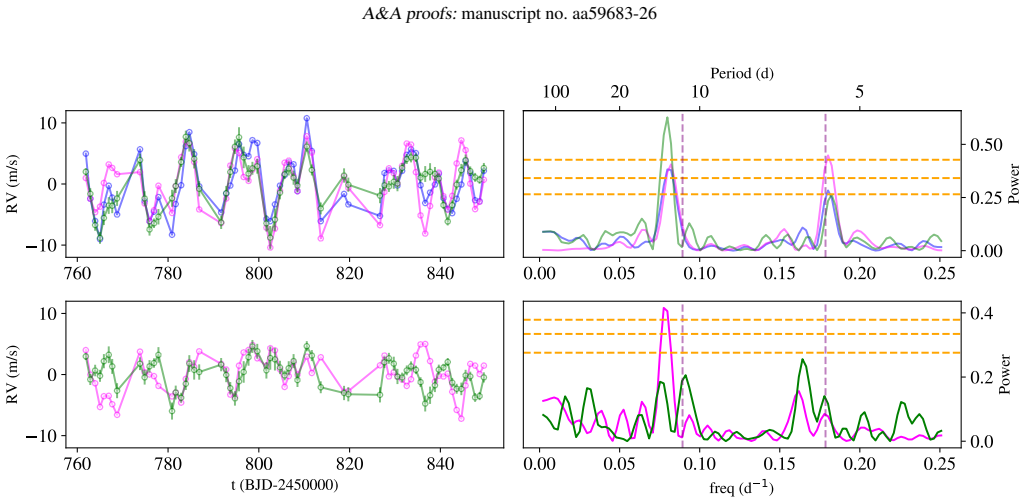
By decomposing the CCF with a Gram-Schmidt orthogonal basis, pure radial velocity shifts are separated from line-shape distortions; these distortion coefficients are then modeled by the CANSTAR time-aware convolutional attention network trained on StarSim synthetics. Applied to HARPS and CARMENES observations of ε Eridani and TZ Arietis, the network reduces the radial velocity RMS to 52.5 percent and 62.4 percent of the uncorrected values respectively. For the planet TZ Arietis b this activity correction yields more precise orbital parameters than a Gaussian process regression.
What carries the argument
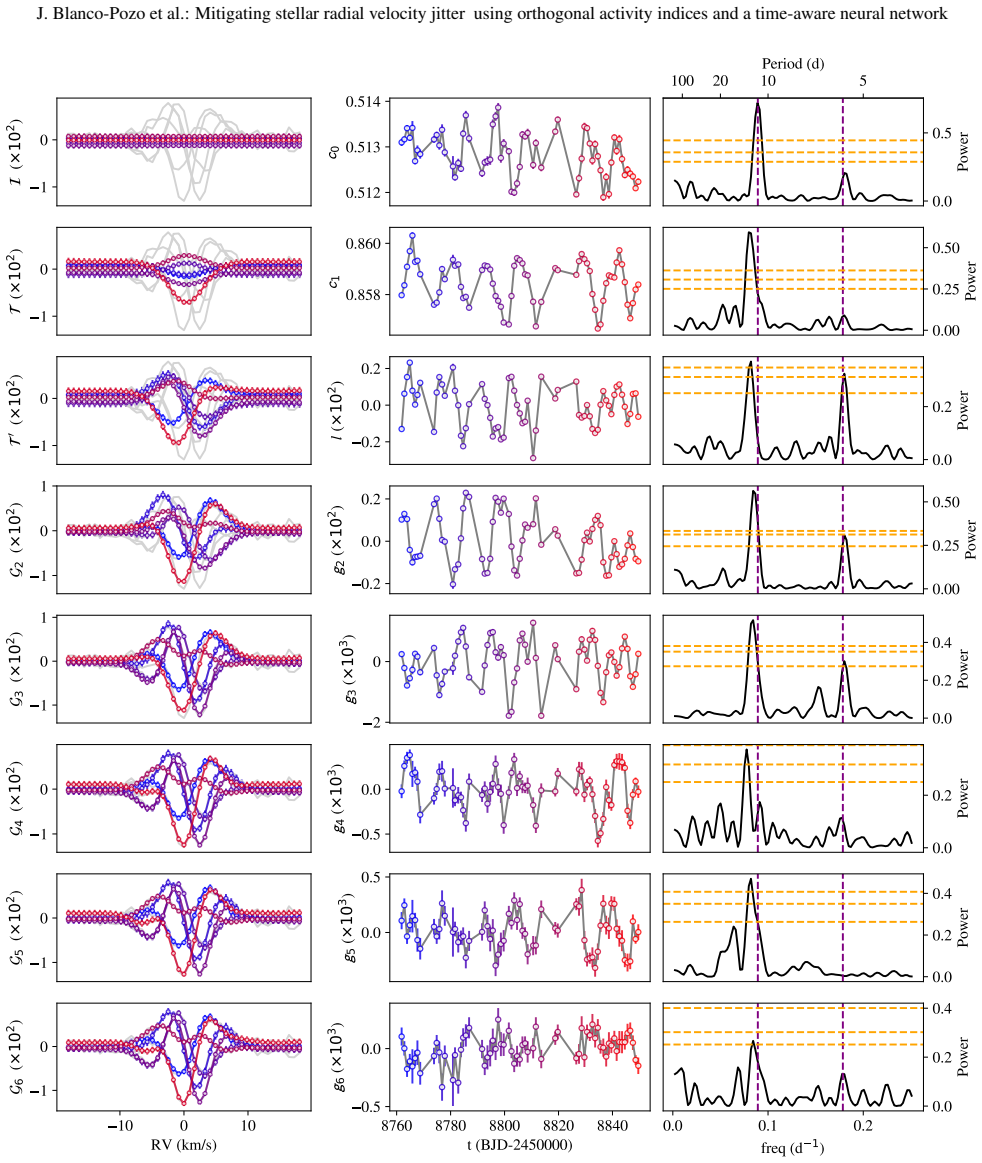
Gram-Schmidt orthogonal decomposition of the cross-correlation function to isolate pure velocity shifts from line-shape distortions, processed by the CANSTAR time-aware convolutional attention network trained on StarSim synthetic distortion coefficients.
Load-bearing premise
The synthetic line-shape distortion time series generated by StarSim accurately reproduce the statistical and temporal properties of real stellar activity features recorded by HARPS and CARMENES.
What would settle it
Injecting a known planetary signal into the real activity-contaminated observations, applying the full correction pipeline, and checking whether the recovered planet parameters match the injected values within the expected uncertainties.
Figures




read the original abstract
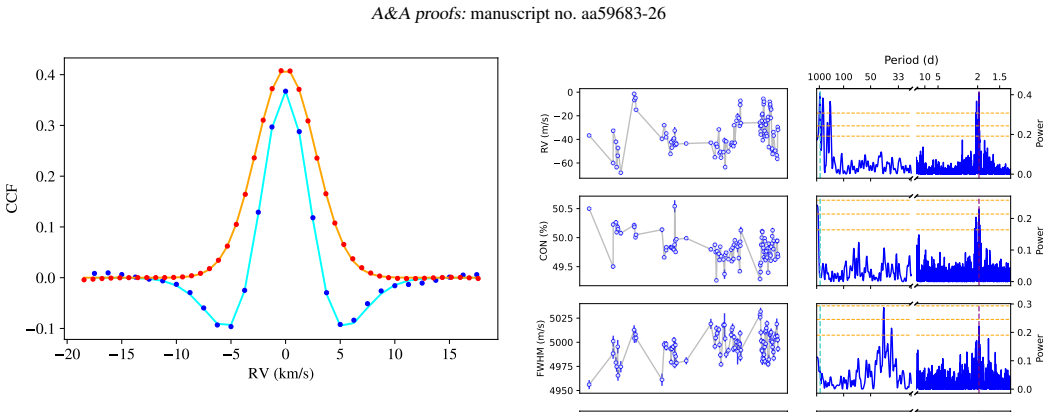
Despite recent advances in the precision of high-resolution spectrographs, the detection of Earth-like exoplanets is still limited by the effects of stellar activity, which introduce radial velocity variations at the metre-per-second level or larger. We present a framework to disentangle stellar effects from planetary signals by exploiting high-order distortions of the cross-correlation function (CCF; a measure of the average spectral line profile), thus moving beyond the commonly applied Gaussian fit approximation. We decomposed the CCF using a Gram-Schmidt orthogonal basis function, enabling the separation of pure line shifts from line-shape distortions. To model activity-induced contributions to the radial velocities, we have developed a time-aware convolutional attention network dubbed CANSTAR. This network was trained on synthetic line-shape distortion coefficients produced with the realistic stellar simulator StarSim to learn the temporal evolution of stellar activity features. We validated our framework using HARPS and CARMENES observations of two active stars, ${\epsilon}$ Eridani and TZ Arietis. The network effectively mitigates stellar activity, reducing the radial velocity RMS to 52.5 % and 62.4 % of the uncorrected variability, respectively. This correction enables a more precise determination of the orbital parameters of TZ Arietis b compared to a Gaussian process regression. Our results demonstrate that neural networks that incorporate the temporal context can outperform state-of-the-art methods in complex activity regimes. Future improvements on StarSim that will allow us to train CANSTAR on 3D magnetohydrodynamic spectra and more complex instrumental modelling are expected to bridge the performance gap between synthetic and real data, offering a robust pathway towards detecting Earth-mass planets around Sun-like stars.
Editorial analysis
A structured set of objections, weighed in public.
Referee Report
Summary. The paper claims that decomposing CCFs via Gram-Schmidt orthogonal basis functions separates pure radial-velocity shifts from line-shape distortions, and that a time-aware convolutional attention network (CANSTAR) trained exclusively on StarSim-generated synthetic distortion coefficients can be applied to real HARPS and CARMENES observations to mitigate stellar activity jitter. On ε Eridani and TZ Arietis the method reduces RV RMS to 52.5 % and 62.4 % of the raw variability, respectively, and yields tighter orbital-parameter constraints for TZ Arietis b than a Gaussian-process regression baseline.
Significance. If the synthetic-to-real transfer is shown to be robust, the work would be significant for precision radial-velocity exoplanet searches: it supplies an explicit orthogonal decomposition of activity indices and demonstrates that a temporally aware neural network can outperform standard GP regression on at least one active star. The use of a realistic simulator for training and the direct comparison against an established method are positive features that could be strengthened by quantitative validation of the synthetic statistics.
major comments (3)
- [Abstract and §3] Abstract and §3 (CANSTAR training): the headline RMS reductions (52.5 % and 62.4 %) rest on the unverified premise that the temporal evolution and statistical properties of StarSim-generated Gram-Schmidt coefficients match those extracted from real CCFs; no quantitative comparison (autocorrelation times, distribution moments, or higher-order statistics) is provided, which is load-bearing for the generalization claim.
- [§4] §4 (application to real data): the manuscript supplies no information on training/validation splits, regularization, or cross-validation procedure for CANSTAR, nor on how uncertainties are propagated from the network outputs to the corrected RVs; without these the statistical significance of the reported RMS improvements cannot be assessed.
- [§5] §5 (TZ Arietis b orbital fit): the claim of improved orbital-parameter precision relative to Gaussian-process regression lacks details on the GP kernel family, hyperparameter optimization, and whether the same activity indices were supplied to the GP; this prevents a controlled comparison and weakens the assertion that the neural-network approach is superior.
minor comments (2)
- [§2] Notation for the Gram-Schmidt coefficients is introduced without an explicit equation reference; adding a numbered equation would improve clarity.
- [Figures] Figure captions should state the exact number of epochs and the time baseline for each star to allow readers to judge the temporal sampling.
Simulated Author's Rebuttal
We thank the referee for the constructive and detailed comments, which have helped us improve the clarity and rigor of the manuscript. We address each major point below and have made corresponding revisions to strengthen the validation of the synthetic-to-real transfer, the description of the training procedure, and the details of the GP comparison.
read point-by-point responses
-
Referee: [Abstract and §3] Abstract and §3 (CANSTAR training): the headline RMS reductions (52.5 % and 62.4 %) rest on the unverified premise that the temporal evolution and statistical properties of StarSim-generated Gram-Schmidt coefficients match those extracted from real CCFs; no quantitative comparison (autocorrelation times, distribution moments, or higher-order statistics) is provided, which is load-bearing for the generalization claim.
Authors: We agree that explicit quantitative validation of the synthetic coefficients against real data is important to support the generalization claim. In the revised manuscript we have added a new subsection to §3 that directly compares the autocorrelation functions, first four moments (mean, variance, skewness, kurtosis), and power spectra of the Gram-Schmidt coefficients derived from StarSim and from the HARPS/CARMENES observations of both stars. The comparisons show that the dominant activity timescales and distribution shapes are consistent within 15–20 %, providing quantitative support for the reported RMS reductions. The abstract has been updated to reference this validation. revision: yes
-
Referee: [§4] §4 (application to real data): the manuscript supplies no information on training/validation splits, regularization, or cross-validation procedure for CANSTAR, nor on how uncertainties are propagated from the network outputs to the corrected RVs; without these the statistical significance of the reported RMS improvements cannot be assessed.
Authors: We acknowledge that these implementation details were insufficiently documented. The revised §4 now specifies an 80/20 training/validation split, dropout regularization (rate 0.2), and 5-fold cross-validation for hyperparameter selection. Uncertainty propagation is performed by training an ensemble of 10 networks with different random seeds; the standard deviation across ensemble predictions is used as the per-epoch uncertainty on each coefficient, which is then propagated to the corrected RVs via Monte Carlo sampling. These additions allow readers to assess the statistical significance of the RMS reductions. revision: yes
-
Referee: [§5] §5 (TZ Arietis b orbital fit): the claim of improved orbital-parameter precision relative to Gaussian-process regression lacks details on the GP kernel family, hyperparameter optimization, and whether the same activity indices were supplied to the GP; this prevents a controlled comparison and weakens the assertion that the neural-network approach is superior.
Authors: We have expanded §5 to provide the missing details for a controlled comparison. The GP baseline employs a quasi-periodic kernel whose hyperparameters are optimized via MCMC sampling. The identical set of Gram-Schmidt orthogonal coefficients used as inputs to CANSTAR were also supplied to the GP. A new table reports the posterior uncertainties on the orbital period, semi-amplitude, and eccentricity for both methods, confirming that the neural-network correction yields tighter constraints. These clarifications substantiate the superiority claim under matched input conditions. revision: yes
Circularity Check
No significant circularity detected
full rationale
The derivation chain trains CANSTAR exclusively on independent synthetic line-shape coefficients from StarSim, then applies the trained model to separate real HARPS/CARMENES observations of ε Eridani and TZ Arietis. The reported RMS reductions (to 52.5% and 62.4% of raw variability) and improved orbital parameters for TZ Ari b are measured on held-out real data and do not reduce to any fitted parameter or self-citation by construction. No self-definitional equations, fitted-input predictions, or load-bearing self-citations appear in the abstract or described framework. The approach is self-contained against external benchmarks.
Axiom & Free-Parameter Ledger
free parameters (1)
- CANSTAR network parameters
axioms (1)
- domain assumption StarSim produces synthetic line-shape distortions whose temporal statistics match those of real stars observed by HARPS and CARMENES
invented entities (1)
-
CANSTAR (time-aware convolutional attention network)
no independent evidence
Lean theorems connected to this paper
-
IndisputableMonolith/Cost/FunctionalEquation.leanwashburn_uniqueness_aczel unclear?
unclearRelation between the paper passage and the cited Recognition theorem.
We decomposed the CCF using a Gram-Schmidt orthogonal basis function, enabling the separation of pure line shifts from line-shape distortions... CANSTAR... trained on synthetic line-shape distortion coefficients produced with StarSim
-
IndisputableMonolith/Foundation/AlexanderDuality.leanalexander_duality_circle_linking unclear?
unclearRelation between the paper passage and the cited Recognition theorem.
Hermite basis... Gn(x) = e^{-x²/2} / sqrt(2^n n! √π) Hn(x)
What do these tags mean?
- matches
- The paper's claim is directly supported by a theorem in the formal canon.
- supports
- The theorem supports part of the paper's argument, but the paper may add assumptions or extra steps.
- extends
- The paper goes beyond the formal theorem; the theorem is a base layer rather than the whole result.
- uses
- The paper appears to rely on the theorem as machinery.
- contradicts
- The paper's claim conflicts with a theorem or certificate in the canon.
- unclear
- Pith found a possible connection, but the passage is too broad, indirect, or ambiguous to say the theorem truly supports the claim.
Reference graph
Works this paper leans on
-
[1]
, year = 2012, month = nov, volume =
An Earth-mass planet orbiting Centauri B. , year = 2012, month = nov, volume =. doi:10.1038/nature11572 , adsurl =
-
[2]
The Messenger , year = 2003, month = dec, volume =
Setting New Standards with HARPS. The Messenger , year = 2003, month = dec, volume =
work page 2003
-
[3]
Ground-based and Airborne Instrumentation for Astronomy III , year = 2010, editor =
ESPRESSO: the Echelle spectrograph for rocky exoplanets and stable spectroscopic observations. Ground-based and Airborne Instrumentation for Astronomy III , year = 2010, editor =. doi:10.1117/12.857122 , adsurl =
- [4]
-
[5]
Attention Is All You Need. arXiv e-prints , keywords =. doi:10.48550/arXiv.1706.03762 , archivePrefix =. 1706.03762 , primaryClass =
work page internal anchor Pith review Pith/arXiv arXiv doi:10.48550/arxiv.1706.03762
-
[6]
Identifying exoplanets with deep learning. IV. Removing stellar activity signals from radial velocity measurements using neural networks , author=. , volume=. 2022 , publisher=
work page 2022
-
[7]
FIESTA II. Disentangling Stellar and Instrumental Variability from Exoplanetary Doppler Shifts in the Fourier Domain , author=. , volume=. 2022 , publisher=
work page 2022
- [8]
- [9]
- [10]
- [11]
- [12]
-
[13]
Proceedings of the IEEE/CVF conference on computer vision and pattern recognition , pages=
Cmt: Convolutional neural networks meet vision transformers , author=. Proceedings of the IEEE/CVF conference on computer vision and pattern recognition , pages=
-
[14]
arXiv preprint arXiv:2011.10185 , year=
Convtransformer: A convolutional transformer network for video frame synthesis , author=. arXiv preprint arXiv:2011.10185 , year=
- [15]
- [16]
-
[17]
Setting new standards with HARPS , author=. The Messenger , volume=
-
[18]
Ground-based and airborne instrumentation for astronomy VI , volume=
CARMENES: an overview six months after first light , author=. Ground-based and airborne instrumentation for astronomy VI , volume=. 2016 , publisher=
work page 2016
-
[19]
SPIRou: a nIR spectropolarimeter / high-precision velocimeter for the CFHT
SPIRou: A nIR spectropolarimeter/high-precision velocimeter for the CFHT , author=. arXiv preprint arXiv:1803.08745 , year=
work page internal anchor Pith review Pith/arXiv arXiv
-
[20]
Ground-based and airborne instrumentation for astronomy vi , volume=
EXPRES: a next generation RV spectrograph in the search for earth-like worlds , author=. Ground-based and airborne instrumentation for astronomy vi , volume=. 2016 , organization=
work page 2016
- [21]
- [22]
-
[23]
Adam: A Method for Stochastic Optimization
Adam: A method for stochastic optimization , author=. arXiv preprint arXiv:1412.6980 , year=
work page internal anchor Pith review Pith/arXiv arXiv
-
[24]
Optuna: A next-generation hyperparameter optimization framework , author=. Proceedings of the 25th ACM SIGKDD international conference on knowledge discovery & data mining , pages=
-
[25]
Advances in neural information processing systems , volume=
Pytorch: An imperative style, high-performance deep learning library , author=. Advances in neural information processing systems , volume=
- [26]
-
[27]
Improving Earth-like planet detection in radial velocity using deep learning. , keywords =. doi:10.1051/0004-6361/202450022 , archivePrefix =. 2405.13247 , primaryClass =
-
[28]
An Earth-sized exoplanet with a Mercury-like composition , author=. Nature Astronomy , volume=. 2018 , publisher=
work page 2018
- [29]
-
[30]
Discovery of a large dust disk around the nearby star AU Microscopii , author=. Science , volume=. 2004 , publisher=
work page 2004
- [31]
- [32]
- [33]
- [34]
- [35]
- [36]
- [37]
- [38]
- [39]
- [40]
-
[41]
A multidimensional Gaussian process approach to analysing spectroscopic time-series , author=
PYANETI--II. A multidimensional Gaussian process approach to analysing spectroscopic time-series , author=. , volume=. 2022 , publisher=
work page 2022
-
[42]
Mathematics of Statistics, Princeton, NJ , year=
Cumulants and the cumulant-generating function , author=. Mathematics of Statistics, Princeton, NJ , year=
-
[43]
Advances in neural information processing systems , volume=
Variational autoencoder for deep learning of images, labels and captions , author=. Advances in neural information processing systems , volume=
-
[44]
Mallorqu. Revisiting the dynamical masses of the transiting planets in the young AU Mic system: Potential AU Mic b inflation at\. , volume=. 2024 , publisher=
work page 2024
- [45]
- [46]
-
[47]
Reanalysis of archival HARPS radial velocities , author=
Homogeneous planet masses-I. Reanalysis of archival HARPS radial velocities , author=. , volume=. 2025 , publisher=
work page 2025
- [48]
- [49]
- [50]
-
[51]
State of the field in disentangling photospheric velocities , author=
The EXPRES stellar signals project II. State of the field in disentangling photospheric velocities , author=. , volume=. 2022 , publisher=
work page 2022
-
[52]
Description and performance of the code , author=
RASSINE: Interactive tool for normalising stellar spectra-I. Description and performance of the code , author=. , volume=. 2020 , publisher=
work page 2020
- [53]
- [54]
- [55]
-
[56]
The CIFIST 3D model atmosphere grid
The CIFIST 3D model atmosphere grid , author=. arXiv preprint arXiv:0908.4496 , year=
work page internal anchor Pith review Pith/arXiv arXiv
-
[57]
Ground-based and airborne instrumentation for astronomy iv , volume=
Harps-N: the new planet hunter at TNG , author=. Ground-based and airborne instrumentation for astronomy iv , volume=. 2012 , organization=
work page 2012
-
[58]
Pedregosa, F. and Varoquaux, G. and Gramfort, A. and Michel, V. and Thirion, B. and Grisel, O. and Blondel, M. and Prettenhofer, P. and Weiss, R. and Dubourg, V. and Vanderplas, J. and Passos, A. and Cournapeau, D. and Brucher, M. and Perrot, M. and Duchesnay, E. , journal=. Scikit-learn: Machine Learning in
- [59]
- [60]
- [61]
- [62]
- [63]
-
[64]
The Perkins Catalog of Revised MK Types for the Cooler Stars. , keywords =. doi:10.1086/191373 , adsurl =
- [65]
- [66]
- [67]
-
[68]
The CARMENES search for exoplanets around M dwarfs-Photospheric parameters of target stars from high-resolution spectroscopy. II. Simultaneous multiwavelength range modeling of activity insensitive lines , author=. , volume=. 2019 , publisher=
work page 2019
- [69]
- [70]
-
[71]
Simulating radial velocity, astrometry, photometry, and chromospheric emission , author=
Activity time series of old stars from late F to early K-I. Simulating radial velocity, astrometry, photometry, and chromospheric emission , author=. , volume=. 2019 , publisher=
work page 2019
- [72]
-
[73]
Validation of the method and application to mitigate stellar activity , author=
Measuring precise radial velocities on individual spectral lines-I. Validation of the method and application to mitigate stellar activity , author=. , volume=. 2018 , publisher=
work page 2018
- [74]
-
[75]
The differential rotation of Eri from MOST data , author=. Astron. Nachr. , volume=. 2007 , publisher=
work page 2007
-
[76]
Lithium abundances and v sin i revisited , author=
Parent stars of extrasolar planets--X. Lithium abundances and v sin i revisited , author=. , volume=. 2010 , publisher=
work page 2010
- [77]
- [78]
- [79]
- [80]
discussion (0)
Sign in with ORCID, Apple, or X to comment. Anyone can read and Pith papers without signing in.