Recognition: 2 theorem links
· Lean TheoremDiverse dust vertical height and settling strength conditions in protoplanetary discs
Pith reviewed 2026-05-11 01:09 UTC · model grok-4.3
The pith
Radiative transfer modeling of ALMA data for inclined protoplanetary discs reveals a range of millimeter dust vertical heights from very thin to extended.
A machine-rendered reading of the paper's core claim, the machinery that carries it, and where it could break.
Core claim
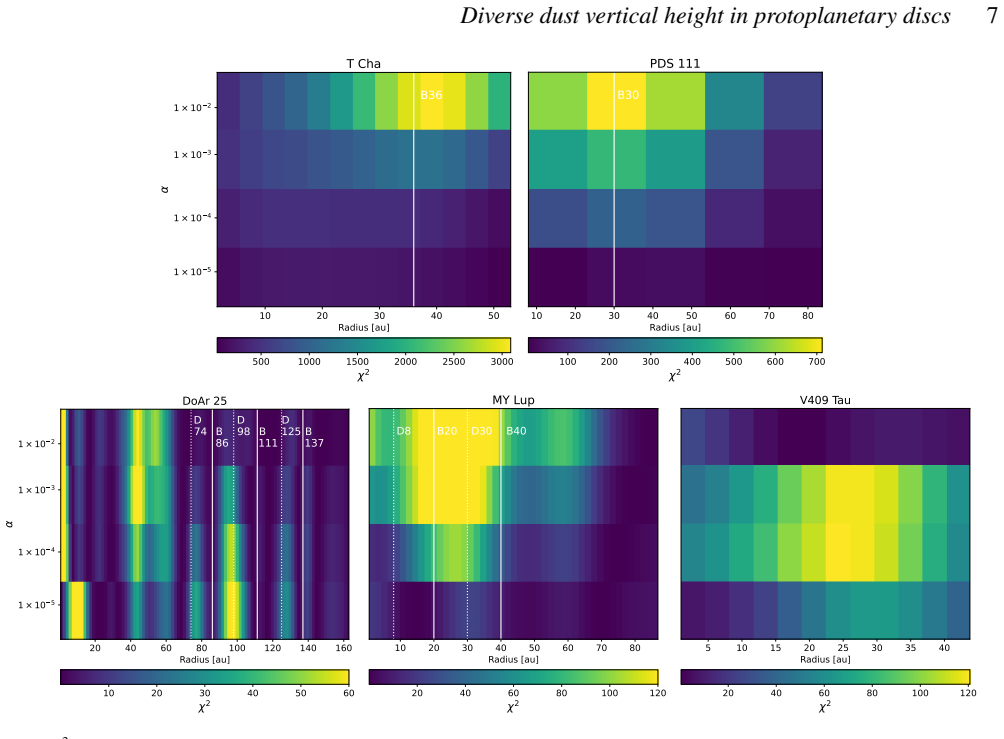
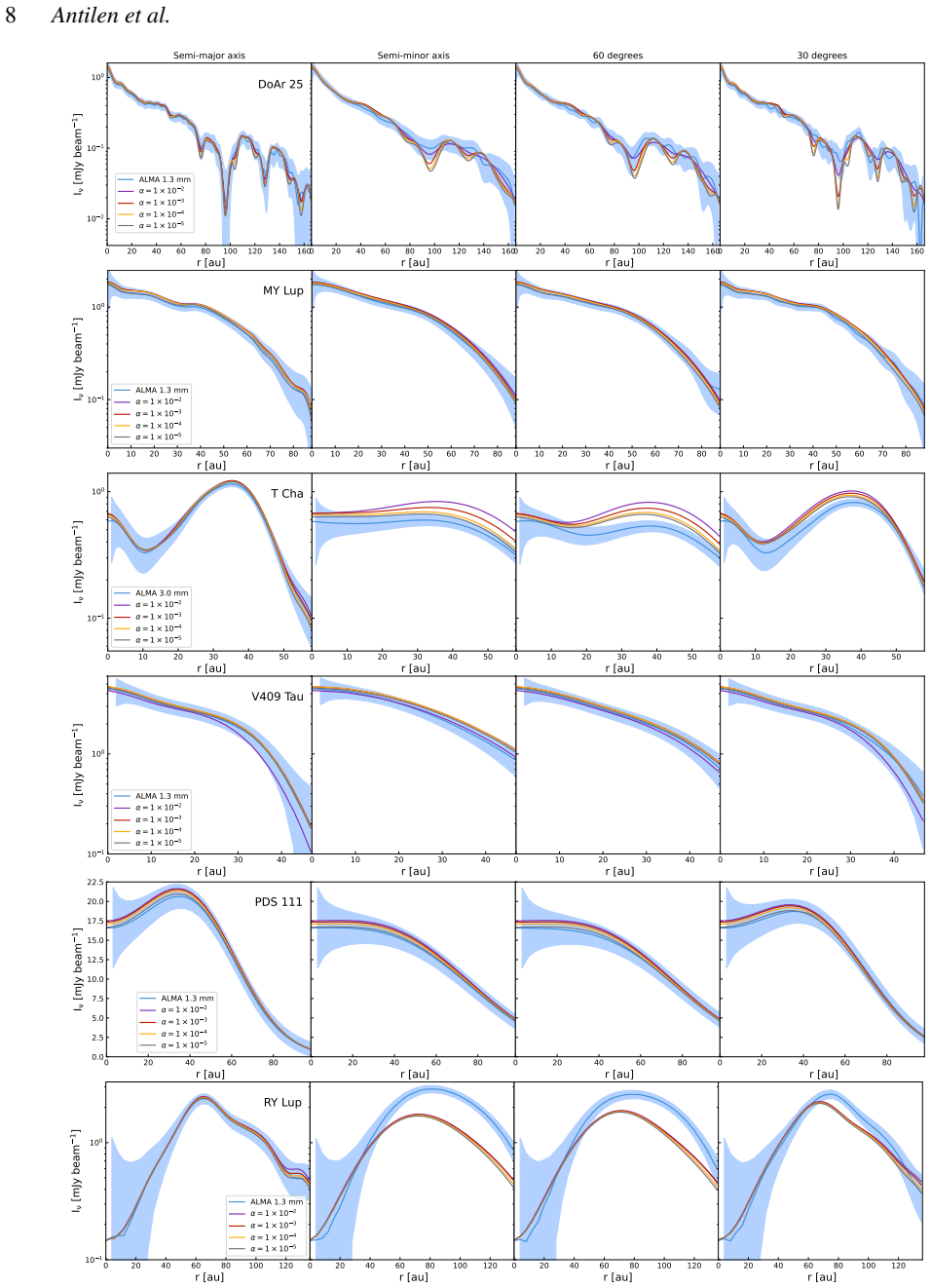
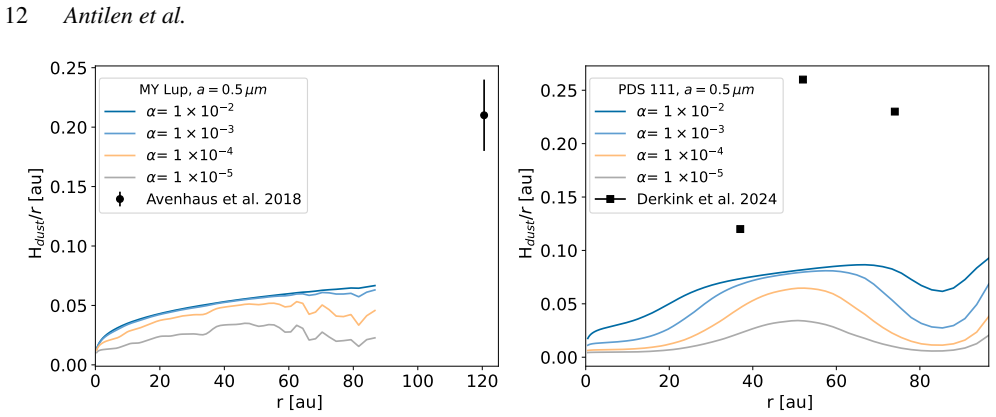
Modeling of the ALMA continuum data yields a very thin millimetre dust disc in T Cha with h_dust less than 0.1 au throughout, a vertically extended disc in DoAr 25 with h_dust around 4.7 au at 140 au, and a tentatively thin disc in MY Lup with h_dust less than 0.5 au at 70 au. Lower-resolution data give similarly thin results for PDS 111 and an extended layer for V409 Tau with h_dust around 1.3 au at 35 au. No constraint was possible for the asymmetric disc RY Lup. The input dust opacities introduce degeneracy, and the best-fitting models do not reproduce the vertical distribution of small grains seen in SPHERE data, indicating that more complex models are needed.
What carries the argument
Radiative transfer simulations that fit ALMA continuum substructures in highly inclined discs to derive the millimetre dust scale height h_dust and settling strength.
Load-bearing premise
The derived dust heights rest on the choice of dust opacities, with all quoted values obtained under the Ricci opacity set.
What would settle it
New higher-resolution ALMA observations that directly measure the vertical thickness of the millimetre dust layer in these same discs, or equivalent modeling runs using a different opacity table that produce systematically different height values.
Figures




read the original abstract
The settling of dust particles plays a critical role in the growth and dynamics of dust grains. We performed a detailed modeling of the ALMA continuum substructures for six highly inclined protoplanetary discs using radiative transfer simulations, to constrain the vertical height of millimetre dust grains and the settling strength. Our modeling results are a very thin millimetre dust disc in T Cha ($\text{h}_{\text{dust}}<$ 0.1 au throughout the disc), a vertically extended dust disc in DoAr 25 ($\text{h}_{\text{dust}}$ of $\sim$ 4.7 au at 140 au) and tentatively a thin disc in MY Lup ($\text{h}_{\text{dust}}<$ 0.5 au at 70 au). From lower resolution observations we found a very thin disc for PDS 111 ($\text{h}_{\text{dust}}<$ 0.1 au throughout the disc) and a more vertically extended millimetre dust disc in V409 Tau ($\text{h}_{\text{dust}}$ of $\sim$ 1.3 au at 35 au). We could not measure the vertical height in the asymmetric disc of RY Lup. We also found that the input dust opacities are a source of degeneracy in our models. Our tentative results, assuming the Ricci dust opacities, point to a diverse settling strength in our sample and possible radial variations. We also compared the models that best fit the ALMA data with the SPHERE data to test if they can reproduce the vertical distribution of small dust grains. This comparison suggests that models that reproduce the dust density distribution in the midplane cannot reproduce the distribution of small dust grains in the upper layers, reinforcing the need for more complex models.
Editorial analysis
A structured set of objections, weighed in public.
Referee Report
Summary. The paper uses radiative transfer modeling of ALMA continuum data for six highly inclined protoplanetary discs to derive vertical scale heights of millimeter dust (h_dust), reporting a very thin disc (h_dust < 0.1 au) in T Cha, an extended disc (h_dust ~4.7 au at 140 au) in DoAr 25, tentative thin disc in MY Lup (h_dust <0.5 au at 70 au), thin disc in PDS 111, and extended in V409 Tau (~1.3 au at 35 au), with no measurement for RY Lup. It concludes diverse settling strengths and radial variations under the Ricci opacity assumption, notes opacity degeneracy, and shows that best-fit models fail to reproduce SPHERE small-grain distributions.
Significance. If the reported diversity in h_dust proves robust to opacity variations, the results would demonstrate that millimeter dust settling is not uniform across discs and can vary radially, providing key observational constraints on dust growth and dynamics models. The explicit comparison to SPHERE data usefully highlights the limitations of single-population models for small grains.
major comments (2)
- [Abstract] Abstract: The central claim of diverse settling strengths rests on specific h_dust values (e.g., <0.1 au vs ~4.7 au) obtained with a single fixed opacity table (Ricci et al.). Although the text states that 'input dust opacities are a source of degeneracy,' no quantitative test or range of h_dust shifts under plausible alternative grain compositions or size distributions is provided, leaving the reported spread vulnerable to being an artifact of the opacity choice rather than intrinsic.
- [Modeling results] Modeling results: No quantitative fit statistics (e.g., reduced chi-squared, visibility residuals), formal uncertainties, or full posterior tables on the reported h_dust values are given. This weakens assessment of whether the claimed heights (such as ~4.7 au at 140 au in DoAr 25) are statistically preferred over other vertical structures.
minor comments (1)
- [Abstract] The abstract and conclusions could more explicitly state the radial locations at which h_dust is reported for each disc to aid comparison.
Simulated Author's Rebuttal
We thank the referee for their constructive and detailed review, which highlights important aspects for strengthening our analysis. We address each major comment below and will revise the manuscript to incorporate the suggested improvements where feasible.
read point-by-point responses
-
Referee: [Abstract] Abstract: The central claim of diverse settling strengths rests on specific h_dust values (e.g., <0.1 au vs ~4.7 au) obtained with a single fixed opacity table (Ricci et al.). Although the text states that 'input dust opacities are a source of degeneracy,' no quantitative test or range of h_dust shifts under plausible alternative grain compositions or size distributions is provided, leaving the reported spread vulnerable to being an artifact of the opacity choice rather than intrinsic.
Authors: We acknowledge that while the manuscript notes the opacity degeneracy and presents the results as tentative under the Ricci et al. assumption, we did not include a quantitative exploration of alternative opacities. We agree this would better support the robustness of the claimed diversity in settling strengths. In the revised manuscript, we will add a dedicated subsection or appendix testing at least two additional opacity tables (e.g., from Birnstiel et al. or other common prescriptions) and report the resulting shifts in h_dust for the extreme cases (T Cha and DoAr 25). This will allow readers to assess whether the spread remains significant across plausible grain assumptions. revision: yes
-
Referee: [Modeling results] Modeling results: No quantitative fit statistics (e.g., reduced chi-squared, visibility residuals), formal uncertainties, or full posterior tables on the reported h_dust values are given. This weakens assessment of whether the claimed heights (such as ~4.7 au at 140 au in DoAr 25) are statistically preferred over other vertical structures.
Authors: We agree that quantitative fit statistics and uncertainties are needed to properly evaluate the modeling results. We will revise the paper to include reduced chi-squared values for the best-fit models, a summary of visibility residuals, and formal uncertainties on the h_dust parameters derived from our grid-based fitting procedure. However, our modeling relies on a discrete parameter grid rather than MCMC sampling, so full posterior tables are not available; we will instead report the range of models that provide acceptable fits (within a defined threshold) and clarify the method in the revised text. revision: partial
Circularity Check
No significant circularity in derivation of dust scale heights from ALMA modeling
full rationale
The paper derives millimetre-dust vertical heights (h_dust) and settling strengths by fitting radiative-transfer models to external ALMA continuum visibilities and images for six inclined discs. These constraints are obtained from independent observational data using standard codes and are not equivalent to the inputs by construction. Opacity choice (Ricci table) is acknowledged as a degeneracy source but remains an external modeling assumption rather than a self-referential reduction. No load-bearing self-citations, self-definitional steps, or fitted inputs renamed as predictions appear in the central claims; the reported diversity in h_dust follows directly from the data fits.
Axiom & Free-Parameter Ledger
free parameters (2)
- Dust opacity model =
Ricci et al.
- Vertical dust scale height =
disk-specific values reported
axioms (2)
- domain assumption ALMA continuum emission traces thermal radiation from millimeter-sized dust grains whose vertical distribution can be recovered via radiative transfer.
- domain assumption The disks can be modeled with axisymmetric density distributions despite possible asymmetries.
Lean theorems connected to this paper
-
IndisputableMonolith/Cost/FunctionalEquation.leanwashburn_uniqueness_aczel unclear?
unclearRelation between the paper passage and the cited Recognition theorem.
We assumed a grain composition... Ricci opacity model... Gaussian profile for the vertical density distribution of the dust: ρ_d(r,z,a) = ... h_dust(r,a) ... Youdin & Lithwick (2007) ... α ... iterative procedure ... χ² vs. r maps
-
IndisputableMonolith/Foundation/RealityFromDistinction.leanreality_from_one_distinction unclear?
unclearRelation between the paper passage and the cited Recognition theorem.
Our modeling results are a very thin millimetre dust disc in T Cha (h_dust < 0.1 au) ... vertically extended ... DoAr 25 (h_dust ~4.7 au at 140 au) ... diverse settling strength
What do these tags mean?
- matches
- The paper's claim is directly supported by a theorem in the formal canon.
- supports
- The theorem supports part of the paper's argument, but the paper may add assumptions or extra steps.
- extends
- The paper goes beyond the formal theorem; the theorem is a base layer rather than the whole result.
- uses
- The paper appears to rely on the theorem as machinery.
- contradicts
- The paper's claim conflicts with a theorem or certificate in the canon.
- unclear
- Pith found a possible connection, but the passage is too broad, indirect, or ambiguous to say the theorem truly supports the claim.
Reference graph
Works this paper leans on
-
[1]
Black holes in binary systems. Observational appearance. , year = 1973, volume = 24, pages =
work page 1973
-
[2]
The Disk Substructures at High Angular Resolution Project (DSHARP). I. Motivation, Sample, Calibration, and Overview. , keywords =. doi:10.3847/2041-8213/aaf741 , archivePrefix =. 1812.04040 , primaryClass =
-
[3]
Avenhaus, H. and Quanz, S. P. and Schmid, H. M. and Dominik, C. and Stolker, T. and Ginski, C. and de Boer, J. and Szulágyi, J. and Garufi, A. and Zurlo, A. and Hagelberg, J. and Benisty, M. and Henning, T. and Ménard, F. and Meyer, M. R. and Baruffolo, A. and Bazzon, A. and Beuzit, J. L. and Costille, A. and Dohlen, K. and Girard, J. H. and Gisler, D. an...
-
[4]
Disks around T Tauri Stars with SPHERE (DARTTS-S). I. SPHERE/IRDIS Polarimetric Imaging of Eight Prominent T Tauri Disks. , keywords =. doi:10.3847/1538-4357/aab846 , archivePrefix =. 1803.10882 , primaryClass =
-
[5]
Bae, Jaehan and Nelson, Richard P. and Hartmann, Lee , title =. 2016 , month =. doi:10.3847/1538-4357/833/2/126 , url =
-
[6]
Wind-driven Accretion in Protoplanetary Disks. I. Suppression of the Magnetorotational Instability and Launching of the Magnetocentrifugal Wind. , keywords =. doi:10.1088/0004-637X/769/1/76 , archivePrefix =. 1301.0318 , primaryClass =
-
[7]
The Disk Substructures at High Angular Resolution Project (DSHARP). V. Interpreting ALMA Maps of Protoplanetary Disks in Terms of a Dust Model. , keywords =. doi:10.3847/2041-8213/aaf743 , archivePrefix =. 1812.04043 , primaryClass =
-
[8]
The Radial Distribution of Dust Particles in the HL Tau Disk from ALMA and VLA Observations. , keywords =. doi:10.3847/1538-4357/ab3d33 , archivePrefix =. 1908.07140 , primaryClass =
-
[9]
Steady-state accretion in magnetized protoplanetary disks. , keywords =. doi:10.1051/0004-6361/202141689 , archivePrefix =. 2110.05639 , primaryClass =
-
[10]
Population synthesis models indicate a need for early and ubiquitous disk substructures. , keywords =. doi:10.1051/0004-6361/202450328 , archivePrefix =. 2405.14501 , primaryClass =
-
[11]
Estimate on Dust Scale Height from the ALMA Dust Continuum Image of the HD 163296 Protoplanetary Disk. , keywords =. doi:10.3847/1538-4357/abe5a6 , archivePrefix =. 2102.06209 , primaryClass =
-
[12]
The impact of dynamic pressure bumps on the observational properties of protoplanetary disks. , keywords =. doi:10.1051/0004-6361/202243338 , archivePrefix =. 2209.07931 , primaryClass =
-
[13]
Disk Evolution Study Through Imaging of Nearby Young Stars (DESTINYS): PDS 111, an old T Tauri star with a young-looking disk. , keywords =. doi:10.1051/0004-6361/202348555 , archivePrefix =. 2406.04160 , primaryClass =
-
[14]
OpTool: Command-line driven tool for creating complex dust opacities
-
[15]
Scattering by Interstellar Dust Grains. I. Optical and Ultraviolet. , keywords =. doi:10.1086/379118 , archivePrefix =. astro-ph/0304060 , primaryClass =
-
[16]
Scattering by Interstellar Dust Grains. II. X-Rays. , keywords =. doi:10.1086/379123 , archivePrefix =. astro-ph/0308251 , primaryClass =
-
[17]
Protostars and Planets VII , year = 2023, editor =
Planet Formation Theory in the Era of ALMA and Kepler: from Pebbles to Exoplanets. Protostars and Planets VII , year = 2023, editor =. doi:10.48550/arXiv.2203.09759 , archivePrefix =. 2203.09759 , primaryClass =
-
[18]
The dust subdisk in the protoplanetary nebula. , keywords =. doi:10.1006/icar.1995.1058 , adsurl =
-
[19]
doi:10.3847/1538-3881/acf9a7 , archivePrefix =
, keywords =. doi:10.3847/1538-3881/acf9a7 , archivePrefix =. 2309.07040 , primaryClass =
-
[20]
The Inner Regions of Protoplanetary Disks. , keywords =. doi:10.1146/annurev-astro-081309-130932 , archivePrefix =. 1006.3485 , primaryClass =
-
[21]
RADMC-3D: A multi-purpose radiative transfer tool
-
[22]
Trapping solids at the inner edge of the dead zone: 3-D global MHD simulations. , keywords =. doi:10.1051/0004-6361/200912834 , archivePrefix =. 1002.2521 , primaryClass =
-
[23]
Turbulence and Steady Flows in Three-dimensional Global Stratified Magnetohydrodynamic Simulations of Accretion Disks. , keywords =. doi:10.1088/0004-637X/735/2/122 , archivePrefix =. 1104.4565 , primaryClass =
-
[24]
Gaps, rings, and non-axisymmetric structures in protoplanetary disks. From simulations to ALMA observations. , keywords =. doi:10.1051/0004-6361/201424693 , archivePrefix =. 1411.2736 , primaryClass =
-
[25]
Gas and Dust Dynamics in Starlight-heated Protoplanetary Disks. , keywords =. doi:10.3847/1538-4357/ab9641 , archivePrefix =. 2005.11974 , primaryClass =
-
[26]
Dust-depleted Inner Disks in a Large Sample of Transition Disks through Long-baseline ALMA Observations. , keywords =. doi:10.3847/1538-4357/ab7b63 , archivePrefix =. 2003.00079 , primaryClass =
-
[27]
Global MHD simulations of stratified and turbulent protoplanetary discs. II. Dust settling. , keywords =. doi:10.1051/0004-6361/200811220 , archivePrefix =. 0901.4434 , primaryClass =
-
[28]
Hydrodynamical simulations of the vertical shear instability with dynamic dust and cooling rates in protoplanetary disks. , keywords =. doi:10.1051/0004-6361/202555624 , archivePrefix =. 2507.11156 , primaryClass =
-
[29]
The full census of planet-forming disks with GTO and DESTINYS programs
The SPHERE view of the Taurus star-forming region. The full census of planet-forming disks with GTO and DESTINYS programs. , keywords =. doi:10.1051/0004-6361/202347586 , archivePrefix =. 2403.02158 , primaryClass =
-
[30]
Peering through the veil: Investigating protoplanetary disk outer edges using backside visibility. , keywords =. doi:10.1051/0004-6361/202554470 , archivePrefix =. 2506.03624 , primaryClass =
-
[31]
The full census of planet-forming disks with GTO and DESTINYS programs
The SPHERE view of the Chamaeleon I star-forming region. The full census of planet-forming disks with GTO and DESTINYS programs. , keywords =. doi:10.1051/0004-6361/202244005 , archivePrefix =. 2403.02149 , primaryClass =
-
[32]
The GRAVITY young stellar object survey. III. The dusty disk of RY Lup. , keywords =. doi:10.1051/0004-6361/202038249 , archivePrefix =. 2008.08527 , primaryClass =
-
[33]
Distribution of solids in the rings of the HD 163296 disk: a multiwavelength study. , keywords =. doi:10.1051/0004-6361/202142303 , archivePrefix =. 2207.01496 , primaryClass =
-
[34]
A likely planet-induced gap in the disc around T Cha. , keywords =. doi:10.1093/mnrasl/slx184 , adsurl =
-
[35]
The Disk Substructures at High Angular Resolution Project (DSHARP). II. Characteristics of Annular Substructures. , keywords =. doi:10.3847/2041-8213/aaf740 , archivePrefix =. 1812.04041 , primaryClass =
-
[36]
High-resolution observations of the outer disk around T Chamaeleontis: the view from ALMA. , keywords =. doi:10.1051/0004-6361/201424404 , archivePrefix =. 1501.06483 , primaryClass =
-
[37]
Puffed-up Inner Rings and Razor-thin Outer Rings in Structured Protoplanetary Disks. , keywords =. doi:10.3847/1538-4357/ae089e , archivePrefix =. 2509.13122 , primaryClass =
-
[38]
Protoplanetary Disk Turbulence Driven by the Streaming Instability: Nonlinear Saturation and Particle Concentration. , keywords =. doi:10.1086/516730 , archivePrefix =. astro-ph/0702626 , primaryClass =
-
[39]
The radial profile of dust grain size in the protoplanetary disc of DS Tau. , keywords =. doi:10.1093/mnras/stac3534 , archivePrefix =. 2211.16833 , primaryClass =
-
[40]
and Li, Rixin and Armitage, Philip J
Streaming Instability and Turbulence: Conditions for Planetesimal Formation. , keywords =. doi:10.3847/1538-4357/ad47a2 , archivePrefix =. 2312.12508 , primaryClass =
-
[41]
Science China Physics, Mechanics, and Astronomy , keywords =
Millimeter gap contrast as a probe for turbulence level in protoplanetary disks. Science China Physics, Mechanics, and Astronomy , keywords =. doi:10.1007/s11433-022-1982-y , archivePrefix =. 2208.09230 , primaryClass =
-
[42]
Dust mass in protoplanetary disks with porous dust opacities. , keywords =. doi:10.1051/0004-6361/202451981 , archivePrefix =. 2411.00277 , primaryClass =
-
[43]
2023, in Astronomical Society of the Pacific Conference Series, Vol
Hydro-, Magnetohydro-, and Dust-Gas Dynamics of Protoplanetary Disks. Protostars and Planets VII , year = 2023, editor =. doi:10.48550/arXiv.2203.09821 , archivePrefix =. 2203.09821 , primaryClass =
-
[44]
Compact Disks in a High-resolution ALMA Survey of Dust Structures in the Taurus Molecular Cloud. , keywords =. doi:10.3847/1538-4357/ab2d2d , archivePrefix =. 1906.10809 , primaryClass =
-
[45]
High-resolution parameter study of the vertical shear instability - II: dependence on temperature gradient and cooling time. , keywords =. doi:10.1093/mnras/stab2599 , archivePrefix =. 2109.01649 , primaryClass =
-
[46]
Modeling optical properties of cosmic dust grains using a distribution of hollow spheres. , keywords =. doi:10.1051/0004-6361:20041920 , archivePrefix =. astro-ph/0503068 , primaryClass =
-
[47]
Catching drifting pebbles. II. A stochastic equation of motion for pebbles. , keywords =. doi:10.1051/0004-6361/201732562 , archivePrefix =. 1803.06150 , primaryClass =
-
[48]
Growing and trapping pebbles with fragile collisions of particles in protoplanetary disks. , keywords =. doi:10.1051/0004-6361/202038920 , archivePrefix =. 2011.09178 , primaryClass =
-
[49]
The Astrophysical Journal , author =
Dust and Gas in the Disk of HL Tauri: Surface Density, Dust Settling, and Dust-to-gas Ratio. , keywords =. doi:10.3847/0004-637X/816/1/25 , archivePrefix =. 1508.00584 , primaryClass =
-
[50]
Constraining turbulence in protoplanetary discs using the gap contrast: an application to the DSHARP sample. , keywords =. doi:10.1093/mnras/stad2057 , archivePrefix =. 2307.11150 , primaryClass =
-
[51]
Material transport in protoplanetary discs with massive embedded planets. , keywords =. doi:10.1093/mnras/stae2229 , archivePrefix =. 2409.16245 , primaryClass =
-
[52]
New constraints on the disk characteristics and companion candidates around T Chamaeleontis with VLT/SPHERE. , keywords =. doi:10.1051/0004-6361/201630234 , archivePrefix =. 1705.03477 , primaryClass =
-
[53]
Dust properties of protoplanetary disks in the Taurus-Auriga star forming region from millimeter wavelengths. , keywords =. doi:10.1051/0004-6361/200913403 , archivePrefix =. 0912.3356 , primaryClass =
-
[54]
Variability of the transitional T Tauri star T Chamaeleontis. , keywords =. doi:10.1051/0004-6361/200811073 , archivePrefix =. 0904.0101 , primaryClass =
-
[55]
High angular resolution evidence of dust traps from deep ALMA Band 3 observations of LkCa15. , keywords =. doi:10.1093/mnras/staf393 , archivePrefix =. 2503.03336 , primaryClass =
-
[56]
2012, MNRAS, 427, 127, doi: 10.1111/j.1365-2966.2012.21948.x
Emergent mesoscale phenomena in magnetized accretion disc turbulence. , keywords =. doi:10.1111/j.1365-2966.2012.20835.x , archivePrefix =. 1203.0314 , primaryClass =
-
[57]
Global Simulations of Accretion Disks. I. Convergence and Comparisons with Local Models. , keywords =. doi:10.1088/0004-637X/749/2/189 , archivePrefix =. 1106.4019 , primaryClass =
-
[58]
Szulágyi, J. and Binkert, F. and Surville, C. , title =. 2022 , month =. doi:10.3847/1538-4357/ac32d1 , url =
-
[59]
Disk Evolution Study Through Imaging of Nearby Young Stars (DESTINYS): The SPHERE view of the Orion star-forming region. , keywords =. doi:10.1051/0004-6361/202347452 , archivePrefix =. 2403.02156 , primaryClass =
-
[60]
A Highly Settled Disk around Oph163131. , keywords =. doi:10.3847/1538-4357/ac5fae , archivePrefix =. 2204.00640 , primaryClass =
-
[61]
JWST Imaging of Edge-on Protoplanetary Disks. II. Appearance of Edge-on Disks with a Tilted Inner Region: Case Study of IRAS04302+2247. , keywords =. doi:10.3847/1538-4357/ad0c4b , archivePrefix =. 2311.07668 , primaryClass =
-
[62]
JWST Imaging of Edge-on Protoplanetary Disks. III. Drastic Morphological Transformation Across the Mid-infrared in Oph163131. , keywords =. doi:10.3847/1538-4357/ad7de0 , archivePrefix =. 2410.00156 , primaryClass =
-
[63]
Turbulence in protoplanetary disks: A systematic analysis of dust settling in 33 disks. , keywords =. doi:10.1051/0004-6361/202553822 , archivePrefix =. 2503.05872 , primaryClass =
-
[64]
The VizieR database of astronomical catalogues , publisher =
Ochsenbein, Francois , keywords =. The VizieR database of astronomical catalogues , publisher =. 1996 , copyright =. doi:10.26093/CDS/VIZIER , url =
-
[65]
Astronomy and Astrophysics Supplement Series , author =
The VizieR database of astronomical catalogues. , keywords =. doi:10.1051/aas:2000169 , archivePrefix =. astro-ph/0002122 , primaryClass =
-
[66]
Protostars and Planets V , year = 2007, editor =
Multiwavelength Imaging of Young Stellar Object Disks: Toward an Understanding of Disk Structure and Dust Evolution. Protostars and Planets V , year = 2007, editor =. doi:10.48550/arXiv.0707.2608 , archivePrefix =. 0707.2608 , primaryClass =
-
[67]
Streaming Instabilities in Protoplanetary Disks. , keywords =. doi:10.1086/426895 , archivePrefix =. astro-ph/0409263 , primaryClass =
-
[68]
Protoplanetary Disk Turbulence Driven by the Streaming Instability: Linear Evolution and Numerical Methods. , keywords =. doi:10.1086/516729 , archivePrefix =. astro-ph/0702625 , primaryClass =
-
[69]
Particle stirring in turbulent gas disks: Including orbital oscillations. , keywords =. doi:10.1016/j.icarus.2007.07.012 , archivePrefix =. 0707.2975 , primaryClass =
-
[70]
Thermal Structure Determines Kinematics: Vertical Shear Instability in Stellar Irradiated Protoplanetary Disks. , keywords =. doi:10.3847/1538-4357/ad4109 , archivePrefix =. 2404.05608 , primaryClass =
discussion (0)
Sign in with ORCID, Apple, or X to comment. Anyone can read and Pith papers without signing in.