Recognition: unknown
Characterizing the bolometric-photoevaporative transition in young sub-Neptunes with radiation-hydrodynamic simulations
Pith reviewed 2026-05-08 17:29 UTC · model grok-4.3
The pith
Sub-Neptunes transition from core-powered bolometric winds to photoevaporative escape as they contract.
A machine-rendered reading of the paper's core claim, the machinery that carries it, and where it could break.
Core claim
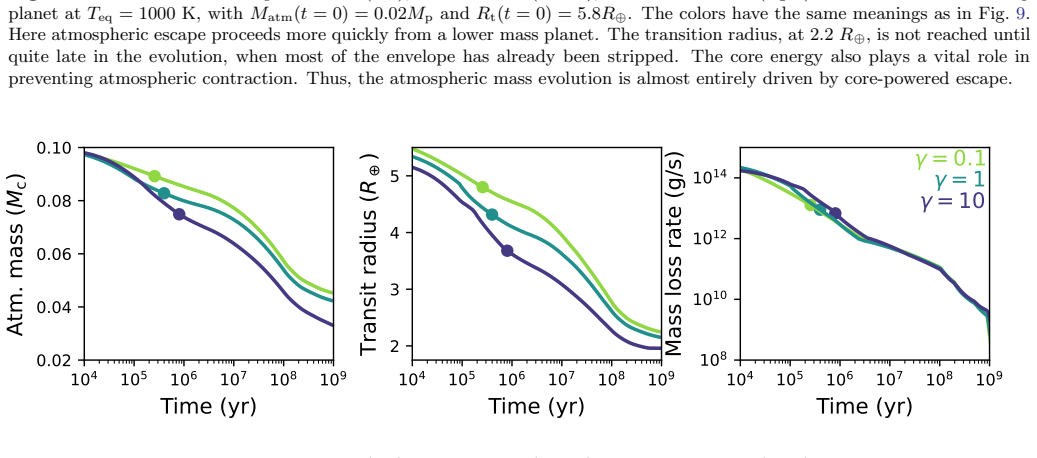
As a typical sub-Neptune contracts, it evolves through distinct escape regimes. The youngest, most inflated planets drive a core-powered, bolometrically heated wind because UV radiation cannot reach the bolometric sonic point. This is followed by a transitional regime shaped by both bolometric and UV heating. As radii decrease further, escape rates approach the purely photoevaporative energy limit. We derive analytic scalings for the transition between these regimes, showing that it occurs at smaller radii for lower-mass and more highly irradiated planets, where core-powered escape dominates. Coupling both processes enhances escape even in more massive, cooler sub-Neptunes. We present the fi
What carries the argument
Radiation-hydrodynamic simulations using AIOLOS coupled to planetary evolution models that identify when UV radiation reaches the bolometric sonic point to switch between escape regimes.
If this is right
- Coupling both processes enhances escape rates even in more massive, cooler sub-Neptunes compared to using either mechanism in isolation.
- The transition between regimes happens at smaller radii for lower-mass planets and those with higher XUV irradiation.
- Atmospheric composition influences escape rates by determining the thermal structure below the UV absorption radius.
- Combined mass-loss rates are provided for various planet masses and XUV luminosities, serving as inputs for evolution models.
- Analytic scalings describe how the bolometric-photoevaporative transition depends on planet mass and irradiation level.
Where Pith is reading between the lines
- Exoplanet population models should incorporate time-dependent regime changes rather than fixed escape rates to reproduce observed demographics.
- Atmospheric retrievals from young sub-Neptunes could test how composition alters the predicted transition radii.
- The unified framework could extend to other heating sources or magnetic effects to explore additional variations in escape.
Load-bearing premise
The AIOLOS radiation-hydrodynamic code when coupled to the planetary evolution model accurately captures all relevant physics including atmospheric composition effects below the UV absorption radius without significant numerical artifacts or missing processes.
What would settle it
A measurement of mass-loss rates in very young highly inflated sub-Neptunes showing UV-driven photoevaporation instead of the predicted core-powered dominance, or radius evolution tracks lacking the predicted transition to photoevaporative limits.
Figures




read the original abstract
Hydrodynamic atmospheric escape plays a central role in shaping the demographics of small, close-in exoplanets. Two mechanisms have been proposed to drive mass loss: photoevaporation, powered by UV irradiation, and core-powered mass loss, in which a bolometrically heated wind is sustained by cooling from the planetary interior. Although each mechanism can independently reproduce observed exoplanet demographics, both likely operate simultaneously. To quantify their combined impact, we use AIOLOS, a hydrodynamic radiative transfer code, coupled to a planetary evolution model to self-consistently compute atmospheric escape and planetary evolution. We find that as a typical sub-Neptune contracts, it evolves through distinct escape regimes. The youngest, most inflated planets drive a core-powered, bolometrically heated wind because UV radiation cannot reach the bolometric sonic point. This is followed by a transitional regime shaped by both bolometric and UV heating. As radii decrease further, escape rates approach the purely photoevaporative energy limit. We derive analytic scalings for the transition between these regimes, showing that it occurs at smaller radii for lower-mass and more highly irradiated planets, where core-powered escape dominates. Coupling both processes enhances escape even in more massive, cooler sub-Neptunes. We present the first combined mass-loss rates for a range of planet masses and XUV luminosities and show that the thermal structure below the UV absorption radius -- set by atmospheric composition -- also affects escape rates. These results integrate core-powered and photoevaporative escape into a unified framework, demonstrating that a self-consistent treatment of atmospheric composition, escape, and evolution is essential for understanding small exoplanets.
Editorial analysis
A structured set of objections, weighed in public.
Referee Report
Summary. The paper uses the AIOLOS radiation-hydrodynamic code coupled to a planetary evolution model to simulate atmospheric escape in young sub-Neptunes. It identifies three regimes as planets contract: core-powered bolometric winds for the most inflated planets (where UV cannot reach the bolometric sonic point), a transitional regime with combined heating, and photoevaporative escape at smaller radii. Analytic scalings for the transition radius are derived (occurring at smaller radii for lower-mass and more highly irradiated planets), combined mass-loss rates are presented across masses and XUV luminosities, and the role of atmospheric composition below the UV absorption radius is highlighted.
Significance. If the numerical results hold, this work offers a valuable unification of core-powered and photoevaporative mass loss into a single self-consistent framework based on first-principles hydrodynamics and radiative transfer. The derived analytic scalings and combined mass-loss rates for a range of parameters represent a concrete advance that could be directly incorporated into population-level models of sub-Neptune demographics. The explicit treatment of composition effects below the UV layer and the coupling to evolution further strengthen the contribution.
major comments (1)
- The abstract states that the transition occurs at smaller radii for lower-mass and more highly irradiated planets 'where core-powered escape dominates,' but this phrasing risks ambiguity with the described regime sequence (core-powered at large radii transitioning to photoevaporative at small radii). The main text should explicitly define the transition radius (e.g., via the condition that UV reaches the bolometric sonic point) and show how the scaling with mass and irradiation follows from the simulations.
minor comments (2)
- The abstract claims these are the 'first combined mass-loss rates,' but a brief comparison to prior separate photoevaporation or core-powered calculations (even qualitatively) would help readers assess the quantitative impact of the unified treatment.
- The role of atmospheric composition below the UV absorption radius is noted as affecting escape rates, but the specific compositions tested and their impact on the thermal structure should be summarized with a table or figure reference for clarity.
Simulated Author's Rebuttal
We thank the referee for their positive assessment of our work and for the constructive comment on clarifying the transition radius. We address the point below and will make the suggested revisions to improve clarity.
read point-by-point responses
-
Referee: The abstract states that the transition occurs at smaller radii for lower-mass and more highly irradiated planets 'where core-powered escape dominates,' but this phrasing risks ambiguity with the described regime sequence (core-powered at large radii transitioning to photoevaporative at small radii). The main text should explicitly define the transition radius (e.g., via the condition that UV reaches the bolometric sonic point) and show how the scaling with mass and irradiation follows from the simulations.
Authors: We agree that the abstract phrasing could be misinterpreted and will revise it for precision. The transition radius is defined as the planetary radius at which UV photons begin to reach and heat the bolometric sonic point (i.e., the point where the UV optical depth drops sufficiently for XUV radiation to penetrate inward of the sonic radius set by bolometric heating). In the main text (Section 3 and the analytic scaling derivation in Section 4), we will explicitly state this definition and demonstrate, using the simulation grid across planet masses (5-20 Earth masses) and XUV luminosities, that lower-mass and more highly irradiated planets reach this penetration condition at smaller radii. This occurs because their lower gravity and higher incident flux shift the bolometric sonic point inward relative to the UV absorption layer, allowing core-powered escape to remain dominant until smaller radii before the photoevaporative regime takes over. We will also add a figure panel or table entry explicitly showing the transition radius versus mass and irradiation to illustrate the scaling directly from the results. revision: yes
Circularity Check
No significant circularity; derivation is self-contained
full rationale
The paper computes mass-loss rates by coupling the AIOLOS radiation-hydrodynamic code (solving the hydrodynamic equations with radiative transfer) to a planetary evolution model. Distinct escape regimes and analytic scalings for the bolometric-photoevaporative transition are extracted from the resulting simulation outputs across planet masses and XUV luminosities. No steps reduce by construction to fitted inputs, self-definitions, or load-bearing self-citations; the central claims follow from direct numerical integration of the governing physics rather than presupposing the identified regimes or transition radii.
Axiom & Free-Parameter Ledger
free parameters (2)
- planet mass
- XUV luminosity
axioms (2)
- domain assumption 1D spherical symmetry and steady-state flow assumptions hold for the atmospheric wind structure
- domain assumption The coupled planetary evolution model supplies accurate bolometric heating and radius contraction history
Reference graph
Works this paper leans on
-
[1]
The False Positive Rate of Kepler and the Occurrence of Planets. , keywords =. 2013. doi:10.1088/0004-637X/766/2/81 , archivePrefix =. 1301.0842 , primaryClass =
-
[2]
Photoionization and photodissociation rates in solar and blackbody radiation fields. , keywords =. doi:10.1016/j.pss.2014.11.022 , adsurl =
-
[3]
Migration of Earth-sized planets in 3D radiative discs. , keywords =. doi:10.1093/mnras/stu304 , archivePrefix =. 1402.2834 , primaryClass =
-
[4]
Atmospheric Loss of Exoplanets Resulting from Stellar X-Ray and Extreme-Ultraviolet Heating. , keywords =. doi:10.1086/380815 , adsurl =
-
[5]
The effect of evaporation on the evolution of close-in giant planets. , keywords =. doi:10.1051/0004-6361:20040129 , archivePrefix =. astro-ph/0404101 , primaryClass =
-
[6]
The reliability of approximate radiation transport methods for irradiated disk studies. , keywords =. doi:10.1051/0004-6361/201321404 , archivePrefix =. 1305.2197 , primaryClass =
-
[7]
Radiation hydrodynamics with adaptive mesh refinement and application to prestellar core collapse. I. Methods. , keywords =. doi:10.1051/0004-6361/201015880 , archivePrefix =. 1102.1216 , primaryClass =
-
[8]
Journal of Computational Physics , year = 2014, month = feb, volume =
Well-balanced schemes for the Euler equations with gravitation. Journal of Computational Physics , year = 2014, month = feb, volume =. doi:10.1016/j.jcp.2013.11.028 , adsurl =
-
[9]
The exact preservation of hydrostatic equilibrium with arbitrary entropy stratification
A well-balanced finite volume scheme for the Euler equations with gravitation. The exact preservation of hydrostatic equilibrium with arbitrary entropy stratification. , keywords =. doi:10.1051/0004-6361/201527815 , adsurl =
-
[10]
Restoration of the contact surface in the HLL-Riemann solver. Shock Waves , keywords =. doi:10.1007/BF01414629 , adsurl =
-
[11]
Riemann Solvers and Numerical Methods for Fluid Dynamics: A Practical Introduction , publisher =
Toro, Eleuterio , year =. Riemann Solvers and Numerical Methods for Fluid Dynamics: A Practical Introduction , publisher =
-
[12]
Passive Irradiated Circumstellar Disks with an Inner Hole. , keywords =. doi:10.1086/323057 , archivePrefix =. astro-ph/0106470 , primaryClass =
-
[13]
Irradiation of Accretion Disks around Young Objects. I. Near-Infrared CO Bands. , keywords =. doi:10.1086/170618 , adsurl =
-
[14]
Spectral Energy Distributions of T Tauri Stars with Passive Circumstellar Disks. , keywords =. doi:10.1086/304869 , archivePrefix =. astro-ph/9706042 , primaryClass =
-
[15]
Super-Earth Atmospheres: Self-consistent Gas Accretion and Retention. , keywords =. 2016. doi:10.3847/0004-637X/825/1/29 , archivePrefix =. 1512.07925 , primaryClass =
-
[16]
Core-powered mass-loss and the radius distribution of small exoplanets. , keywords =. doi:10.1093/mnras/sty290 , archivePrefix =. 1708.01621 , primaryClass =
-
[17]
Planetary evaporation by UV & X-ray radiation: basic hydrodynamics. , keywords =. 2012. doi:10.1111/j.1365-2966.2012.21481.x , archivePrefix =. 1206.2367 , primaryClass =
-
[18]
The Evaporation Valley in the Kepler Planets. , keywords =. 2017. doi:10.3847/1538-4357/aa890a , archivePrefix =. 1705.10810 , primaryClass =
-
[19]
M., Ercolano B., Dale J., Teixeira P
Disc clearing of young stellar objects: evidence for fast inside-out dispersal. , keywords =. doi:10.1093/mnras/sts276 , archivePrefix =. 1210.6268 , primaryClass =
-
[20]
The California-Kepler Survey. III. A Gap in the Radius Distribution of Small Planets. , keywords =. 2017. doi:10.3847/1538-3881/aa80eb , archivePrefix =. 1703.10375 , primaryClass =
-
[21]
doi:10.1093/mnras/stz738 , eprint =
Atmospheric mass-loss due to giant impacts: the importance of the thermal component for hydrogen-helium envelopes. , keywords =. 2019. doi:10.1093/mnras/stz738 , archivePrefix =. 1809.06810 , primaryClass =
-
[22]
, year = 1958, month = nov, volume =
Dynamics of the Interplanetary Gas and Magnetic Fields. , year = 1958, month = nov, volume =. doi:10.1086/146579 , adsurl =
-
[23]
Internal structure of massive terrestrial planets. , keywords =. 2006. doi:10.1016/j.icarus.2005.11.021 , archivePrefix =. astro-ph/0511150 , primaryClass =
-
[24]
SciPy 1.0: fundamental algorithms for scientific computing in Python. Nature Methods , keywords =. doi:10.1038/s41592-019-0686-2 , archivePrefix =. 1907.10121 , primaryClass =
-
[25]
Computing in Science & Engineering9(3), 90–95 (2007) https://doi.org/10.1109/MCSE.2007.55
Matplotlib: A 2D Graphics Environment. Computing in Science and Engineering , keywords =. 2007. doi:10.1109/MCSE.2007.55 , adsurl =
-
[26]
Array Programming with NumPy. , keywords =. doi:10.1038/s41586-020-2649-2 , archivePrefix =. 2006.10256 , primaryClass =
-
[27]
S., Fegley Jr., B., Schaefer, L., & Ford, E
Atmosphere Origins for Exoplanet Sub-Neptunes. , keywords =. doi:10.3847/1538-4357/ab6ffb , archivePrefix =. 2001.09269 , primaryClass =
-
[28]
Current Population Statistics Do Not Favor Photoevaporation over Core-powered Mass Loss as the Dominant Cause of the Exoplanet Radius Gap. , keywords =. 2020. doi:10.3847/1538-4357/ab6605 , archivePrefix =. 1912.12305 , primaryClass =
-
[29]
Line and Mean Opacities for Ultracool Dwarfs and Extrasolar Planets. , keywords =. doi:10.1086/521793 , archivePrefix =. 0706.2374 , primaryClass =
-
[30]
Jupiter's evolution with primordial composition gradients. , keywords =. doi:10.1051/0004-6361/201732522 , archivePrefix =. 1801.08149 , primaryClass =
-
[31]
The primordial entropy of Jupiter. , keywords =. doi:10.1093/mnras/sty1000 , archivePrefix =. 1804.06019 , primaryClass =
-
[32]
Science , year = 1995, month = sep, volume =
Condensation of Methane, Ammonia, and Water and the Inhibition of Convection in Giant Planets. Science , year = 1995, month = sep, volume =. doi:10.1126/science.7569896 , adsurl =
-
[33]
Condensation-inhibited convection in hydrogen-rich atmospheres . Stability against double-diffusive processes and thermal profiles for Jupiter, Saturn, Uranus, and Neptune. , keywords =. doi:10.1051/0004-6361/201629140 , archivePrefix =. 1610.05506 , primaryClass =
-
[34]
Constraining the Effect of Convective Inhibition on the Thermal Evolution of Uranus and Neptune. PSJ , keywords =. doi:10.3847/PSJ/ac091d , archivePrefix =. 2106.04637 , primaryClass =
-
[35]
Chemical Equilibrium between Cores, Mantles, and Atmospheres of Super-Earths and Sub-Neptunes and Implications for Their Compositions, Interiors, and Evolution. PSJ , keywords =. doi:10.3847/PSJ/ac68e6 , archivePrefix =. 2107.10405 , primaryClass =
-
[36]
To cool is to keep: residual H/He atmospheres of super-Earths and sub-Neptunes. , keywords =. doi:10.1093/mnras/stab895 , archivePrefix =. 2103.09212 , primaryClass =
-
[37]
Losing oceans: The effects of composition on the thermal component of impact-driven atmospheric loss. , keywords =. doi:10.1093/mnras/staa3614 , archivePrefix =. 2007.01446 , primaryClass =
-
[38]
Sculpting the valley in the radius distribution of small exoplanets as a by-product of planet formation: the core-powered mass-loss mechanism. , keywords =. 2019. doi:10.1093/mnras/stz1230 , archivePrefix =. 1811.03202 , primaryClass =
-
[39]
The Mass-Radius Relation for 65 Exoplanets Smaller than 4 Earth Radii. , keywords =. doi:10.1088/2041-8205/783/1/L6 , archivePrefix =. 1312.0936 , primaryClass =
-
[40]
Superabundance of Exoplanet Sub-Neptunes Explained by Fugacity Crisis. , keywords =. doi:10.3847/2041-8213/ab59d9 , archivePrefix =. 1912.02701 , primaryClass =
-
[41]
Solubility of molecular hydrogen in silicate melts and consequences for volatile evolution of terrestrial planets. Earth and Planetary Science Letters , year = 2012, month = sep, volume =. doi:10.1016/j.epsl.2012.06.031 , adsurl =
-
[42]
Journal of Geophysical Research (Planets) , keywords =
Vertically Resolved Magma Ocean-Protoatmosphere Evolution: H _ 2 , H _ 2 O, CO _ 2 , CH _ 4 , CO, O _ 2 , and N _ 2 as Primary Absorbers. Journal of Geophysical Research (Planets) , keywords =. doi:10.1029/2020JE006711 , archivePrefix =. 2101.10991 , primaryClass =
-
[43]
Chemistry of Impact-generated Silicate Melt-vapor Debris Disks. , keywords =. doi:10.1088/2041-8205/767/1/L12 , archivePrefix =. 1303.3905 , primaryClass =
-
[44]
Understanding the Mass-Radius Relation for Sub-neptunes: Radius as a Proxy for Composition. , keywords =. doi:10.1088/0004-637X/792/1/1 , archivePrefix =. 1311.0329 , primaryClass =
-
[45]
2017, Astronomy & Astrophysics, 597, A37, doi: 10.1051/0004-6361/201628708
A generalized Bayesian inference method for constraining the interiors of super Earths and sub-Neptunes. , keywords =. doi:10.1051/0004-6361/201628708 , archivePrefix =. 1609.03908 , primaryClass =
-
[46]
A Framework for Quantifying the Degeneracies of Exoplanet Interior Compositions. , keywords =. doi:10.1088/0004-637X/712/2/974 , archivePrefix =. 0912.3288 , primaryClass =
-
[47]
, year = 1947, month = mar, volume =
Stellar Models with Convection and with Discontinuity of the Mean Molecular Weight. , year = 1947, month = mar, volume =. doi:10.1086/144905 , adsurl =
-
[48]
A New Perspective on the Interiors of Ice-rich Planets: Ice-Rock Mixture Instead of Ice on Top of Rock. , keywords =. doi:10.3847/1538-4357/ac458c , archivePrefix =. 2011.00602 , primaryClass =
-
[49]
Comparing Jupiter interior structure models to Juno gravity measurements and the role of a dilute core. , keywords =. doi:10.1002/2017GL073160 , archivePrefix =. 1707.01997 , primaryClass =
-
[50]
Unveiling the planet population at birth. , keywords =. doi:10.1093/mnras/stab529 , archivePrefix =. 2007.11006 , primaryClass =
-
[51]
Mass-Radius Relationships for Solid Exoplanets. , keywords =. 2007. doi:10.1086/521346 , archivePrefix =. 0707.2895 , primaryClass =
-
[52]
Proceedings of the National Academy of Science , keywords =
Electrical conductivity of SiO2 at extreme conditions and planetary dynamos. Proceedings of the National Academy of Science , keywords =. doi:10.1073/pnas.1704762114 , adsurl =
-
[53]
Progress of Theoretical Physics Supplement , year = 1981, month = jan, volume =
Structure of the Solar Nebula, Growth and Decay of Magnetic Fields and Effects of Magnetic and Turbulent Viscosities on the Nebula. Progress of Theoretical Physics Supplement , year = "1981", month = "Jan", volume =. doi:10.1143/PTPS.70.35 , adsurl =
-
[54]
To Cool is to Accrete: Analytic Scalings for Nebular Accretion of Planetary Atmospheres. , keywords =. 2015. doi:10.1088/0004-637X/811/1/41 , archivePrefix =. 1508.05096 , primaryClass =
-
[55]
Earth and Planetary Science Letters , keywords =
A vaporization model for iron/silicate fractionation in the Mercury protoplanet. Earth and Planetary Science Letters , keywords =. doi:10.1016/0012-821X(87)90196-8 , adsurl =
-
[56]
, year = 2004, month = may, volume =
A thermodynamic model of high temperature lava vaporization on Io. , year = 2004, month = may, volume =. doi:10.1016/j.icarus.2003.08.023 , adsurl =
-
[57]
Make Super-Earths, Not Jupiters: Accreting Nebular Gas onto Solid Cores at 0.1 AU and Beyond. , keywords =. doi:10.1088/0004-637X/797/2/95 , archivePrefix =. 1409.3578 , primaryClass =
-
[58]
S., Lustig-Yaeger, J., Fortney, J
Gaseous Mean Opacities for Giant Planet and Ultracool Dwarf Atmospheres over a Range of Metallicities and Temperatures. , keywords =. doi:10.1088/0067-0049/214/2/25 , archivePrefix =. 1409.0026 , primaryClass =
-
[59]
Photoevaporation versus core-powered mass-loss: model comparison with the 3D radius gap. , keywords =. doi:10.1093/mnras/stab2897 , archivePrefix =. 2105.03443 , primaryClass =
-
[60]
Atmospheres of Low-mass Planets: The ``Boil-off''. , keywords =. doi:10.3847/0004-637X/817/2/107 , archivePrefix =. 1506.02049 , primaryClass =
-
[61]
Kepler Planets: A Tale of Evaporation. , keywords =. doi:10.1088/0004-637X/775/2/105 , archivePrefix =. 1303.3899 , primaryClass =
-
[62]
An asteroseismic view of the radius valley: stripped cores, not born rocky. , keywords =. 2018. doi:10.1093/mnras/sty1783 , archivePrefix =. 1710.05398 , primaryClass =
-
[63]
Mapping out the parameter space for photoevaporation and core-powered mass-loss. , keywords =. doi:10.1093/mnras/stad3972 , archivePrefix =. 2308.00020 , primaryClass =
-
[64]
Homogeneous Analysis of Hot Earths: Masses, Sizes, and Compositions. , keywords =. doi:10.3847/1538-4357/ab3a3b , archivePrefix =. 1908.06299 , primaryClass =
-
[65]
arXiv e-prints , keywords =
Chemistry of the Earth's Earliest Atmosphere. arXiv e-prints , keywords =
-
[66]
On the Role of Dissolved Gases in the Atmosphere Retention of Low-mass Low-density Planets. , keywords =. doi:10.3847/1538-4357/aaa459 , archivePrefix =. 1802.04296 , primaryClass =
-
[67]
How planets grow by pebble accretion. II. Analytical calculations on the evolution of polluted envelopes. , keywords =. doi:10.1051/0004-6361/201936480 , archivePrefix =. 1908.02742 , primaryClass =
-
[68]
Explaining the low luminosity of Uranus: a self-consistent thermal and structural evolution. , keywords =. doi:10.1051/0004-6361/201936588 , archivePrefix =. 1908.10682 , primaryClass =
-
[69]
Ab Initio Simulations for Material Properties along the Jupiter Adiabat. , keywords =. doi:10.1088/0067-0049/202/1/5 , adsurl =
-
[70]
, year = 2016, month = jun, volume =
Optical Properties of Fluid Hydrogen at the Transition to a Conducting State. , year = 2016, month = jun, volume =. doi:10.1103/PhysRevLett.116.255501 , adsurl =
-
[71]
Magnetism and thermal evolution of the terrestrial planets. , keywords =. doi:10.1016/0019-1035(83)90241-5 , adsurl =
-
[72]
How planets grow by pebble accretion. III. Emergence of an interior composition gradient. , keywords =. doi:10.1051/0004-6361/202039706 , archivePrefix =. 2010.14213 , primaryClass =
-
[73]
Proceedings of the National Academy of Science , keywords =
Growth model interpretation of planet size distribution. Proceedings of the National Academy of Science , keywords =. doi:10.1073/pnas.1812905116 , archivePrefix =. 1906.04253 , primaryClass =
-
[74]
Irradiated Ocean Planets Bridge Super-Earth and Sub-Neptune Populations. , keywords =. doi:10.3847/2041-8213/ab9530 , archivePrefix =. 2002.05243 , primaryClass =
-
[75]
How deep is the ocean? Exploring the phase structure of water-rich sub-Neptunes. , keywords =. doi:10.1093/mnras/stab1500 , archivePrefix =. 2106.02061 , primaryClass =
-
[76]
The importance of silicate vapour in determining the structure, radii, and envelope mass fractions of sub-Neptunes. , keywords =. doi:10.1093/mnras/stac1732 , archivePrefix =. 2201.04299 , primaryClass =
-
[77]
Convective inhibition with an ocean. I. Supercritical cores on sub-Neptunes/super-Earths. , keywords =. doi:10.1051/0004-6361/202243359 , archivePrefix =. 2207.04708 , primaryClass =
-
[78]
Density, not radius, separates rocky and water-rich small planets orbiting M dwarf stars. Science , keywords =. doi:10.1126/science.abl7164 , archivePrefix =. 2209.03871 , primaryClass =
-
[79]
A diffuse core in Saturn revealed by ring seismology. Nature Astronomy , keywords =. doi:10.1038/s41550-021-01448-3 , archivePrefix =. 2104.13385 , primaryClass =
-
[80]
Thermodynamically Governed Interior Models of Uranus and Neptune. PSJ , keywords =. doi:10.3847/PSJ/abd1e0 , archivePrefix =. 2012.04166 , primaryClass =
discussion (0)
Sign in with ORCID, Apple, or X to comment. Anyone can read and Pith papers without signing in.