Recognition: unknown
Revisiting the ultraviolet spectroscopy of the eta Tel edge-on debris disk
Pith reviewed 2026-05-14 20:13 UTC · model grok-4.3
The pith
A -1 km/s absorption feature toward eta Tel is likely circumstellar gas with low C/O ratio.
A machine-rendered reading of the paper's core claim, the machinery that carries it, and where it could break.
Core claim
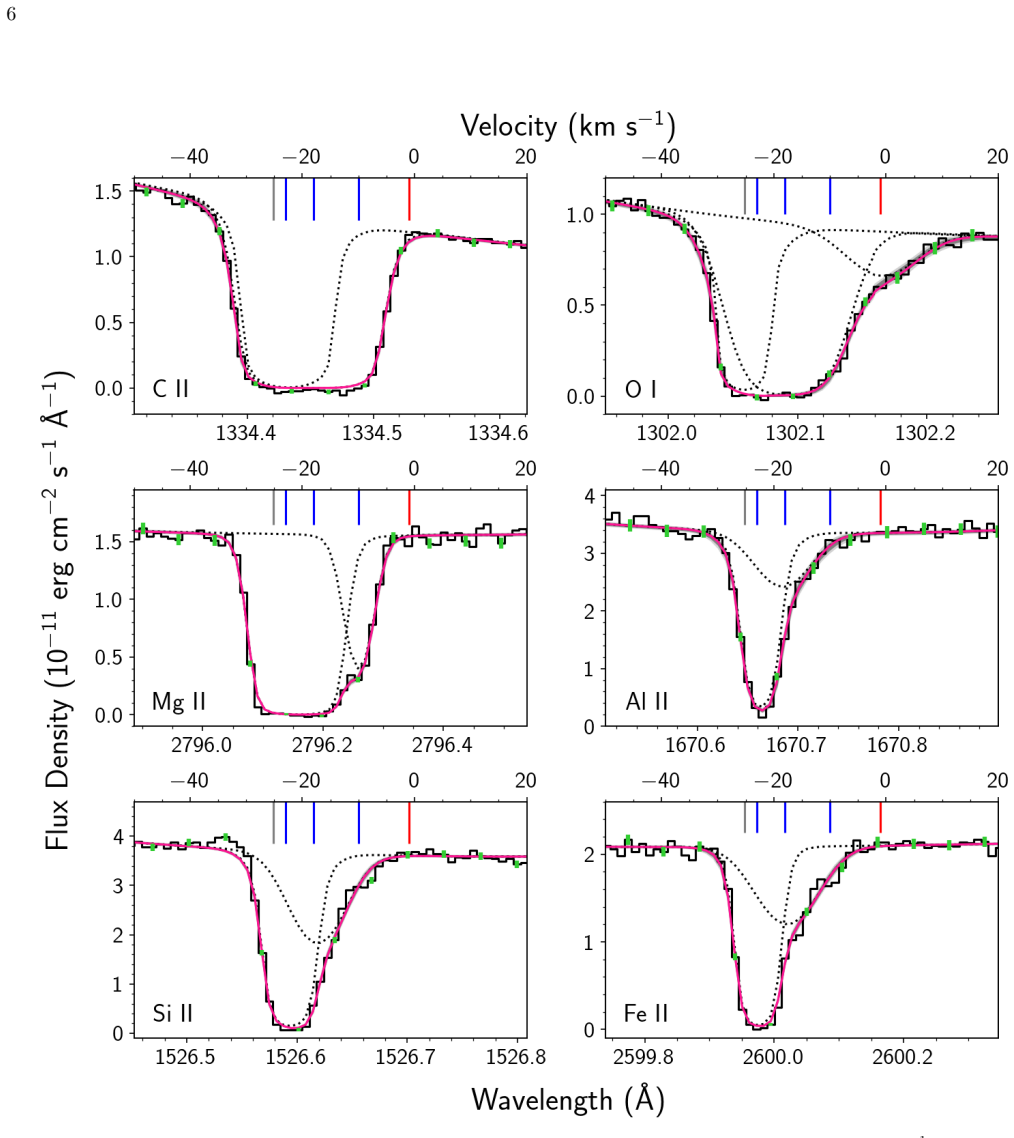
The fourth absorption component near -1 km s^{-1}, detected only in O I, is inconsistent with an interstellar origin and is likely circumstellar. A 3-sigma upper limit on its C/O ratio is log C/O < -2.1, consistent with Earth and solar system comet abundances but inconsistent with the carbon-rich disks of beta Pic and 49 Cet, probably due to greater radiation pressure on carbon from the warmer A0V star eta Tel. This low ratio is also inconsistent with the Herschel [CII] detection and may indicate that the carbon gas is misaligned from the line of sight or variable in time.
What carries the argument
Velocity-resolved ultraviolet absorption spectroscopy of atomic lines, particularly O I, used to separate interstellar and circumstellar gas components along the line of sight through the edge-on debris disk.
Load-bearing premise
The -1 km/s velocity component does not match any interstellar cloud along the line of sight to eta Tel.
What would settle it
Higher-resolution spectra that either detect or rule out absorption lines from carbon or other species at exactly -1 km/s, or spatially resolved observations that map whether the gas is extended like the disk.
Figures
read the original abstract
We revisit the ultraviolet absorption spectroscopy of the edge-on debris disk surrounding the A0V star $\eta$ Telescopii. Previous work found absorption components at four velocities ($\sim$ -23, -18, -10, -1 km s$^{-1}$), with the most blueshifted component (-23 km s$^{-1}$) interpreted as a likely disk wind. However, optical spectroscopy of $\eta$ Tel and other nearby stars in projection demonstrate that the -23 km s$^{-1}$ component is likely interstellar in origin. We find that there are three interstellar components toward this sight line (-23, -18, -10 km s$^{-1}$), but that the fourth component near -1 km s$^{-1}$, which was only detected in O I, is inconsistent with an interstellar origin and could be circumstellar. We place a 3-$\sigma$ upper limit on the C/O ratio of the -1 km s$^{-1}$ gas (log C/O $<$ -2.1), finding that it is consistent with Earth and solar system comet abundances. However, the abundance is inconsistent with the carbon-rich disks of $\beta$ Pic (A5V) and 49 Cet (A1V), probably because $\eta$ Tel (A0V) is a warmer star imposing greater levels of radiation pressure on carbon atoms in the disk. A low C/O ratio is also inconsistent with Herschel's [CII] detection toward $\eta$ Tel and may indicate that carbon gas is misaligned from the line of sight or variable in time.
Editorial analysis
A structured set of objections, weighed in public.
Referee Report
Summary. The paper reanalyzes ultraviolet absorption spectra toward the edge-on debris disk of the A0V star η Telescopii. It identifies three absorption components at approximately -23, -18, and -10 km s^{-1} as interstellar on the basis of velocity coincidence with optical spectroscopy of η Tel and nearby stars, while arguing that the fourth component at -1 km s^{-1} (detected only in O I) is inconsistent with an interstellar origin and is therefore likely circumstellar. From the non-detection of carbon lines in this component the authors derive a 3-σ upper limit log C/O < -2.1, which they compare to solar-system comet and Earth abundances and to the carbon-rich disks of β Pic and 49 Cet, attributing the difference to stronger radiation pressure on carbon from the warmer η Tel star. They also note tension with the Herschel [C II] detection.
Significance. If the velocity-scale alignment between the UV and optical datasets is secure to ≲1 km s^{-1}, the result supplies a rare C/O constraint for gas in an A0V debris disk and illustrates how stellar effective temperature can modulate carbon retention via radiation pressure. The non-detection-based upper limit and the explicit comparison to both solar-system and other-disk compositions constitute a concrete, falsifiable datum that can be tested with future UV or sub-mm observations.
major comments (2)
- [§3.2] §3.2 (velocity comparison): The assignment of the -1 km s^{-1} O I feature as circumstellar rests on its velocity offset from the three interstellar components identified in optical data. No quantitative assessment of the relative wavelength zero-point uncertainty between the UV (HST) and optical spectra is provided; a systematic offset of only ~1 km s^{-1} would allow the feature to be a weak, previously undetected interstellar cloud. A direct cross-calibration or Monte-Carlo velocity-shift test is required before the circumstellar interpretation can be considered secure.
- [§4.3] §4.3 (C/O limit): The 3-σ upper limit log C/O < -2.1 is derived from non-detection of C I and C II lines. The manuscript does not tabulate the specific transitions used, the adopted oscillator strengths, the continuum-placement uncertainty, or the full error budget that converts the non-detection into the quoted limit. These details are load-bearing for the abundance claim and must be supplied.
minor comments (2)
- [Figure 1] Figure 1: The velocity axis labels should explicitly state the reference frame (heliocentric or LSR) and include a note on the adopted zero-point uncertainty.
- Throughout the text, velocity values are sometimes given to 0 km s^{-1} precision and sometimes to 1 km s^{-1}; adopt a uniform reporting convention.
Simulated Author's Rebuttal
We thank the referee for their thorough review and helpful suggestions, which have improved the clarity and robustness of our analysis. We address each major comment below and have revised the manuscript to incorporate the requested details and tests.
read point-by-point responses
-
Referee: [§3.2] §3.2 (velocity comparison): The assignment of the -1 km s^{-1} O I feature as circumstellar rests on its velocity offset from the three interstellar components identified in optical data. No quantitative assessment of the relative wavelength zero-point uncertainty between the UV (HST) and optical spectra is provided; a systematic offset of only ~1 km s^{-1} would allow the feature to be a weak, previously undetected interstellar cloud. A direct cross-calibration or Monte-Carlo velocity-shift test is required before the circumstellar interpretation can be considered secure.
Authors: We agree that a quantitative assessment of the relative wavelength zero-point uncertainty is necessary to secure the circumstellar interpretation. In the revised manuscript we have added a dedicated paragraph in §3.2 that performs a direct cross-calibration using the three interstellar components detected in both the HST UV and optical spectra. This yields a relative zero-point uncertainty of ≲0.4 km s^{-1}. We have also included the results of a Monte-Carlo velocity-shift test in which the UV spectrum is shifted by ±1 km s^{-1} in 0.1 km s^{-1} increments; in all cases the -1 km s^{-1} O I feature remains statistically distinct from the nearest interstellar component at -10 km s^{-1}. These additions confirm that the feature cannot be reassigned as interstellar within the stated uncertainties. revision: yes
-
Referee: [§4.3] §4.3 (C/O limit): The 3-σ upper limit log C/O < -2.1 is derived from non-detection of C I and C II lines. The manuscript does not tabulate the specific transitions used, the adopted oscillator strengths, the continuum-placement uncertainty, or the full error budget that converts the non-detection into the quoted limit. These details are load-bearing for the abundance claim and must be supplied.
Authors: We thank the referee for highlighting this omission. The revised manuscript now includes a new table (Table 3) that lists every C I and C II transition examined, the adopted oscillator strengths (with references), the 3-σ equivalent-width upper limits, and the continuum-placement uncertainties derived from the local rms. Section 4.3 has been expanded with a complete error budget that propagates photon noise, continuum-fitting errors, and oscillator-strength uncertainties into the final log C/O < -2.1 limit. The derivation is now fully reproducible from the tabulated values. revision: yes
Circularity Check
No circularity: claims rest on direct observational velocity comparisons to external optical data and non-detection upper limits
full rationale
The paper identifies three interstellar velocity components (-23, -18, -10 km s^{-1}) by matching UV absorption features to independent optical spectroscopy of η Tel and projected nearby stars. The -1 km s^{-1} O I component is classified as potentially circumstellar solely because it lacks counterparts in those external optical tracers and appears only in O I. The log C/O < -2.1 upper limit follows from a 3-σ non-detection of carbon lines at that velocity, without any fitted parameter that is then renamed as a prediction. No self-citations, ansatzes, or uniqueness theorems are invoked to close the argument; the chain is anchored in raw spectral data and external benchmarks.
Axiom & Free-Parameter Ledger
axioms (1)
- domain assumption Velocity components observed in UV absorption can be classified as interstellar when they match velocities seen in optical spectra of the target and nearby stars.
Reference graph
Works this paper leans on
-
[1]
All \`e gre , C., Manh \`e s , G., & Lewin , \'E . 2001, title Chemical composition of the Earth and the volatility control on planetary genetics , Earth and Planetary Science Letters, 185, 49, 10.1016/S0012-821X(00)00359-9
-
[2]
E., & Paresce , F
Backman , D. E., & Paresce , F. 1993, title Main-Sequence Stars with Circumstellar Solid Material - the VEGA Phenomenon , in Protostars and Planets III, ed. E. H. Levy & J. I. Lunine , 1253
1993
-
[3]
Beust , H., Vidal-Madjar , A., Ferlet , R., & Lagrange-Henri , A. M. 1990, title The Beta Pictoris circumstellar disk. X - Numerical simulations of infalling evaporating bodies , , 236, 202. http://adsabs.harvard.edu/cgi-bin/nph-bib_query?bibcode=1990A
1990
-
[4]
Brandeker , A., Cataldi , G., Olofsson , G., et al. 2016, title Herschel detects oxygen in the Pictoris debris disk , , 591, A27, 10.1051/0004-6361/201628395
-
[5]
Chai , Y., Chen , C. H., Worthen , K., et al. 2024, title A JWST MIRI MRS View of the Tel Debris Disk and Its Brown Dwarf Companion , , 976, 167, 10.3847/1538-4357/ad74f4
-
[6]
Chen , C. H., Sargent , B. A., Bohac , C., et al. 2006, title Spitzer IRS Spectroscopy of IRAS-discovered Debris Disks , , 166, 351, 10.1086/505751
-
[7]
2007, title Collisional Vaporization of Dust and Production of Gas in the Pictoris Dust Disk , , 660, 1541
Czechowski , A., & Mann , I. 2007, title Collisional Vaporization of Dust and Production of Gas in the Pictoris Dust Disk , , 660, 1541
2007
-
[8]
Dent , W. R. F., Thi , W. F., Kamp , I., et al. 2013, title GASPS A Herschel Survey of Gas and Dust in Protoplanetary Disks: Summary and Initial Statistics , , 125, 477, 10.1086/670826
-
[9]
2006, title Braking the Gas in the Pictoris Disk , , 643, 509
Fernandez , R., Brandeker , A., & Wu , Y. 2006, title Braking the Gas in the Pictoris Disk , , 643, 509
2006
-
[10]
and Lang, Dustin and Goodman, Jonathan , title =
Foreman-Mackey , D., Hogg , D. W., Lang , D., & Goodman , J. 2013, title emcee: The MCMC Hammer , , 125, 306, 10.1086/670067
-
[11]
Gaia Collaboration , Vallenari , A., Brown , A. G. A., et al. 2023, title Gaia Data Release 3. Summary of the content and survey properties , , 674, A1, 10.1051/0004-6361/202243940
-
[12]
Goldsmith , P. F., Langer , W. D., Pineda , J. L., & Velusamy , T. 2012, title Collisional Excitation of the [C II] Fine Structure Transition in Interstellar Clouds , , 203, 13, 10.1088/0067-0049/203/1/13
-
[13]
2007, title Survival of icy grains in debris discs
Grigorieva , A., Th \'e bault , P., Artymowicz , P., & Brandeker , A. 2007, title Survival of icy grains in debris discs. The role of photosputtering , , 475, 755, 10.1051/0004-6361:20077686
-
[14]
Hollenbach , D., & McKee , C. F. 1989, title Molecule Formation and Infrared Emission in Fast Interstellar Shocks. III. Results for J Shocks in Molecular Clouds , , 342, 306, 10.1086/167595
-
[15]
Hunter, J. D. 2007, title Matplotlib: A 2D Graphics Environment , Computing in Science & Engineering, 9, 90, 10.1109/MCSE.2007.55
-
[16]
P., Pani \'c , O., & Rebollido , I
Iglesias , D. P., Pani \'c , O., & Rebollido , I. 2023, title Gas absorption towards the Tel debris disc: winds or clouds? , , 526, 2500, 10.1093/mnras/stad2836
-
[17]
K \'o sp \'a l , \'A ., Mo \'o r , A., Juh \'a sz , A., et al. 2013, title ALMA Observations of the Molecular Gas in the Debris Disk of the 30 Myr Old Star HD 21997 , , 776, 77, 10.1088/0004-637X/776/2/77
-
[18]
Lehtmets , A., Kama , M., Fossati , L., & Aret , A. 2026, title Investigating Circumstellar Atomic Radiation-Driven Dynamics , Astronomische Nachrichten, 347, e70071, 10.1002/asna.70071
-
[19]
Linsky , J., Redfield , S., Ryder , D., & Moebius , E. 2022, title Inhomogeneity in the Local ISM and Its Relation to the Heliosphere , , 218, 16, 10.1007/s11214-022-00884-5
-
[20]
2003, The Astrophysical Journal, 591, 1220, doi: 10.1086/375492
Lodders, K. 2003, title Solar System Abundances and Condensation Temperatures of the Elements , The Astrophysical Journal, 591, 1220, 10.1086/375492
-
[21]
Mamajek , E. E., & Bell , C. P. M. 2014, title On the age of the Pictoris moving group , , 445, 2169, 10.1093/mnras/stu1894
-
[22]
Mannings , V., & Barlow , M. J. 1998, title Candidate Main-Sequence Stars with Debris Disks: A New Sample of Vega-like Sources , , 497, 330, 10.1086/305432
-
[23]
2016, title Exocometary gas in the HD 181327 debris ring , , 460, 2933, 10.1093/mnras/stw1216
Marino , S., Matr \`a , L., Stark , C., et al. 2016, title Exocometary gas in the HD 181327 debris ring , , 460, 2933, 10.1093/mnras/stw1216
-
[24]
Miles, B. E., Roberge, A., & Welsh, B. 2016, title UV SPECTROSCOPY OF STAR-GRAZING COMETS WITHIN THE 49 CETI DEBRIS DISK , The Astrophysical Journal, 824, 126, 10.3847/0004-637X/824/2/126
-
[25]
Mo \'o r , A., Cur \'e , M., K \'o sp \'a l , \'A ., et al. 2017, title Molecular Gas in Debris Disks around Young A-type Stars , , 849, 123, 10.3847/1538-4357/aa8e4e
-
[26]
Morton, D. C. 2003, title Atomic Data for Resonance Absorption Lines. III. Wavelengths Longward of the Lyman Limit for the Elements Hydrogen to Gallium , The Astrophysical Journal Supplement Series, 149, 205, 10.1086/377639
-
[27]
H., Lazzoni , C., Zurlo , A., et al
Nogueira , P. H., Lazzoni , C., Zurlo , A., et al. 2024, title Astrometric and photometric characterization of Tel B combining two decades of observations , , 687, A301, 10.1051/0004-6361/202449222
-
[28]
Perez, F., & Granger, B. E. 2007, title IPython: A System for Interactive Scientific Computing , Computing in Science & Engineering, 9, 21, 10.1109/MCSE.2007.53
-
[29]
2018, title The co-existence of hot and cold gas in debris discs , , 614, A3
Rebollido , I., Eiroa , C., Montesinos , B., et al. 2018, title The co-existence of hot and cold gas in debris discs , , 614, A3
2018
-
[30]
2020, title Exocomets: A spectroscopic survey , arXiv e-prints, arXiv:2003.11084
Rebollido , I., Eiroa , C., Montesinos , B., et al. 2020, title Exocomets: A spectroscopic survey , arXiv e-prints, arXiv:2003.11084
-
[31]
Redfield , S., & Falcon , R. E. 2008, title The Structure of the Local Interstellar Medium. V. Electron Densities , , 683, 207, 10.1086/589230
-
[32]
Redfield , S., & Linsky , J. L. 2004, title The Structure of the Local Interstellar Medium. II. Observations of D I, C II, N I, O I, Al II, and Si II toward Stars within 100 Parsecs , , 602, 776, 10.1086/381083
-
[33]
Redfield, S., & Linsky, J. L. 2008, title The Structure of the Local Interstellar Medium. IV. Dynamics, Morphology, Physical Properties, and Implications of Cloud‐Cloud Interactions , The Astrophysical Journal, 673, 283, 10.1086/524002
-
[34]
Riviere-Marichalar , P., Barrado , D., Montesinos , B., et al. 2014, title Gas and dust in the beta Pictoris moving group as seen by the Herschel Space Observatory , , 565, A68, 10.1051/0004-6361/201322901
-
[35]
Roberge, A., Feldman, P. D., Weinberger, A. J., Deleuil, M., & Bouret, J.-C. 2006, title The Carbon-Rich Gas in the Beta Pictoris Circumstellar Disk , Nature, 441, 724, 10.1038/nature04832
-
[36]
Roberge, A., Welsh, B. Y., Kamp, I., Weinberger, A. J., & Grady, C. A. 2014, title VOLATILE-RICH CIRCUMSTELLAR GAS IN THE UNUSUAL 49 CETI DEBRIS DISK , The Astrophysical Journal, 796, L11, 10.1088/2041-8205/796/1/L11
-
[37]
Robitaille, T. P., Tollerud, E. J., Greenfield, P., et al. 2013, title Astropy: A community Python package for astronomy , Astronomy & Astrophysics, 558, A33, 10.1051/0004-6361/201322068
-
[38]
Sahu , S., G \"a nsicke , B. T., Williams , J. T., et al. 2025, title Discovery of an icy and nitrogen-rich extrasolar planetesimal , arXiv e-prints, arXiv:2509.13422, 10.48550/arXiv.2509.13422
-
[39]
Schneider , G., Silverstone , M. D., Hines , D. C., et al. 2006, title Discovery of an 86 AU Radius Debris Ring around HD 181327 , , 650, 414, 10.1086/506507
-
[40]
Seligman , D. Z., Rogers , L. A., Cabot , S. H. C., et al. 2022, title The Volatile Carbon-to-oxygen Ratio as a Tracer for the Formation Locations of Interstellar Comets , , 3, 150, 10.3847/PSJ/ac75b5
-
[41]
Smith , R., Churcher , L. J., Wyatt , M. C., Moerchen , M. M., & Telesco , C. M. 2009, title Resolved debris disc emission around Telescopii: a young solar system or ongoing planet formation? , , 493, 299, 10.1051/0004-6361:200810706
-
[42]
Tielens , A. G. G. M., & Hollenbach , D. 1985, title Photodissociation regions. I. Basic model. , , 291, 722, 10.1086/163111
-
[43]
van der Walt, S., Colbert, S. C., & Varoquaux, G. 2011, title The NumPy Array: A Structure for Efficient Numerical Computation , Computing in Science & Engineering, 13, 22, 10.1109/MCSE.2011.37
-
[44]
Wilson , D. J., G \"a nsicke , B. T., Farihi , J., & Koester , D. 2016, title Carbon to oxygen ratios in extrasolar planetesimals , , 459, 3282, 10.1093/mnras/stw844
-
[45]
Youngblood , A., Roberge , A., MacGregor , M. A., et al. 2021, title A Radiatively Driven Wind from the Tel Debris Disk , , 162, 235, 10.3847/1538-3881/ac21d1
-
[46]
Youngblood , A., France , K., Loyd , R. O. P., et al. 2016, title The MUSCLES Treasury Survey. II. Intrinsic LY and Extreme Ultraviolet Spectra of K and M Dwarfs with Exoplanets* , , 824, 101, 10.3847/0004-637X/824/2/101
-
[47]
2012, title A 40-Myr Old Gaseous Circumstellar Disk at 49 Ceti: Massive CO-rich Comet Clouds at Young A-type Stars , , 758, 77
Zuckerman , B., & Song , I. 2012, title A 40-Myr Old Gaseous Circumstellar Disk at 49 Ceti: Massive CO-rich Comet Clouds at Young A-type Stars , , 758, 77
2012
-
[48]
Zuckerman , B., Song , I., Bessell , M. S., & Webb , R. A. 2001, title The Pictoris Moving Group , , 562, L87, 10.1086/337968
discussion (0)
Sign in with ORCID, Apple, or X to comment. Anyone can read and Pith papers without signing in.