Recognition: 2 theorem links
· Lean Theoremαβ q_th-mapping of planet-induced density wave damping in protoplanetary discs
Pith reviewed 2026-05-14 20:22 UTC · model grok-4.3
The pith
Nonlinear shocks usually dominate damping of planet-launched density waves, but cooling on orbital timescales rivals them for sub-thermal planets while viscosity needs high values to matter.
A machine-rendered reading of the paper's core claim, the machinery that carries it, and where it could break.
Core claim
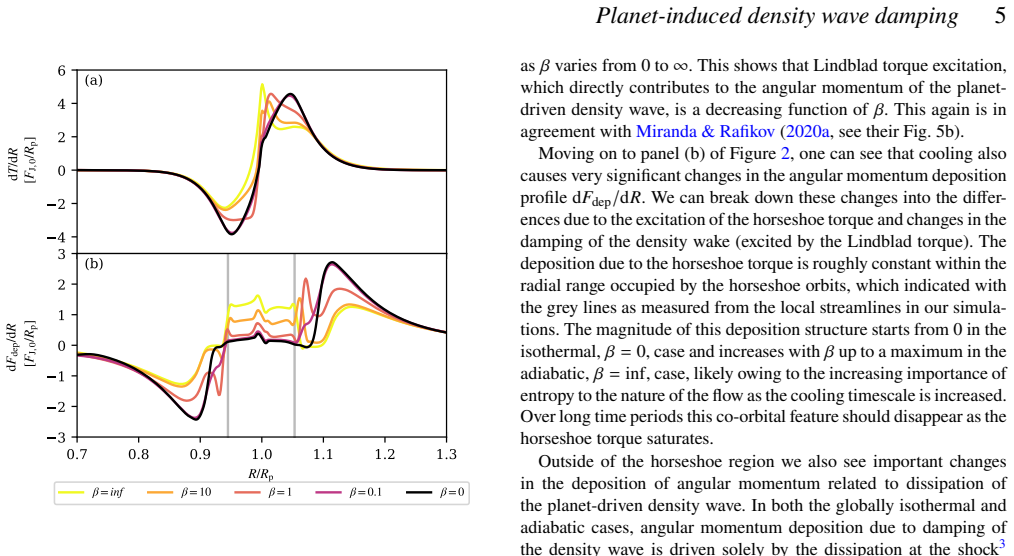
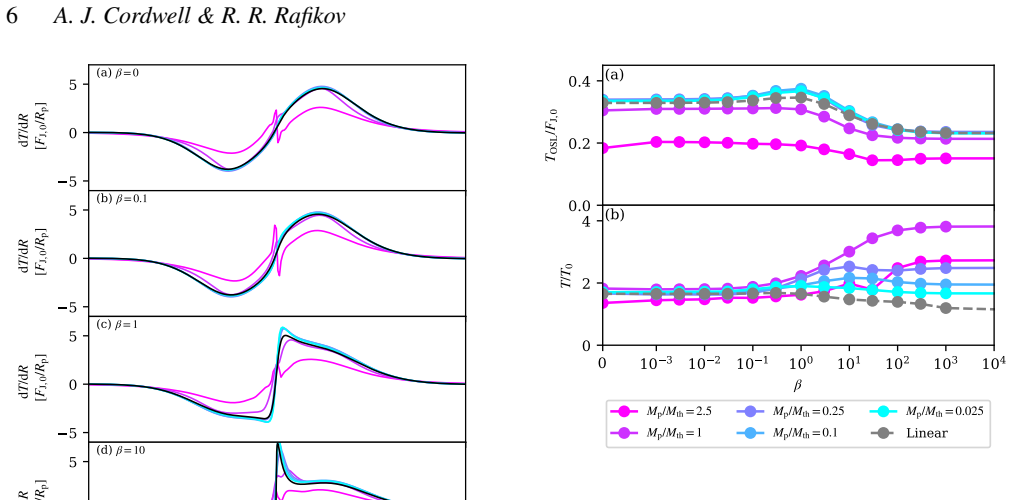
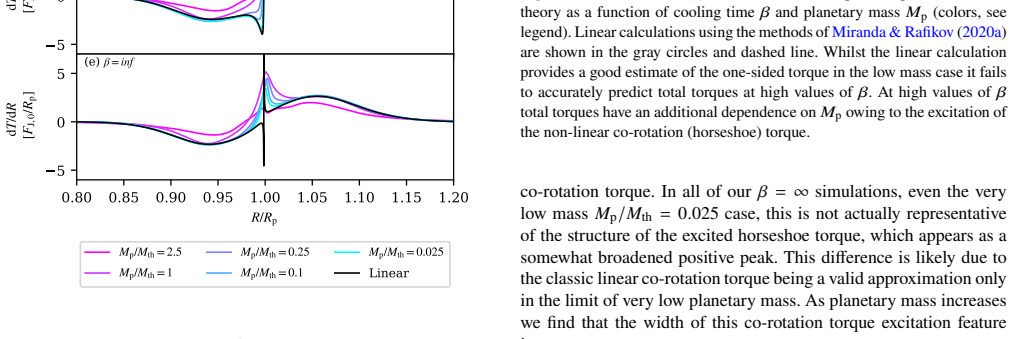
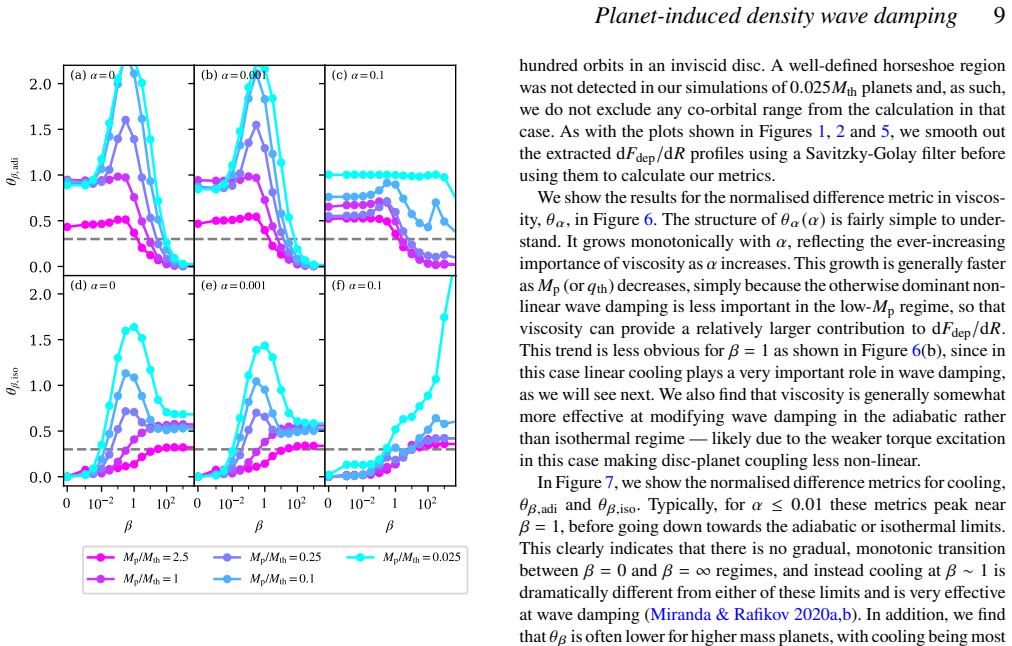
Nonlinear wave evolution leading to shock formation is typically the most important cause of angular momentum deposition, but that cooling on timescales comparable to local orbital time reaches similar levels of importance for low mass planets (sub-thermal, q_th<1). On the contrary, linear wave damping due to viscosity is rather inefficient, requiring α ≳ 10^{-1.5} to noticeably affect damping of waves launched by thermal mass planets. Even for lowest mass planets considered (q_th=0.025), viscosity affects wave damping only if α ≳ 10^{-2.9}.
What carries the argument
The joint mapping of wave angular momentum deposition profiles across the α-β-q_th parameter space extracted from hydrodynamic simulations that vary planetary mass, viscosity coefficient, and cooling timescale.
If this is right
- Cooling becomes a first-order effect for sub-thermal planets and must be included when modeling their gap-opening ability.
- Viscosity can be neglected in wave-damping calculations unless its value exceeds roughly 10^{-2} even for the smallest planets.
- Observed disc gaps around low-mass planets may reflect a mixture of shock and cooling damping rather than shocks alone.
- The same damping hierarchy should apply to waves in other thin astrophysical discs where similar parameters can be defined.
Where Pith is reading between the lines
- Discs with moderate cooling rates may show shallower or narrower gaps around low-mass planets than pure shock models predict.
- Including magnetic fields in future runs could shift the relative importance of cooling versus shocks if they enhance effective viscosity or alter wave propagation.
- The αβq_th maps offer a route to constrain local disc cooling times from the detailed shape of observed gaps once planet masses are known.
Load-bearing premise
The hydrodynamic simulations capture all relevant damping physics without missing contributions from magnetic fields, realistic radiative transfer, or three-dimensional effects.
What would settle it
A mismatch between predicted radial profiles of angular momentum deposition and those inferred from observed gap depths in a disc with independently estimated planet mass, cooling time, and viscosity would falsify the claimed dominance ordering of the three mechanisms.
Figures





read the original abstract
Planets embedded in protoplanetary discs are capable of creating a wide variety of substructures through gravitational interactions. This process is mediated through the excitation and damping of density waves which carry angular momentum across the disc. Therefore, to interpret observations of substructures, it is critical to understand the physical processes which lead to deposition of wave angular momentum to the disc fluid. In this study, we explore the relative efficiency of viscosity ($\alpha$), cooling ($\beta$), and non-linear wave evolution ($q_\mathrm{th}$) in damping planet-generated density waves. We run a large suite of hydrodynamic simulations varying viscosity, cooling timescale, and planetary mass, from which we extract radial profiles of wave angular momentum deposition. We quantify the efficiency of different wave damping mechanisms as a joint function of planetary mass, viscosity and cooling time. We find that nonlinear wave evolution leading to shock formation is typically the most important cause of angular momentum deposition, but that cooling on timescales comparable to local orbital time reaches similar levels of importance for low mass planets (sub-thermal, $q_\mathrm{th}<1$). On the contrary, linear wave damping due to viscosity is rather inefficient, requiring $\alpha \gtrsim 10^{-1.5}$ to noticeably affect damping of waves launched by thermal mass planets. Even for lowest mass planets considered ($q_\mathrm{th}=0.025$), viscosity affects wave damping only if $\alpha \gtrsim 10^{-2.9}$. Our findings could be applied to interpret observations of protoplanetary discs; they are also important for understanding wave propagation in other types of astrophysical discs.
Editorial analysis
A structured set of objections, weighed in public.
Referee Report
Summary. The manuscript investigates the relative efficiencies of viscosity (α), cooling (β), and nonlinear wave evolution (q_th) in damping planet-induced density waves in protoplanetary discs. Through a suite of 2D hydrodynamic simulations, radial profiles of angular momentum deposition are extracted and used to quantify the contributions of each mechanism as a function of planetary mass, viscosity, and cooling timescale. The central finding is that nonlinear shock formation is typically the dominant damping process, with cooling on orbital timescales becoming comparably important for sub-thermal planets (q_th < 1), while viscous damping is inefficient unless α is relatively high (≳ 10^{-1.5} for thermal mass planets).
Significance. If the numerical results are robust, this work offers a valuable parameter mapping for understanding wave damping mechanisms, which has implications for interpreting disc observations and modeling wave propagation in various astrophysical contexts. The direct simulation approach provides concrete thresholds for when each mechanism dominates.
major comments (3)
- [Methods] Methods section: The procedure for extracting and partitioning the angular momentum deposition profiles into contributions from viscosity, cooling, and nonlinear evolution is not sufficiently detailed. This partitioning is essential for the quantified relative efficiencies and the claims about their importance.
- [Results] Results section: No error bars, uncertainty quantification, or convergence tests (e.g., with grid resolution) are provided for the deposition profiles or efficiency metrics. Given that shock formation is sensitive to numerical effects, this weakens the reliability of the reported thresholds such as α ≳ 10^{-1.5}.
- [Discussion] Discussion: The central claim that nonlinear evolution is 'typically the most important' rests on the assumption that the 2D β-cooling hydrodynamics captures the dominant physics. The potential effects of 3D structure and magnetic fields on the relative damping efficiencies are not explored or bounded, which could alter the conclusions for sub-thermal planets.
minor comments (2)
- [Abstract] Abstract: The symbol q_th is used without a brief definition or reference to its meaning as the thermal mass parameter.
- [Figures] Figures: Several figures showing radial profiles would benefit from explicit labels indicating which mechanism dominates in different regions to aid reader interpretation.
Simulated Author's Rebuttal
We thank the referee for their constructive and detailed review of our manuscript. We have addressed each of the major comments by expanding the Methods and Results sections and adding discussion of limitations. Point-by-point responses follow.
read point-by-point responses
-
Referee: [Methods] Methods section: The procedure for extracting and partitioning the angular momentum deposition profiles into contributions from viscosity, cooling, and nonlinear evolution is not sufficiently detailed. This partitioning is essential for the quantified relative efficiencies and the claims about their importance.
Authors: We agree that the partitioning procedure requires more detail for reproducibility. In the revised manuscript we have expanded the Methods section with a step-by-step description: angular momentum deposition is obtained by integrating the torque exerted on the disc fluid; the viscous contribution is isolated by subtracting runs with α=0; the cooling contribution is isolated by subtracting runs with β→∞; and the nonlinear contribution is the residual after both subtractions. Control simulations and explicit formulae for each term are now provided. revision: yes
-
Referee: [Results] Results section: No error bars, uncertainty quantification, or convergence tests (e.g., with grid resolution) are provided for the deposition profiles or efficiency metrics. Given that shock formation is sensitive to numerical effects, this weakens the reliability of the reported thresholds such as α ≳ 10^{-1.5}.
Authors: We acknowledge the absence of formal uncertainty quantification. We have added a new subsection to the Results section reporting resolution convergence tests performed at 1.5× and 2× the fiducial grid resolution for a representative subset of models spanning the q_th–α–β parameter space. The deposition profiles and derived thresholds (including α ≳ 10^{-1.5}) agree to within ~8 % across resolutions; we now quote this level of variation as approximate uncertainty and include error bands on the efficiency curves. revision: yes
-
Referee: [Discussion] Discussion: The central claim that nonlinear evolution is 'typically the most important' rests on the assumption that the 2D β-cooling hydrodynamics captures the dominant physics. The potential effects of 3D structure and magnetic fields on the relative damping efficiencies are not explored or bounded, which could alter the conclusions for sub-thermal planets.
Authors: We agree that 3D vertical structure and magnetic fields are not captured and could modify the relative importance of the three mechanisms, especially for sub-thermal planets. The revised Discussion now contains an explicit limitations paragraph that (i) notes the standard use of 2D for wave-propagation studies, (ii) provides order-of-magnitude estimates of how 3D wave focusing and MRI turbulence might alter damping rates, and (iii) states that the reported 2D thresholds should be regarded as a baseline pending future 3D MHD simulations. We do not claim the 2D results are universally definitive. revision: yes
Circularity Check
No circularity: claims derived from direct hydrodynamic simulations
full rationale
The paper's central results on relative efficiencies of viscosity, cooling, and nonlinear shock damping are obtained by running a suite of 2D hydrodynamic simulations across ranges of α, β, and q_th, then extracting and comparing radial angular-momentum deposition profiles. No parameter is fitted to a target outcome and then re-labeled as a prediction; no uniqueness theorem or ansatz is imported via self-citation to force the conclusions; and the reported thresholds (e.g., α ≳ 10^{-1.5} for thermal-mass planets) are direct numerical measurements rather than algebraic identities. The derivation chain is therefore self-contained against external benchmarks and receives the default non-circularity score.
Axiom & Free-Parameter Ledger
axioms (1)
- standard math The disk fluid obeys the standard inviscid or viscous hydrodynamic equations in a rotating frame
Lean theorems connected to this paper
-
IndisputableMonolith/Foundation/RealityFromDistinction.leanreality_from_one_distinction unclear?
unclearRelation between the paper passage and the cited Recognition theorem.
We explore the relative efficiency of viscosity (α), cooling (β), and non-linear wave evolution (q_th) in damping planet-generated density waves... nonlinear wave evolution leading to shock formation is typically the most important cause...
-
IndisputableMonolith/Cost/FunctionalEquation.leanwashburn_uniqueness_aczel unclear?
unclearRelation between the paper passage and the cited Recognition theorem.
We run a large suite of hydrodynamic simulations varying viscosity, cooling timescale, and planetary mass, from which we extract radial profiles of wave angular momentum deposition.
What do these tags mean?
- matches
- The paper's claim is directly supported by a theorem in the formal canon.
- supports
- The theorem supports part of the paper's argument, but the paper may add assumptions or extra steps.
- extends
- The paper goes beyond the formal theorem; the theorem is a base layer rather than the whole result.
- uses
- The paper appears to rely on the theorem as machinery.
- contradicts
- The paper's claim conflicts with a theorem or certificate in the canon.
- unclear
- Pith found a possible connection, but the passage is too broad, indirect, or ambiguous to say the theorem truly supports the claim.
Reference graph
Works this paper leans on
-
[2]
Angular Momentum Transport and Variability in Boundary Layers of Accretion Disks Driven by Global Acoustic Modes. , keywords =. doi:10.1088/0004-637X/760/1/22 , archivePrefix =. 1205.4009 , primaryClass =
work page internal anchor Pith review Pith/arXiv arXiv doi:10.1088/0004-637x/760/1/22
-
[4]
Protostars and Planets VII , year = 2023, editor =
Optical and Near-infrared View of Planet-forming Disks and Protoplanets. Protostars and Planets VII , year = 2023, editor =. doi:10.48550/arXiv.2203.09991 , archivePrefix =. 2203.09991 , primaryClass =
-
[5]
2001, MNRAS, 322, 231, doi: 10.1046/j.1365-8711.2001.04022.x
Non-linear dynamics of the corotation torque. , keywords =. doi:10.1046/j.1365-8711.2001.04619.x , adsurl =
-
[6]
Radiatively Damped Density Waves in Optically Thick Protostellar Disks. , keywords =. doi:10.1086/178107 , adsurl =
-
[7]
On the Horseshoe Drag of a Low-Mass Planet. I. Migration in Isothermal Disks. , keywords =. doi:10.1088/0004-637X/703/1/845 , archivePrefix =. 0907.4677 , primaryClass =
work page internal anchor Pith review Pith/arXiv arXiv doi:10.1088/0004-637x/703/1/845
-
[10]
Boundary layers of accretion discs: Discovery of vortex-driven modes and other waves. , keywords =. doi:10.1093/mnras/stab2962 , archivePrefix =. 2103.12119 , primaryClass =
-
[11]
Boundary layers of accretion discs: wave-driven transport and disc evolution. , keywords =. doi:10.1093/mnras/stac732 , archivePrefix =. 2111.03068 , primaryClass =
-
[12]
Early stages of gap opening by planets in protoplanetary discs. , keywords =. doi:10.1093/mnras/stae2089 , archivePrefix =. 2407.01728 , primaryClass =
-
[13]
The Open Journal of Astrophysics , keywords =
On inertial forces (indirect terms) in problems with a central body. The Open Journal of Astrophysics , keywords =. doi:10.33232/001c.141682 , archivePrefix =. 2506.23331 , primaryClass =
-
[14]
Vortex generation in protoplanetary disks with an embedded giant planet
Vortex generation in protoplanetary disks with an embedded giant planet. , keywords =. doi:10.1051/0004-6361:20077169 , archivePrefix =. 0706.3200 , primaryClass =
work page internal anchor Pith review Pith/arXiv arXiv doi:10.1051/0004-6361:20077169
-
[15]
The Effects of Cooling on Boundary Layer Accretion. , keywords =. doi:10.3847/1538-4357/ad6d6b , archivePrefix =. 2405.20367 , primaryClass =
-
[18]
Spiral Density Waves and Torque Balance in the Kerr Geometry. arXiv e-prints , keywords =. doi:10.48550/arXiv.2601.19123 , archivePrefix =. 2601.19123 , primaryClass =
-
[20]
Eccentric planet-disc interactions: orbital migration and eccentricity evolution. , keywords =. doi:10.1093/mnras/staf117 , archivePrefix =. 2407.20398 , primaryClass =
-
[21]
Weak Turbulence in the HD 163296 Protoplanetary Disk Revealed by ALMA CO Observations
Weak Turbulence in the HD 163296 Protoplanetary Disk Revealed by ALMA CO Observations. , keywords =. doi:10.1088/0004-637X/813/2/99 , archivePrefix =. 1510.01375 , primaryClass =
work page internal anchor Pith review Pith/arXiv arXiv doi:10.1088/0004-637x/813/2/99
-
[22]
A Three-dimensional View of Turbulence: Constraints on Turbulent Motions in the HD 163296 Protoplanetary Disk Using DCO ^ +. , keywords =. doi:10.3847/1538-4357/aa79f9 , archivePrefix =. 1706.04504 , primaryClass =
work page internal anchor Pith review Pith/arXiv arXiv doi:10.3847/1538-4357/aa79f9
-
[23]
Inferring Planet Mass from Spiral Structures in Protoplanetary Disks
Inferring Planet Mass from Spiral Structures in Protoplanetary Disks. , keywords =. doi:10.1088/2041-8205/815/2/L21 , archivePrefix =. 1511.01178 , primaryClass =
work page internal anchor Pith review Pith/arXiv arXiv doi:10.1088/2041-8205/815/2/l21 2041
-
[28]
The role of dissipation in shepherding of ring particles. , keywords =. doi:10.1016/0019-1035(83)90142-2 , adsurl =
-
[29]
Global MHD Simulations of Accretion Disks in Cataclysmic Variables. I. The Importance of Spiral Shocks. , keywords =. doi:10.3847/0004-637X/823/2/81 , archivePrefix =. 1604.00715 , primaryClass =
work page internal anchor Pith review Pith/arXiv arXiv doi:10.3847/0004-637x/823/2/81
-
[30]
Exploring the formation of multiple dust-trapping rings in the inner Solar System. , keywords =. doi:10.1051/0004-6361/202555284 , archivePrefix =. 2508.02410 , primaryClass =
-
[31]
Type I Planet Migration in Nearly Laminar Disks
Type I Planet Migration in Nearly Laminar Disks. , keywords =. doi:10.1088/0004-637X/690/1/L52 , archivePrefix =. 0812.0586 , primaryClass =
work page internal anchor Pith review Pith/arXiv arXiv doi:10.1088/0004-637x/690/1/l52
-
[33]
On the Tidal Interaction between Protoplanets and the Primordial Solar Nebula. II. Self-Consistent Nonlinear Interaction. , keywords =. doi:10.1086/164426 , adsurl =
-
[34]
On the Tidal Interaction between Protoplanets and the Protoplanetary Disk. III. Orbital Migration of Protoplanets. , keywords =. doi:10.1086/164653 , adsurl =
-
[36]
, volume = 875, number = 1, pages = 37, doi =
-
[38]
, volume = 892, number = 1, pages = 65, doi =
-
[41]
I - Linear calculation of the role of angular momentum exchange
On the tidal interaction between protoplanets and the primordial solar nebula. I - Linear calculation of the role of angular momentum exchange. , keywords =. doi:10.1086/162561 , adsurl =
-
[46]
Indirect forces in disc-planet interaction
Indirect forces in disc─planet interaction. , keywords =. doi:10.1093/mnras/stag344 , archivePrefix =. 2511.10745 , primaryClass =
work page internal anchor Pith review Pith/arXiv arXiv doi:10.1093/mnras/stag344
-
[47]
Observational appearance
Black holes in binary systems. Observational appearance. , year = 1973, month = jan, volume =
1973
-
[49]
Spiral-wave-driven accretion in quiescent dwarf nov. , keywords =. doi:10.1051/0004-6361/202346090 , archivePrefix =. 2304.13773 , primaryClass =
-
[54]
Astronomy & Astrophysics , author =
Particle dynamics in discs with turbulence generated by the vertical shear instability , volume =. Astronomy & Astrophysics , author =. 2016 , pages =. doi:10.1051/0004-6361/201527716 , urldate =
-
[55]
Magnetic shear-flow instability in thin accretion discs , volume =. Monthly Notices of the Royal Astronomical Society , author =. 1999 , pages =. doi:10.1046/j.1365-8711.1999.02577.x , language =
-
[56]
Astronomy & Astrophysics , author =
Magnetic shear-driven instability and turbulent mixing in magnetized protostellar disks , volume =. Astronomy & Astrophysics , author =. 2008 , pages =. doi:10.1051/0004-6361:20077562 , number =
-
[57]
The Astrophysical Journal , author =. 2013 , pages =. doi:10.1088/0004-637X/769/1/76 , number =
-
[58]
The Astrophysical Journal , author =
Wind-driven. The Astrophysical Journal , author =. 2013 , note =. doi:10.1088/0004-637X/772/2/96 , abstract =
-
[59]
Monthly Notices of the Royal Astronomical Society , author =
Protoplanetary disc ‘isochrones’ and the evolution of discs in the. Monthly Notices of the Royal Astronomical Society , author =. 2017 , pages =. doi:10.1093/mnras/stx2273 , language =
-
[60]
The evolution of viscous discs and the origin of the nebular variables. , volume =. Monthly Notices of the Royal Astronomical Society , author =. 1974 , note =. doi:10.1093/mnras/168.3.603 , abstract =
-
[61]
Qiao, Lin and Coleman, Gavin A. L. and Haworth, Thomas J. , month = mar, year =. Planet formation via pebble accretion in externally photoevaporating discs , url =
-
[62]
Astronomy & Astrophysics , author =
A spectacular jet from the bright 244-440. Astronomy & Astrophysics , author =. 2023 , note =. doi:10.1051/0004-6361/202245428 , abstract =
-
[63]
The Astrophysical Journal , author =
Protoplanetary. The Astrophysical Journal , author =. 2017 , pages =. doi:10.3847/1538-4357/aa6249 , number =
-
[64]
Restrepo, Steven Rendon and Barge, Pierre and Vavrik, Radim , month = mar, year =
-
[65]
Astronomy & Astrophysics , author =
Separating gas-giant and ice-giant planets by halting pebble accretion , volume =. Astronomy & Astrophysics , author =. 2014 , pages =. doi:10.1051/0004-6361/201423814 , urldate =
-
[66]
Monthly Notices of the Royal Astronomical Society , author =
A simple time-dependent method for calculating spirals: applications to eccentric planets in protoplanetary discs , volume =. Monthly Notices of the Royal Astronomical Society , author =. 2022 , pages =. doi:10.1093/mnras/stab3641 , abstract =
-
[67]
Monthly Notices of the Royal Astronomical Society , author =
Density waves in protoplanetary discs excited by eccentric planets: linear theory , volume =. Monthly Notices of the Royal Astronomical Society , author =. 2022 , pages =. doi:10.1093/mnras/stac2802 , abstract =
-
[68]
The Astrophysical Journal , author =
Circumplanetary. The Astrophysical Journal , author =. 2019 , pages =. doi:10.3847/1538-4357/ab53da , number =
-
[69]
The Astrophysical Journal , author =
New. The Astrophysical Journal , author =. 2019 , pages =. doi:10.3847/1538-4357/ab20ce , number =
-
[70]
The Astrophysical Journal , author =
An. The Astrophysical Journal , author =. 2020 , pages =. doi:10.3847/1538-4357/ab5b0f , number =
-
[71]
The Astrophysical Journal , author =
The. The Astrophysical Journal , author =. 2018 , pages =. doi:10.3847/2041-8213/aaf747 , number =
-
[72]
and Fukuhara, S
Komaki, A. and Fukuhara, S. and Suzuki, T. K. and Yoshida, N. , month = apr, year =. Simulations of
-
[73]
Monthly Notices of the Royal Astronomical Society , author =
Deep and wide gaps by super. Monthly Notices of the Royal Astronomical Society , author =. 2018 , pages =. doi:10.1093/mnras/sty1466 , language =
-
[74]
A Simple Analytical Model for Gaps in Protoplanetary Disks
Duffell, Paul C. , year =. A. doi:10.48550/ARXIV.1505.03514 , abstract =
work page internal anchor Pith review Pith/arXiv arXiv doi:10.48550/arxiv.1505.03514
-
[75]
Multiple
Yang, Yi and Liu, Hauyu Baobab and Muto, Takayuki and Hashimoto, Jun and Dong, Ruobing and Kanagawa, Kazuhiro and Momose, Munetake and Akiyama, Eiji and Hasegawa, Yasuhiro and Tsukagoshi, Takashi and Konishi, Mihoko and Tamura, Motohide , month = mar, year =. Multiple
-
[76]
The Astrophysical Journal , author =
What is the. The Astrophysical Journal , author =. 2017 , note =. doi:10.3847/1538-4357/835/2/146 , abstract =
-
[77]
The Astrophysical Journal , author =
Pileups and. The Astrophysical Journal , author =. 2020 , pages =. doi:10.3847/1538-4357/ab723c , number =
-
[78]
The Astrophysical Journal , author =
Multiple. The Astrophysical Journal , author =. 2018 , pages =. doi:10.3847/1538-4357/aadadd , number =
-
[79]
The Astrophysical Journal , author =
The. The Astrophysical Journal , author =. 2018 , note =. doi:10.3847/2041-8213/aaf744 , abstract =
-
[80]
The Astrophysical Journal , author =
Mapping the. The Astrophysical Journal , author =. 2022 , note =. doi:10.3847/2041-8213/ac64a7 , abstract =
-
[81]
On the Horseshoe Drag of a Low-Mass Planet. II. Migration in Adiabatic Disks. , keywords =. doi:10.1088/0004-637X/703/1/857 , archivePrefix =. 0907.4676 , primaryClass =
work page internal anchor Pith review Pith/arXiv arXiv doi:10.1088/0004-637x/703/1/857
-
[82]
The Astrophysical Journal , author =
Multiple. The Astrophysical Journal , author =. 2019 , pages =. doi:10.3847/1538-4357/ab0f9e , number =
-
[83]
Hu, Xiao and Li, Zhi-Yun and Wang, Lile and Zhu, Zhaohuan and Bae, Jaehan , month = may, year =. Gap
-
[84]
and Batygin, K
Morbidelli, A. and Batygin, K. and Lega, E. , month = jun, year =. In-situ enrichment in heavy elements of hot
-
[85]
Monthly Notices of the Royal Astronomical Society , author =
Planet-driven density waves in protoplanetary discs:. Monthly Notices of the Royal Astronomical Society , author =. 2021 , note =. doi:10.1093/mnras/stab2652 , abstract =
-
[86]
Monthly Notices of the Royal Astronomical Society , author =
Vortex weighing and dating of planets in protoplanetary discs , volume =. Monthly Notices of the Royal Astronomical Society , author =. 2023 , note =. doi:10.1093/mnras/stac3692 , abstract =
-
[87]
Monthly Notices of the Royal Astronomical Society , author =
Emergence of vortices at the edges of planet-driven gaps in protoplanetary discs , volume =. Monthly Notices of the Royal Astronomical Society , author =. 2023 , note =. doi:10.1093/mnras/stac3507 , abstract =
-
[88]
The interplay between pebble and planetesimal accretion in population synthesis models and its role in giant planet formation , url =
Kessler, Andrin and Alibert, Yann , month = apr, year =. The interplay between pebble and planetesimal accretion in population synthesis models and its role in giant planet formation , url =
-
[89]
The Astrophysical Journal , author =
Protoplanetary. The Astrophysical Journal , author =. 2016 , note =. doi:10.3847/0004-637X/831/2/122 , abstract =
-
[90]
Publications of the Astronomical Society of Japan , author =
Mass constraint for a planet in a protoplanetary disk from the gap width , volume =. Publications of the Astronomical Society of Japan , author =. 2016 , note =. doi:10.1093/pasj/psw037 , abstract =
-
[91]
, month = jan, year =
Armitage, Philip J. , month = jan, year =. Astrophysics of planet formation,
-
[92]
Observations of. Annual Review of Astronomy and Astrophysics , author =. 2020 , pages =. doi:10.1146/annurev-astro-031220-010302 , abstract =
-
[93]
The Astrophysical Journal , author =
The excitation of density waves at the. The Astrophysical Journal , author =. 1979 , note =. doi:10.1086/157448 , abstract =
-
[94]
The Astrophysical Journal , author =
An. The Astrophysical Journal , author =. 2019 , note =. doi:10.3847/1538-4357/ab2537 , abstract =
-
[95]
The Astrophysical Journal , author =
Planet. The Astrophysical Journal , author =. 2002 , note =. doi:10.1086/340228 , abstract =
-
[96]
Accretion disc viscosity: how big is alpha? , volume =. Monthly Notices of the Royal Astronomical Society , author =. 2007 , pages =. doi:10.1111/j.1365-2966.2007.11556.x , language =
-
[97]
Binkert, Fabian , month = jun, year =. Beyond
-
[98]
The Astrophysical Journal , author =
Radial. The Astrophysical Journal , author =. 2002 , note =. doi:10.1086/344437 , abstract =
-
[99]
Astronomy & Astrophysics , author =
Pebble isolation mass --- scaling law and implications for the formation of super-. Astronomy & Astrophysics , author =. 2018 , note =. doi:10.1051/0004-6361/201731931 , abstract =
-
[100]
and Dong, Ruobing and Choquet, Élodie and Vigan, Arthur and Gonzalez, Jean-François and Wagner, Kevin and Fang, Taotao and Ubeira-Gabellini, Maria Giulia , month = jun, year =
Xie, Chen and Ren, Bin B. and Dong, Ruobing and Choquet, Élodie and Vigan, Arthur and Gonzalez, Jean-François and Wagner, Kevin and Fang, Taotao and Ubeira-Gabellini, Maria Giulia , month = jun, year =. Dynamical detection of a companion driving a spiral arm in a protoplanetary disk , url =
-
[101]
On the mass of gas giant planets:
Helled, Ravit , month = jun, year =. On the mass of gas giant planets:
-
[102]
The Astrophysical Journal , author =
Gaps and. The Astrophysical Journal , author =. 2020 , pages =. doi:10.3847/1538-4357/abbee7 , number =
-
[103]
and Caselli, Paola and Gong, Munan and Silsbee, Kedron , month = jun, year =
Akimkin, Vitaly and Ivlev, Alexei V. and Caselli, Paola and Gong, Munan and Silsbee, Kedron , month = jun, year =. Coagulation-
-
[104]
and Harsono, Daniel and Vazan, Allona and Liu, Beibei and Ormel, Chris W
Drazkowska, Joanna and Bitsch, Bertram and Lambrechts, Michiel and Mulders, Gijs D. and Harsono, Daniel and Vazan, Allona and Liu, Beibei and Ormel, Chris W. and Kretke, Katherine and Morbidelli, Alessandro , month = may, year =. Planet
-
[105]
Astronomy & Astrophysics , author =
Protostellar half-life: new methodology and estimates , volume =. Astronomy & Astrophysics , author =. 2018 , pages =. doi:10.1051/0004-6361/201731584 , abstract =
discussion (0)
Sign in with ORCID, Apple, or X to comment. Anyone can read and Pith papers without signing in.