Recognition: 3 theorem links
· Lean TheoremImpact of Climate States and Seasons on Future Exo-Earth Observations
Pith reviewed 2026-05-08 17:56 UTC · model grok-4.3
The pith
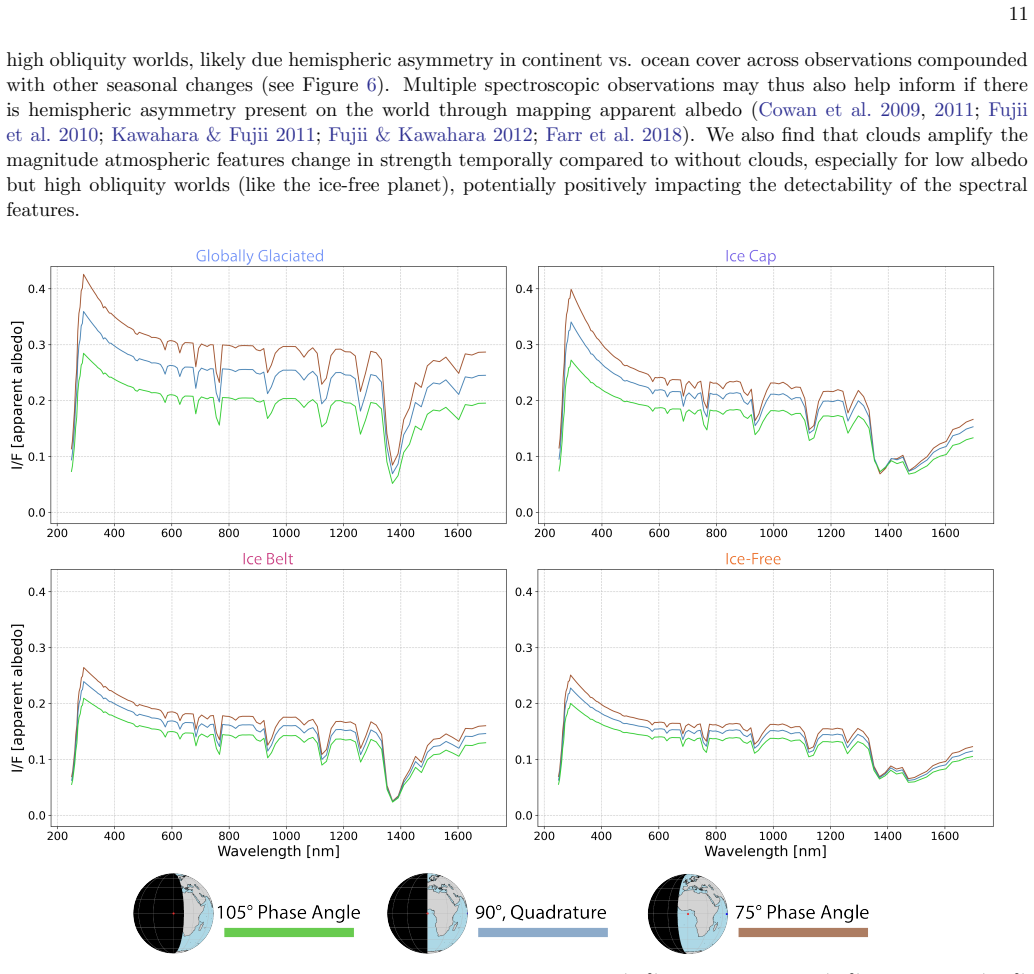
Distinct climate states on Earth-like exoplanets change their apparent albedos and the exposure times needed to detect atmospheric features and biosignatures like O2 in reflected light.
A machine-rendered reading of the paper's core claim, the machinery that carries it, and where it could break.
Core claim
Worlds with the same atmospheric composition but distinct climate states have notable differences in apparent albedos and feature detectability. An additional consequence is that the exposure time required to detect atmospheric features and biosignatures, such as O2, will depend on climate state, with icier worlds being more favorable for biosignature detection while ice-limited worlds may be more habitable. Clouds improve the strength and detectability of atmospheric features in reflected light, especially for ice-limited low albedo worlds. Temporal variation in the strength of spectra at different seasons on high obliquity worlds causes the required time to resolve atmospheric features to
What carries the argument
Climate state, defined by ice coverage and planetary obliquity, which alters apparent albedo and the strength of reflectance spectral features observed in direct imaging.
If this is right
- Exposure time to detect O2 and other atmospheric features varies with climate state.
- Clouds strengthen atmospheric features and improve their detectability, especially on low-albedo ice-limited worlds.
- High-obliquity planets exhibit seasonal changes in spectral strength between equinoxes and solstices.
- Repeated observations combined with astrometry can help determine climate state and habitability.
Where Pith is reading between the lines
- Mission planning could optimize biosignature searches by favoring targets with inferred icy climates for shorter required exposures.
- Repeated seasonal monitoring might separate climate-driven albedo changes from potential biological signals in the spectra.
- Albedo measurements paired with spectra could provide indirect constraints on surface ice coverage not otherwise observable.
Load-bearing premise
The distinct climate states modeled are physically plausible for Earth-like exoplanets and the radiative transfer simulations accurately capture real reflectance properties without major unmodeled effects.
What would settle it
Direct imaging of an exo-Earth with independent constraints on ice coverage that shows identical O2 detection exposure times across different climate states would falsify the claimed dependence.
Figures



read the original abstract
Many planetary parameters impact the climate state of Earth-like exoplanets and could vary significantly from those on Earth. However, some of these parameters may be impossible to observe, causing ambiguity in determining exoplanet climate and characterizing their atmospheric features. We explore how distinct planetary climate states impact their reflectance spectra to reduce uncertainty in the interpretation of future direct imaging observations, such as with the Habitable Worlds Observatory. We find that worlds with the same atmospheric composition but distinct climate states have notable differences in apparent albedos and feature detectability. An additional consequence is that the exposure time required to detect atmospheric features and biosignatures, such as O$_2$, will depend on climate state, with icier worlds being more favorable for biosignature detection while ice-limited worlds may be more habitable. We find that clouds improve the strength and detectability of atmospheric features in reflected light, especially for ice-limited low albedo worlds. We find temporal variation in the strength of spectra at different seasons on high obliquity worlds, causing the required time to resolve atmospheric features to vary between the equinoxes and solstices. This abiogenic seasonality could be detectable through repeated direct imaging observations and may help inform the planetary climate state, especially in combination with constraints on inclination and mass. Our work elevates the importance of astrometry performed concurrently with direct imaging for characterizing climate state and planetary habitability of exoplanets. Interpretation of future spectroscopic observations must also account for temporal variations created by obliquity when searching for biosignatures.
Editorial analysis
A structured set of objections, weighed in public.
Referee Report
Summary. The manuscript uses outputs from general circulation models for distinct climate states of Earth-like exoplanets (varying ice coverage, temperature distributions, and cloud properties) as input to radiative transfer calculations with fixed atmospheric composition. It reports that these climate states produce notable differences in apparent albedo and the strength/detectability of atmospheric features including O2, with icier worlds requiring shorter exposure times for biosignature detection. Clouds are found to enhance feature detectability especially for low-albedo cases, and high-obliquity planets exhibit seasonal spectral variations that could be observable and help constrain climate state when combined with astrometry.
Significance. If the quantitative differences hold, the work is significant for the interpretation and planning of direct-imaging observations with the Habitable Worlds Observatory. It provides concrete evidence that climate state and obliquity-driven seasonality must be folded into exposure-time estimates and biosignature searches, and it strengthens the case for simultaneous astrometry to break degeneracies. The forward-modeling approach that isolates radiative effects of climate fields is a clear methodological strength.
major comments (3)
- [Methods] Methods section: The modeling holds atmospheric mixing ratios fixed while varying climate state from GCM runs. This isolates the radiative impact of ice, temperature, and clouds but is load-bearing for the central claim of 'notable differences' in albedo and exposure times. Real planets would experience climate-chemistry feedbacks that alter H2O, CO2, aerosols, and cloud properties; the reported trends (especially icier vs. ice-limited) could be reduced or reversed once these are included. A sensitivity test or explicit discussion of this limitation is needed.
- [Results (detectability subsection)] Results on feature detectability and exposure times: The conclusion that icier worlds are more favorable for O2 detection rests on the computed albedos and line depths. Without reported details on the noise model, assumed telescope aperture, or Monte Carlo error propagation on the exposure-time estimates, it is not possible to judge how sensitive the ranking of climate states is to plausible uncertainties in surface or atmospheric variability.
- [Seasonal variations results] High-obliquity seasonal analysis: The paper states that abiogenic seasonality in spectral features could be detectable and informative about climate state. However, no quantitative metric is given for the amplitude of seasonal changes relative to other variability sources or for the number of epochs required to distinguish obliquity-driven signals from noise or other effects.
minor comments (3)
- [Abstract] The abstract asserts that 'ice-limited worlds may be more habitable' without a supporting metric or reference in the text; this statement should be either quantified or removed.
- [Figures] Figure captions and axis labels for albedo and spectral plots should explicitly name the climate states (e.g., 'high-obliquity ice-covered' vs. 'ice-limited') and seasons to improve readability.
- [Discussion] Add a short paragraph in the discussion comparing the modeled albedo differences to existing literature on Earth-analog phase curves or cloud effects.
Simulated Author's Rebuttal
We thank the referee for their constructive review and positive assessment of the significance of our work for future direct-imaging missions. We have carefully considered each major comment and provide point-by-point responses below. Where appropriate, we will revise the manuscript to incorporate additional details and discussion while preserving the integrity of our modeling approach and results.
read point-by-point responses
-
Referee: [Methods] Methods section: The modeling holds atmospheric mixing ratios fixed while varying climate state from GCM runs. This isolates the radiative impact of ice, temperature, and clouds but is load-bearing for the central claim of 'notable differences' in albedo and exposure times. Real planets would experience climate-chemistry feedbacks that alter H2O, CO2, aerosols, and cloud properties; the reported trends (especially icier vs. ice-limited) could be reduced or reversed once these are included. A sensitivity test or explicit discussion of this limitation is needed.
Authors: We agree that climate-chemistry feedbacks are an important consideration not included in our current framework. Our study deliberately fixes atmospheric composition to isolate the radiative effects arising from differences in surface ice coverage, temperature distributions, and cloud properties, as described in the Methods. This controlled approach is what enables us to attribute the reported differences in albedo and feature detectability directly to climate state. We will add an explicit discussion of this limitation in a revised Methods section, clarifying the scope of our conclusions and noting that full climate-chemistry coupling could modulate the trends. A comprehensive sensitivity test with coupled models lies beyond the present scope but is highlighted as valuable future work. revision: yes
-
Referee: [Results (detectability subsection)] Results on feature detectability and exposure times: The conclusion that icier worlds are more favorable for O2 detection rests on the computed albedos and line depths. Without reported details on the noise model, assumed telescope aperture, or Monte Carlo error propagation on the exposure-time estimates, it is not possible to judge how sensitive the ranking of climate states is to plausible uncertainties in surface or atmospheric variability.
Authors: We appreciate this request for greater transparency. The exposure-time estimates follow a standard direct-imaging noise model that incorporates photon noise, read noise, and zodiacal background, with assumptions for a 6-m class telescope aperture consistent with Habitable Worlds Observatory concepts. We will expand the relevant subsection of the Methods to provide a complete description of the noise model, telescope parameters, and the procedure used to derive exposure times. This added detail will allow readers to assess the robustness of the climate-state ranking to the stated assumptions. revision: yes
-
Referee: [Seasonal variations results] High-obliquity seasonal analysis: The paper states that abiogenic seasonality in spectral features could be detectable and informative about climate state. However, no quantitative metric is given for the amplitude of seasonal changes relative to other variability sources or for the number of epochs required to distinguish obliquity-driven signals from noise or other effects.
Authors: We acknowledge that the seasonal results would be strengthened by quantitative metrics. In the revised manuscript we will report the fractional amplitude of seasonal variation in key spectral feature depths (e.g., the O2 A-band) between equinox and solstice for the high-obliquity cases. We will also compare these amplitudes to representative observational uncertainties and discuss the approximate number of epochs needed to distinguish the obliquity-driven signal from noise, assuming typical direct-imaging performance. These additions will make the detectability claim more concrete while remaining within the scope of the existing simulations. revision: yes
Circularity Check
No significant circularity; claims follow from forward GCM-to-RT modeling
full rationale
The paper's central results are obtained by running GCMs for distinct climate states (varying ice coverage, temperature, obliquity, etc.) while holding atmospheric mixing ratios fixed, then passing the resulting fields into a radiative transfer code to compute reflectance spectra, albedos, and exposure times. These outputs are genuine model predictions, not definitions or fits that presuppose the reported differences. No equations or steps reduce by construction to the inputs, no self-citations are invoked as uniqueness theorems or load-bearing premises, and no ansatz or renaming of known results is presented as a derivation. The work is self-contained against external benchmarks (standard GCM and RT codes) and the derivation chain does not loop back on itself.
Axiom & Free-Parameter Ledger
Reference graph
Works this paper leans on
-
[1]
The Astrophysical Journal, in Revision , author =
Synergistic. The Astrophysical Journal, in Revision , author =
-
[2]
and Kofman, Vincent and Fauchez, Thomas J
Payne, Allison and Villanueva, Geronimo L. and Kofman, Vincent and Fauchez, Thomas J. and Faggi, Sara and Mandell, Avi M. and Roberge, Aki and Alei, Eleonora , month = feb, year =. A. The Planetary Science Journal , publisher =. doi:10.3847/PSJ/ae2feb , abstract =
-
[3]
Gough, D. O. , editor =. Solar. Sol. 1981 , keywords =. doi:10.1007/978-94-010-9633-1_4 , abstract =
-
[4]
Astrophysics Source Code Library , author =
rfast:. Astrophysics Source Code Library , author =. 2023 , note =
2023
-
[5]
The Planetary Science Journal , author =
Exploring and. The Planetary Science Journal , author =. 2023 , pages =. doi:10.3847/PSJ/acac9a , abstract =
-
[6]
Astronomy and Computing , author =
From global climate models (. Astronomy and Computing , author =. 2025 , keywords =. doi:10.1016/j.ascom.2025.100982 , abstract =
-
[7]
Krissansen-Totton, Joshua and Arney, Giada N. and Catling, David C. , month = apr, year =. Constraining the climate and ocean. Proceedings of the National Academy of Sciences , publisher =. doi:10.1073/pnas.1721296115 , abstract =
-
[8]
Earth and Planetary Science Letters , author =
A coupled carbon-silicon cycle model over. Earth and Planetary Science Letters , author =. 2020 , keywords =. doi:10.1016/j.epsl.2020.116181 , abstract =
-
[9]
Olson, Stephanie L. and Reinhard, Christopher T. and Lyons, Timothy W. , month = oct, year =. Limited role for methane in the mid-. Proceedings of the National Academy of Sciences , publisher =. doi:10.1073/pnas.1608549113 , abstract =
-
[10]
Wogan, Nicholas F. and Batalha, Natasha E. and Zahnle, Kevin and Krissansen-Totton, Joshua and Catling, David C. and Wolf, Eric T. and Robinson, Tyler D. and Meadows, Victoria and Arney, Giada and Domagal-Goldman, Shawn , month = nov, year =. The. The Planetary Science Journal , publisher =. doi:10.3847/PSJ/ae0e1c , abstract =
-
[11]
Wogan, Nicholas F. and Catling, David C. and Zahnle, Kevin J. and Claire, Mark W. , month = sep, year =. Rapid timescale for an oxic transition during the. Proceedings of the National Academy of Sciences , publisher =. doi:10.1073/pnas.2205618119 , abstract =
-
[12]
Journal of Geophysical Research: Atmospheres , author =
Exploring the faint young. Journal of Geophysical Research: Atmospheres , author =. 2013 , note =. doi:10.1002/jgrd.50808 , abstract =
-
[13]
Wolf, E.T. and Toon, O.B. , month = jul, year =. Hospitable. Astrobiology , publisher =. doi:10.1089/ast.2012.0936 , abstract =
-
[14]
Wolf, E. T. and Kopparapu, R. K. and Haqq-Misra, J. , month = may, year =. Simulated. The Astrophysical Journal , publisher =. doi:10.3847/1538-4357/ab184a , abstract =
-
[15]
Salvador, Arnaud and Robinson, Tyler D. and Fortney, Jonathan J. and Marley, Mark S. , month = jul, year =. Influence of. The Astrophysical Journal Letters , publisher =. doi:10.3847/2041-8213/ad54c5 , abstract =
-
[16]
Foreman-Mackey, Daniel and Hogg, David W. and Lang, Dustin and Goodman, Jonathan , month = feb, year =. emcee:. Publications of the Astronomical Society of the Pacific , publisher =. doi:10.1086/670067 , abstract =
-
[17]
and Turbet, Martin and Wolf, Eric T
Fauchez, Thomas J. and Turbet, Martin and Wolf, Eric T. and Boutle, Ian and Way, Michael J. and Del Genio, Anthony D. and Mayne, Nathan J. and Tsigaridis, Konstantinos and Kopparapu, Ravi K. and Yang, Jun and Forget, Francois and Mandell, Avi and Domagal Goldman, Shawn D. , month = feb, year =. Geoscientific Model Development , publisher =. doi:10.5194/gm...
-
[18]
The Astrophysical Journal, in Revision , author =
Impact of. The Astrophysical Journal, in Revision , author =
-
[19]
Fundamentals of the
Villanueva, Geronimo Luis and Liuzzi, Giuliano and Faggi, Sara and Protopapa, Silvia and Kofman, Vincent and Fauchez, Thomas and Stone, Shane Wesley and Mandell, Avi Max , month = jan, year =. Fundamentals of the
-
[20]
Planetary. Journal of Quantitative Spectroscopy and Radiative Transfer , author =. 2018 , pages =. doi:10.1016/j.jqsrt.2018.05.023 , abstract =
-
[21]
Mamajek, Eric and Stapelfeldt, Karl , month = feb, year =. doi:10.48550/arXiv.2402.12414 , abstract =
-
[22]
Arney, Giada N. , month = mar, year =. The. The Astrophysical Journal Letters , publisher =. doi:10.3847/2041-8213/ab0651 , abstract =
-
[23]
International Journal of Astrobiology , author =
Spin evolution of. International Journal of Astrobiology , author =. 2015 , keywords =. doi:10.1017/S1473550414000226 , abstract =
-
[24]
Planet formation: statistics of spin rates and obliquities of extrasolar planets , volume =. Monthly Notices of the Royal Astronomical Society , author =. 2010 , pages =. doi:10.1111/j.1365-2966.2010.16804.x , abstract =
-
[25]
Capirala, Ashika and Olson, Stephanie L. , month = jan, year =. Slowing planetary rotation influences ocean nutrient cycling and oxygenation , volume =. Science Advances , publisher =. doi:10.1126/sciadv.adw3368 , abstract =
-
[26]
Part I: Wintertime Leading Mode
Curry, Judith A. and Schramm, Julie L. and Ebert, Elizabeth E. , month = feb, year =. Sea. Journal of Climate , publisher =. doi:10.1175/1520-0442(1995)008<0240:SIACFM>2.0.CO;2 , abstract =
-
[27]
Del Genio, Anthony and Suozzo, Robert J. , month = mar, year =. A. Journal of the Atmospheric Sciences , publisher =. doi:10.1175/1520-0469(1987)044<0973:ACSORA>2.0.CO;2 , abstract =
-
[28]
Journal of Geophysical Research: Atmospheres , author =
Global climate model high-obliquity solutions to the ancient climate puzzles of the. Journal of Geophysical Research: Atmospheres , author =. 2000 , note =. doi:10.1029/1999JD901125 , abstract =
-
[29]
Hunt, B. G. , month = sep, year =. The effects of past variations of the. Nature , publisher =. doi:10.1038/281188a0 , abstract =
-
[30]
Earth-Science Reviews , author =
History of the earth's obliquity , volume =. Earth-Science Reviews , author =. 1993 , pages =. doi:10.1016/0012-8252(93)90004-Q , abstract =
-
[31]
Possible climates on terrestrial exoplanets , volume =. Philosophical Transactions of the Royal Society A: Mathematical, Physical and Engineering Sciences , author =. 2014 , pages =. doi:10.1098/rsta.2013.0084 , abstract =
-
[32]
Reinhard, Christopher T. and Olson, Stephanie L. and Schwieterman, Edward W. and Lyons, Timothy W. , month = apr, year =. False. Astrobiology , publisher =. doi:10.1089/ast.2016.1598 , abstract =
-
[33]
Lyons, Timothy W. and Reinhard, Christopher T. and Planavsky, Noah J. , month = feb, year =. The rise of oxygen in. Nature , publisher =. doi:10.1038/nature13068 , abstract =
-
[34]
Journal of Geophysical Research , author =
Climatic variations on. Journal of Geophysical Research , author =. 1974 , note =. doi:10.1029/JC079i024p03375 , abstract =
-
[35]
Krissansen-Totton, Joshua and Ulses, Anna Grace and Frissell, Maxwell and Gilbert-Janizek, Samantha and Young, Amber and Lustig-Yaeger, Jacob and Robinson, Tyler and Olson, Stephanie and Alei, Eleonora and Arney, Giada and Hagee, Celeste and Harman, Chester and Hinkel, Natalie and Lafleche, Emilie and Latouf, Natasha and Mandell, Avi and Moussa, Mark M. a...
-
[36]
Tuchow, Noah W. and Harada, Caleb K. and Mamajek, Eric E. and Tanner, Angelle and Hinkel, Natalie R. and Belikov, Ruslan and Sirbu, Dan and Ciardi, David R. and Stark, Christopher C. and Morgan, Rhonda M. and Savransky, Dmitry and Turmon, Michael , month = oct, year =. Publications of the Astronomical Society of the Pacific , publisher =. doi:10.1088/1538...
-
[37]
Chasing rainbows and ocean glints:. Monthly Notices of the Royal Astronomical Society , author =. 2023 , pages =. doi:10.1093/mnras/stad2127 , abstract =
-
[38]
Morgan, Rhonda and Savransky, Dmitry and Damiano, Mario and Lisman, Doug and Mennesson, Bertrand and Mamajek, Eric E. and Robinson, Tyler D. and Turmon, Michael , month = oct, year =. Exo-. Techniques and. doi:10.1117/12.2677785 , abstract =
-
[39]
Reviews in Mineralogy and Geochemistry , keywords =
An. Reviews in Mineralogy and Geochemistry , author =. 2024 , pages =. doi:10.2138/rmg.2024.90.13 , number =
-
[40]
Journal of Astronomical Telescopes, Instruments, and Systems , author =
Optimized bandpasses for the. Journal of Astronomical Telescopes, Instruments, and Systems , author =. 2024 , note =
2024
-
[41]
Geochemistry, Geophysics, Geosystems , author =
Evidence that low-temperature oceanic hydrothermal systems play an important role in the silicate-carbonate weathering cycle and long-term climate regulation , volume =. Geochemistry, Geophysics, Geosystems , author =. 2013 , note =. doi:10.1002/ggge.20113 , abstract =
-
[42]
Earth and Planetary Science Letters , author =
Alteration of ocean crust provides a strong temperature dependent feedback on the geological carbon cycle and is a primary driver of the. Earth and Planetary Science Letters , author =. 2015 , keywords =. doi:10.1016/j.epsl.2015.01.027 , abstract =
-
[43]
and Crouse, Jaime and Arney, Giada and Domagal-Goldman, Shawn and Robinson, Tyler D
Young, Amber V. and Crouse, Jaime and Arney, Giada and Domagal-Goldman, Shawn and Robinson, Tyler D. and Bastelberger, Sandra T. , month = jan, year =. Retrievals. The Planetary Science Journal , publisher =. doi:10.3847/PSJ/ad09b1 , abstract =
-
[44]
Meadows, Victoria S. and Reinhard, Christopher T. and Arney, Giada N. and Parenteau, Mary N. and Schwieterman, Edward W. and Domagal-Goldman, Shawn D. and Lincowski, Andrew P. and Stapelfeldt, Karl R. and Rauer, Heike and DasSarma, Shiladitya and Hegde, Siddharth and Narita, Norio and Deitrick, Russell and Lustig-Yaeger, Jacob and Lyons, Timothy W. and Si...
-
[45]
URL https://doi.org/10.1051/0004-6361/202243445
Farhat, Mohammad and Auclair-Desrotour, Pierre and Boué, Gwenaël and Laskar, Jacques , month = sep, year =. The resonant tidal evolution of the. Astronomy & Astrophysics , publisher =. doi:10.1051/0004-6361/202243445 , abstract =
-
[46]
Cary, S. Craig and McDonald, Ian R. and Barrett, John E. and Cowan, Don A. , month = feb, year =. On the rocks: the microbiology of. Nature Reviews Microbiology , publisher =. doi:10.1038/nrmicro2281 , abstract =
-
[47]
Journal of Arid Environments , author =
Outline of the biological history of the. Journal of Arid Environments , author =. 1992 , pages =. doi:10.1016/S0140-1963(18)30653-0 , abstract =
-
[48]
and Zhou, Jizhong and Pointing, Stephen B
Chan, Yuki and Van Nostrand, Joy D. and Zhou, Jizhong and Pointing, Stephen B. and Farrell, Roberta L. , month = may, year =. Functional ecology of an. Proceedings of the National Academy of Sciences , publisher =. doi:10.1073/pnas.1300643110 , abstract =
-
[49]
and Lyons, W
Doran, Peter T. and Lyons, W. Berry and McKnight, Diane M. , month = apr, year =. Life in
-
[50]
Noy-Meir, Imanuel , year =. Desert. Annual Review of Ecology and Systematics , publisher =
-
[51]
Journal of Astronomical Telescopes, Instruments, and Systems , keywords =
Stark, Christopher C. and Belikov, Rus and Bolcar, Matthew R. and Cady, Eric and Crill, Brendan P. and Ertel, Steve and Groff, Tyler and Hildebrandt, Sergi and Krist, John and Lisman, P. Douglas and Mazoyer, Johan and Mennesson, Bertrand and Nemati, Bijan and Pueyo, Laurent and Rauscher, Bernard J. and Riggs, A. J. and Ruane, Garreth and Shaklan, Stuart B...
-
[52]
doi:10.1051/0004-6361/202243846 , nasaads =
Kammerer, Jens and Quanz, Sascha P. and Dannert, Felix , month = dec, year =. Large. Astronomy & Astrophysics , publisher =. doi:10.1051/0004-6361/202243846 , abstract =
-
[53]
and Lustig-Yaeger, Jacob and Davis, Christopher Evan and Kopparapu, Ravi Kumar and Way, Michael J
Guzewich, Scott D. and Lustig-Yaeger, Jacob and Davis, Christopher Evan and Kopparapu, Ravi Kumar and Way, Michael J. and Meadows, Victoria S. , month = apr, year =. The. The Astrophysical Journal , publisher =. doi:10.3847/1538-4357/ab83ec , abstract =
-
[54]
Atmospheric. The Astrophysical Journal , author =. 2018 , note =. doi:10.3847/2041-8213/aac171 , abstract =
-
[55]
Alei, Eleonora and Mandell, Avi M. and Currie, Miles H. and Roberge, Aki and Stark, Christopher C. and Payne, Allison and Kofman, Vincent and Villanueva, Geronimo L. and Hu, Renyu and Young, Amber V. , month = jan, year =. Multi-bandpass. doi:10.48550/arXiv.2512.05279 , abstract =
-
[56]
Astrobiology , author =
Extreme. Astrobiology , author =
-
[57]
Water loss from terrestrial planets orbiting ultracool dwarfs: implications for the planets of. Monthly Notices of the Royal Astronomical Society , author =. 2017 , pages =. doi:10.1093/mnras/stw2578 , abstract =
-
[58]
Lammer, Helmut and Lichtenegger, Herbert I.M. and Kulikov, Yuri N. and Grießmeier, Jean-Mathias and Terada, N. and Erkaev, Nikolai V. and Biernat, Helfried K. and Khodachenko, Maxim L. and Ribas, Ignasi and Penz, Thomas and Selsis, Franck , month = feb, year =. Coronal. Astrobiology , publisher =. doi:10.1089/ast.2006.0128 , abstract =
-
[59]
Valente, Ema F. S. and Correia, Alexandre C. M. , month = sep, year =. Tidal excitation of the obliquity of. Astronomy & Astrophysics , publisher =. doi:10.1051/0004-6361/202244010 , abstract =
-
[60]
The Astrophysical Journal Letters , publisher =
Wang, Yuwei and Liu, Yonggang and Tian, Feng and Yang, Jun and Ding, Feng and Zhou, Linjiong and Hu, Yongyun , month = may, year =. The Astrophysical Journal Letters , publisher =. doi:10.3847/2041-8205/823/1/L20 , abstract =
-
[61]
Multiple. Journal of Climate , author =. 2023 , pages =. doi:10.1175/JCLI-D-21-0984.1 , abstract =
-
[62]
and Charnay, Benjamin and Arney, Giada and Robinson, Tyler D
Krissansen-Totton, Joshua and Schwieterman, Edward W. and Charnay, Benjamin and Arney, Giada and Robinson, Tyler D. and Meadows, Victoria and Catling, David C. , month = jan, year =. The Astrophysical Journal , publisher =. doi:10.3847/0004-637X/817/1/31 , abstract =
-
[63]
0.25. Astrobiology , author =. 2020 , note =. doi:10.1089/ast.2019.2053 , abstract =
-
[64]
Pozarycki, Chad and Seaton, Kenneth M. and C. Vincent, Emily and Novak Sanders, Carlie and Nuñez, Nickie and Castillo, Mariah and Ingall, Ellery and Klempay, Benjamin and Pontefract, Alexandra and Fisher, Luke A. and Paris, Emily R. and Buessecker, Steffen and Alansson, Nikolas B. and Carr, Christopher E. and Doran, Peter T. and Bowman, Jeff S. and Schmid...
-
[65]
Extraordinary climates of. International Journal of Astrobiology , author =. 2003 , keywords =. doi:10.1017/S1473550403001356 , abstract =
-
[66]
Journal of Geophysical Research: Atmospheres , author =
The. Journal of Geophysical Research: Atmospheres , author =. 2022 , note =. doi:10.1029/2021JD036003 , abstract =
-
[67]
2019, Earth System Dynamics, 10, 73, doi: 10.5194/esd-10-73-2019
Giorgi, Filippo and Raffaele, Francesca and Coppola, Erika , month = feb, year =. The response of precipitation characteristics to global warming from climate projections , volume =. Earth System Dynamics , publisher =. doi:10.5194/esd-10-73-2019 , abstract =
-
[68]
Climate Research 47(1-2):123--138
Changes in precipitation with climate change , volume =. Climate Research , author =. 2011 , keywords =. doi:10.3354/cr00953 , abstract =
-
[69]
Geophysical Research Letters , author =
Relationships between precipitation and surface temperature , volume =. Geophysical Research Letters , author =. 2005 , note =. doi:10.1029/2005GL022760 , abstract =
-
[70]
Sievers, J. and Sørensen, L. L. and Papakyriakou, T. and Else, B. and Sejr, M. K. and Haubjerg Søgaard, D. and Barber, D. and Rysgaard, S. , month = aug, year =. Winter observations of. The Cryosphere , publisher =. doi:10.5194/tc-9-1701-2015 , abstract =
-
[71]
Johnson, Benjamin W. and Poulton, Simon W. and Goldblatt, Colin , month = nov, year =. Marine oxygen production and open water supported an active nitrogen cycle during the. Nature Communications , publisher =. doi:10.1038/s41467-017-01453-z , abstract =
-
[72]
Howell, James Endres , month = jun, year =. Comment on “. Research Notes of the AAS , publisher =. doi:10.3847/2515-5172/ab2a76 , language =
-
[73]
Journal of Geophysical Research: Oceans , author =
Annual cycles of. Journal of Geophysical Research: Oceans , author =. 2012 , note =. doi:10.1029/2011JC007346 , abstract =
-
[74]
Distribution of. Journal of Geophysical Research: Oceans , author =. 1998 , note =. doi:10.1029/97JC02473 , abstract =
-
[75]
Journal of Geophysical Research: Oceans , author =
Snowball. Journal of Geophysical Research: Oceans , author =. 2005 , note =. doi:10.1029/2004JC002525 , abstract =
-
[76]
Earth and Planetary Science Letters , author =
History of water loss and atmospheric. Earth and Planetary Science Letters , author =. 2015 , keywords =. doi:10.1016/j.epsl.2015.09.051 , abstract =
-
[77]
Wordsworth, R. D. and Schaefer, L. K. and Fischer, R. A. , month = apr, year =. Redox. The Astronomical Journal , publisher =. doi:10.3847/1538-3881/aab608 , abstract =
-
[78]
Schwieterman, Edward W. and Reinhard, Christopher T. and Olson, Stephanie L. and Harman, Chester E. and Lyons, Timothy W. , month = jun, year =. A. The Astrophysical Journal , publisher =. doi:10.3847/1538-4357/ab1d52 , abstract =
-
[79]
Schwieterman, Edward W. and Reinhard, Christopher T. and Olson, Stephanie L. and Ozaki, Kazumi and Harman, Chester E. and Hong, Peng K. and Lyons, Timothy W. , month = mar, year =. Rethinking. The Astrophysical Journal , publisher =. doi:10.3847/1538-4357/ab05e1 , abstract =
-
[80]
Komacek, Thaddeus D. and Showman, Adam P. , month = apr, year =. The Astrophysical Journal , publisher =. doi:10.3847/0004-637X/821/1/16 , abstract =
discussion (0)
Sign in with ORCID, Apple, or X to comment. Anyone can read and Pith papers without signing in.