REVIEW 3 major objections 4 minor 1 cited by
The isostructural alpha-gamma phase transition in cerium from the perspective of meta-generalized gradient approximations
T0 review · 3 major / 4 minor · reviewed 2026-08-07 · deepseek-v4-flash
Pith's one-line read A single DFT calculation reproduces both phases of cerium's volume collapse.
desk verdict A potentially important meta-GGA result for cerium, but the γ phase rests on an unvalidated spin-polarized solution that could be a metastable artifact. read the letter →
The pith
A machine-rendered reading of the paper's core claim, the machinery that carries it, and where it could break.
The reading
What carries the argument
The load-bearing object is the LAK meta-GGA. It is a semilocal functional built from the density, its gradient, and the orbital kinetic energy density τ, entering through the variable α = (τ − τ_W)/τ_unif that separates one-electron regions from the uniform electron gas. LAK adjusts the relative weights of gradient and τ contributions so that its exchange enhancement factor satisfies ∂F_x(s, α)/∂α < 0, the ultranonlocality condition that mimics some effects of exact exchange. The double minimum appears only in the spin-polarized solution: allowing a magnetic moment at large volume localizes the f electrons and stabilizes γ-Ce, so the mechanism is the combination of ultranonlocality with spin polarization.
What would settle it
Repeat the LAK calculation with initial magnetic moments of 0, 1, 2, and 4 μB, and with antiferromagnetic starting configurations. If the γ-phase minimum disappears or the energy ordering reverses in any of these runs, the claim that LAK captures the phase transition from a single self-consistent calculation fails. A second check is to compare the predicted ferromagnetic moment of ~1.2 μB with magnetic-susceptibility or neutron-scattering data that show γ-Ce has no long-range magnetic order.
Extended reading notes
Core claim
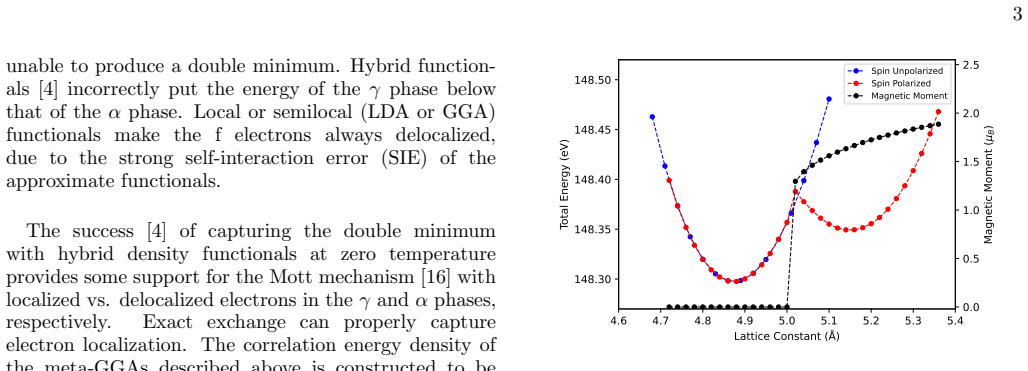
The central discovery is that the LAK meta-GGA produces a double minimum in the total energy as a function of lattice constant for bulk cerium, but only when the calculation is spin-polarized and starts from a magnetic moment of 3.0 μB. The minimum at larger volume is γ-Ce, with a magnetic moment of about 1.2 μB per atom and f electrons localized at atomic sites; the minimum at smaller volume is α-Ce, with zero moment and delocalized f electrons. From that single self-consistent calculation the authors obtain lattice constants of 5.14 Å and 4.87 Å for the γ and α phases, a critical pressure of -0.4 GPa, and a volume collapse of about 16%, all in reasonable agreement with experiment. The projected electron-density difference shows more charge buildup at atomic sites in the γ phase and more interstitial charge in the α phase, consistent with the localization picture.
Load-bearing premise
The γ-phase minimum is obtained from a spin-polarized calculation that assumes an initial magnetic moment of 3.0 μB, and the paper treats this ferromagnetic-like solution as physical even though γ-Ce is experimentally paramagnetic with local moments.
Editorial extensions
If this is right
- LAK captures both cerium phases at zero temperature without exact exchange, Hubbard U, or random-phase approximation, unlike LDA, PBE, SCAN, r2SCAN, and OFR2.
- The zero-temperature lattice constants from LAK (4.87 Å for α, 5.14 Å for γ) are close to room-temperature experimental values.
- The predicted volume collapse of about 16% is much closer to the experimental 14–15% than the roughly 30% collapse from the hybrid-based (EX+cRPA)@PBE0 calculation.
- The magnetic moment jumps from 0 in α-Ce to about 1.2 μB in γ-Ce, marking the localization of f electrons at the transition.
- If these results hold, ultranonlocal meta-GGAs could serve as a low-cost alternative to fourth- and fifth-rung methods for f-electron materials.
Reading between the lines
- I infer that the same mechanism may apply to other f-electron metals with volume-collapse transitions, such as plutonium or americium, where a spin-polarized LAK calculation could be tested for a double minimum.
- The sensitivity to the initial magnetic moment suggests a systematic scan over starting magnetizations is needed to determine whether the γ minimum is the ground state or a metastable ferromagnetic state.
- A natural extension is to compute phonons and finite-temperature free energies with LAK to verify the experimental finding that phonon entropy does not drive the transition.
- The ultranonlocality of LAK may also improve charge-transfer and band-gap descriptions in other metals or Mott insulators, not just cerium; this could be tested on simple oxides.
Editorial analysis
A structured set of objections, weighed in public.
Referee Report
Summary. The manuscript applies the LAK meta-GGA to bulk cerium and reports, from a single self-consistent spin-polarized calculation, a double minimum in the energy-volume curve corresponding to the alpha and gamma phases, with lattice parameters 4.87 Å and 5.14 Å, a magnetic moment of about 1.2 μB, a critical pressure of -0.4 GPa, and a volume collapse of 15.8%. Two other meta-GGAs, OFR2 and r2SCAN, are shown to yield only the alpha phase. The paper argues that LAK's ultranonlocality is responsible for capturing localization/delocalization of f electrons and that this constitutes a parameter-free first-principles description of the isostructural alpha-gamma transition.
Significance. If the central claim holds, the result is significant: LAK would be the first semilocal-level functional without a Hubbard U or exact exchange to produce both cerium phases with the correct ordering and a realistic volume collapse, at a fraction of the cost of hybrid or RPA approaches. The study also provides a useful benchmark comparison of modern meta-GGAs on a correlated f-electron material. The paper's strengths are that it uses an external functional without fitting to cerium data, reports lattice constants close to experiment, and includes a computed volume collapse in good agreement with the measured value. However, the central claim depends entirely on a broken-symmetry spin-polarized solution whose stability and physical interpretation are not established, so the result is promising but not yet fully validated.
major comments (3)
- [Figure 1 and the paragraph describing the spin-polarized LAK calculation] The double minimum appears only in the spin-polarized calculation initialized with an initial magnetic moment of 3.0 μB; the spin-unpolarized LAK curve has only the alpha minimum. Because the gamma phase is carried entirely by this particular broken-symmetry magnetic solution, the manuscript must demonstrate that this minimum is a stable stationary point of the LAK functional rather than a metastable artifact. Concretely, the authors should scan initial magnetic moments (for example 0.5, 1.0, 2.0, 3.0, 4.0 μB), test an antiferromagnetic two-atom cell, and test a noncollinear ordering. Without this evidence, the central claim reduces to the weaker statement that LAK has only an alpha phase unless artificially initialized into a ferromagnetic-like state.
- [Figure 2 discussion and the magnetic-moment paragraph] The text states that the gamma phase is 'ferromagnetic in nature' and reports a magnetic moment of about 1.2 μB, but the Introduction correctly describes gamma-Ce as paramagnetic with Curie-Weiss susceptibility and localized moments. This contradiction is load-bearing because the physical identification of the calculated broken-symmetry state with the gamma phase depends on the local-moment picture. The paper should either provide evidence that the computed ferromagnetic-like solution represents the paramagnetic local-moment state (for example, by comparing with the expected Ce3+ effective moment or with the reduced moment expected from Kondo screening) or explicitly discuss the discrepancy.
- [Table II and the critical-pressure discussion] LAK's predicted critical pressure of -0.4 GPa is compared only with the value -0.8 GPa taken from Ref. [22], which is a theoretical study, while the experimental room-temperature values listed in Table II are +1.8 and +1.44 GPa. The sign of the predicted pressure is opposite to the room-temperature experimental sign, and the manuscript does not provide a temperature or pressure argument justifying the comparison to the extrapolated or theoretical value. This weakens the claim that LAK predicts the transition pressure 'reasonably close' to experiment; the authors should clarify what quantity is being compared and why a negative pressure is consistent with the measured phase transition.
minor comments (4)
- [Abstract and text near Figure 1] There are duplicated words in the text, for example 'the the total energy' and 'the the double minimum'; these should be corrected.
- [Figure 3 caption and the corresponding paragraph] The projected density difference is defined as n_alpha - n_gamma, and the text says there is more charge localization in the gamma phase at the atomic sites. With a conventional color scale, this would make the atomic sites negative (blue) rather than deep red. The caption and color scale need to be clarified so the sign convention is unambiguous.
- [Figure 4 discussion] The density of states figure is described as the sum of spin-up and spin-down states, but the figure does not show the spin-resolved components. Since the magnetic moment and the f-electron localization are central to the argument, showing the spin channels or at least reporting the f-occupancy in each phase would make the comparison more informative.
- [Table II and Ref. [22]] The same reference [22] is used for both the lattice parameters and the extrapolated pressure; the authors should explicitly state which entries in the tables are experimental and which are theoretical, since the text sometimes calls the -0.8 GPa value 'extrapolated to 0 K' without making clear that it is a theoretical estimate.
Circularity Check
No significant circularity: LAK is an external, parameter-free functional and cerium results are computed outputs, not fitted inputs.
full rationale
This paper applies the LAK meta-GGA, an external functional defined in Lebeda, Aschebrock and Kümmel (PRL 133, 136402, 2024), to bulk cerium. No parameter of LAK is fitted to cerium or to the alpha-gamma transition; the authors explicitly aim for a 'parameter free' model. The central outputs (alpha/gamma lattice constants 4.87/5.14 Angstrom, volume collapse 15.8%, critical pressure -0.4 GPa) are computed from self-consistent E-V curves and compared against experiment; they are not inputs. The Birch-Murnaghan fit is a standard interpolation and does not inject the double minimum. Self-citations (SCAN [8], mTASK [11]) are contextual and not load-bearing: SCAN is invoked precisely because it fails to produce a gamma minimum, and mTASK appears only in the band-gap background discussion. The main weakness - the gamma minimum appears only in spin-polarized runs initialized at 3.0 micro-Bohr magnetons, and the paper calls gamma-Ce 'ferromagnetic in nature' while its own introduction cites Curie-Weiss paramagnetism with local moments - is a robustness and physical-validity concern (correctness risk), not a circularity: no derivation step equates an input with an output, and no fitted parameter is renamed as a prediction. On the scale defined here this is a 1: minor self-citation present but not load-bearing; the core claim stands as a benchmark application of an external functional with independent content.
Assumptions & free parameters
assumptions (3)
- domain assumption The LAK meta-GGA accurately describes exchange-correlation effects in cerium, including f-electron localization.
- domain assumption Phonon entropy contributions to the alpha-gamma phase transition are negligible.
- domain assumption The VASP PAW potential Ce_3, with 4f electrons as valence states, is accurate for cerium.
Cite this review
Pith. "Pith review of The isostructural alpha-gamma phase transition in cerium from the perspective of meta-generalized gradient approximations." pith.science (2026). https://pith.science/paper/X7HRXO6Q
@misc{pith2026250603578,
  author       = {Pith},
  title        = {Pith review of: The isostructural alpha-gamma phase transition in cerium from the perspective of meta-generalized gradient approximations},
  year         = {2026},
  howpublished = {\url{https://pith.science/paper/X7HRXO6Q}},
  note         = {Machine review of arXiv:2506.03578}
}
read the original abstract
Meta-generalized gradient approximations (meta-GGAs) on the third rung of the functional hierarchy are gaining increasing relevance for the electronic structure. Meta-GGAs are constructed from numerous ingredients including the orbital kinetic energy density that make them more flexible than generalized gradient approximations (GGAs) including the heavily used PBE-GGA. Still, most meta-GGAs cope with the expected limitations of a semilocal density functional when band gaps or localization of electrons are needed. On the other hand, meta-GGAs are implicit functionals of the orbitals. This feature resembles hybrid density functionals with exact exchange. Efforts in recent years demonstrate that some meta-GGAs can rise beyond the accuracy of semilocal approximation when band gaps are computed. Cerium is an ideal testbed to challenge some recent meta-GGAs. Cerium shows an isostructural alpha - gamma phase transition with delocalized and localized f electrons in each phase, respectively. Since the phonon entropy term was found negligible in the alpha - gamma phase transition of cerium by accurate experiments, all changes in the transition are driven by electronic correlation. The correlation of f electron systems is hardly captured by semilocal approximations but the recent LAK meta-GGA with ultranonlocality steps out of the framework of conventional semilocal density functionals and delivers spectacular accuracy for the phase transition of cerium. LAK and further meta-GGAs inspired by the success of LAK can open a forefront of meta-GGAs for quantum materials with localized electrons.
Figures


Figures from the paper (1 more)

Forward citations
Cited by 1 Pith paper
-
Artificial Symmetry Breaking by Self-Interaction Error
Self-interaction error alone can force semilocal density functionals to break symmetry in one-electron multicenter systems, and a purpose-built functional avoids the artifact.
Reference graph
Works this paper leans on
-
[22]
M. Casadei, X. Ren, P. Rinke, A. Rubio, and M. Schef- fler, Physical Review B 93, 075153 (2016)
work page 2016
-
[1]
D. C. Koskenmaki and K. A. Gschneidner Jr, Handbook on the physics and chemistry of rare earths1, 337 (1978)
work page 1978
-
[2]
S. Eryigit, C. Parlak, and R. Eryigit, Journal of Physics: Condensed Matter 34, 295402 (2022)
work page 2022
-
[3]
Svane, Physical Review Letters 72, 1248 (1994)
A. Svane, Physical Review Letters 72, 1248 (1994)
work page 1994
-
[4]
M. Casadei, X. Ren, P. Rinke, A. Rubio, and M. Schef- fler, Physical Review Letters 109, 146402 (2012)
work page 2012
- [5]
-
[6]
Kohn and L
W. Kohn and L. J. Sham, Physical Review 140, A1133 (1965)
1965
-
[7]
J. P. Perdew, K. Burke, and M. Ernzerhof, Physical Review Letters 77, 3865 (1996)
1996
Show all 25 references
-
[8]
J. Sun, A. Ruzsinszky, and J. P. Perdew, Physical Re- view Letters 115, 036402 (2015)
2015
-
[9]
J. W. Furness, A. D. Kaplan, J. Ning, J. P. Perdew, and J. Sun, The Journal of Physical Chemistry Letters 11, 8208 (2020)
2020
-
[10]
Aschebrock and S
T. Aschebrock and S. K¨ ummel, Physical Review Re- search 1, 033082 (2019)
2019
-
[11]
Neupane, H
B. Neupane, H. Tang, N. K. Nepal, S. Adhikari, and A. Ruzsinszky, Physical Review Materials 5, 063803 (2021)
2021
-
[12]
Lebeda, T
T. Lebeda, T. Aschebrock, and S. K¨ ummel, Physical Review Letters 133, 136402 (2024)
2024
-
[13]
A. D. Kaplan and J. P. Perdew, Physical Review Mate- rials 6, 083803 (2022)
2022
-
[14]
Mejia-Rodriguez and S
D. Mejia-Rodriguez and S. Trickey, Physical Review B 98, 115161 (2018)
2018
-
[15]
Mej ´ ıa-Rodr ´ ıguez and S
D. Mej ´ ıa-Rodr ´ ıguez and S. Trickey, Physical Review B 102, 121109 (2020)
2020
-
[16]
Mott, Reviews of Modern Physics 40, 677 (1968)
N. Mott, Reviews of Modern Physics 40, 677 (1968)
1968
-
[17]
Johansson, Philosophical Magazine 30, 469 (1974)
B. Johansson, Philosophical Magazine 30, 469 (1974)
1974
-
[18]
Allen and R
J. Allen and R. M. Martin, Physical Review Letters 49, 1106 (1982)
1982
-
[19]
Chakrabarti, M
B. Chakrabarti, M. Pezzoli, G. Sordi, K. Haule, and G. Kotliar, Physical Review B 89, 125113 (2014)
2014
-
[20]
F. D. Murnaghan, Proceedings of the National Academy of Sciences 30, 244 (1944)
1944
-
[21]
Kresse and J
G. Kresse and J. Furthm¨ uller, Physical Review B 54, 11169 (1996)
1996
-
[23]
Olsen, L
J. Olsen, L. Gerward, U. Benedict, and J.-P. Iti´ e, Physica B+C 133, 129 (1985)
1985
-
[24]
J. M. Lawrence, P. S. Riseborough, and R. D. Parks, Reports on Progress in Physics 44, 1 (1981)
1981
-
[25]
Decremps, L
F. Decremps, L. Belhadi, D. Farber, K. Moore, F. Oc- celli, M. Gauthier, A. Polian, D. Antonangeli, C. Aracne- Ruddle, and B. Amadon, Physical Review Letters 106, 065701 (2011)
2011
Reviewed August 7, 2026 · model on record in the stance chip above.
Discussion (0). Sign in to comment.