REVIEW 2 major objections 6 minor 1 cited by
Artificial Symmetry Breaking by Self-Interaction Error
T0 review · 2 major / 6 minor · reviewed 2026-08-06 · deepseek-v4-flash
Pith's one-line read Self-interaction error alone can spuriously break DFT symmetry.
desk verdict Clean model demonstration that SIE alone can create spurious symmetry-broken states in semilocal functionals; the missing symmetric-branch energies are the one real gap. read the letter →
The pith
A machine-rendered reading of the paper's core claim, the machinery that carries it, and where it could break.
The reading
What carries the argument
The central objects are (i) the one-electron multicenter Hamiltonian family $\mathrm{H}^+_{n\times(2/n)}(R)$—$n$ equal point charges $+2/n\,e$ on a circle of radius $R$ with one electron—which makes Hartree-Fock exact and symmetric, and (ii) the dissociation-limit scaling condition $F_x(s_{H/n})=n^{-2/3}F_x(s_H)$, derived from requiring $E_x[\rho]+E_H[\rho]=0$ for one-electron densities under uniform density scaling. This condition forces $F_x\propto s^{-2}$ for the reduced density gradient $s$ in the energetically important region, and the paper uses it to build the proof-of-concept functional $F_x^{\mathrm{POC}}(s)=h_x^0/(1+(s/a)^2)$. The mechanism that drives the artifact is the concave curvature of the semilocal energy $E(N)$ for small fractional electron number $\delta$, which favors a localized-over-delocalized density distribution and leads to the observed symmetry breaking.
What would settle it
Locate the symmetry-preserving stationary solution for LDA, PBE, and SCAN on $\mathrm{H}^+_{8\times 1/4}(R)$ at large $R$ (for example, by constraining the density to the $C_8$-symmetric subspace or starting from a symmetric initial guess) and compare its total energy with the localized solution. If the symmetric solution is lower in energy, the claim that the functional intrinsically prefers symmetry breaking would be refuted.
Extended reading notes
Core claim
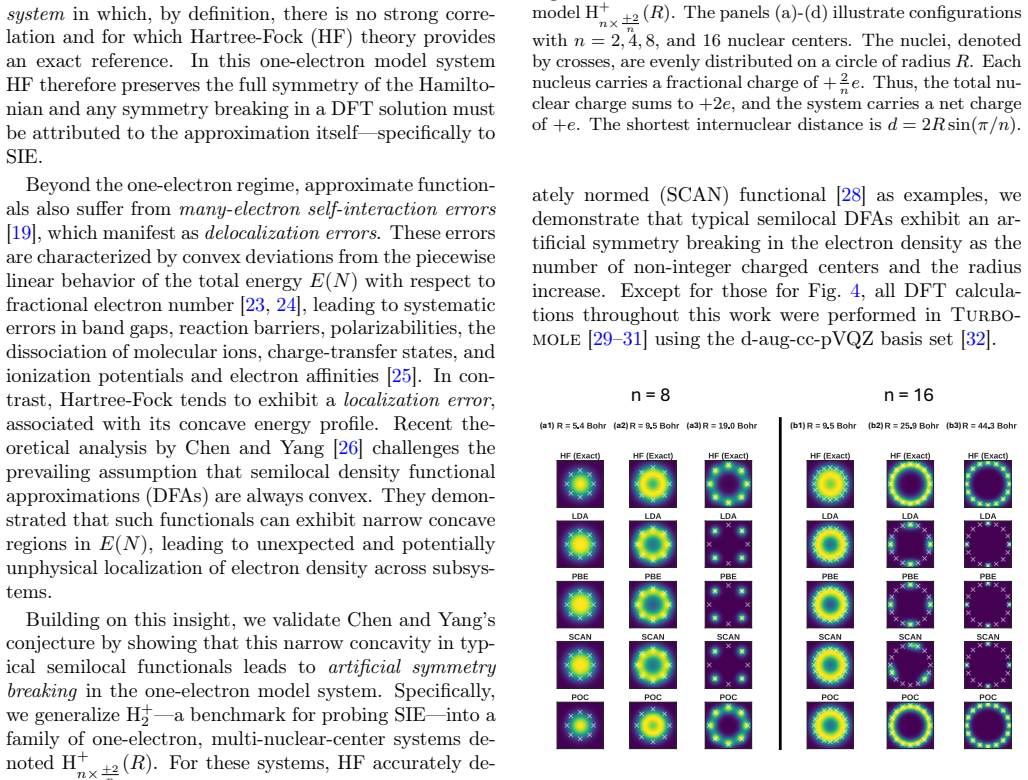
Using a one-electron, multicenter model $\mathrm{H}^+_{n\times(2/n)}(R)$ in which each of $n$ nuclei carries charge $+2/n$ and a single electron binds to the total charge $+2$, the authors show that the exact Hartree-Fock solution remains delocalized over all centers and preserves the global $C_n$ symmetry, while the semilocal functionals LDA, PBE, and SCAN break that symmetry by localizing the electron onto roughly four centers as $n$ and $R$ grow. Because the system contains only one electron, there is no strong correlation, so the only source of error in these functionals is self-interaction error. The paper further shows that this artificial symmetry breaking is a localization error, the opposite of the usual delocalization error, and traces it to a narrow concave region in the energy as a function of fractional particle number predicted in a recent analysis. A proof-of-concept semilocal functional constructed from the dissociation-limit scaling condition $F_x \propto s^{-2}$ removes the artifact in the model and substantially reduces it in the real-material case of the Ti$_{Zn}$v$_O$ defect in ZnO, where SCAN falsely lowers $C_{3v}$ to $C_{1h}$ while the hybrid HSE keeps $C_{3v}$.
Load-bearing premise
The load-bearing premise is that the localized, symmetry-broken densities computed for LDA, PBE, and SCAN are true lower-energy stationary states of those functionals rather than artifacts of the self-consistent-field convergence or the basis set; the paper does not report the energy of the symmetry-preserving solution for direct comparison.
Editorial extensions
If this is right
- If correct, the result implies that symmetry breaking observed with semilocal functionals in weakly correlated systems should not automatically be read as physical; a check against a hybrid or exact-exchange calculation is warranted.
- The proof-of-concept functional demonstrates that a semilocal form can satisfy the one-electron self-interaction condition in the dissociation limit, offering a new constraint for functional design beyond equilibrium norms.
- The localization error reported here acts oppositely to the usual delocalization error, so error-cancellation arguments that assume delocalization will misestimate semilocal failures in highly symmetric multicenter settings.
- For defect physics in wide-gap materials, the $C_{3v}$-breaking behavior of SCAN in Ti$_{Zn}$v$_O$ implies that self-interaction error can spuriously alter point-group symmetry, which matters for qubit candidate defects where symmetry controls spin properties.
Reading between the lines
- A natural test would be to scan $n$ continuously and locate the critical radius $R_c$ at which each functional first breaks symmetry; the supplemental videos show a gradual onset for $n=8$ and an abrupt three-to-four-center switch for SCAN at $n=16$, so the transition could be mapped as a function of functional parameters.
- Because the negative-curvature region of $E(N)$ is expected to be very narrow, the artifact should be highly sensitive to basis set and density fitting; comparing basis-set convergence would clarify whether the reported localization is intrinsic or numerically amplified.
- The scaling condition $F_x\propto s^{-2}$ is only justified in one-electron regions; extending it via density-Laplacian indicators of iso-orbital regions might yield a general-purpose functional that avoids SIE-driven symmetry breaking without sacrificing equilibrium accuracy.
Editorial analysis
A structured set of objections, weighed in public.
Referee Report
Summary. This paper investigates whether self-interaction error (SIE) alone can spuriously drive symmetry breaking in semilocal density functional approximations. It introduces a one-electron multicenter model H^+_{n×(2/n)}(R), with n fractional nuclei arranged on a circle of radius R. Hartree-Fock, being exact for one electron, preserves the global Cn symmetry and delocalizes the electron. The authors show that LDA, PBE, and SCAN converge to symmetry-broken localized electron densities for large R when n=8 and n=16. They derive a scaling condition (Eq. (5), Fx ∼ s^-2) that enforces Ex+EH=0 in the dissociation limit, and construct a proof-of-concept semilocal functional (POC, Eq. (6)) that avoids the localization artifact. The paper also presents a SCAN vs HSE calculation for the TiZnvO defect in ZnO, where SCAN breaks the C3v symmetry while HSE preserves it. The central interpretation is that SIE alone can create artificial symmetry breaking in approximate density functionals.
Significance. If substantiated, this result would provide the first clean demonstration that SIE alone—without strong correlation—can drive artificial symmetry breaking. The model is well chosen: with one electron there is no correlation, HF is exact, and the d-aug-cc-pVQZ basis is large. The dissociation-limit derivation of condition (5) is exact under the stated density-scaling assumption, and the connection to the Li-Yang concavity analysis supplies a mechanistic explanation for the localization. The POC functional is a constructive proof of concept, and the authors are careful to note its limitations for many-electron densities and near-equilibrium properties. However, the central numerical claim currently lacks one control calculation—the energy of the symmetry-preserving solution—and the POC functional depends on a hand-chosen parameter. These gaps do not invalidate the work but do temper the strength of the conclusion. Overall, the paper is a valuable contribution to the understanding of SIE in semilocal functionals.
major comments (2)
- [Fig. 3 and total-energy analysis] The central claim that LDA, PBE, and SCAN 'exhibit symmetry-breaking localization' rests on the converged SCF densities in Fig. 2. To attribute the broken densities to the functional rather than to the SCF algorithm, the paper must report the energy of the Cn-symmetric solution at the same R. The total energies in Fig. 3 are for the broken branch only; no symmetric-branch energies are given. If the symmetry-preserving solution has lower energy, the broken density is a metastable stationary state and the statement that the functional itself prefers symmetry breaking would not be established. I request symmetry-constrained calculations (for example, by symmetrizing the density or imposing occupation constraints) and an energy-difference plot for n=8 and n=16 around the onset of symmetry breaking.
- [POC functional, Eq. (6)] The proof-of-concept functional depends on the hand-chosen parameter a=2. The paper reports that the alternative value a=12.37, obtained from the hydrogen atom exchange energy, does not satisfy condition (5) in the energetically important region, but no systematic sensitivity analysis for a is provided. Because the POC is used to demonstrate that a semilocal functional can avoid the artifact, the robustness of that conclusion to the choice of a should be established, for instance by scanning a over a range and showing that the avoidance of symmetry breaking is not a fine-tuned accident.
minor comments (6)
- [Near Fig. 3] In the sentence 'the typical smilocal DFAs provide reasonable approximations', 'smilocal' should be 'semilocal'.
- [Reference [26] and text] The text attributes the analysis to 'Chen and Yang', but reference [26] is by Li and Yang; the citation should be corrected.
- [Abstract and model definition] The notation H^+_{n×(2/n)}(R) is used in the abstract without definition; please define it at first use, as is done later near Fig. 1.
- [Introduction] The phrase 'Many work have shown' should be 'Many works have shown'.
- [SCAN transition at R=32.5 Bohr] The abrupt SCAN transition from three-center to four-center occupation is interpreted as a degeneracy, but no energy comparison of the two states is shown; adding an energy-difference curve around R=32.5 Bohr would make this statement verifiable.
- [Fig. 2 caption and text] The description that the 'donut' densities do not lie precisely on the nuclear circle is confusing; please clarify whether this is a basis-set or functional effect and define what 'precisely' means quantitatively.
Circularity Check
No significant circularity: the central symmetry-breaking claim is an observed discrepancy against an exact one-electron HF reference, and the POC functional is a constructive test with independently fixed parameters; the only flag is one minor, non-load-bearing self-citation (Ref. 38).
-
other
[p. 3-4, POC paragraph following Eqs. (4)-(5), sentence before the POC form Eq. (6).]
"We rationalize in the Supplemental Material [33, 37, 38] why this condition also removes the region of negative curvature."
The mechanism premise that condition (5) (Fx ∝ s^{-2}) also removes the region of negative curvature of E(N) is what makes the POC functional expected to avoid the symmetry-breaking artifact; the paper defers the justification to 'the Supplemental Material [33, 37, 38]', where Ref. [38] is a 'submitted' manuscript by the present co-authors Lebeda and Sun (overlapping authorship). This is a self-citation supporting a load-bearing mechanism claim. It is not uniquely load-bearing because the paper states the rationalization is also in its own Supplemental Material, which is in-scope evidence, and the central empirical claims are anchored to the exact HF reference and to external results (Perdew-Zunger Eq. (1); Li and Yang Ref. [26]).
full rationale
The central derivation chain is not circular. The reference is exact for the test systems: the paper states 'Hartree-Fock (HF) theory provides an exact reference' and that 'any symmetry breaking in a DFT solution must be attributed to the approximation itself—specifically to SIE'; for one-electron densities the Perdew-Zunger condition Ex[ρ]+EH[ρ]=0, Ec[ρ]=0 (Eq. 1) is the sole definition of the approximation's error, so the observed LDA/PBE/SCAN symmetry breaking and HF symmetry preservation is a controlled numerical discrepancy against an exact benchmark, not a fitted or renamed input. The functional-design chain is also open: Eqs. (2)-(5) derive Fx ∝ s^{-2} from Eq. (1) by uniform density scaling, a closed derivation that does not assume the target outcome; the POC form, Eq. (6), has independently fixed parameters (h0 = 1.174 from the two-electron tight bound; a = 2 by a stated compromise between satisfying Eq. (5) and numerical stability, with the a = 12.37 variant explicitly noted as not fulfilling condition (5) in the energetically important region), and the symmetry behavior is then observed, with honest partial failures (slight overlocalization for n = 8, residual delocalization for n = 16) that a tuned-to-succeed construction would not report. The one flagged self-citation, Ref. [38], backs the mechanism rationalization but is accompanied by the in-paper Supplemental Material and external Ref. [37], so no result reduces to it. The TiZnvO section calibrates HSE through the authors' prior work [22], but the SCAN-versus-HSE symmetry contrast is an independent observation. A non-circularity caveat: the paper reports energies of the converged broken branch (Fig. 3) but never the energy of the Cn-symmetric solution at the same R, so whether the functional energetically prefers breaking or the SCF rests in a metastable state is unverified; this evidential gap weakens the strongest inference but is not a reduction of any claim to its own inputs.
Assumptions & free parameters
free parameters (1)
- POC parameter a =
2
assumptions (4)
- standard math Exact condition for freedom from SIE for one-electron densities: Ex[ρ] + EH[ρ] = 0 and Ec[ρ] = 0 (Perdew-Zunger, Eq. 1 of the paper)
- domain assumption Hartree-Fock is exact for one-electron systems
- standard math Semilocal DFAs can have narrow concave regions in E(N) for small fractional charge (Li and Yang 2017)
- standard math Density scaling relation sδ = (1+δ)^{-1/3} s0, used to reduce condition (4)
Cite this review
Pith. "Pith review of Artificial Symmetry Breaking by Self-Interaction Error." pith.science (2026). https://pith.science/paper/YAXU22FC
@misc{pith2026250620662,
  author       = {Pith},
  title        = {Pith review of: Artificial Symmetry Breaking by Self-Interaction Error},
  year         = {2026},
  howpublished = {\url{https://pith.science/paper/YAXU22FC}},
  note         = {Machine review of arXiv:2506.20662}
}
abstract
Symmetry is a cornerstone of quantum mechanics and materials theory, underpinning the classification of electronic states and the emergence of complex phenomena such as magnetism and superconductivity. While symmetry breaking in density functional theory can reveal strong electron correlation, it may also arise spuriously from self-interaction error (SIE), an intrinsic flaw in many approximate exchange-correlation functionals. In this work, we present clear evidence that SIE alone can induce artificial symmetry breaking, even in the absence of strong correlation. Using a family of one-electron, multi-nuclear-center systems \( \mathrm{H}^+_{n \times \frac{+2}{n}}(R) \), we show that typical semilocal density functionals exhibit symmetry-breaking localization as system size increases, deviating from the exact, symmetry-preserving Hartree-Fock solution. We further demonstrate that this localization error contrasts with the well-known delocalization error of semilocal density functionals and design a semilocal density functional that avoids the artifact. Finally, we illustrate the real-world relevance of this effect in the \ch{Ti_{Zn}v_O} defect in ZnO, where a semilocal density functional breaks the $C_{3v}$ symmetry while a hybrid density functional preserves it. These findings highlight the need for improved functional design to prevent spurious symmetry breaking in both model and real materials.
Figures


Figures from the paper (1 more)

Forward citations
Cited by 1 Pith paper
-
Electron Localization in Non-Compact Covalent Bonds Captured by the r2SCAN+V Approach
All five tested r2SCAN failures — graphene, Cr2, VO2, Cr, Fe — share one mechanism: electrons are localized at atoms but under-localized between nuclei in non-compact covalent bonds, and a fitted inter-site +V correct...
Reference graph
Works this paper leans on
-
[1]
J. Bardeen, L. N. Cooper, and J. R. Schrieffer, Theory of superconductivity, Physical Review108, 1175 (1957)
work page 1957
-
[2]
J. R. Schrieffer,Theory of superconductivity, 1st ed. (CRC press, 1999)
work page 1999
-
[3]
Tinkham,Introduction to superconductivity, 2nd ed
M. Tinkham,Introduction to superconductivity, 2nd ed. (Dover Publications, Mineola, N.Y., 2004)
work page 2004
-
[4]
V. L. Ginzburg, V. L. Ginzburg, and L. D. Landau,On the theory of superconductivity(Springer, Berlin, Heidel- berg, 2009)
work page 2009
-
[5]
L. E. Sadler, J. M. Higbie, S. R. Leslie, M. Vengalattore, and D. M. Stamper-Kurn, Spontaneous symmetry break- inginaquenchedferromagneticspinorbose–einsteincon- densate, Nature443, 312 (2006)
work page 2006
-
[6]
Nakahara,Geometry, topology and physics, 2nd ed
M. Nakahara,Geometry, topology and physics, 2nd ed. (CRC press, 2003)
work page 2003
-
[7]
Hohenberg and W
P. Hohenberg and W. Kohn, Inhomogeneous electron gas, Physical Review136, B864 (1964)
1964
-
[8]
J. P. Perdew, A. Ruzsinszky, J. Sun, N. K. Nepal, and A. D. Kaplan, Interpretations of ground-state symme- try breaking and strong correlation in wavefunction and density functional theories, Proceedings of the National Academy of Sciences118, e2017850118 (2021)
work page 2021
Show all 54 references
-
[9]
Zhang, J
Y. Zhang, J. Furness, R. Zhang, Z. Wang, A. Zunger, and J. Sun, Symmetry-breaking polymorphous descrip- tions for correlated materials without interelectronic u, Physical Review B102, 045112 (2020)
2020
-
[10]
Gunnarsson and B
O. Gunnarsson and B. I. Lundqvist, Exchange and corre- lationinatoms, molecules, andsolidsbythespin-density- functional formalism, Physical Review B13, 4274 (1976)
1976
-
[11]
Zhang, C
Y. Zhang, C. Lane, J. W. Furness, B. Barbiellini, J. P. Perdew, R. S. Markiewicz, A. Bansil, and J. Sun, Com- peting stripe and magnetic phases in the cuprates from first principles, Proceedings of the National Academy of Sciences117, 68 (2020)
2020
-
[12]
Zhang, C
R. Zhang, C. Lane, J. Nokelainen, B. Singh, B. Barbi- ellini, R.S.Markiewicz, A.Bansil,andJ.Sun,Emergence of competing stripe phases in undoped infinite-layer nick- elates, Physical Review Letters133, 066401 (2024)
2024
-
[13]
Trimarchi, Z
G. Trimarchi, Z. Wang, and A. Zunger, Polymorphous band structure model of gapping in the antiferromagnetic and paramagnetic phases of the mott insulators mno, feo, coo, and nio, Physical Review B97, 035107 (2018)
2018
-
[14]
Varignon, M
J. Varignon, M. Bibes, and A. Zunger, Origin of band gaps in 3 d perovskite oxides, Nature communications 10, 1658 (2019)
2019
-
[15]
Zunger, Bridging the gap between density functional theory and quantum materials, Nature computational science2, 529 (2022)
A. Zunger, Bridging the gap between density functional theory and quantum materials, Nature computational science2, 529 (2022). 6
2022
-
[16]
J. P. Perdew, M. Ernzerhof, K. Burke, and A. Savin, On-top pair-density interpretation of spin density func- tional theory, with applications to magnetism, Interna- tional journal of quantum chemistry61, 197 (1997)
1997
-
[17]
J. P. Perdew and A. Zunger, Self-interaction correction to density-functional approximations for many-electron systems, Physical Review B23, 5048 (1981)
1981
-
[18]
Ruzsinszky, J
A. Ruzsinszky, J. P. Perdew, G. I. Csonka, O. A. Vydrov, and G. E. Scuseria, Spurious fractional charge on dissoci- ated atoms: Pervasive and resilient self-interaction error of common density functionals, The Journal of Chemical Physics125, 194112 (2006)
2006
-
[19]
Mori-Sánchez, A
P. Mori-Sánchez, A. J. Cohen, and W. Yang, Many- electron self-interaction error in approximate density functionals, The Journal of Chemical Physics125, 201102 (2006)
2006
-
[20]
Kronik and S
L. Kronik and S. Kümmel, Piecewise linearity, freedom from self-interaction, and a coulomb asymptotic poten- tial: three related yet inequivalent properties of the exact density functional, Physical Chemistry Chemical Physics 22, 16467 (2020)
2020
-
[21]
Karapatzakis, J
I. Karapatzakis, J. Resch, M. Schrodin, P. Fuchs, M. Ki- eschnick, J. Heupel, L. Kussi, C. Sürgers, C. Popov, J. Meijer,et al., Microwave control of the tin-vacancy spin qubit in diamond with a superconducting waveg- uide, Physical Review X14, 031036 (2024)
2024
-
[22]
Zhang, T
S. Zhang, T. Park, E. Perez, K. Li, X. Wang, Y. Wang, J. D. V. Bazantes, R. Zhang, J. Sun, K.-M. C. Fu, H. Seo, and Y. Ping, arXiv:2502.00551
-
[23]
Mori-Sánchez, A
P. Mori-Sánchez, A. J. Cohen, and W. Yang, Localiza- tion and delocalization errors in density functional the- ory and implications for band-gap prediction, Physical Review Letters100, 146401 (2008)
2008
-
[24]
K. R. Bryenton, A. A. Adeleke, S. G. Dale, and E. R. Johnson, Delocalization error: The greatest outstanding challenge in density-functional theory, Wiley Interdisci- plinary Reviews: Computational Molecular Science13, e1631 (2023)
2023
-
[25]
A. J. Cohen, P. Mori-Sánchez, and W. Yang, Insights into current limitations of density functional theory, Science 321, 792 (2008)
2008
-
[26]
Li and W
C. Li and W. Yang, On the piecewise convex or concave nature of ground state energy as a function of fractional number of electrons for approximate density functionals, The Journal of Chemical Physics146, 074107 (2017)
2017
-
[27]
J. P. Perdew, K. Burke, and M. Ernzerhof, Generalized gradient approximation made simple, Physical Review Letters77, 3865 (1996)
1996
-
[28]
J. Sun, A. Ruzsinszky, and J. P. Perdew, Strongly con- strained and appropriately normed semilocal density functional, Physical Review Letters115, 036402 (2015)
2015
-
[29]
S. G. Balasubramaniet al., TURBOMOLE: Modu- lar program suite forab initioquantum-chemical and condensed-matter simulations, The Journal of Chemical Physics152, 184107 (2020)
2020
-
[30]
Weigend, M
F. Weigend, M. Häser, H. Patzelt, and R. Ahlrichs, Ri- mp2: Optimized auxiliary basis sets and demonstration of efficiency, Chemical Physics Letters294, 143 (1998)
1998
-
[31]
Neese, An improvement of the resolution of the iden- tity approximation for the formation of the coulomb and exchange matrix, Journal of Computational Chemistry 24, 1740 (2003)
F. Neese, An improvement of the resolution of the iden- tity approximation for the formation of the coulomb and exchange matrix, Journal of Computational Chemistry 24, 1740 (2003)
2003
-
[32]
T. H. Dunning, Gaussian basis sets for use in correlated molecular calculations. I. The atoms boron through neon and hydrogen, The Journal of Chemical Physics90, 1007 (1989)
1989
-
[33]
Additionally, we provide videos of a contin- uous variation of the radius in the digital Supplemental Material
See Supplemental Material at [URL will be inserted by publisher] for details on the derivation of the condition Fx ∝s −2, a discussion of the divergence of the curvature ofE(N)ingeneralized gradientapproximations, total en- ergy errors at the Hartree-Fock equilibrium, an energ...
-
[34]
J. P. Perdew, R. G. Parr, M. Levy, and J. L. Balduz Jr, Density-functional theory for fractional particle number: derivative discontinuities of the energy, Physical Review Letters49, 1691 (1982)
1982
-
[35]
A. D. Becke, Correlation energy of an inhomogeneous electron gas: A coordinate-space model, The Journal of Chemical Physics88, 1053 (1988)
1988
-
[36]
shape of the correlation potential and diamagnetic susceptibility for atoms, Physical Review A32, 2010 (1985)
M.LevyandJ.P.Perdew,Hellmann-feynman, virial, and scaling requisites for the exact universal density function- als. shape of the correlation potential and diamagnetic susceptibility for atoms, Physical Review A32, 2010 (1985)
1985
-
[37]
Singh, P
N. Singh, P. Elliott, T. Nautiyal, J. K. Dewhurst, and S. Sharma, Adiabatic generalizedgradient approximation kernel in time-dependent density functional theory, Phys- ical Review B99, 035151 (2019)
2019
-
[38]
Oueis, A
Y. Oueis, A. Ramasamy, J. W. Furness, J. Kidd, T. Lebeda, and J. Sun, submitted
-
[39]
Levy and J
M. Levy and J. P. Perdew, Tight bound and convex- ity constraint on the exchange-correlation-energy func- tional in the low-density limit, and other formal tests of generalized-gradient approximations, Physical Review B 48, 11638 (1993)
1993
-
[40]
J. P. Perdew, A. Ruzsinszky, J. Sun, and K. Burke, Gedanken densities and exact constraints in density func- tional theory, The Journal of Chemical Physics140, 18A533 (2014)
2014
-
[41]
Aschebrock and S
T. Aschebrock and S. Kümmel, Ultranonlocality and ac- curate band gaps from a meta-generalized gradient ap- proximation, Physical Review Research1, 033082 (2019)
2019
-
[42]
J. W. Furness, A. D. Kaplan, J. Ning, J. P. Perdew, and J. Sun, Accurate and numerically efficient r2scan meta-generalized gradient approximation, The Journal of Physical Chemistry Letters11, 8208 (2020)
2020
-
[43]
Mejía-Rodríguez and S
D. Mejía-Rodríguez and S. Trickey, Meta-gga perfor- mance in solids at almost gga cost, Physical Review B 102, 121109 (2020)
2020
-
[44]
Lebeda, T
T. Lebeda, T. Aschebrock, J. Sun, L. Leppert, and S. Kümmel, Right band gaps for the right reason at low computational cost with a meta-gga, Physical Review Materials7, 093803 (2023)
2023
-
[45]
Lebeda, T
T. Lebeda, T. Aschebrock, and S. Kümmel, Balancing the contributions to the gradient expansion: Accurate binding and band gaps with a nonempirical meta-GGA, Physical Review Letters133, 136402 (2024)
2024
-
[46]
Lebeda and S
T. Lebeda and S. Kümmel, Meta-GGA that describes weak interactions in addition to bond energies and band gaps, Physical Review B111, 155133 (2025)
2025
-
[47]
A. Giri, C. Shahi, and A. Ruzsinszky, arXiv:2506.03578
-
[48]
Luise, C.-W
G. Luise, C.-W. Huang, T. Vogels, D. Kooi, S. Ehlert, S. Lanius, K. Giesbertz, A. Karton, D. Gunceler, M. Stanley, W. Bruinsma, L. Huang, X. wei, J. Gar- rido Torres, A. Katbashev, B. Máté, S.-O. Kaba, R. Sor- 7 dillo, Y. Chen, D. B. Williams-Young, C. Bishop, J. Hermann, R. v...
-
[49]
Ramasamy, L
A. Ramasamy, L. Hou, J. V. Bazantes, T. J. P. Irons, A. M. Wibowo-Teale, T. Lebeda, and J. Sun, arXiv:2410.08887
-
[50]
Kresse and J
G. Kresse and J. Hafner, Ab initio molecular dynamics for open-shell transition metals, Physical Review B48, 13115 (1993)
1993
-
[51]
Kresse and J
G. Kresse and J. Furthmüller, Efficient iterative schemes for ab initio total-energy calculations using a plane-wave basis set, Physical Review B54, 11169 (1996)
1996
-
[52]
Kresse and D
G. Kresse and D. Joubert, From ultrasoft pseudopoten- tials to the projector augmented-wave method, Physical Review B59, 1758 (1999)
1999
-
[53]
J. Heyd, G. E. Scuseria, and M. Ernzerhof, Hybrid func- tionals based on a screened coulomb potential, The Jour- nal of chemical physics118, 8207 (2003)
2003
-
[54]
Zhang, J
Y. Zhang, J. W. Furness, B. Xiao, and J. Sun, Subtlety of tio2 phase stability: Reliability of the density functional theory predictions and persistence of the self-interaction error, The Journal of chemical physics150(2019)
2019
Reviewed August 6, 2026 · model on record in the stance chip above.
Discussion (0). Sign in to comment.