REVIEW 4 major objections 3 minor 36 references
Heterogeneous response and non-Markovianity in the microrheology of semisolid viscoelastic materials
T0 review · 4 major / 3 minor · reviewed 2026-08-07 · deepseek-v4-flash
Pith's one-line read This paper argues that a single fitted exponent α, extracted from particle-tracking data on semisolid materials, quantifies micro-heterogeneity and predicts the low-frequency loss modulus.
desk verdict Transparent numerical follow-up to the NM-KVMH model, but the Prony approximation means the simulations validate the approximate equations, not the original hallmarks. read the letter →
The pith
A machine-rendered reading of the paper's core claim, the machinery that carries it, and where it could break.
The reading
What carries the argument
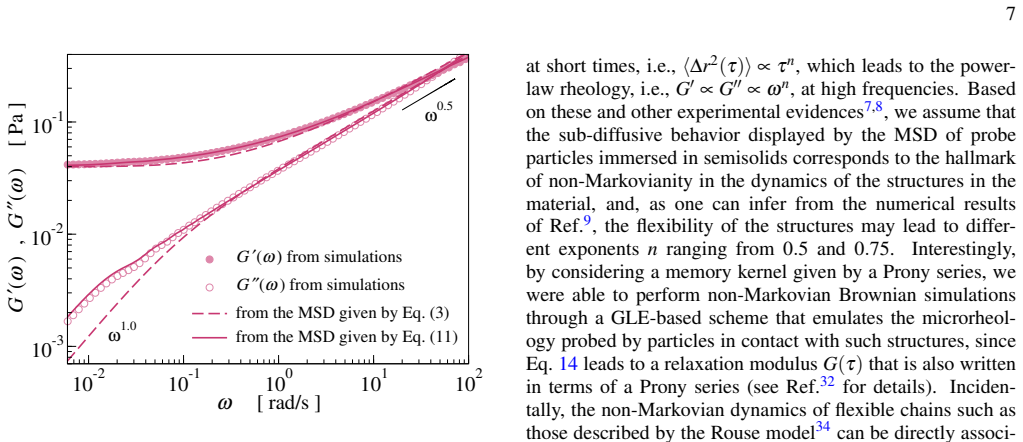
The argument is carried by a regional-average construction: the measured mean squared displacement is the integral over mesoscopic regions, $\langle\Delta x^2(\tau)\rangle=\int_0^\infty \langle\Delta x^2(\tau)\rangle_\xi\,\rho(\xi)\,d\xi$, in which each region is labeled by a single random variable $\xi$ drawn from the generalized gamma distribution $\rho(\xi)=\xi^{-(1-p)}e^{-\xi}/\Gamma(p)$. Heterogeneity enters through the rule that every local Prony relaxation time rescales as $\gamma_{j,\xi}=(p/\xi)\gamma^*_j$, so one parameter $p$ — whose counterpart in the closed-form model is $\alpha$ — carries all the disorder. The average yields two closed-form results: the MSD $\langle\Delta x^2(\tau)\rangle=2k_BT/\kappa-\sum_{j=1}^{N+1}q^*_j\,[1+\tau/(p\gamma^*_j)]^{-p}$ and its derivative $D(\tau)$, the time-dependent diffusion coefficient. Numerically, the machinery is a Prony-series simulation scheme: the stretched-exponential local MSD with exponent $n=0.5$ is approximated by an eight-mode sum of exponentials, converted through the generalized Stokes–Einstein relation into a Prony memory kernel $\mu_\xi(\tau)=\mu_{0,\xi}\,\delta(\tau)-\sum_j c_{j,\xi}e^{-\tau/\Lambda_{j,\xi}}$, and integrated through $N+1$ coupled stochastic differential equations, one trajectory per heterogeneity realization, with parameters recomputed per trajectory as in Appendix A. This last step is what makes it possible to interpret micro-heterogeneities as a distribution of local mobilities, i.e., local viscosities. Two acknowledged limits of this machinery are that the Prony approximation works only for $\tau\ge 0.1$ s and that Eqs. (11)–(12) are not strictly equivalent to Eqs. (5)–(6) of the closed-form model.
What would settle it
Measure the mean squared displacement and the linear shear moduli on the same gel, fit the MSD to Eq. (5) to extract $\alpha$, and check whether the independently measured low-frequency loss modulus follows the predicted power law $G''(\omega)\propto\omega^{\alpha n}$ whenever $\alpha n<1$; a gel whose MSD fit gives $\alpha n<1$ but whose loss modulus stays linear in $\omega$ would falsify the central claim. A more direct check is to map the local mechanical properties with a spatially resolved probe, such as AFM indentation or optical-trap compliance scans, and compare the measured distribution of local relaxation times with the generalized gamma distribution implied by the fitted $\alpha$; a substantial mismatch would show that the single-parameter gamma ansatz is not an accurate description of the material's actual heterogeneity.
Extended reading notes
Core claim
The central claim is that the hallmark of micro-heterogeneities on probe particles in semisolids is a smooth crossover between the power-law and plateau regimes in the mean squared displacement, which leads to the more identifiable power-law behavior of the time-dependent diffusion coefficient at later times, $D(\tau)\propto\tau^{-(1+\alpha n)}$, where $\alpha$ is a single parameter that characterizes the distribution of local viscoelastic properties. The paper further claims that this same parameter, extracted by fitting experimental MSD data to the non-Markovian Kelvin–Voigt model with micro-heterogeneities (NM-KVMH), predicts the low-frequency loss modulus, $G''(\omega)\propto\omega^{\alpha n}$ when $\alpha n<1$, in contrast to the linear $G''\propto\omega$ of homogeneous viscoelastic models, and that heterogeneous response makes displacement distributions non-Gaussian at short times. To support these claims the authors build a simulation scheme that emulates a real microrheology experiment: the stretched-exponential local MSD of the NM-KV model (the same model without heterogeneities) is approximated by an eight-mode Prony series, a finite sum of exponentials, each simulated trajectory receives its own heterogeneity variable drawn from the generalized gamma distribution, and the overdamped generalized Langevin equation, a stochastic equation of motion with a memory kernel, is integrated through coupled stochastic differential equations. The simulated MSD, diffusion coefficient, van Hove distributions, and shear moduli agree with the analytical model and reproduce qualitatively the experimental behavior of polyacrylamide, $\beta$-lactoglobulin, and colloidal gels. The paper itself notes, in Secs. II and IV, that the Prony approximation is accurate only for $\tau\ge 0.1$ s and that the resulting model is not strictly equivalent to the closed-form NM-KVMH at early and late times.
Load-bearing premise
The entire framework depends on the assumption that all micro-heterogeneity of a real semisolid is captured by a single random number per region, with every local relaxation time rescaled by the same fixed factor and those numbers drawn from one particular distribution the model chooses; if real materials distribute their local stiffnesses and viscosities in any other way, the fitted heterogeneity parameter $\alpha$ and the predicted low-frequency loss modulus would be systematically wrong.
Editorial extensions
If this is right
- One fit of an experimental MSD to Eq. (5) delivers $\alpha$, and the same $\alpha$ fixes the late-time tail of the time-dependent diffusion coefficient, $D(\tau)\propto\tau^{-(1+\alpha n)}$, with no second measurement required.
- For heterogeneous samples with $\alpha n<1$, the low-frequency loss modulus should rise as $G''(\omega)\propto\omega^{\alpha n}$ rather than linearly, so conventional bulk rheology can confirm or challenge the heterogeneity parameter extracted from particle tracking.
- Displacement (van Hove) distributions from the simulations show clearly non-Gaussian excess kurtosis at short times that decays at later times, meaning single-particle tracking histograms reveal heterogeneity directly, not only through averaged quantities.
- The GLE scheme generates statistically faithful single-particle trajectories for a heterogeneous semisolid, so the same code can be applied to other observables of the model, such as two-time correlations or first-passage statistics, without new analytical work.
- Because the heterogeneous response is equivalent to a distribution of local viscosities, the effective zero-shear viscosity of the heterogeneous model exceeds that of the homogeneous model at the same mean parameters, as the simulated moduli in Fig. 4 show.
Reading between the lines
- A decisive test of the model would map local mechanical properties directly, for instance by AFM indentation or optical-trap compliance scans across a gel, and compare the measured distribution of relaxation times with the gamma form implied by the fitted $\alpha$; the previous validation of the gamma ansatz relied on displacement statistics, not on direct local mechanical measurements.
- Materials with two coexisting sources of heterogeneity, such as a bimodal distribution of pore or cross-link sizes, would break the single-parameter assumption; the same averaging integral that produces Eq. (11) could host a mixture distribution and still give closed-form MSDs, offering a direct way to test whether one parameter ever suffices.
- Because the Prony approximation and the closed-form NM-KVMH disagree at early and late times, the practical rule that follows from the paper's own comparisons is to fit experimental data with Eqs. (5)–(6) and then verify that the extracted $\alpha$ also reproduces the measured $D(\tau)$ tail and the low-frequency loss modulus.
- The predicted short-time excess kurtosis is cheap to check: existing single-particle-tracking datasets on gels already contain full displacement histograms, so the predicted non-Gaussian signature and its decay can be tested on published data before any new experiment is run.
Editorial analysis
A structured set of objections, weighed in public.
Referee Report
Summary. The paper presents GLE-based Brownian simulations intended to validate the non-Markovian Kelvin-Voigt model with micro-heterogeneities (NM-KVMH). The authors approximate the local NM-KV mean squared displacement by a Prony series (Eq. 9, Table I), average over a generalized gamma distribution of local relaxation times (Eqs. 7-10), and derive approximate closed forms for the ensemble-averaged MSD and time-dependent diffusion coefficient (Eqs. 11-12). They then simulate the corresponding overdamped GLE, report agreement between simulation and Eqs. 11-12, and examine non-Gaussian displacement distributions and shear moduli. The paper claims that the hallmark of micro-heterogeneity is a smooth crossover in the MSD and a power-law tail in D(τ), and that fitting Eq. 5 yields a single heterogeneity parameter α that predicts low-frequency loss-modulus behavior.
Significance. If the central claim is correct, the paper offers a practical framework: a single parameter α extracted from a microrheology MSD would characterize micro-heterogeneity and predict both D(τ) tails and low-frequency G''(ω) behavior. The analytical Prony averaging is carried out explicitly, and the numerical implementation appears to reproduce Eqs. 11-12 faithfully, which is a useful technical validation of the simulation scheme. The non-Gaussian displacement distributions in Fig. 3 provide a concrete, potentially falsifiable prediction. However, the significance is reduced by the fact that the simulations do not directly test the original NM-KVMH equations, Eqs. 5-6, and the validation is partly by construction because the averaging is performed over the same assumed gamma distribution used to derive the model.
major comments (4)
- [Sec. IV, Fig. 2, Eqs. 11-12 vs Eqs. 5-6] The simulations do not test the original NM-KVMH hallmarks because the Prony approximation is used and is valid only for τ ≥ 0.1 s, with a finite limit for D(τ→0) instead of the true diverging τ^{n-1} behavior. The paper itself states that Eqs. 11-12 are 'not strictly equivalent' to Eqs. 5-6, and Fig. 2(b) shows that Eq. 6 predicts D(τ) ∝ τ^{-2.5} while Eq. 12 gives D(τ) ∝ τ^{-0.7}, with the numerical data changing from one regime to the other at later times. Consequently, the agreement between simulation and Eqs. 11-12 validates only the Prony-averaged model, not the model used for experimental interpretation in Fig. 1 and for the central claim that D(τ) ∝ τ^{-(1+αn)} at later times. This is a load-bearing gap that must be addressed, either by rephrasing the simulation claims in terms of the approximate model or by providing numerical evidence for the original equations.
- [Sec. IV, Fig. 2(b), Eq. 6] The fitted value α ≈ 3 from the MSD does not predict the simulated D(τ) tail: Eq. 6 with α ≈ 3 gives D(τ) ∝ τ^{-2.5}, while the simulation follows the Prony-averaged prediction τ^{-0.7}. Because the paper explicitly proposes that fitting Eq. 5 yields an α that characterizes heterogeneity and predicts the later-time D(τ) behavior and low-frequency G''(ω), this discrepancy undermines the predictive link. A direct test of Eq. 6 on simulated trajectories that actually follow the NM-KVMH local dynamics, or a clear demonstration of how the Prony approximation preserves the α-dependence at relevant timescales, is needed.
- [Sec. IV, Fig. 4] The claimed low-frequency loss-modulus hallmark G''(ω) ∝ ω^{αn} is not tested by the presented simulations. The paper notes that for the simulated case α ≈ 3 and n = 0.5, so αn ≈ 1.5, which yields a linear G''(ω) rather than the power-law regime that is the stated hallmark for αn < 1. Thus Fig. 4 cannot support the conclusion that micro-heterogeneities produce the power-law loss modulus observed in Fig. 1. The authors should either simulate a parameter set with αn < 1 or obtain G''(ω) directly from Eq. 5 to demonstrate the predicted scaling.
- [Sec. II, Eqs. 8 and 10] The generalized gamma distribution and the scaling relation γ_{j,ξ} = (p/ξ)γ*_j are assumed rather than independently validated. Since the simulation averages over this assumed distribution, the agreement with Eqs. 11-12 is expected by construction and cannot serve as independent evidence for the gamma-distribution ansatz. The paper should discuss this limitation explicitly and, ideally, test sensitivity to alternative heterogeneity distributions or compare against independent measurements of local viscoelastic properties or van Hove distributions beyond the fits to the model's own expressions.
minor comments (3)
- [Throughout] The text contains typographical issues such as 'V oigt' instead of 'Voigt' in the introduction; these should be corrected in a final revision.
- [Sec. III, Eq. 17] The notation for the stochastic terms is slightly confusing: ε_j(t) is defined as N_j(0,1)√Δt, but later in the same equation the noise is written with ε_0(t) and ε_j(t); clarifying that these are independent increments would improve readability.
- [Sec. IV, Fig. 3(i)] The kurtosis figure labels (a)-(h) and the corresponding text are not fully aligned with the panel descriptions; adding explicit time values to the panel labels in the text would help the reader connect the figure to the narrative.
Circularity Check
The numerical validation of the NM-KVMH hallmarks is largely a self-consistency check: the simulations and the analytic curves compared with them are generated from the same gamma-distribution averaging ansatz and Prony parameters imported from the authors' prior Refs.
-
ansatz smuggled in via citation
[Sec. II (Eqs. 7-10) and Sec. IV (Eqs. 11-12, Fig. 2)]
"Based on the ideas of Ref. 6 and following the approach used to obtain the Markovian KVMH model4, we assume that the MSD can be evaluated as the average over trajectories where different probe particles experience different viscoelastic properties due to micro-heterogeneities... As detailed in Ref. 6, the exponent α characterizes a generalized gamma distribution... we consider that q_{j,ξ}=q*_j and that... the characteristic times scale as γ_{j,ξ}=(p/ξ)γ*_j."
This is the defining ansatz of the NM-KVMH model: Eq. (7) is the same averaging prescription, Eq. (8) the same generalized-gamma distribution, and Eq. (10) the same scaling used in Ref. 6 to obtain Eqs. (5)-(6). The simulations are then constructed from this same local Prony MSD with the same q*_j, γ*_j and ξ, and the numerical curves are compared with Eqs. (11)-(12), which are simply the result of inserting Eq. (9) into Eq. (7). The match therefore verifies that the SDE integrator implements the authors' ansatz; it is not an independent test of the physical model. The paper itself limits the claim to validating 'the non-Markovian numerical scheme.'
-
self citation load bearing
[Sec. V, Concluding Remarks]
"From the ideas of our previous studies 4,6 and the analysis of the experimental data presented in Fig. 1, we established that the hallmark of the influence of micro-heterogeneities on the dynamics of probe particles immersed in semisolids is a smooth crossover between the power-law and plateau regimes in the mean squared displacement, which leads to the more identifiable power-law behavior observed in the time-dependent diffusion coefficient D(τ) at later times."
The central claim of the paper is explicitly grounded in the authors' own Refs. 4 and 6 rather than in a derivation or out-of-sample test presented here. The new simulations in Fig. 2 do not reproduce the D(τ) tail of Eq. (6): the paper notes that with p=0.7, Eq. (6) gives D∝τ^{−2.5} while Eq. (12) gives D∝τ^{−0.7}, and the data 'seem to change from one regime to the other.' The experimental panels in Fig. 1 are fits of published data to Eqs. (5)-(6), which are the equations imported from Ref. 6. Hence the load-bearing support for the hallmark is a self-citation chain, not independent evidence.
full rationale
The paper's own text contains the key limitation statements: the Prony approximation 'works only for a restricted temporal window, i.e., τ≥0.1 s' and 'the above expressions are not strictly equivalent to the expressions of the NM-KVMH, i.e., Eqs. 5 and 6'; Eq. (12) yields D∝τ^{−0.7} instead of the Eq. (6) prediction D∝τ^{−2.5}; and the simulated case αn≈1.5 gives a linear G″(ω) rather than the claimed G″∝ω^{αn} hallmark. These admissions show that the numerical experiments validate only the approximated Prony-averaged model (Eqs. 11-12), which is derived from the same gamma-distribution ansatz used to define the NM-KVMH, and not the central hallmarks Eqs. (5)-(6) used to interpret experimental data. The experimental fits in Fig. 1 do use external published data, which is genuine evidence, but they fit the very model taken from the authors' prior Ref. 6 and are not independent predictions. On balance the central claim is partly circular: the simulation 'prediction' is a self-consistency check of the authors' ansatz, and the hallmark is anchored in self-citation. However, the paper is transparent about the approximation and does implement a nontrivial GLE simulation scheme, so a score of 6 (partial circularity) is appropriate rather than 8 or 10.
Assumptions & free parameters
free parameters (4)
- Gamma distribution shape p (or alpha) =
p=0.7 (simulation); alpha≈3 (fit to Eq. 5 in Fig. 2 inset)
- Exponent n of NM-KV power law =
0.5
- Prony reference amplitudes q*_j and times gamma*_j (Table I) =
Listed in Table I
- Characteristic time tau_c =
Not quoted; used in fits of Eqs. 3 and 5 in Fig. 2
assumptions (5)
- domain assumption The generalized Stokes-Einstein relation (Eq. 13) connecting the MSD Laplace transform to the memory function holds for each mesoscopic region.
- ad hoc to paper The memory kernel can be written as a Prony series with a delta function plus N exponentials (Eq. 14).
- ad hoc to paper Micro-heterogeneities are described by a generalized gamma distribution ρ(ξ) = ξ^{-(1-p)} e^{-ξ}/Γ(p) (Eq. 8).
- ad hoc to paper The local relaxation times scale as γ_{j,ξ} = (p/ξ) γ*_j (Eq. 10) across all modes.
- domain assumption The Prony series with N=7 modes adequately approximates the NM-KV MSD for the time window of interest (τ ≥ 0.1 s).
Cite this review
Pith. "Pith review of Heterogeneous response and non-Markovianity in the microrheology of semisolid viscoelastic materials." pith.science (2026). https://pith.science/paper/3G56U5CR
@misc{pith2026250605311,
  author       = {Pith},
  title        = {Pith review of: Heterogeneous response and non-Markovianity in the microrheology of semisolid viscoelastic materials},
  year         = {2026},
  howpublished = {\url{https://pith.science/paper/3G56U5CR}},
  note         = {Machine review of arXiv:2506.05311}
}
read the original abstract
Recent works indicate that heterogeneous response and non-Markovianity may yield recognizable hallmarks in the microrheology of semisolid viscoelastic materials. Here we perform numerical simulations using a non-Markovian overdamped Langevin approach to explore how the microrheology experienced by probe particles immersed in an effective semisolid material can be influenced by its micro-heterogeneities. Our results show that, besides affecting the mean squared displacement, the time-dependent diffusion coefficient, and the shear moduli, the micro-heterogeneities lead to displacement distributions that deviate from the usual Gaussian behavior. In addition, our study provides an analytical way to characterize the micro-heterogeneities of semisolid viscoelastic materials through their microrheology.
Figures


Figures from the paper (1 more)
Reference graph
Works this paper leans on
-
[1]
author author J. D. \ Ferry ,\ @noop title Viscoelastic Properties of Polymers ,\ edition 3rd \ ed.\ ( publisher John Wiley & Sons, New York ,\ year 1980 ) NoStop
work page 1980
-
[2]
author author M. A. \ Rao ,\ @noop title Rheology of Fluid, Semisolid, and Solid Foods: Principles and Applications ,\ edition 3rd \ ed.\ ( publisher Springer, New York ,\ year 2014 ) NoStop
work page 2014
-
[3]
author author L. G. \ Rizzi \ and\ author M. Tassieri ,\ title title Microrheology of biological specimens , \ in\ @noop booktitle Encyclopedia of Analytical Chemistry \ ( publisher John Wiley & Sons ,\ year 2018 )\ pp.\ pages 1--24 NoStop
work page 2018
-
[4]
author author T. N. \ Azevedo , author K. M. \ Oliveira , author H. P. \ Maia , author A. V. N. C. \ Teixeira , \ and\ author L. G. \ Rizzi ,\ title title Microrheological model for K elvin- V oigt materials with micro-heterogeneities , \ @noop journal journal Soft Matter \ volume 21 ,\ pages 1498 ( year 2025 ) NoStop
work page 2025
-
[5]
author author T. N. \ Azevedo \ and\ author L. G. \ Rizzi ,\ title title Microrheology of filament networks from B rownian dynamics simulations , \ @noop journal journal J. Phys.: Conf. Ser. \ volume 1483 ,\ pages 012001 ( year 2020 ) NoStop
work page 2020
-
[6]
author author L. G. \ Rizzi ,\ title title Microrheological approach for the viscoelastic response of gels , \ @noop journal journal J. Rheol. \ volume 64 ,\ pages 969 ( year 2020 ) NoStop
work page 2020
-
[7]
author author M. Jahnel , author T. A. \ Waigh , \ and\ author J. Lu ,\ title title Thermal fluctuations of fibrin fibres at short time scales , \ @noop journal journal Soft Matter \ volume 4 ,\ pages 1438--1442 ( year 2008 ) NoStop
work page 2008
-
[8]
author author P. Georgiades , author P. D. A. \ Pudney , author D. J. \ Thornton , \ and\ author T. A. \ Waigh ,\ title title Particle tracking microrheology of purified gastrointestinal mucins , \ @noop journal journal Biopolymers \ volume 101 ,\ pages 366 ( year 2013 ) NoStop
work page 2013
Show all 36 references
-
[9]
author author L. K. R. \ Duarte , author A. V. N. C. \ Teixeira , \ and\ author L. G. \ Rizzi ,\ title title Microrheology of semiflexible filament solutions based on relaxation simulations , \ @noop journal journal Soft Matter \ volume 17 ,\ pages 2920 ( year 2021 ) NoStop
2021
-
[10]
Romer , author F
author author S. Romer , author F. Scheffold , \ and\ author P. Schurtenberger ,\ title title Sol-gel transition of concentrated colloidal suspensions , \ @noop journal journal Phys. Rev. Lett. \ volume 85 ,\ pages 4980 ( year 2000 ) NoStop
2000
-
[11]
Veerman , author K
author author C. Veerman , author K. Rajagopal , author C. S. \ Palla , author D. J. \ Pochan , author J. P. \ Schneider , \ and\ author E. M. \ Furst ,\ title title Gelation kinetics of -hairpin peptide hydrogel networks , \ @noop journal journal Macromolecules \ volume 39 ,\...
2006
-
[12]
author author T. H. \ Larsen \ and\ author E. M. \ Furst ,\ title title Microrheology of the liquid-solid transition during gelation , \ @noop journal journal Phys. Rev. Lett. \ volume 100 ,\ pages 146001 ( year 2008 ) NoStop
2008
-
[13]
author author T. H. \ Larsen , author K. M. \ Schultz , \ and\ author E. M. \ Furst ,\ title title Hydrogel microrheology near the liquid-solid transition , \ @noop journal journal Korea-Aust. Rheol. J. \ volume 20 ,\ pages 165–173 ( year 2008 ) NoStop
2008
-
[14]
author author T. H. \ Larsen , author M. C. \ Branco , author K. Rajagopal , author J. P. \ Schneider , \ and\ author E. M. \ Furst ,\ title title Sequence-dependent gelation kinetics of -hairpin peptide hydrogels , \ @noop journal journal Macromolecules \ volume 42 ,\ pages 8...
2009
-
[15]
author author A. M. \ Corrigan \ and\ author A. M. \ Donald ,\ title title Particle tracking microrheology of gel-forming amyloid fibril networks , \ @noop journal journal Eur. Phys. J. E \ volume 28 ,\ pages 457 ( year 2009 a ) NoStop
2009
-
[16]
author author A. M. \ Corrigan \ and\ author A. M. \ Donald ,\ title title Passive microrheology of solvent-induced fibrillar protein networks , \ @noop journal journal Langmuir \ volume 25 ,\ pages 8599--8605 ( year 2009 b ) NoStop
2009
-
[17]
author author K. M. \ Schultz \ and\ author E. M. \ Furst ,\ title title Microrheology of biomaterial hydrogelators , \ @noop journal journal Soft Matter \ volume 8 ,\ pages 6198 ( year 2012 ) NoStop
2012
-
[18]
Aufderhorst-Roberts , author W
author author A. Aufderhorst-Roberts , author W. J. \ Frith , \ and\ author A. M. \ Donald ,\ title title Micro-scale kinetics and heterogeneity of a p H triggered hydrogel , \ @noop journal journal Soft Matter \ volume 8 ,\ pages 5940 ( year 2012 ) NoStop
2012
-
[19]
Aufderhorst-Roberts , author W
author author A. Aufderhorst-Roberts , author W. J. \ Frith , \ and\ author A. M. \ Donald ,\ title title A microrheological study of hydrogel kinetics and micro-heterogeneity , \ @noop journal journal Eur. Phys. J. E \ volume 37 ,\ pages 44 ( year 2014 ) NoStop
2014
-
[20]
Romer , author H
author author S. Romer , author H. Bissig , author P. Schurtenberger , \ and\ author F. Scheffold ,\ title title Rheology and internal dynamics of colloidal gels from the dilute to the concentrated regime , \ @noop journal journal Europhys. Lett. \ volume 108 ,\ pages 48006 ( ...
2014
-
[21]
Havlin \ and\ author D
author author S. Havlin \ and\ author D. Ben-Avraham ,\ title title Diffusion in disordered media , \ @noop journal journal Adv. Phys. \ volume 51 ,\ pages 187--292 ( year 2002 ) NoStop
2002
-
[22]
author author T. A. \ Waigh ,\ title title Advances in the microrheology of complex fluids , \ @noop journal journal Rep. Prog. Phys. 79 \ volume 79 ,\ pages 074601 ( year 2016 ) NoStop
2016
-
[23]
author author R. M. L. \ Evans , author M. Tassieri , author D. Auhl , \ and\ author T. A. \ Waigh ,\ title title Direct conversion of rheological compliance measurements into storage and loss moduli , \ @noop journal journal Phys. Rev. E \ volume 80 ,\ pages 012501 ( year 200...
2009
-
[24]
author author L. G. \ Rizzi ,\ title title On the relationship between the plateau modulus and the threshold frequency in peptide gels , \ @noop journal journal J. Chem. Phys. \ volume 147 ,\ pages 244902 ( year 2017 ) NoStop
2017
-
[25]
Krall , author Z
author author A. Krall , author Z. Huang , \ and\ author D. Weitz ,\ title title Dynamics of density fluctuations in colloidal gels , \ @noop journal journal Physica A \ volume 235 ,\ pages 19--33 ( year 1997 ) NoStop
1997
-
[26]
author author A. H. \ Krall \ and\ author D. A. \ Weitz ,\ title title Internal dynamics and elasticity of fractal colloidal gels , \ @noop journal journal Phys. Rev. Lett. \ volume 80 ,\ pages 778 ( year 1998 ) NoStop
1998
-
[27]
author author A. V. \ Teixeira , author E. Geissler , \ and\ author P. Licinio ,\ title title Dynamic scaling of polymer gels comprising nanoparticles , \ @noop journal journal J. Phys. Chem. B \ volume 111 ,\ pages 340 ( year 2007 ) NoStop
2007
-
[28]
author author G. E. \ Crooks ,\ @noop title Field Guide to Continuous Probability Distributions \ ( year 2019 ) NoStop
2019
-
[29]
Zaccone , author H
author author A. Zaccone , author H. H. \ Winter , author M. Siebenb\"urger , \ and\ author M. Ballauff ,\ title title Linking self-assembly, rheology, and gel transition in attractive colloids , \ @noop journal journal J. Rheol. \ volume 58 ,\ pages 1219--1244 ( year 2014 ) NoStop
2014
-
[30]
author author J. C. \ Mauro \ and\ author Y. Z. \ Mauro ,\ title title On the P rony series representation of stretched exponential relaxation , \ @noop journal journal Physica A \ volume 506 ,\ pages 75--87 ( year 2018 ) NoStop
2018
-
[31]
author author I. S. \ Gradshteyn \ and\ author I. M. \ Ryzhik ,\ @noop title Table of Integrals, Series, and Products \ ( publisher Academic Press, San Diego ,\ year 2007 ) NoStop
2007
-
[32]
C\'ordoba , author T
author author A. C\'ordoba , author T. Indei , \ and\ author J. D. \ Schieber ,\ title title Elimination of inertia from a generalized L angevin equation: Applications to microbead rheology modeling and data analysis , \ @noop journal journal J. Rheol. \ volume 56 ,\ pages 185...
2012
-
[33]
author author H. A. \ Houghton , author I. A. \ Hasnain , \ and\ author A. M. \ Donald ,\ title title Particle tracking to reveal gelation of hectorite dispersions , \ @noop journal journal Eur. Phys. J. E \ volume 25 ,\ pages 119 ( year 2008 ) NoStop
2008
-
[34]
Rubinstein \ and\ author R
author author M. Rubinstein \ and\ author R. H. \ Colby ,\ @noop title Polymer Physics \ ( publisher Oxford University Press ,\ year 2003 ) NoStop
2003
-
[35]
Bonfanti , author J
author author A. Bonfanti , author J. L. \ Kaplan , author G. Charras , \ and\ author A. Kabla ,\ title title Fractional viscoelastic models for power-law materials , \ @noop journal journal Soft Matter \ volume 16 ,\ pages 6002 ( year 2020 ) NoStop
2020
-
[36]
Bantawa , author B
author author M. Bantawa , author B. Keshavarz , author M. Geri , author M. Bouzid , author T. Divoux , author G. H. \ McKinley , \ and\ author E. D. \ Gado ,\ title title The hidden hierarchical nature of soft particulate gels , \ @noop journal journal Nature Phys. \ volume 1...
2023
Reviewed August 7, 2026 · model on record in the stance chip above.
Discussion (0). Sign in to comment.