REVIEW 1 major objections 1 minor 2 references
A high -quality and -throughput colloidal lithography by mechanical assembly and ice-based transfer
T0 review · 1 major / 1 minor · reviewed 2026-08-07 · deepseek-v4-flash
Pith's one-line read This paper claims that a particle monolayer assembled by dry rubbing on PDMS can be moved to any target substrate by freezing it in water; after the ice melts and evaporates, a defect-free mask remains, with no glue or other added…
desk verdict A genuinely useful ice-transfer method whose 'no foreign material' claim doesn't survive contact with its own Triton X-100. read the letter →
The pith
A machine-rendered reading of the paper's core claim, the machinery that carries it, and where it could break.
The reading
What carries the argument
The load-bearing object is the ice film used as a temporary carrier: it mechanically locks the rubbed monolayer while the PDMS donor is peeled away, then removes itself by melting and evaporation, leaving only particles. Its thickness is set by drop volume following the empirical rule 20d+10 μm, which is thick enough to embed the particles but thin enough to dry quickly. The surfactant (0.25 mM Triton X-100, with pH adjusted to 10 by ammonium hydroxide) regulates the particle-water-substrate interactions during the final evaporation, suppressing empty patches and double-layer clusters. This combination—rubbing for local order, ice for transfer, surfactant for drying—is what the paper claims produces clean, defect-free masks.
What would settle it
Run X-ray photoelectron spectroscopy or contact-angle measurements on a substrate immediately after ice transfer and drying, alongside a clean control; if carbon, nitrogen, or altered wettability from Triton X-100 or ammonium hydroxide appears, the no-foreign-material claim fails. A complementary check is a large-area SEM defect count of a transferred monolayer, since the defect-free claim is quantitative and should hold outside the small imaged regions.
Extended reading notes
Core claim
The central claim is that ice-assisted transfer removes the last obstacle to using rubbing-based colloidal assembly outside PDMS. The monolayer is first assembled on PDMS by dry rubbing; a drop of water is then placed on the particle-coated surface, the target substrate presses down to spread it into a film of thickness about 20d+10 μm (d in microns), and freezing embeds the particles in ice. Peeling the PDMS off leaves the ice with the embedded particles on the target, and melting followed by evaporation deposits the monolayer. The authors report defect-free, high-quality polycrystalline monolayers for polystyrene particles from 200 nm to 2 μm, with no added materials, and they demonstrate that the transferred mask survives silicon dry etching, sapphire etching through a nickel mask, and replication into PDMS.
Load-bearing premise
The load-bearing premise is that the water film, including the surfactant and pH adjuster dissolved in it, leaves nothing behind at the particle-substrate interface after it melts and evaporates; the paper infers this from successful etching and liftoff rather than from direct surface chemistry measurements.
Editorial extensions
If this is right
- Pattern transfer by etching or metal liftoff can proceed through a truly clean particle mask, avoiding the residual-glue artifacts shown for PEI-based transfer.
- Moth-eye antireflective coatings made this way can reach near-zero reflection in the mid-infrared, with defect density directly controlling residual reflection.
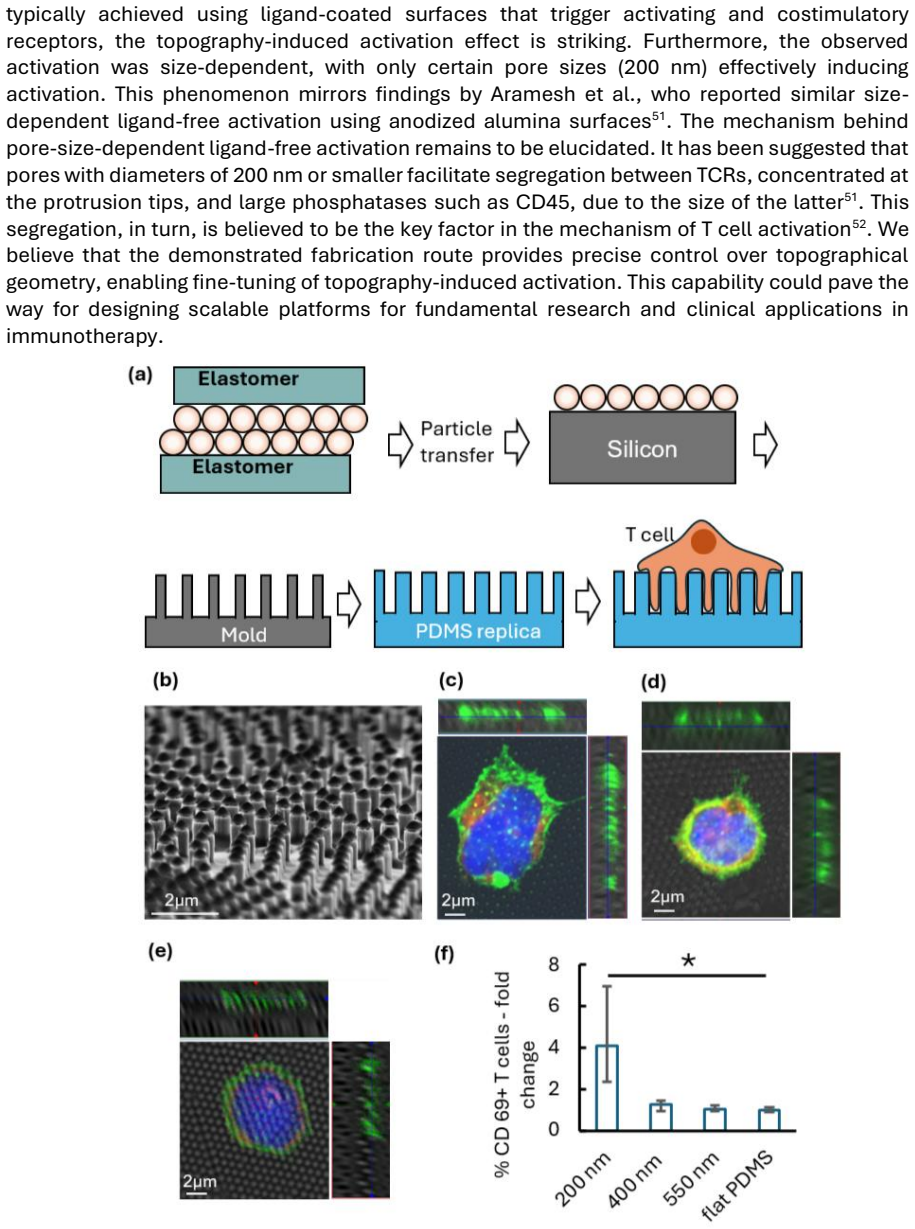
- Nanoscale topography alone, specifically 200-nm pores, can raise ligand-free T-cell activation fourfold, giving a cell-culture surface for studying mechanical activation.
- The process produces large-area patterns in minutes with no specialized equipment, making colloidal lithography practical for optics and biomedicine rather than only lab prototypes.
- The demonstrated route reaches sub-100 nm feature separation using only simple equipment, a regime the paper notes is otherwise reachable mainly by advanced photolithography.
Reading between the lines
- Direct surface spectroscopy after transfer would test the cleanliness claim; this is the natural experiment the paper does not report.
- Because dry rubbing already works for non-spherical and inorganic particles in other studies, the ice-transfer step is likely portable to those particles, though only polystyrene spheres are shown here.
- Freezing and thawing place physical constraints on substrates and particles; flexible or thermally sensitive targets may need a gentler version of the freezing step, which the paper does not explore.
- The sharp 200-nm pore-size threshold in T-cell activation suggests a size-based mechanism that could be probed by independently varying pore depth, spacing, and wall chemistry; the paper does not perform that decoupling.
Editorial analysis
A structured set of objections, weighed in public.
Referee Report
Summary. The manuscript introduces an 'ice-assisted transfer' method for colloidal lithography: polystyrene particles are assembled by dry rubbing between PDMS substrates, a water film is frozen between the particle-coated PDMS and a target substrate, the PDMS is peeled off, and the ice is melted and evaporated to leave a particle monolayer on the target. The authors optimize surfactant concentration and water film thickness, quantify monolayer quality by FFT, Voronoi analysis, and defect-area measurements, and demonstrate two applications: mid-infrared moth-eye antireflective coatings on silicon and sapphire, and nanotopographic PDMS surfaces for ligand-free T-cell activation. The central claims are that the method achieves defect-free, high-quality monolayers and that the transfer introduces no foreign material, in contrast to prior PEI-based transfer.
Significance. If the claims are substantiated, the work would be a useful advance in colloidal lithography: it offers a relatively simple, fast, and low-cost route to transfer dry-assembled particle monolayers onto arbitrary substrates, potentially extending rubbing-based assembly beyond PDMS. The quantitative quality metrics (FFT peak width, Voronoi regularity index, areal disorder factor, defect area) are a strength, as is the direct comparison between surfactant and no-surfactant monolayers in the antireflective application. The two applications, especially the moth-eye coatings whose measured reflectance is compared to transfer-matrix simulations, provide concrete demonstrations of functional impact. However, the main advertised advantages—'defect-free' monolayers and a 'clean transfer process' with no foreign material—are not supported by the data and process chemistry as presented, which limits the current significance until these are addressed.
major comments (1)
- [Fig. 2g and Fig. 3d] The claim that the surfactant-assisted monolayer leads to 'almost zero-reflection' at 2.8 microns is supported by the reflectance measurement, but the attributions of the 5% reflection in the no-surfactant case to 'excessive defects... particularly in the form of relatively large patches with missing particles' and to scattering are plausible rather than demonstrated. A quantitative correlation between defect area (Fig. 2g) and measured reflectance (e.g., a plot of reflectance versus defect fraction) would strengthen this functional claim. As written, the text assumes the causal link without direct evidence.
minor comments (1)
- [Fig. 3 and Fig. 4] In Figure 4, the text refers to 'pores with diameters of 200 nm, 400 nm, and 550 nm' and shows the data in Fig. 4d as fold change, but the Materials and Methods mentions a 500 nm diameter in addition to 200, 400, and 550 nm; please clarify which diameters were actually used and the correspondence between the figures and the text.
Circularity Check
No significant circularity: the paper's claims are supported by externally measured quality metrics and independent benchmarks, not by self-referential derivation.
full rationale
This is an experimental process-development paper with no formal derivation chain whose conclusions are fed back as premises. The central outputs, monolayer quality metrics (FFT peak width, Voronoi regularity index, areal disorder factor, defect area), are measured from SEM images using standard, external analysis methods, and the process optima (0.25 mM Triton X-100, water-film rule 20d+10 um) are empirically fitted to those measured metrics; they are not used to predict the same metrics. The moth-eye reflectance results are compared with a transfer-matrix simulation from ref. 37, which is self-authored but is a standard, independently established method, and the measured spectra are not used to fit the simulation inputs. The T-cell activation result is benchmarked against flat PDMS and against independent prior work by Aramesh et al., and the size-dependent activation is presented as a phenomenon to be explained rather than as a consequence of the model. Self-citations (refs. 26 and 37, and the antiadhesive protocol in the SI) serve as background, prior baseline, or procedural reference; none is load-bearing for the ice-transfer novelty claim. The only substantive concern, whether residual nonvolatile Triton X-100 contradicts the 'without introducing any additional materials' claim, is a surface-chemistry validation issue and belongs under correctness risk, not circularity, because that claim is asserted from process chemistry and indirect etch/liftoff evidence rather than derived from the surfactant-concentration results. No step in the paper reduces by construction to its own inputs.
Assumptions & free parameters
free parameters (3)
- Water film thickness rule constants (slope 20 and intercept 10 micrometers) =
20d+10 micrometers, where d is particle diameter in microns
- Optimal Triton X-100 surfactant concentration =
0.25 mM
- Ammonium hydroxide addition to set pH 10 =
pH 10 (no concentration given)
assumptions (4)
- domain assumption Rubbed particle monolayers on PDMS are high-quality and defect-controlled as described in prior work (ref 20).
- domain assumption Freezing the water film embeds the particles without disturbing the rubbing-created order, and peeling the PDMS leaves the monolayer intact on the target.
- domain assumption The final water-evaporation step reorganizes particles by known convective assembly mechanisms, and surfactant tuning is sufficient to control this reordering.
- standard math The transfer matrix method simulation (ref 37) accurately predicts the reflectance of perfectly ordered moth-eye structures, and deviations are attributed to defects.
Cite this review
Pith. "Pith review of A high -quality and -throughput colloidal lithography by mechanical assembly and ice-based transfer." pith.science (2026). https://pith.science/paper/YLUFVS6W
@misc{pith2026250606385,
  author       = {Pith},
  title        = {Pith review of: A high -quality and -throughput colloidal lithography by mechanical assembly and ice-based transfer},
  year         = {2026},
  howpublished = {\url{https://pith.science/paper/YLUFVS6W}},
  note         = {Machine review of arXiv:2506.06385}
}
read the original abstract
Colloidal lithography has emerged as a promising alternative to conventional nanofabrication techniques, offering the ability to create nanoscale patterns in a cost-effective and scalable manner. However, it has been so far limited by defects such as empty areas or multilayered regions, hindering its application. We introduce a novel "ice-assisted transfer" technique that combines rubbing-based particle assembly on elastomer substrates with ice-mediated transfer to achieve defect-free, high-quality polycrystalline particle monolayers. This approach eliminates foreign material contamination and enables precise control of particle arrangement and density. By optimizing process parameters, including surfactant concentration and water film thickness, we minimized defects and demonstrated the versatility of this method in fabricating functional nanoscale structures. We highlighted the benefits of this process through two applications: (1) antireflective "moth-eye" coatings, which achieved near-zero reflection in the mid-infrared spectrum due to improved particle monolayer quality; and (2) nanostructured surfaces for ligand-free T-cell activation, whose topography enhanced cell activation, showcasing potential for immunotherapy applications. The process achieves rapid, cost-efficient patterning without requiring specialized equipment, making it suitable for diverse fields requiring scalable nanostructuring. This work represents a significant advancement in colloidal lithography, addressing critical challenges and unlocking its potential for practical applications in optics, biotechnology, and beyond.
Figures


Figures from the paper (1 more)
Reference graph
Works this paper leans on
-
[988]
(13) Lu, Y .; Zhang, X.; Zhao, L.; Liu, H.; Yan, M.; Zhang, X.; Mochizuki, K.; Yang, S
https://doi.org/10.1039/C7LC01326D. (13) Lu, Y .; Zhang, X.; Zhao, L.; Liu, H.; Yan, M.; Zhang, X.; Mochizuki, K.; Yang, S. Metal- Organic Framework Template-Guided Electrochemical Lithography on Substrates for SERS Sensing Applications. Nat. Commun. 2023, 14 (1), 5860. https://doi.org/10.1038/s41467-023-41563-5. (14) Chan, L. W.; Morse, D. E.; Gordon, M....
-
[1546]
https://doi.org/10.1002/anie.201104454. (8) Tao, A. R.; Huang, J.; Yang, P . Langmuir−Blodgettry of Nanocrystals and Nanowires. Acc. Chem. Res. 2008, 41 (12), 1662–1673. https://doi.org/10.1021/ar8000525. (9) Cai, Z.; Li, Z.; Ravaine, S.; He, M.; Song, Y .; Yin, Y .; Zheng, H.; Teng, J.; Zhang, A. From Colloidal Particles to Photonic Crystals: Advances in...
Reviewed August 7, 2026 · model on record in the stance chip above.
Discussion (0). Sign in to comment.