REVIEW 4 major objections 4 minor 50 references
Spin-glass state in nickelate superconductors
T0 review · 4 major / 4 minor · reviewed 2026-08-07 · deepseek-v4-flash
Pith's one-line read Spin glass lives in nickelate superconductors far above Tc
desk verdict Solid new Kerr data on nickelate films with a genuinely new substrate comparison, but the intrinsic spin-glass claim leans on a degraded-sample muSR correlation and the Ni-particle alternative is not fully closed. read the letter →
The pith
A machine-rendered reading of the paper's core claim, the machinery that carries it, and where it could break.
The reading
What carries the argument
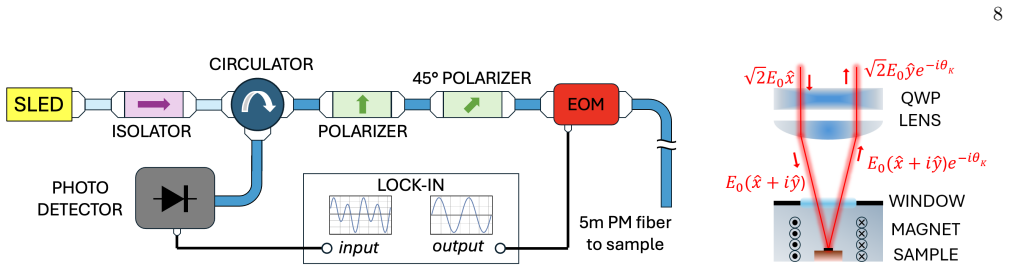
The central instrument is the zero-area-loop Sagnac interferometer (ZALSI), a fiber-optic device that measures the polar Kerr rotation $\theta_K$ with a noise floor near 100 nrad/$\sqrt{\rm Hz}$. Because $\theta_K \propto \sigma_{xy}(\omega) \propto M_z$, the Kerr angle is a direct probe of out-of-plane magnetization, and since a nonzero Kerr signal requires time-reversal symmetry breaking, it serves as a magnetic signature. The argument rests on three dynamical hallmarks of spin glasses observed in the Kerr signal—irreversible susceptibility under field-cooled and zero-field-cooled protocols, slow aging relaxation after a field step, and a memory effect after partial thermal cycles—plus the substrate comparison (STO versus LSAT) that tunes the disorder strength.
What would settle it
Map the polar Kerr rotation spatially at 10 K on the NSNO/STO film and overlay it with the known distribution of interfacial NiO$_x$ particles: if the $\sim 6~\mu$rad signal appears only where the particles sit, or if a film grown with a capping scheme that eliminates those particles shows no signal, the intrinsic-bulk interpretation fails. Alternatively, measuring muSR and Kerr simultaneously on one sample as $T_c$ degrades would show whether both probes track the same magnetic population.
Extended reading notes
Core claim
Using a zero-area-loop Sagnac interferometer (ZALSI), a fiber-optic polarimeter with sub-microradian sensitivity, the authors observe in La$_{0.8}$Sr$_{0.2}$NiO$_2$/STO a spontaneous polar Kerr rotation appearing below $T_{\rm onset} \approx 80$ K, and in Nd$_{0.825}$Sr$_{0.175}$NiO$_2$/STO below $\approx 70$ K. The signal shows the classic spin-glass signatures: irreversible magnetic susceptibility between zero-field-cooled and field-cooled protocols, slow aging of the magnetization on minute timescales, and a memory effect when the system is warmed through previously visited temperatures. In Nd$_{0.825}$Sr$_{0.175}$NiO$_2$/LSAT the signal is much weaker, about 1 $\mu$rad, and onsets near 14 K, while $T_c$ rises from 12.5 to 15.3 K. The authors take these observations, together with agreement with an earlier muon spin-relaxation study on the same La-based sample, to demonstrate a bulk spin-glass phase coexisting with superconductivity up to temperatures far above $T_c$.
Load-bearing premise
The conclusion that the glass is intrinsic and bulk rests on the assumption that the Kerr signal comes from the nickelate film itself and that the earlier muSR measurement, taken on the same sample before it degraded, probes the same magnetic population that the Kerr effect sees.
Editorial extensions
If this is right
- Superconductivity in infinite-layer nickelates emerges from a normal state that is already magnetically glassy, with $T_g$ well above $T_c$.
- The glassy state is not a byproduct of the superconducting condensate, since it persists to temperatures several times $T_c$.
- Crystallinity, not doping alone, controls the strength and onset of the glass: better-ordered films on LSAT show a roughly sixfold weaker magnetic signal with only about a 20% change in $T_c$.
- If the muSR correspondence holds, the glass is a bulk intrinsic property of the nickelate layers rather than a cluster-driven surface effect.
- The weak coupling between glass and $T_c$ suggests magnetic disorder is not the primary pairing mechanism, possibly by analogy to the cuprates.
Reading between the lines
- If the glass arises from remnant apical-oxygen disorder, then chemical routes that reduce such disorder should suppress $T_{\rm onset}$ and could raise $T_c$ further; this is a testable prediction of the disorder-based picture.
- The wavelength-dependent sign reversal of the Kerr signal between 0.8 and 1.5 eV, reminiscent of elemental nickel, suggests the magnetism lives on Ni orbitals; resonant Kerr spectroscopy could identify which optical transitions generate $\sigma_{xy}$.
- The memory effect implies a hierarchical free-energy landscape; multi-stop temperature protocols could map its timescales and distinguish droplet-like from hierarchical glass dynamics.
- The substrate dependence implies that disorder, not just doping, is a control parameter for the magnetism; comparing films with identical composition but different Ruddlesden-Popper fault densities would isolate the role of each disorder source.
Editorial analysis
A structured set of objections, weighed in public.
Referee Report
Summary. The manuscript reports magneto-optical Kerr and Faraday measurements on superconducting infinite-layer nickelate thin films, La0.8Sr0.2NiO2 on SrTiO3 and Nd0.825Sr0.175NiO2 on SrTiO3 and LSAT substrates. The authors observe a remanent Kerr rotation after field cooling that reverses with training-field direction, irreversible susceptibility between zero-field-cooled and in-field-cooled protocols, slow aging at 15 K, a small hysteresis loop, and a memory feature at previously visited temperatures. They interpret these as hallmarks of a spin-glass phase that coexists with superconductivity and persists to temperatures well above Tc, and they report a strong substrate dependence of the signal magnitude and onset temperature. The central interpretive claim is that this magneto-optical signal is intrinsic to the nickelate film rather than dominated by NiOx particles at the nickelate/capping-layer interface.
Significance. If the intrinsic interpretation is correct, this paper provides the first direct magneto-optical evidence that infinite-layer nickelate superconductors host a spin-glass state that coexists with superconductivity and extends to temperatures much higher than Tc, in contrast to the typical cuprate phase diagram where spin-glass order and superconductivity are more exclusive. The paper uses a well-established zero-area-loop Sagnac interferometer with sub-microradian sensitivity and presents several independent glassy fingerprints (aging, memory, irreversibility) in at least one sample. The substrate dependence and the explicit comparison of wavelength-dependent Kerr response are valuable experimental constraints. However, the load-bearing step from the observed signals to an intrinsic bulk nickelate spin glass rests on a correlation with a prior muSR study on a sample that the authors acknowledge has degraded, and the wavelength dependence resembles elemental nickel; these concerns are not fully resolved by the data as presented.
major comments (4)
- [Discussion, paragraph beginning 'Importantly, present magneto-optical measurements agree with the muSR study...'] The conclusion that the glassy signal is intrinsic and not due to Ni clusters is supported only by the agreement with the muSR study of Ref. [23], yet the manuscript itself states in the Methods that the LSNO sample has degraded (Tc decreased) since the muSR measurements, and the muSR study shares several co-authors with the present work. Consequently, the muSR correlation does not independently establish that the present Kerr signal arises from the bulk nickelate. A quantitative estimate of the expected contribution from the reported ~37 Ni particles per µm^2 (Ref. [24]), or an element-specific control, is needed to rule out a dominant NiOx contribution.
- [Methods, paragraph on wavelength dependence and 'Relationship between MOKE and magnetization'] The manuscript notes that the 830-nm Kerr signal reverses sign relative to 1550 nm and explicitly states that this behavior is 'similar to elemental nickel.' If the signal were dominated by metallic Ni particles, exactly this sign reversal would be expected. The paper provides no quantitative estimate of the Ni-particle magneto-optical response, so the wavelength dependence weakens rather than strengthens the intrinsic interpretation. This is a central point because the title and abstract attribute the spin-glass state to the nickelate superconductor, not to interfacial particles.
- [Results, paragraph on Nd0.825Sr0.175NiO2 on LSAT (Fig. 4c,d)] For NSNO/LSAT the authors state that the magnetic signal is so small that aging could not be demonstrated, and the evidence is limited to irreversible susceptibility and a gradual onset. In the Results for LSNO they explicitly acknowledge that irreversible susceptibility and gradual onset 'could also be explained with domain physics alone.' For NSNO/LSAT no aging or memory data are presented, so the attribution of a spin-glass phase in that sample is not supported by the same dynamical fingerprints, and the claim of a dramatic substrate-dependent spin-glass onset is correspondingly weaker.
- [Conclusions, first paragraph] Given the concerns above, the statement that the measurements 'clearly demonstrate the presence of a spin-glass phase' is too strong. The data are consistent with glassy dynamics, but the intrinsic-bulk attribution is not uniquely determined; the manuscript itself discloses the sample-degradation and wavelength-dependence caveats. The conclusions should be tempered to match the level of evidence or be backed by additional controls.
minor comments (4)
- [Methods, Samples section] There is a typographical error: 'The La0.8Sr0.2NiO2 sample was was grown on SrTiO3' repeats 'was'.
- [Abstract and Introduction] The contrast with cuprates is overstated: the authors themselves cite studies of La2−xSrxCuO4 where spin-glass order coexists with superconductivity and extends into the superconducting dome, so the phrase 'where magnetism and superconductivity remain largely exclusive' is imprecise.
- [Table I] The criteria for Tcusp and Tonset are not defined in the main text or table caption; defining how these temperatures are extracted from the Kerr and susceptibility data would improve reproducibility.
- [Methods, Eq. (A.6)] The notation V_RMS_omega and V_RMS_2omega is introduced without defining the lock-in voltage readings; a brief definition would improve readability.
Circularity Check
No significant circularity: the spin-glass inference is an experimental signature analysis, and the intrinsic-origin claim leans on an independent muSR measurement rather than on a fitted or self-defined quantity.
full rationale
The paper's derivation chain is experimental. The Kerr/MOFE signals are interpreted via Eq. (1) (θK ∝ σxy(ω) ∝ ±Mz), which is a standard magneto-optical relation, not a parameter fitted to the data being 'predicted.' The spin-glass assignment rests on measured hallmarks (irreversible susceptibility, aging, memory effect) that are externally established criteria; no quantity is fitted to one subset and then reported as a prediction of a closely related quantity. The only potentially load-bearing external premise is the conclusion that the signal is intrinsic rather than dominated by interfacial NiOx particles. That conclusion is supported by agreement with the muSR study [23] on the same LSNO mosaic. Although Ref. [23] shares authors and the sample had degraded between measurements, the muSR data are an independent, externally obtainable measurement, not a restatement of the present Kerr data; citing them is evidence, not definitional circularity. The reported wavelength-sign reversal similar to elemental nickel and the lack of a quantitative Ni-particle budget are correctness risks, but they are candidly disclosed and do not make the central claim equivalent to its inputs. No self-definition, fitted-input-as-prediction, uniqueness-imported-from-authors, or ansatz-smuggled-in-via-citation pattern is present. The paper is self-contained against external benchmarks for its main experimental inference.
Assumptions & free parameters
assumptions (5)
- domain assumption The Kerr angle is a direct probe of magnetization: theta_K proportional to sigma_xy(omega) proportional to Mz (Eq. 1).
- domain assumption ZALSI is insensitive to time-reversal-preserving optical activity such as birefringence or chirality.
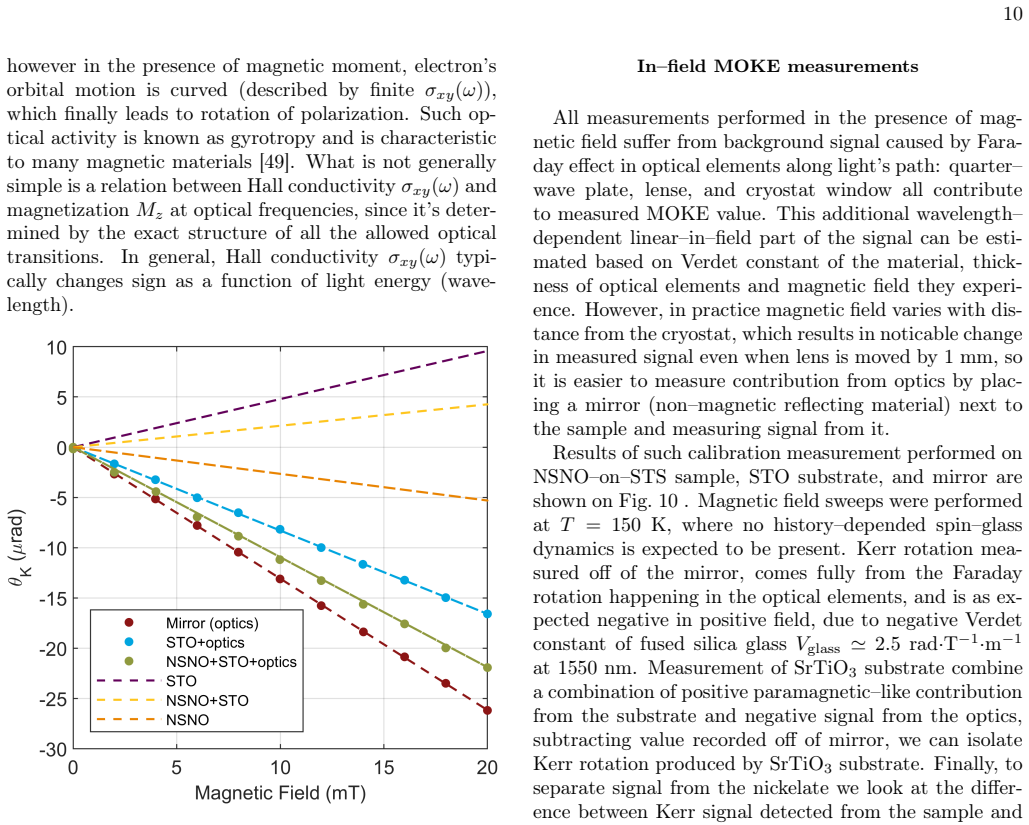
- domain assumption Substrate and optics contributions to in-field data are separable and temperature-independent (Fig. 11).
- domain assumption Aging, memory, and irreversible susceptibility uniquely identify a spin glass over ferromagnetic domain-wall dynamics.
- domain assumption The muSR-detected magnetism of Ref 23 on the same LSNO sample represents the same magnetic state as the Kerr signal.
Cite this review
Pith. "Pith review of Spin-glass state in nickelate superconductors." pith.science (2026). https://pith.science/paper/LFWFTBTP
@misc{pith2026250603262,
  author       = {Pith},
  title        = {Pith review of: Spin-glass state in nickelate superconductors},
  year         = {2026},
  howpublished = {\url{https://pith.science/paper/LFWFTBTP}},
  note         = {Machine review of arXiv:2506.03262}
}
abstract
Magneto-optical measurements in La${}_{0.8}$Sr${}_{0.2}$NiO${}_2$ and Nd${}_{0.825}$Sr${}_{0.175}$NiO${}_2$ reveal an intriguing new facet of infinite-layer nickelate superconductors: the onset of spin-glass behavior at a temperature far exceeding the superconducting critical temperature $T_c$. This discovery sharply contrasts with copper oxide superconductors, where magnetism and superconductivity remain largely exclusive. Moreover, the magnitude and onset temperature of the polar Kerr effect in Nd${}_{0.825}$Sr${}_{0.175}$NiO${}_2$ fabricated on SrTiO${}_3$ and (LaAlO${}_3$)${}_{0.3}$(Sr${}_2$TaAlO${}_6$)${}_{0.7}$ substrates differ dramatically, while $T_c$ does not.
Figures


Figures from the paper (8 more)




Reference graph
Works this paper leans on
- [23]
-
[24]
R. A. Shi, B. Y. Wang, Y. Iguchi, M. Osada, K. Lee, B. H. Goodge, L. F. Kourkoutis, H. Y. Hwang, and K. A. Moler, Physical Review Materials8, 024802 (2024)
work page 2024
-
[1]
Keimer, S
B. Keimer, S. A. Kivelson, M. R. Norman, S. Uchida, and J. Zaanen, Nature518, 179 (2015)
2015
-
[2]
C. Park and R. L. Snyder, Journal of the American Ceramic Society 78, 3171 (1995), https://ceramics.onlinelibrary.wiley.com/doi/pdf/10.1111/j.1151- 2916.1995.tb07953.x
arXiv 1995
-
[3]
T. Siegrist, S. M. Zahurak, D. W. Murphy, and R. S. Roth, Nature334, 231 (1988)
work page 1988
- [4]
-
[5]
R. T. Scalettar, D. J. Scalapino, R. L. Sugar, and S. R. White, Phys. Rev. B44, 770 (1991)
work page 1991
- [6]
Show all 50 references
-
[7]
Parzyck, Y
C. Parzyck, Y. Wu, L. Bhatt, M. Kang, Z. Arthur, T. Pedersen, R. Sutarto, S. Fan, J. Pelliciari, V. Bisogni, et al., arXiv preprint arXiv:2410.02007 (2024)
2024 arXiv
-
[8]
Sahib, A
H. Sahib, A. Raji, F. Rosa, G. Merzoni, G. Ghiringhelli, M. Salluzzo, A. Gloter, N. Viart, and D. Preziosi, Ad- vanced Materials , 2416187 (2024)
2024
-
[9]
Hayward and M
M. Hayward and M. Rosseinsky, Solid State Sciences5, 839 (2003), international Conference on Inorganic Mate- rials 2002
2003
-
[10]
von Rohr, and A
H.Lin, D.J.Gawryluk, Y.M.Klein, S.Huangfu, E.Pom- jakushina, F. von Rohr, and A. Schilling, New Journal of Physics24, 013022 (2022)
2022
-
[11]
D. Li, K. Lee, B. Y. Wang, M. Osada, S. Crossley, H. R. Lee, Y. Cui, Y. Hikita, and H. Y. Hwang, Nature572, 624 (2019)
2019
-
[12]
A. S. Botana and M. R. Norman, Phys. Rev. X 10, 011024 (2020). 6
2020
-
[13]
Aharony, R
A. Aharony, R. J. Birgeneau, A. Coniglio, M. A. Kastner, and H. E. Stanley, Phys. Rev. Lett.60, 1330 (1988)
1988
-
[14]
Julien, Physica B: Condensed Matter 329-333, 693 (2003), proceedings of the 23rd International Con- ference on Low Temperature Physics
M.-H. Julien, Physica B: Condensed Matter 329-333, 693 (2003), proceedings of the 23rd International Con- ference on Low Temperature Physics
2003
-
[15]
Stilp, A
E. Stilp, A. Suter, T. Prokscha, E. Morenzoni, H. Keller, B. M. Wojek, H. Luetkens, A. Gozar, G. Logvenov, and I. Božović, Phys. Rev. B88, 064419 (2013)
2013
-
[16]
Niedermayer, C
C. Niedermayer, C. Bernhard, T. Blasius, A. Golnik, A. Moodenbaugh, and J. I. Budnick, Phys. Rev. Lett. 80, 3843 (1998)
1998
-
[17]
J. L. Tallon, C. Bernhard, and C. Niedermayer, Super- conductor Science and Technology10, A38 (1997)
1997
-
[18]
F. C. Chou, N. R. Belk, M. A. Kastner, R. J. Birgeneau, and A. Aharony, Phys. Rev. Lett.75, 2204 (1995)
1995
-
[19]
N.Hasselmann, A.H.CastroNeto, andC.MoraisSmith, Phys. Rev. B69, 014424 (2004)
2004
-
[20]
B. M. Andersen, M. Schmid, S. Graser, P. Hirschfeld, and A. P. Kampf, Journal of Physics and Chemistry of Solids 72, 358 (2011), spectroscopies in Novel Supercon- ductors 2010
2011
-
[21]
R. A. Ortiz, P. Puphal, M. Klett, F. Hotz, R. K. Kremer, H. Trepka, M. Hemmida, H.-A. K. von Nidda, M. Isobe, R. Khasanov, H. Luetkens, P. Hansmann, B. Keimer, T. Schäfer, and M. Hepting, Phys. Rev. Res.4, 023093 (2022)
2022
-
[22]
Puphal, B
P. Puphal, B. Wehinger, J. Nuss, K. Küster, U. Starke, G. Garbarino, B. Keimer, M. Isobe, and M. Hepting, Phys. Rev. Mater.7, 014804 (2023)
2023
-
[25]
H. Lu, M. Rossi, A. Nag, M. Osada, D. F. Li, K. Lee, B. Y. Wang, M. Garcia-Fernandez, S. Agrestini, Z. X. Shen, E. M. Been, B. Moritz, T. P. Devereaux, J. Zaanen, H. Y. Hwang, K.-J. Zhou, and W. S. Lee, Science 373, 213 (2021), https://www.science.org/doi/pdf/10.1126/science.abd7726
2021 doi
-
[26]
Y. Cui, C. Li, Q. Li, X. Zhu, Z. Hu, Y.-f. Yang, J. Zhang, R. Yu, H.-H. Wen, and W. Yu, Chinese Physics Letters 38, 067401 (2021)
2021
-
[27]
J. Xia, P. T. Beyersdorf, M. M. Fejer, and A. Kapitulnik, Applied Physics Letters89, 062508 (2006)
2006
-
[28]
Supplementary material,
“Supplementary material,” URL will be provided by pub- lisher. It includes Refs. [23, 27, 29, 32, 34, 39, 41– 43, 45, 46, 49]
-
[29]
P. M. Oppeneer,Theory of the magneto-optical Kerr ef- fect in ferromagnetic compounds (1999)
1999
-
[30]
Kapitulnik, Physica B: Condensed Matter460, 151 (2015), special Issue on Electronic Crystals (ECRYS- 2014)
A. Kapitulnik, Physica B: Condensed Matter460, 151 (2015), special Issue on Electronic Crystals (ECRYS- 2014)
2015
-
[31]
A. D. Fried, Physical Review B90, 121112 (2014)
2014
-
[32]
B. I. Halperin, in The Physics and Chemistry of Ox- ide Superconductors, edited by Y. Iye and H. Yasuoka (Springer Berlin Heidelberg, Berlin, Heidelberg, 1992) pp. 439–450
1992
-
[33]
V. S. Dotsenko, Uspekhi Fizicheskikh Nauk 163, 1 (1993)
1993
-
[34]
K. Lee, B. Y. Wang, M. Osada, B. H. Goodge, T. C. Wang, Y. Lee, S. Harvey, W. J. Kim, Y. Yu, C. Murthy, S. Raghu, L. F. Kourkoutis, and H. Y. Hwang, Nature 619, 288 (2023)
2023
-
[35]
X. Ren, J. Li, W.-C. Chen, Q. Gao, J. J. Sanchez, J. Hales, H. Luo, F. Rodolakis, J. L. McChesney, T. Xi- ang, et al., Communications Physics6, 341 (2023)
2023
-
[36]
K. Lee, B. H. Goodge, D. Li, M. Osada, B. Y. Wang, Y. Cui, L. F. Kourkoutis, and H. Y. Hwang, APL Materials 8, 041107 (2020), https://pubs.aip.org/aip/apm/article- pdf/doi/10.1063/5.0005103/14564406/041107_1_online.pdf
2020 doi
-
[37]
Q. Li, C. He, J. Si, X. Zhu, Y. Zhang, and H.-H. Wen, Communications Materials1, 16 (2020)
2020
-
[38]
Q. Gao, S. Fan, Q. Wang, J. Li, X. Ren, I. Biało, A. Drewanowski, P. Rothenbühler, J. Choi, R. Sutarto, et al., Nature Communications15, 5576 (2024)
2024
-
[39]
J. Xia, Y. Maeno, P. T. Beyersdorf, M. M. Fejer, and A. Kapitulnik, Phys. Rev. Lett.97, 167002 (2006)
2006
-
[40]
J. Xia, V. Shelukhin, M. Karpovski, A. Kapitulnik, and A. Palevski, Phys. Rev. Lett.102, 087004 (2009)
2009
-
[41]
E. R. Schemm, W. J. Gannon, C. M. Wishne, W. P. Halperin, and A. Kapitulnik, Science345, 190 (2014)
2014
-
[42]
I. M. Hayes, D. S. Wei, T. Metz, J. Zhang, Y. S. Eo, S. Ran, S. R. Saha, J. Collini, N. P. Butch, D. F. Agter- berg, A. Kapitulnik, and J. Paglione, Science373, 797 (2021)
2021
-
[43]
D. S. Wei, D. Saykin, O. Y. Miller, S. Ran, S. R. Saha, D. F. Agterberg, J. Schmalian, N. P. Butch, J. Paglione, and A. Kapitulnik, Phys. Rev. B105, 024521 (2022)
2022
-
[44]
J. Xia, W. Siemons, G. Koster, M. R. Beasley, and A. Kapitulnik, Phys. Rev. B79, 140407(R) (2009)
2009
-
[45]
D. R. Saykin, C. Farhang, E. D. Kountz, D. Chen, B. R. Ortiz, C. Shekhar, C. Felser, S. D. Wilson, R. Thomale, J. Xia, and A. Kapitulnik, Phys. Rev. Lett.131, 016901 (2023)
2023
-
[46]
Farhang, J
C. Farhang, J. Wang, B. R. Ortiz, S. D. Wilson, and J. Xia, Nature Communications14, 5326 (2023)
2023
-
[47]
Farhang, W
C. Farhang, W. R. Meier, W. Lu, J. Li, Y. Wu, S. Mozaf- fari, R. P. Madhogaria, Y. Zhang, D. Mandrus, and J. Xia, arXiv preprint arXiv:2502.14568 (2025)
2025 arXiv
-
[48]
Buschow, Handbook of Ferromagnetic Materials,4, 493 (1988)
K. Buschow, Handbook of Ferromagnetic Materials,4, 493 (1988)
1988
-
[49]
L. D. Landau, J. S. Bell, M. Kearsley, L. Pitaevskii, E. Lifshitz, and J. Sykes, Electrodynamics of continu- ous media, Vol. 8 (elsevier, 2013). 7 CONTENTS Introduction 1 Results 2 Discussion 4 Conclusions 4 Methods 5 Acknowledgments 5 References 5 Samples 7 Zero-area-loop Sag...
2013
-
[50]
The La 0.8Sr0.2NiO2 sample studied in this work is one of eight 2.5 × 5 mm pieces constituting the mo- saic of samples measured by Fowlie et al [23]
for the La0.8Sr0.2NiO2 and Nd0.825Sr0.175NiO2 films, respectively. The La 0.8Sr0.2NiO2 sample studied in this work is one of eight 2.5 × 5 mm pieces constituting the mo- saic of samples measured by Fowlie et al [23]. The La0.8Sr0.2NiO2 sample was was grown on SrTiO3 sub- strat...
Reviewed August 7, 2026 · model on record in the stance chip above.
Discussion (0). Sign in to comment.