REVIEW 3 major objections 5 minor 47 references
Revisiting the cofactor conditions: Elimination of transition layers in compound domains
T0 review · 3 major / 5 minor · reviewed 2026-08-07 · deepseek-v4-flash
Pith's one-line read Extreme compatibility conditions let compound twins form stress-free interfaces with austenite at all volume fractions.
desk verdict A genuine extension of the cofactor framework to compound and non-conventional twins, with explicit algebraic conditions; the main risk is two load-bearing sufficiency checks that are asserted rather than demonstrated. read the letter →
The pith
A machine-rendered reading of the paper's core claim, the machinery that carries it, and where it could break.
The reading
What carries the argument
The load-bearing objects are the martensitic stretch tensors $U_i$ and the rank-one compatibility equations that link variants to each other and to austenite. The machinery has three parts: the commutation property of variant pairs, shown to imply compound-domain structure and to generate two distinct planar triple clusters (triple junctions or parallel domain walls) with austenite; the four algebraic conditions (EC1)–(EC4), which characterize when any compound pair—commuting or not—forms a triple cluster; and the cofactor conditions (CC1)–(CC3), with (CC3) supplying the sufficiency step that upgrades a triple cluster to a laminate compatible with austenite at all volume fractions. The two eigenvalue identities $\lambda_3=\lambda_1/\sqrt{2\lambda_1^2-1}$ and $\lambda_3=\sqrt{2-\lambda_1^2}$ are the special cases in which both twinning solutions of a commuting pair produce triple clusters of the same kind.
What would settle it
One decisive check is to recompute the positivity inequality for columns 1–4 with the stretch tensors (85) and (86) and to solve the austenite–laminate compatibility equation at $\mu=1/2$ under $d=1$ with $\lambda_3=\lambda_1/\sqrt{2\lambda_1^2-1}$; a single negative inequality value or a single missing interface solution would refute the corresponding extreme-compatibility claim.
Extended reading notes
Core claim
The paper's central claim is that eliminating transition layers at austenite–martensite interfaces requires a sharper set of 'extreme compatibility conditions' than the cofactor conditions, and that these conditions are both necessary and sufficient. For cubic-to-orthorhombic transformations, extreme compatibility holds exactly when the middle eigenvalue of the stretch tensor is $d=1$ and the other two eigenvalues satisfy either (27) or (38); at these points all Type I/II and compound laminates are compatible with austenite for every volume fraction $\mu\in[0,1]$, including the limiting cases. For cubic-to-monoclinic-II transformations, extreme compatibility holds only for the two fixed stretch tensors (85) and (86), which force the transformation to be volume-preserving and make all conventional twin columns form their triple clusters simultaneously. The argument turns on a commutation property: compatible martensitic variants that commute necessarily form compound domains, and commuting pairs can form two distinct triple clusters with austenite, whereas Type I/II pairs can form at most one. This lets the paper classify non-conventional generic twins, such as those observed in NiMnGa-type systems, as compound domains and construct stress-free interfaces for their laminates as well.
Load-bearing premise
The result depends on two algebraic checks that the paper asserts without displaying all details: a positivity inequality must hold for every conventional twin column for the two monoclinic stretch tensors, and at exactly half volume fraction the two candidate interfaces must merge into one rather than vanish.
Editorial extensions
If this is right
- Compound twin laminates, previously excluded from cofactor-condition design, can now form zero-elastic-energy interfaces with austenite for every volume fraction, without transition layers.
- Both solutions of the twinning equation for a commuting compound pair yield distinct planar triple clusters, doubling the interface flexibility available from Type I/II pairs.
- Non-conventional generic twins, such as those in cubic-to-monoclinic-II transformations, become treatable as compound domains with explicit twinning elements and stress-free austenite interfaces.
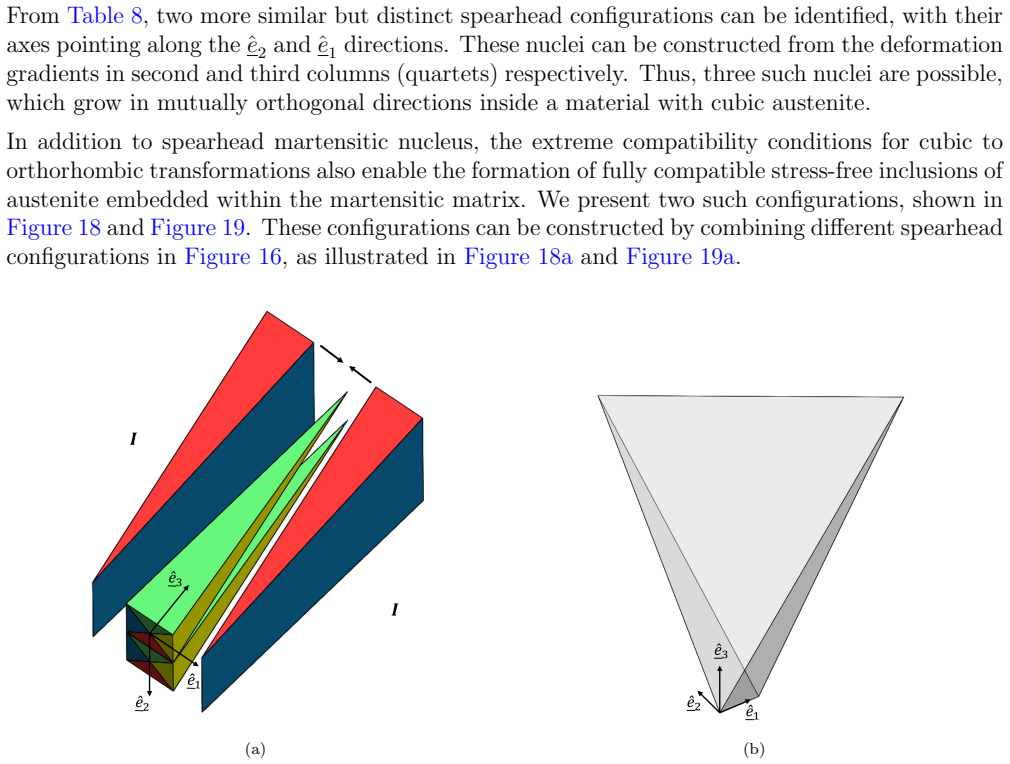
- Under the cubic-to-orthorhombic extreme compatibility conditions, new zero-energy microstructures appear: spearhead-shaped martensitic nuclei, finite austenite inclusions with rhombic disphenoid and rhombic dipyramid shapes, and four-fold martensitic clusters with all interfaces of the same type.
- In cubic-to-monoclinic-II transformations, extreme compatibility forces a volume-preserving transformation with stretch tensors (85) or (86), and the paper argues that all conventional twin columns then satisfy the sufficiency condition simultaneously.
Reading between the lines
- The authors do not develop this direction, but a one-parameter eigenvalue curve such as (27) or (38) is a concrete screen for alloy composition searches, parallel to the $\lambda_2=1$ screening already used in phase engineering.
- An untested extension suggested by the paper's own commutation examples is to run the same extreme-compatibility analysis for tetragonal-to-monoclinic transformations, where the paper reports analogous non-conventional commuting pairs.
- The automatic triplet-condition satisfaction noted in Section 5 implies that extreme compatibility is not only about austenite-martensite interfaces; it also upgrades martensite-martensite accommodation, which should affect mechanical fatigue even in fully transformed material.
- Because the cubic-to-monoclinic-II stretch tensors (85) and (86) contain no free parameters, exact extreme compatibility is a stiff target; the paper's hinted relaxation of equations (81), (83), or (84) is likely the version experimentalists would tune for.
Editorial analysis
A structured set of objections, weighed in public.
Referee Report
Summary. The paper extends the cofactor-condition framework to compound and non-conventional twins. It introduces 'extreme compatibility conditions' under which laminates of both Type I/II and compound domains form stress-free interfaces with austenite for all volume fractions without transition layers. For cubic-to-orthorhombic transformations the claimed conditions are d = 1 together with either (27) or (38); for cubic-to-monoclinic-II transformations the claimed conditions are that the stretch tensor equals one of the two fixed matrices (85) or (86). The derivation is algebraic and parameter-free, building on the commuting-variant structure of the martensitic stretch tensors. The paper also constructs several new zero-energy microstructures, including spearhead nuclei, austenite inclusions, and four-fold martensitic clusters, and connects these to the older experimental micrograph of Smith and Bowles.
Significance. If the two unshown sufficiency checks identified below are supplied, this would be a substantive extension of the cofactor-condition framework: it would bring compound and non-conventional twins into the class of systems that can form zero-elastic-energy interfaces with austenite for every volume fraction. The commutation Theorem 3.1, the necessary conditions (EC1)–(EC4), and the explicit cubic-to-orthorhombic conditions (27)/(38) are derived without fitted parameters and yield falsifiable predictions for alloy design. The proposed microstructures are novel and potentially testable. No code or machine-checked supplement is provided, so the burden falls on the displayed algebra; the paper is generally careful, but two load-bearing verifications are currently asserted rather than shown.
major comments (3)
- [Section 4.2] Immediately after Eq. (86), the sufficiency of the cubic-to-monoclinic-II extreme compatibility conditions is dismissed with the sentence 'It is easy to check that the sufficiency condition, (CC3), is satisfied for all columns 1,2,3 and 4, for both the matrices in (85) and (86).' This is load-bearing: (CC3) (equivalently (CC3′)) is exactly what guarantees that the crystallographic equation (17) has a solution for every volume fraction µ ∈ [0,1]. The magnitude |a| entering (CC3′) is different for Type-I/II solutions (13) and compound solutions (14), so for each of the two matrices at least four distinct inequalities must hold. Since neither the inequalities nor their verification are displayed, the reader cannot check the central claim that (85) and (86) are sufficient for extreme compatibility in cubic-to-monoclinic-II transformations. Please include the explicit |a|² expressions for each column and the resulting symbolic verification, or provide the computation in a supplement.
- [Section 4.1] The claim that compound laminates in cubic-to-orthorhombic transformations are compatible with austenite 'for all volume fractions' depends on the endpoint µ = 1/2, where the left-hand side of (76) vanishes. The paper states that 'By a brute force computation' the eigenvalues of the laminate at µ = 1/2 are 1, 1, and λ1²/√(2λ1²−1), and that the two solutions of (17) collapse into a single solution. No such computation is shown. This is not a cosmetic omission: if at µ = 1/2 the two solutions instead disappeared, or the average deformation were not rank-one compatible, the sufficiency for compound laminates would fail at that volume fraction. Please display the computation, specifying whether the eigenvalues are those of (FᵀF)^{1/2} or of the symmetric stretch, and show explicitly how the two solutions of (17) coincide.
- [Section 5] In Theorem 5.1 the paper asserts, without calculation, that condition (92) is automatically satisfied when d = 1 and (27) holds, and that (93) is automatically satisfied when d = 1 and (38) holds. These verifications are needed to support the claimed four-fold, all-Type-I and all-Type-II microstructures. They are short algebraic computations and should be displayed or placed in an appendix so that the microstructural claims are checkable.
minor comments (5)
- [Section 4.1] There is a typo: 'Foe example' should be 'For example'.
- [Section 2] In the introductory paragraph of Section 2, 'Chen at al' should be 'Chen et al.'.
- [Section 4.2] The typeset matrices (85) and (86) are ambiguous: the entries '3√2 − 1√2' and similar expressions should be written as 3/√2, 1/√2, etc., with clear row and column spacing, since the intended fractions are essential to the claim that the matrices have eigenvalues √2±1 and 1.
- [Section 4.1] The phrase 'stretch tensor corresponding to the average deformation gradient' should be defined precisely, i.e. as the polar stretch of the average deformation or as the square root of the Cauchy–Green tensor, to avoid ambiguity in the µ = 1/2 computation.
- [Section 5] For the case of (38), the paper says 'For brevity, the complete calculations are omitted' and presents the microstructures of Figure 22 only descriptively; adding the analogue of equations (89)–(91) would make the corresponding configurations verifiable.
Circularity Check
No circularity: the extreme-compatibility conditions are derived algebraically from compatibility equations, not from their own conclusions.
full rationale
I walked the derivation chain and found no step in which a claimed prediction reduces by construction to an input or to a self-citation. The cubic-to-orthorhombic conditions d=1 with (27) or (38) are obtained as algebraic consequences of the EC conditions: Corollary 3.2 derives (27) from (EC1)+(EC2) and (38) from (EC3)+(EC4), and the sufficiency checks (74) and (76) are explicit inequalities following from substitution into (CC3'). The cubic-to-monoclinic-II tensors (85) and (86) are solved from the necessary equations (78),(81),(83) and (81),(82),(84), respectively; the remaining claim that (CC3) holds is asserted rather than displayed, but that is an omitted verification, not a circular definition. No parameter is fitted to data and then renamed a prediction. The citations to Chen et al. [15] supply standard twinning-solution formulas and cofactor-condition theorems used as lemmas; although coauthor Dabade appears on [15], those results are independently published and do not contain the target extreme-compatibility claim, so they are not load-bearing self-citation in the circularity sense. The forthcoming-work citation [36] is not used to justify any derivation. The 'brute force computation' at volume fraction 1/2 and the 'easy to check' (CC3) statement are genuine verification gaps and should be assessed as correctness risk, but they do not make the argument circular.
Assumptions & free parameters
assumptions (7)
- domain assumption The free energy density is frame-indifferent with energy wells SO(3)U_i for martensite and SO(3)I for austenite, and the Cauchy-Born rule relates lattice deformations to continuum gradients.
- domain assumption Twins are classified into Type I/II, compound, non-conventional generic, and non-generic twins; non-generic twins are treated as incompatible.
- standard math Ball and James theorem and the crystallographic theory of martensite: rank-one connections between variants and austenite exist when the middle eigenvalue condition holds, and the solutions are given by (10) and (11).
- domain assumption Theorem 2.3 from Chen et al.: a pair of variants forming compound domains has two distinct symmetry axes and the twinning solutions (14).
- domain assumption The cofactor conditions (CC1)-(CC3) are necessary and sufficient for Type I/II laminates to eliminate transition layers, and (CC3) serves as the sufficiency condition for the laminate-to-austenite interface.
- ad hoc to paper At volume fraction 1/2, the vanishing of (CC3') for compound laminates still permits a stress-free interface because the two solutions of equation (17) collapse into one.
- ad hoc to paper The microstructures in Section 5 (spearhead nucleus, austenite inclusions, four-fold clusters) are realizable as zero-energy configurations by stacking rank-one compatible deformation gradients.
Cite this review
Pith. "Pith review of Revisiting the cofactor conditions: Elimination of transition layers in compound domains." pith.science (2026). https://pith.science/paper/UAFCKCSG
@misc{pith2026250604754,
  author       = {Pith},
  title        = {Pith review of: Revisiting the cofactor conditions: Elimination of transition layers in compound domains},
  year         = {2026},
  howpublished = {\url{https://pith.science/paper/UAFCKCSG}},
  note         = {Machine review of arXiv:2506.04754}
}
read the original abstract
This paper investigates the conditions necessary for the elimination of transition layers at interfaces involving compound domains, extending the classical framework of cofactor conditions. Although cofactor conditions enable stress-free phase boundaries between Type I/II domains and austenite, their applicability to compound domains has remained limited. Here, we present a comprehensive theoretical framework to characterize all compatible interfaces, highlighting the fundamental importance of the commutation property among martensitic variants. By establishing necessary and sufficient algebraic conditions, referred to as extreme compatibility conditions, we demonstrate the simultaneous elimination of transition layers at phase interfaces for both Type I/II and compound laminates, across all volume fractions of the martensitic variants. We also investigate the possibility of achieving supercompatibility in non-conventional twins, recently observed in the NiMnGa system. The focus of our work is on cubic-to-orthorhombic and cubic-to-monoclinic~II phase transformations, for which the extreme compatibility conditions are explicitly derived and systematically analyzed. The theory predicts novel zero-elastic-energy microstructures, including an increased number of triple clusters, spearhead-shaped martensitic nuclei, stress-free inclusions of austenite within martensite, and distinctive four-fold martensitic clusters. This significantly expands the possible modes of forming stress-free interfaces between phases and reveals new energy-minimizing microstructures that can facilitate the nucleation of martensite within austenite and vice versa. These configurations highlight significant enhancements in transformation reversibility and material durability, guiding the rational design of next-generation shape memory alloys with optimized functional properties.
Figures


Figures from the paper (22 more)






Reference graph
Works this paper leans on
-
[15]
Xian Chen, Vijay Srivastava, Vivekanand Dabade, and Richard D. James. Study of the cofac- tor conditions: Conditions of supercompatibility between phases. Journal of the Mechanics and Physics of Solids , 61(12):2566–2587, 2013. ISSN 0022-5096. doi: https://doi.org/10. 1016/j.jmps.2013.08.004. URL https://www.sciencedirect.com/science/article/pii/ S0022509...
work page 2013
-
[1]
Non-conventional twins in five-layer modulated ni-mn-ga martensite
Hanuˇ s Seiner, Robert Chulist, Wojciech Maziarz, Alexei Sozinov, Oleg Heczko, and Ladislav Straka. Non-conventional twins in five-layer modulated ni-mn-ga martensite. Scripta Materi- alia, 162:497–502, 2019. ISSN 1359-6462. doi: https://doi.org/10.1016/j.scriptamat.2018.12
-
[2]
Prasanth Velvaluri, Arun Soor, Paul Plucinsky, Rodrigo Lima de Miranda, Richard D. James, and Eckhard Quandt. Origami-inspired thin-film shape memory alloy devices. Scientific Reports, 11(1):10988, 2021. doi: 10.1038/s41598-021-90291-6
-
[3]
Stewart, Reza Mirzaeifar, Eckhard Quandt, and Shashank Priya
Prashant Kumar, Ravi Anant Kishore, Deepam Maurya, Colin J. Stewart, Reza Mirzaeifar, Eckhard Quandt, and Shashank Priya. Shape memory alloy engine for high efficiency low- temperature gradient thermal to electrical conversion. Applied Energy, 251:113277, October
-
[4]
Vijay Srivastava, Yintao Song, Kanwal Bhatti, and R. D. James. The direct conversion of heat to electricity using multiferroic alloys. Advanced Energy Materials , 1(1):97–104, 2011. doi: 10.1002/aenm.201000048. First published: 15 December 2010
-
[5]
Y. Haga, T. Umeda, T. Saitoh, and K. Kawashima. Medical and welfare applications of shape memory alloy microcoil actuators. Smart Materials and Structures , 14(5):S266–S271, 2005. doi: 10.1088/0964-1726/14/5/015
-
[6]
Jaronie Mohd Jani, Martin Leary, Aleksandar Subic, and Mark A. Gibson. A review of shape memory alloy research, applications and opportunities. Materials & Design , 56:1078–1113, April 2014. doi: 10.1016/j.matdes.2013.11.084
-
[7]
J.M. Ball. Mathematical models of martensitic microstructure. Materials Science and Engi- neering: A , 378(1):61–69, 2004. ISSN 0921-5093. doi: https://doi.org/10.1016/j.msea.2003.11
Show all 47 references
-
[8]
James and K.F
R.D. James and K.F. Hane. Martensitic transformations and shape-memory materials. Acta Materialia , 48(1):197–222, 2000. ISSN 1359-6454. doi: https://doi.org/10.1016/ S1359-6454(99)00295-5. URL https://www.sciencedirect.com/science/article/pii/ S1359645499002955
2000
-
[9]
Richard D. James. Materials from mathematics. Bulletin of the American Mathematical So- ciety (New Series) , 56(1):1–28, 2019. doi: 10.1090/bull/1644. Article electronically published on August 30, 2018. 64
2019 doi
-
[10]
Hanlin Gu, Lars Bumke, Christoph Chluba, Eckhard Quandt, and Richard D. James. Phase engineering and supercompatibility of shape memory alloys. Materials Today, 21(3):265–277, April 2018. doi: 10.1016/j.mattod.2017.10.002
2018 doi
-
[11]
Chu, Olugbenga O
Jun Cui, Yong S. Chu, Olugbenga O. Famodu, Yasubumi Furuya, Jae Hattrick-Simpers, Richard D. James, Alfred Ludwig, Sigurd Thienhaus, Manfred Wuttig, Zhiyong Zhang, and Ichiro Takeuchi. Combinatorial search of thermoelastic shape-memory alloys with extremely small hysteresis wi...
2006 doi
-
[12]
James, and Stefan M¨ uller
Zhiyong Zhang, Richard D. James, and Stefan M¨ uller. Energy barriers and hysteresis in martensitic phase transformations. Acta Materialia, 57(15):4332–4352, 2009. doi: 10.1016/j. actamat.2009.05.034
2009 doi
-
[13]
Young, Alan Savan, Yasubumi Furuya, Sig- urd Thienhaus, Burkhard Maaß, Mustafa Rahim, Jan Frenzel, Hayo Brunken, Yong S
Robert Zarnetta, Ryota Takahashi, Marcus L. Young, Alan Savan, Yasubumi Furuya, Sig- urd Thienhaus, Burkhard Maaß, Mustafa Rahim, Jan Frenzel, Hayo Brunken, Yong S. Chu, Vijay Srivastava, Richard D. James, Ichiro Takeuchi, Gunther Eggeler, and Alfred Ludwig. Identification of ...
1917 doi
-
[14]
R. D. James and Z. Zhang. A way to search for multiferroic materials with unlikely combina- tions of physical properties. In A. Planes, L. Ma˜ nosa, and A. Saxena, editors,Magnetism and Structure in Functional Materials , volume 9 of Springer Series in Materials Science , page...
2005
-
[16]
Enhanced reversibility and unusual microstructure of a phase-transforming material
Yintao Song, Xian Chen, Vivekanand Dabade, Thomas W Shield, and Richard D James. Enhanced reversibility and unusual microstructure of a phase-transforming material. Nature, 502(7469):85–88, October 2013
2013
-
[17]
Ultralow-fatigue shape memory alloy films
Christoph Chluba, Wenwei Ge, Rodrigo Lima de Miranda, Julian Strobel, Lorenz Kienle, Eckhard Quandt, and Manfred Wuttig. Ultralow-fatigue shape memory alloy films. Science, 348(6238):1004–1007, 2015. doi: 10.1126/science.1261164. URL https://www.science.org/ doi/abs/10.1126/sc...
2015 doi
-
[18]
On the cofactor conditions and further conditions of supercompatibility between phases
Francesco Della Porta. On the cofactor conditions and further conditions of supercompatibility between phases. Journal of the Mechanics and Physics of Solids , 122:27–53, 2019. ISSN 0022-
2019
-
[19]
Triplet condition: A new condition of supercompatibility be- tween martensitic phases
Francesco Della Porta, Akira Heima, Yuri Shinohara, Hiroshi Akamine, Minoru Nishida, and Tomonari Inamura. Triplet condition: A new condition of supercompatibility be- tween martensitic phases. Journal of the Mechanics and Physics of Solids , 169:105050,
-
[20]
URL https://www.sciencedirect.com/science/article/pii/S1359646218307553
-
[21]
Bhattacharya
K. Bhattacharya. Microstructure of Martensite: Why it Forms and how it Gives Rise to the Shape-memory Effect . Oxford Series on Materials Modelling. OUP Oxford, 2003. ISBN 9780198509349. URL https://books.google.co.in/books?id=gas0P67KijcC
2003
-
[22]
J. L. Ericksen. Weak Martensitic Transformations in Bravais Lattices , pages 145–158. Springer Berlin Heidelberg, Berlin, Heidelberg, 1991. ISBN 978-3-642-75975-8. doi: 10.1007/ 978-3-642-75975-8 8. URL https://doi.org/10.1007/978-3-642-75975-8_8
1991 doi
-
[23]
Continuum Models for Phase Transitions and Twinning in Crystals (1st ed.)
M Pitteri and G Zanzotto. Continuum Models for Phase Transitions and Twinning in Crystals (1st ed.). Chapman and Hall/CRC, 2002. URL https://doi.org/10.1201/9781420036145
2002 doi
-
[24]
The cauchy and born hypothesis for crystals
JL Ericksen. The cauchy and born hypothesis for crystals. Phase Transformations and Material Instabilities in Solids , pages 61–77, 1984
1984
-
[25]
Kinematics of crossing twins
Kaushik Bhattacharya. Kinematics of crossing twins. In V. M. A. Le´ on, R. D. Bus- tamante, J. H. H. Pieper, and M. A. G. Hernaez, editors, Contemporary Research in the Mechanics and Mathematics of Materials , pages 251–262. CIMNE, Barcelona, Spain,
-
[26]
Morton E. Gurtin. Two-phase deformations of elastic solids. Archive for Rational Mechanics and Analysis , 84(1):1–29, Mar 1983. ISSN 1432-0673. doi: 10.1007/BF00251547. URL https://doi.org/10.1007/BF00251547
1983 doi
-
[27]
Pitteri and G
M. Pitteri and G. Zanzotto. Generic and non-generic cubic-to-monoclinic transitions and their twins11dedicated to prof. i. muller on his 60th birthday. Acta Materialia, 46(1):225–237,
-
[28]
Horn and Charles R
Roger A. Horn and Charles R. Johnson. Matrix Analysis. Cambridge University Press, 1985
1985
-
[29]
Georgios Grekas, Patricia-Lia Pop-Ghe, Eckhard Quandt, and Richard D. James. Theory of intermediate twinning and spontaneous polarization in the phase transformations of ferroelec- tric potassium sodium niobate, 2023. URL https://arxiv.org/abs/2302.01797
2023 arXiv
-
[30]
Greer, Richard D
Justin Jetter, Hanlin Gu, Haolu Zhang, Manfred Wuttig, Xian Chen, Julia R. Greer, Richard D. James, and Eckhard Quandt. Tuning crystallographic compatibil- ity to enhance shape memory in ceramics. Phys. Rev. Mater. , 3:093603, Sep 2019. doi: 10.1103/PhysRevMaterials.3.093603. ...
2019 doi
-
[31]
J. M. Ball and R. D. James. Fine phase mixtures as minimizers of energy. Archive for Rational Mechanics and Analysis, 100(1):13–52, Mar 1987. ISSN 1432-0673. doi: 10.1007/BF00281246. URL https://doi.org/10.1007/BF00281246
1987 doi
-
[32]
A microstructure of martensite which is not a minimiser of energy: the x- interface
Guy Ruddock. A microstructure of martensite which is not a minimiser of energy: the x- interface. Archive for Rational Mechanics and Analysis , 127(1):1–39, September 1994. 66
1994
-
[33]
James, Wenyin Qi, Alexander V
Yunxiang Tong, Hanling Gu, Richard D. James, Wenyin Qi, Alexander V. Shuitcev, and Li Li. Novel tinicunb shape memory alloys with excellent thermal cycling stability.Journal of Alloys and Compounds, 782:343–347, 2019. doi: 10.1016/j.jallcom.2018.12.219
2019 doi
-
[34]
Tuning the hysteresis of a metal- insulator transition via lattice compatibility
Y G Liang, S Lee, H S Yu, H R Zhang, Y J Liang, P Y Zavalij, X Chen, R D James, L A Bendersky, A V Davydov, X H Zhang, and I Takeuchi. Tuning the hysteresis of a metal- insulator transition via lattice compatibility. Nature Communications, 11(1):35–39, July 2020
2020
-
[35]
Self-accommodation in martensite
Kaushik Bhattacharya. Self-accommodation in martensite. Archive for Rational Mechanics and Analysis , 120(3):201–244, Sep 1992. ISSN 1432-0673. doi: 10.1007/BF00375026. URL https://doi.org/10.1007/BF00375026
1992 doi
-
[36]
Extreme compatibility and nucleation of martensite
Mohd Tahseen and Vivekanand Dabade. Extreme compatibility and nucleation of martensite. (forthcoming)
-
[37]
Marc De Graef and Michael E. McHenry. Structure of Materials: An Introduction to Crys- tallography, Diffraction and Symmetry . Cambridge University Press, Cambridge, 2 edition, 2012
2012
-
[38]
On the computation of crystalline microstructure
Mitchell Luskin. On the computation of crystalline microstructure. Acta Numerica, 5:191–257,
-
[39]
Enhanced functional reversibility in lead-free ferroelectric material over long cycle pyroelectric energy conversion
Chenbo Zhang, Zeyuan Zhu, Ka Hung Chan, Ruhao Huang, and Xian Chen. Enhanced functional reversibility in lead-free ferroelectric material over long cycle pyroelectric energy conversion. Physical Review Materials , 7(6):064408, 2023. doi: 10.1103/PhysRevMaterials.7. 064408. 67
2023 doi
-
[46]
R. I. Smith and J. S. Bowles. The crystallography of the cubic to orthorhombic transformation in the alloy aucu. Acta Metallurgica, 8(7):405–415, 1960. doi: 10.1016/0001-6160(60)90026-2. URL https://doi.org/10.1016/0001-6160(60)90026-2
1960 doi
-
[55]
European Symposium on Martensitic Transformation and Shape-Memory
URL https://www.sciencedirect.com/science/article/pii/S0921509303015193. European Symposium on Martensitic Transformation and Shape-Memory
-
[1996]
doi: 10.1017/S0962492900002658
-
[1997]
URL https://resolver.caltech.edu/CaltechAUTHORS: 20160127-081030087
ISBN 9788487867743. URL https://resolver.caltech.edu/CaltechAUTHORS: 20160127-081030087
-
[1998]
doi: https://doi.org/10.1016/S1359-6454(97)00203-6
ISSN 1359-6454. doi: https://doi.org/10.1016/S1359-6454(97)00203-6. URL https: //www.sciencedirect.com/science/article/pii/S1359645497002036
-
[2019]
doi: 10.1016/j.apenergy.2019.113277
2019
-
[2022]
URL https://www.sciencedirect.com/science/ article/pii/S0022509622002289
doi: 10.1016/j.jmps.2022.105050. URL https://www.sciencedirect.com/science/ article/pii/S0022509622002289. 65
2022
-
[5096]
URL https://www.sciencedirect
doi: https://doi.org/10.1016/j.jmps.2018.08.012. URL https://www.sciencedirect. com/science/article/pii/S0022509618304836
2018 doi
Reviewed August 7, 2026 · model on record in the stance chip above.
Discussion (0). Sign in to comment.