REVIEW 2 major objections 5 minor 54 references
Fluctuations of stochastic charged cellular automata
T0 review · 2 major / 5 minor · reviewed 2026-08-09 · deepseek-v4-flash
Pith's one-line read The paper derives exact charge-current statistics for a stochastic charged cellular automaton by mapping it to a vacancy-dressed bistochastic six-vertex model, yielding a one-parameter fluctuation distribution interpolating between…
desk verdict A solid exact-FCS result for a charged cellular automaton; the main unresolved step is an unchecked uniform asymptotics interchange, but the physics and numerics support the central distribution. read the letter →
The pith
A machine-rendered reading of the paper's core claim, the machinery that carries it, and where it could break.
The reading
What carries the argument
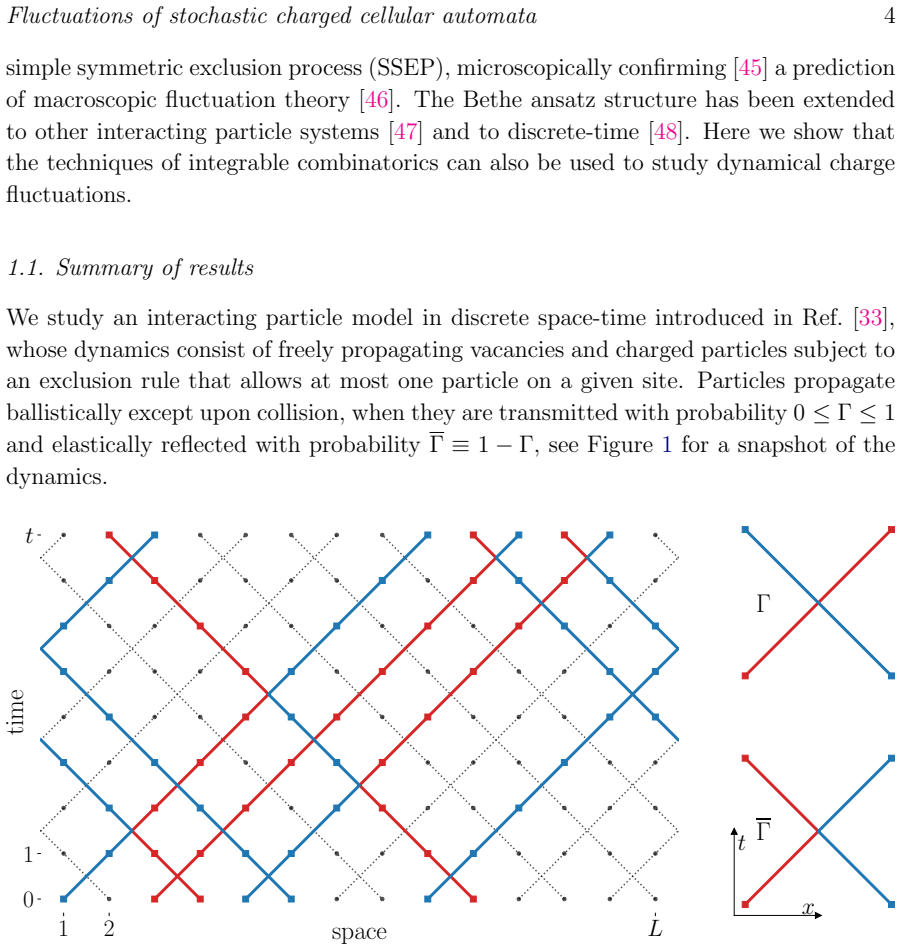
The vacancy-dressed full counting statistics (2.47) is the central object: vacancies are contracted exactly because they pass freely, leaving the six-vertex generating function for particles evaluated at dressed counting fields $\mu_\pm = \cosh\lambda \mp b_\pm \sinh\lambda$ and their product $\mu = \mu_+\mu_-$. The six-vertex part is carried by the Fredholm determinant $\det_{c_r}[1+(\mu-1)K_{x,t}]$ of the kernel $K_{x,t}(z,z') = z^{t-x} h^t(z)/(1-2z+zz')$, where $h(z) = (1+(z^{-1}-2)\Gamma)/(1-\Gamma z)$ is an exponentiated discrete dispersion relation. The argument proceeds by expanding the determinant in traces, applying Laplace's method to each trace sum, and using the reflection identity $E_{\rm step}(\mu^{N_x}|t)\,\mu^t = E_{\rm step}(\mu^{N_t}|x)\,\mu^x$ to cover the whole spacetime quadrant; these pieces combine into the asymptotic generating function and then the current distribution.
What would settle it
Evaluate the exact trace sum in Eq. (4.2) numerically for $k=1,2,3$ at $t=2^{16}$, $\Gamma=0.5$, and $t-x=\delta\sqrt{t}$ with $\delta=0.1$, and compare each trace with the asymptotic expression $\sqrt{t/(\pi\gamma k)}\,p(\delta\sqrt{\gamma k}/4)$, where $p(z)=e^{-z^2}-z\sqrt{\pi}\,\mathrm{erfc}\,z$. If the ratio does not approach 1 as $t$ grows, the interchange of the Laplace method and the trace summation leading to Eq. (4.51) is not justified; alternatively, direct simulation of the automaton at zero net charge would show deviations from Eq. (5.18) that persist at large $t$.
Extended reading notes
Core claim
The paper's central claim is that the full counting statistics $\langle e^{\lambda J(t)}\rangle$ of the stochastic charged cellular automaton equals a vacancy-dressed full counting statistics of a bistochastic six-vertex model with step initial conditions, Eq. (2.47). From there, an exact multiple-integral and Fredholm determinant representation of the six-vertex generating function leads, by Laplace-method asymptotics of the trace expansion, to the asymptotic formula (4.51) for diffusive shape fluctuations. Substituting this into the vacancy dressing yields, at vanishing charge density, the typical fluctuation distribution (5.18), a one-parameter family with scale parameter $a = 2\sqrt{\rho/\gamma}$. In the limits $\Gamma \to 0$ and $\Gamma \to 1$ it reduces respectively to the Mainardi-Wright distribution and a Gaussian, and the large-deviation function (5.22) is independent of $\Gamma$, confirming the hydrodynamic prediction.
Load-bearing premise
The load-bearing premise is that the family of Laplace-method asymptotics for the trace terms is accurate uniformly in the trace order $k$ and that the sum and integral can be interchanged when resumming into Eq. (4.51), a step for which the paper supplies no error bound.
Editorial extensions
If this is right
- At zero net charge, typical charge current fluctuations are non-Gaussian, occur on the $t^{1/4}$ scale, and are described by Eq. (5.18) for every scattering probability $0 \le \Gamma < 1$.
- Any nonzero back-scattering rate changes the dynamical exponent for charge fluctuations from ballistic ($z=1$) to diffusive ($z=2$); the variance diverges as $\Gamma \to 1$, signalling the return to free-particle fluctuations.
- Large charge fluctuations are exponentially suppressed with a rate (5.22) that is independent of $\Gamma$, confirming the hydrodynamic prediction for the single-file case.
- As an intermediate result, the paper gives a closed asymptotic formula, Eq. (4.51), for the full counting statistics of the bistochastic six-vertex model on a large square lattice with diffusive shape fluctuations, and shows that ballistic shape fluctuations are exponentially suppressed.
Reading between the lines
- The same vacancy-dressing plus Fredholm-determinant route should extend to generic bipartite initial measures, not only equilibrium ones, in analogy with the previously solved single-file case; the paper explicitly flags this direction.
- The one-parameter family (5.18) is likely the fingerprint of a wider stochastic-scattering universality class: any microscopic model whose particles reflect with probability $\Gamma$ and pass with probability $1-\Gamma$ should show the same scaled current distribution.
- The point $\Gamma=1$ appears singular: the $t^{1/4}$ family reaches the Gaussian only in the limit, so the free point is not itself part of the diffusive family, and any small amount of scattering changes the fluctuation scale discontinuously.
- A natural testable extension is a biased version of the automaton in which positive and negative particles scatter asymmetrically; the same integrable combinatorics should yield a modified one-parameter family, which could be checked by simulation.
Editorial analysis
A structured set of objections, weighed in public.
Referee Report
Summary. The paper studies equilibrium charge-current fluctuations in a one-dimensional stochastic cellular automaton with vacancies and positively/negatively charged particles that are transmitted or reflected stochastically upon collision. The authors map the full counting statistics (FCS) of the charge current to a vacancy-dressed stochastic six-vertex model, obtain a Fredholm determinant representation, and then analyze its asymptotics. Their central physical results are: (i) for zero net charge, typical fluctuations occur on the diffusive scale and obey the one-parameter distribution (5.18), interpolating between the Mainardi--Wright distribution at pure reflection and a Gaussian at pure transmission; and (ii) large fluctuations are independent of the crossing probability and match the ballistic macroscopic fluctuation theory prediction (5.22). The manuscript includes parameter-free numerical comparisons over several decades of the distribution tails.
Significance. If the asymptotic steps are valid, this is a substantial exact result: it extends the previously known single-file and free limits to a tunable stochastic scattering model and gives a concrete microscopic confirmation of a hydrodynamic prediction with no fitted parameters. The strengths of the manuscript are the careful reduction to the dressed six-vertex model, the exact Fredholm determinant representation, the nontrivial checks against the continuous-time SSEP limit and the free/single-file limits, and the direct numerical verification of the final distribution. The main unresolved point is an asymptotic resummation in Section 4.4 whose uniformity is not demonstrated; because the later equilibrium fluctuation results inherit this step, the central claim is defensible but needs that point tightened.
major comments (2)
- [Section 4.4, Eqs. (4.49)--(4.51)] The passage from the exact series (3.29) to the asymptotic FCS replaces each trace I^(k) by the Laplace estimate (4.42) and then interchanges the sum over k with the integral over xi via identity (4.50). The estimate (4.42) is obtained for fixed k, and no error bound uniform in k is supplied; the identity (4.50) is an exact summation identity, and applying it after substitution of an asymptotic approximation requires a uniformity or dominated-convergence argument. This step is load-bearing because Eq. (5.13), and hence the central distribution (5.18), are extracted from (4.51). I ask the authors to either prove the required uniformity (with explicit remainder bounds) or, more simply, derive the O(lambda^2) coefficient entering (5.13) directly from the k=1 term of (4.42), which is the only term contributing at the typical scale.
- [Section 5.1, Eqs. (5.11)--(5.14)] The asymptotic form (4.51) is inserted into the vacancy integral over delta whose support includes delta=0 and, through the reflection relation (3.42), negative delta. The trace estimate (4.42) is stated for t-x=delta sqrt(t) with delta>=0 and its remainder is not controlled uniformly in delta near zero; after the reflection extension the same remark applies for delta<0. Since the Gaussian prefactor does not by itself justify interchanging the lambda -> 0 limit with the delta integral, the derivation of the variance term in (5.18) needs an additional uniformity argument or an alternative route that avoids resummed expression (4.51). Deriving the k=1 contribution directly on both sides of delta=0 would address this concern and would also remove reliance on the uncontrolled resummation.
minor comments (5)
- [Throughout] There are numerous typographical errors that should be corrected, including “aymtptotics”, “exlcusion”, “the the”, “correspodning”, “dynamicaly”, “bistochstic”, “is is”, and “indicting” in Sections 1, 3, 4, and 5.
- [Figure 2 caption] The labels “210 211 212 213 214 215 216” should read “2^10, 2^11, ..., 2^16” (or equivalent) to avoid confusion between exponents and powers of ten.
- [Eqs. (3.29)--(3.30) and (4.1)--(4.3)] The notation for the traces alternates between I^(k) and I_(k); please unify the notation throughout Section 3 and Section 4.
- [Eq. (2.41) and surrounding text] In the summary and in (2.41), “the left of x+1” should read “to the left of x+1”; please also check that the definition of N_x is stated consistently in the main text and in the abstract-level formulas.
- [Section 5.1.2 after Eq. (5.19)] The phrase “s(z -> infinity) -> 0” and the similar phrase for z -> 0 should be written as “s(z) -> 0 as z -> infinity” and “s(z) ~ pi^{-1/2} z^{-1} as z -> 0” to keep the notation precise.
Circularity Check
No significant circularity: the central FCS derivation is self-contained, parameter-free, and only uses self-citations as benchmarks and limits.
full rationale
The central claim does not reduce to its inputs. The dressed FCS in Eq. (2.47) is obtained by a direct contraction of the exact three-color vertex-model partition function, with no fitted parameters. The six-vertex FCS is then derived from the external multiple-integral/Fredholm-determinant results of Borodin-Corwin-Gorin [48] and the trace-manipulation method of Derrida-Gerschenfeld [44]; these are independent published tools, not self-citations. The asymptotic formula (4.51) follows from Laplace-method trace estimates and the identity (4.50); the absence of a uniform error bound for the k-resummation is a technical rigor concern, not a circular reduction. The final distribution (5.18) has parameters sigma^2=2 rho rho-bar and a=2 sqrt(rho/gamma) fixed by the model parameters, and the comparison with direct simulation is explicitly parameter-free. Self-citations to Refs. [25,27,31] appear only as limiting-case checks and as a quoted evaluation of the known single-file large-deviation sum; Eq. (5.21) reduces the large-deviation problem to that known expression, so the citation is a benchmark rather than a load-bearing input. No fitted quantity is renamed as a prediction, and no uniqueness or ansatz is imported from the authors' prior work. The derivation is self-contained given its stated external theorems, so the circularity score is 0.
Assumptions & free parameters
assumptions (4)
- standard math Theorem 4.9 of Borodin-Corwin-Gorin (Ref. [48]) provides the multiple-integral representation for the transition probability of the stochastic six-vertex model with step initial condition.
- standard math The symmetrization identities (3.5), (3.6) and the Tracy-Widom determinant identity (3.7) hold.
- domain assumption The Laplace-method trace asymptotics of Eq. (4.42) hold uniformly in the summation index k, so that the series and integral can be interchanged in Eqs. (4.49) to (4.51).
- domain assumption The De Moivre-Laplace approximation for the vacancy sum, Eq. (5.8), and the diffusive six-vertex full counting statistics are valid simultaneously for vacancy numbers n_plus and n_minus within O(t^{1/2}) of t rho.
Cite this review
Pith. "Pith review of Fluctuations of stochastic charged cellular automata." pith.science (2026). https://pith.science/paper/OBQ65PTB
@misc{pith2026250202509,
  author       = {Pith},
  title        = {Pith review of: Fluctuations of stochastic charged cellular automata},
  year         = {2026},
  howpublished = {\url{https://pith.science/paper/OBQ65PTB}},
  note         = {Machine review of arXiv:2502.02509}
}
read the original abstract
We obtain the exact full counting statistics of a cellular automaton with freely propagating vacancies and charged particles that are stochastically scattered or transmitted upon collision by identifying the problem as a colored stochastic six-vertex model with one inert color. Typical charge current fluctuation at vanishing net charge follow a one-parameter distribution that interpolates between the distribution of the charged single-file class in the limit of pure reflection and a Gaussian distribution in the limit of pure transmission.
Figures


Figures from the paper (2 more)


Reference graph
Works this paper leans on
-
[1]
ˇZnidariˇ c M 2014 Phys. Rev. Lett. 112 URL https://doi.org/10.1103/physrevlett.112. 040602
- [2]
-
[3]
Commun.8 16117 URL https://doi.org/10
Ljubotina M, ˇZnidariˇ c M and Prosen T 2017Nat. Commun.8 16117 URL https://doi.org/10. 1038/ncomms16117
-
[4]
Ilievski E, De Nardis J, Medenjak M and Prosen T 2018 Phys. Rev. Lett.121(23) 230602 URL https://doi.org/10.1103/PhysRevLett.121.230602
-
[5]
De Nardis J, Medenjak M, Karrasch C and Ilievski E 2019 Phys. Rev. Lett.123(18) 186601 URL https://doi.org/10.1103/PhysRevLett.123.186601
-
[6]
Gopalakrishnan S and Vasseur R 2019 Phys. Rev. Lett.122(12) 127202 URL https://doi.org/ 10.1103/PhysRevLett.122.127202
-
[7]
Ljubotina M, ˇZnidariˇ c M and Prosen T 2019 Phys. Rev. Lett.122 210602 URL https://doi. org/10.1103/PhysRevLett.122.210602
-
[8]
Dupont M and Moore J E 2020 Phys. Rev. B 101 URL https://doi.org/10.1103/physrevb. 101.121106
doi:10.1103/physrevb 2020
Show all 54 references
-
[9]
Weiner F, Schmitteckert P, Bera S and Evers F 2020 Phys. Rev. B 101(4) 045115 URL https: //doi.org/10.1103/PhysRevB.101.045115
2020 doi
-
[10]
De Nardis J, Gopalakrishnan S, Ilievski E and Vasseur R 2020 Phys. Rev. Lett.125(7) 070601 URL https://doi.org/10.1103/PhysRevLett.125.070601
2020 doi
-
[11]
Ilievski E, De Nardis J, Gopalakrishnan S, Vasseur R and Ware B 2021 Phys. Rev. X11(3) 031023 URL https://doi.org/10.1103/PhysRevX.11.031023
2021 doi
-
[12]
Das A, Kulkarni M, Spohn H and Dhar A 2019 Phys. Rev. E 100(4) 042116 URL https: //doi.org/10.1103/PhysRevE.100.042116
2019 doi
-
[13]
Krajnik ˇZ and Prosen T 2020 J. Stat. Phys. 179 110–130 URL https://doi.org/10.1007/ s10955-020-02523-1 Fluctuations of stochastic charged cellular automata 36
2020
-
[14]
9(3) 038 URL https://scipost.org/10
Krajnik ˇZ, Ilievski E and Prosen T 2020 SciPost Phys. 9(3) 038 URL https://scipost.org/10. 21468/SciPostPhys.9.3.038
2020
-
[15]
McRoberts A J, Bilitewski T, Haque M and Moessner R 2022 Phys. Rev. B 105 URL https: //doi.org/10.1103/PhysRevB.105.L100403
2022 doi
-
[16]
Roy D, Dhar A, Spohn H and Kulkarni M 2024 Phys. Rev. E 110 URL https://doi.org/10. 1103/PhysRevE.110.044110
2024
-
[17]
Scheie A, Sherman N E, Dupont M, Nagler S E, Stone M B, Granroth G E, Moore J E and Tennant D A 2021 Nat. Phys. 17 726–730 URL https://doi.org/10.1038/s41567-021-01191-6
2021 doi
-
[18]
2022 Science 376 716–720 URL https://www.science.org/doi/abs/10.1126/ science.abk2397
Wei D et al. 2022 Science 376 716–720 URL https://www.science.org/doi/abs/10.1126/ science.abk2397
2022
-
[19]
Jepsen P N, Amato-Grill J, Dimitrova I, Ho W W, Demler E and Ketterle W 2020 Nature 588 403–407 URL https://doi.org/10.1038/s41586-020-3033-y
2020 doi
-
[20]
ˇZnidariˇ c M 2014Phys. Rev. B90 URL https://doi.org/10.1103/physrevb.90.115156
-
[21]
Krajnik ˇZ, Ilievski E and Prosen T 2022 Phys. Rev. Lett.128(9) 090604 URL https://doi.org/ 10.1103/PhysRevLett.128.090604
2022 doi
-
[22]
Krajnik ˇZ, Schmidt J, Ilievski E and Prosen T 2024 Phys. Rev. Lett. 132(1) 017101 URL https://doi.org/10.1103/PhysRevLett.132.017101
2024 doi
-
[23]
Takeuchi K A, Takasan K, Busani O, Ferrari P L, Vasseur R and Nardis J D 2024 Partial yet definite emergence of the Kardar-Parisi-Zhang class in isotropic spin chains (Preprint 2406.07150) URL https://arxiv.org/abs/2406.07150
2024 arXiv
-
[24]
2024 Science 384 48–53 URL https://www.science.org/doi/abs/10.1126/ science.adi7877
Rosenberg E et al. 2024 Science 384 48–53 URL https://www.science.org/doi/abs/10.1126/ science.adi7877
2024
-
[25]
Krajnik ˇZ, Schmidt J, Pasquier V, Ilievski E and Prosen T 2022 Phys. Rev. Lett.128(16) 160601 URL https://doi.org/10.1103/PhysRevLett.128.160601
2022 doi
-
[26]
Kormos M, V¨ or¨ os D and Zar´ and G 2022Phys. Rev. B106(20) 205151 URL https://doi.org/ 10.1103/PhysRevB.106.205151
-
[27]
Krajnik ˇZ, Schmidt J, Pasquier V, Prosen T and Ilievski E 2024 Phys. Rev. Res.6(1) 013260 URL https://doi.org/10.1103/PhysRevResearch.6.013260
2024 doi
-
[28]
Krajnik ˇZ 2024 Phys. Rev. E 110(2) 024118 URL https://doi.org/10.1103/PhysRevE.110. 024118
2024 doi
-
[29]
Medenjak M, Klobas K and Prosen T 2017 Phys. Rev. Lett. 119(11) 110603 URL https: //doi.org/10.1103/PhysRevLett.119.110603
2017 doi
-
[30]
Gopalakrishnan S, McCulloch E and Vasseur R 2024 Proc. Natl. Acad. Sci.121 URL https: //doi.org/10.1073/pnas.2403327121
2024 doi
-
[31]
Yoshimura T and Krajnik ˇZ 2024 Anomalous current fluctuations from Euler hydrodynamics (Preprint 2406.20091) URL https://arxiv.org/abs/2406.20091
2024 arXiv
-
[32]
15 136 URL https: //scipost.org/10.21468/SciPostPhys.15.4.136
Doyon B, Perfetto G, Sasamoto T and Yoshimura T 2023 SciPost Phys. 15 136 URL https: //scipost.org/10.21468/SciPostPhys.15.4.136
2023 doi
-
[33]
Klobas K, Medenjak M and Prosen T 2018 J. Stat. Mech.2018 123202 URL https://doi.org/ 10.1088/1742-5468/aae853
2018 doi
-
[34]
Georges A and Le Doussal P 1989 J. Stat. Phys.54 1011–1064 URL https://doi.org/10.1007/ BF01019786
1989
-
[35]
Lebowitz J L, Maes C and Speer E R 1990 J. Stat. Phys.59 117–170 URL https://doi.org/10. 1007/BF01015566
1990
-
[36]
Gwa L H and Spohn H 1992 Phys. Rev. Lett. 68 725–728 URL https://doi.org/10.1103/ PhysRevLett.68.725
1992
-
[37]
Sch¨ utz G M 1997J. Stat. Phys.88 427–445 URL https://doi.org/10.1007/BF02508478
-
[38]
Tracy C A and Widom H 2008 Commun. Math. Phys.279 815–844 URL https://doi.org/10. 1007/s00220-008-0443-3
2008
-
[39]
Tracy C A and Widom H 2008 J. Stat. Phys. 132 291–300 URL https://doi.org/10.1007/ s10955-008-9562-7 Fluctuations of stochastic charged cellular automata 37
2008
-
[40]
Tracy C A and Widom H 2009 Commun. Math. Phys.290 129–154 URL https://doi.org/10. 1007/s00220-009-0761-0
2009
-
[41]
Kardar M, Parisi G and Zhang Y C 1986 Phys. Rev. Lett.56(9) 889–892 URL https://doi.org/ 10.1103/PhysRevLett.56.889
1986 doi
-
[42]
01 1130001 URL https://doi.org/10.1142/ s2010326311300014
Corwin I 2012 Random Matrices: Theory Appl. 01 1130001 URL https://doi.org/10.1142/ s2010326311300014
2012
-
[43]
Takeuchi K A 2018 Physica A 504 77–105 URL https://doi.org/10.1016/j.physa.2018.03. 009
2018 doi
-
[44]
Derrida B and Gerschenfeld A 2009 J. Stat. Phys. 136 1–15 URL https://doi.org/10.1007/ s10955-009-9772-7
2009
-
[45]
Derrida B and Gerschenfeld A 2009 J. Stat. Phys. 137 978–1000 URL https://doi.org/10. 1007/s10955-009-9830-1
2009
-
[46]
Bertini L, De Sole A, Gabrielli D, Jona-Lasinio G and Landim C 2015 Rev. Mod. Phys. 87(2) 593–636 URL https://doi.org/10.1103/RevModPhys.87.593
2015 doi
-
[47]
Borodin A, Corwin I, Petrov L and Sasamoto T 2015 Commun. Math. Phys.339 1167–1245 URL https://doi.org/10.1007/s00220-015-2424-7
2015 doi
-
[48]
Borodin A, Corwin I and Gorin V 2016 Duke Math. J. 165 563 – 624 URL https://doi.org/ 10.1215/00127094-3166843
2016 doi
-
[49]
Imamura T, Mallick K and Sasamoto T 2021 Communications in Mathematical Physics 384 1409–1444 URL http://dx.doi.org/10.1007/s00220-021-03954-x
2021 doi
-
[50]
Derrida B, Dou¸ cot B and Roche P E 2004 J. Stat. Phys.115 717–748 URL https://doi.org/ 10.1023/B:JOSS.0000022379.95508.b2
2004
-
[51]
Mainardi F 1996 Appl. Math. Lett. 9 23–28 URL https://doi.org/10.1016/0893-9659(96) 00089-4
1996 doi
-
[52]
Mainardi F and Consiglio A 2020 Mathematics 8 884 URL https://doi.org/10.3390/ math8060884
2020
-
[53]
Bertini B, Calabrese P, Collura M, Klobas K and Rylands C 2023 Phys. Rev. Lett.131(14) 140401 URL https://doi.org/10.1103/PhysRevLett.131.140401
2023 doi
-
[54]
Bertini B, Klobas K, Collura M, Calabrese P and Rylands C 2024 Phys. Rev. B109(18) 184312 URL https://doi.org/10.1103/PhysRevB.109.184312
2024 doi
Reviewed August 9, 2026 · model on record in the stance chip above.
Discussion (0). Continue with ORCID to comment.