Ozone double ionization yields excited oxygen ions
First valence double-ionization spectrum and calculations show both ground and excited O+ fragments, revealing more breakup pathways than此前已

Atomic and Molecular Clusters
Atomic and molecular clusters, nanoparticles: geometric, electronic, optical, chemical, magnetic properties, shell structure, phase transitions, optical spectroscopy, mass spectrometry, photoelectron spectroscopy, ionization potential, electron affinity, interaction with intense light pulses, electron diffraction, light scattering, ab initio calculations, DFT theory, fragmentation, Coulomb explosion, hydrodynamic expansion.
First valence double-ionization spectrum and calculations show both ground and excited O+ fragments, revealing more breakup pathways than此前已
SU(4) tetrahedral lattice unifies tripod, diamond, and five other topologies under a single rate equation, with peak intensity scaling as N^
· “Multi-channel collective dissipation via the symmetric irreducible representation of SU(4)”

MC-BE/TMMM matches benzene and naphthalene experiments near threshold using only TDDFT amplitudes

A dark collisional state opens a narrow transparency window inside a Feshbach resonance

Augmenting Gaussian bases with exponential tails aligns theory with measured angular distributions except in the weakest-binding cases.
Simulations show proton transfer and dissociation rise sharply from dimer to tetramer while net charge per molecule stays nearly constant.
· “Size Effects in the Strong-Field Ionization and Dissociation Dynamics of (H₂O)_n (n=1-4)”
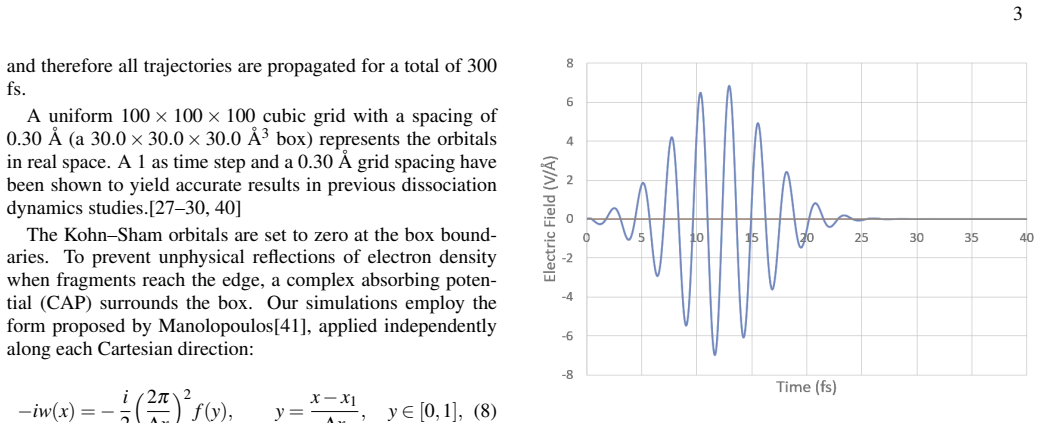
Interference between electrons 0.031 per angstrom apart in gold and graphene patterns yields the value at 30 keV.
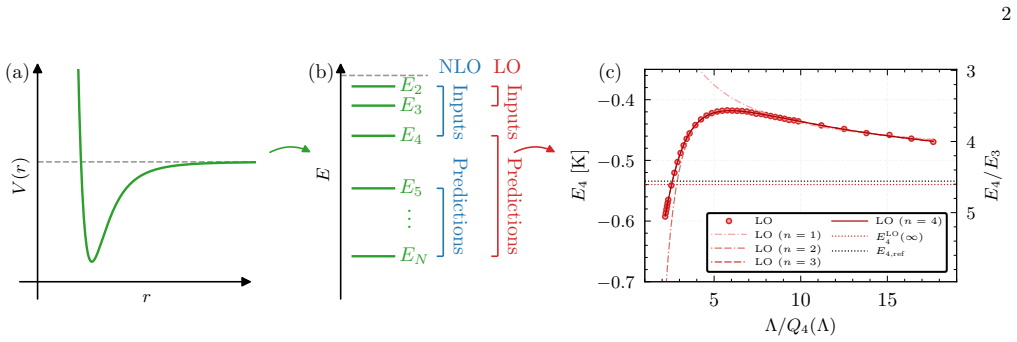
Leading-order theory uses only dimer and trimer energies to predict results up to 15 particles that match realistic potentials.
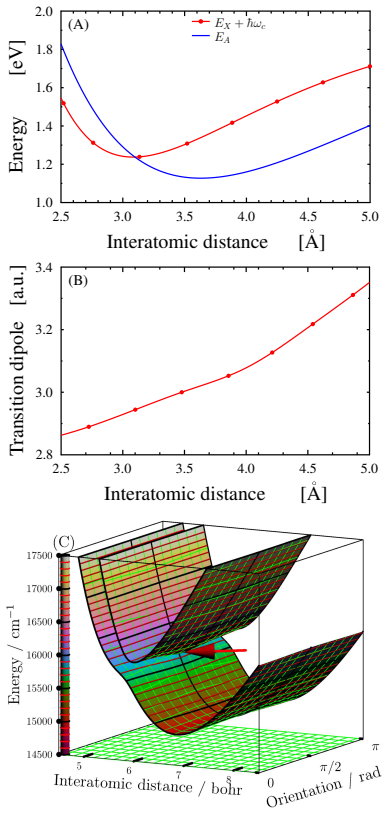
Axial separation starts circulation and lateral offset tunes frequency for dynamical sensing

It remains accurate yet cheaper, while rotation adds nonadiabatic effects through light-induced conical intersections
· “Light-induced nonadiabatic dissipative quantum dynamics of the Na2 molecule”
The simplified approach matches experiments on MgO and TiO2 at low computational cost.
· “A first-principles approach for predicting infrared optical properties of solids”
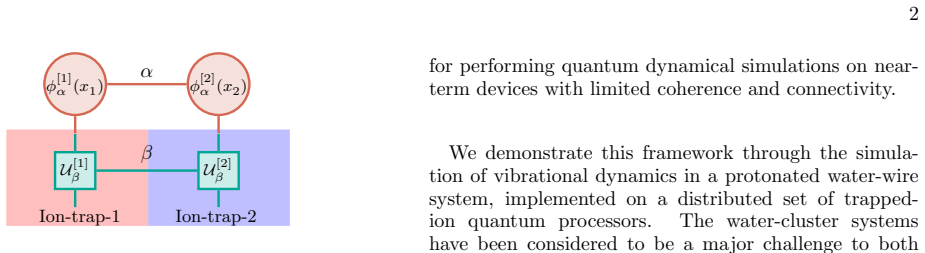
The decomposition enables asynchronous execution across heterogeneous hardware and produces vibrational spectra of a protonated water cluste
· “Tensor-Network-Based Distributed Quantum Dynamics on Independent Quantum Computers”
Wave-packet results on a large manifold show rotational couplings boost the rate well above previous models

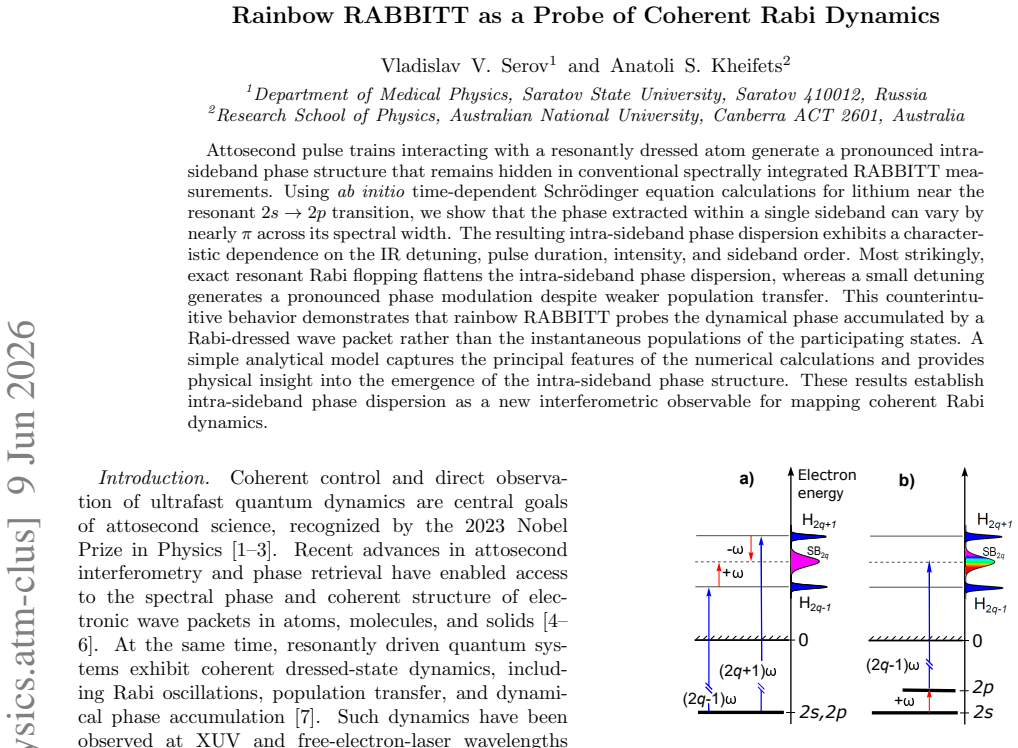
Intra-sideband phase varies by nearly pi across its width and flattens at exact resonance, showing the method reads accumulated dynamical ph
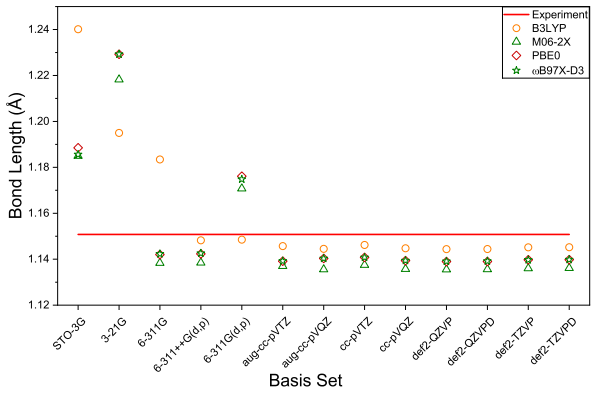
Target properties from different functionals move resonance positions and alter cross sections in R-matrix models of nitric oxide.
· “Influence of DFT Functionals on Low-Energy Electron Scattering Cross Sections of Nitric Oxide”
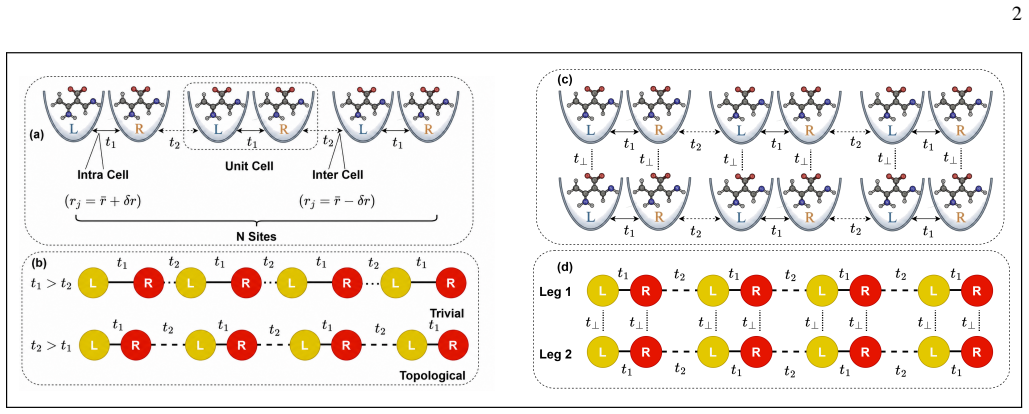
Left edge state localizes on left-handed molecules and right edge on right-handed ones in dimerized dipolar arrays.
· “Topological Edge States from Molecular Chirality: A General Framework for Dimerized Dipolar Arrays”
Beijing measurements show DEA and PZ drive more nucleation than dimethylamine, requiring updates to standard urban aerosol models
· “Emerging Amines reshape the paradigm of urban atmospheric particle formation”
ChatMOSP retrieves parameters from literature to reproduce Pd nanoparticle shape changes and Pt activity oscillations under CO oxidation con
· “ChatMOSP: A Chemistry-Grounded Mobile Agent for Working-State Catalyst Simulations”
Tests on five neural potentials show equivariant models like MACE and PaiNN generalize better to new molecules than SchNet.
· “Benchmarking machine-learned interatomic potentials for molecular infrared spectroscopy”

Accelerated simulations treating both electron correlation and nuclear quantum effects shift the shared proton closer to the bond center.

Spectroscopy and simulations link distinct doublet and singlet behaviors to different lattice environments and reorganization.

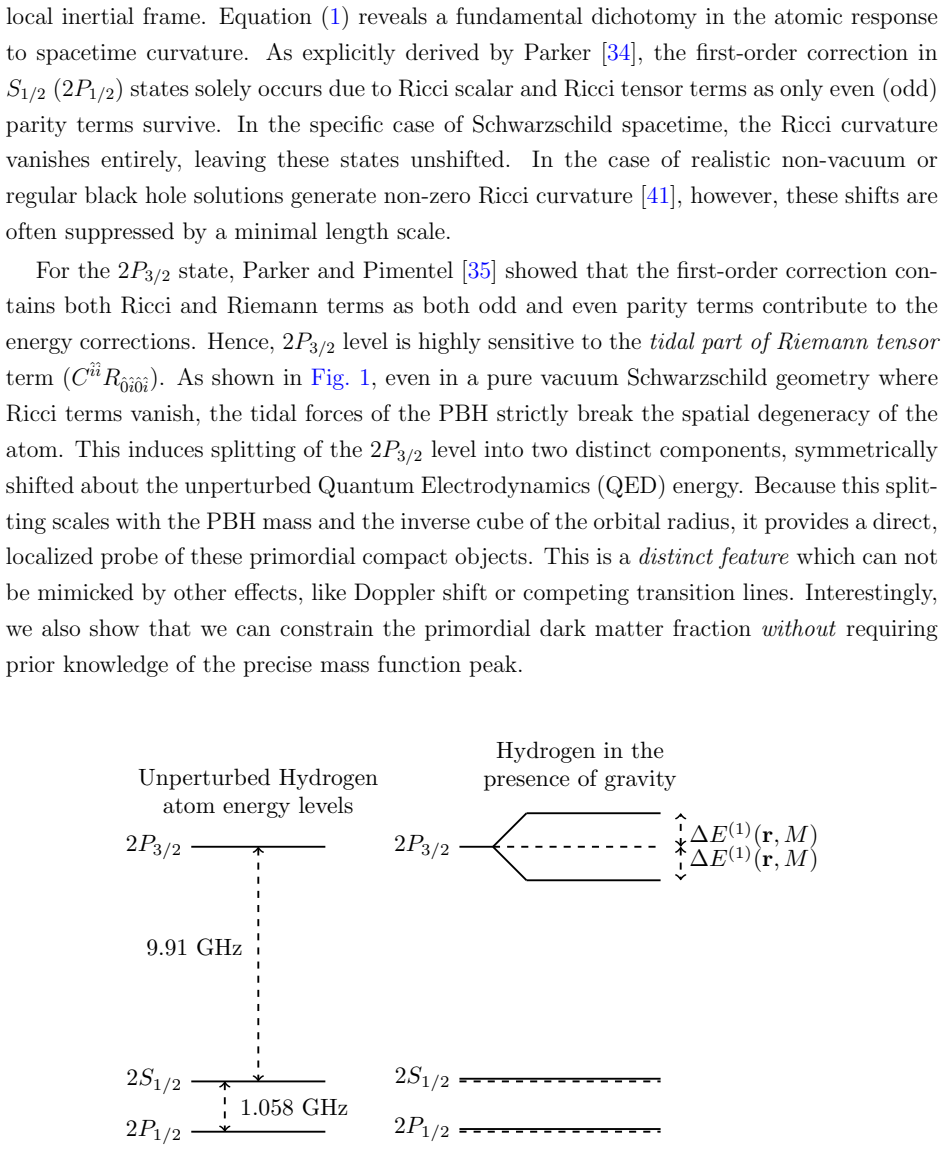
Tidal splitting of bound hydrogen atoms creates an enhanced absorption signature that radio surveys could use to constrain PBH dark matter.
· “The Gravitational Spectral Radio Forest: A Signature of Primordial Black Holes”
In clusters of 5-20 atoms both sets reconstruct the density, but natural orbitals from the density matrix do so more accurately, with thegap
Covers transparent to opaque regimes in long tubes and recovers standard axial flux for source design.
· “Analytical emission model for the design of primary effusive sources”

New IR and THz measurements of hyperfine-resolved transitions in a cold ion trap tighten the ground-state parameters of the molecular ion.
· “Hyperfine-Resolved Rovibrational and Rotational Spectroscopy of OH^+ (X ³Sigma^-)”

Dark states sharpen while bright states diverge at asymmetric positions, showing direct electric control over long-lived collective modes.
· “Locally-Induced Stark Shifts of Collective Excitonic Modes in Polyradical Aggregates”
Contributors share perspectives on unresolved questions in nanocluster electron dynamics and behavior
Emitter interactions cause Raman-type anharmonicities to show as sidebands on collective resonances, allowing control of spectral features.
· “Hidden optical nonlinearities in linear spectra of quantum emitter arrays”

Trapped ions in a scalable chip design enable pT-sensitive detection and precise field gradient measurements across separate zones.
· “Scalable surface ion trap design for magnetic quantum sensing and gradiometry”
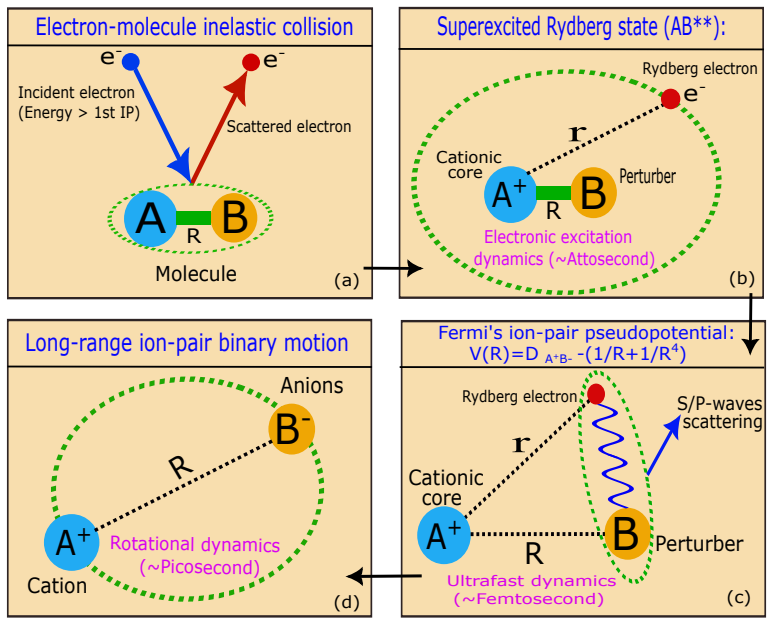
Angular distributions show partial-wave shifts that invalidate the dipole-Born model and point to quasi-resonant superexcited states.
TUNA shows that numerical differentiation plus diatomic symmetry yields a transparent teaching and benchmarking code
· “TUNA: A streamlined quantum chemistry program for atoms and diatomics”
Concave forms restore fivefold symmetry by diffusion; shallow convex forms lose twins rapidly, yet two atomic layers of depth stabilizes the
In NV centers the real part diverges to negative infinity only along non-reciprocal coupling, stays finite along detuning, and follows from
The attraction arises from quantum correlations between positrons rather than electrons, yielding an unusually strong dispersion force.
· “The two-positron gluic bond as a manifestation of "super" van der Waals interactions”
Dynamic modules of correlated contacts explain how signals travel between distant sites in these proteins.
· “Contact cluster modeling of allosteric communication in PDZ domains”

The tool adds weighted confidence scores to user clusters so physicists can quickly isolate rare events in multi-particle coincidence sets.

Density-dependent interaction strength lets researchers compute quantum-droplet states and breathing modes without extra parameters.
· “Generalized Gross-Pitaevskii Equation for 2D Bosons with Attractive Interactions”

Partial equilibrium lets cluster sizes be treated collectively, making thermal diffusion key in temperature and pressure gradients.

Eu-HFC3 complex shows asymmetries similar to small molecules, proving PECD works for large systems
· “Photoelectron Spectroscopy and Circular Dichroism of an Open-Shell Organometallic Camphor Complex”
Microwave parameters tune the interaction without breaking the protection that keeps losses low, opening a path to stable degenerate samples
· “Tunable Field-Linked s-wave Interactions in Dipolar Fermi Mixtures”

For regular potentials the difference equals the Breit-Pauli mass-velocity, Darwin and spin-orbit sum
Subsystem networks combine to reach sub-kcal/mol accuracy on protonated 21-water cluster at CCSD level.
· “A large language model-type architecture for high-dimensional molecular potential energy surfaces”

Adding the 3p4s–3p4p avoided crossing makes DIM agree with HPP on Ar₂*–Ar_{N-2} localization.
· “An Update to Isomers of Rydberg Excitations in Argon Clusters”

Cryogenic drift-tube measurements in helium show distinct low-field reduced mobilities that track with electronic configuration and field-dw

Larger pores retain first-order transitions but smaller ones become continuous with lower condensation pressure than bulk
· “Statistical modeling of equilibrium phase transition in confined fluids”

Two- and three-body contacts extracted from momentum tails increase as noninteger dimension drops, affecting gas observables.
· “Single-particle momentum distribution of Efimov states in noninteger dimensions”

Spatial filtering of the deflected beam selects droplets by radius, revealing the mean free path for charge hopping in helium.
Femtosecond laser explosion data in helium droplets plus alignment yields select the slipped-parallel or slightly rotated forms.
Oscillations in molecular alignment arise from quantum-state-specific transfer to the superfluid on picosecond timescales.
· “Far-from-equilibrium dynamics of angular momentum in a quantum many-particle system”

Electrons from consecutive half-cycles show opposite forward-backward preferences despite zero average ellipticity.
· “Controlling Sub-Cycle Optical Chirality in the Photoionization of Chiral Molecules”

The dichroic signal in methyloxirane arises via resonant Auger decay and reverses sign across the resonance even though separate channels do
· “Recovery of high-energy photoelectron circular dichroism through Fano interference”
