REVIEW 2 major objections 6 minor 56 references
One equation unifies all seven four-level superradiant topologies
Reviewed by Pith at T0; open to challenge. T0 means a machine referee read the full paper against a public rubric. the ladder, T0–T4 →
T0 review · glm-5.2
2026-07-09 01:42 UTC pith:T7RGKWB4
load-bearing objection The SU(4) framework is sound and new; the power-law scaling claim is the real soft spot. the 2 major comments →
Multi-channel collective dissipation via the symmetric irreducible representation of SU(4)
The pith
A machine-rendered reading of the paper's core claim, the machinery that carries it, and where it could break.
Core claim
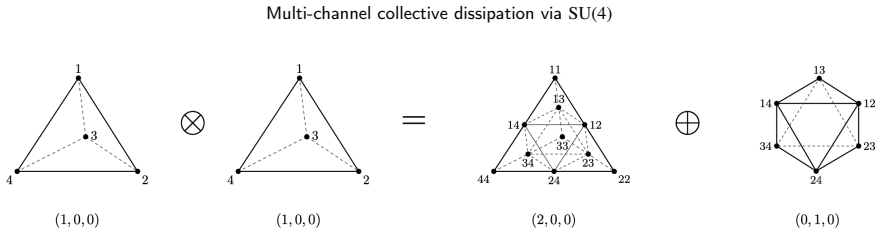
The central object is the Pauli-type population-rate equation (Eq. 22) on the SU(4) tetrahedral weight lattice. The key mechanism is that the collective transition operator A_nm acting on a symmetric occupation state ||q1,q2,q3,q4>> produces a Bose-enhanced factor sqrt(q_m(q_n+1)), which is the four-level generalization of the Dicke factor sqrt((J-M)(J+M+1)). This factor closes the rate equation on diagonal populations alone and produces the superlinear intensity scaling. The paper's main result is that this single equation, combined with a configuration-dependent mask of allowed decay channels, reproduces the dissipative dynamics of all seven dipole-allowed four-level topologies, with peak-
What carries the argument
The symmetric irreducible representation (N,0,0) of SU(4); the tetrahedral weight lattice of occupation-number states; six embedded su(2) subalgebras acting as ladder operators; the Pauli-type rate equation (Eq. 22); the closed-form intensity formula (Eq. 25); the energy-balance identity d<E>/dt = -I(t)
Load-bearing premise
The derivation of the Pauli-type rate equation from the full Lindblad master equation assumes that the diagonal populations alone form a closed set of equations, which holds only when atom-atom coherences in the symmetric subspace are negligible. The paper acknowledges this: the entire numerical framework, the intensity formula, and the scaling exponents are computed from this population-only equation, so if coherences contribute non-subleading corrections, the extracted exop
What would settle it
If atom-atom coherences in the symmetric subspace contribute non-negligibly to the population dynamics, the rate equation would not close on diagonal populations alone, and the extracted power-law exponents and topology-dependent peak rankings could shift. Additionally, the power-law fits are established only over the finite range N=20-40; if the scaling is a finite-size crossover effect rather than an asymptotic law, the exponents may drift toward 2 or toward other values at larger N.
If this is right
- All seven dipole-allowed four-level atomic configurations can be simulated within a single numerical framework by masking decay channels, reducing the problem from exponentially large Hilbert-space evolution to a polynomial-sized O(N^3) linear ODE system.
- Configurations that funnel population into a common lower level (inverted tripod, Y, inverted Y) achieve the largest scaling exponents (p ~ 1.90-1.92), while branched topologies (tripod, double-Lambda, diamond) combine smaller exponents with larger absolute peak intensities, providing topology-specific design guidance for superradiant sources.
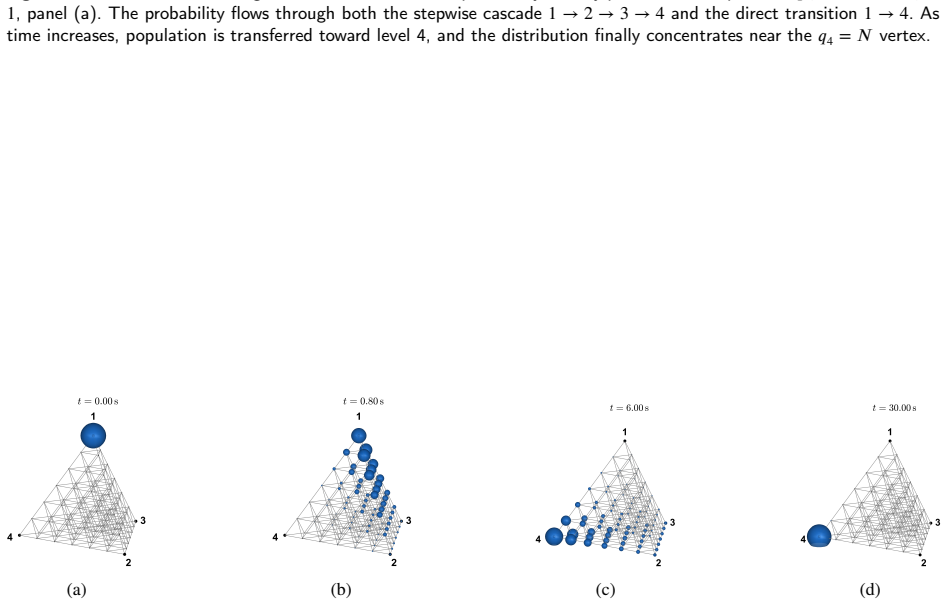
- The tetrahedral probability-flow visualization reveals qualitatively distinct dynamical signatures for each topology—trinomial spreading (tripod), one-dimensional shuttling with a shortcut (closed cascade), and funneling into a dark vertex (diamond)—that could be experimentally distinguishable.
- The framework extends naturally to include coherent Rabi driving on selected channels, mapping onto optical-Bloch equations on the SU(4) lattice for double-EIT, slow light, and biphoton source applications.
Editorial analysis
A structured set of objections, weighed in public.
Referee Report
Summary. This paper extends Agarwal's multi-level collective spontaneous-emission formalism to four-level atoms by working in the fully symmetric irreducible representation (N,0,0) of SU(4). The occupation-number basis forms a tetrahedral weight lattice on which six embedded su(2) subalgebras act as ladder operators. The authors derive a Pauli-type population-rate equation (Eq. 22) and a closed-form expression for the total emitted intensity (Eq. 25) from the Lindblad master equation (Eq. 17). They specialize this single framework to all seven dipole-allowed four-level topologies (tripod, inverted tripod, Y, inverted Y, double-Lambda, closed cascade, diamond) by simply zeroing forbidden decay channels. They solve the resulting rate equations numerically for N up to 50, visualize probability flow on the SU(4) tetrahedron, and fit the peak emitted intensity to a power law I_peak = aN^p, finding exponents in the range 1.81-1.92.
Significance. The paper provides a clean algebraic unification of all seven four-level dipole topologies under a single rate equation, which is a natural and useful extension of the authors' prior SU(3) trilogy. The derivation of the collective matrix elements (Eq. 11) and the rate equation (Eq. 22) from the Lindblad master equation is mathematically sound and follows standard Schwinger-boson methods. The energy-balance identity (Eq. 27) provides a valuable self-consistency check. The numerical solutions are exact within the symmetric subspace, and the visualization of probability flow on the tetrahedral lattice is pedagogically effective. The power-law scaling exponents constitute a falsifiable, topology-dependent prediction. The reduction of the many-body problem to O(N^3) equations is a practical strength.
major comments (2)
- Section 5.3, Figure 5.5: The power-law fit I_peak = aN^p is performed over the range N=20-40, which appears to involve only three data points (N=20, 30, 40; Figure 5.4 shows transients for N=20, 30, 40, 50). Fitting a two-parameter power law to three points will yield R^2 approximately 1 by construction, so the reported R^2 values do not validate the power-law form. The claim that the power law 'accurately describes the numerical data' (Section 5.3) is not substantiated by this fit. The authors should either (i) include additional data points (e.g., N=20, 22, 24, ..., 40) to make the fit non-trivial, or (ii) provide an analytical argument for why a pure power law is expected over a form like aN^2(1 - b/N^alpha + ...). As it stands, the topology-dependent ranking of exponents, which rests on differences as small as 0.07 (diamond p=1.851 vs Y p=1.922), is not robustly established.
- Section 6(i): The statement that 'The diagonal Pauli-type rate equation neglects atom-atom coherence in the symmetric subspace' is misleading. For Lindblad dynamics with number-conserving jump operators A_nm = a_n^dagger a_m, the diagonal elements of the density matrix in the occupation-number basis form an exactly closed subsystem: off-diagonal coherences evolve independently and never feed back into populations. The rate equation (Eq. 22) is therefore an exact consequence of Eq. (17), not an approximation. The authors should correct this statement to avoid confusion, clarifying that the population dynamics are exact within the symmetric subspace and that coherences are only needed for computing quantities such as g^(2) correlations, not for I(t) as defined in Eq. (25).
minor comments (6)
- Abstract: The sentence ending with 'indicating a superlinear.' is grammatically incomplete; a noun such as 'scaling' or 'growth' is missing.
- Figure 5.5 caption: The caption states the fit is over N=20,...,40, but Figure 5.4 shows transients for N=20, 30, 40, 50. It is unclear whether N=50 data is included in the fit. This should be clarified.
- Section 5.2: The initial conditions for the inverted tripod and Y configurations involve floor functions (e.g., N - 2*floor(N/3)). The rationale for these specific initial states is not explained. A brief justification would help the reader understand why these (rather than, say, all population in the highest level) are the natural choices.
- Section 5.2: The transition frequencies omega_nm are stated to be in 'arbitrary units.' Since I(t) depends on these weights (Eq. 25), the absolute values of I_peak and the fitted prefactor 'a' depend on this choice. The authors should note that the exponents p are independent of this scaling but the prefactors a are not.
- Equation (2): The notation is confusing. The left side defines A_nm = |n><m|, but the right side appears to show a sum from i=n to 4 of |n><n| = I. This seems to be a formatting issue; the second line should likely be A_nn = |n><n| or similar.
- Data availability: The statement that code is 'available from the corresponding author upon reasonable request' is less transparent than a public repository deposit. Given that the paper emphasizes numerical results, a public code release would strengthen reproducibility.
Simulated Author's Rebuttal
We thank the referee for a careful and constructive report. Both major comments are well-taken. On the first, we agree that the power-law fit over only three data points is insufficient and will expand the fitting range substantially. On the second, the referee is mathematically correct that the diagonal rate equation is an exact consequence of the Lindblad master equation for number-conserving jump operators, and we will correct the misleading statement in Section 6(i).
read point-by-point responses
-
Referee: Section 5.3, Figure 5.5: The power-law fit I_peak = aN^p is performed over the range N=20-40, which appears to involve only three data points (N=20, 30, 40). Fitting a two-parameter power law to three points will yield R^2 approximately 1 by construction, so the reported R^2 values do not validate the power-law form. The claim that the power law 'accurately describes the numerical data' is not substantiated by this fit. The authors should either (i) include additional data points (e.g., N=20, 22, 24, ..., 40) to make the fit non-trivial, or (ii) provide an analytical argument for why a pure power law is expected over a form like aN^2(1 - b/N^alpha + ...). As it stands, the topology-dependent ranking of exponents, which rests on differences as small as 0.07 (diamond p=1.851 vs Y p=1.922), is not robustly established.
Authors: The referee is correct on all counts. Fitting a two-parameter power law to only three data points (N=20, 30, 40) is indeed insufficient: with three points and two free parameters, R^2 near unity is nearly guaranteed and carries no independent statistical content. We also agree that exponent differences as small as 0.07 cannot be robustly established from such a fit. We will address this in the revised manuscript by adopting the referee's option (i): we will recompute I_peak for all seven topologies at N = 20, 22, 24, ..., 40 (i.e., 11 data points per topology) and refit. This will make the fit genuinely over-determined and the R^2 values meaningful. We will additionally report the residuals explicitly so that the reader can assess whether a pure power law aN^p or a corrected form aN^2(1 - b/N^alpha + ...) provides a better description. We will also soften the claim that the power law 'accurately describes the numerical data' to reflect that it is a finite-size empirical fit, not a derived asymptotic law, and we will explicitly caution that the topology-dependent ranking of exponents should be interpreted as a qualitative trend rather than a precisely established ordering given the small differences involved. revision: yes
-
Referee: Section 6(i): The statement that 'The diagonal Pauli-type rate equation neglects atom-atom coherence in the symmetric subspace' is misleading. For Lindblad dynamics with number-conserving jump operators A_nm = a_n^dagger a_m, the diagonal elements of the density matrix in the occupation-number basis form an exactly closed subsystem: off-diagonal coherences evolve independently and never feed back into populations. The rate equation (Eq. 22) is therefore an exact consequence of Eq. (17), not an approximation. The authors should correct this statement to avoid confusion, clarifying that the population dynamics are exact within the symmetric subspace and that coherences are only needed for computing quantities such as g^(2) correlations, not for I(t) as defined in Eq. (25).
Authors: The referee is mathematically correct, and we thank them for this precise observation. For the Lindblad master equation (Eq. 17) with number-conserving jump operators A_nm = a_n^dagger a_m, the diagonal elements of the density matrix in the occupation-number basis do form an exactly closed subsystem: the off-diagonal coherences decouple and never feed back into the populations. Equation (22) is therefore an exact consequence of Eq. (17) within the symmetric subspace, not an approximation. The statement in Section 6(i) that the rate equation 'neglects atom-atom coherence' is misleading and will be corrected. Specifically, we will revise Section 6(i) to state clearly that: (a) the population dynamics described by Eq. (22) are exact within the symmetric subspace; (b) off-diagonal coherences evolve independently and do not affect the populations or the total emitted intensity I(t) as defined in Eq. (25); and (c) coherences are needed only for computing quantities such as g^(2) correlation functions and biphoton statistics, which are the subject of future work. We will also add a brief remark in Section 3, at the point where Eq. (22) is derived, explicitly noting the closure property of the diagonal subsystem for number-conserving Lindblad dynamics, so that the exactness of the rate equation is clear from the outset. revision: yes
Circularity Check
No significant circularity; derivation is self-contained from standard Lindblad dynamics and SU(4) representation theory.
full rationale
The paper's derivation chain proceeds as follows: (1) The Lindblad master equation (Eq. 17) is taken from Agarwal's established formalism [36–38], an external source. (2) The collective transition matrix elements (Eq. 11) follow from the Schwinger representation of SU(4) in the fully symmetric (N,0,0) irreducible representation — standard representation theory, not fitted or assumed. (3) The Pauli-type rate equation (Eq. 22) is obtained by substituting Eq. 11 into Eq. 17 and projecting onto diagonal elements. This closure is exact for bilinear jump operators A_nm = a†_n a_m, since each jump maps one occupation state to exactly one other (not a superposition), so coherences never feed back into populations. (4) The intensity formula (Eq. 25) and energy-balance identity (Eq. 27) follow algebraically from the rate equation structure. (5) The power-law exponents p ≈ 1.81–1.92 are extracted by fitting numerical solutions of the rate equation over N = 20–40; the fit parameters are outputs of the simulation, not inputs. The power-law functional form is assumed rather than analytically derived, but this is a modeling choice (a correctness/approximation concern), not circularity — the fitted exponents are not forced by construction. The self-citations to the authors' SU(3) trilogy [41–43] appear in the introduction and conclusion for motivational context and as a three-level precursor, but they are not load-bearing for the SU(4) mathematical derivation, which proceeds independently from Agarwal's equation and standard Lie algebra. No step in the chain reduces to its own inputs by definition or by self-citation. The one point is assigned for the presence of non-load-bearing self-citations that establish continuity with prior work but do not underpin any derivation step in this paper. The actual soft spot — narrow N-range for the power-law fit with no analytical justification for the power-law form — is a correctness risk, not a circularity issue. No circular steps found. No circular steps found. No circular steps found. No circular steps found. No circular steps found. No circular steps found. No circular steps found. No circular steps found. No circular steps found. No circular steps found. No circular steps found. No circular steps found. No circular steps found. No circular steps found. No circular steps found. No circular steps found. No circular steps found. No circular steps found. No circular steps found. No circular steps found. No circular steps found. No 1
Axiom & Free-Parameter Ledger
free parameters (3)
- γ_nm (decay rates) =
γ = 0.08 for all open channels (equal rates)
- ω_nm (transition frequencies) =
ω21=0.20, ω31=0.35, ω41=0.50, ω32=0.15, ω42=0.30, ω43=0.15 (arbitrary units)
- (a, p) power-law parameters =
a and p vary by topology; e.g., tripod a=0.029, p=1.812; Y a=0.0111, p=1.922
axioms (4)
- domain assumption Agarwal's multi-level Lindblad master equation (Eq. 17) correctly describes collective spontaneous emission from N identical atoms in the small-sample (point-like) limit.
- domain assumption The diagonal populations p(q1,q2,q3,q4,t) form a closed set of equations, i.e., coherences in the symmetric subspace are negligible.
- domain assumption All-to-all (Dicke) coupling: all atoms interact identically with the radiation field, preserving permutation symmetry.
- domain assumption The parity selection rule limits dipole-allowed four-level topologies to exactly seven inequivalent configurations.
read the original abstract
We specialize Agarwal's multi-level collective spontaneous-emission formalism to the four-level case by formulating it in the fully symmetric \SU(4) representation of $N$ identical atoms. In the irreducible representation $(N,0,0)$, the occupation-number basis forms a tetrahedral weight lattice on which the six embedded $\mathfrak{su}(2)$ transition subalgebras act as ladder operators. From these algebraic factors we obtain a compact Pauli-type population-rate equation and a closed-form expression for the total emitted intensity that apply to any combination of open dipole channels. The formalism is then specialized to the seven dipole-allowed four-level topologies -- tripod, inverted tripod, Y, inverted Y, double-$\Lambda$, closed cascade, and diamond -- and the resulting rate equations are solved numerically for atom numbers up to $N=50$. In every case the emitted intensity develops a delayed cooperative burst whose peak height obeys a power law $I_{\mathrm{peak}}=aN^{p}$ with topology-dependent parameters $(a,p)$; the fitted exponents lie in the range $1.81\lesssim p\lesssim 1.92$, indicating a superlinear. The \SU(4) tetrahedral flow and the seven configuration-dependent transients together provide a unified geometric picture of multi-channel collective dissipation in four-level atomic ensembles.
Figures






Reference graph
Works this paper leans on
-
[1]
R. H. Dicke, Coherence in spontaneous radiation processes, Phys. Rev. 93 (1954) 99–110.doi:10.1103/PhysRev.93.99. URLhttps://link.aps.org/doi/10.1103/PhysRev.93.99
-
[2]
N. E. Rehler, J. H. Eberly, Superradiance, Phys. Rev. A 3 (1971) 1735–1751.doi:10.1103/PhysRevA.3.1735. URLhttps://link.aps.org/doi/10.1103/PhysRevA.3.1735
-
[3]
R. Bonifacio, P. Schwendimann, F. Haake, Quantum statistical theory of superradiance. i, Phys. Rev. A 4 (1971) 302–313.doi:10.1103/ PhysRevA.4.302. URLhttps://link.aps.org/doi/10.1103/PhysRevA.4.302
-
[4]
R. Bonifacio, P. Schwendimann, F. Haake, Quantum statistical theory of superradiance. ii, Phys. Rev. A 4 (1971) 854–864.doi:10.1103/ PhysRevA.4.854. URLhttps://link.aps.org/doi/10.1103/PhysRevA.4.854
-
[5]
R. Bonifacio, L. A. Lugiato, Cooperative radiation processes in two-level systems: Superfluorescence, Phys. Rev. A 11 (1975) 1507–1521. doi:10.1103/PhysRevA.11.1507. URLhttps://link.aps.org/doi/10.1103/PhysRevA.11.1507
-
[6]
Degiorgio, Statistical properties of superradiant pulses, Opt
V. Degiorgio, Statistical properties of superradiant pulses, Opt. Commun. 2 (8) (1971) 362–364.doi:10.1016/0030-4018(71)90159-6
-
[7]
J. C. MacGillivray, M. S. Feld, Theory of superradiance in an extended, optically thick medium, Phys. Rev. A 14 (1976) 1169–1189. doi:10.1103/PhysRevA.14.1169. URLhttps://link.aps.org/doi/10.1103/PhysRevA.14.1169
-
[8]
M. Gross, S. Haroche, Superradiance: An essay on the theory of collective spontaneous emission, Phys. Rep. 93 (5) (1982) 301–396. doi:10.1016/0370-1573(82)90102-8
-
[9]
M.G.Benedict,A.M.Ermolaev,V.A.Malyshev,I.V.Sokolov,E.D.Trifonov,Super-radiance:MultiatomicCoherentEmission,CRCPress, Boca Raton, 1996
work page 1996
-
[10]
C. T. Lee, Exact solutions of the superradiance master equation. I. Complete initial excitation, Phys. Rev. A 15 (1977) 2019–2029.doi: 10.1103/PhysRevA.15.2019
-
[11]
C. T. Lee, Exact solution of the superradiance master equation. II. Arbitrary initial excitation, Phys. Rev. A 16 (1977) 301–312.doi: 10.1103/PhysRevA.16.301
-
[12]
C. T. Lee, Fluctuations in tipping angles and delay times of simple superfluorescence, Appl. Phys. Lett. 41 (9) (1982) 821–823.doi: 10.1063/1.93712
-
[13]
N. Skribanowitz, I. P. Herman, J. C. MacGillivray, M. S. Feld, Observation of Dicke superradiance in optically pumped HF gas, Phys. Rev. Lett. 30 (1973) 309–312.doi:10.1103/PhysRevLett.30.309. URLhttps://link.aps.org/doi/10.1103/PhysRevLett.30.309
-
[14]
Q.H.F.Vrehen,M.F.H.Schuurmans,D.Polder,Superfluorescence:macroscopicquantumfluctuationsinthetimedomain,Nature285(5761) (1980) 70–71.doi:10.1038/285070a0
-
[15]
Q. H. F. Vrehen, J. J. der Weduwe, Quantum fluctuations in superfluorescence delay times, Phys. Rev. A 24 (1981) 2857–2860.doi: 10.1103/PhysRevA.24.2857
-
[16]
A. A. Svidzinsky, J.-T. Chang, M. O. Scully, Dynamical evolution of correlated spontaneous emission of a single photon from a uniformly excited cloud of N atoms, Phys. Rev. Lett. 100 (2008) 160504.doi:10.1103/PhysRevLett.100.160504. M. Lutsukh et al.:Preprint submitted to ElsevierPage 14 of 16 Multi-channel collective dissipation viaSU(4)
-
[17]
R. Röhlsberger, K. Schlage, B. Sahoo, S. Couet, R. Rüffer, Collective lamb shift in single-photon superradiance, Science 328 (5983) (2010) 1248–1251.doi:10.1126/science.1187770
-
[18]
M. O. Scully, A. A. Svidzinsky, The super of superradiance, Science 325 (5947) (2009) 1510–1511.doi:10.1126/science.1176695
-
[19]
C. Bradac, M. T. Johnsson, M. van Breugel, B. Q. Baragiola, R. Martin, M. L. Juan, G. K. Brennen, T. Volz, Room temperature spontaneous superradiance from single diamond nanocrystals, Nat. Commun. 8 (2017) 1205.doi:10.1038/s41467-017-01397-4
-
[20]
G.Rainò,M.A.Becker,M.I.Bodnarchuk,R.F.Mahrt,M.V.Kovalenko,T.Stöferle,Superfluorescencefromleadhalideperovskitequantum dot superlattices, Nature 563 (2018) 671–675.doi:10.1038/s41586-018-0683-0
-
[21]
G. Findik, M. Biliroglu, D. Seyiitliiyev, J. Mendes, A. Barrette, H. Ardekani, L. Lei, Q. Dong, F. So, K. Gundogdu, High-temperature superfluorescence in methyl ammonium lead iodide, Nat. Photonics 15 (2021) 676–680.doi:10.1038/s41566-021-00830-x
-
[22]
M. Biliroglu, G. Findik, J. Mendes, D. Seyiitliiyev, L. Lei, Q. Dong, Y. Mehta, V. V. Temnov, F. So, K. Gundogdu, Room-temperature superfluorescence in hybrid perovskites and its origins, Nat. Photonics 16 (2022) 324–329.doi:10.1038/s41566-022-00974-4
-
[23]
Photonics 16 (2022) 737–742.doi:10.1038/s41566-022-01060-5
K.Huang,K.K.Green,L.Huang,H.Hallen,G.Han,S.F.Lim,Room-temperatureupconvertedsuperfluorescenceinasinglelanthanide-doped up-conversion nanoparticle, Nat. Photonics 16 (2022) 737–742.doi:10.1038/s41566-022-01060-5
-
[24]
J.G.Bohnet,Z.Chen,J.M.Weiner,D.Meiser,M.J.Holland,J.K.Thompson,Asteady-statesuperradiantlaserwithlessthanoneintracavity photon, Nature 484 (2012) 78–81.doi:10.1038/nature10920
-
[25]
M. A. Norcia, M. N. Winchester, J. R. K. Cline, J. K. Thompson, Superradiance on the millihertz linewidth strontium clock transition, Sci. Adv. 2 (10) (2016) e1601231.doi:10.1126/sciadv.1601231
-
[26]
K. Cong, Q. Zhang, Y. Wang, G. T. Noe II, A. Belyanin, J. Kono, Dicke superradiance in solids (invited review), J. Opt. Soc. Am. B 33 (7) (2016) C80–C101.doi:10.1364/JOSAB.33.000C80
-
[27]
V. V. Kocharovsky, V. V. Zheleznyakov, E. R. Kocharovskaya, V. V. Kocharovsky, Superradiance: the principles of generation and implementation in lasers, Physics-Uspekhi 60 (4) (2017) 345–384.doi:10.3367/UFNe.2017.03.038098
-
[28]
G.O.Ariunbold,Onmacroscopicquantumcoherencewithsynchronizedatomsandmolecules:Superradiance,Processes10(9)(2022)1885. doi:10.3390/pr10091885. URLhttps://www.mdpi.com/2227-9717/10/9/1885
-
[29]
G.O.Ariunbold,M.M.Kash,V.A.Sautenkov,H.Li,Y.V.Rostovtsev,G.R.Welch,M.O.Scully,Observationofpicosecondsuperfluorescent pulses in rubidium atomic vapor pumped by 100-fs laser pulses, Phys. Rev. A 82 (2010) 043421.doi:10.1103/PhysRevA.82.043421. URLhttps://link.aps.org/doi/10.1103/PhysRevA.82.043421
-
[30]
G. O. Ariunbold, V. A. Sautenkov, M. O. Scully, Temporal coherent control of superfluorescent pulses, Opt. Lett. 37 (13) (2012) 2400–2402. doi:10.1364/OL.37.002400
-
[31]
J. Thompson, C. W. Ballmann, H. Cai, Z. Yi, Y. V. Rostovtsev, A. V. Sokolov, P. Hemmer, A. M. Zheltikov, G. O. Ariunbold, M. O. Scully, Pulsed cooperative backward emissions from non-degenerate atomic transitions in sodium, New J. Phys. 16 (2014) 103017.doi: 10.1088/1367-2630/16/10/103017
-
[32]
G. O. Ariunbold, V. A. Sautenkov, M. O. Scully, Ultrafast laser control of backward superfluorescence towards standoff sensing, Appl. Phys. Lett. 104 (2) (2014) 021114.doi:10.1063/1.4861939
-
[33]
G. O. Ariunbold, V. A. Sautenkov, H. Li, R. K. Murawski, X. Wang, M. Zhi, T. Begzjav, A. V. Sokolov, M. O. Scully, Y. V. Rostovtsev, Observations of ultrafast superfluorescent beatings in a cesium vapor excited by femtosecond laser pulses, Phys. Lett. A 428 (2022) 127945. doi:10.1016/j.physleta.2022.127945
-
[34]
C. Braggio, F. Chiossi, G. Carugno, A. Ortolan, G. Ruoso, Spontaneous formation of a macroscopically extended coherent state, Phys. Rev. Res. 2 (2020) 033059.doi:10.1103/PhysRevResearch.2.033059
-
[35]
F. Chiossi, C. Braggio, A. Khanbekyan, G. Carugno, A. Ortolan, G. Ruoso, R. Calabrese, A. Di Lieto, L. Tomassetti, M. Tonelli, Cascade superfluorescence in Er:YLF, Phys. Rev. Res. 3 (2021) 013138.doi:10.1103/PhysRevResearch.3.013138
-
[36]
G. S. Agarwal, Master-equation approach to spontaneous emission, Phys. Rev. A 2 (1970) 2038–2046.doi:10.1103/PhysRevA.2.2038. URLhttps://link.aps.org/doi/10.1103/PhysRevA.2.2038
-
[37]
G. S. Agarwal, Quantum statistical theory of coherent emission from a system of multi-level atoms, Physics Letters A 45 (1) (1973) 15–17. doi:10.1016/0375-9601(73)90484-2. URLhttps://www.sciencedirect.com/science/article/pii/0375960173904842
-
[38]
G. S. Agarwal, S. S. Trivedi, Superradiance from three-level systems in atomic coherent state representation, Optics Communications 18 (4) (1976) 417–420.doi:10.1016/0030-4018(76)90284-4. URLhttps://www.sciencedirect.com/science/article/pii/0030401876902844
-
[39]
Y. C. Cho, N. A. Kurnit, R. Gilmore, Coherent states for the coupled oscillator, the kepler problem, and related problems, in: L. Mandel, E. Wolf (Eds.), Coherence and Quantum Optics, Plenum, New York, 1973, p. 755
work page 1973
-
[40]
Gilmore, Coherent states in modern physics, in: L
R. Gilmore, Coherent states in modern physics, in: L. Mandel, E. Wolf (Eds.), Coherence and Quantum Optics, Plenum, New York, 1973, p. 217
work page 1973
-
[41]
G. O. Ariunbold, A cascade superradiance model, Phys. Lett. A 452 (2022) 128468.doi:10.1016/j.physleta.2022.128468
-
[42]
G. O. Ariunbold, T. Begzjav, A mode-selective control in two-mode superradiance from lambda three-level atoms, Photonics 12 (7) (2025) 674.doi:10.3390/photonics12070674
-
[43]
G. O. Ariunbold, T. Begzjav, Superradiant syntheses via the V-type three-level atoms, Phys. Lett. A 571 (2026) 131299.doi:10.1016/j. physleta.2025.131299
work page doi:10.1016/j 2026
-
[44]
M. Fleischhauer, A. Imamoglu, J. P. Marangos, Electromagnetically induced transparency: Optics in coherent media, Rev. Mod. Phys. 77 (2005) 633–673.doi:10.1103/RevModPhys.77.633. URLhttps://link.aps.org/doi/10.1103/RevModPhys.77.633
-
[45]
I. E. Mazets, Adiabatic pulse propagation in coherent atomic media with the tripod level configuration, Phys. Rev. A 71 (2005) 023806. doi:10.1103/PhysRevA.71.023806. M. Lutsukh et al.:Preprint submitted to ElsevierPage 15 of 16 Multi-channel collective dissipation viaSU(4) URLhttps://link.aps.org/doi/10.1103/PhysRevA.71.023806
-
[46]
Y. Niu, S. Gong, Enhancing kerr nonlinearity via spontaneously generated coherence in a four-level atomic system, Phys. Rev. A 73 053811 (2006). URLhttps://doi.org/10.1103/PhysRevA.73.053811
-
[47]
C. Shu, P. Chen, T. K. A. Chow, L. Zhu, Y. Xiao, M. M. T. Loy, S. Du, Subnatural-linewidth biphotons from a doppler-broadened hot atomic vapour cell, Nature Communications 7 (1) (2016) 12783.doi:10.1038/ncomms12783. URLhttps://doi.org/10.1038/ncomms12783
-
[48]
R. Unanyan, M. Fleischhauer, B. W. Shore, K. Bergmann, Robust creation and phase-sensitive probing of superposition states via stimulated raman adiabatic passage (stirap) with degenerate dark states, Optics Communications 155 (1) (1998) 144–154.doi:10.1016/ S0030-4018(98)00358-7. URLhttps://www.sciencedirect.com/science/article/pii/S0030401898003587
work page 1998
-
[49]
M. D. Lukin, M. Fleischhauer, A. S. Zibrov, H. G. Robinson, V. L. Velichansky, L. Hollberg, M. O. Scully, Spectroscopy in dense coherent media: Line narrowing and interference effects, Phys. Rev. Lett. 79 (1997) 2959–2962.doi:10.1103/PhysRevLett.79.2959. URLhttps://link.aps.org/doi/10.1103/PhysRevLett.79.2959
-
[50]
Y.-W. Cho, G. T. Campbell, J. L. Everett, J. Bernu, D. B. Higginbottom, M. T. Cao, J. Geng, N. P. Robins, P. K. Lam, B. C. Buchler, Highly efficientopticalquantummemorywithlongcoherencetimeincoldatoms,Optica3(1)(2016)100–107.doi:10.1364/OPTICA.3.000100. URLhttps://opg.optica.org/optica/abstract.cfm?URI=optica-3-1-100
-
[51]
M. K. Tey, Z. Chen, S. A. Aljunid, B. Chng, F. Huber, G. Maslennikov, C. Kurtsiefer, Strong interaction between light and a single trapped atom without the need for a cavity, Nature Physics 4 (12) (2008) 924–927.doi:10.1038/nphys1096. URLhttps://doi.org/10.1038/nphys1096
-
[52]
A. Sivan, M. Orenstein, Adding photonic entanglement to superradiance by using multilevel atoms, Phys. Rev. Res. 7 (2025) 033170. doi:10.1103/yv7y-pyjk. URLhttps://link.aps.org/doi/10.1103/yv7y-pyjk
-
[53]
117 (2016) 043601.doi:10.1103/PhysRevLett.117.043601
L.Garziano,V.Macrì,R.Stassi,O.DiStefano,F.Nori,S.Savasta,Onephotoncansimultaneouslyexcitetwoormoreatoms,Phys.Rev.Lett. 117 (2016) 043601.doi:10.1103/PhysRevLett.117.043601. URLhttps://link.aps.org/doi/10.1103/PhysRevLett.117.043601
-
[54]
H. H. Jen, Superradiant cascade emissions in an atomic ensemble via four-wave mixing, Annals of Physics 360 (2015) 556–570.doi: 10.1016/j.aop.2015.05.028. URLhttps://www.sciencedirect.com/science/article/pii/S0003491615002213
-
[55]
W.-K. Mok, A. Asenjo-Garcia, T. C. Sum, L.-C. Kwek, Dicke superradiance requires interactions beyond nearest neighbors, Phys. Rev. Lett. 130 (2023) 213605.doi:10.1103/PhysRevLett.130.213605. URLhttps://link.aps.org/doi/10.1103/PhysRevLett.130.213605
-
[56]
G. O. Ariunbold, W. Yang, A. V. Sokolov, V. A. Sautenkov, M. O. Scully, Superradiance in a three-photon resonant medium, Phys. Rev. A 85 (2012) 023424.doi:10.1103/PhysRevA.85.023424. M. Lutsukh et al.:Preprint submitted to ElsevierPage 16 of 16 Multi-channel collective dissipation viaSU(4) Figure 5.4: Collective emission dynamics for the seven four-level ...
discussion (0)
Sign in with ORCID, Apple, or X to comment. Anyone can read and Pith papers without signing in.