REVIEW 6 minor 93 references
Collisional interference opens a narrow transparency window inside a lossy Feshbach resonance for matter waves.
Reviewed by Pith at T0; open to challenge. T0 means a machine referee read the full paper against a public rubric. the ladder, T0–T4 →
T0 review · grok-4.5
2026-07-11 23:42 UTC pith:OZKBR7NP
load-bearing objection Clean experimental realization of a collisional dark-state transparency window inside a Feshbach resonance, with tunable linewidth and Floquet pathway control; the observation holds even if the phenomenological loss model is only approximate.
Matter-wave Induced Transparency
The pith
A machine-rendered reading of the paper's core claim, the machinery that carries it, and where it could break.
Core claim
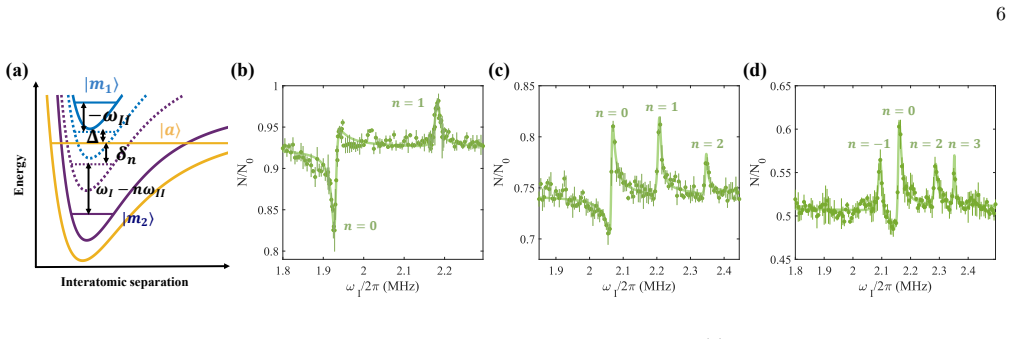
Under the dark-state condition δ = 0 a narrow, tunable loss-suppressed transparency window appears inside the broad dissipative Feshbach resonance of the |4g(4)⟩ molecular state; its linewidth is controlled by the modulation-induced coupling |Ω_eff_12| and the participating scattering pathways can be selected by multi-frequency Floquet sidebands.
What carries the argument
Matter-wave induced transparency (MWIT): a dark dressed state of free atoms and two Feshbach molecules formed by collisional couplings renormalized by Floquet Bessel factors, which destructively interferes the lossy pathway and restores the scattering length toward its background value.
Load-bearing premise
All inelastic processes can be captured by two fixed phenomenological decay rates on the molecular poles; if intensity-dependent or extra open channels are stronger than those rates, complete loss suppression fails.
What would settle it
Measure the remaining atom fraction while scanning magnetic field at the dark-state condition with successively larger modulation intensity; if the narrow transparency dip never reaches the background survival level or its width fails to scale as I²/Δ_b, the claimed interference mechanism is ruled out.
If this is right
- Reactive loss in ultracold molecular gases can be suppressed by interference while resonant scattering remains tunable.
- The steep dispersion of the complex scattering length near the transparency window can slow or engineer phonon propagation in a BEC.
- Multi-frequency Floquet drives become a programmable toolbox for selecting, enhancing or eliminating specific atom–molecule pathways.
- The same three-level structure produces observable bound states in the continuum and resonance interference in the loss spectrum.
Where Pith is reading between the lines
- Because the couplings are intrinsic collisions rather than optical Rabi frequencies, MWIT can operate at lower drive power and with weaker spontaneous emission than optical EIT analogues.
- The same Floquet dressing applied to a pure two-level Feshbach resonance should control Landau–Zener–Stückelberg–Majorana interference, offering a matter-wave interferometer without a third molecular state.
- If the second molecular decay rate can be made negligible, the imaginary part of the scattering length vanishes exactly at δ = 0, giving a lossless resonant interaction useful for quantum simulation of non-Hermitian Hamiltonians.
Editorial analysis
A structured set of objections, weighed in public.
Referee Report
Summary. The manuscript reports the experimental realization of matter-wave induced transparency (MWIT) in a cesium Bose–Einstein condensate. By combining a magnetic Feshbach resonance with modulation-induced coupling between two closed-channel molecular states (|4g(4)⟩ and |6s⟩), the authors engineer an effective Λ-type three-level atom–molecule system. Under the dark-state condition δ = 0 they observe a narrow, tunable loss-suppressed window embedded in a broad dissipative collisional resonance; the window’s magnetic-field locus tracks the independently measured |6s⟩ binding energy, its linewidth scales linearly with I²/Δ_b as expected for modulation-controlled |Ω_eff_12|², and dual-frequency Floquet drive selects or suppresses individual scattering sidebands. Supplementary coupled-channel and MQDT calculations reproduce the complex scattering length, Fano lineshapes, and Friedrich–Wintgen BIC signatures.
Significance. If the observations hold, MWIT supplies a genuinely new interference-based handle on collisional loss that does not rely on optical dressing of the open channel. The combination of (i) a two-dimensional (B, ω) transparency ridge, (ii) intensity-controlled linewidth scaling, (iii) multi-frequency pathway selection, and (iv) BIC signatures constitutes a multi-signature experimental demonstration that is rare in ultracold-collision work. Independent microwave and power-dependent calibrations of magnetic moments and modulation amplitudes remove circularity from the dark-state assignment. The platform is immediately relevant to loss suppression in ultracold molecules, precision magnetometry near Feshbach resonances, and programmable non-Hermitian/Floquet scattering. The thorough supplementary theory (effective Hamiltonian, MQDT comparison, mean-field condensate dynamics) further strengthens the result.
minor comments (6)
- Fig. 2(b) and Fig. 4(a): the residual atom fraction at the transparency peak is visibly below unity. A short quantitative statement of residual loss relative to the far-detuned background (and to the peak-loss value) would help readers judge how “dark” the experimental dark state is under the measured γ₂ > 0.
- Main-text discussion of BICs is brief and relegated largely to the Supplementary Material (Figs. S8–S9). A single sentence or panel in the main text that shows the disappearance of one Fano branch near the calculated Friedrich–Wintgen condition would make this secondary but interesting result more accessible.
- Eqs. (1)–(2) and the subsequent dark-state condition (3): the light-shift compensation that converts the solid fit line into the dashed line in Fig. 3(c) is mentioned only in the caption and Supplementary Section V. A brief parenthetical in the main text would clarify why the raw Fano centers do not lie exactly on the spectroscopic |6s⟩ line.
- Supplementary Eq. (S42) and the surrounding text: the phenomenological rates γ₁, γ₂ absorb spin relaxation, optical bound-free transitions, and higher Floquet scattering. A one-sentence caveat that intensity-dependent optical losses may cause γ₁,₂ themselves to grow with I would forestall over-interpretation of the complete-suppression limit.
- Typographical consistency: “F eshbach” and “T ransparency” appear with stray spaces in several figure captions (e.g., Fig. 1 caption); “OBSER V A TION” and similar spaced headings should be cleaned for the final version.
- References [18] and [19] report closely related modulation-induced Feshbach work; a short comparative sentence distinguishing the present three-level interference from those two-level Floquet resonances would help non-specialist readers.
Circularity Check
No significant circularity: transparency window, locus, and linewidth scaling are direct experimental observables validated against independent calibrations, not quantities forced by definition or self-fit.
full rationale
The central claims rest on measured atom-loss spectra (N/N0 vs B or ω) that exhibit a narrow high-survival ridge inside a broad Feshbach loss feature (Figs. 2–3), intensity-dependent broadening of the narrow Fano branch linear in I^{2}/Δb (Fig. 4), and sideband-selective peaks/dips under dual-frequency drive (Fig. 5). These are raw observables. Magnetic moments Δμ1, Δμ2 and modulation amplitudes αi, βi are calibrated independently via microwave spectroscopy, power-dependent resonance shifts, and modulation spectroscopy of the |6s⟩ binding energy (Supp. Sec. V); the dark-state locus δ=0 is then a parameter-free prediction that matches the extracted Fano centers after a separately measured light-shift correction (Fig. 3c). The effective Hamiltonian and complex-scattering-length formulae (Supp. Eqs. S10, S35, S42, S51) are used only for lineshape interpretation and parameter extraction; complete Im(a)=0 is never asserted for the experimental γ2>0 case. Self-citations to the authors’ prior modulation-induced Feshbach work supply the experimental platform but are not load-bearing for the interference claim itself. No step reduces a claimed prediction to its own fitted input by construction, and no uniqueness theorem or ansatz is imported circularly. Minor residual |a angle–|m2 angle coupling appears as observed Fano asymmetry and is quantified, not hidden. The derivation chain is therefore self-contained against external benchmarks.
Axiom & Free-Parameter Ledger
free parameters (3)
- modulation amplitudes α_i, β_i
- phenomenological decay rates γ1, γ2
- Fano amplitudes, centers and widths
axioms (3)
- domain assumption Multichannel quantum-defect theory and the pole approximation for closed-channel Green functions correctly describe the low-energy s-wave scattering length near the two Feshbach resonances.
- domain assumption Rotating-wave approximation retains only the near-resonant Floquet sidebands; higher-order photon processes are absorbed into the phenomenological decay rates.
- domain assumption Magnetic-moment differences Δμ1 and Δμ2 may be treated as constant over the experimental field range 19.9–20.6 G.
read the original abstract
Electromagnetically induced transparency suppresses optical absorption through destructive interference, playing a central role in light-matter interaction and quantum information science. We report matter-wave induced transparency, where atomic collisional interactions induce transmission through a lossy molecular potential for the incident atomic scattering waves. Using cesium Bose-Einstein condensates and modulation-induced Feshbach resonances, we realize a three-level atom-molecule coupled system with unprecedented flexibility. Under the dark state condition, a narrow and tunable transparency window appears within a broad dissipative collisional resonance. The transparency window linewidth is controlled by modulation-induced coupling. And scattering pathways are selectable via multifrequency Floquet modulation. These results establish an interference-based route for exploring programmable nonequilibrium and non-Hermitian physics, steering quantum chemistry and precision measurements.
Figures


Reference graph
Works this paper leans on
-
[1]
Observation of electromagnetically induced transparency , author =. Phys. Rev. Lett. , volume =. 1991 , month =. doi:10.1103/PhysRevLett.66.2593 , url =
-
[2]
Hau, Lene Vestergaard and Harris, S. E. and Dutton, Zachary and Behroozi, Cyrus H. , title =. Nature , year =
-
[3]
Effective control of cold collisions with radio-frequency fields , author =. Phys. Rev. A , volume =. 2017 , month =. doi:10.1103/PhysRevA.95.022709 , url =
-
[4]
Controlling the group velocity of colliding atomic Bose-Einstein condensates with Feshbach resonances , author =. Phys. Rev. A , volume =. 2013 , month =. doi:10.1103/PhysRevA.87.053608 , url =
-
[5]
Le Kien, Fam and Schneeweiss, Philipp and Rauschenbeutel, Arno , year =. Dynamical polarizability of atoms in arbitrary light fields: general theory and application to cesium , volume =. The European Physical Journal D , publisher =. doi:10.1140/epjd/e2013-30729-x , number =
-
[6]
Vexiau, R. and Bouloufa, N. and Aymar, M. and Danzl, J. G. and Mark, M. J. and Nägerl, H. C. and Dulieu, O. , year =. Optimal trapping wavelengths of Cs2 molecules in an optical lattice , volume =. The European Physical Journal D , publisher =. doi:10.1140/epjd/e2011-20085-4 , number =
-
[7]
Semianalytic theory of laser-assisted resonant cold collisions , author =. Phys. Rev. A , volume =. 1999 , month =. doi:10.1103/PhysRevA.60.414 , url =
-
[8]
Kippenberg , title =
Stefan Weis and Rémi Rivière and Samuel Deléglise and Emanuel Gavartin and Olivier Arcizet and Albert Schliesser and Tobias J. Kippenberg , title =. Science , volume =. 2010 , doi =
2010
-
[9]
Science , volume =
Haruka Tanji-Suzuki and Wenlan Chen and Renate Landig and Jonathan Simon and Vladan Vuletić , title =. Science , volume =. 2011 , doi =
2011
-
[10]
Beck and Robert Bücker and Michael Gullans and Mikhail D
Wenlan Chen and Kristin M. Beck and Robert Bücker and Michael Gullans and Mikhail D. Lukin and Haruka Tanji-Suzuki and Vladan Vuletić , title =. Science , volume =. 2013 , doi =
2013
-
[11]
Efficient quantum memory for single-photon polarization qubits , Ty =
Wang, Yunfei and Li, Jianfeng and Zhang, Shanchao and Su, Keyu and Zhou, Yiru and Liao, Kaiyu and Du, Shengwang and Yan, Hui and Zhu, Shi-Liang , Da =. Efficient quantum memory for single-photon polarization qubits , Ty =. Nat. Photonics , Number =. 2019 , Bdsk-Url-1 =. doi:10.1038/s41566-019-0368-8 , Id =
-
[12]
Electromagnetically induced transparency: optics in coherent media , author =. Rev. Mod. Phys. , volume =. 2005 , month =. doi:10.1103/RevModPhys.77.633 , url =
-
[13]
M. R. Andrews and C. G. Townsend and H.-J. Miesner and D. S. Durfee and D. M. Kurn and W. Ketterle , title =. Science , volume =. 1997 , doi =
1997
-
[14]
Theis, M. and Thalhammer, G. and Winkler, K. and Hellwig, M. and Ruff, G. and Grimm, R. and Denschlag, J. Hecker , journal =. Tuning the scattering length with an optically induced. 2004 , month =. doi:10.1103/PhysRevLett.93.123001 , url =
-
[15]
Bauer, Dominik M and Lettner, Matthias and Vo, Christoph and Rempe, Gerhard and D. Control of a magnetic. doi:10.1038/nphys1232 , journal =
-
[16]
Thalhammer, Gregor and Theis, Matthias and Winkler, Klaus and Grimm, Rudolf and Denschlag, Johannes Hecker , journal =. Inducing an optical. 2005 , month =. doi:10.1103/PhysRevA.71.033403 , url =
-
[17]
Observation of modulation-induced
Wang, Tongkang and Liu, Yuqi and Wang, Jundong and Huang, Youjia and Chen, Wenlan and Zhang, Zhendong and Hu, Jiazhong , journal =. Observation of modulation-induced. 2025 , month =. doi:10.1103/qrz6-gjp6 , url =
-
[18]
Alexander Guthmann and Felix Lang and Louisa Marie Kienesberger and Sian Barbosa and Artur Widera , title =. Sci. Adv. , volume =. 2025 , doi =
2025
-
[19]
Chin, Cheng and Grimm, Rudolf and Julienne, Paul and Tiesinga, Eite , journal =. 2010 , month =. doi:10.1103/RevModPhys.82.1225 , url =
-
[20]
Mark, M. and Ferlaino, F. and Knoop, S. and Danzl, J. G. and Kraemer, T. and Chin, C. and N\"agerl, H.-C. and Grimm, R. , journal =. Spectroscopy of ultracold trapped cesium. 2007 , month =. doi:10.1103/PhysRevA.76.042514 , url =
-
[21]
K\"ohler, Thorsten and G\'oral, Krzysztof and Julienne, Paul S. , journal =. Production of cold molecules via magnetically tunable. 2006 , month =. doi:10.1103/RevModPhys.78.1311 , url =
-
[22]
Jachymski, Krzysztof and Julienne, Paul S. , journal =. Analytical model of overlapping. 2013 , month =. doi:10.1103/PhysRevA.88.052701 , url =
-
[23]
Jagannathan, A. and Arunkumar, N. and Joseph, J. A. and Thomas, J. E. , journal =. Optical control of magnetic. 2016 , month =. doi:10.1103/PhysRevLett.116.075301 , url =
-
[25]
Knoop, S. and Mark, M. and Ferlaino, F. and Danzl, J. G. and Kraemer, T. and N\"agerl, H.-C. and Grimm, R. , journal =. Metastable. 2008 , month =. doi:10.1103/PhysRevLett.100.083002 , url =
-
[26]
and Ha, Li-Chung and Xu, Chen-Yu and Chin, Cheng , journal =
Clark, Logan W. and Ha, Li-Chung and Xu, Chen-Yu and Chin, Cheng , journal =. Quantum dynamics with spatiotemporal control of interactions in a stable. 2015 , month =. doi:10.1103/PhysRevLett.115.155301 , url =
-
[27]
Chin, Cheng and Vuleti. Precision. Phys. Rev. A , volume =. 2004 , month =. doi:10.1103/PhysRevA.70.032701 , url =
-
[28]
Tscherbul, T. V. and Calarco, T. and Lesanovsky, I. and Krems, R. V. and Dalgarno, A. and Schmiedmayer, J. , journal =. rf-field-induced. 2010 , month =. doi:10.1103/PhysRevA.81.050701 , url =
-
[29]
Inducing resonant interactions in ultracold atoms with a modulated magnetic field , author =. Phys. Rev. Lett. , volume =. 2015 , month =. doi:10.1103/PhysRevLett.115.193002 , url =
-
[30]
Berninger, Martin and Zenesini, Alessandro and Huang, Bo and Harm, Walter and N\"agerl, Hanns-Christoph and Ferlaino, Francesca and Grimm, Rudolf and Julienne, Paul S. and Hutson, Jeremy M. , journal =. 2013 , month =. doi:10.1103/PhysRevA.87.032517 , url =
-
[31]
and Xie, Ting and Hutson, Jeremy M
Owens, Daniel J. and Xie, Ting and Hutson, Jeremy M. , journal =. Creating. 2016 , month =. doi:10.1103/PhysRevA.94.023619 , url =
-
[32]
Zhang, Zhendong and Yao, Kai-Xuan and Feng, Lei and Hu, Jiazhong and Chin, Cheng , year =. Pattern formation in a driven. Nat. Phys. , publisher =. doi:10.1038/s41567-020-0839-3 , number =
-
[33]
Clark and Cheng Chin , title =
Lei Feng and Jiazhong Hu and Logan W. Clark and Cheng Chin , title =. Science , volume =. 2019 , doi =
2019
-
[34]
Hu, Jiazhong and Feng, Lei and Zhang, Zhendong and Chin, Cheng , year =. Quantum simulation of. Nat. Phys. , publisher =. doi:10.1038/s41567-019-0537-1 , number =
-
[35]
Papoular, D. J. and Shlyapnikov, G. V. and Dalibard, J. , journal =. Microwave-induced. 2010 , month =. doi:10.1103/PhysRevA.81.041603 , url =
-
[36]
Inouye, S. and Andrews, M. R. and Stenger, J. and Miesner, H.-J. and Stamper-Kurn, D. M. and Ketterle, W. , year =. Observation of. Nature , publisher =. doi:10.1038/32354 , number =
-
[37]
Wu, Haibin and Thomas, J. E. , journal =. Optical control of. 2012 , month =. doi:10.1103/PhysRevLett.108.010401 , url =
-
[38]
Sub-natural-linewidth quantum interference features observed in photoassociation of a thermal gas , author =. Phys. Rev. A , volume =. 2005 , month =. doi:10.1103/PhysRevA.72.041801 , url =
-
[39]
Many-body physics with ultracold gases , author =. Rev. Mod. Phys. , volume =. 2008 , month =. doi:10.1103/RevModPhys.80.885 , url =
-
[40]
Huang, Youjia and Nagata, Shu and Jachinowski, Joseph and Hu, Jiazhong and Chin, Cheng , journal =. Two-dimensional arrays of. 2024 , month =. doi:10.1103/PhysRevResearch.6.043272 , url =
-
[41]
Matter-wave diffraction from a quasicrystalline optical lattice , author =. Phys. Rev. Lett. , volume =. 2019 , month =. doi:10.1103/PhysRevLett.122.110404 , url =
-
[42]
Observation of diffraction phases in matter-wave scattering , author =. Phys. Rev. A , volume =. 2013 , month =. doi:10.1103/PhysRevA.88.013603 , url =
-
[43]
Burchianti, A. and D'Errico, C. and Marconi, L. and Minardi, F. and Fort, C. and Modugno, M. , journal =. Effect of interactions in the interference pattern of. 2020 , month =. doi:10.1103/PhysRevA.102.043314 , url =
-
[44]
Hagley, E. W. and Deng, L. and Kozuma, M. and Trippenbach, M. and Band, Y. B. and Edwards, M. and Doery, M. and Julienne, P. S. and Helmerson, K. and Rolston, S. L. and Phillips, W. D. , journal =. Measurement of the coherence of a. 1999 , month =. doi:10.1103/PhysRevLett.83.3112 , url =
-
[45]
Chang, Ming-Shien and Qin, Qishu and Zhang, Wenxian and You, Li and Chapman, Michael S. , year =. Coherent spinor dynamics in a spin-1. Nat. Phys. , publisher =. doi:10.1038/nphys153 , number =
-
[46]
, volume =
Supplementary material , author =. , volume =. 2026 , publisher =
2026
-
[47]
Abi-Salloum, Tony Y. , journal =. Electromagnetically induced transparency and. 2010 , month =. doi:10.1103/PhysRevA.81.053836 , url =
-
[48]
Anisimov, Petr M. and Dowling, Jonathan P. and Sanders, Barry C. , journal =. Objectively discerning. 2011 , month =. doi:10.1103/PhysRevLett.107.163604 , url =
-
[49]
What is and what is not electromagnetically induced transparency in whispering-gallery microcavities , journal =
Peng, Bo and. What is and what is not electromagnetically induced transparency in whispering-gallery microcavities , journal =. 2014 , volume =
2014
-
[50]
Interfering resonances and bound states in the continuum , author =. Phys. Rev. A , volume =. 1985 , month =. doi:10.1103/PhysRevA.32.3231 , url =
-
[51]
Douglas and Joannopoulos, John D
Hsu, Chia Wei and Zhen, Bo and Stone, A. Douglas and Joannopoulos, John D. and Solja. Bound states in the continuum , journal =. 2016 , volume =
2016
-
[52]
Park and Yu-Kun Lu and Alan O
Hyungmok Son and Juliana J. Park and Yu-Kun Lu and Alan O. Jamison and Tijs Karman and Wolfgang Ketterle , title =. Science , volume =. 2022 , doi =
2022
-
[53]
Controlling few-body reaction pathways using a
Haze, Shinsuke and Li, Jing-Lun and Dorer, Dominik and D'Incao, Jos. Controlling few-body reaction pathways using a. Nat. Phys. , year =. doi:10.1038/s41567-024-02726-3 , url =
-
[54]
D'Incao, J. P. and Esry, B. D. , journal =. Ultracold three-body collisions near overlapping. 2009 , month =. doi:10.1103/PhysRevLett.103.083202 , url =
-
[55]
Effects of configuration interaction on intensities and phase shifts , author =. Phys. Rev. , volume =. 1961 , month =. doi:10.1103/PhysRev.124.1866 , url =
-
[56]
and Rybin, Mikhail V
Limonov, Mikhail F. and Rybin, Mikhail V. and Poddubny, Alexander N. and Kivshar, Yuri S. , title =. Nat. Photonics , year =
-
[57]
Enhanced Sensitivity to Fundamental Constants In Ultracold Atomic and Molecular Systems near Feshbach Resonances , author =. Phys. Rev. Lett. , volume =. 2006 , month =. doi:10.1103/PhysRevLett.96.230801 , url =
-
[58]
Quantum field simulator for dynamics in curved spacetime , journal =
Viermann, Celia and Sparn, Marius and Liebster, Nikolas and Hans, Maurus and Kath, Elinor and Parra-L. Quantum field simulator for dynamics in curved spacetime , journal =. 2022 , volume =
2022
-
[59]
Rarified Liquid Properties of Hybrid Atomic-Molecular Bose-Einstein Condensates , author =. Phys. Rev. Lett. , volume =. 1999 , month =. doi:10.1103/PhysRevLett.83.2691 , url =
-
[60]
Bose-Stimulated Raman Adiabatic Passage in Photoassociation , author =. Phys. Rev. Lett. , volume =. 2000 , month =. doi:10.1103/PhysRevLett.84.3803 , url =
-
[61]
Multimode Dynamics of a Coupled Ultracold Atomic-Molecular System , author =. Phys. Rev. Lett. , volume =. 2001 , month =. doi:10.1103/PhysRevLett.86.1397 , url =
-
[62]
Transition from an atomic to a molecular Bose-Einstein condensate , volume =
Zhang, Zhendong and Chen, Liangchao and Yao, Kai-Xuan and Chin, Cheng , year =. Transition from an atomic to a molecular Bose-Einstein condensate , volume =. Nature , publisher =. doi:10.1038/s41586-021-03443-0 , number =
-
[63]
Many-body chemical reactions in a quantum degenerate gas , volume =
Zhang, Zhendong and Nagata, Shu and Yao, Kai-Xuan and Chin, Cheng , year =. Many-body chemical reactions in a quantum degenerate gas , volume =. Nature Physics , publisher =. doi:10.1038/s41567-023-02139-8 , number =
-
[64]
Creating a Stable Molecular Condensate Using a Generalized Raman Adiabatic Passage Scheme , author =. Phys. Rev. Lett. , volume =. 2004 , month =. doi:10.1103/PhysRevLett.93.250403 , url =
-
[65]
Atom-Molecule Dark States in a Bose-Einstein Condensate , author =. Phys. Rev. Lett. , volume =. 2005 , month =. doi:10.1103/PhysRevLett.95.063202 , url =
-
[66]
D.D. Yavuz , abstract =. Elimination of Feshbach loss in a Bose–Einstein condensate , journal =. 2004 , issn =. doi:https://doi.org/10.1016/j.optcom.2004.02.061 , url =
-
[67]
2023 , doi =
Nonadiabatic Landau–Zener–Stückelberg–Majorana transitions, dynamics, and interference , journal =. 2023 , doi =
2023
-
[68]
and Ferlaino, F
Mark, M. and Ferlaino, F. and Knoop, S. and Danzl, J. G. and Kraemer, T. and Chin, C. and N\"agerl, H.-C. and Grimm, R., Spectroscopy of ultracold trapped cesium Feshbach molecules, Phys. Rev. A 76, 042514 (2007)
2007
-
[69]
Berninger, A
M. Berninger, A. Zenesini, B. Huang, W. Harm, H.-C. N\" a gerl, F. Ferlaino, R. Grimm, P. S. Julienne, and J. M. Hutson, Feshbach resonances, weakly bound molecular states, and coupled-channel potentials for cesium at high magnetic fields, Phys. Rev. A 87, 032517 (2013)
2013
-
[70]
Fano, Effects of configuration interaction on intensities and phase shifts, Phys
U. Fano, Effects of configuration interaction on intensities and phase shifts, Phys. Rev. 124, 1866--1878 (1961)
1961
-
[71]
M. F. Limonov, M. V. Rybin, A. N. Poddubny, Y. S. Kivshar, Feshbach resonances, Fano resonances in photonics, Nat. Photonics 11(9), 543–554 (2017)
2017
-
[72]
T. Wang, Y. Liu, J. Wang, Y. Huang, W. Chen, Z. Zhang, and J. Hu, Observation of modulation-induced Feshbach resonance, Phys. Rev. Lett. 135, 203201 (2025)
2025
-
[73]
K\" o hler, K
T. K\" o hler, K. G\' o ral, and P. S. Julienne, Production of cold molecules via magnetically tunable Feshbach resonances, Rev. Mod. Phys. 78, 1311--1361 (2006)
2006
-
[74]
C. Chin, R. Grimm, P. S. Julienne, and E. Tiesinga, Feshbach resonances in ultracold gases, Rev. Mod. Phys. 82, 1225--1286 (2010)
2010
-
[75]
D. H. Smith, Inducing resonant interactions in ultracold atoms with a modulated magnetic field, Phys. Rev. Lett. 115, 193002 (2015)
2015
-
[76]
Theis, G
M. Theis, G. Thalhammer, K. Winkler, M. Hellwig, G. Ruff, R. Grimm, and J. Hecker Denschlag, Tuning the scattering length with an optically induced Feshbach resonance, Phys. Rev. Lett. 93, 123001 (2004)
2004
-
[77]
D. M. Bauer, M. Lettner, C. Vo, G. Rempe, and S. D\" u rr, Control of a magnetic Feshbach resonance with laser light, Nat. Phys. 5, 339--342 (2009)
2009
-
[78]
Y. Ding, J. P. D'Incao, and C. H. Greene, Effective control of cold collisions with radio-frequency fields, Phys. Rev. A 95, 022709 (2017)
2017
-
[79]
J. L. Bohn and P. S. Julienne, Semianalytic theory of laser-assisted resonant cold collisions, Phys. Rev. A 60, 414--425 (1999)
1999
-
[80]
Mathew and E
R. Mathew and E. Tiesinga, Controlling the group velocity of colliding atomic Bose-Einstein condensates with Feshbach resonances, Phys. Rev. A 87, 053608 (2013)
2013
-
[81]
Friedrich and D
H. Friedrich and D. Wintgen, Interfering resonances and bound states in the continuum, Phys. Rev. A 32, 3231--3242 (1985)
1985
discussion (0)
Sign in with ORCID, Apple, or X to comment. Anyone can read and Pith papers without signing in.