Tensor-Network-Based Distributed Quantum Dynamics on Independent Quantum Computers
Pith reviewed 2026-06-27 09:53 UTC · model grok-4.3
The pith
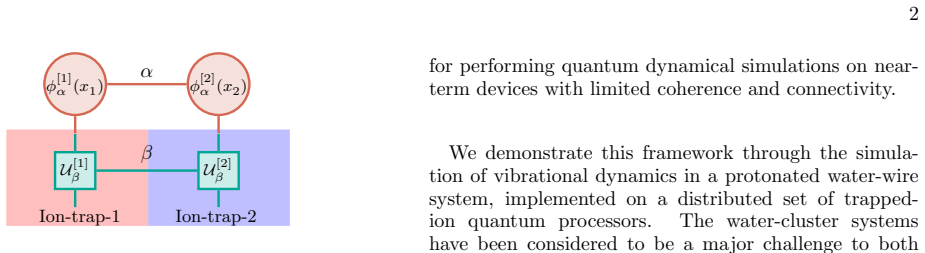
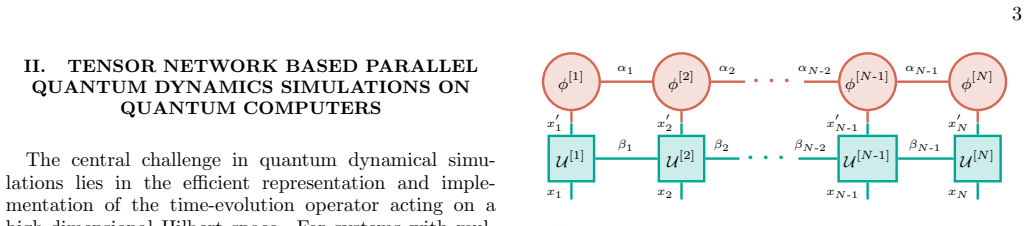
Tensor-network decomposition of the time-evolution operator splits entangled quantum dynamics into independent lower-dimensional propagations executable asynchronously on separate quantum computers.
A machine-rendered reading of the paper's core claim, the machinery that carries it, and where it could break.
Core claim
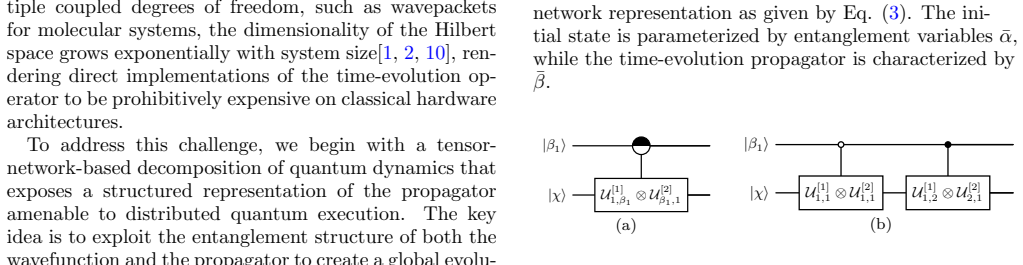
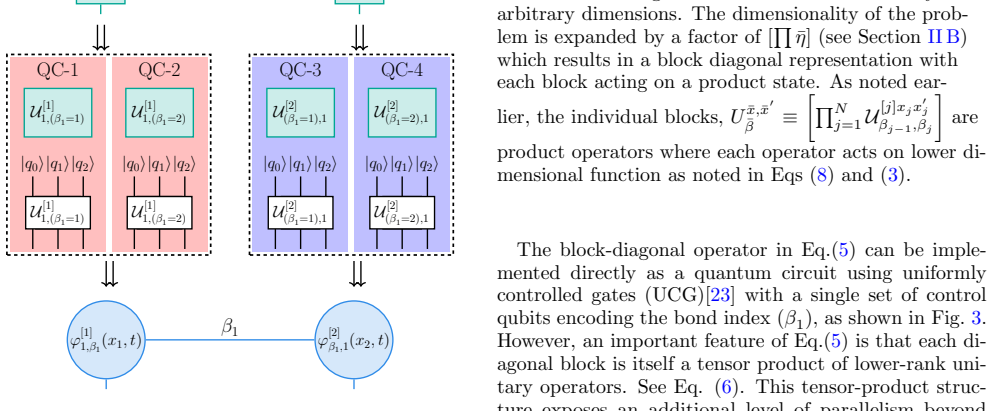
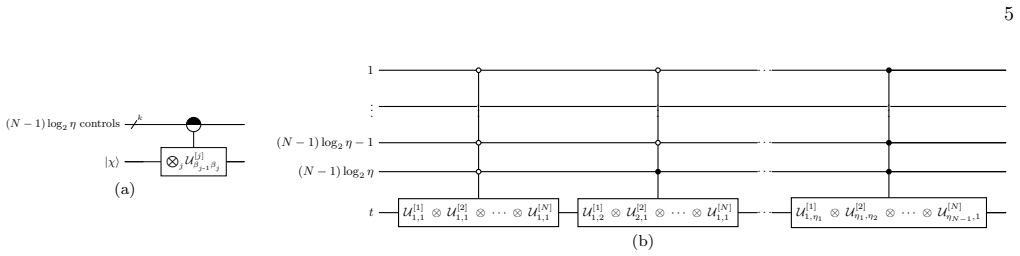
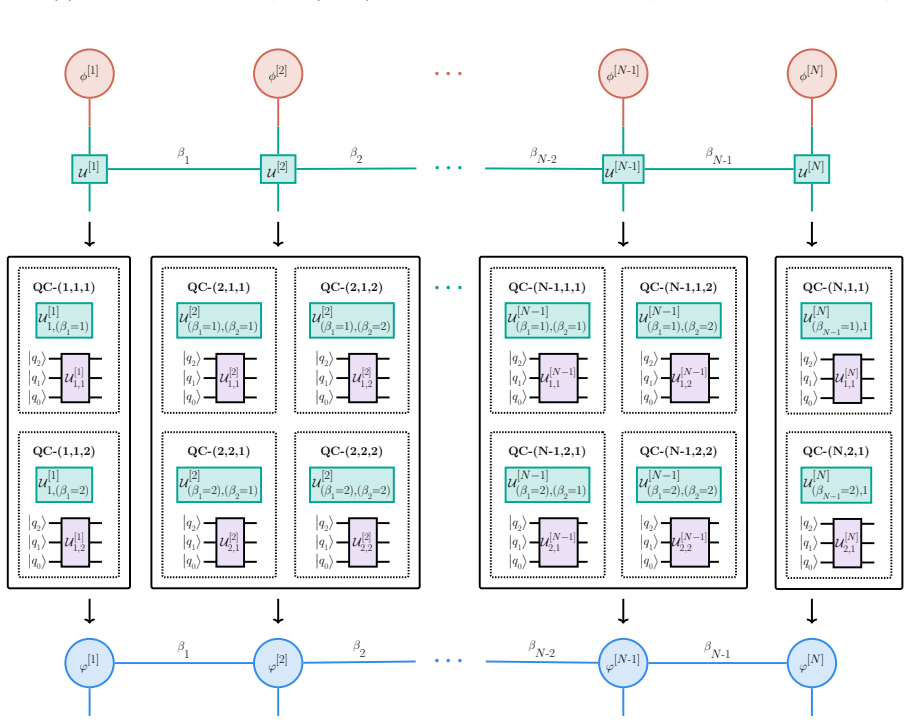
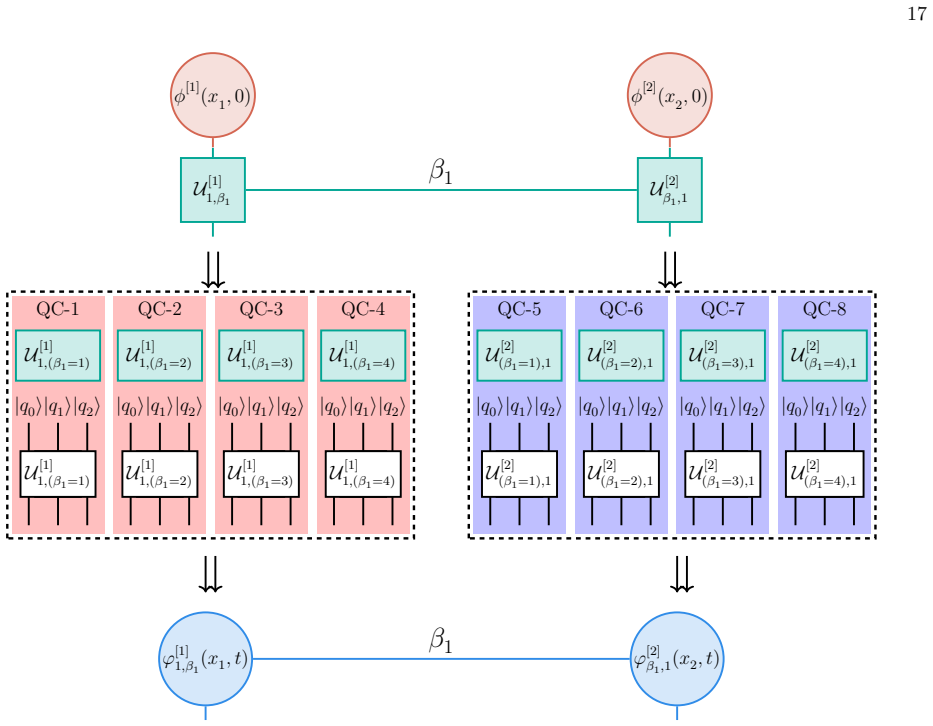
The tensor-network representation of the multidimensional time-evolution operator naturally induces an elevated Hilbert space where the dynamics decomposes into a set of independent lower-dimensional propagations. This transformation converts an entangled quantum evolution into a set of parallel computational tasks that can be executed asynchronously across heterogeneous quantum and classical computing architectures. The formalism links tensor-network decompositions to uniformly controlled quantum circuits and asynchronous distributed quantum computing. On trapped-ion hardware the circuits are realized with native partial-entangling XX( heta) gates, and the method yields vibrational spectra
What carries the argument
The tensor-network representation of the multidimensional time-evolution operator, which induces an elevated Hilbert space that factors the dynamics into independent lower-dimensional propagations.
Load-bearing premise
The tensor-network decomposition converts an entangled quantum evolution into parallel tasks executable asynchronously on independent machines without introducing approximation errors or synchronization overhead large enough to invalidate the reported spectral agreement.
What would settle it
A recomputation of the same protonated water cluster spectrum on a larger-scale exact simulator or on a single coherent quantum device that deviates from the distributed result by more than 4 cm^{-1} would falsify the claim that the decomposition preserves accuracy without significant overhead.
Figures


read the original abstract
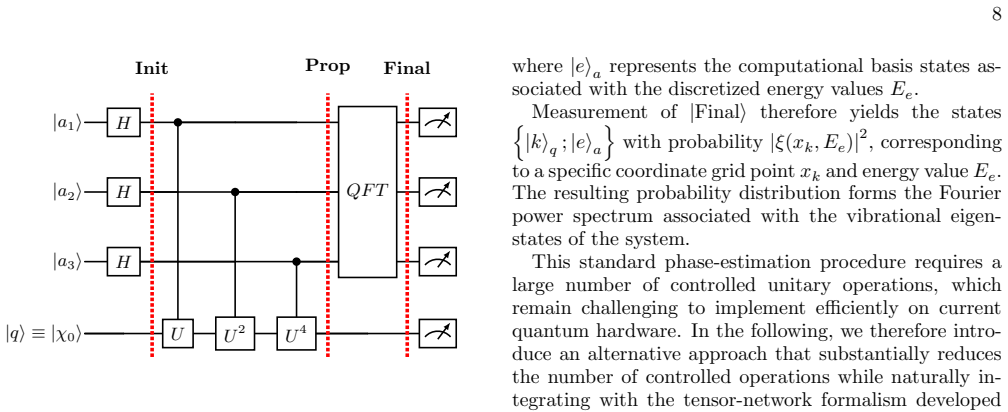
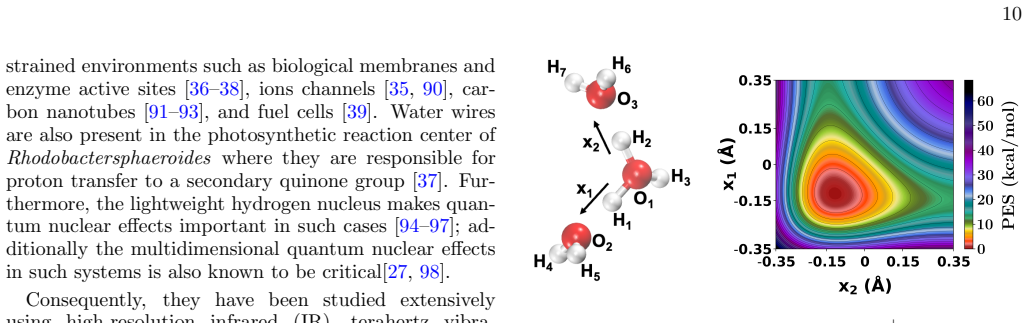
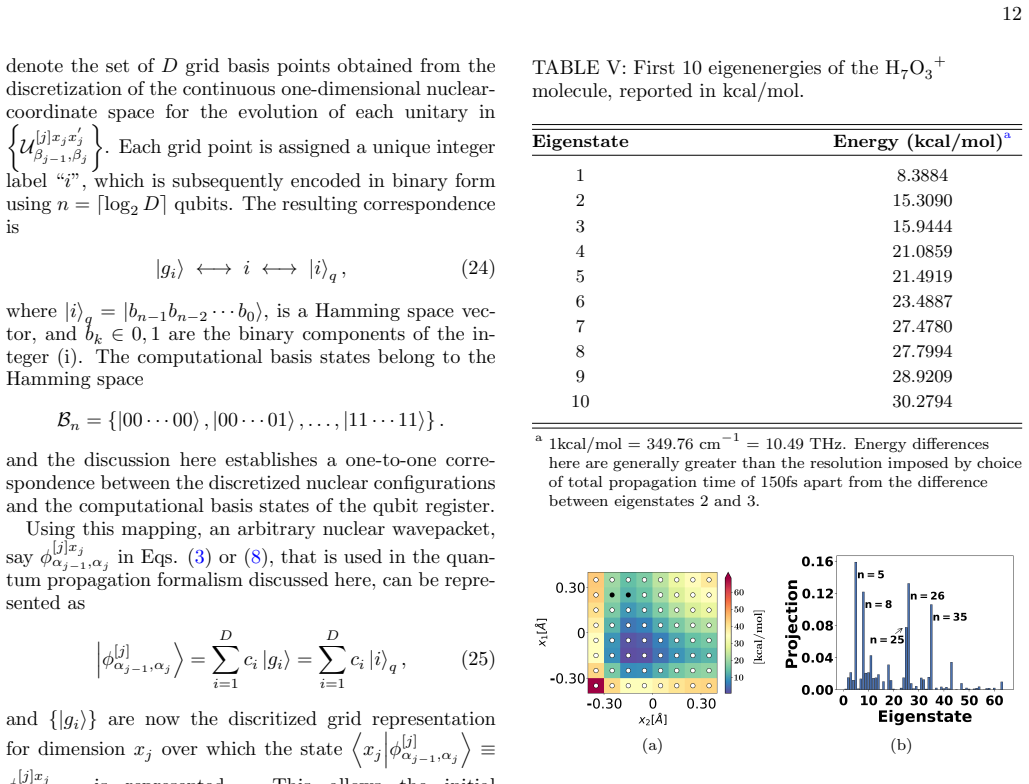
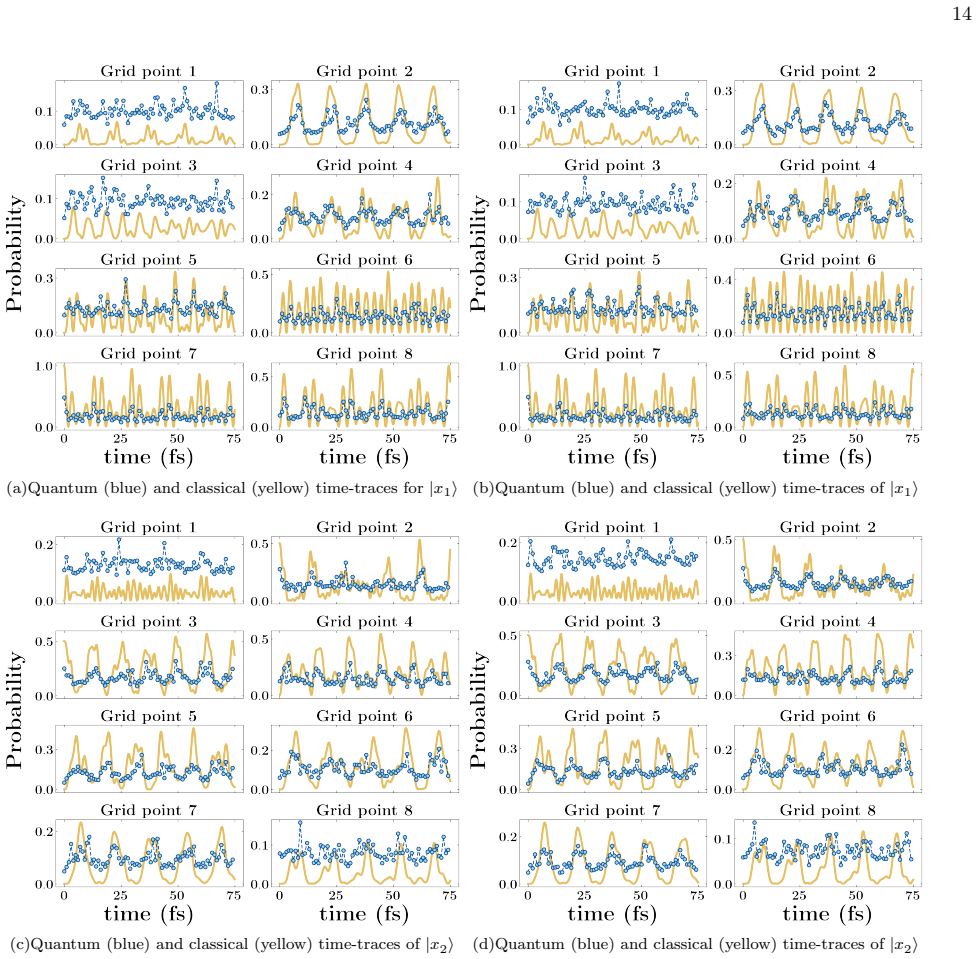
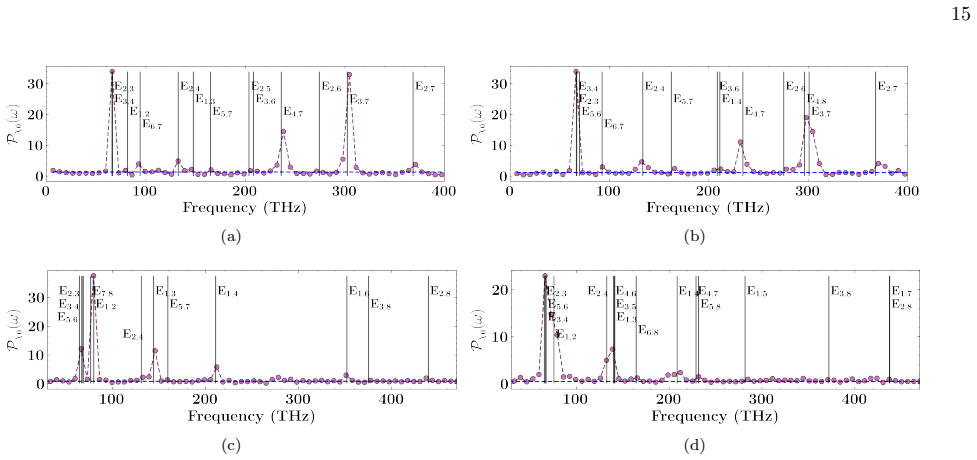
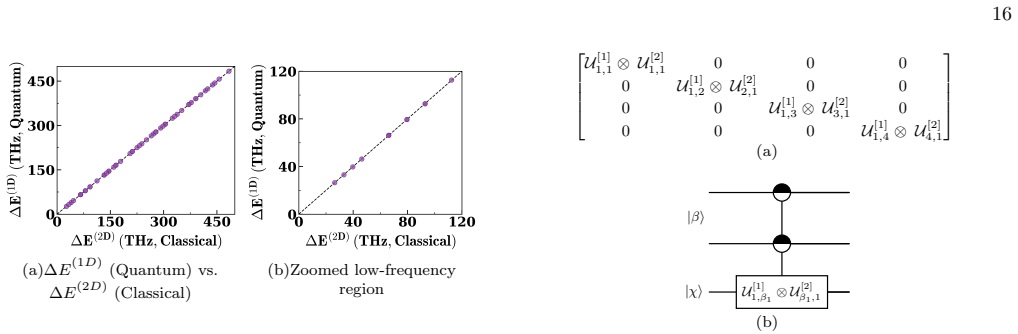
We present an approach based on tensor networks for distributed quantum computing simulation of chemical wavepacket dynamics in a continuous variable representation. The central idea is that the tensor-network representation of the multidimensional time-evolution operator naturally induces an elevated Hilbert space where the dynamics decomposes into a set of independent lower-dimensional propagations. This transformation converts an entangled quantum evolution into a set of parallel computational tasks that can be executed asynchronously across heterogeneous quantum and classical computing architectures. The resulting formalism establishes a direct connection between tensor-network decompositions, uniformly controlled quantum circuits, and asynchronous distributed quantum computing. The approach is developed with a goal towards hybrid quantum/classical implementation, and is appropriate for a general heterogeneous mixture of quantum hardware systems. The experimental realization of the asynchronously distributed quantum processes that arise from the tensor-network decomposition are carried out on the Sandia National Laboratories' trapped-ion quantum computer, where the circuits are compiled using native partial-entangling $XX(\theta)$ gates, reducing the expected two-qubit gate infidelity by more than 30\% relative to conventional fully entangling decompositions. We demonstrate the methodology by quantum computing the vibrational spectra of a small protonated water cluster that shows critical quantum nuclear behavior. Such water cluster systems have been found to be challenging for experimental action spectroscopy and for theory, and here, for the first time, we provide results for vibrational spectroscopy that are in agreement with the respective classical results to within 4cm$^{-1}$, thus allowing for the potential for spectroscopic accuracy from quantum computations.
Editorial analysis
A structured set of objections, weighed in public.
Referee Report
Summary. The manuscript proposes a tensor-network-based formalism for distributed quantum simulation of chemical wavepacket dynamics in a continuous-variable representation. The central claim is that the tensor-network representation of the multidimensional time-evolution operator induces an elevated Hilbert space permitting an exact decomposition of the dynamics into independent lower-dimensional propagations that can be executed asynchronously across heterogeneous quantum and classical architectures. This is linked to uniformly controlled quantum circuits. The approach is experimentally implemented on Sandia’s trapped-ion hardware using native partial-entangling XX(θ) gates, which reportedly reduce two-qubit gate infidelity by more than 30% relative to fully entangling decompositions. The method is demonstrated by computing vibrational spectra of a protonated water cluster, reported to agree with classical results to within 4 cm^{-1}.
Significance. If the tensor-network decomposition is exact and incurs neither truncation nor synchronization overhead, the work would establish a concrete bridge between tensor-network methods, uniformly controlled circuits, and asynchronous distributed quantum computing, enabling hybrid implementations for molecular dynamics on heterogeneous hardware. The experimental use of native XX(θ) gates on trapped ions and the reported spectral accuracy for a challenging water-cluster system constitute concrete strengths that could be impactful if the exactness claim is substantiated.
major comments (2)
- [Abstract] Abstract: the claim that the tensor-network representation 'naturally induces an elevated Hilbert space where the dynamics decomposes into a set of independent lower-dimensional propagations' that can be executed asynchronously without significant approximation errors is load-bearing for the reported 4 cm^{-1} spectral agreement; the manuscript provides no derivation, explicit construction of the elevated space, or error analysis demonstrating that the decomposition is exact and free of the bond-dimension truncation or Trotter errors standard in tensor-network time evolution.
- [Abstract] Abstract / experimental realization paragraph: the trapped-ion demonstration uses native XX(θ) gates on a single device and shows circuit compilation, but does not report measurements of distribution overhead, synchronization costs, or asynchronous execution across independent quantum computers; without such controls the 4 cm^{-1} agreement cannot be attributed to the distributed tensor-network decomposition.
minor comments (1)
- [Abstract] The abstract states a >30% reduction in expected two-qubit gate infidelity but does not identify the conventional fully entangling decomposition used as the baseline for comparison.
Simulated Author's Rebuttal
We thank the referee for their careful reading and constructive comments. We address each major comment point by point below, indicating where we agree that revisions will strengthen the manuscript.
read point-by-point responses
-
Referee: [Abstract] Abstract: the claim that the tensor-network representation 'naturally induces an elevated Hilbert space where the dynamics decomposes into a set of independent lower-dimensional propagations' that can be executed asynchronously without significant approximation errors is load-bearing for the reported 4 cm^{-1} spectral agreement; the manuscript provides no derivation, explicit construction of the elevated space, or error analysis demonstrating that the decomposition is exact and free of the bond-dimension truncation or Trotter errors standard in tensor-network time evolution.
Authors: The explicit construction of the elevated Hilbert space induced by the tensor-network representation of the time-evolution operator, together with the exact decomposition into independent lower-dimensional propagations, is given in Section 3 of the main text. This section derives the mapping for the continuous-variable vibrational problem and shows that the structure avoids standard bond-dimension truncation. We agree that a consolidated error analysis would improve clarity and will add a dedicated subsection in the revised manuscript that includes a proof outline establishing exactness (no Trotter or truncation errors) for the reported dynamics. revision: partial
-
Referee: [Abstract] Abstract / experimental realization paragraph: the trapped-ion demonstration uses native XX(θ) gates on a single device and shows circuit compilation, but does not report measurements of distribution overhead, synchronization costs, or asynchronous execution across independent quantum computers; without such controls the 4 cm^{-1} agreement cannot be attributed to the distributed tensor-network decomposition.
Authors: The experimental demonstration validates the circuit compilation and native-gate implementation of the decomposed propagations on the trapped-ion hardware. The 4 cm^{-1} spectral agreement is obtained from these quantum computations performed according to the tensor-network decomposition. We acknowledge that the current hardware run is on a single device and does not include direct measurements of distribution overhead or multi-device asynchronous execution. We will revise the experimental section and discussion to include estimated overheads for asynchronous distribution and to clarify how the single-device results support the broader distributed framework. revision: partial
Circularity Check
No circularity: derivation connects tensor networks to distributed execution without reduction to inputs or self-citation chains.
full rationale
The paper presents the tensor-network representation of the time-evolution operator as naturally inducing an elevated Hilbert space for decomposition into independent propagations, framed as a connection between existing tensor-network concepts, uniformly controlled circuits, and asynchronous distributed computing. No equations or claims in the provided text reduce the central result to a fitted parameter, self-definition, or load-bearing self-citation. The experimental validation against classical vibrational spectra (within 4 cm^{-1}) supplies an external benchmark independent of the formalism's internal construction. This is the expected self-contained case.
Axiom & Free-Parameter Ledger
axioms (1)
- domain assumption The tensor-network representation of the multidimensional time-evolution operator naturally induces an elevated Hilbert space where the dynamics decomposes into independent lower-dimensional propagations.
Reference graph
Works this paper leans on
-
[1]
and here, the computational basis corresponding to |q⟩are mapped onto a multi-dimensional grid basis rep- resentation to describe the quantum nuclear wavepacket. More details on the general map between the continuous representation|x⟩and discrete qubit computational basis representation for the nuclear dynamics problem treated here are presented in discus...
-
[2]
Simulating physics with comput- ers,
Richard P. Feynman, “Simulating physics with comput- ers,”International Journal of Theoretical Physics, In- ternational Journal of Theoretical Physics21, 467–488 (1982)
1982
-
[3]
Richard Phillips Feynman, JG Hey, and Robin W Allen, Feynman Lectures on Computation(Addison-Wesley Longman Publishing Co., Inc.75 Arlington Street, Suite 300 Boston, MAUnited States, 1998)
1998
-
[4]
R. P. Feynman and A. R. Hibbs,Quantum Mechanics and Path Integrals(McGraw-Hill Book Company, New York, 1965)
1965
-
[5]
The multi-configurational time-dependent hartree ap- proach,
H-D Meyer, U Manthe, and L S Cederbaum, “The multi-configurational time-dependent hartree ap- proach,” Chem. Phys. Lett.165, 73–78 (1990)
1990
-
[6]
Wave- packet dynamics within the multiconfiguration hartree framework: General aspects and application to NOCl,
U. Manthe, H. D. Meyer, and L. S. Cederbaum, “Wave- packet dynamics within the multiconfiguration hartree framework: General aspects and application to NOCl,” J. Chem. Phys.97, 3199–3213
-
[7]
The multiconfiguration time-dependent hartree (MCTDH) method: a highly efficient algorithm for propagating wavepackets,
M H Beck, A J¨ ackle, G A Worth, and H-D Meyer, “The multiconfiguration time-dependent hartree (MCTDH) method: a highly efficient algorithm for propagating wavepackets,” Phys. Rep.324, 1–105 (2000)
2000
-
[8]
17: Full gate sequence for subroutinesA 1,2 (top) andB 1,2 (bottom) used in the partial-angle QSD decomposi- tion
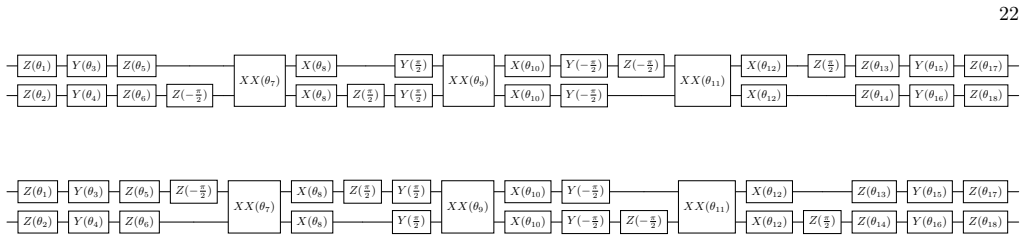
Hans-Dieter Meyer, Fabien Gatti, and Graham A Worth,Multidimensional Quantum Dynamics: 22 Z(θ1) Y(θ3) Z(θ5) XX(θ7) X(θ8) Y(π2) XX(θ9) X(θ10) Y(−π2) Z(−π2) XX(θ11) X(θ12) Z(π2) Z(θ13) Y(θ15) Z(θ17) Z(θ2) Y(θ4) Z(θ6) Z(−π2) X(θ8) Z(π2) Y(π2) X(θ10) Y(−π2) X(θ12) Z(θ14) Y(θ16) Z(θ18) Z(θ1) Y(θ3) Z(θ5) Z(−π2) XX(θ7) X(θ8) Z(π2) Y(π2) XX(θ9) X(θ10) Y(−π2) XX(θ...
-
[9]
Y( π 2) XX12(θ4) X(θ5) Y(−π
-
[10]
Z(θ6) XX13(π 2) X(−π 2) Y( π
-
[11]
X(θ3) X(θ5) Y(−π 2) Y( π
-
[12]
X(π) Y(−π 2) Y(θ1) Z(−π 2) XX12(θ2) X(θ3) Z(π 2) XX13(π 2) X(−π
-
[13]
Z(−π 2) XX12(θ4) X(θ5) Z(π
-
[14]
Y(θ6) XX13(π 2) X(−π 2) Y(π
-
[15]
X(θ3) X(θ5) Y(−π 2) Y(π
-
[16]
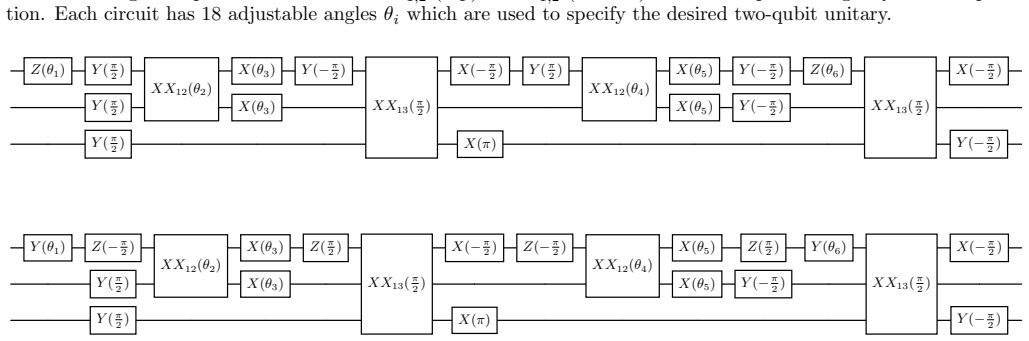
18: Gate decomposition for multicontrolled three-qubit subroutinesM R z (top) andM R y (bottom)
X(π) Y(−π 2) FIG. 18: Gate decomposition for multicontrolled three-qubit subroutinesM R z (top) andM R y (bottom). Each cir- cuit contains 6 adjustable anglesθ i used to specify the target multicontrolled unitary. MCTDH Theory and Applications(John Wiley & Sons, 2009)
2009
-
[17]
Multilayer formula- tion of the multiconfiguration time-dependent hartree theory,
Haobin Wang and Michael Thoss, “Multilayer formula- tion of the multiconfiguration time-dependent hartree theory,” J. Chem. Phys.119, 1289–1299 (2003)
2003
-
[18]
First-principles quantum simulations of exciton diffusion on a minimal oligothiophene chain at finite temperature,
Robert Binder and Irene Burghardt, “First-principles quantum simulations of exciton diffusion on a minimal oligothiophene chain at finite temperature,” Faraday Discuss.221, 406–427 (2020)
2020
-
[19]
Multi-layer potfit: An accurate potential representation for efficient high-dimensional quantum dynamics,
Frank Otto, “Multi-layer potfit: An accurate potential representation for efficient high-dimensional quantum dynamics,” J. Chem. Phys.140, 014106 (2014)
2014
-
[20]
Adaptive dimensional decoupling for compression of quantum nu- clear wave functions and efficient potential energy sur- face representations through tensor network decomposi- tion,
Nicole DeGregorio and Srinivasan S Iyengar, “Adaptive dimensional decoupling for compression of quantum nu- clear wave functions and efficient potential energy sur- face representations through tensor network decomposi- tion,” J. Chem. Theory Comput.15, 2780–2796 (2019)
2019
-
[21]
Tensor-train split-operator fourier transform (tt-soft) method: Mul- tidimensional nonadiabatic quantum dynamics,
Samuel M Greene and Victor S Batista, “Tensor-train split-operator fourier transform (tt-soft) method: Mul- tidimensional nonadiabatic quantum dynamics,” Jour- nal of chemical theory and computation13, 4034–4042 (2017)
2017
-
[22]
Michael A Nielsen and Isaac L Chuang,Quantum com- putation and quantum information(Cambridge Univer- sity Press, Cambridge, New York, NY, 2000)
2000
-
[23]
Quantum computing and the entangle- ment frontier,
John Preskill, “Quantum computing and the entangle- ment frontier,” arXiv:1203.5813 [quant-ph] (2012)
Pith/arXiv arXiv 2012
-
[24]
Quantum computing 40 years later,
John Preskill, “Quantum computing 40 years later,” (2021), arXiv:2106.10522 [quant-ph]
arXiv 2021
-
[25]
Juncheng (Harry) Zhang and Srinivasan S. Iyengar, “Graph-|Q⟩ ⟨C|: A graph-based quantum-classical algo- rithm for efficient electronic structure on hybrid quan- tum/classical hardware systems: Improved quantum circuit depth performance,” J. Chem. Theory Comput. 18, 2885 (2022)
2022
-
[26]
Graph-|Q⟩ ⟨C|: A quantum algorithm with reduced quantum circuit depth for electronic structure,
Srinivasan S. Iyengar, Juncheng Harry Zhang, De- badrita Saha, and Timothy C. Ricard, “Graph-|Q⟩ ⟨C|: A quantum algorithm with reduced quantum circuit depth for electronic structure,” J. Phys. Chem. A127, 9334 (2023)
2023
-
[27]
Two- qubit entangling gates for superconducting quantum computers,
Muhammad AbuGhanem and Hichem Eleuch, “Two- qubit entangling gates for superconducting quantum computers,” Results in Physics56, 107236 (2024)
2024
-
[28]
Limitations of noisy quantum devices in comput- ing and entangling power,
Yuxuan Yan, Zhenyu Du, Junjie Chen, and Xiongfeng Ma, “Limitations of noisy quantum devices in comput- ing and entangling power,” npj Quantum Information 11, 188 (2025)
2025
-
[29]
Does qubit connectivity impact quantum circuit com- plexity?
Pei Yuan, Jonathan Allcock, and Shengyu Zhang, “Does qubit connectivity impact quantum circuit com- plexity?” IEEE Transactions on computer-aided design of integrated circuits and systems43, 520–533 (2023)
2023
-
[30]
Quantum nuclear dynam- ics on a distributed set of ion-trap quantum computing systems,
Anurag Dwivedi, A. J. Rasmussen, Philip Richerme, and Srinivasan S. Iyengar, “Quantum nuclear dynam- ics on a distributed set of ion-trap quantum computing systems,” J. Am. Chem. Soc.146, 29355–29363 (2024)
2024
-
[31]
Anurag Dwivedi, Miguel Angel Lopez-Ruiz, and Srini- vasan S. Iyengar, “Resource optimization for quan- tum dynamics with tensor networks: Quantum and 23 classical algorithms,” The Journal of Physical Chem- istry A128, 6774–6797 (2024), pMID: 39101545, https://doi.org/10.1021/acs.jpca.4c03407
-
[32]
Quantum circuits with uni- formly controlled one-qubit gates,
Ville Bergholm, Juha J Vartiainen, Mikko M¨ ott¨ onen, and Martti M Salomaa, “Quantum circuits with uni- formly controlled one-qubit gates,” Physical Review A—Atomic, Molecular, and Optical Physics71, 052330 (2005)
2005
-
[33]
Quantum multiplexer simplification for state preparation,
Jos´ e Alex de Carvalho, Carlos Batista, Tiago de Veras, Israel Araujo, and Adenilton Jos´ e da Silva, “Quantum multiplexer simplification for state preparation,” ACM Transactions on Quantum Computing6, 1–12 (2025)
2025
-
[34]
Quantum Computing in the NISQ era and beyond,
John Preskill, “Quantum Computing in the NISQ era and beyond,” Quantum2, 79 (2018)
2018
-
[35]
On the need for large quantum depth,
Nai-Hui Chia, Kai-Min Chung, and Ching-Yi Lai, “On the need for large quantum depth,” inProceedings of the 52nd Annual ACM SIGACT Symposium on Theory of Computing, STOC 2020 (Association for Computing Machinery, New York, NY, USA, 2020) p. 902–915
2020
-
[36]
Infrared signature of struc- tures associated with the H +(H2O)n (n = 6 to 27) clus- ters,
J.-W. Shin, N. I. Hammer, E. G. Diken, M. A. John- son, R. S. Walters, T. D. Jaeger, M. A. Duncan, R. A. Christie, and K. D. Jordan, “Infrared signature of struc- tures associated with the H +(H2O)n (n = 6 to 27) clus- ters,” Science304, 1137 (2004)
2004
-
[37]
Spectroscopic snap- shots of the proton-transfer mechanism in water,
Conrad T. Wolke, Joseph A. Fournier, Laura C. Dzu- gan, Matias R. Fagiani, Tuguldur T. Odbadrakh, Harald Knorke, Kenneth D. Jordan, Anne B. McCoy, Knut R. Asmis, and Mark A. Johnson, “Spectroscopic snap- shots of the proton-transfer mechanism in water,” Sci- ence354, 1131 (2016)
2016
-
[38]
Dynamics and infrared spectroscopy of the protonated water dimer,
Oriol Vendrell, Fabien Gatti, and Hans-Dieter Meyer, “Dynamics and infrared spectroscopy of the protonated water dimer,” Ang. Chem. Intl. Ed.46, 6918 (2007)
2007
-
[39]
Vendrell, F
O. Vendrell, F. Gatti, and H.-D. Meyer, “Full dimen- sional (15d) quantum-dynamical simulation of the pro- tonated water-dimer ii: Infrared spectrum and vibra- tional dynamics dynamics and infrared spectroscopy of the protonated water dimer,” J. Chem. Phys.127, 184303 (2007)
2007
-
[40]
Strong isotope effects in the infrared spectrum of the zundel cation,
O. Vendrell, F. Gatti, and H.-D. Meyer, “Strong isotope effects in the infrared spectrum of the zundel cation,” Angew. Chem. Intl. Ed.48, 352 (2009)
2009
-
[41]
Constructing periodic phase space orbits from ab initio molecular dynamics trajectories to analyze vibrational spectra: Case study of the zundel (H 5O+ 2 ) cation,
S. M. Dietrick and S. S. Iyengar, “Constructing periodic phase space orbits from ab initio molecular dynamics trajectories to analyze vibrational spectra: Case study of the zundel (H 5O+ 2 ) cation,” J. Chem. Theory and Comput.8, 4876 (2012)
2012
-
[42]
The properties of ion-water clusters. i. the protonated 21-water cluster,
S. S. Iyengar, M. K. Petersen, T. J. F. Day, C. J. Burn- ham, V. E. Teige, and G. A. Voth, “The properties of ion-water clusters. i. the protonated 21-water cluster,” J. Chem. Phys.123, 084309 (2005)
2005
-
[43]
Further analysis of the dynamically av- eraged vibrational spectrum for the “magic
S. S. Iyengar, “Further analysis of the dynamically av- eraged vibrational spectrum for the “magic” protonated 21-water cluster,” J. Chem. Phys.126, 216101 (2007)
2007
-
[44]
Gramicidin A channel as a test ground for molecular dynamics force fields,
Toby W Allen, Turgut Ba¸ stu˘ g, Serdar Kuyucak, and Shin-Ho Chung, “Gramicidin A channel as a test ground for molecular dynamics force fields,” Biophys. J.84, 2159–2168 (2003)
2003
-
[45]
Molecular mechanisms for proton transport in membranes,
J. F. Nagle and H. J. Morowitz, “Molecular mechanisms for proton transport in membranes,” Proc.Natl.Acad.Sci.75, 298– (1978)
1978
-
[46]
Interruption of the water chain in the reaction center from Rhodobacter sphaeroides reduces the rates of the proton uptake and of the second electron transfer to QB,
Laura Baciou and Hartmut Michel, “Interruption of the water chain in the reaction center from Rhodobacter sphaeroides reduces the rates of the proton uptake and of the second electron transfer to QB,” Biochemistry 34, 7967–7972 (1995)
1995
-
[47]
Proton transfer in the hydrogen-bonded chains of lepidocrocite: a com- putational study,
Haibo Guo and Amanda S Barnard, “Proton transfer in the hydrogen-bonded chains of lepidocrocite: a com- putational study,” Phys. Chem. Chem. Phys.13, 17864 (2011)
2011
-
[48]
Wa- ter soluble polymers as proton exchange membranes for fuel cells,
Yun-Sheng Ye, John Rick, and Bing-Joe Hwang, “Wa- ter soluble polymers as proton exchange membranes for fuel cells,” Polymers4, 913–963 (2012)
2012
-
[49]
On the depletion of antarctic ozone,
S Solomon, R. R. Garcia, F. S. Rowland, and D. J. Wuebbles, “On the depletion of antarctic ozone,” Na- ture321, 755 (1986)
1986
-
[50]
Chemistry of the upper and lower atmosphere: Theory, experiments, and applications,
B. J. Finlayson-Pitts and J. N. Pitts, Jr., “Chemistry of the upper and lower atmosphere: Theory, experiments, and applications,” (Academic, San Diego, 2000)
2000
-
[51]
Heterogeneous physicochemistry of the polar ozone hole,
R. P. Turco, O. B. Toon, and P. Hamil, “Heterogeneous physicochemistry of the polar ozone hole,” Journal Of Geophysical Research94, 16493 (1989)
1989
-
[52]
Stratospheric ozone depletion: A review of concepts and history,
S. Solomon, “Stratospheric ozone depletion: A review of concepts and history,” Reviews of Geophysics37, 275 (1999)
1999
-
[53]
Measurement of oh and ho 2 in the troposphere,
Dwayne E. Heard and Michael J. Pilling, “Measurement of oh and ho 2 in the troposphere,” Chem. Revs.103, 5163 (2003)
2003
-
[54]
Detailed modeling of the temperature and pressure dependence of the reaction h+o 2(+ m)→ ho2(+ m),
J. Troe, “Detailed modeling of the temperature and pressure dependence of the reaction h+o 2(+ m)→ ho2(+ m),” Proceedings of the combustion institute28, 1463 (2000)
2000
-
[55]
Tropospheric chemistry: A global perspec- tive,
J. A. Logan, M. J. Prather, S. C. Wofsy, and M. B. McElroy, “Tropospheric chemistry: A global perspec- tive,” J. Geophys. Res.86, 7210 (1981)
1981
-
[56]
Chemistry in the upper atmosphere,
M. J. McEwan and L. F. Phillips, “Chemistry in the upper atmosphere,” Accounts of Chemical Research3, 9 (1970)
1970
-
[57]
Ionic clusters,
A. W. Castleman and R. G. Keesee, “Ionic clusters,” Chem. Rev.86, 589 (1986)
1986
-
[58]
M. J. McEwan and L. F. Phillips,Chemistry of the At- mosphere(Eward Arnold:London, 1975)
1975
-
[60]
Radical water complexes in earth’s atmosphere,
J. S. Aloisio, S.; Francisco, “Radical water complexes in earth’s atmosphere,” Accounts of Chemical Research 33, 825 (2000)
2000
-
[61]
The Mechanism of N 2 Reduction Catalyzed by Fe- Nitrogenase Involves Reductive Elimination of H2,
D. F. Harris, D. A. Lukoyanov, S. Shaw, P. Comp- ton, M. Tokmina-Lukaszewska, B. Bothner, N. Kelle- her, D. R. Dean, B. M. Hoffman, and L. C. Seefeldt, “The Mechanism of N 2 Reduction Catalyzed by Fe- Nitrogenase Involves Reductive Elimination of H2,” Bio- chemistry57, 701–710 (2018)
2018
-
[62]
Molybdenum en- zymes,
R. N. F. Thorneley and D. J. Lowe, “Molybdenum en- zymes,” (Wiley-Interscience: New York, 1985) Chap. Kinetics and Mechanism of the Nitrogenase Enzymatic System, pp. 221–284
1985
-
[63]
Reduction of dini- trogen to ammonia at a well-protected reaction site in a molybdenum triamidoamine complex,
D. V. Yandulov and R. R. Schrock, “Reduction of dini- trogen to ammonia at a well-protected reaction site in a molybdenum triamidoamine complex,” J. Am. Chem. Soc.124, 6252 (2002)
2002
-
[64]
The Grotthuss Mechanism,
N. Agmon, “The Grotthuss Mechanism,” Chem. Phys. Lett.244, 456 (1995)
1995
-
[65]
A practical introduction to tensor net- works: Matrix product states and projected entangled pair states,
Rom´ an Or´ us, “A practical introduction to tensor net- works: Matrix product states and projected entangled pair states,” Ann. Physics349, 117 – 158 (2014)
2014
-
[66]
Graph-theoretic molecular frag- 24 mentation for potential surfaces leads naturally to a ten- sor network form and allows accurate and efficient quan- tum nuclear dynamics,
Anup Kumar, Nicole DeGregorio, Timothy Ricard, and Srinivasan S. Iyengar, “Graph-theoretic molecular frag- 24 mentation for potential surfaces leads naturally to a ten- sor network form and allows accurate and efficient quan- tum nuclear dynamics,” J. Chem. Theory Comput.18, 7243 (2022)
2022
-
[67]
Out-of- equilibrium dynamics with matrix product states,
Michael L Wall and Lincoln D Carr, “Out-of- equilibrium dynamics with matrix product states,” New Journal of Physics14, 125015 (2012)
2012
-
[68]
Ma- trix product operator representations,
B Pirvu, V Murg, J I Cirac, and F Verstraete, “Ma- trix product operator representations,” New Journal of Physics12, 025012 (2010)
2010
-
[69]
An area law for one-dimensional quan- tum systems,
M B Hastings, “An area law for one-dimensional quan- tum systems,” Journal of Statistical Mechanics: Theory and Experiment2007, P08024 (2007)
2007
-
[70]
On the product of semi-groups of oper- ators,
M. F. Trotter, “On the product of semi-groups of oper- ators,” Proc. Am. Math. Soc.10, 545 (1959)
1959
-
[71]
Feynman integrals and the schr¨ odinger equation,
E. Nelson, “Feynman integrals and the schr¨ odinger equation,” J. Math. Phys.5, 332 (1964)
1964
-
[72]
Large language model-type architecture for high-dimensional molecu- lar potential energy surfaces,
Xiao Zhu and Srinivasan S. Iyengar, “Large language model-type architecture for high-dimensional molecu- lar potential energy surfaces,” Phys. Rev. X16, 011012 (2026)
2026
-
[73]
Quantum circuit and mapping algorithms for wavepacket dynamics: case study of anharmonic hy- drogen bonds in protonated and hydroxide water clus- ters,
Debadrita Saha, Philip Richerme, and Srinivasan S Iyengar, “Quantum circuit and mapping algorithms for wavepacket dynamics: case study of anharmonic hy- drogen bonds in protonated and hydroxide water clus- ters,” Journal of Chemical Theory and Computation21, 3814–3831 (2025)
2025
-
[74]
Re- alization and calibration of continuously parameterized two-qubit gates on a trapped-ion quantum processor,
Christopher G Yale, Ashlyn D Burch, Matthew NH Chow, Brandon P Ruzic, Daniel S Lobser, Brian K Mc- Farland, Melissa C Revelle, and Susan M Clark, “Re- alization and calibration of continuously parameterized two-qubit gates on a trapped-ion quantum processor,” IEEE Transactions on Quantum Engineering (2025)
2025
-
[75]
Phoenix and peregrine ion traps,
Melissa C. Revelle, “Phoenix and peregrine ion traps,” arXiv preprint arXiv:2009.02398 (2020)
arXiv 2009
-
[76]
Manipulation and detection of a trapped yb[sup +] hyperfine qubit,
S. Olmschenk, K. C. Younge, D. L. Moehring, D. N. Matsukevich, P. Maunz, and C. Monroe, “Manipulation and detection of a trapped yb[sup +] hyperfine qubit,” Phys. Rev. A76, 052314 (2007)
2007
-
[77]
Engineering the quantum scientific comput- ing open user testbed,
Susan M. Clark, Daniel Lobser, Melissa C. Revelle, Christopher G. Yale, David Bossert, Ashlyn D. Burch, Matthew N. Chow, Craig W. Hogle, Megan Ivory, Jes- sica Pehr, Bradley Salzbrenner, Daniel Stick, William Sweatt, Joshua M. Wilson, Edward Winrow, and Peter Maunz, “Engineering the quantum scientific comput- ing open user testbed,” IEEE Transactions on Q...
2021
-
[78]
Acousto optic solutions,
L3 Harris, “Acousto optic solutions,” https://www.l3harris.com/all-capabilities/acousto- optic-solutions (2020)
2020
-
[79]
High-performance gates on trapped ion qubits using counterpropagating pulse- shaped laser beams,
Evangelos Piliouras, Hisham Amer, Susan M. Clark, Melissa C. Revelle, Edward C. Tortorici, Matthew N. H. Chow, Brandon Ruzic, Daniel S. Lobser, Brian K. Mc- Farland, Christopher G. Yale, Edwin Barnes, and Sophia E. Economou, “High-performance gates on trapped ion qubits using counterpropagating pulse- shaped laser beams,” (2026), manuscript in prepara- tion
2026
-
[80]
An automated geometric space curve approach for designing dynamically corrected gates,
Evangelos Piliouras, Dennis Lucarelli, and Edwin Barnes, “An automated geometric space curve approach for designing dynamically corrected gates,” npj Quan- tum Information12, 46 (2026)
2026
-
[81]
Hisham Amer, Evangelos Piliouras, Edwin Barnes, and Sophia E. Economou, “Implementing and benchmark- ing dynamically corrected gates on superconducting devices using space curve quantum control,” arXiv preprint arXiv:2504.09767 (2025)
arXiv 2025
discussion (0)
Sign in with ORCID, Apple, or X to comment. Anyone can read and Pith papers without signing in.