REVIEW 3 major objections 6 minor 2 cited by
Quantum reservoir computing induced by controllable damping
T0 review · 3 major / 6 minor · reviewed 2026-08-05 · deepseek-v4-flash
Pith's one-line read A tunable induced-damping primitive keeps gate-based quantum reservoirs processing temporal data well past the coherence time.
desk verdict Tunable amplitude-damping for QRC is a real idea, but Eq. (6) contradicts the appendix and the hardware claims need channel characterization. read the letter →
The pith
A machine-rendered reading of the paper's core claim, the machinery that carries it, and where it could break.
The reading
What carries the argument
The load-bearing object is the induced-dissipation block consisting of a controlled-NOT to an ancilla in |0⟩ followed by a controlled rotation CRX(ϑ) on the reservoir qubit. Tracing out the ancilla realizes an amplitude-damping-like map with tunable rate set by cos²(ϑ/2) acting on the |1⟩ population; this is the non-unital operation that keeps the system away from the maximally mixed state. The argument is carried by the trace-distance inequality bounding input separability by the reservoir's deviation from the maximally mixed state, together with the fact that projective measurements shrink that deviation while the damping block increases it.
What would settle it
Perform quantum process tomography of the one-step reservoir map—encoding rotation, mid-circuit measurement, controlled-NOT to the ancilla, controlled rotation, and ancilla reset—on a real processor. If the reconstructed channel has substantial depolarizing or dephasing components, or if the measured trace-distance from the maximally mixed state does not increase with the damping angle as the ideal relaxation model predicts, the sustained-memory improvement cannot be attributed to the induced damping.
Extended reading notes
Core claim
At the center is a circuit block: after the input unitary and mid-circuit measurement, each reservoir qubit is entangled with an ancilla prepared in |0⟩ by a controlled-NOT, and a controlled rotation CRX(ϑ) partially moves the |1⟩ population into |0⟩. Tracing out the ancilla yields a non-unital channel (a map that does not fix the identity state) with a strength set by ϑ. The authors prove by a trace-distance argument that this induced relaxation balances the depolarizing effect of repeated projective measurements: unitaries preserve the distance from the maximally mixed state, measurements reduce it, and the damping restores it. The reservoir therefore keeps a finite displacement from the m
Load-bearing premise
The whole scheme assumes the damping block behaves like a clean relaxation toward the |0⟩ state, and that the helper qubit's reset and gates add no significant extra noise; on real hardware this was not separately characterized.
Editorial extensions
If this is right
- A gate-based reservoir with mid-circuit measurements can in principle process input sequences of arbitrary length, because the controlled damping keeps the state from settling into the maximally mixed state.
- The damping angle ϑ is a task-dependent knob: the same circuit can be tuned for higher memory or for stronger fading to match the benchmark at hand.
- Including multi-qubit correlated observables in the readout improves memory capacity without extra measurements, provided the input encoding uses entangling gates.
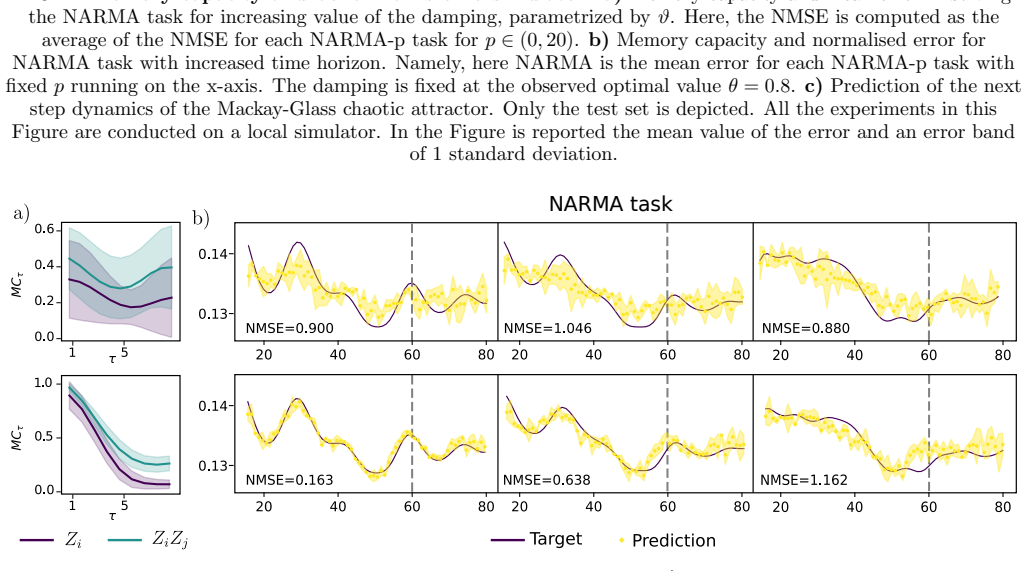
- On current superconducting hardware the algorithm improves on previous noise-based implementations, reaching accurate reconstruction of nonlinear functionals such as NARMA-5 rather than only NARMA-2.
- The method does not depend on native dissipation, so it remains applicable when hardware becomes less noisy and eventually fault-tolerant.
Reading between the lines
- Editorial extension: the same ancilla-controlled-rotation primitive should work on any qubit platform with mid-circuit measurements, making non-unitality a programmed resource rather than a property of the hardware noise.
- Editorial extension: because the effective damping channel on the processor was not separately characterized, a calibration experiment—process tomography of the damping block—would tell whether the improvement comes from the intended relaxation or from incidental gate noise.
- Editorial extension: the optimal angle found (ϑ = 0.8) is empirical; an analytic relation between ϑ, entangling-gate structure, and memory capacity would turn the tuning knob into a design rule.
- Editorial extension: the trace-distance argument suggests any non-unital operation that pushes the state away from maximally mixed could substitute for the controlled rotation, so measurement-feedback or reset-based primitives may also lengthen reservoir memory.
Editorial analysis
A structured set of objections, weighed in public.
Referee Report
Summary. The paper proposes a gate-based quantum reservoir computing scheme in which each reservoir qubit is coupled to an ancilla via a CNOT and a controlled rotation, with the aim of inducing tunable amplitude damping. This damping is intended to counteract the depolarizing effect of repeated mid-circuit measurements, keeping the reservoir away from the maximally mixed state and enabling stable temporal processing. The authors validate the scheme numerically on memory-capacity, NARMA, and Mackey-Glass benchmarks, and on an IBM superconducting device, reporting improved memory and task performance compared with damping-free implementations. The theoretical core is the reduced-channel calculation in Appendix B, which shows that tracing out the ancilla yields an amplitude-damping-like map. The central claims are that the damping is tunable, that it stabilizes the reservoir over time, and that it can be implemented on currently available hardware.
Significance. If correct, the proposed controlled-damping circuit would be a useful primitive for quantum reservoir computing: it provides a mechanism for non-unital evolution without relying on intrinsic hardware dissipation, and it could in principle allow longer temporal processing than protocols that progressively lose information to measurement. The simulator benchmarks (NARMA, Mackey-Glass, memory capacity) are appropriate and do provide evidence that the damping angle and the choice of correlated observables affect performance. I also credit the authors for explicitly stating that there is no a priori method for choosing the optimal damping angle and for reporting error bands on the numerical results. The Appendix B reduced-channel calculation is a valuable explicit derivation, even though it is not consistently used in the main text. The central idea is plausible and worth publishing after revision, but the main-text equation describing the damping operation is incorrect, and the hardware claims are not backed by a characterization of the implemented channel.
major comments (3)
- [Section II.B, Eq. (6) vs Appendix B] Equation (6) is not a correct description of the proposed damping operation. Writing the output as (α + i sin(ϑ/2))|0⟩ + β cos(ϑ/2)|1⟩ gives a pure state that is not normalized for general α, β, and it resembles a unitary rotation rather than the non-unital amplitude-damping channel derived in Appendix B (Eqs. B5–B6). The correct reduced state is a mixture, |α|²|0⟩⟨0| + |β|² sin²(ϑ/2)|0⟩⟨0| + |β|² cos²(ϑ/2)|1⟩⟨1|. Because Eq. (6) is the formal statement of the central mechanism, this is load-bearing. The authors should replace it with the correct Kraus representation or the explicit partial-trace outcome, and should clarify which description was actually implemented in the simulations.
- [Section II.E and Methods (ancilla reset and process characterization)] The hardware experiment reports no characterization of the effective channel realized on the IBM device. The improvement in Fig. 5 could in principle arise from the additional gates and ancilla noise rather than from the intended amplitude damping. This concern is amplified by the Methods statement that on hardware 'it is possible to leverage all available qubits to reduce the number of reset operations'; if ancillas are reused without full reset, the per-step map is no longer the ideal amplitude-damping channel of Eq. (B6), and correlated errors across time can appear. I ask the authors to provide at least a single-qubit process characterization or randomized-benchmarking-based estimate of the implemented channel, or to explicitly restrict the hardware claims to a comparison of circuits with and without the damping block while acknowledging that the effective map has not been verified.
- [Section II.B and Conclusion (long-time stability claim)] The paper claims that the algorithm is 'inherently stable over time' and can process 'arbitrarily long input sequences.' This is a theoretical statement about the ideal channel: in the ideal simulator the non-unital map keeps the state away from the maximally mixed state. However, the hardware results in Fig. 5 show clear deterioration for NARMA-p with p > 5, and the paper attributes this to device noise. The claim should be qualified so that it is not read as a demonstrated hardware capability. The authors should state explicitly that the long-time stability is a property of the ideal circuit model and that the hardware demonstration is limited by additional unital and correlated noise.
minor comments (6)
- [Appendix B, Eq. (B6)] The coefficient d_ϑ = -i sin(ϑ/2) is inserted as d²_ϑ in the |0⟩⟨0| term; this should be |d_ϑ|² = sin²(ϑ/2). Also, the text in B5 says 'control on qa and target on qa', which appears to be a typo; the controlled rotation must target the accessible qubit and be controlled by the ancilla (or vice versa) for the partial trace to yield amplitude damping.
- [Methods, Experiment on hardware] The sentence about reducing the number of reset operations is too vague. The authors should specify exactly how many ancilla qubits were used, whether they were reset at each time step, and how the ancilla register was reused across the 10800 repetitions.
- [Eq. (3)] The notation T(ρx - ρy) is confusing; T is used for trace distance of two states, so it should be T(ρx, ρy). Please correct this throughout.
- [Fig. 4 caption] 'Mackay-Glass' is a typo; the correct name is 'Mackey-Glass'. The same typo appears elsewhere in the text.
- [Appendix A, Eq. (A1)] 'CPTC channels' should be 'CPTP channels' (completely positive trace-preserving).
- [Fig. 2 caption] The caption says 'Trace distance of the circuit from the ˆI along 40 time steps'; please clarify that this is the distance from the maximally mixed state I/d, and add axis labels in panel (c) for clarity.
Circularity Check
No significant circularity: the damping algorithm is evaluated by fresh simulations and hardware comparison; the one self-citation is motivational only.
full rationale
The paper's central claim is a circuit-level algorithm for tunable amplitude damping. The circuit is explicitly defined (CNOT + CR_X(theta) per qubit), and Appendix B derives the resulting channel by tracing out the ancilla. The stability claim (away from the maximally mixed state) is a mathematical consequence of the non-unital channel and is additionally checked in Fig. 2c by direct simulation. The main computational evidence (memory capacity, NARMA, Mackey-Glass) comes from fresh simulations on standard benchmarks and from an IBM hardware experiment comparing the circuit with and without the damping block on the same device. The damping angle theta is explicitly presented as a tuned hyperparameter, so it is not a fitted parameter renamed as a prediction. The only self-citation with a direct role is Eq. (3), attributed to Ref. [39], used to argue that deviation from the maximally mixed state improves input separability; this is motivational, and the paper's own numerical results do not depend on that inequality. The absence of hardware process characterization is a correctness/robustness concern, not circularity. Thus, no step in the derivation chain reduces by construction to its own inputs.
Assumptions & free parameters
free parameters (2)
- damping angle ϑ =
0.8 for NARMA (simulator and hardware), 0.6 for hardware memory-capacity experiment
- readout weights W =
fit by Moore-Penrose on the training set
assumptions (4)
- standard math The combined effect of mid-circuit measurement and unitary encoding is described by the CPTP trajectory channel (Eqs. 11-12 and B1-B3), and the ensemble dynamics is a statistical mixture over measurement outcomes.
- domain assumption Input separability is governed by the trace-distance bound of Eq. (3) from Ref. [39]: T(ρx,ρy) ≤ C(U) C(|x-y|) T(ρ, I/d).
- domain assumption The NARMA and Mackey-Glass benchmarks, with the stated parameters (α, β, γ, δ and τ=17), are representative reservoir-computing tasks whose linear-readout error measures network quality.
- domain assumption Hardware noise other than the induced amplitude damping (dephasing, depolarizing) is sufficiently small that the tuned ϑ effect survives and dominates the dynamics.
Cite this review
Pith. "Pith review of Quantum reservoir computing induced by controllable damping." pith.science (2026). https://pith.science/paper/7NG7YG5M
@misc{pith2026250814621,
  author       = {Pith},
  title        = {Pith review of: Quantum reservoir computing induced by controllable damping},
  year         = {2026},
  howpublished = {\url{https://pith.science/paper/7NG7YG5M}},
  note         = {Machine review of arXiv:2508.14621}
}
read the original abstract
Quantum reservoir computing has emerged as a promising machine learning paradigm for processing temporal data on near-term quantum devices, as it allows for exploiting the large computational capacity of the qubits without suffering from typical issues that occur when training a variational quantum circuit. In particular, quantum gate-based echo state networks have proven effective for learning when the evolution of the reservoir circuit is non-unital. Nonetheless, a method for ensuring a tunable and stable non-unital evolution of the circuit was still lacking. We propose an algorithm for inducing damping by applying a controlled rotation to each qubit in the reservoir. It enables tunable, circuit-level amplitude amplification of the zero state, maintaining the system away from the maximally mixed state and preventing information loss caused by repeated mid-circuit measurements. The algorithm is inherently stable over time as it can, in principle, process arbitrarily long input sequences, well beyond the coherence time of individual qubits, by inducing an arbitrary damping on each qubit. Moreover, we show that quantum correlations between qubits provide an improvement in terms of memory retention, underscoring the potential utility of employing a quantum system as a computational reservoir. We demonstrate, through typical benchmarks for reservoir computing, that such an algorithm enables robust and scalable quantum random computing on fault-tolerant quantum hardware.
Figures


Figures from the paper (4 more)



Forward citations
Cited by 2 Pith papers
-
General theory of monitored Quantum Reservoir Computing
Monitored quantum reservoirs can be made viable by measurement back-action, with projective, weak, partial, and dissipative monitoring described by one unified framework.
-
Excitation of toroidal Alfv\'en eigenmode by energetic particles in DTT and effect of negative triangularity
A new non-perturbative gyrokinetic eigenvalue code shows that negative triangularity can either stabilize or destabilize energetic-particle-driven toroidal Alfven eigenmodes in DTT, depending on the dominant mechanism.
Reference graph
Works this paper leans on
-
[1]
Deutsch, I. H. Harnessing the power of the second quan- tum revolution. PRX Quantum 1, 020101 (2020)
work page 2020
-
[2]
Bharti, K. et al. Noisy intermediate-scale quantum algo- rithms. Rev. Mod. Phys. 015004 (2022)
work page 2022
-
[3]
Quantum neuromorphic hardware for quantum artificial intelligence
Prati, E. Quantum neuromorphic hardware for quantum artificial intelligence. In Journal of Physics: Conference Series, vol. 880 (IOP Publishing, 2017)
work page 2017
-
[4]
Schuld, M. & Petruccione, F. Chapter in: ”Machine learning with quantum computers” , vol. 676 (Springer, 2021)
work page 2021
-
[5]
Lloyd, S., Mohseni, M. & Rebentrost, P. Quantum prin- cipal component analysis. Nature physics 10, 631–633 (2014)
work page 2014
-
[6]
Innocenti, L. et al. Potential and limitations of quantum extreme learning machines. Communications Physics 6, 118 (2023)
work page 2023
-
[7]
McClean, J., Boixo, S., Smelyanskiy, V., Babbush, R. & Neven, H. Barren plateaus in quantum neural network training landscapes. Nature Communications (2018)
work page 2018
-
[8]
Larocca, M. et al. Barren plateaus in variational quan- tum computing. Nature Reviews Physics 1–16 (2025)
work page 2025
Show all 51 references
-
[9]
Mujal, P. et al. Opportunities in quantum reservoir com- puting and extreme learning machines. Advanced Quan- tum Technologies 4 (2021)
2021
-
[10]
Short term memory in echo state networks (2001)
Jaeger, H. Short term memory in echo state networks (2001)
2001
-
[11]
W., Natschl¨ ager, T
Maass, W. W., Natschl¨ ager, T. & Markram, H. Real- time computing without stable states: a new framework for neural computation based on perturbations. Neural Computation (2002)
2002
-
[12]
& Markram, H
Maass, W. & Markram, H. On the computational power of circuits of spiking neurons. J. Comput. Syst. Sci. (2004)
2004
-
[13]
& Fischer, I
Nakajima, K. & Fischer, I. Reservoir Computing. Theory, Physical Implementations, and Applications (Springer Singapore, 2021)
2021
-
[14]
& Prati, E
Monzani, F. & Prati, E. Universality conditions of unified classical and quantum reservoir computing. Neurocom- puting 130391 (2025)
2025
-
[15]
Tanaka, G. et al. Recent advances in physical reservoir computing: a review. Neural Networks 115 (2019). 11
2019
-
[16]
& Grollier, J
Markovi´ c, D. & Grollier, J. Quantum neuromorphic com- puting. Applied Physics Letters 117 (2020)
2020
-
[17]
Senanian, A. et al. Microwave signal processing using an analog quantum reservoir computer. Nature Communi- cations 15 (2024)
2024
-
[18]
& Mujal, P
Franceschetto, G., P lodzie´ n, M., Lewenstein, M., Ac ´ ın, A. & Mujal, P. Harnessing quantum back-action for time- series processing. arXiv:2411.03979 (2024)
2024 arXiv
-
[19]
& Liew, T
Ghosh, S., Opala, A., Matuszewski, M., Paterek, T. & Liew, T. C. H. Quantum reservoir processing. npj Quan- tum Information 5 (2019)
2019
-
[20]
& Liew, T
Ghosh, S., Krisnanda, T., Paterek, T. & Liew, T. C. H. Realising and compressing quantum circuits with quan- tum reservoir computing. Communications Physics 4 (2021)
2021
-
[21]
& Gies, C
G¨ otting, N., Lohof, F. & Gies, C. Exploring quantumness in quantum reservoir computing. Physical Review A 108, 052427 (2023)
2023
-
[22]
& Hashimoto, T
Nakajima, M., Tanaka, K. & Hashimoto, T. Scalable reservoir computing on coherent linear photonic proces- sor. Communications Physics 4 (2021)
2021
-
[23]
L., Soriano, M
Garc ´ ıa-Beni, J., Giorgi, G. L., Soriano, M. C. & Zam- brini, R. Scalable photonic platform for real-time quan- tum reservoir computing. Phys. Rev. Appl. 20 (2023)
2023
-
[24]
A., Najafi, K., Gao, X
Bravo, R. A., Najafi, K., Gao, X. & Yelin, S. F. Quantum reservoir computing using arrays of Rydberg atoms.PRX Quantum 3, 030325 (2022)
2022
-
[25]
Govia, L. C. G., Ribeill, G. J., Rowlands, G. E., Krovi, H. K. & Ohki, T. A. Quantum reservoir computing with a single nonlinear oscillator. Phys. Rev. Res. 3, 013077 (2021)
2021
-
[26]
Nokkala, J. et al. Gaussian states of continuous-variable quantum systems provide universal and versatile reser- voir computing. Communications Physics 4 (2021)
2021
-
[27]
Spagnolo, M., Morris, J., Piacentini, S. et al. Experimen- tal photonic quantum memristor. Nature Photonics 16, 318–323 (2022)
2022
-
[28]
& Schumacher, J
Pfeffer, P., Heyder, F. & Schumacher, J. Hybrid quantum-classical reservoir computing of thermal con- vection flow. Phys. Rev. Res. 4 (2022)
2022
-
[29]
& Magri, L
Ahmed, O., Tennie, F. & Magri, L. Prediction of chaotic dynamics and extreme events: A recurrence-free quan- tum reservoir computing approach. Phys. Rev. Res. 6 (2024)
2024
-
[30]
Dudas, J. et al. Quantum reservoir computing implemen- tation on coherently coupled quantum oscillators. npj Quantum Information 9, 64 (2023)
2023
-
[31]
Angelatos, G., Khan, S. A. & T¨ ureci, H. E. Reser- voir computing approach to quantum state measurement. Phys. Rev. X 11, 041062 (2021)
2021
-
[32]
Chen, J., Nurdin, H. I. & Yamamoto, N. Temporal infor- mation processing on noisy quantum computers. Phys. Rev. Appl. 14 (2020)
2020
-
[33]
& Prati, E
Molteni, R., Destri, C. & Prati, E. Optimization of the memory reset rate of a quantum echo-state network for time sequential tasks. Phys. Lett. A (2023)
2023
-
[34]
C., Yasuoka, K
Suzuki, Y., Gao, Q., Pradel, K. C., Yasuoka, K. & Ya- mamoto, N. Natural quantum reservoir computing for temporal information processing. Scientific reports 12 (2022)
2022
-
[35]
Kubota, T. et al. Temporal information processing in- duced by quantum noise. Physical Review Research 5, 023057 (2023)
2023
-
[36]
Hu, F. et al. Overcoming the coherence time barrier in quantum machine learning on temporal data. Nature communications 15, 7491 (2024)
2024
-
[37]
Xiong, W. et al. On fundamental aspects of quantum ex- treme learning machines. Quantum Machine Intelligence 7, 20 (2025)
2025
-
[38]
& Ortega, J.-P
Mart ´ ınez-Pe˜ na, R. & Ortega, J.-P. Quantum reservoir computing in finite dimensions. Physical Review E 107 (2022)
2022
-
[39]
& Prati, E
Monzani, F., Ricci, E., Nigro, L. & Prati, E. Non- unital noise in a superconducting quantum computer as a computational resource for reservoir computing. arXiv:2409.07886 (2024)
2024 arXiv
-
[40]
& Borondo, F
Domingo, L., Carlo, G. & Borondo, F. Taking advan- tage of noise in quantum reservoir computing. Sci. Rep. (2023)
2023
-
[41]
C., Giorgi, G
Sannia, A., Mart ´ ınez-Pe˜ na, R., Soriano, M. C., Giorgi, G. L. & Zambrini, R. Dissipation as a resource for Quan- tum Reservoir Computing. Quantum 8, 1291 (2024)
2024
-
[42]
& Sharma, K
Fefferman, B., Ghosh, S., Gullans, M., Kuroiwa, K. & Sharma, K. Effect of nonunital noise on random-circuit sampling. PRX Quantum 5 (2024)
2024
-
[43]
Mele, A. A. et al. Noise-induced shallow circuits and absence of barren plateaus (2024). 2403.13927
2024 arXiv
-
[44]
& Prati, E
No` e, D., Rocutto, L., Moro, L. & Prati, E. Quantum parallel training of a Boltzmann machine on an adia- batic quantum computer. Advanced Quantum Technolo- gies 2300330 (2024)
2024
-
[45]
& Parlos, A
Atiya, A. & Parlos, A. New results on recurrent net- work training: unifying the algorithms and accelerating convergence. IEEE Transactions on Neural Networks 11 (2000)
2000
-
[46]
& Massar, S
Antonik, P., Gulina, M., Pauwels, J. & Massar, S. Us- ing a reservoir computer to learn chaotic attractors, with applications to chaos synchronization and cryptography. Phys. Rev. E 98 (2018)
2018
-
[47]
& Chua, L
Boyd, S. & Chua, L. Fading memory and the problem of approximating nonlinear operators with Volterra series. IEEE Transactions on Circuits and Systems 32, 1150– 1161 (1985)
1985
-
[48]
& Ortega, J.-P
Mart ´ ınez-Pe˜ na, R. & Ortega, J.-P. Input-dependence in quantum reservoir computing. Physical Review E 111, 065306 (2025)
2025
-
[49]
Helstrom, C. W. Quantum detection and estimation the- ory. Journal of Statistical Physics 1, 231–252 (1969)
1969
-
[50]
Holevo, A. S. Bounds for the quantity of information transmitted by a quantum communication channel.Prob- lemy Peredachi Informatsii 9, 3–11 (1973)
1973
-
[51]
Yasuda, T. et al. Quantum reservoir computing with re- peated measurements on superconducting devices (2023). 2310.06706. 12 Appendix A: Three families of gate-based quantum reservoir computers We discuss here three different families of gate-based echo state networks for sequ...
2023 arXiv
Reviewed August 5, 2026 · model on record in the stance chip above.
Discussion (0). Sign in to comment.