REVIEW 2 major objections 5 minor 82 references
A quantum extreme learning machine can retrieve exoplanet atmospheric parameters from spectra, and its results on a real quantum processor match simulation closely enough to demonstrate fault tolerance.
Reviewed by Pith at T0; open to challenge. T0 means a machine referee read the full paper against a public rubric. the ladder, T0–T4 →
A QELM retrieves exoplanet atmospheric parameters from simulated spectra and reproduces noiseless-simulation accuracy on IBM Fez hardware.
T0 review reviewed 2026-08-05 challenge →
load-bearing objection First QELM-on-exoplanet-spectra demo with a real IBM Fez run, but the claimed retrieval accuracies are likely inflated by fitting PCA on the full dataset, and the fault-tolerance proof is a single run without error bars. the 2 major comments →
Exoplanetary atmospheres retrieval via a quantum extreme learning machine
The pith
A machine-rendered reading of the paper's core claim, the machinery that carries it, and where it could break.
The reading
Core claim
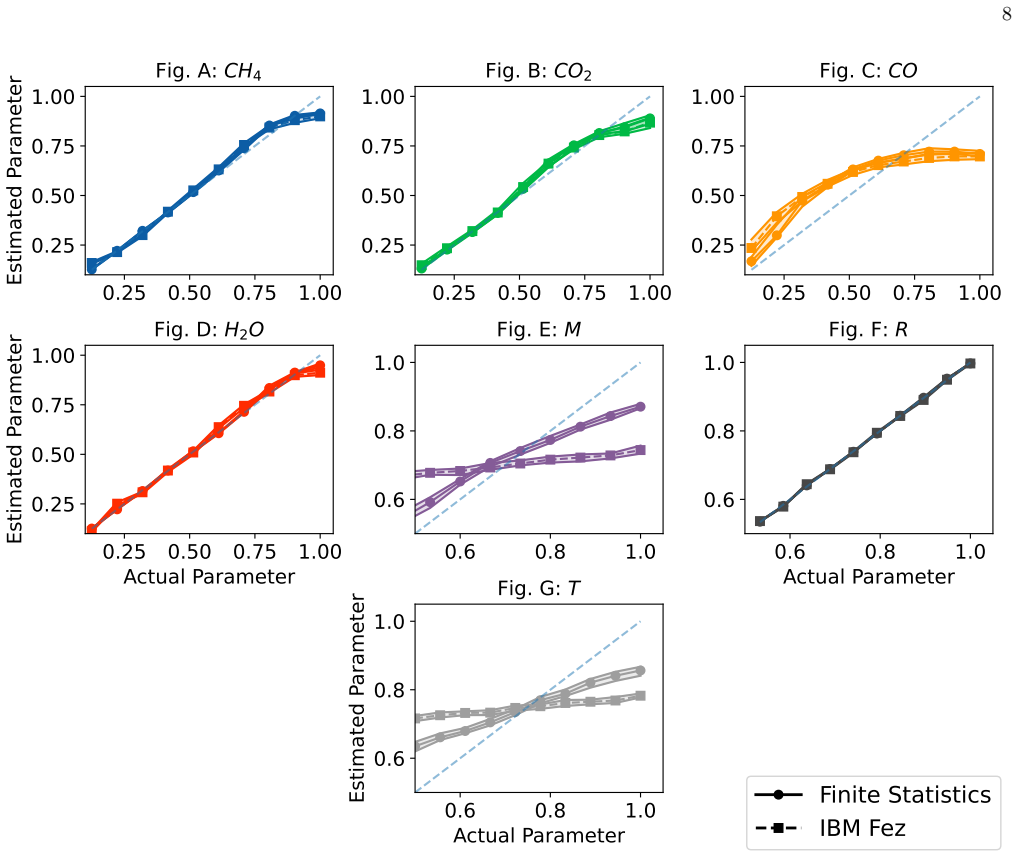
The paper claims that a quantum extreme learning machine can retrieve exoplanet atmospheric parameters from synthetic spectra and tolerate real hardware noise. The pipeline splits each spectrum into 8 or 14 patches, compresses each patch with principal component analysis, and encodes the components into 5-qubit random-gate reservoirs whose readout probabilities are linearly mapped to seven atmospheric parameters. On JWST-range spectra, infinite-statistics simulation retrieves radius, CH4, CO2, H2O with 100%, 96.3%, 86.6%, 99.7% accuracy; on the Fez device at 20,000 shots, those reach 100%, 83.6%, 75.1%, 86.2%. Device and finite-statistics results nearly coincide, which the authors take as pr
What carries the argument
The central object is a factorized quantum extreme learning machine: several 5-qubit reservoirs, each with the spectrum patch encoded in RX rotation angles, a fixed random layer of RY and CNOT gates, and an output of all 25 measurement probabilities. Because the quantum map and the output layer are linear in the state, training is a single Moore-Penrose pseudoinverse solve, which the authors argue prevents overfitting. The patch factorization keeps each circuit shallow, enabling the hardware demonstration.
Load-bearing premise
The load-bearing premise is that the principal components used to encode the spectra are computed without seeing the test spectra; the paper does not state that the PCA is fit on the training split only, so if it is fit on the full dataset the test spectra shape the encoding and inflate the reported retrieval accuracies.
What would settle it
Refit the principal components using only the training split (or cross-validate within it), then recompute the retrieval accuracies on untouched test spectra; if the CH4 and H2O accuracies on the Fez device fall well below the reported 83.6% and 86.2%, the headline retrieval numbers are inflated by information leakage from the test set.
If this is right
- QELM-based retrieval can run on present-day quantum processors without error mitigation, since hardware and finite-statistics simulation agree.
- Training reduces to one pseudoinverse calculation, so adding training spectra or output features is cheap on the classical side.
- Appendix results show that with more principal components and larger training sets, infinite-statistics accuracy for most parameters reaches 99–100%, so the main practical gap is shot statistics.
- The authors propose using QELM predictions as ansätze to warm-start classical retrieval codes and speed their convergence.
- The patching and encoding scheme is instrument-agnostic and can be redeployed for other spectral ranges, such as those expected from the Ariel space mission.
Where Pith is reading between the lines
- If the principal components are fit on the combined train and test set, as the text appears to describe, the test spectra influence the feature representation and the reported accuracies are optimistic; a train-only PCA fit would settle how much of the retrieval claim survives.
- The no-overfitting argument covers the linear reservoir-to-output map, but the PCA pre-processing is itself a data-dependent representation choice, so overfitting or leakage can enter before the quantum circuit.
- The demonstrated fault tolerance applies to these shallow, factorized 5-qubit circuits; deeper or more entangled reservoirs may show a larger hardware-simulation gap and would need their own test.
- The weak retrievals of CO, mass, and temperature, which the paper attributes to spectral degeneracy and shot statistics, suggest a testable extension: a second-stage QELM trained on residuals or on physically motivated features might recover those parameters.
Editorial analysis
A structured set of objections, weighed in public.
Referee Report
Summary. The paper introduces a quantum extreme learning machine (QELM) architecture for atmospheric retrieval from synthetic exoplanet spectra. The spectrum is split into wavelength patches, each patch is normalized and reduced via PCA to M components, and these are encoded into a factorized quantum reservoir of 5-qubit registers; the measured probabilities are linearly post-processed to predict seven atmospheric parameters (CH4, CO2, CO, H2O, mass, radius, temperature). The authors report retrieval accuracies on TauREx and JWST-binned datasets, and compare an infinite-statistics simulation, a 20,000-shot simulation, and a run on the IBM Fez device. They find close agreement between the finite-statistics simulation and the hardware run, and interpret this as demonstrating the fault tolerance of the strategy.
Significance. The proposed factorized-reservoir approach is a sensible way to reduce qubit count and circuit depth when applying QELMs to high-dimensional spectral data, and the hardware demonstration on a 156-qubit device is a useful step. If the preprocessing leakage is removed and the fault-tolerance claim is supported by repeated runs, the paper would provide a credible proof-of-concept for quantum ML in exoplanet retrieval. The appendices give helpful scaling information for M and training-set size. However, the reported retrieval accuracies are not yet reliable out-of-sample estimates because the PCA features appear to be computed on the full dataset before the train/test split, and the fault-tolerance conclusion is drawn from a single execution without statistical characterization.
major comments (2)
- [Section III.B and Appendix A] The preprocessing pipeline is not described as training-only. Section III.B states that the last step is to 'extract the M principal components of each of the spectral bands,' and Section IV reports that M=5 components are extracted and then 'the 75% used for training while the remaining 25% for testing'; Appendix A selects M and the 10-component PCA denoising filter using cumulative explained variance computed over the full dataset. If the PCA projection and per-patch normalization are fit on all spectra before the split, the test spectra participate in defining the feature axes. The accuracies in Table II and Fig. 5 are then transductive estimates, not out-of-sample generalization, and the 100% radius / 83.6% CH4 / 86.2% H2O numbers are inflated. Please fit the PCA and normalization on the training split only, freeze them, transform the test split, and re-report. A validation split sho
- [Section IV, Fig. 5, Table II] The fault-tolerance conclusion rests on a single hardware execution: 'there is almost no difference between the results obtained with a finite statistics simulation and those obtained with IBM Fez, proving successfully the fault tolerance of the algorithm.' No error bars, repeated runs, device-noise parameters, or statistical test are reported, and accuracy is a thresholded aggregate that can mask per-sample deviations. A single run cannot rule out a fortuitous agreement. Please provide multiple hardware runs (or at least a noise-inclusive simulation calibrated to Fez's reported error rates), report per-parameter confidence intervals, and perform a statistical comparison before claiming fault tolerance. The term 'fault tolerance' is also stronger than what a single noisily executed circuit can establish; 'robustness to device noise' would be more precise.
minor comments (5)
- [Section II, Eq. (2)] The claim that 'QELMs cannot be affected by over-fitting' is not justified: the output layer is a linear map trained by pseudo-inverse on a finite set of reservoir outcomes, and it can overfit when the feature dimension is large relative to Dtrain or when singular values are small, unless regularization is used. Please qualify this statement.
- [General] No classical baseline is provided. A classical ELM or linear regression on the same PCA features would contextualize the reported accuracies and should be added or at least discussed, even if the paper does not claim a quantum advantage.
- [Various] Typos and wording: 'whichhandle' (Sec. III.A), 'finite finite statistics' (Sec. IV), 'on IBM F ez' (Sec. IV), 'Ncam' (Sec. III.B), and 'the the normalization' (Appendix B) should be corrected.
- [Fig. 5 and Table II] The finite-statistics and hardware bars are single values. Error bars from repeated runs or shot-noise resampling would make the comparison between simulation and hardware more informative.
- [Eq. (4)] The relative error metric places the true value in the denominator, which is sensitive to the discrete grid and small target values. Consider reporting a symmetric or dimensionless metric, or explaining why the 5% threshold is a meaningful retrieval tolerance.
Circularity Check
No circularity: the output layer is trained on labeled spectra, and the fault-tolerance claim is an empirical simulator-vs-hardware comparison.
full rationale
The retrieval pipeline is supervised end-to-end only in the final linear layer: W = Y_train R(S_train)^+ (Eq. 2), with Y_train the true atmospheric labels. The reservoir is a fixed random circuit (Section III.C) and the input encoding uses PCA features of the spectra (Section III.B); neither uses the retrieval targets, so no prediction is a fitted constant renamed as discovery. The fault-tolerance claim is not definitional: it compares a finite-statistics simulation (20000 shots) against IBM Fez on the same preprocessed JWST inputs (Section IV, Table II), and the small differences are empirical, not imposed by the equations. Self-citations (refs 48, 50, 74) provide background QELM theory; the spectral application and its accuracy numbers are computed from the paper's own TauREx/JWST pipeline and would stand even if those references were removed. The main caveat is a data-hygiene issue, not circularity: the manuscript never states that the PCA projection in Section III.B / Appendix A is fitted on the training split only. If it is computed on the combined train+test set, the test spectra shape the feature encoder and the reported accuracies are transductive/optimistic. This does not make the retrieval reduce to its inputs by construction, and it leaves the hardware-vs-simulation fault-tolerance comparison intact.
Axiom & Free-Parameter Ledger
free parameters (5)
- M, number of PCA components per patch =
5 (hardware), 6-7 (simulations)
- PCA filter components for noisy spectra =
10
- Training set size Dtrain =
3060 (75% of 4080) for hardware; 8000 for best simulations
- Number of spectral patches Np =
14 (TauREx), 8 (JWST)
- Success threshold epsilon =
5%
axioms (3)
- domain assumption TauREx synthetic spectra are a faithful proxy for real exoplanet transmission spectra
- domain assumption PCA of each spectral patch preserves the information needed for retrieval
- domain assumption The discrete 10-value grid for each atmospheric parameter is sufficient to benchmark retrieval
Cite this review
Pith. "Pith review of Exoplanetary atmospheres retrieval via a quantum extreme learning machine." pith.science (2026). https://pith.science/paper/QLU2ZSU2
@misc{pith2026250903617,
  author       = {Pith},
  title        = {Pith review of: Exoplanetary atmospheres retrieval via a quantum extreme learning machine},
  year         = {2026},
  howpublished = {\url{https://pith.science/paper/QLU2ZSU2}},
  note         = {Machine review of arXiv:2509.03617}
}
read the original abstract
The study of exoplanetary atmospheres traditionally relies on forward models to analytically compute the spectrum of an exoplanet by fine-tuning numerous chemical and physical parameters. However, the high-dimensionality of parameter space often results in a significant computational overhead. In this work, we introduce a novel approach to atmospheric retrieval leveraging on quantum extreme learning machines (QELMs). QELMs are quantum machine learning techniques that employ quantum systems as a black box for processing input data. In this work, we propose a framework for extracting exoplanetary atmospheric features using QELMs, employing an intrinsically fault-tolerant strategy suitable for near-term quantum devices, and we demonstrate such fault tolerance with a direct implementation on IBM Fez. The QELM architecture we present shows the potential of quantum computing in the analysis of astrophysical datasets and may, in the near-term future, unlock new computational tools to implement fast, efficient, and more accurate models in the study of exoplanetary atmospheres.
Figures




Reference graph
Works this paper leans on
-
[1]
Kreidberg, M
L. Kreidberg, M. R. Line, V. Parmentier, K. B. Steven- son, T. Louden, M. Bonnefoy, J. K. Faherty, G. W. Henry, M. H. Williamson, K. Stassun, et al. , The Astro- nomical Journal 156, 17 (2018)
2018
-
[2]
A. Tsiaras, I. Waldmann, T. Zingales, M. Rocchetto, G. Morello, M. Damiano, K. Karpouzas, G. Tinetti, L. McKemmish, J. Tennyson, et al. , The Astronomical Journal 155, 156 (2018)
work page 2018
- [3]
-
[4]
M. Mansfield, J. L. Bean, M. R. Line, V. Parmentier, L. Kreidberg, J.-M. D´ esert, J. J. Fortney, K. B. Steven- son, J. Arcangeli, and D. Dragomir, The Astronomical Journal 156, 10 (2018)
work page 2018
-
[5]
J. J. Spake, D. K. Sing, T. M. Evans, A. Oklopˇ ci´ c, V. Bourrier, L. Kreidberg, B. V. Rackham, J. Irwin, D. Ehrenreich, A. Wyttenbach, et al. , Nature 557, 68 (2018)
work page 2018
-
[6]
K. B. Sheppard, A. M. Mandell, P. Tamburo, S. Gandhi, A. Pinhas, N. Madhusudhan, and D. Deming, The Astrophysical Journal Letters 850, L32 (2017)
work page 2017
-
[7]
J. K. Barstow, S. Aigrain, P. G. Irwin, and D. K. Sing, The Astrophysical Journal 834, 50 (2016)
work page 2016
-
[8]
M. Rocchetto, I. Waldmann, O. Venot, P.-O. Lagage, and G. Tinetti, The Astrophysical Journal 833, 120 (2016)
work page 2016
- [9]
-
[10]
The views expressed are those of the authors and do not reflect the official policy or position of IBM or the IBM Quantum team
We acknowledge the use of IBM Quantum Credits for this work. The views expressed are those of the authors and do not reflect the official policy or position of IBM or the IBM Quantum team
-
[11]
N. Madhusudhan and S. Seager, The Astrophysical Jour- nal 707, 24 (2009)
work page 2009
-
[12]
M. R. Line, A. S. Wolf, X. Zhang, H. Knutson, J. A. Kammer, E. Ellison, P. Deroo, D. Crisp, and Y. L. Yung, The Astrophysical Journal 775, 137 (2013)
work page 2013
- [13]
-
[14]
P. Cubillos, J. Blecic, J. Harrington, P. Rojo, N. Lust, O. Bowman, M. Stemm, A. Foster, T. J. Loredo, J. Fort- ney, et al. , Astrophysics Source Code Library , ascl (2016)
work page 2016
-
[15]
S. Gandhi and N. Madhusudhan, Monthly Notices of the Royal Astronomical Society 474, 271 (2018)
work page 2018
- [16]
-
[17]
Pluriel, William, Zingales, Tiziano, Leconte, J´ er´ emy, and Parmentier, Vivien, A&A 636, A66 (2020)
work page 2020
-
[18]
W. Pluriel, J. Leconte, V. Parmentier, T. Zingales, A. Falco, F. Selsis, and P. Bord´ e, A&A658, A42 (2022), arXiv:2110.09080 [astro-ph.EP]
work page internal anchor Pith review Pith/arXiv arXiv 2022
-
[19]
F. Feroz and M. P. Hobson, Monthly Notices of the Royal Astronomical Society 384, 449 (2008)
work page 2008
-
[20]
Skilling, Bayesian inference and maximum entropy methods in science and engineering 735, 395 (2004)
J. Skilling, Bayesian inference and maximum entropy methods in science and engineering 735, 395 (2004)
work page 2004
- [21]
-
[22]
P. C. Gregory, Monthly Notices of the Royal Astronomi- cal Society 410, 94 (2011)
work page 2011
-
[23]
Supervised Machine Learning for Analysing Spectra of Exoplanetary Atmospheres
P. M´ arquez-Neila, C. Fisher, R. Sznitman, and K. Heng, Nature Astronomy 2, 719 (2018), arXiv:1806.03944 [astro-ph.EP]
work page internal anchor Pith review Pith/arXiv arXiv 2018
-
[24]
T. Zingales and I. P. Waldmann, The Astronomical Journal 156, 268 (2018)
work page 2018
-
[25]
A. D. Cobb, M. D. Himes, F. Soboczenski, S. Zorzan, M. D. O’Beirne, A. G. Baydin, Y. Gal, S. D. Domagal- Goldman, G. N. Arney, D. Angerhausen, et al. , The astronomical journal 158, 33 (2019)
work page 2019
-
[26]
K. A. Pearson, L. Palafox, and C. A. Griffith, Monthly Notices of the Royal Astronomical Society 474, 478 (2018)
work page 2018
-
[27]
C. J. Shallue and A. Vanderburg, The Astronomical Journal 155, 94 (2018)
work page 2018
-
[28]
D. M. Kipping and C. Lam, Monthly Notices of the Royal Astronomical Society 465, 3495 (2016)
work page 2016
-
[29]
Waldmann, The Astrophysical Journal 820, 107 (2016)
I. Waldmann, The Astrophysical Journal 820, 107 (2016)
work page 2016
-
[30]
J. P. Gardner, J. C. Mather, M. Clampin, R. Doyon, M. A. Greenhouse, H. B. Hammel, J. B. Hutchings, P. Jakobsen, S. J. Lilly, K. S. Long, et al., Space Science Reviews 123, 485 (2006)
work page 2006
-
[31]
G. Tinetti, P. Drossart, P. Eccleston, P. Hartogh, A. Heske, J. Leconte, G. Micela, M. Ollivier, G. Pilbratt, L. Puig, et al. , in Space Telescopes and Instrumentation 2016: Optical, Infrared, and Millimeter Wave , Vol. 9904 (SPIE, 2016) pp. 658–667
work page 2016
-
[32]
Z. Konkoli, in Advances in Unconventional Computing: Volume 1: Theory , Emergence, Complexity and Compu- tation, edited by A. Adamatzky (Springer International Publishing, Cham, 2017) pp. 573–607
work page 2017
-
[33]
G.-B. Huang, Q.-Y. Zhu, and C.-K. Siew, in 2004 IEEE International Joint Conference on Neural Net- works (IEEE Cat. No.04CH37541) , Vol. 2 (2004) pp. 985–990 vol.2, iSSN: 1098-7576. 10
work page 2004
- [34]
-
[35]
J. Wang, S. Lu, S.-H. Wang, and Y.-D. Zhang, Multi- media Tools and Applications 81, 41611 (2022)
work page 2022
-
[36]
U. Markowska-Kaczmar and M. Kosturek, Neural Com- puting and Applications 33, 15121 (2021)
work page 2021
- [37]
-
[38]
M. C. Soriano, S. Ort ´ ın, L. Keuninckx, L. Appeltant, J. Danckaert, L. Pesquera, and G. van der Sande, IEEE Transactions on Neural Networks and Learning Systems 26, 388 (2015)
work page 2015
-
[39]
P. Bhovad and S. Li, Sci Rep 11, 13002 (2021), number: 1 Publisher: Nature Publishing Group
work page 2021
-
[40]
K. Nakajima, H. Hauser, T. Li, and R. Pfeifer, Scientific Reports 5, 10487 (2015)
work page 2015
-
[41]
J. C. Coulombe, M. C. A. York, and J. Sylvestre, PLOS ONE 12, e0178663 (2017), publisher: Public Library of Science
work page 2017
-
[42]
A. Goudarzi, M. R. Lakin, and D. Stefanovic, in DNA Computing and Molecular Programming , Lecture Notes in Computer Science, edited by D. Soloveichik and B. Yurke (Springer International Publishing, Cham,
- [43]
-
[44]
J. Nokkala, R. Mart ´ ınez-Pe˜ na, R. Zambrini, and M. C. Soriano, IEEE Transactions on Neural Networks and Learning Systems 33, 2664 (2022), conference Name: IEEE Transactions on Neural Networks and Learning Systems
work page 2022
-
[45]
Biamonte, P
J. Biamonte, P. Wittek, N. Pancotti, P. Rebentrost, N. Wiebe, and S. Lloyd, Nature 549, 195 (2017)
2017
- [46]
- [47]
- [48]
-
[49]
M. Vetrano, G. L. Monaco, L. Innocenti, S. Lorenzo, and G. M. Palma, arXiv preprint arXiv:2409.06782 (2024)
Pith/arXiv arXiv 2024
-
[50]
Opportunities in Quantum Reservoir Computing and Extreme Learning Machines
P. Mujal, R. Mart ´ ınez-Pe˜ na, J. Nokkala, J. Garc ´ ıa-Beni, G. L. Giorgi, M. C. Soriano, and R. Zambrini, Adv Quan- tum Tech 4, 2100027 (2021), arXiv:2102.11831 [quant- ph]
work page internal anchor Pith review Pith/arXiv arXiv 2021
-
[51]
Experimental property-reconstruction in a photonic quantum extreme learning machine,
A. Suprano, D. Zia, L. Innocenti, S. Lorenzo, V. Ci- mini, T. Giordani, I. Palmisano, E. Polino, N. Spagnolo, F. Sciarrino, G. M. Palma, A. Ferraro, and M. Pa- ternostro, “Experimental property-reconstruction in a photonic quantum extreme learning machine,” (2023), arXiv:2308.04543 [quant-ph]
arXiv 2023
-
[52]
L. C. G. Govia, G. J. Ribeill, G. E. Rowlands, H. K. Krovi, and T. A. Ohki, Phys. Rev. Research 3, 013077 (2021), arXiv:2004.14965 [cond-mat, physics:quant-ph]
Pith/arXiv arXiv 2021
-
[53]
R. Mart ´ ınez-Pe˜ na and J.-P. Ortega, Phys. Rev. E107, 035306 (2023), publisher: American Physical Society
work page 2023
- [54]
- [55]
-
[56]
R. Mart ´ ınez-Pe˜ na, G. L. Giorgi, J. Nokkala, M. C. So- riano, and R. Zambrini, Phys. Rev. Lett. 127, 100502 (2021)
work page 2021
- [57]
- [58]
- [59]
-
[60]
T. Krisnanda, S. Ghosh, T. Paterek, and T. C. H. Liew, Neural Networks 136, 141 (2021)
work page 2021
-
[61]
J. Garc ´ ıa-Beni, G. L. Giorgi, M. C. Soriano, and R. Zam- brini, Phys. Rev. Appl. 20, 014051 (2023), publisher: American Physical Society
work page 2023
-
[62]
R. Mart ´ ınez-Pe˜ na, J. Nokkala, G. L. Giorgi, R. Zam- brini, and M. C. Soriano, Cogn Comput (2020), 10.1007/s12559-020-09772-y
-
[63]
K. Fujii and K. Nakajima, Phys. Rev. Appl. 8, 024030 (2017), publisher: American Physical Society
work page 2017
-
[64]
On fundamental as- pects of quantum extreme learning machines,
W. Xiong, G. Facelli, M. Sahebi, O. Agnel, T. Chotibut, S. Thanasilp, and Z. Holmes, “On fundamental as- pects of quantum extreme learning machines,” (2023), arXiv:2312.15124 [quant-ph, stat]
Pith/arXiv arXiv 2023
-
[65]
K. Nakajima, K. Fujii, M. Negoro, K. Mitarai, and M. Kitagawa, Physical Review Applied 11, 034021 (2019)
work page 2019
-
[66]
Preskill, Quantum 2, 79 (2018)
J. Preskill, Quantum 2, 79 (2018)
2018
-
[67]
J. W. Z. Lau, K. H. Lim, H. Shrotriya, and L. C. Kwek, AAPPS bulletin 32, 27 (2022)
work page 2022
- [68]
-
[69]
S. L. Tsang, M. T. West, S. M. Erfani, and M. Usman, IEEE Transactions on Quantum Engineering (2023)
work page 2023
-
[70]
A. F. Al-Refaie, Q. Changeat, I. P. Waldmann, and G. Tinetti, Astrophys. J. 917, 37 (2021), arXiv:1912.07759 [astro-ph.IM]
work page internal anchor Pith review Pith/arXiv arXiv 2021
-
[71]
I. P. Waldmann, G. Tinetti, M. Rocchetto, E. J. Barton, S. N. Yurchenko, and J. Tennyson, The Astrophysical Journal 802, 107 (2015)
work page 2015
-
[72]
I. Goodfellow, Y. Bengio, and A. Courville, Deep Learn- ing (MIT Press, 2016) http://www.deeplearningbook. org
work page 2016
-
[73]
M. Lukoˇ seviˇ cius and H. Jaeger, Computer Science Re- view 3, 127 (2009)
work page 2009
-
[74]
Serre, in Matrices: Theory and Applications (Springer, 2010) pp
D. Serre, in Matrices: Theory and Applications (Springer, 2010) pp. 163–181
work page 2010
-
[75]
On the potential and limitations of quantum extreme learning machines,
L. Innocenti, S. Lorenzo, I. Palmisano, A. Ferraro, M. Pa- ternostro, and G. M. Palma, “On the potential and limitations of quantum extreme learning machines,” (2023), arXiv:2210.00780 [quant-ph]
Pith/arXiv arXiv 2023
-
[76]
A. De Lorenzis, M. Casado, M. Estarellas, N. L. Gullo, T. Lux, F. Plastina, A. Riera, and J. Settino, arXiv preprint arXiv:2409.00998 (2024)
Pith/arXiv arXiv 2024
-
[77]
G. Fu, N. Espinoza, D. K. Sing, J. D. Lothringer, L. A. Dos Santos, Z. Rustamkulov, D. Deming, E. M.-R. Kempton, T. D. Komacek, H. A. Knutson, et al. , The Astrophysical Journal Letters 940, L35 (2022)
work page 2022
- [78]
- [79]
-
[80]
P. Rebentrost, M. Mohseni, and S. Lloyd, Physical review letters 113, 130503 (2014)
work page 2014
This paper was first reviewed by deepseek-v4-flash on August 5, 2026.
discussion (0)
Sign in with ORCID, Apple, or X to comment. Anyone can read and Pith papers without signing in.