REVIEW 4 major objections 5 minor 1 cited by
Influence of growth parameters on the superconducting transition temperature in granular aluminum films
T0 review · 4 major / 5 minor · reviewed 2026-08-10 · deepseek-v4-flash
Pith's one-line read This paper establishes substrate temperature as a decisive growth parameter for granular aluminum films: the superconducting transition temperature $T_c$ follows a dome-shaped dependence on aluminum evaporation rate from 300 K down to 25…
desk verdict A useful, honest growth-parameter map for granular aluminum, with a real confound in the cross-temperature comparison that the authors themselves acknowledge. read the letter →
The pith
A machine-rendered reading of the paper's core claim, the machinery that carries it, and where it could break.
The reading
What carries the argument
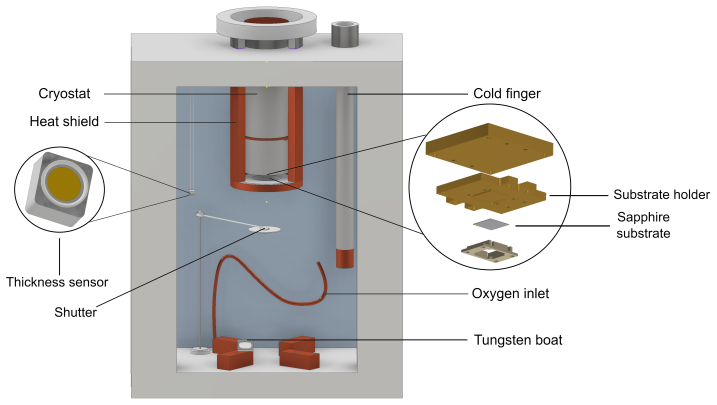
The central object is the superconducting dome, the inverted-U curve of $T_c$ plotted against a disorder or growth variable, here the aluminum evaporation rate at fixed oxygen flow. It is the experimental expression of a competition between enhanced Cooper pairing in individual decoupled grains and suppression of phase coherence as grains decouple further. The paper uses this dome as a sensitive probe: by measuring how the dome's peak and flanks move as substrate temperature drops, it reads out how growth parameters reshape the granular microstructure. The supporting machinery is a thermal evaporation chamber with in-situ four-point resistance monitoring, a cryogenic substrate holder reaching 25 K, and a quartz-crystal thickness monitor that lets each film be assigned a resistivity from its measured thickness and resistance.
What would settle it
Grow matched series at 300 K and 100 K with identical film thickness and oxygen flow, sweep evaporation rate across the same range, and check whether the $T_c$ dome still peaks at a higher evaporation rate on the colder substrate; if the peaks coincide once thickness is fixed, the reported substrate-temperature shift is an artifact of the uncontrolled thickness differences.
Extended reading notes
Core claim
The paper's central discovery is that the superconducting dome of granular aluminum—$T_c$ rising then falling as the film's normal-state resistivity grows—can be navigated systematically by growth parameters, and that substrate temperature shifts the whole map. At a fixed substrate temperature of 100 K, increasing oxygen flow at fixed evaporation rate raises $\rho_{\mathrm{dc}}$, while increasing evaporation rate at low oxygen flow lowers it; the resulting $T_c$ versus evaporation-rate curve forms a dome spanning resistivities from 50 to 4000 $\mu\Omega\,\mathrm{cm}$. Comparing depositions at 300 K, 150 K, 100 K, and 25 K, the same dome shape persists, but the optimal conditions move: colder substrates require higher aluminum evaporation rates and reduced oxygen flow to achieve comparable films. The authors ascribe this to lower surface mobility of aluminum atoms on cold sapphire, which slows grain nucleation unless compensated by a faster flux. They conclude that substrate temperature, rarely explored before, is a practical tuning knob for tailoring granular aluminum's superconducting properties.
Load-bearing premise
The load-bearing premise is that the cross-temperature comparison in Fig. 4 isolates the effect of substrate temperature on the superconducting dome, even though the films compared at different temperatures also differ in thickness and oxygen flow—and the paper itself says that thickness influences $T_c$.
Editorial extensions
If this is right
- Growth recipes do not transfer across substrate temperatures: changing the substrate temperature by tens of kelvins requires retuning oxygen flow and evaporation rate to keep resistivity and $T_c$ on target.
- High-resistivity films, the ones prized for large kinetic inductance in quantum circuits and detectors, are the most sensitive to growth conditions, so reproducible fabrication demands narrow windows on all three parameters.
- The persistence of the dome down to 25 K shows that granular aluminum can be grown directly on cryogenic substrates, keeping the film properties tunable even when the substrate cannot be heated.
- Over the resistivity range from about 50 to 4000 $\mu\Omega\,\mathrm{cm}$, the dome shows that granular aluminum can be tuned continuously from strongly coupled, low-resistivity films to weakly coupled, high-resistivity films while remaining superconducting.
Reading between the lines
- Beyond the paper: because the authors note thickness itself shifts $T_c$, the substrate-temperature comparison in Fig. 4 could partly be a thickness effect; a matched-thickness series would separate the two and is the natural next experiment.
- Beyond the paper: the same compensation logic—colder substrates need faster metal flux to keep grains connected—plausibly applies to other reactively evaporated granular metals, making substrate temperature a general knob for disorder-driven superconductivity.
- Beyond the paper: a quantitative map from evaporation rate, oxygen flow, and substrate temperature to grain size and oxide barrier thickness would turn the empirical dome into an inverse design tool, letting a device engineer start from a target $T_c$ or kinetic inductance and read off a growth recipe.
Editorial analysis
A structured set of objections, weighed in public.
Referee Report
Summary. This manuscript reports a growth-parameter study of granular aluminum films prepared by thermal evaporation on sapphire substrates at temperatures from 300 K down to 25 K. The authors measure the normal-state resistivity ρdc at 5 K and the superconducting transition temperature Tc (50% criterion) for films grown under different oxygen flows and aluminum evaporation rates. The main reported correlations are that ρdc increases with oxygen flow, that Tc versus evaporation rate has a dome shape with resistivity spanning 50–4000 µΩ·cm, and that at lower substrate temperatures higher evaporation rates and lower oxygen flows are needed to reach comparable resistivities. The paper is explicitly framed as a practical guide for optimizing growth conditions for granular aluminum devices.
Significance. If the claimed substrate-temperature dependence is correct, the paper extends the known growth-parameter space for granular aluminum to cryogenic substrate temperatures and provides useful practical guidance for fabricating films with targeted resistivities and critical temperatures. The strengths of the paper are its direct in-situ resistance monitoring, the raw data shown in the figures, and the transparent description of the deposition system, including the known caveat that film thickness affects Tc. However, the central cross-temperature comparison is currently confounded by uncontrolled thickness and oxygen-flow variations, and the quantitative evidence for the claimed trends is limited by the absence of error bars and reproducibility data. The significance of the substrate-temperature result is therefore conditional on additional controlled measurements.
major comments (4)
- [Section 2 and Fig. 4] The central claim that the Tc dome persists and shifts with substrate temperature is not cleanly supported because Fig. 4 compares films that differ simultaneously in substrate temperature, film thickness, and oxygen-flow range. Section 2 explicitly states that thickness was initially assumed unimportant but 'later realized that the thickness of the films does, in fact, influence the Tc [41].' This admission makes thickness a known uncontrolled variable in exactly the comparison used to establish the substrate-temperature dependence. A thickness-matched series at fixed oxygen flow, or a quantitative analysis that accounts for thickness and oxygen flow as covariates, is required before the shift of the dome with substrate temperature can be attributed to the growth temperature itself.
- [Section 3, Figs. 3 and 4] No error bars, confidence intervals, or replicate measurements are reported for either ρdc or Tc. Given that the evaporation rate shows 'typical fluctuations' (Fig. 2) and the process is manually stabilized, single points per growth condition are insufficient to establish the systematic correlations claimed in the text. The authors should state the measurement uncertainty, the run-to-run reproducibility, and whether error bars would be smaller than the plot symbols.
- [Section 3, Fig. 3(a)] The oxygen-flow dependence is not as clean as stated. In Fig. 3(a), the two films grown at 0.5 SCCM differ in evaporation rate, and the resulting 'dip in resistivity and a corresponding decrease in Tc' is attributed to that rate difference. This means the rate is not held constant across the oxygen-flow series, so the apparent steep variation at 0.5 SCCM confounds the oxygen-flow effect with the rate effect. A series with the evaporation rate held constant within a tight tolerance is needed to support the claim that ρdc increases with oxygen flow in a systematic way.
- [Section 3, Fig. 4(a)] The assertion that the Tc–rate relation forms a 'dome' at each substrate temperature is qualitative and based on few points per temperature without any fit, peak-location estimate, or uncertainty quantification. The manuscript should at least specify the number of samples per curve, report the peak Tc and optimal rate for each temperature, and indicate whether the dome shape is statistically distinguishable from a monotonic trend given the scatter.
minor comments (5)
- [Abstract] The abstract and the main text open with 'Thisstudy' and 'Thisstudyinvestigates' due to a missing space in the LaTeX source; this should be corrected.
- [Section 2] The statement that 'the oxygen flow rate was adjusted for each deposition and then held constant during the growth process' is clear in intent but should specify whether the rate is set before the shutter opens; Fig. 2 shows the rate stabilizing before growth, so this should be stated explicitly in the text.
- [Section 2] The definition of the 'evaporation rate averaged over the entire growth process' (used in Fig. 3b) needs more detail: since the rate fluctuates (Fig. 2), the averaging method (e.g., time-weighted vs. thickness-weighted) should be given for reproducibility.
- [Section 3, Fig. 3] The caption of Fig. 3 should include the film thickness (20 nm), the substrate temperature (100 K), and the exact oxygen-flow ranges used in panels (a) and (b), since this information is currently only in the body text.
- [Section 2] The phrase 'tuning the superconducting dome [41]' at the end of Section 2 is vague; the authors should briefly state what [41] established and how the present work extends it, rather than only citing it.
Circularity Check
No circular derivation found: the paper reports direct measured correlations between growth parameters and superconducting properties, and its self-citations to companion work are background references, not load-bearing inputs.
full rationale
This paper is an experimental parameter study rather than a derivation. It reports measured dependencies of normal-state resistivity ρ_dc and superconducting transition temperature T_c on oxygen flow, aluminum evaporation rate, and substrate temperature. There is no fitting of parameters to data, no equation that is shown to reproduce an input by construction, and no quantity labeled a prediction that is later verified against the same data used to produce it. The T_c dome in Fig. 3(b) is a direct plot of measured T_c versus measured evaporation rate, and the cross-temperature comparison in Fig. 4 is a compilation of measured films. The paper cites its own companion work [41] for background statements: the existence of the superconducting dome, the influence of film thickness on T_c, and the 50%-criterion definition of T_c. These citations do not force the present results; the measured trends are displayed directly in the present data. The admitted uncontrolled variation of film thickness and oxygen flow across substrate temperatures in Fig. 4 is a genuine experimental confound and a correctness risk, but it is not circularity: the reported correlations are measurements, not consequences of the inputs by construction. Following the rule that self-citation becomes circularity only when the load-bearing argument reduces to an unverified self-citation, no circular step can be identified. A score of 2 reflects the presence of minor, non-load-bearing self-citations without treating them as circular. Honest non-finding is appropriate here.
Assumptions & free parameters
assumptions (4)
- domain assumption The quartz crystal rate meter provides an accurate measure of film thickness during growth.
- domain assumption The van der Pauw four-point measurement gives a representative average resistivity of the film.
- domain assumption The 50% normal-state resistance criterion defines the superconducting transition temperature consistently.
- domain assumption Substrate temperature remains stable during deposition despite radiative heating.
Cite this review
Pith. "Pith review of Influence of growth parameters on the superconducting transition temperature in granular aluminum films." pith.science (2026). https://pith.science/paper/X4W4GBU6
@misc{pith2026250103962,
  author       = {Pith},
  title        = {Pith review of: Influence of growth parameters on the superconducting transition temperature in granular aluminum films},
  year         = {2026},
  howpublished = {\url{https://pith.science/paper/X4W4GBU6}},
  note         = {Machine review of arXiv:2501.03962}
}
read the original abstract
This study investigates the influence of various growth parameters on normal-state resistivity and superconducting transition temperature Tc of granular aluminum films. Specifically, we focus on the effects of oxygen flow and aluminum evaporation rate during the growth process conducted at different substrate temperatures, from 300 K down to 25 K. We report systematic correlations between the growth conditions, the normal-state resistivity, and Tc. Furthermore our findings provide insights into optimizing the superconducting characteristics of granular aluminum.
Figures


Figures from the paper (1 more)

Forward citations
Cited by 1 Pith paper
-
High-performance amorphous superconducting rhenium films by e-beam evaporation
Amorphous rhenium films made by room-temperature electron beam evaporation superconduct above 7 K with high critical current and field, offering a manufacturable route to stable high-Tc devices.
Reference graph
Works this paper leans on
-
[41]
A. Deshpande, J. Pusskeiler, C. Prange, U. Rogge, M. Dressel, M. Schef- fler, Tuning the superconducting dome in granular aluminum thin films, J. Appl. Phys. 137 (2025) 013902.doi:10.1063/5.0250146
-
[1]
B. Abeles, R. W. Cohen, G. W. Cullen, Enhancement of supercon- ductivity in metal films, Phys. Rev. Lett. 17 (1966) 632–634. doi: 10.1103/PhysRevLett.17.632
-
[2]
B. Abeles, R. W. Cohen, W. R. Stowell, Critical magnetic fields of granular superconductors, Phys. Rev. Lett. 18 (1967) 902–905. doi: 10.1103/PhysRevLett.18.902
-
[3]
R. H. Parmenter, Isospin formulation of the theory of a granular su- perconductor, Phys. Rev. 154 (1967) 353–368.doi:10.1103/PhysRev. 154.353
doi:10.1103/physrev 1967
-
[4]
R. W. Cohen, B. Abeles, Superconductivity in granular aluminum films, Phys. Rev. 168 (1968) 444–450.doi:10.1103/PhysRev.168.444
-
[5]
Deutscher, Granular superconductivity: a playground for Josephson, Anderson, Kondo, and Mott, J
G. Deutscher, Granular superconductivity: a playground for Josephson, Anderson, Kondo, and Mott, J. Supercond. Nov. Magn. 34 (2021) 1699–
work page 2021
-
[6]
M. Kunchur, P. Lindenfeld, W. L. McLean, J. S. Brooks, Absence of superconductivity in metallic granular aluminum, Phys. Rev. Lett. 59 (1987) 1232–1235. doi:10.1103/PhysRevLett.59.1232
- [7]
Show all 54 references
-
[8]
Deutscher, H
G. Deutscher, H. Fenichel, M. Gershenson, Y. Imry, E. Grünbaum, Transition to zero dimensionality in granular aluminum superconduct- ing films, J. Low Temp. Phys. 10 (1973) 231–243. doi:10.1007/ BF00655256
1973
-
[9]
H. M. Jaeger, D. B. Haviland, B. G. Orr, A. M. Goldman, Onset of superconductivity in ultrathin granular metal films, Phys. Rev. B 40 (1989) 182–196. doi:10.1103/PhysRevB.40.182
1989 doi
-
[10]
Frydman, O
A. Frydman, O. Naaman, R. C. Dynes, Universal transport in two- dimensional granular superconductors, Phys. Rev. B 66 (2002) 052509. doi:10.1103/PhysRevB.66.052509
2002 doi
-
[11]
I. S. Beloborodov, A. V. Lopatin, V. M. Vinokur, K. B. Efetov, Granular electronic systems, Rev. Mod. Phys. 79 (2007) 469–518.doi:10.1103/ RevModPhys.79.469
2007
-
[12]
Grenet, J
T. Grenet, J. Delahaye, M. Sabra, F. Gay, Anomalous electric-field effect and glassy behaviour in granular aluminium thin films: electron glass?, Eur.Phys.J.B56(2007)183–197. doi:10.1140/epjb/e2007-00109-4
2007 doi
-
[13]
Bachar, S
N. Bachar, S. Lerer, A. Levy, S. Hacohen-Gourgy, B. Almog, H. Saadaoui, Z. Salman, E. Morenzoni, G. Deutscher, Mott transi- tion in granular aluminum, Phys. Rev. B 91 (2015) 041123. doi: 10.1103/PhysRevB.91.041123
2015 doi
-
[14]
Levy-Bertrand, T
F. Levy-Bertrand, T. Klein, T. Grenet, O. Dupré, A. Benoît, A. Bideaud, O. Bourrion, M. Calvo, A. Catalano, A. Gomez, J. Goupy, L. Grünhaupt, U. v. Luepke, N. Maleeva, F. Valenti, I. M. Pop, A. Mon- fardini, Electrodynamics of granular aluminum from superconductor to insulator...
2019 doi
-
[15]
Mayoh, A
J. Mayoh, A. M. García-García, Strong enhancement of bulk supercon- ductivity by engineered nanogranularity, Phys. Rev. B 90 (2014) 134513. doi:10.1103/PhysRevB.90.134513
2014 doi
-
[17]
Levy-Bertrand, A
F. Levy-Bertrand, A. Benoît, O. Bourrion, M. Calvo, A. Catalano, J. Goupy, F. Valenti, N. Maleeva, L. Grünhaupt, I. Pop, A. Monfar- dini, Subgap kinetic inductance detector sensitive to 85-GHz radiation, Phys. Rev. Appl. 15 (2021) 044002. doi:10.1103/PhysRevApplied. 15.044002
2021 doi
-
[18]
Winkel, I
P. Winkel, I. Takmakov, D. Rieger, L. Planat, W. Hasch-Guichard, L. Grünhaupt, N. Maleeva, F. Foroughi, F. Henriques, K. Borisov, J. Ferrero, A. V. Ustinov, W. Wernsdorfer, N. Roch, I. M. Pop, Nondegenerate parametric amplifiers based on dispersion-engineered Josephson-junctio...
2020 doi
-
[19]
Winkel, K
P. Winkel, K. Borisov, L. Grünhaupt, D. Rieger, M. Spiecker, F. Valenti, A. V. Ustinov, W. Wernsdorfer, I. M. Pop, Implementation of a trans- mon qubit using superconducting granular aluminum, Phys. Rev. X 10 (2020) 031032. doi:10.1103/PhysRevX.10.031032
2020 doi
-
[20]
Grünhaupt, N
L. Grünhaupt, N. Maleeva, S. T. Skacel, M. Calvo, F. Levy-Bertrand, A. V. Ustinov, H. Rotzinger, A. Monfardini, G. Catelani, I. M. Pop, Loss mechanisms and quasiparticle dynamics in superconducting microwave resonators made of thin-film granular aluminum, Phys. Rev. Lett. 121 ...
2018 doi
-
[21]
Ziemann, G
P. Ziemann, G. Heim, W. Buckel, Oxygen content and oxide barrier thickness in granular aluminum films, Solid State Commun. 27 (1978) 1131–1135. doi:10.1016/0038-1098(78)91127-4. 12
1978 doi
-
[22]
Kamenov, W.-S
P. Kamenov, W.-S. Lu, K. Kalashnikov, T. DiNapoli, M. T. Bell, M. E. Gershenson, Granular aluminum meandered superinductors for quantum circuits, Phys. Rev. Appl. 13 (2020) 054051. doi:10.1103/ PhysRevApplied.13.054051
2020
-
[24]
Borisov, D
K. Borisov, D. Rieger, P. Winkel, F. Henriques, F. Valenti, A. Ionita, M. Wessbecher, M. Spiecker, D. Gusenkova, I. M. Pop, W. Wernsdor- fer, Superconducting granular aluminum resonators resilient to mag- netic fields up to 1 tesla, Appl. Phys. Lett. 117 (2020) 120502.doi: 10....
2020 doi
-
[25]
Maleeva, L
N. Maleeva, L. Grünhaupt, T. Klein, B. A. Levitan, H. L. Calvo, K. S. Tikhonov, A. Y. Mironov, A. V. Ustinov, D. P. DiVincenzo, I. M. Pop, Circuit quantum electrodynamics of granular aluminum resonators, Nat. Commun. 9 (2018) 3889.doi:10.1038/s41467-018-06386-9
2018 doi
-
[26]
Schoen, J
Y. Schoen, J. N. Voss, M. Wildermuth, A. Schneider, S. T. Skacel, M. P. Weides, J. H. Cole, H. Rotzinger, A. V. Ustinov, Rabi oscillations in a superconducting nanowire circuit, NPJ Quant. Mater. 5 (2020).doi: 10.1038/s41535-020-0220-x
2020 doi
-
[27]
Rieger, S
D. Rieger, S. Guenzler, M. Spiecker, P. Paluch, P. Winkel, L. Hahn, J. K. Hohmann, A. Bacher, W. Wernsdorfer, I. M. Pop, Granular aluminium nanojunction fluxonium qubit, Nat. Mater. 22 (2023) 194–199. doi: 10.1038/s41563-022-01417-9
2023 doi
-
[28]
B. H. Eom, P. K. Day, H. G. LeDuc, J. Zmuidzinas, A wideband, low- noise superconducting amplifier with high dynamic range, Nat. Phys. 8 (2012) 623–627. doi:10.1038/NPHYS2356
2012 doi
-
[29]
Zapata, I
N. Zapata, I. Takmakov, S. Günzler, S. Geisert, S. Ihssen, M. Field, A. Nambisan, D. Rieger, T. Reisinger, W. Wernsdorfer, I. M. Pop, Gran- ular aluminum parametric amplifier for low-noise measurements in tesla fields, Phys. Rev. Lett. 133 (2024) 260604.doi:10.1103/PhysRevLett...
2024 doi
-
[30]
P. K. Day, H. G. LeDuc, B. A. Mazin, A. Vayonakis, J. Zmuidzinas, A broadband superconducting detector suitable for use in large arrays, Nature 425 (2003) 817–821.doi:10.1038/nature02037
2003 doi
-
[31]
Avraham, S
S. Avraham, S. Bachar, A. G. Moshe, E. Farber, G. Deutscher, Granu- lar aluminum nano-superconducting quantum interference device, Appl. Phys. Lett. 123 (17) (2023) 172601.doi:10.1063/5.0168514
2023 doi
-
[32]
Esmaeil Zadeh, J
I. Esmaeil Zadeh, J. Chang, J. W. N. Los, S. Gyger, A. W. Elshaari, S. Steinhauer, S. N. Dorenbos, V. Zwiller, Superconducting nanowire single-photon detectors: A perspective on evolution, state-of-the-art, future developments, and applications, Appl. Phys. Lett. 118 (2021) 19...
2021 doi
-
[33]
Rotzinger, S
H. Rotzinger, S. T. Skacel, M. Pfirrmann, J. N. Voss, J. Münzberg, S. Probst, P. Bushev, M. P. Weides, A. V. Ustinov, J. E. Mooij, Aluminium-oxide wires for superconducting high kinetic inductance circuits, Supercond. Sci. Technol. 30 (2016) 025002. doi:10.1088/ 0953-2048/30/2/025002
2016
-
[34]
K. D. Irwin, M. D. Niemack, J. Beyer, H. M. Cho, W. B. Doriese, G. C. Hilton, C. D. Reintsema, D. R. Schmidt, J. N. Ullom, L. R. Vale, Code- division multiplexing of superconducting transition-edge sensor arrays, Supercond. Sci. Technol. 23 (2010) 034004.doi:10.1088/0953-2048/...
2010 doi
-
[35]
Kurter, J
C. Kurter, J. Abrahams, S. M. Anlage, Miniaturized superconducting metamaterials for radio frequencies, Appl. Phys. Lett. 96 (2010) 253504. doi:10.1063/1.3456524
2010 doi
-
[36]
Steinberg, M
K. Steinberg, M. Scheffler, M. Dressel, Quasiparticle response of su- perconducting aluminum to electromagnetic radiation, Phys. Rev. B 77 (2008) 214517. doi:10.1103/PhysRevB.77.214517
2008 doi
-
[37]
Bachar, U
N. Bachar, U. S. Pracht, E. Farber, M. Dressel, G. Deutscher, M. Scheffler, Signatures of unconventional superconductivity in gran- ular aluminum, J. Low Temp. Phys. 179 (2015) 83–89.doi:10.1007/ s10909-014-1244-z
2015
-
[38]
U. S. Pracht, N. Bachar, L. Benfatto, G. Deutscher, E. Farber, M. Dres- sel, M. Scheffler, Enhanced Cooper pairing versus suppressed phase 14 coherence shaping the superconducting dome in coupled aluminum nanograins, Phys. Rev. B 93 (2016) 100503.doi:10.1103/PhysRevB. 93.100503
2016 doi
-
[39]
U. S. Pracht, T. Cea, N. Bachar, G. Deutscher, E. Farber, M. Dres- sel, M. Scheffler, C. Castellani, A. M. García-García, L. Benfatto, Op- tical signatures of the superconducting Goldstone mode in granular aluminum: Experiments and theory, Phys. Rev. B 96 (2017) 094514. doi:10...
2017 doi
-
[40]
A. G. Moshe, E. Farber, G. Deutscher, Optical conductivity of granular aluminum films near the Mott metal-to-insulator transition, Phys. Rev. B 99 (2019) 224503.doi:10.1103/PhysRevB.99.224503
2019 doi
-
[42]
A. G. Moshe, E. Farber, G. Deutscher, Granular superconductors for high kinetic inductance and low loss quantum devices, Appl. Phys. Lett. 117 (2020) 062601. doi:10.1063/5.0017749
2020 doi
-
[43]
Deutscher, M
G. Deutscher, M. Gershenson, E. Grünbaum, Y. Imry, Granular su- perconducting films, J. Vac. Sci. Technol. 10 (1973) 697–701. doi: 10.1116/1.1318416
1973 doi
-
[44]
A. D. Caviglia, S. Gariglio, N. Reyren, D. Jaccard, T. Schneider, M. Gabay, S. Thiel, G. Hammerl, J. Mannhart, J.-M. Triscone, Elec- tric field control of the LaAlO3/SrTiO3 interface ground state, Nature 456 (2008) 624–627. doi:10.1038/nature07576
2008 doi
-
[45]
Varma, Mind the pseudogap, Nature 468 (2010) 184–185.doi:10
C. Varma, Mind the pseudogap, Nature 468 (2010) 184–185.doi:10. 1038/468184a
2010
-
[46]
Shibauchi, A
T. Shibauchi, A. Carrington, Y. Matsuda, A quantum critical point lying beneath the superconducting dome in iron pnictides, Annu. Rev. Condens. Matter Phys. 5 (2014) 113–135. doi:10.1146/ annurev-conmatphys-031113-133921. 15
2014
-
[47]
Keimer, S
B. Keimer, S. A. Kivelson, M. R. Norman, S. Uchida, J. Zaanen, From quantum matter to high-temperature superconductivity in copper ox- ides, Nature 518 (2015) 179–186.doi:10.1038/nature14165
2015 doi
-
[48]
Thiemann, M
M. Thiemann, M. H. Beutel, M. Dressel, N. R. Lee-Hone, D. M. Broun, E. Fillis-Tsirakis, H. Boschker, J. Mannhart, M. Scheffler, Single-gap superconductivity and dome of superfluid density in Nb-doped SrTiO3, Phys. Rev. Lett. 120 (2018) 237002.doi:10.1103/PhysRevLett.120. 237002
2018 doi
-
[49]
M. N. Gastiasoro, J. Ruhman, R. M. Fernandes, Superconductivity in dilute SrTiO3: A review, Annals of Physics 417 (2020) 168107. doi: 10.1016/j.aop.2020.168107
2020
-
[50]
A. M. García-García, J. D. Urbina, E. A. Yuzbashyan, K. Richter, B. L. Altshuler, Bardeen-Cooper-Schrieffer theory of finite-size super- conducting metallic grains, Phys. Rev. Lett. 100 (2008) 187001.doi: 10.1103/PhysRevLett.100.187001
2008 doi
-
[51]
S.Bose, P.Ayyub, Areviewoffinitesizeeffectsinquasi-zerodimensional superconductors, Rep. Progr. Phys. 77 (2014) 116503. doi:10.1088/ 0034-4885/77/11/116503
2014
-
[52]
Bachar, Spin-flip scattering in superconducting granular aluminum films, PhD thesis, Tel Aviv University (2014)
N. Bachar, Spin-flip scattering in superconducting granular aluminum films, PhD thesis, Tel Aviv University (2014)
2014
-
[53]
V. J. Emery, S. A. Kivelson, Importance of phase fluctuations in su- perconductors with small superfluid density, Nature 374 (6521) (1995) 434–437. doi:10.1038/374434a0
1995 doi
-
[54]
D’Arnese, Superconducting granular aluminum films grown at cryo- genic condition, MSc thesis, Universität Stuttgart (2019)
A. D’Arnese, Superconducting granular aluminum films grown at cryo- genic condition, MSc thesis, Universität Stuttgart (2019)
2019
-
[55]
D. S. Rausch, M. Thiemann, M. Dressel, D. Bothner, D. Koelle, R. Kleiner, M. Scheffler, Superconducting coplanar microwave res- onators with operating frequencies up to 50 GHz, J. Phys. D: Appl. Phys. 51 (2018) 465301.doi:10.1088/1361-6463/aae2fa. 16
2018 doi
-
[1703]
doi:10.1007/s10948-020-05773-y. 10
Reviewed August 10, 2026 · model on record in the stance chip above.
Discussion (0). Continue with ORCID to comment.