REVIEW 4 major objections 6 minor 69 references
Linear scaling relation between two-dimensional massless Dirac fermion Fermi velocity and Fe-As bond length in iron arsenide superconductor systems
T0 review · 4 major / 6 minor · reviewed 2026-08-07 · deepseek-v4-flash
Pith's one-line read This paper claims that magneto-infrared peaks in superconducting NaFeAs are Landau-level transitions of two-dimensional massless Dirac fermions, and that the Fermi velocity of these carriers scales linearly with the Fe-As bond length.
desk verdict Genuinely new NaFeAs Dirac-fermion observation wrapped in a three-point scaling claim that is statistically and arithmetically shaky. read the letter →
The pith
A machine-rendered reading of the paper's core claim, the machinery that carries it, and where it could break.
The reading
What carries the argument
The load-bearing object is the Landau-level spectrum of two-dimensional massless Dirac fermions, $E_n=\operatorname{sgn}(n)v_F^D\sqrt{2e\hbar|n|B}$, with the selection rule $|n|-|n'|=\pm1$ for optical transitions. In this spectrum, the allowed transitions $LL_{-1}\to LL_0$ and $LL_{-1}\to LL_{+2}$ have an energy ratio $(\sqrt{2}+1):1\approx 2.414$, matching the observed T2/T1 ratio, and the slopes of $E$ versus $\sqrt{B}$ give $v_F^D$ directly. The scaling claim is carried by plotting those extracted velocities against Fe-As bond lengths and by the DFT+DMFT and tight-binding result that $\sqrt{m^*}$ and $\sqrt{t_1(xy,xy)+t_2(xy,xy)}$ for the $d_{xy}$ orbital are themselves linear in the bond length, which connects $v_F^D=\sqrt{E_k/m^*}$ to a lattice parameter.
What would settle it
Measure the magneto-infrared Landau-level transitions of a fourth iron arsenide with a well-determined Fe-As bond length, for example SrFe2As2, and check whether the resulting Fermi velocity falls on the same straight line; a clear miss would falsify the scaling. The transition assignment itself can be tested by tracking the relative spectral weight of T1 and T2 with field, since the assignment used here predicts that the zeroth-Landau-level peak T1 grows in dominance as the field increases, while the alternative assignment predicts the opposite.
Extended reading notes
Core claim
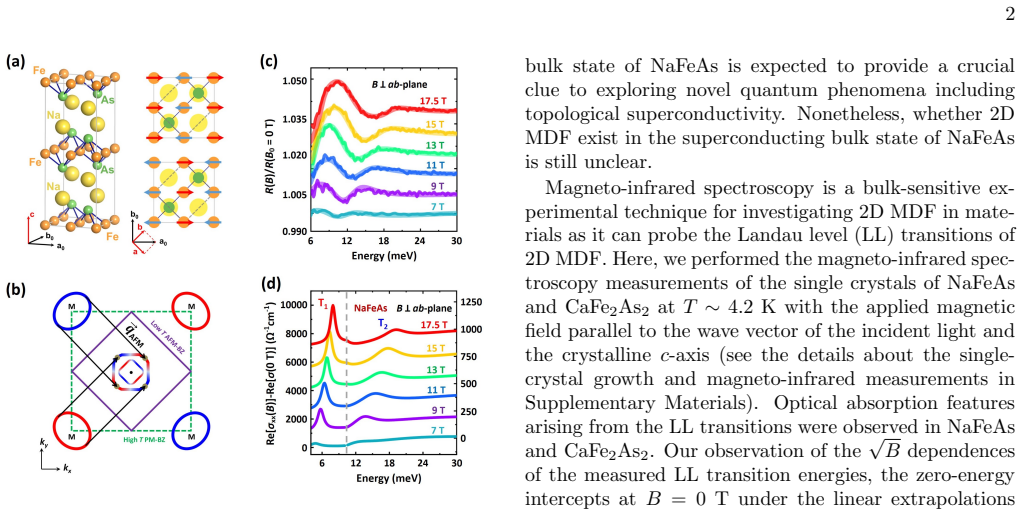
On the paper's own terms, the central discovery is that two-dimensional massless Dirac fermions exist in the superconducting and antiferromagnetic bulk state of NaFeAs, not only on surfaces or in non-superconducting parent compounds. Magneto-infrared spectra show two Landau-level transitions, labelled T1 and T2, whose energies follow $\sqrt{B}$ and pass through zero at $B=0$, with $E_{T2}/E_{T1}\approx 2.4$ and with the zeroth-Landau-level-related T1 peak dominant. The paper assigns T1 to $LL_{-1}\to LL_0$ and T2 to $LL_{-1}\to LL_{+2}$, yielding $v_F^D\approx 5.4\times10^4$ m/s for NaFeAs. Together with $v_F^D\approx 1.18\times10^4$ m/s for BaFe2As2 and $v_F^D\approx 2.16\times10^5$ m/s for CaFe2As2, the Fermi velocities scale linearly with the Fe-As bond length, and the authors support this relation with linear plots of $\sqrt{m^*}$ and $\sqrt{t_1(xy,xy)+t_2(xy,xy)}$ against the same bond length.
Load-bearing premise
The whole scaling argument rests on assigning the two observed peaks to specific Landau-level transitions, which assumes NaFeAs reaches the regime where only the lowest Landau level is occupied at low magnetic fields and that its Fermi energy is only about 2–3 meV; if the other allowed assignment is the correct one, the extracted velocity and the linear relation both fail.
Editorial extensions
If this is right
- If NaFeAs truly hosts 2D massless Dirac fermions in its superconducting bulk, then a single stoichiometric 3D material can be used to study the interplay of superconductivity, antiferromagnetism, and Dirac physics at once.
- The linear $v_F^D$–bond-length relation provides a quantitative design rule: choosing or tuning an iron arsenide's Fe-As bond length predicts its Dirac velocity and therefore its Landau-level spacing.
- Magneto-infrared spectroscopy becomes a bulk-sensitive probe of Dirac carriers inside the superconducting state, because the Landau-level transitions are observed at 4.2 K in fields up to 17.5 T.
- The agreement between the Landau-level slopes and the independently calculated $\sqrt{m^*}$ and $\sqrt{t_1+t_2}$ trends supports the $d_{xy}$-orbital character of the Dirac cones across the iron-pnictide family.
Reading between the lines
- Editorial extension: a direct test is to measure a fourth iron pnictide, such as SrFe2As2 or a LaFeAsO-family compound, by the same technique and check whether its extracted Fermi velocity falls on the same line; a miss would mean the scaling is compound-specific rather than universal.
- Editorial extension: because the velocity-bond length relation is tied to $d_{xy}$ tight-binding parameters, the same linear trend should show up in zero-field measurements—ARPES band slopes or quantum-oscillation effective masses—across the family, which would be an independent and cheaper check.
- Editorial extension: if the same bond length that sets the Dirac velocity also influences pairing, the scaling line may help separate structural from electronic contributions to $T_c$ in iron-based superconductors, although the paper itself does not make that claim.
Editorial analysis
A structured set of objections, weighed in public.
Referee Report
Summary. The manuscript reports magneto-infrared reflectance and optical-conductivity measurements at T ≈ 4.2 K in magnetic fields up to 17.5 T on single crystals of NaFeAs and CaFe2As2. Two peak-like features, T1 and T2, are observed in the relative optical conductivity of NaFeAs; their energies are linear in √B, extrapolate to zero energy at B = 0, and exhibit a field-independent energy ratio of about 2.4. The authors rule out Kane and Weyl fermion interpretations and assign the two features to inter-Landau-level transitions of two-dimensional massless Dirac fermions (case ii: T1 = LL−1→LL0 and T2 = LL−1→LL+2), obtaining vF ≈ 5.4 × 10^4 m/s. A single √B-linear transition in CaFe2As2 is assigned to LL−1→LL0, giving vF ≈ 2.16 × 10^5 m/s. Combining these values with a BaFe2As2 velocity of 1.18 × 10^4 m/s taken from Ref. [29], the authors claim that the 2D-MDF Fermi velocity scales linearly with the Fe-As bond length, and they cite linear dependencies of √m* and of √(t1 + t2) on the bond length as support. DFT+DMFT calculations show dispersions that are linear within the FeAs plane and weak along kz for both compounds.
Significance. If confirmed, the observation of two-dimensional massless Dirac fermions in the superconducting bulk state of NaFeAs would be a notable result, and a quantitative relation between the Dirac Fermi velocity and a structural parameter would be a genuinely useful design rule for iron-based superconductors. The paper's strengths include the bulk-sensitive magneto-infrared probe, the systematic √B analysis with zero-energy intercepts and a field-independent transition ratio, the comparison against Kane and Weyl fermion alternatives, and the accompanying DFT+DMFT band calculations. However, the headline scaling claim is not established: it rests on three points without reported uncertainties, and two of them (NaFeAs and CaFe2As2) are fixed only by Landau-level index assignments that are degenerate in the measured quantities and are disambiguated by an argument that contains a numerical error. The massless-Dirac interpretation itself is more robust than the scaling claim, since both competing assignments are Dirac Landau-level transitions.
major comments (4)
- [Assignment discussion following Eq. (4)] The choice between case (i) (T1 = LL−2→LL−1, T2 = LL−1→LL0) and case (ii) (T1 = LL−1→LL0, T2 = LL−1→LL+2) is load-bearing for the whole paper, because both cases give identical √B-linear transition energies and an identical T2/T1 ratio of √2+1 ≈ 2.414. The disambiguation offered after Eq. (4) is not sound as written. First, the text claims that case (i) with vF = 1.30 × 10^5 m/s implies EF ≈ 81 meV at B = 17.5 T, but direct substitution of these numbers into Eq. (2) gives |E±1| ≈ 20 meV, and no derivation of the 81 meV value or of the assumed Landau-level filling model is provided. Second, the concluding sentence assigns 'T1 and T2 to the LL transitions LL−1→LL+2 and LL−1→LL0, respectively', which reverses the observed energy ordering (T1 is the lower-energy peak, while LL−1→LL+2 is the higher-energy transition by the factor √2+1) and contradicts the immediately preceding case-(ii) discussion. Since the alternative assignment changes vF(NaFeAs) by the factor 2.414 and destroys the linear relation in Fig. 4(b), the central claim cannot be evaluated until the assignment is corrected and justified with a quantitative calculation (for example, oscillator strengths and a filling-factor model).
- [Fig. 4(b) and the CaFe2As2 measurement (§3)] The linear scaling relation in Fig. 4(b) is displayed as three points without error bars, fit statistics, or a stated fitting procedure, and one of the points (BaFe2As2, vF = 1.18 × 10^4 m/s) is imported from a separate earlier study (Ref. [29]) without discussion of the comparability of measurement and analysis conditions. The CaFe2As2 point is likewise not uniquely determined: a single transition is observed, and assigning it to LL−2→LL−1 instead of LL−1→LL0 would multiply the extracted velocity by 2.414 (from 2.16 × 10^5 to about 5.2 × 10^5 m/s), while the stated grounds for the assignment (low EF from DFT+DMFT and growth of spectral weight with field) are qualitative. Thus two of the three points in the central plot rest on assignment choices that are not independently verified, and a three-point line without quantified uncertainties cannot support the quantitative 'linear scaling' claim in the title. If the uncertainty analysis and fit statistics appear in the Supplementary Materials, they need to be summarized in the main text.
- [§4, Figs. 4(c)-4(d)] The support claimed for the scaling is logically insufficient. From the stated relation vF = sqrt(Ek/m*), the observation that sqrt(Ek) and sqrt(m*) are each (approximately) linear in the Fe-As bond length does not imply that their ratio is linear in the bond length: the ratio of two linear functions is generically a rational function, and it is identically linear only under restrictive conditions (for example, a constant denominator), in which case it would be constant rather than varying. The correlations in Figs. 4(c) and 4(d) are therefore at most consistency checks, not supporting evidence for a linear scaling of vF, and the relation vF = sqrt(Ek/m*) itself is asserted without derivation in §4. Accordingly, the abstract's statement that the linear scaling is 'supported by (i) ... and (ii)' should be substantially weakened.
- [CaFe2As2 results paragraph (§3)] In the CaFe2As2 results paragraph, the sentence 'The 2D-MDF Fermi velocity in CaFe2As2 is larger than those in NaFeAs and BaFe2As2 (vF ≈ 1.18 × 10^4 m/s) [29]' is ambiguous: read literally, the parenthetical attributes the value 1.18 × 10^4 m/s to both NaFeAs and BaFe2As2, which contradicts the NaFeAs value of 5.4 × 10^4 m/s derived earlier in the paper. The parenthetical should be attached explicitly to the BaFe2As2 value only, so that the central data summary is internally consistent.
minor comments (6)
- [Conclusion] The concluding paragraph contains 'Our wok offers a new material platform', which should read 'Our work offers', and 'exotic novel quantum phenomena' is redundant.
- [Assignment paragraph] The phrase 'the presence of of the intra-LL transition' contains a duplicated 'of' and should be corrected.
- [References] Refs. [63] and [65] are identical (Ashby and Carbotte, Phys. Rev. B 87, 245131 (2013)); the text cites both when contrasting the zeroth-LL density of states of Weyl fermions and 3D massless Dirac fermions, so this contrast is not supported by two independent sources.
- [Summary paragraph] The summary states that the Fermi velocities 'increase linearly with the Fe-As bond lengths', but the physical argument in §4 (shorter Fe-As distance implies larger bandwidth and hence higher vF) and the relative values quoted for the three compounds imply the opposite direction of the dependence; the wording should be reconciled with Fig. 4(b).
- [Introduction] Please verify and cite the value Tc ≈ 23 K for NaFeAs; published values for stoichiometric NaFeAs are typically near 9 K in the literature, and if a doped or pressurized compound is meant, this should be stated explicitly.
- [Supplementary Materials (fitting procedure)] The magneto-optical fitting model (number and type of oscillators or Drude terms, parameter ranges, and how the errors of the extracted peak positions were obtained) is deferred to the Supplementary Materials; a brief summary in the main text would improve reproducibility, especially because the peak assignments are decisive for the claims.
Circularity Check
No circularity found: Fermi velocities are measured inputs, the scaling is an empirical three-point correlation, and the NaFeAs LL-assignment choice is made from independent EF constraints rather than from the scaling relation.
full rationale
The derivation chain is self-contained with respect to the circularity definitions. The NaFeAs and CaFe2As2 Fermi velocities are extracted from the slopes of the observed sqrt(B)-linear Landau-level transition energies using Eq. (4); the BaFe2As2 value is taken from Ref. [29], a previously published magneto-optical study that is independent of the present data set. The Fe-As bond lengths enter only after the Fermi velocities are extracted, so the scaling plot in Fig. 4(b) is an empirical correlation rather than a quantity defined in terms of bond length. The choice between case (i) and case (ii) LL-index assignments for NaFeAs is argued from independent constraints: the low EF measured by ARPES and obtained from DFT+DMFT, the low-field quantum limit, and comparison of vF with ARPES values. This is an identification and robustness issue, not a circular reduction, because the scaling relation itself is not used to select case (ii). The supporting linearities of sqrt(t1+t2) and sqrt(m*) versus bond length come from prior published calculations (Ref. [48]) and are not fitted to the vF values. Ref. [29] is a self-citation, but it provides an externally measured vF point and standard LL formulas also cited to graphene papers; it is not a load-bearing self-citation chain. The unresolved numerical detail around the EF=81 meV estimate for case (i) is a correctness concern, not evidence of circularity. No equation in the paper is equivalent to its own input by construction.
Assumptions & free parameters
free parameters (4)
- vF(NaFeAs) =
5.4e4 m/s
- vF(CaFe2As2) =
2.16e5 m/s
- vF(BaFe2As2) =
1.18e4 m/s
- linear scaling slope and intercept for vF versus Fe-As bond length =
not stated
assumptions (6)
- standard math Landau-level spectrum of 2D MDF follows E_n = sgn(n) vF sqrt(2 e hbar |n| B) with the selection rule |n|-|n'| = +/-1.
- domain assumption AFM order in iron arsenides causes band folding and topologically protected Dirac nodes near EF.
- domain assumption The observed peaks are not caused by magnetic-field-induced changes in AFM order or by detwinning.
- domain assumption The Dirac cones near EF are predominantly of Fe dxy orbital character, so dxy hopping and effective mass control vF.
- ad hoc to paper vF = sqrt(Ek/m*) holds for these Dirac fermions.
- domain assumption The linearity of sqrt(m*) and sqrt(t1+t2) with Fe-As bond length from Ref. 48 applies to the three compounds studied here.
Cite this review
Pith. "Pith review of Linear scaling relation between two-dimensional massless Dirac fermion Fermi velocity and Fe-As bond length in iron arsenide superconductor systems." pith.science (2026). https://pith.science/paper/75N7HHXX
@misc{pith2026250515719,
  author       = {Pith},
  title        = {Pith review of: Linear scaling relation between two-dimensional massless Dirac fermion Fermi velocity and Fe-As bond length in iron arsenide superconductor systems},
  year         = {2026},
  howpublished = {\url{https://pith.science/paper/75N7HHXX}},
  note         = {Machine review of arXiv:2505.15719}
}
abstract
Two-dimensional (2D) massless Dirac fermions (MDF), which represent a type of quasi-particles with linear energy-momentum dispersions only in 2D momentum space, provide a fertile ground for realizing novel quantum phenomena. However, 2D MDF were seldom observed in the superconducting bulk states of 3D materials. Furthermore, as a cornerstone for accurately tuning the quantum phenomena based on 2D MDF, a quantitative relationship between 2D MDF and a structural parameter has rarely been revealed so far. Here, we report magneto-infrared spectroscopy studies of the iron-arsenide-superconductor systems NaFeAs and $A\mathrm{Fe_2As_2} (A = \mathrm{Ca, Ba})$ at temperature $T \sim 4.2 $ K and at magnetic fields ($B$) up to 17.5 T. Our results demonstrate the existence of 2D MDF in the superconducting bulk state of NaFeAs. Moreover, the 2D-MDF Fermi velocities in NaFeAs and $A\mathrm{Fe_2As_2} (A = \mathrm{Ca, Ba})$, which are extracted from the slopes of the linear $\sqrt{B}$ dependences of the Landau-level transition energies, scale linearly with the Fe-As bond lengths. The linear scaling between the 2D-MDF Fermi velocities and the Fe-As bond lengths is supported by (i) the linear relationship between the square root of the effective mass of the $d_{xy}$ electrons and the Fe-As bond length and (ii) the linear dependence of the square root of the calculated tight-binding hopping energy on the Fe-As bond length. Our results open up new avenues for exploring and tuning novel quantum phenomena based on 2D MDF in the superconducting bulk states of 3D materials.
Figures


Figures from the paper (1 more)

Reference graph
Works this paper leans on
-
[29]
S. V. Bakurskiy, N. V. Klenov, I. I. Soloviev, M. Y. Kupriyanov, and A. A. Golubov, Superconducting phase domains for memory applications, Appl. Phys. Lett. 108, 042602 (2016)
work page 2016
-
[1]
K. S. Novoselov, A. K. Geim, S. V. Morozov, D. Jiang, Y. Zhang, S. V. Dubonos, I. V. Grigorieva, and A. A. Firsov, Electric Field Effect in Atomically Thin Carbon Films, Science 306, 666 (2004)
work page 2004
-
[2]
: 1 ≈ 2.414 between the LL transitions, LL −1 → LL+2 and LL−1 → LL0(or LL −2 → LL+1 and LL 0 → LL+1). To extract the 2D-MDF Fermi velocity in NaFeAs, it is es- sential to determine which group of LL transitions of 2D MDF leads to the two peak-like features T 1 and T 2. If we assumed that the peak-like features T 1 and T2 sepa- rately arise from the LL tra...
-
[3]
K. S. Novoselov, A. K. Geim, S. V. Morozov, D. Jiang, M. I. Katsnelson, I. V. Grigorieva, S. V. Dubonos, and A. A. Firsov, Two-dimensional gas of massless Dirac fermions in graphene, Nature 438, 197 (2005)
2005
-
[4]
Y. Zhang, Y.-W. Tan, H. L. Stormer, and P. Kim, Ex- perimental observation of the quantum Hall effect and Berry’s phase in graphene, Nature 438, 201 (2005)
work page 2005
-
[5]
C. W. J. Beenakker, Colloquium: Andreev reflection and Klein tunneling in graphene, Rev. Mod. Phys. 80, 1337 (2008)
2008
- [6]
-
[7]
D. C. Elias, R. V. Gorbachev, A. S. Mayorov, S. V. Mo- rozov, A. A. Zhukov, P. Blake, L. A. Ponomarenko, I. V. Grigorieva, K. S. Novoselov, F. Guinea, and A. K. Geim, Dirac cones reshaped by interaction effects in suspended graphene, Nat. Phys. 7, 701 (2011)
2011
Show all 69 references
-
[8]
Faugeras, S
C. Faugeras, S. Berciaud, P. Leszczynski, Y. Henni, K. Nogajewski, M. Orlita, T. Taniguchi, K. Watanabe, C. Forsythe, P. Kim, R. Jalil, A. K. Geim, D. M. Basko, and M. Potemski, Landau Level Spectroscopy of Electron- Electron Interactions in Graphene, Phys. Rev. Lett. 114, 126...
2015
-
[9]
Y. Feng, D. Liu, B. Feng, X. Liu, L. Zhao, Z. Xie, Y. Liu, A. Liang, C. Hu, Y. Hu, S. He, G. Liu, J. Zhang, C. Chen, Z. Xu, L. Chen, K. Wu, Y.-T. Liu, H. Lin, Z.-Q. Huang, C.-H. Hsu, F.-C. Chuang, A. Bansil, and X. J. Zhou, Direct evidence of interaction-induced Dirac cones in...
2016
-
[10]
Hsieh, D
D. Hsieh, D. Qian, L. Wray, Y. Xia, Y. S. Hor, R. J. Cava, and M. Z. Hasan, A topological Dirac insulator in a quantum spin Hall phase, Nature 452, 970 (2008)
2008
-
[11]
Y. L. Chen, J. G. Analytis, J.-H. Chu, Z. K. Liu, S.- K. Mo, X. L. Qi, H. J. Zhang, D. H. Lu, X. Dai, Z. Fang, S. C. Zhang, I. R. Fisher, Z. Hussain, and Z.-X. Shen, Experimental Realization of a Three-Dimensional Topological Insulator, Bi 2Te3, Science 325, 178 (2009)
2009
-
[12]
Cheng, C
P. Cheng, C. Song, T. Zhang, Y. Zhang, Y. Wang, J.-F. Jia, J. Wang, Y. Wang, B.-F. Zhu, X. Chen, X. Ma, K. He, L. Wang, X. Dai, Z. Fang, X. Xie, X.-L. Qi, C.-X. Liu, S.-C. Zhang, and Q.-K. Xue, Landau Quantization of Topological Surface States in Bi 2Se3, Phys. Rev. Lett. 105,...
2010
-
[13]
Hanaguri, K
T. Hanaguri, K. Igarashi, M. Kawamura, H. Takagi, and T. Sasagawa, Momentum-resolved Landau-level spec- troscopy of Dirac surface state in Bi 2Se3, Phys. Rev. B 82, 081305 (2010)
2010
-
[14]
Huang, Y
Q. Huang, Y. Qiu, W. Bao, M. A. Green, J. W. Lynn, Y. C. Gasparovic, T. Wu, G. Wu, and X. H. Chen, Neutron-Diffraction Measurements of Magnetic Order and a Structural Transition in the Parent BaFe2As2 Com- pound of FeAs-Based High-Temperature Superconduc- tors, Phys. Rev. Lett...
2008
-
[15]
J. Zhao, W. Ratcliff, J. W. Lynn, G. F. Chen, J. L. Luo, N. L. Wang, J. Hu, and P. Dai, Spin and lattice structures of single-crystalline SrFe 2As2, Phys. Rev. B 78, 140504 (2008)
2008
-
[16]
Y. Ran, F. Wang, H. Zhai, A. Vishwanath, and D.-H. Lee, Nodal spin density wave and band topology of the FeAs-based materials, Phys. Rev. B 79, 014505 (2009)
2009
-
[17]
Morinari, E
T. Morinari, E. Kaneshita, and T. Tohyama, Topolog- ical and Transport Properties of Dirac Fermions in an Antiferromagnetic Metallic Phase of Iron-Based Super- conductors, Phys. Rev. Lett. 105, 037203 (2010)
2010
-
[18]
Richard, K
P. Richard, K. Nakayama, T. Sato, M. Neupane, Y. M. Xu, J. H. Bowen, G. F. Chen, J. L. Luo, N. L. Wang, X. Dai, Z. Fang, H. Ding, and T. Takahashi, Observation 8 of Dirac Cone Electronic Dispersion in BaFe 2As2, Phys. Rev. Lett. 104, 137001 (2010)
2010
-
[19]
Harrison and S
N. Harrison and S. E. Sebastian, Dirac nodal pockets in the antiferromagnetic parent phase of FeAs superconduc- tors, Phys. Rev. B 80, 224512 (2009)
2009
-
[20]
Nakajima, T
M. Nakajima, T. Liang, S. Ishida, Y. Tomioka, K. Ki- hou, C. H. Lee, A. Iyo, H. Eisaki, T. Kakeshita, T. Ito, and S. Uchida, Unprecedented anisotropic metallic state in undoped iron arsenide BaFe 2As2 revealed by optical spectroscopy, Proc. Natl. Acad. Sci. 108, 12238 (2011)
2011
-
[21]
K. K. Huynh, Y. Tanabe, and K. Tanigaki, Both Electron and Hole Dirac Cone States in Ba(FeAs) 2 Confirmed by Magnetoresistance, Phys. Rev. Lett. 106, 217004 (2011)
2011
-
[22]
Terashima, N
T. Terashima, N. Kurita, M. Tomita, K. Kihou, C.-H. Lee, Y. Tomioka, T. Ito, A. Iyo, H. Eisaki, T. Liang, M. Nakajima, S. Ishida, S.-i. Uchida, H. Harima, and S. Uji, Complete Fermi Surface in BaFe 2As2 Observed via Shubnikov–de Haas Oscillation Measurements on De- twinned Sin...
2011
-
[23]
Matusiak, Z
M. Matusiak, Z. Bukowski, and J. Karpinski, Doping de- pendence of the Nernst effect in Eu(Fe1−xCox)2As2: De- parture from Dirac-fermion physics, Phys. Rev. B 83, 224505 (2011)
2011
-
[24]
C. He, Y. Zhang, B. P. Xie, X. F. Wang, L. X. Yang, B. Zhou, F. Chen, M. Arita, K. Shimada, H. Na- matame, M. Taniguchi, X. H. Chen, J. P. Hu, and D. L. Feng, Electronic-Structure-Driven Magnetic and Struc- ture Transitions in Superconducting NaFeAs Single Crys- tals Measured ...
2010
-
[25]
M. Yi, D. H. Lu, R. G. Moore, K. Kihou, C. H. Lee, A. Iyo, H. Eisaki, T. Yoshida, A. Fujimori, and Z. X. Shen, Electronic reconstruction through the structural and magnetic transitions in detwinned NaFeAs, New J. Phys 14, 073019 (2012)
2012
-
[26]
Sugai, Y
S. Sugai, Y. Mizuno, R. Watanabe, T. Kawaguchi, K. Takenaka, H. Ikuta, Y. Takayanagi, N. Hayamizu, and Y. Sone, Spin-Density-Wave Gap with Dirac Nodes and Two-Magnon Raman Scattering in BaFe 2As2, J. Phys. Soc. Jpn. 81, 024718 (2012)
2012
-
[27]
Y. Imai, F. Nabeshima, D. Nakamura, T. Katase, H. Hi- ramatsu, H. Hosono, and A. Maeda, Ultralow-Dissipative Conductivity by Dirac Fermions in BaFe 2As2, J. Phys. Soc. Jpn. 82, 043709 (2013)
2013
-
[28]
S. Y. Tan, Y. Fang, D. H. Xie, W. Feng, C. H. P. Wen, Q. Song, Q. Y. Chen, W. Zhang, Y. Zhang, L. Z. Luo, B. P. Xie, X. C. Lai, and D. L. Feng, Observation of Dirac cone band dispersions in FeSe thin films by photoemis- sion spectroscopy, Phys. Rev. B 93, 104513 (2016)
2016
-
[30]
Z.-G. Chen, L. Wang, Y. Song, X. Lu, H. Luo, C. Zhang, P. Dai, Z. Yin, K. Haule, and G. Kotliar, Two- Dimensional Massless Dirac Fermions in Antiferromag- netic AFe2As2 (A = Ba , Sr), Phys. Rev. Lett. 119, 096401 (2017)
2017
-
[31]
Terashima, H
T. Terashima, H. T. Hirose, D. Graf, Y. Ma, G. Mu, T. Hu, K. Suzuki, S. Uji, and H. Ikeda, Fermi Surface with Dirac Fermions in CaFeAsF Determined via Quan- tum Oscillation Measurements, Phys. Rev. X 8, 011014 (2018)
2018
-
[32]
B. Xu, H. Xiao, B. Gao, Y. H. Ma, G. Mu, P. Marsik, E. Sheveleva, F. Lyzwa, Y. M. Dai, R. P. S. M. Lobo, and C. Bernhard, Optical study of Dirac fermions and related phonon anomalies in the antiferromagnetic com- pound CaFeAsF, Phys. Rev. B 97, 195110 (2018)
2018
-
[33]
Wang and D.-H
F. Wang and D.-H. Lee, Topological relation between bulk gap nodes and surface bound states: Application to iron-based superconductors, Phys. Rev. B 86, 094512 (2012)
2012
-
[34]
Lau and C
A. Lau and C. Timm, Topological surface states and Andreev bound states in superconducting iron pnictides, Phys. Rev. B 90, 024517 (2014)
2014
-
[35]
Zhang, Z
P. Zhang, Z. Wang, X. Wu, K. Yaji, Y. Ishida, Y. Ko- hama, G. Dai, Y. Sun, C. Bareille, K. Kuroda, T. Kondo, K. Okazaki, K. Kindo, X. Wang, C. Jin, J. Hu, R. Thomale, K. Sumida, S. Wu, K. Miyamoto, T. Okuda, H. Ding, G. D. Gu, T. Tamegai, T. Kawakami, M. Sato, and S. Shin, Mul...
2019
-
[36]
Z. Wang, P. Zhang, G. Xu, L. K. Zeng, H. Miao, X. Xu, T. Qian, H. Weng, P. Richard, A. V. Fedorov, H. Ding, X. Dai, and Z. Fang, Topological nature of the FeSe 0.5Te0.5 superconductor, Phys. Rev. B 92, 115119 (2015)
2015
-
[37]
G. Xu, B. Lian, P. Tang, X.-L. Qi, and S.-C. Zhang, Topological Superconductivity on the Surface of Fe- Based Superconductors, Phys. Rev. Lett. 117, 047001 (2016)
2016
-
[38]
Zhang, K
P. Zhang, K. Yaji, T. Hashimoto, Y. Ota, T. Kondo, K. Okazaki, Z. Wang, J. Wen, G. D. Gu, H. Ding, and S. Shin, Observation of topological superconductivity on the surface of an iron-based superconductor, Science360, 182 (2018)
2018
-
[39]
S. Qin, C. Fang, F.-C. Zhang, and J. Hu, Topological Superconductivity in an Extended s-Wave Superconduc- tor and Its Implication to Iron-Based Superconductors, Phys. Rev. X 12, 011030 (2022)
2022
-
[40]
D. Wang, L. Kong, P. Fan, H. Chen, S. Zhu, W. Liu, L. Cao, Y. Sun, S. Du, J. Schneeloch, R. Zhong, G. Gu, L. Fu, H. Ding, and H.-J. Gao, Evidence for Majorana bound states in an iron-based superconductor, Science 362, 333 (2018)
2018
-
[41]
Zhang, W
R.-X. Zhang, W. S. Cole, and S. Das Sarma, Helical Hinge Majorana Modes in Iron-Based Superconductors, Phys. Rev. Lett. 122, 187001 (2019)
2019
-
[42]
Jiang, X
K. Jiang, X. Dai, and Z. Wang, Quantum Anomalous Vortex and Majorana Zero Mode in Iron-Based Super- conductor Fe(Te,Se), Phys. Rev. X 9, 011033 (2019)
2019
-
[43]
Z. Wang, J. O. Rodriguez, L. Jiao, S. Howard, M. Gra- ham, G. D. Gu, T. L. Hughes, D. K. Morr, and V. Mad- havan, Evidence for dispersing 1D Majorana channels in an iron-based superconductor, Science 367, 104 (2020)
2020
-
[44]
W. Liu, L. Cao, S. Zhu, L. Kong, G. Wang, M. Papaj, P. Zhang, Y.-B. Liu, H. Chen, G. Li, F. Yang, T. Kondo, S. Du, G.-H. Cao, S. Shin, L. Fu, Z. Yin, H.-J. Gao, and H. Ding, A new Majorana platform in an Fe-As bilayer superconductor, Nat. Commun. 11, 5688 (2020)
2020
-
[45]
C.-H. Lee, A. Iyo, H. Eisaki, H. Kito, M. Teresa Fernandez-Diaz, T. Ito, K. Kihou, H. Matsuhata, M. Braden, and K. Yamada, Effect of Structural Parameters on Superconductivity in Fluorine-Free LnFeAsO1−y(Ln = La , Nd), J. Phys. Soc. Jpn. 77, 083704 (2008)
2008
-
[46]
Mizuguchi, Y
Y. Mizuguchi, Y. Hara, K. Deguchi, S. Tsuda, T. Yam- aguchi, K. Takeda, H. Kotegawa, H. Tou, and Y. Takano, 9 Anion height dependence of Tc for the Fe-based super- conductor, Supercon. Sci. Technol. 23, 054013 (2010)
2010
-
[47]
Okabe, N
H. Okabe, N. Takeshita, K. Horigane, T. Muranaka, and J. Akimitsu, Pressure-induced high- Tc superconducting phase in FeSe: Correlation between anion height and Tc, Phys. Rev. B 81, 205119 (2010)
2010
-
[48]
D. C. Johnston, The puzzle of high temperature super- conductivity in layered iron pnictides and chalcogenides, Adv. Phys. 59, 803 (2010)
2010
-
[49]
Z. P. Yin, K. Haule, and G. Kotliar, Kinetic frustration and the nature of the magnetic and paramagnetic states in iron pnictides and iron chalcogenides, Nat. Mater. 10, 932 (2011)
2011
-
[50]
M. L. Sadowski, G. Martinez, M. Potemski, C. Berger, and W. A. de Heer, Landau Level Spectroscopy of Ul- trathin Graphite Layers, Phys. Rev. Lett. 97, 266405 (2006)
2006
-
[51]
Jiang, E
Z. Jiang, E. A. Henriksen, L. C. Tung, Y. J. Wang, M. E. Schwartz, M. Y. Han, P. Kim, and H. L. Stormer, In- frared Spectroscopy of Landau Levels of Graphene, Phys. Rev. Lett. 98, 197403 (2007)
2007
-
[52]
E. D. Palik and J. K. Furdyna, Infrared and microwave magnetoplasma effects in semiconductors, Rep. Prog. Phys. 33, 1193 (1970)
1970
-
[53]
Tokunaga, I
M. Tokunaga, I. Katakura, N. Katayama, and K. Oh- gushi, High-Field Studies on Single Crystals of EuFe2As2, J. Low Temp. Phys. 159, 601 (2010)
2010
-
[54]
W. Z. Hu, G. Li, P. Zheng, G. F. Chen, J. L. Luo, and N. L. Wang, Optical study of the spin-density-wave prop- erties of single-crystalline Na 1−δFeAs, Phys. Rev. B 80, 100507 (2009)
2009
-
[55]
M. A. Tanatar, A. Kreyssig, S. Nandi, N. Ni, S. L. Bud’ko, P. C. Canfield, A. I. Goldman, and R. Prozorov, Direct imaging of the structural domains in the iron pnic- tides AFe2As2 (A = Ca, Sr, Ba), Phys. Rev. B 79, 180508 (2009)
2009
-
[56]
J.-H. Chu, J. G. Analytis, D. Press, K. De Greve, T. D. Ladd, Y. Yamamoto, and I. R. Fisher, In-plane electronic anisotropy in underdoped Ba(Fe1−xCox)2As2 revealed by partial detwinning in a magnetic field, Phys. Rev. B 81, 214502 (2010)
2010
-
[57]
S. Zapf, C. Stingl, K. W. Post, J. Maiwald, N. Bach, I. Pietsch, D. Neubauer, A. L¨ ohle, C. Clauss, S. Jiang, H. S. Jeevan, D. N. Basov, P. Gegenwart, and M. Dressel, Persistent Detwinning of Iron-Pnictide EuFe 2As2 Crys- tals by Small External Magnetic Fields, Phys. Rev. Let...
2014
-
[58]
Orlita, D
M. Orlita, D. M. Basko, M. S. Zholudev, F. Teppe, W. Knap, V. I. Gavrilenko, N. N. Mikhailov, S. A. Dvoretskii, P. Neugebauer, C. Faugeras, A. L. Barra, G. Martinez, and M. Potemski, Observation of three- dimensional massless Kane fermions in a zinc-blende crystal, Nat. Phys. ...
2014
-
[59]
Teppe, M
F. Teppe, M. Marcinkiewicz, S. S. Krishtopenko, S. Ruf- fenach, C. Consejo, A. M. Kadykov, W. Desrat, D. But, W. Knap, J. Ludwig, S. Moon, D. Smirnov, M. Orlita, Z. Jiang, S. V. Morozov, V. I. Gavrilenko, N. N. Mikhailov, and S. A. Dvoretskii, Temperature-driven massless Kane ...
2016
-
[60]
H. Weng, C. Fang, Z. Fang, B. A. Bernevig, and X. Dai, Weyl Semimetal Phase in Noncentrosymmet- ric Transition-Metal Monophosphides, Phys. Rev. X 5, 011029 (2015)
2015
-
[61]
S.-Y. Xu, C. Liu, S. K. Kushwaha, R. Sankar, J. W. Krizan, I. Belopolski, M. Neupane, G. Bian, N. Alidoust, T.-R. Chang, H.-T. Jeng, C.-Y. Huang, W.-F. Tsai, H. Lin, P. P. Shibayev, F.-C. Chou, R. J. Cava, and M. Z. Hasan, Observation of Fermi arc surface states in a topologic...
2015
-
[62]
B. Q. Lv, N. Xu, H. M. Weng, J. Z. Ma, P. Richard, X. C. Huang, L. X. Zhao, G. F. Chen, C. E. Matt, F. Bisti, V. N. Strocov, J. Mesot, Z. Fang, X. Dai, T. Qian, M. Shi, and H. Ding, Observation of Weyl nodes in TaAs, Nat. Phys. 11, 724 (2015)
2015
-
[63]
L. X. Yang, Z. K. Liu, Y. Sun, H. Peng, H. F. Yang, T. Zhang, B. Zhou, Y. Zhang, Y. F. Guo, M. Rahn, D. Prabhakaran, Z. Hussain, S. K. Mo, C. Felser, B. Yan, and Y. L. Chen, Weyl semimetal phase in the non- centrosymmetric compound TaAs, Nat. Phys. 11, 728 (2015)
2015
-
[65]
Sun and A.-M
Y. Sun and A.-M. Wang, Magneto-optical conductivity of double Weyl semimetals, Phys. Rev. B96, 085147 (2017)
2017
-
[66]
P. E. C. Ashby and J. P. Carbotte, Magneto-optical con- ductivity of Weyl semimetals, Phys. Rev. B 87, 245131 (2013)
2013
-
[67]
Orlita, C
M. Orlita, C. Faugeras, J. M. Schneider, G. Martinez, D. K. Maude, and M. Potemski, Graphite from the Viewpoint of Landau Level Spectroscopy: An Effective Graphene Bilayer and Monolayer, Phys. Rev. Lett. 102, 166401 (2009)
2009
-
[68]
Orlita, I
M. Orlita, I. Crassee, C. Faugeras, A. B. Kuzmenko, F. Fromm, M. Ostler, Th. Seyller, G. Martinez, M. Polini, and M. Potemski, Classical to quantum crossover of the cyclotron resonance in graphene: a study of the strength of intraband absorption, New J. Phys. 14, 095008 (2012)
2012
-
[69]
Y. M. Dai, A. Akrap, S. L. Bud’ko, P. C. Canfield, and C. C. Homes, Optical properties of AFe2As2 (A = Ca, Sr, and Ba) single crystals, Phys. Rev. B 94, 195142 (2016)
2016
-
[70]
Z. P. Yin, K. Haule, and G. Kotliar, Magnetism and charge dynamics in iron pnictides, Nat. Phys. 7, 294 (2011)
2011
Reviewed August 7, 2026 · model on record in the stance chip above.
Discussion (0). Continue with ORCID to comment.