REVIEW 2 major objections 4 minor 31 references
Dimensional crossovers in the Gaussian critical fluctuations above $T_c$ of two-layer and three-layer superconductors
T0 review · 2 major / 4 minor · reviewed 2026-08-11 · deepseek-v4-flash
Pith's one-line read For two- and three-layer superconductors, Gaussian fluctuations above $T_c$ produce a dimensional crossover with critical exponent dipping to about 0.83 for $N=2$.
desk verdict Correct Gaussian-fluctuation calculation for two- and three-layer stacks, with a genuine but fixable gap: the predicted crossover sits inside the non-Gaussian regime for the cuprate parameters the paper itself quotes. read the letter →
The pith
A machine-rendered reading of the paper's core claim, the machinery that carries it, and where it could break.
The reading
What carries the argument
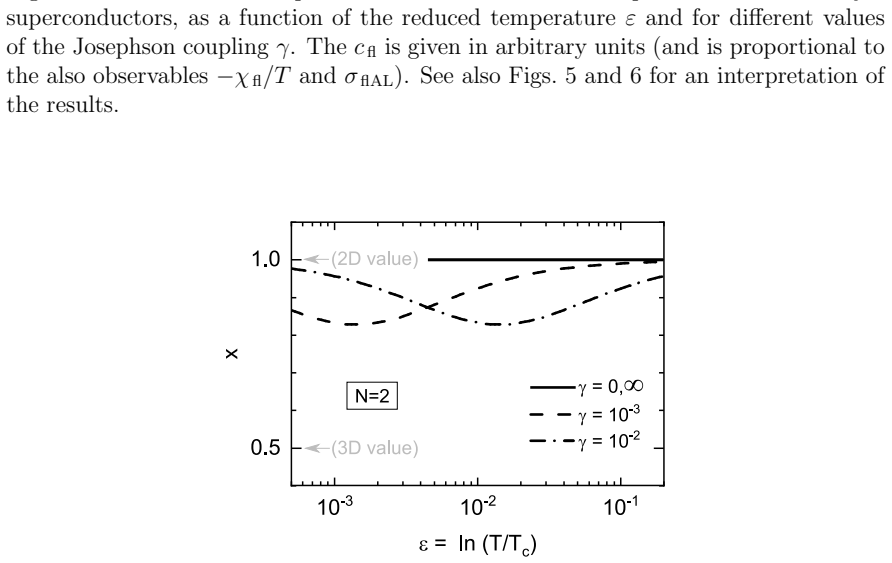
The load-bearing object is the $2\times 2$ or $3\times 3$ interlayer energy matrix of the Gaussian-Ginzburg-Landau functional, whose eigenvalues $\omega_j$ are the energies of the independent Josephson-coupled fluctuation modes. For $N=2$ with equal $T_c$, the eigenvalues are $\omega_1=\varepsilon$ and $\omega_2=\varepsilon+2\gamma$; for $N=3$, they are $\omega_1=\varepsilon$ and $\omega_{2,3}=\varepsilon+\gamma_1+\gamma_2\pm\sqrt{\gamma_1^2-\gamma_1\gamma_2+\gamma_2^2}$. All three computed observables are proportional to $\sum_j \omega_j^{-1}$, so this single sum ties the heat capacity, diamagnetism, and paraconductivity together and controls both the critical exponent and the effective plane number. The Josephson coupling $\gamma$ sets the crossover scale: modes with shifted energies freeze out as $\varepsilon$ passes $\gamma$, and interplane correlation grows when the c-axis coherence length reaches the stack thickness.
What would settle it
Measure the fluctuation paraconductivity or fluctuation diamagnetism of a two-layer superconducting film with known Josephson coupling $\gamma$ and plot $x=-d\ln\sigma^{\rm fl}/d\ln\varepsilon$. If the minimum is not near $\varepsilon=\sqrt{2}\gamma$ with $x\approx 0.83$, and if the effective number of planes does not cross between 1 and 2 over roughly one decade of $\varepsilon$ around $\gamma$, the central claim fails. A numerical Ginzburg-Landau calculation retaining the quartic term for the same $N=2$ model would also settle whether the exponent dip survives beyond the Gaussian approximation.
Extended reading notes
Core claim
The paper's result is that a few-plane stack has its own Gaussian fluctuation spectrum: for $N=2$ with a common $T_c$, one mode costs energy $\varepsilon$ and the other $\varepsilon+2\gamma$; for $N=3$, the modes are $\varepsilon$ and $\varepsilon+\gamma_1+\gamma_2\pm\sqrt{\gamma_1^2-\gamma_1\gamma_2+\gamma_2^2}$. Because each fluctuation observable is proportional to $\sum_j \omega_j^{-1}$, the reduced-temperature dependence of this sum fully determines the fluctuation signals. The paper shows that the log-log critical exponent $x(\varepsilon)$ equals 1 both for very small and very large $\varepsilon$, with an intermediate minimum $x\approx 0.83$ at $\varepsilon=\sqrt{2}\gamma$ for the bilayer, and that the effective number of independently fluctuating planes, defined by the ratio of the fluctuation amplitude to the single-plane value, interpolates between $N_e=1$ and $N_e=N$. In the trilayer with different couplings, a plateau at $N_e\simeq 2$ produces a double-valley structure in $x(\varepsilon)$. These are explicit, analytic predictions stated inside the Gaussian approximation.
Load-bearing premise
The calculation assumes the quartic $|\psi|^4$ term in the Ginzburg-Landau free energy can be neglected in exactly the reduced-temperature window where the predicted crossover occurs, which for small Josephson couplings lies close to $T_c$ where that Gaussian approximation is known to weaken.
Editorial extensions
If this is right
- For a two-layer film with equal layer $T_c$'s, the fluctuation specific heat, diamagnetic susceptibility, and paraconductivity all share the same critical exponent $x(\varepsilon)$, which stays at 1 for $\varepsilon\to 0$ and $\varepsilon\to\infty$ but reaches about 0.83 at $\varepsilon=\sqrt{2}\gamma$.
- The effective number of independent fluctuating planes $N_e$ interpolates between $N_e=1$ (strong coupling or very close to $T_c$) and $N_e=N$ (weak coupling or far from $T_c$), so the amplitude of the fluctuations carries the same crossover information as the exponent.
- For three layers with unequal Josephson couplings, $N_e$ can plateau at 2 over a range of $\varepsilon$, producing a double-valley structure in $x(\varepsilon)$ that is absent in symmetric trilayers and in the infinite-layer model.
- Because the three observable formulas are proportional to the same sum of inverse mode energies, a measurement of any one of them predicts the behavior of the other two, with the same crossover scale set by $\gamma$.
- In the $N\to\infty$ limit the functional returns the known infinite-layer result, so the finite-layer formulas are a controlled truncation of an established model rather than an unrelated construction.
Reading between the lines
- The $\varepsilon=\sqrt{2}\gamma$ minimum for realistic small Josephson couplings lies close to $T_c$, where the quartic term in the Ginzburg-Landau free energy is no longer negligible; the qualitative dip-and-recover shape of $x(\varepsilon)$ may survive a fuller treatment, but its depth and location are likely to be renormalized.
- The shared proportionality of the three observables to $\sum_j\omega_j^{-1}$ suggests that a simultaneous diamagnetism and paraconductivity measurement on one few-layer sample could cross-check the crossover even when the sample volume is too small for calorimetry.
- In artificial heterostructures where the interlayer barrier can be tuned, $\gamma$ should be continuously variable; one would then predict the position of the $x$-minimum to move in proportion to $\gamma$, a trend that is testable but not emphasized in the paper.
- The equal-$T_c$ assumption is idealized, and the supplementary material shows that differing plane critical temperatures mostly shift the effective transition and obscure the dimensional crossover; the cleanest experimental test would use symmetric films with nearly identical per-layer $T_c$.
Editorial analysis
A structured set of objections, weighed in public.
Referee Report
Summary. The paper calculates Gaussian-Ginzburg-Landau (GGL) fluctuation contributions to the specific heat, magnetic susceptibility, and Aslamazov-Larkin conductivity for a superconductor made of N=2 or N=3 Josephson-coupled parallel planes. The authors diagonalize the interlayer coupling matrix, obtain explicit formulas for the sum of inverse mode energies (Eqs. 22 and 23), and then present the resulting fluctuation observables (Eqs. 24-26), the critical exponent x (Eqs. 28 and 29), and an effective number of fluctuating planes N_e (Eq. 30). For N=2, they find a minimum of x at epsilon = sqrt(2) gamma with x ~ 0.83, together with a crossover of N_e from 1 to 2. For N=3, they discuss both symmetric and asymmetric couplings, including a plateau at N_e ~ 2 for strongly asymmetric cases. The derivation is self-contained and the limiting behaviors gamma -> 0 and gamma -> infinity are consistent with independent or locked planes, respectively.
Significance. The calculation is a useful, parameter-free benchmark within the GGL model, and the analytic formulas for N=2 and N=3 are a genuine addition to the literature. The paper correctly identifies that finite-layer stacks display intermediate-dimensionality behavior that is qualitatively different from the 2D-to-3D crossover of the infinite-layer Lawrence-Doniach model. The mathematics is internally consistent and the explicit eigenvalue computations check out. The main limitation is that the physical relevance to real layered superconductors such as cuprates is asserted without a quantitative Ginzburg-Levanyuk criterion; for the quoted values of gamma, the predicted crossover may lie in the non-Gaussian fluctuation regime. This does not invalidate the model calculation, but it does need to be addressed explicitly before the physical conclusions can be considered robust.
major comments (2)
- [Section 4 and Section 2.1] The Gaussian approximation neglects the |psi|^4 term in Eq. (3), and the validity of this neglect is controlled by a Ginzburg-Levanyuk criterion. The manuscript quotes gamma values of order 0.001-0.05 for cuprates and predicts the N=2 crossover at epsilon_crossover = sqrt(2) gamma, i.e., epsilon ~ 0.0014-0.07. For a quasi-2D cuprate, the non-Gaussian critical region extends to reduced temperatures of order Gi_2D ~ 0.01-0.1, so for the smaller values of gamma the crossover lies inside the regime where quartic interactions are not negligible. The paper should compute or at least estimate Gi for the few-layer geometry and compare it with the crossover temperature; at minimum, the conclusions should explicitly state that the crossover is predicted only in the GGL regime and may not be observable in the quoted parameter range. This is load-bearing because the physical motivation of the paper rests on applying the results to real few-layer systems.
- [Eq. (30) and Eq. (24)] The definition of N_e is ambiguous regarding the role of L_z. In Eq. (24), L_z is described as the thickness of the N-layer system, but in Eq. (30) the same L_z is used for the N=1 reference. If L_z scales with N (as would be natural for a physical stack), then for gamma -> 0 the ratio c_fl / c_fl^{N=1} would not equal N because the independent-layer sum 2/epsilon is divided by a proportionally larger L_z. The authors presumably intend a fixed normalization thickness, but this should be stated explicitly, and the physical meaning of c_fl as a volumetric quantity versus a total heat capacity should be clarified. Since N_e is used throughout the interpretation of the results, this needs to be corrected.
minor comments (4)
- [Throughout] There are numerous spelling errors, including 'posibilities' in the Introduction, 'suscetibility' throughout, 'transtion' in the Conclusions, and 'maneagable' in Appendix B. These should be corrected.
- [Figure 3 caption] The caption contains several typos, such as 'ant that' for 'and that' and 'corossover occurrs' for 'crossover occurs'.
- [Section 7] The conclusion says 'two- and tree-layer' instead of 'two- and three-layer'; likewise, the abstract and Section 1 contain the phrase 'similitudes' which, while not wrong, is unusual and could be replaced by 'similarities'.
- [Section 3.1] The sentence introducing the statistical averages says 'as expected it is <f^2> proportional to ...', but the proportionality constant is not written; for completeness, the full expression would make the subsequent formulas easier to check.
Circularity Check
No significant circularity: the few-layer fluctuation observables are derived from the stated GGL functional by diagonalization and Gaussian integration; self-citations are not load-bearing.
full rationale
The derivation chain is self-contained. The paper starts from the GL functional (Eqs. 2-5), diagonalizes the interlayer coupling matrix for N=2 and N=3 (Eqs. 10-21), computes the sum of inverse mode energies (Eqs. 22-23), and obtains c_fl, chi_fl, and sigma_AL through standard Gaussian statistical averages (Eqs. 24-26). The critical exponent x (Eq. 27) and effective plane number N_e (Eq. 30) are defined from those computed observables, so statements such as the N=2 exponent minimum at epsilon_crossover = sqrt(2) gamma follow algebraically from Eq. 28 rather than being imposed as inputs. The Josephson coupling gamma and coherence-length amplitudes are model parameters swept in figures, not fitted to the predicted quantities. Self-citations, notably Ref. [6] for LD fluctuation specific heat, point to standard GGL/LD formulas that are adapted rather than used as the sole justification for the few-layer result; they are not load-bearing. The absence of an explicit Ginzburg-Levanyuk criterion for the Gaussian approximation near the crossover (Section 2.1 neglects the quartic term; Section 4 locates the crossover at epsilon = sqrt(2) gamma) is a physical-validity limitation, not circularity.
Assumptions & free parameters
assumptions (5)
- domain assumption The superconducting state is described by a Ginzburg-Landau functional with a quartic term that is neglected in the Gaussian approximation.
- domain assumption Interlayer coupling is of the Josephson type, gamma_j |psi_j - psi_{j+1}|^2, with nearest-neighbor coupling only.
- domain assumption The in-plane coherence length amplitude xi_ab(0) is identical for all planes.
- domain assumption The fluctuation contributions to c_fl, chi_fl, and sigma_AL are all proportional to the sum over modes of omega_j^{-1}.
- domain assumption For the main analysis, all planes share a common critical temperature Tc.
Cite this review
Pith. "Pith review of Dimensional crossovers in the Gaussian critical fluctuations above $T_c$ of two-layer and three-layer superconductors." pith.science (2026). https://pith.science/paper/PQ2KTCEZ
@misc{pith2026241218251,
  author       = {Pith},
  title        = {Pith review of: Dimensional crossovers in the Gaussian critical fluctuations above $T_c$ of two-layer and three-layer superconductors},
  year         = {2026},
  howpublished = {\url{https://pith.science/paper/PQ2KTCEZ}},
  note         = {Machine review of arXiv:2412.18251}
}
abstract
By using a Ginzburg-Landau functional in the Gaussian approximation, we calculate the energy of superconducting fluctuations above the transition, at zero external magnetic field, of a system composed by a small number $N$ of parallel two-dimensional superconducting planes, each of them Josephson coupled to its first neighbour, with special focus in the $N=2$ and $3$ cases. This allows us to obtain expressions for the critical contributions to various observables (fluctuation specific heat and magnetic susceptibility and Aslamazov-Larkin paraconductivity). Our results suggest that these systems may display deviations from pure 2D behaviour and interesting crossover effects, with both similitudes and differences to those known to occur in infinite-layers superconductors. Some challenges for future related research are also outlined.
Figures


Figures from the paper (9 more)



Reference graph
Works this paper leans on
-
[1]
Supercond Sci Technol 29:103001
Bollinger AT, Boˇ zovi´ c I (2016) Two-dimensional superconductivity in the cuprates revealed by atomic-layer-by-layer molecular beam epitaxy. Supercond Sci Technol 29:103001. https://doi.org/10.1088/0953-2048/29/10/103001 and the rest of articles in the same special issue
-
[2]
Sen K, Marsik P, Das S, Perret E, de Andres Prada R, Alberca A, Biˇ skup N, Varela M, Bernhard C (2017) Superconductivity and charge- carrier localization in ultrathin La 1.85Sr0.15CuO4/La2CuO4 bilayers. Phys Rev B 95:214506. https://doi.org/10.1103/PhysRevB.95.214506. 16
-
[3]
Alegria LD, Bøttcher CGL, Saydjari AK, Pierce AT, Lee SH, Harvey SP, Vool U, Yacoby A (2021) High-energy quasiparticle injection into mesoscopic superconductors. Nat Nanotech 16:404-408. https://doi.org/10.1038/s41565-020- 00834-8
-
[4]
Katzer C, Stahl C, Michalowski P, Treiber S, Schmidl F, Seidel P, Albrecht J, Sch¨ utz G (2013) Gold nanocrystals in high-temperature superconducting films: creation of pinning patterns of choice. New J Phys 15:113029. https://doi.org/10.1088/1367-2630/15/11/113029
-
[5]
Wang F, Lee DH (2011) The Electron-Pairing Mechanism of Iron-Based Superconductors. Science 332:200-204. https://doi.org/10.1126/science.1200182
-
[6]
Ramallo MV, Vidal F (1999) Fluctuation specific heat in multilayered superconductors: Bilayered Gaussian-Ginzburg-Landau scenario for the thermal fluctuations of Cooper pairs around T c in YBa 2Cu3O 7−δ. Phys Rev B 59:4475-
work page 1999
-
[7]
Hohenberg PC, Halperin BI (1977) Theory of dynamic critical phenomena. Rev Mod Phys 49:435-479. https://doi.org/10.1103/RevModPhys.49.435
-
[8]
Kosterlitz JM, Thouless D (1973) Ordering, metastability and phase transitions in two-dimensional systems. J Phys C 6:1181-1203. https://doi.org/10.1088/0022- 3719/6/7/010
doi:10.1088/0022- 1973
Show all 31 references
-
[9]
J Low Temp Phys 36:599-616
Halperin BI, Nelson DR (1979) Resistive transition in superconducting films. J Low Temp Phys 36:599-616. https://doi.org/10.1007/BF00116988
1979 doi
-
[10]
In Kanda E (ed) Proc
Lawrence WE, Doniach S (1971) Theory of Layer Structure Superconductors. In Kanda E (ed) Proc. Twelfth International Conference on Low Temperature Physics. Academic Press of Japan, Tokio, pp 361-362
1971
-
[11]
Phys Rev B 65:212509
Vi˜ na J, Camp´ a JA, Carballeira C, Curr´ as SR, Maignan A, Ramallo MV, Rasines I, Veira JA, Wagner P, Vidal F (2002) Universal behavior of the in-plane paraconductivity of cuprate superconductors in the short-wavelength fluctuation regime. Phys Rev B 65:212509. https://doi.o...
2002 doi
-
[12]
J of Physics: Cond Matter 13:9271-9279
Carballeira C, Mosqueira J, Ramallo MV, Veira JA, Vidal F (2001) Fluctuation- induced diamagnetism in bulk isotropic superconductors at high reduced temper- atures. J of Physics: Cond Matter 13:9271-9279. https://doi.org/10.1088/0953- 8984/13/41/316
2001 doi
-
[13]
Diamagnetism and Cooper pairing above Tc in cuprates
Rey RI, Ramos- ´Alvarez A, Mosqueira J, Ramallo MV, Vidal F (2013) Comment on “Diamagnetism and Cooper pairing above Tc in cuprates”. Phys Rev B 87:056501. https://doi.org/10.1103/PhysRevB.87.056501
2013 doi
-
[14]
J Low Temp Phys 9:525-538
Tsuzuki T (1972) On the long-range order in superconducting intercalated layer compounds. J Low Temp Phys 9:525-538. https://doi.org/10.1007/BF00655310
1972 doi
-
[15]
Phys Rev B 38:11977-11980
Quader KF, Abrahams E (1988) Superconducting fluctuations in specific heat in a magnetic field: dimensional crossover. Phys Rev B 38:11977-11980. https://doi.org/10.1103/PhysRevB.38.11977
1988 doi
-
[16]
Annals of Physics 10:553-588
Thouless DJ (1960) Perturbation theory in statistical mechanics and the theory of superconductivity. Annals of Physics 10:553-588. https://doi.org/10.1016/0003- 4916(60)90122-6
1960 doi
-
[17]
J Low Temp Phys 1:241-271
Ferrell RA (1969) Fluctuations and the superconducting phase transition: Critical specific heat and paraconductivity. J Low Temp Phys 1:241-271. https://doi.org/10.1007/BF00628412
1969 doi
-
[18]
Phys Rev B 44:262-273
Ullah S, Dorsey AT (1991) Effect of fluctuations on the transport properties of type-II superconductors in a magnetic field. Phys Rev B 44:262-273. https://doi.org/10.1103/PhysRevB.44.262
1991 doi
-
[19]
Phys Rev B 68:054517
Puica I, Lang W (2003) Critical fluctuation conductivity in layered superconductors in a strong electric field. Phys Rev B 68:054517. https://doi.org/10.1103/PhysRevB.68.054517
2003 doi
-
[20]
Europhys Lett 59:754-
Vidal F, Carballeira C, Curr´ as SR, Mosqueira J, Ramallo MV, Veira JA, Vi˜ na J (2002) On the consequences of the uncertainty principle on the superconducting fluctuations well inside the normal state. Europhys Lett 59:754-
2002
-
[21]
Phys Rev Lett 84:3157-3160
Carballeira C, Mosqueira J, Revcolevschi A, Vidal F (2000) First obser- vation for a cuprate superconductor of fluctuation-induced diamagnetism well inside the finite-magnetic-field regime. Phys Rev Lett 84:3157-3160. https://doi.org/10.1103/PhysRevLett.84.3157
2000 doi
-
[22]
Phys Rev B 65:174522
Mosqueira J, Ramallo MV, Curr´ as SR, Torr´ on C, Vidal F (2002) Fluctuation- induced diamagnetism above the superconducting transition in MgB 2. Phys Rev B 65:174522. https://doi.org/10.1103/PhysRevB.65.174522
2002 doi
-
[23]
Phys Rev B 41:2073-2097
Klemm RA (1990) Phenomenological model of the copper oxide superconductors. Phys Rev B 41:2073-2097. https://doi.org/10.1103/PhysRevB.41.2073
1990 doi
-
[24]
Phys Lett A 171:408-414
Baraduc C, Buzdin A (1992) Fluctuations in layered superconductors: different inter-plane coupling and effect on the London penetration depth. Phys Lett A 171:408-414. https://doi.org/10.1016/0375-9601(92)90666-A
1992 doi
-
[25]
Superconductor Sci Tech 27:085006-085014
Vargunin A, ¨Ord T (2014) Shrinking of the fluctuation region in a two-band superconductor. Superconductor Sci Tech 27:085006-085014. http://dx.doi.org/10.1088/0953-2048/27/8/085006
2014 doi
-
[26]
Phys Rev B 94:054518
Galteland PN, SubdøA (2016) Current loops, phase transitions, and the Higgs mechanism in Josephson-coupled multicomponent superconductors. Phys Rev B 94:054518. https://doi.org/10.1103/PhysRevB.94.054518
2016 doi
-
[27]
Phys Rev B 93: 054524
Sellin K, Babaev E (2016) First-order phase transition and tricritical point in multiband U(1) London superconductors. Phys Rev B 93: 054524. https://doi.org/10.1103/PhysRevB.93.054524
2016 doi
-
[28]
Phys Rev B 81:134522
Stanev V, Teˇ sanovi´ c Z (2010) Three-band superconductivity and the order parameter that breaks time-reversal symmetry. Phys Rev B 81:134522. https://doi.org/10.1103/PhysRevB.81.134522
2010 doi
-
[29]
SIAM J Appl Phys 55:156-174
Chapman SJ, Du Q, Gunzburger MD (1995) On the Lawrence–Doniach and Anisotropic Ginzburg–Landau Models for Layered Superconductors. SIAM J Appl Phys 55:156-174. https://doi.org/10.1137/S0036139993256837. 19 Figure 1: Panel (a): Schematic representation of a Lawrence-Doniach (LD...
1995 doi
-
[759]
https://doi.org/10.1209/epl/i2002-00190-3. 18
-
[4485]
https://doi.org/10.1103/PhysRevB.59.4475
Reviewed August 11, 2026 · model on record in the stance chip above.
Discussion (0). Continue with ORCID to comment.