REVIEW 5 minor 24 references
Apparent nonreciprocal transport in FeSe bulk crystals
T0 review · 0 major / 5 minor · reviewed 2026-08-07 · deepseek-v4-flash
Pith's one-line read Bulk FeSe's second-harmonic resistance, a signal often read as nonreciprocal transport, is argued to be a Joule-heating artifact at the current contacts acting through FeSe's thermoelectric response.
desk verdict A careful experimental demonstration that apparent nonreciprocal transport in bulk FeSe is a joule-heating/thermoelectric artifact; strong controls make the qualitative conclusion robust. read the letter →
The pith
A machine-rendered reading of the paper's core claim, the machinery that carries it, and where it could break.
The reading
What carries the argument
The analytical core is the expansion $V = R_1I + R_2I^2 + R_3I^3$ and its decomposition into field-symmetric and antisymmetric parts. The load-bearing object is the second-harmonic resistance $R_2$: because a current contact dissipates Joule power proportional to $I^2$, the local temperature oscillates at twice the drive frequency, and FeSe's Seebeck and Nernst effects convert the resulting temperature gradient into a voltage at the same $I^2$ harmonic. The paper's diagnostics are contact reversal, which changes the temperature-gradient direction and hence the sign of $R_2$; immersion in superfluid helium, which suppresses the gradient; and the frequency-dependent phase lag of the lock-in signal, which follows the expected thermal-response behavior.
What would settle it
Directly measure the temperature difference between the two voltage contacts while 3 mA of alternating current flows, and measure the Seebeck and Nernst coefficients of the same crystal. If the contact-to-contact gradient is far below the assumed 1 K, or the coefficients are much smaller, the thermoelectric explanation cannot account for the observed $R_2$ magnitude.
Extended reading notes
Core claim
The paper's central claim is that the nonzero second-harmonic resistance $R_2$ observed in bulk FeSe does not come from a genuine nonreciprocal transport effect. The authors show that $R_2$ (both the magnetic-field-symmetric part $R^s_2$ and the antisymmetric part $R^a_2$) correlates with contact resistance and sample heating: it was large for contact configurations containing a roughly 3 to 5 ohm contact, small or absent for low-resistance configurations, changed sign when current and voltage leads were exchanged, and collapsed below the superfluid helium $\lambda$ point where heat exchange is strongest. They attribute the effect to Joule heating at the current contact producing a temperature gradient, which FeSe's large Seebeck and Nernst coefficients convert into a voltage proportional to $I^2$; the frequency-dependent phase lag of the second-harmonic signal matches this thermal picture. This supports the interpretation that the zero-field superconducting diode effect in FeSe flakes described in ref. [6] is thermoelectric rather than intrinsic.
Load-bearing premise
The mechanism's size depends on an assumed local temperature difference of about 1 kelvin between the voltage contacts and on thermoelectric coefficients as large as the ones reported for FeSe in one cited study; neither quantity was directly measured on the crystals used here.
Editorial extensions
If this is right
- Second-harmonic resistance in bulk FeSe should not be read as evidence for intrinsic nonreciprocal transport; contact quality and thermal anchoring control its magnitude and sign.
- Reversing current and voltage contacts should flip the antisymmetric second-harmonic signal when the artifact dominates, as observed in two of the samples.
- Measurements in superfluid helium or with low-resistance contacts suppress the artifact, so a nearly vanishing $R_2$ under those conditions is a practical test for intrinsic origin.
- The zero-field superconducting diode effect reported in FeSe flakes is more plausibly thermoelectric in origin, consistent with the field-free diode signal seen in the bulk crystal.
- Diagnoses of broken space-inversion symmetry based on second-harmonic resistance need to exclude thermoelectric contamination, especially in materials with small Fermi energy.
Reading between the lines
- Beyond the paper: the same contact-heating pathway should produce apparent nonreciprocal signatures in any material with large Seebeck and Nernst coefficients, so published second-harmonic data on small-Fermi-energy semimetals may need re-examination even when contact reversal was not performed.
- Beyond the paper: the frequency-dependent phase lag of $R_2$ could be turned into a quantitative thermal diagnostic, since fitting the quadrature-to-in-phase crossover would give a local thermal time constant for the contact-sample system.
- Beyond the paper: the paper's suggestion that thermoelectric gradients could be used deliberately to build superconducting diodes implies a testable device concept: pattern asymmetric contacts or a small heater on a superconductor with large thermoelectric response and measure the direction-dependent critical current.
Editorial analysis
A structured set of objections, weighed in public.
Referee Report
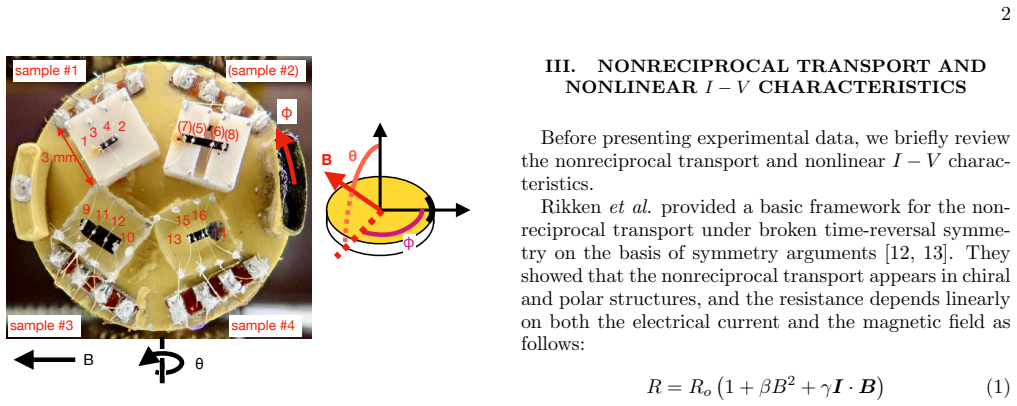
Summary. The manuscript reports low-frequency ac first- and second-harmonic resistance measurements and dc I-V measurements on bulk FeSe single crystals, together with contact-resistance characterization and field-angle/current-frequency variation. The authors first observe second-harmonic resistances that mimic nonreciprocal transport, with both a symmetric part and an antisymmetric part linear in field and current. They then present a series of controls — near-zero R2 in superfluid helium, a jump at the lambda point, an increase when the sample is no longer surrounded by liquid helium, a frequency-dependent phase delay, sign reversal when current and voltage contacts are exchanged, and a correlation between R2 and contact resistance — and conclude that the apparent nonreciprocal transport is not intrinsic to the bulk crystal but arises from Joule heating at a current contact combined with the thermoelectric effect. The paper explicitly supports the interpretation of the zero-field FeSe superconducting diode effect in the recent preprint of Nagata et al. as thermoelectric in origin.
Significance. If correct, the paper is an important cautionary result: second-harmonic resistance measurements, including antisymmetric-in-field components, are not by themselves a reliable diagnostic of broken space-inversion symmetry or nonreciprocal transport. The manuscript's central claim is supported by multiple independent controls rather than by a single fitting procedure, which is a genuine strength: the superfluid-helium experiment, the contact-swapping sign reversal, the frequency-dependent phase delay, and the cross-sample correlation with contact resistance each point to a thermal/contact artifact. The paper also provides a concrete protocol for distinguishing such artifacts in future experiments and connects its result to the independent zero-field superconducting diode report in FeSe flakes. The main limitation is that the quantitative Section V estimate assumes a local temperature difference and uses literature thermoelectric coefficients rather than measuring them on the same crystals; this affects the magnitude of the proposed mechanism but not the qualitative artifact conclusion.
minor comments (5)
- [Section V] The order-of-magnitude estimate that explains the observed R2 through the thermoelectric effect assumes a local temperature difference of about 1 K between the voltage contacts and uses Seebeck and Nernst coefficients from the literature, in particular ref. [10], rather than from direct measurements on the same crystals. The authors should state more explicitly that this is a plausibility estimate; the qualitative conclusion that the signal is a thermal-contact artifact is already firmly established by the superfluid-helium, contact-reversal, and frequency-response controls, but the specific thermoelectric mechanism is not directly metrologically confirmed.
- [Section IV.A, Fig. 7] The interpretation of the jump at T = 4.2 K relies on the sample 'becoming no longer surrounded by liquid helium'; the text should clarify the precise thermal environment change (for example, liquid level falling below the sample versus a transition to exchange-gas cooling), since this distinction is central to the heat-transfer argument.
- [Section IV.A, Fig. 8] The frequency dependence of V2^Ly and V2^Lx is presented qualitatively as evidence of a thermal phase delay. A fit to a simple thermal time-constant model, even with a single effective time constant, would make the argument more quantitative and would strengthen the identification of the second-harmonic response with Joule-heating-induced temperature oscillations.
- [Section IV.A] The statement that sign reversal of Ra2 upon exchanging current and voltage contacts is 'difficult to explain if the second-harmonic resistance was intrinsic to sample bulk' is plausible but is not supported by a formal reciprocity or symmetry argument. The authors could add a short remark or reference explaining why intrinsic bulk second-harmonic response would be expected to survive current/voltage exchange in this geometry.
- [Section III, Eq. (2)] The early data are described as compatible with the polar-structure expression R = R0(1 + beta B^2 + gamma I·(P x B)), but FeSe is centrosymmetric. It would be helpful to state explicitly in this section that this compatibility is only formal and does not imply that FeSe is polar; the later thermal-artifact discussion already makes this clear, but the early framing could mislead a reader.
Circularity Check
No significant circularity: the thermal-artifact conclusion rests on internal controls; the only same-author citation is a non-load-bearing magnitude check.
full rationale
The paper's central claim is that the observed second-harmonic resistance in bulk FeSe is not genuine nonreciprocal transport but results from Joule heating at a current contact acting through the thermoelectric effect. This conclusion is established by controlled phenomenology rather than by any derivation that assumes the result: R2 is almost zero in superfluid helium, jumps at the lambda point, grows when the sample is no longer surrounded by liquid helium, shows a frequency-dependent phase delay consistent with a thermal time constant, reverses sign when current and voltage contacts are exchanged, and is drastically reduced when the high-resistance contact is removed from the current path (samples #1 and #4). These observations do not depend on the quantitative thermoelectric estimate in Section V. The only same-author citation is ref. [10], used to argue that large thermoelectric coefficients are plausible for FeSe. But that citation is not load-bearing: the paper also cites non-overlapping refs. [19] and [20], whose more moderate values (Seebeck of order -10 uV/K, Nernst of order 0.9 uV/K/T) already exceed the order-of-magnitude requirements estimated from the observed R2 (0.2 uV/K for the Seebeck contribution, and a small fraction of the Nernst voltage). The logical chain is therefore not circular: an external empirical magnitude is compared with a consistency estimate, and the central 'artifact' conclusion stands independently of that estimate. The unmeasured local temperature gradient is an assumption in the quantitative plausibility check, but it is not a fitted parameter renamed as a prediction, and it does not make the conclusion equivalent to its inputs. No self-citation chain, uniqueness argument, or ansatz-smuggling step is load-bearing. The paper is self-contained against its own controls, and the minor self-citation does not affect the central result.
Assumptions & free parameters
free parameters (2)
- Local temperature difference between voltage contacts =
1 K (assumed, not measured)
- Nernst coefficient =
2 µV/K/T (order-of-magnitude assumption)
assumptions (4)
- domain assumption The measured crystals have thermoelectric coefficients of the order of those reported in ref. [10] (large Seebeck and Nernst coefficients).
- domain assumption A local temperature difference of order 1 K develops between the voltage contacts under measurement conditions.
- standard math The I-V response can be expanded as V = R1 I + R2 I^2 + R3 I^3.
- standard math Rikken et al.'s symmetry framework for nonreciprocal transport (Eqs. 1 and 2) is valid background.
Cite this review
Pith. "Pith review of Apparent nonreciprocal transport in FeSe bulk crystals." pith.science (2026). https://pith.science/paper/MOIDQCZD
@misc{pith2026250208928,
  author       = {Pith},
  title        = {Pith review of: Apparent nonreciprocal transport in FeSe bulk crystals},
  year         = {2026},
  howpublished = {\url{https://pith.science/paper/MOIDQCZD}},
  note         = {Machine review of arXiv:2502.08928}
}
abstract
We performed low-frequency ac first- and second-harmonic resistance measurements and dc $I-V$ measurements on bulk FeSe crystals in a temperature range between 1.8 and 150 K and in magnetic field up to 14 T. We observed considerable second-harmonic resistance, indicative of nonreciprocal charge transport, in some samples. By examining correlation between contact resistances and second-harmonic signals, we concluded that the second-harmonic resistance was not due to the genuine nonreciprocal transport effect but was caused by joule heating at a current contact through the thermoelectric effect. Our conclusion is consistent with a recent preprint (Nagata \textit{et al.}, arXiv:2409.01715), in which the authors reported a zero-field superconducting diode effect in devices fabricated with FeSe flakes and attributed it to the thermoelectric effect.
Figures


Figures from the paper (4 more)


Reference graph
Works this paper leans on
-
[10]
S. Margadonna, Y. Takabayashi, M. T. McDonald, K. Kasperkiewicz, Y. Mizuguchi, Y. Takano, A. N. Fitch, E. Suard, and K. Prassides, Crystal structure of the new FeSe1−x superconductor, Chem. Commun. 2008, 5607 (2008)
work page 2008
-
[1]
T. Ideue and Y. Iwasa, Symmetry breaking and nonlin- ear electric transport in van der Waals nanostructures, Annu. Rev. Condens. Matter Phys. 12, 201 (2021)
work page 2021
-
[2]
The antisymmetric part is linear in B
The magnetic field was applied at an angle θ of 18◦ from the c axis ( ϕ = 90 ◦) for a technical reason. The antisymmetric part is linear in B. Figure 3(b) shows the antisymmetric part Ra 2 measured with different current strengths. All the curves coincide within error, indicat- ing that the resistance linearly depends on the current. Thus the bilinear nat...
-
[3]
Let us assume a typical size of the second- harmonic resistance to be 0.02 Ω/A. This corresponds to a voltage of ∼0.2 µV at I = 3 mA. Let us assume the temperature difference between the voltage contacts of 1 K. Then, a Seebeck coefficient of 0.2 µVK−1 suffices. For the Nernst effect, the estimation is more difficult because the direction of the temperatu...
-
[4]
H. Isobe, S.-Y. Xu, and L. Fu, High-frequency rectifi- cation via chiral Bloch electrons, Sci. Adv. 6, eaay2497 (2020)
work page 2020
-
[5]
T. Morimoto and N. Nagaosa, Nonreciprocal current from electron interactions in noncentrosymmetric crys- tals: roles of time reversal symmetry and dissipation, Sci. Rep. 8, 2973 (2018). 9
work page 2018
-
[6]
F. Ando, Y. Miyasaka, T. Li, J. Ishizuka, T. Arakawa, Y. Shiota, T. Moriyama, Y. Yanase, and T. Ono, Obser- vation of superconducting diode effect, Nature 584, 373 (2020)
2020
-
[7]
F. Liu, Y. M. Itahashi, S. Aoki, Y. Dong, Z. Wang, N. Ogawa, T. Ideue, and Y. Iwasa, Superconducting diode effect under time-reversal symmetry, Science Ad- vances 10, eado1502 (2024)
work page 2024
Show all 24 references
-
[8]
Nagata, M
U. Nagata, M. Aoki, A. Daido, S. Kasahara, Y. Kasa- hara, R. Ohshima, Y. Ando, Y. Yanase, Y. Matsuda, and M. Shiraishi, Field-free superconducting diode effect in layered superconductor FeSe, arXiv:2409.01715 (2024)
2024
-
[9]
Hsu, J.-Y
F.-C. Hsu, J.-Y. Luo, K.-W. Yeh, T.-K. Chen, T.-W. Huang, P. M. Wu, Y.-C. Lee, Y.-L. Huang, Y.-Y. Chu, D.-C. Yan, and M.-K. Wu, Superconductivity in the PbO-Type Structure α-FeSe, Proc. Nat. Acad. Sci. U. S. A. 105, 14262 (2008)
2008
-
[11]
R¨ oßler, M
S. R¨ oßler, M. Coduri, A. A. Tsirlin, C. Ritter, G. Cuello, C. Koz, L. Muzica, U. Schwarz, U. K. R¨ oßler, S. Wirth, and M. Scavini, Nematic state of the FeSe superconduc- tor, Phys. Rev. B 105, 064505 (2022)
2022
-
[12]
Kasahara, T
S. Kasahara, T. Yamashita, A. Shi, R. Kobayashi, Y. Shimoyama, T. Watashige, K. Ishida, T. Terashima, T. Wolf, F. Hardy, C. Meingast, H. v. L¨ ohneysen, A. Levchenko, T. Shibauchi, and Y. Matsuda, Gi- ant superconducting fluctuations in the compensated semimetal FeSe at the BC...
2016
-
[13]
A. E. B¨ ohmer, F. Hardy, F. Eilers, D. Ernst, P. Adel- mann, P. Schweiss, T. Wolf, and C. Meingast, Lack of coupling between superconductivity and orthorhombic distortion in stoichiometric single-crystalline FeSe, Phys. Rev. B 87, 180505 (2013)
2013
-
[14]
G. L. J. A. Rikken, J. F¨ olling, and P. Wyder, Electrical magnetochiral anisotropy, Phys. Rev. Lett. 87, 236602 (2001)
2001
-
[15]
G. L. J. A. Rikken and P. Wyder, Magnetoelectric anisotropy in diffusive transport, Phys. Rev. Lett. 94, 016601 (2005)
2005
-
[16]
Yokouchi, Y
T. Yokouchi, Y. Ikeda, T. Morimoto, and Y. Shiomi, Gi- ant magnetochiral anisotropy in Weyl semimetal WTe 2 induced by diverging Berry curvature, Phys. Rev. Lett. 130, 136301 (2023)
2023
-
[17]
Y. Wang, H. F. Legg, T. B¨ omerich, J. Park, S. Biesenkamp, A. A. Taskin, M. Braden, A. Rosch, and Y. Ando, Gigantic magnetochiral anisotropy in the topo- logical semimetal ZrTe 5, Phys. Rev. Lett. 128, 176602 (2022)
2022
-
[18]
Ideue, K
T. Ideue, K. Hamamoto, S. Koshikawa, M. Ezawa, S. Shimizu, Y. Kaneko, Y. Tokura, N. Nagaosa, and Y. Iwasa, Bulk rectification effect in a polar semicon- ductor, Nat. Phys. 13, 578 (2017)
2017
-
[19]
M. A. Dubson, Y. C. Hui, M. B. Weissman, and J. C. Garland, Measurement of the fourth moment of the cur- rent distribution in two-dimensional random resistor net- works, Phys. Rev. B 39, 6807 (1989)
1989
-
[20]
L. Lu, W. Yi, and D. L. Zhang, 3 ω method for specific heat and thermal conductivity measurements, Rev. Sci. Instrum. 72, 2996 (2001)
2001
-
[21]
T. M. McQueen, Q. Huang, V. Ksenofontov, C. Felser, Q. Xu, H. Zandbergen, Y. S. Hor, J. Allred, A. J. Williams, D. Qu, J. Checkelsky, N. P. Ong, and R. J. Cava, Extreme sensitivity of superconductivity to stoi- chiometry in Fe1+δSe, Phys. Rev. B 79, 014522 (2009)
2009
-
[22]
H. Yang, G. Chen, X. Zhu, J. Xing, and H.-H. Wen, BCS- like critical fluctuations with limited overlap of cooper pairs in FeSe, Phys. Rev. B 96, 064501 (2017)
2017
-
[23]
L. Chen, Z. Xiang, C. Tinsman, B. Lei, X. Chen, G. D. Gu, and L. Li, Spontaneous Nernst effect in the iron- based superconductor Fe1+yTe1−xSex, Phys. Rev. B 102, 054503 (2020)
2020
-
[24]
Behnia and H
K. Behnia and H. Aubin, Nernst effect in metals and superconductors: a review of concepts and experiments, Rep. Prog. Phys. 79, 046502 (2016)
2016
Reviewed August 7, 2026 · model on record in the stance chip above.
Discussion (0). Continue with ORCID to comment.