REVIEW 3 major objections 4 minor 1 cited by
Theoretical investigation of the superconducting pairing symmetry in a bilayer two-orbital model of pressurized La$_3$Ni$_2$O$_7$
T0 review · 3 major / 4 minor · reviewed 2026-08-11 · deepseek-v4-flash
Pith's one-line read In the bilayer two-orbital model of La3Ni2O7, pairing symmetry is decided by magnetic competition: γ band alone gives odd-frequency triplet, four bands give s±-wave, and residual ferromagnetic fluctuation gives d-wave.
desk verdict A useful band-by-band RPA decomposition that explains the s±/d-wave competition in La3Ni2O7, but the headline s± prediction is parameter-set specific and the paper is honest about that. read the letter →
The pith
A machine-rendered reading of the paper's core claim, the machinery that carries it, and where it could break.
The reading
What carries the argument
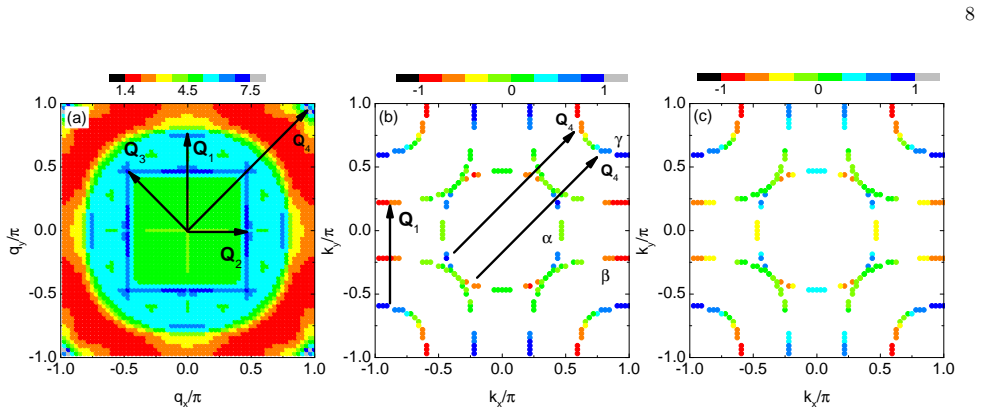
The machinery is a band-resolved random-phase-approximation susceptibility feeding a linearized Eliashberg equation. The spin susceptibility $\chi_s(q) = [I - \chi_0(q) U_s]^{-1}\chi_0(q)$ is evaluated for the four-band model, and its largest eigenvalue $\rho_s(q)$ shows where in momentum space the spin fluctuations live; the Stoner factor $\alpha_s$ measures the proximity to a magnetic instability. The paper then artificially keeps only selected bands in the Green's functions, computes the pairing interaction $V(q) = \tfrac{1}{2}[3U_s\chi_s U_s - U_c\chi_c U_c + U_s + U_c]$ for singlet pairing (and the analogous triplet expression), and solves the linearized Eliashberg equation by the power method. The key diagnostic is the location of the $\rho_s(q)$ peak: a ferromagnetic peak at $q=(0,0)$ promotes odd-frequency triplet $s$-wave pairing, while antiferromagnetic peaks at finite $Q$ promote sign-changing singlet pairing. The narrow $\gamma$ band and its small Fermi velocity are what make the ferromagnetic region so influential.
What would settle it
Measure the magnetic response of pressurized La$_3$Ni$_2$O$_7$ with inelastic neutron scattering: the four-band model predicts the dominant spin fluctuation sits at $Q_1 \approx (\pm 0.84\pi, 0)$ and $(0, \pm 0.84\pi)$, not at $q=(0,0)$; a strong ferromagnetic peak near $q=(0,0)$ would falsify the $s_\pm$-wave claim. Alternatively, a phase-sensitive experiment that finds no sign change between the $\beta$ Fermi surface and the $\alpha$ and $\gamma$ Fermi surfaces would rule out $s_\pm$-wave pairing.
Extended reading notes
Core claim
On the paper's own terms, the central discovery is that a single band, $\gamma$, carries the ferromagnetic instability that decides the pairing channel. Solving the linearized Eliashberg equation with only the $\gamma$ band gives a spin-triplet pairing function with odd frequency dependence ($\Delta_{\gamma\gamma}(k, ip_n) = -\Delta_{\gamma\gamma}(k, -ip_n)$), even parity in momentum, and $s$-wave symmetry; its magnetic driver is a broad $\rho_s(q)$ peak around $q=(0,0)$. When the other bands are switched on, the antiferromagnetic peaks from $\beta$--$\gamma$, $\beta$--$\beta$, and $\alpha$--$\gamma$ scattering grow, while the $\delta$ band, though unoccupied, removes the ferromagnetic response through inter-band scattering. With all four bands, $\rho_s(q)$ peaks at $Q_1 \approx (\pm 0.84\pi, 0)$ and $(0, \pm 0.84\pi)$, and the leading instability is spin-singlet $s_\pm$-wave: the gap is approximately isotropic and of one sign on the $\alpha$ and $\gamma$ sheets, and of the opposite sign on the $\beta$ sheet, with nodes or gap minima near $k_x = \pm k_y$ on $\beta$. Omitting the $\delta$ band leaves the ferromagnetic region intact and turns the leading solution into $d_{x^2-y^2}$-wave with nodes along $k_x=\pm k_y$. The paper therefore claims that the correct pairing symmetry in this model is not unique: it depends on whether the ferromagnetic fluctuation is completely suppressed, which in turn is controlled by the tight-binding parameters.
Load-bearing premise
The $s_\pm$-wave conclusion rests on the specific set of electron hopping parameters taken from Ref. [2]; the paper itself notes that with other published parameter sets the ferromagnetic fluctuation is not fully suppressed and the pairing becomes $d$-wave, so if those alternative parameter sets are equally valid for pressurized La$_3$Ni$_2$O$_7$, the central claim is not robust.
Editorial extensions
If this is right
- If the paper is right, models that neglect the unoccupied $\delta$ band will systematically overestimate the tendency to $d$-wave pairing, because the $\delta$ band is needed to suppress the ferromagnetic fluctuation.
- The full four-band model predicts an $s_\pm$-wave gap on the $\beta$ Fermi surface with nodes or near-nodes along $k_x = \pm k_y$, while the $\alpha$ and $\gamma$ sheets carry a relatively isotropic gap of the opposite sign.
- A material realization that isolates the $\gamma$ band would be a candidate for odd-frequency $s$-wave spin-triplet superconductivity, but in the full model this state loses to singlet pairing.
- Experiments that determine the gap symmetry (such as specific heat, penetration depth, or phase-sensitive probes) should also be able to discriminate between the competing tight-binding parameter sets.
- The pairing mechanism here is magnetic in origin: whichever spin fluctuation dominates sets the pairing channel, so magnetic probes and superconducting gap probes should agree.
Reading between the lines
- If the competition story is right, artificially flattening the $\gamma$ band (by reducing its hopping) should strengthen the ferromagnetic response and push the leading pairing toward the triplet/$d$-wave side; this is a testable consequence the paper does not state.
- The same band-resolved mechanism may transfer to other bilayer nickelates with the $R_3$Ni$_2$O$_7$ structure, where modest changes in band structure could flip the pairing symmetry between $s_\pm$-wave and $d$-wave.
- A heterostructure or exfoliated flake that selects only the $\gamma$-like band could be a route to realizing odd-frequency spin-triplet pairing, though the paper proposes no such device.
Editorial analysis
A structured set of objections, weighed in public.
Referee Report
Summary. This paper investigates the superconducting pairing symmetry of pressurized La3Ni2O7 using a bilayer two-orbital tight-binding model and RPA/linearized-Eliashberg calculations. The model has four bands (α, β, γ, δ), and the paper analyzes the pairing obtained when different subsets of these bands are retained in the Green's functions. The central result is that the γ band alone produces ferromagnetic spin fluctuations and an odd-frequency, s-wave spin-triplet pairing state, while adding the other bands suppresses the ferromagnetic fluctuations and enhances antiferromagnetic ones, leading to a d-wave singlet and finally to an s±-wave singlet when all four bands are included. The paper attributes the conflicting s±-versus-d-wave predictions in the literature to whether this ferromagnetic fluctuation is completely suppressed, which depends on the tight-binding parameters.
Significance. If the mechanism is correct, the paper offers a physically transparent explanation for the spread of pairing-symmetry predictions in pressurized La3Ni2O7: the competition between ferromagnetic fluctuations from the narrow γ band and antiferromagnetic fluctuations from other bands. The methodological backbone is standard RPA spin-fluctuation theory and linearized Eliashberg equations, implemented with a dense momentum/frequency grid, and the full-model result (Case 1) reproduces earlier published s±-wave solutions for the same tight-binding parameters. The paper is also commendably explicit in the Summary that the s±-wave outcome is tied to the specific parameter set of Ref. 2, and that alternative published parameter sets (Refs. 21, 22) lead to d-wave pairing. The main weakness is that this parameter-set sensitivity is not reflected in the abstract's unqualified 'finally into an s±-wave one,' and the cross-case comparisons rely on an ad-hoc normalization of the interaction strength.
major comments (3)
- [Abstract; Section IV (Summary)] The abstract states that the pairing 'finally into an s±-wave one' as the outcome for pressurized La3Ni2O7, but the Summary explicitly concedes that with the tight-binding parameters of Refs. 21 and 22 the same analysis yields d-wave pairing because the ferromagnetic fluctuation is not completely suppressed. Since the paper offers no physical criterion for selecting the Ref. 2 parameter set over the alternatives, the headline prediction is parameter-set specific, not a robust statement about the material. The abstract and title should be qualified (e.g., 'for the parameter set of Ref. 2') or the paper should justify why that parameter set is the appropriate representation of pressurized La3Ni2O7.
- [Section III, Cases 2-6] The comparison of pairing tendencies across the band-selection cases is made by tuning U to different values (U=4, 2.08, 1.7, 1.5, 2) so that the Stoner factor α_s≈0.9 in each case, even though the physical interaction in the full model is U=1.16. This normalization is an assumption rather than a derived result, and the relative strength of ferromagnetic versus antiferromagnetic fluctuations could differ at fixed U. Although the paper states that the conclusions of Cases 3-6 are qualitatively unchanged at U=1.16, the central mechanistic claim would be more convincing if the paper showed the evolution of the leading pairing symmetry as a function of U within each case, or justified why α_s≈0.9 is the correct common comparison point.
- [Section II, Eq. (6); Section III, Cases 2-6] The procedure of 'artificially setting Q_{s1 s2}=0' to isolate individual bands in the Green's function is not a standard band projection: it discards selected columns of the unitary transformation rather than truncating the Hilbert space, and it is not demonstrated that the resulting Green's function corresponds to any physical Hamiltonian or preserves the analytic behavior required for the Eliashberg equation. Since the case-by-case results are the main evidence for the proposed mechanism, this projection should be justified more rigorously or shown to be equivalent to a well-defined restricted model (e.g., an orbital-selective or band-selective decoupling).
minor comments (4)
- [Section III, Case 6, Eq. (24)] In Eq. (24), the term 'cos 4x cos 3ky' should presumably be 'cos 4kx cos 3ky'.
- [References, Ref. 29] Reference 29 contains a corrupted author name 'A. T. R ϕer'; this should be corrected to 'A. T. Rømer'.
- [Section III, Case 2] The pairing on the β band is described as 's-wave' even though the text states there are nodes along kx=±ky and at kx=±π, ky=±π; the classification would be clearer if the point-group symmetry were stated explicitly, since a nodal s-wave is an unusual characterization.
- [Section I, Introduction] The phrase 'In literatures, they are denoted as' should be 'In the literature, they are denoted as'.
Circularity Check
No circularity: the s±/d-wave pairing symmetry is an output of RPA susceptibility and Eliashberg eigenvalue analysis, not an input or fit.
full rationale
The derivation chain is self-contained and the central claim is computed, not imposed. The model Hamiltonian (Eq. 1) and its tight-binding parameters are taken from Ref. 2, and the interaction (Eq. 7) is the standard multiorbital Hubbard form. The bare susceptibility (Eq. 8), RPA susceptibilities (Eq. 9), and the linearized Eliashberg equation (Eq. 12) are standard formulas; Ref. 25 is one citation among several (Refs. 23, 24, 26, 28) for these equations, so the self-citation is not load-bearing. The pairing symmetry in each case is obtained by numerically solving Eq. (12) for the largest positive eigenvalue and reading off the anomalous self-energy (Eq. 17); no target symmetry is inserted into the calculation. The case-by-case band selection is a controlled decomposition achieved by zeroing unitary-matrix elements in Eq. (6), which is a numerical probe of band contributions rather than an assumption of the outcome. Tuning U in the reduced-band cases to reach a comparable Stoner factor α_s ≈ 0.9 changes the interaction strength but not the symmetry; the paper explicitly states that at U = 1.16 the conclusions do not change qualitatively. The trigonometric fits in Eqs. (18)-(24) are post hoc descriptions of the converged gap, not inputs. The Summary's statement that different published tight-binding parameters (Refs. 21, 22) lead to d-wave pairing is an admission of parameter sensitivity, not a circular reduction. No fitted parameter is renamed as a prediction, and no uniqueness or ansatz is imported from the author's prior work. Therefore there is no significant circularity.
Assumptions & free parameters
free parameters (2)
- U (intra-orbital Coulomb repulsion) =
1.16 eV (case 1), 4 eV (case 2), 2.08 eV (case 3), 1.7 eV (case 4), 1.5 eV (case 5), 2 eV (case 6)
- Target Stoner factor α_s =
0.9
assumptions (5)
- domain assumption The RPA susceptibilities (Eq. 9) and the Eliashberg pairing interaction (Eqs. 13-14) correctly describe the leading superconducting instability in this multiorbital system.
- domain assumption The bilayer two-orbital tight-binding model (Eq. 1) with parameters from Ref. 2 accurately represents pressurized La3Ni2O7.
- domain assumption Interaction parameters satisfy U' = U - 2J_H and J_H = J' = U/6.
- ad hoc to paper Setting Q matrix elements to zero isolates the contribution of a chosen band (or bands) to the Green's function and pairing.
- ad hoc to paper Comparing cases at a fixed Stoner factor α_s≈0.9 by adjusting U is a valid normalization for assessing pairing tendencies.
Cite this review
Pith. "Pith review of Theoretical investigation of the superconducting pairing symmetry in a bilayer two-orbital model of pressurized La$_3$Ni$_2$O$_7$." pith.science (2026). https://pith.science/paper/IXGM4ESD
@misc{pith2026241211429,
  author       = {Pith},
  title        = {Pith review of: Theoretical investigation of the superconducting pairing symmetry in a bilayer two-orbital model of pressurized La$_3$Ni$_2$O$_7$},
  year         = {2026},
  howpublished = {\url{https://pith.science/paper/IXGM4ESD}},
  note         = {Machine review of arXiv:2412.11429}
}
abstract
We investigate the superconducting pairing symmetry in pressurized La$_3$Ni$_2$O$_7$ based on a bilayer two-orbital model. There are two symmetric bands $\alpha$ and $\gamma$, as well as two antisymmetric ones $\beta$ and $\delta$. It is found that the $\gamma$ band induces considerable ferromagnetic spin fluctuation and prefers an odd-frequency, $s$-wave spin triplet pairing state. The addition of the other bands gradually suppresses the ferromagnetic spin fluctuation and enhances the antiferromagnetic ones. The superconducting pairing then evolves from a spin triplet into a $d$-wave spin singlet, and finally into an $s_\pm$-wave one. The competition between the $d$-wave and $s_\pm$-wave pairings relies on whether the ferromagnetic spin fluctuation is suppressed completely or not.
Figures


Figures from the paper (4 more)



Forward citations
Cited by 1 Pith paper
-
Probing Sign-Changing Order Parameters via Impurity States in unconventional superconductors: Implications for La$_3$Ni$_2$O$_7$ Superconductors with interlayer pairing
Impurity-induced in-gap states in superconductors are tied to sign-changing order parameters, and the effect can be used to test pairing symmetry in La3Ni2O7.
Reference graph
Works this paper leans on
-
[1]
H. Sun, M. Huo, X. Hu, J. Li, Z. Liu, Y. Han, L. Tang, Z. Mao, P. Yang, B. Wang, J. Cheng, D.-X. Yao, G.-M. Zhang, and M. Wang, Signatures of superconductivity near 80K in a nickelate under high pressure, Nature 621, 493-498 (2023)
work page 2023
-
[2]
Z. Luo , X. Hu , M. Wang , W. W u , and D.-X. Yao, Bilayer Two-Orbital Model of La _3 Ni _2 O _7 under Pressure, Phys. Rev. Lett. 131, 126001 (2023)
work page 2023
- [3]
-
[4]
Y. Gu, C. Le, Z. Yang, X. Wu, and J. Hu, Effective model and pairing tendency in bilayer Ni-based superconductor La _3 Ni _2 O _7 , arXiv:2306.07275v2
-
[5]
Yang, G.-M
Y.-f. Yang, G.-M. Zhang, and F.-C. Zhang, Interlayer valence bonds and two-component theory for high- T_c superconductivity of La _3 Ni _2 O _7 under pressure, Phys. Rev. B 108, L201108 (2023)
2023
- [6]
-
[7]
Y. Zhang, L.-F. Lin, A. More, T. A. Maier, and E. Dagotto, Trends in electronic structures and s_ -wave pairing for the rare-earth series in bilayer nickelate superconductor R_3 Ni _2 O _7 , Phys. Rev. B 108, 165141 (2023)
work page 2023
-
[8]
Q. Qin, and Y.-f. Yang, High- T_c superconductivity by mobilizing local spin singlets and possible route to higher T_c in pressurized La _3 Ni _2 O _7 , Phys. Rev. B 108, L140504 (2023)
work page 2023
Show all 29 references
-
[9]
Q.-G. Yang, D. Wang, and Q.-H. Wang, Possible s_ -wave superconductivity in La _3 Ni _2 O _7 , Phys. Rev. B 108, L140505 (2023)
2023
-
[10]
C. Lu, Z. Pan, F. Yang, and C. Wu, Interlayer-Coupling-Driven High-Temperature Superconductivity in La _3 Ni _2 O _7 under Pressure, Phys. Rev. Lett. 132, 146002 (2024)
2024
-
[11]
Sakakibara, N
H. Sakakibara, N. Kitamine, M. Ochi, and K. Kuroki, Possible High T_c Superconductivity in La _3 Ni _2 O _7 under High Pressure through Manifestation of a Nearly Half-Filled Bilayer Hubbard Model, Phys. Rev. Lett. 132, 106002 (2024)
2024
-
[12]
Jiang, Y.-H
K.-Y. Jiang, Y.-H. Cao, Q.-G. Yang, H.-Y. Lu, and Q.-H. Wang, Theory of Pressure Dependence of Superconductivity in Bilayer Nickelate La _3 Ni _2 O _7 , arXiv:2409.17861v1
-
[13]
Zhang, L.-F
Y. Zhang, L.-F. Lin, A. Moreo, T. A. Maier, and E. Dagotto, Structural phase transition, s_ -wave pairing, and magnetic stripe order in bilayered superconductor La _3 Ni _2 O _7 under pressure, Nat. Commu. 15, 2470 (2024)
2024
-
[14]
Z. Liao, L. Chen, G. Duan, Y. Wang, C. Liu, R. Yu, and Q. Si, Electron correlations and superconductivity in La _3 Ni _2 O _7 under pressure tuning, Phys. Rev. B 108, 214522 (2023)
2023
-
[15]
Oh and Y.-H
H. Oh and Y.-H. Zhang, Type-II t-J model and shared superexchange coupling from Hund's rule in superconducting La _3 Ni _2 O _7 , Phys. Rev. B 108, 174511 (2023)
2023
-
[16]
Fan, J.-F
Z. Fan, J.-F. Zhang, B. Zhan, D. Lv, X.-Y. Jiang, B. Normand, and T. Xiang, Superconductivity in nickelate and cuprate superconductors with strong bilayer coupling, Phys. Rev. B 110, 024514 (2024)
2024
-
[17]
Heier, K
G. Heier, K. Park, and S. Y. Savrasov, Competing d_ xy and s_ pairing symmetries in superconducting La _3 Ni _2 O _7 : LDA+ FLEX calculations, Phys. Rev. B 109, 104508 (2024)
2024
-
[18]
D. K. Singh, G. Goyal, Y. Bang, Possible pairing states in the superconducting bilayer nickelate, arXiv:2409.09321v2
-
[19]
Bejas, X
M. Bejas, X. Wu, D. Chakraborty, A. P. Schnyder, and A. Greco, Out-of-plane bond order phase, superconductivity, and their competition in the t-J_\|-J_ model for pressurized nickelates, arXiv:2411.00269v1
-
[20]
Jiang, Z
K. Jiang, Z. Wang, and F.-C. Zhang, High-Temperature Superconductivity in La _3 Ni _2 O _7 , Chinese Phys. Lett. 41, 017402 (2024)
2024
-
[21]
H. Liu, C. Xia, S. Zhou, and H. Chen, Role of crystal-field-splitting and longe-range-hoppings on superconducting pairing symmetry of La _3 Ni _2 O _7 , arXiv:2311.07316v1
-
[22]
Lechermann, J
F. Lechermann, J. Gondolf, S. B o tzel, and I. M. Eremin, Electronic correlations and superconducting instability in La _3 Ni _2 O _7 under high pressure, Phys. Rev. B 108, L201121 (2023)
2023
-
[23]
Graser, T
S. Graser, T. A. Maier, P. J. Hirschfeld, and D. J. Scalapino, Near-degeneracy of several pairing channels in multiorbital models for the Fe pnictides, New J. Phys. 11, 025016 (2009)
2009
-
[24]
Kubo, Pairing symmetry in a two-orbital Hubbard model on a square lattice, Phys
K. Kubo, Pairing symmetry in a two-orbital Hubbard model on a square lattice, Phys. Rev. B 75, 224509 (2007)
2007
-
[25]
Gao, Robust A_1 superconductivity in the kagome lattice, Phys
Y. Gao, Robust A_1 superconductivity in the kagome lattice, Phys. Rev. B 109, 214501 (2024)
2024
-
[26]
Takimoto, T
T. Takimoto, T. Hotta, and K. Ueda, Strong-coupling theory of superconductivity in a degenerate Hubbard model, Phys. Rev. B 69, 104504 (2004)
2004
-
[27]
Andrilli and D
S. Andrilli and D. Hecker, Elementary Linear Algebra (Fifth Edition) (2016)
2016
-
[28]
Linder and A
J. Linder and A. V. Balatsky, Odd-frequency superconductivity, Rev. Mod. Phys. 91, 045005 (2019)
2019
-
[29]
A. T. R er, A. Kreisel, I. Eremin, M. A. Malakhov, T. A. Maier, P. J. Hirschfeld, and B. M. Andersen, Pairing symmetry of the one-band Hubbard model in the paramagnetic weak-coupling limit: A numerical RPA study, Phys. Rev. B 92, 104505 (2015)
2015
Reviewed August 11, 2026 · model on record in the stance chip above.
Discussion (0). Continue with ORCID to comment.