REVIEW 4 major objections 5 minor 2 cited by
Engineering Topological Materials
T0 review · 4 major / 5 minor · reviewed 2026-08-05 · deepseek-v4-flash
Pith's one-line read Adding engineered localized defects that connect the two valleys of a chiral Dirac material turns a non-topological phase into a topological one in a prescribed symmetry class, with the defect field's phase winding serving as the topologica
desk verdict A genuinely new bilayer-vacancy example (BDI→CII, T^2=−1) is buried under a framework that mostly restates Teo–Kane and the authors' own previous work, and the key derivation is asserted rather than shown. read the letter →
The pith
A machine-rendered reading of the paper's core claim, the machinery that carries it, and where it could break.
The reading
What carries the argument
The Hamiltonian symbol $H(k,r)$ obtained from a discrete Weyl transform, together with the defect-induced complex scalar field $\phi(r)=|\phi|e^{im\theta}$. The field's phase winding around the defect is the topological charge: a vacancy adds $\phi_1\sigma_x\otimes\tau_x+\phi_2\sigma_x\otimes\tau_y$ to the Dirac-point symbol, and the winding number $\nu=\frac{1}{2\pi}\oint d\theta\,\partial_\theta\arg\phi$ follows from the Atiyah–Singer index theorem as the count of localized zero modes. The accessible symmetry classes are fixed by $s=p-q\bmod 8$, the parity condition $\delta-s\equiv 0 \pmod 4$ selecting integer ($\mathbb{Z}$) topology.
What would settle it
Exact diagonalization of a tight-binding honeycomb lattice with a vacancy whose potential is a finite-range function with the same $\pm\theta$ angular dependence but different radial decay: if the number of zero-energy modes (or the computed winding number) deviates from $\mp1$ for monolayer, or from $\mp4$ for aligned bilayer vacancies, while the phase winding is held fixed, the profile-independence assumption fails. An STM measurement of zero-mode counts on differently terminated vacancies would settle the same question experimentally.
Extended reading notes
Core claim
The central claim: a topological phase with prescribed symmetry class can be engineered by localized defects that couple low-energy modes around Dirac points. The defect adds a complex scalar field $\phi(r)=|\phi|e^{\mp i\theta}$ (or $e^{\mp 2i\theta}$ for quadratic points), preserving chiral symmetry and connecting valleys, so that the symbol $\mathbf{h}(k)\cdot\boldsymbol{\gamma}$ becomes elliptic with winding number $\nu_{H_f}=\mp1$ (monolayer) or $\mp4$ (bilayer). By the Atiyah–Singer index theorem these windings are tied to zero modes localized at the vacancies—two for the bilayer's winding 4—realizing BDI→BDI and BDI→CII transitions. The latter creates an effective $T^2=-1$ spin degree
Load-bearing premise
Replacing the physical vacancy potential (whose symbol behaves like a derivative of a delta function) with an arbitrary localized complex scalar field $\phi(r)=|\phi|e^{im\theta}$, assuming only the phase winding matters while the exact radial profile does not alter the topological index; if this substitution fails for realistic vacancy shapes, the computed winding numbers do not describe the actual lattice.
Editorial extensions
If this is right
- A non-topological chiral Dirac material with paired valleys (graphene, brickwall, Kagome, Mielke lattices) becomes topological under a single vacancy: monolayer lands in class BDI with winding $\mp1$, bilayer in class CII with winding $\mp4$.
- Effective spin-1/2 degrees of freedom are generated on demand: the AB-stacked bilayer construction yields time-reversal symmetry with $T^2=-1$ starting from a system with $T^2=+1$, without any intrinsic spin-orbit coupling.
- Topological zero modes localize at the vacancy sites themselves, so the bulk–edge correspondence holds with defects playing the role of quasi-boundaries inside the material.
- The method's scope extends to non-lattice systems: the same defect-field construction works for quantum graphs, where the relevant operators are elliptic and the index theorem still applies.
- Chiral materials satisfying the Nielsen–Ninomiya theorem form a general family for this 'tenfold navigation'; the table of possible $(d,s,D)$ combinations up to $d=3$ specifies which defect type (point, line, surface) realizes a $\mathbb{Z}$ phase.
Reading between the lines
- A direct test of the profile-independence assumption is available: compute the winding number in a tight-binding honeycomb lattice for several vacancy models (removed site, renormalized hoppings, hydrogen-passivated) with identical $\pm\theta$ phase structure; the claim predicts the index stays $\pm1$, and a deviating index would refute the continuum replacement.
- The same mechanism should transfer to artificial Dirac platforms—photonic lattices, acoustic metamaterials, and cold-atom optical lattices—where 'defects' can be carved with controlled phase windings, offering a tabletop implementation of tenfold-navigation.
- The two zero modes in the CII bilayer example, protected by chiral symmetry, suggest a natural topologically protected pseudospin qubit; whether the two localized modes can be addressed and braided without breaking the symmetry is an open extension.
- Because the paper links the tenfold classification to two-qubit entanglement, the engineered effective spin might also serve as a physical resource for entanglement-based quantum gates, although the specific circuit-level construction is not given.
Editorial analysis
A structured set of objections, weighed in public.
Referee Report
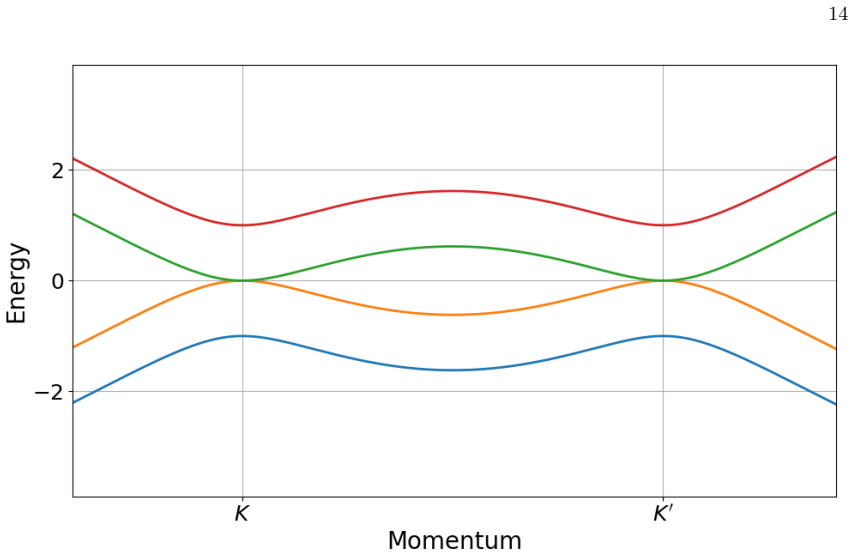
Summary. The paper proposes a constructive method for engineering topological phases by embedding point defects or textures into chiral Dirac materials. The method is framed through the authors' 'symbol of a Hamiltonian' approach, with the Atiyah–Singer index theorem used to relate the analytical index of an elliptic operator to a topological winding number. After laying out general rules for navigating the tenfold classification, the authors apply the construction to two-dimensional chiral materials: a monolayer honeycomb/brick-wall lattice with a vacancy is claimed to yield class BDI with winding number ν = ∓1; an AB-stacked bilayer with aligned vacancies is claimed to yield class CII, with an emergent valley-based T² = −1 symmetry and winding number ν = ∓4; AA stacking is claimed to preserve BDI but move the topological modes to finite energy. Exact-diagonalization results showing zero modes are presented in support.
Significance. If the construction is correct, it provides a concrete, design-oriented bridge between the tenfold classification and material engineering: starting from a non-topological Dirac material, a prescribed defect converts the system into a prescribed topological class. The paper's strengths are its explicit low-energy symbols, the concrete lattice realizations (monolayer vacancy, AB- and AA-stacked bilayers), and the numerical zero modes that are consistent with the claimed invariants. The monolayer vacancy result reproduces the authors' earlier PRB result, and the AB-stacked bilayer result is a new prediction. However, the central 'guarantee' rests on an unproved replacement of a distributional vacancy potential by a smooth complex scalar field, and the bilayer CII derivation is asserted rather than fully shown. The quantitative predictions ν = ∓1 and ν = ∓4 are therefore plausible but not established to the standard claimed by the paper.
major comments (4)
- [Main text, Eq. (8); Supplementary Eq. (3)] The winding-number formula in Eq. (8) is written as an integral over dθ only, with the result ν = ∓1. The general formula in Supplementary Eq. (3) contains an integration over the full phase space, ∫ d^d k d^D r, normalized by S_{d+D}. As printed, Eq. (8) omits the momentum integration and the normalization factor. If the momentum integration is exactly trivial, that should be shown; if it contributes a constant factor, that factor must appear. The same issue affects the statement 'after a simple integration over the momentum variables' in Supplementary Eq. (40). This is load-bearing because the quantitative values ν = ∓1 and ν = ∓4 are the central predictions.
- [Supplementary Eqs. (35)-(37) and main text after Eq. (8)] The vacancy potential is shown to have symbol V ∝ e^{iθ}(-i∂_r δ(r)). The authors regularize the delta function and then replace −i∂_rδ(r) by an arbitrary localized function φ(r), declaring 'only its angular dependence matters' and, in the bilayer, that the exact radial profile 'does not play a crucial role'. No proof or controlled asymptotic argument is given that this replacement preserves the topological index for the full lattice symbol, including subleading terms. For a distributional symbol, ellipticity and the index can depend on the regularization. This assumption is the mechanism behind the claimed 'guarantee' of class BDI or CII, so it needs either a proof of homotopy invariance under the replacement or a direct lattice-level check of the invariant for an actual vacancy.
- [Supplementary Eqs. (54)-(55) and main text around Eq. (9)] The derivation of the effective bilayer vacancy coupling Φ_eff is not shown. The statement 'Using Löwdin partitioning on Φ, which has the same structure as F, we find Φ_eff(r) = φ(r)(0 e^{2iθ}; e^{2iθ} 0)' is a single assertion. This step is responsible for the factor 2θ that converts the monolayer winding ∓1 into the bilayer winding ∓4, and it involves products of distributional vacancy fields on opposite sublattices. The phase bookkeeping is opaque. Please provide the explicit Löwdin computation for the 8×8 symbol, or otherwise demonstrate the 2θ phase from the lattice Hamiltonian.
- [Main text after Eq. (9); Supplementary Eq. (56)] The claimed invariant ν = ∓4 for the quadratic-Dirac bilayer is not derived. The statement 'Similarly to (8), the associated winding number now becomes ν = ∓4' is insufficient: one factor of 2 is attributed to the quadratic dispersion and one to the combined phases, but the Jacobian integral for H_AB(k,r) is not displayed. An explicit calculation of the invariant from the symbol in Eq. (56) is required, especially to confirm that the two factors of 2 multiply rather than cancel.
minor comments (5)
- [Main Eq. (1) vs. Supplementary Eq. (1)] The Weyl transform convention differs between the main text and the supplement (R(j) vs. R(j)/2). The supplement notes the redefinition, but the two displayed formulas are not equivalent as written. Please use one convention consistently or state the relation explicitly.
- [Supplementary Eq. (38) and surrounding notation] The symbol φ(r) is used both for the full complex field φ1 + iφ2 and for the radial amplitude, and Eq. (38) is not manifestly Hermitian as printed. Please clarify the notation and verify the conjugation of the off-diagonal blocks.
- [Main text after Eq. (10)] The relation NZM = |Index Q| = (1/2)|ν_Hf| is introduced without derivation and is not universal: if applied to the monolayer case |ν| = 1 it would give a half-integer. Please state the symmetry class and operator Q for which this relation holds.
- [General presentation] The manuscript contains duplicated introductory blocks ('TOPAZ: the strategy!') and refers to figures that are not included in the text. Please ensure all figures and captions are present and remove extraneous material.
- [Section on Nielsen–Ninomiya] The pairing of Dirac points is attributed to the Nielsen–Ninomiya theorem; this is a loose use of the theorem, which is traditionally about lattice fermion doubling. Please clarify the precise statement being used.
Circularity Check
No significant circularity: the central derivations are re-derived in the supplementary and the bilayer CII example is a genuinely new calculation.
full rationale
The paper's derivation chain is largely self-contained. The symbol transform is defined in Eq. (1), and the vacancy potential symbol is derived from the tight-binding Hamiltonian in Supplementary Eq. (27)-(35), where the phase e^{iθ} follows from the sublattice geometry rather than being inserted by hand. The subsequent replacement of -i∂_r δ(r) by a smooth localized φ(r) is an assertion of topological invariance of the radial profile; this is a rigor gap, not a circular reduction, because the winding number in Eq. (40) is a direct integral over the resulting φ and is independently corroborated by the sublattice index in Eq. (41) and by numerical zero modes. The bilayer AB-stacked example is a new calculation: Löwdin partitioning of the 8×8 vacancy-coupling matrix (Supplementary Eqs. (52)-(55)) produces Φ_eff ∝ e^{2iθ}, leading to ν=∓4 and two zero modes, consistent with the Atiyah-Singer index prediction. No parameter is fitted to the target data, and no equation reduces to its own input by construction. The self-citations [9,53] supply the symbol framework and earlier vacancy results, but the crucial steps are re-derived here, and the bilayer CII prediction goes beyond those references. Thus there is no load-bearing circularity; the main risks are the unproved delta-to-smooth replacement and the terseness of the bilayer Löwdin derivation, both of which are correctness concerns rather than circularity.
Assumptions & free parameters
free parameters (1)
- Angular winding m of the defect field =
1 (monolayer vacancy and adatom examples) or 2 (AB-stacked bilayer)
assumptions (6)
- standard math The Atiyah-Singer Index Theorem connects the analytical index of elliptic operators to the topological invariants of the tenfold table.
- standard math Nielsen-Ninomiya theorem: lattice Dirac points come in pairs of opposite chirality.
- domain assumption The 'symbol of a Hamiltonian' computed via the Weyl transform captures the topological class, with symmetry class s=p-q mod 8 and index condition p+q=d+D.
- ad hoc to paper The vacancy/adatom potential in the continuum limit can be replaced by a smooth localized complex scalar field whose radial profile is irrelevant for the topological index.
- domain assumption In AB-stacked bilayer graphene with aligned vacancies, the interlayer coupling causes the two vacancy phases to add (2 theta = theta + theta), producing the effective CII Hamiltonian (9) with T=sigma_z x tau_y K and T^2=-1.
- domain assumption The symbol of the defective Hamiltonian is elliptic, vanishing only at isolated phase-space points (k=K,r=0) and (k=K',r=0).
invented entities (2)
-
Complex scalar defect field phi(r)
-
Effective spin-1/2-like degree of freedom from valley pseudo-spin
Cite this review
Pith. "Pith review of Engineering Topological Materials." pith.science (2026). https://pith.science/paper/V7UDHODE
@misc{pith2026250804927,
  author       = {Pith},
  title        = {Pith review of: Engineering Topological Materials},
  year         = {2026},
  howpublished = {\url{https://pith.science/paper/V7UDHODE}},
  note         = {Machine review of arXiv:2508.04927}
}
read the original abstract
The tenfold classification provides a powerful framework for organizing topological phases of matter based on symmetry and spatial dimension. However, it does not offer a systematic method for transitioning between classes or engineering materials to realize desired topological properties. In this work, we introduce a general method for designing topological materials by embedding defects or spatial textures, which alter symmetry or dimension. This enables controlled navigation across the tenfold table, allowing one to induce topological phase transitions on demand. We illustrate this approach through several nontrivial examples, demonstrating how local defects can generate phases with different symmetries and topological invariants.
Figures


Figures from the paper (6 more)




Forward citations
Cited by 2 Pith papers
-
Vacancy-Induced Topological Phase Transition via Valley Annihilation in an Anisotropic Honeycomb Lattice
A single vacancy in an anisotropic honeycomb lattice carries winding number ∓1 below t'/t=2 and exactly 0 at and above t'/t=2, a topological phase transition driven by Dirac-valley annihilation.
-
Topological Winding Numbers from Wavefront Dislocations in Local Electronic Density
Wavefront dislocations in the local electron density around a vacancy in graphene carry the chiral winding number, measurable from STM images through a Fourier filtering protocol.
Reference graph
Works this paper leans on
-
[1]
B. A. Bernevig, T. L. Hughes, and S.-C. Zhang, Quantum spin hall effect and topological phase transi- tion in hgte quantum wells, Science 314, 1757 (2006), https://www.science.org/doi/pdf/10.1126/science.1133734
-
[2]
M. K¨ onig, S. Wiedmann, C. Br¨ une, A. Roth, H. Buhmann, L. W. Molenkamp, X.-L. Qi, and S.-C. Zhang, Quantum spin hall insulator state in hgte quantum wells, Science 318, 766 (2007), https://www.science.org/doi/pdf/10.1126/science.1148047
-
[3]
M. Z. Hasan and C. L. Kane, Colloquium: Topological insulators, Rev. Mod. Phys. 82, 3045 (2010)
2010
-
[4]
Qi and S.-C
X.-L. Qi and S.-C. Zhang, Topological insulators and su- perconductors, Rev. Mod. Phys. 83, 1057 (2011)
2011
-
[5]
Altland and M
A. Altland and M. R. Zirnbauer, Nonstandard symme- try classes in mesoscopic normal-superconducting hybrid structures, Physical Review B 55, 1142 (1997)
1997
-
[6]
Kitaev, Periodic table for topological insulators and superconductors, AIP Conference Proceedings 1134, 22 (2009)
A. Kitaev, Periodic table for topological insulators and superconductors, AIP Conference Proceedings 1134, 22 (2009)
2009
-
[7]
A. P. Schnyder, S. Ryu, A. Furusaki, and A. W. W. Lud- wig, Classification of topological insulators and super- conductors in three spatial dimensions, Phys. Rev. B 78, 195125 (2008)
2008
-
[8]
J. C. Y. Teo and C. L. Kane, Topological defects and gapless modes in insulators and superconductors, Phys. Rev. B 82, 115120 (2010)
2010
Show all 75 references
-
[9]
A. Goft, Y. Abulafia, N. Orion, C. L. Schochet, and E. Akkermans, Defects in graphene: A topological de- scription, Phys. Rev. B 108, 054101 (2023)
2023
-
[10]
Orion and E
N. Orion and E. Akkermans, Topological tenfold classi- fication and the entanglement of two qubits, Phys. Rev. B 111, 245408 (2025)
2025
-
[11]
Eguchi, P
T. Eguchi, P. B. Gilkey, and A. J. Hanson, Gravitation, Gauge Theories and Differential Geometry, Phys. Rept. 66, 213 (1980)
1980
-
[12]
Yankowsky, A
E. Yankowsky, A. Schwarz, and S. Levy, Quantum Field Theory and Topology , Grundlehren der mathematischen Wissenschaften (Springer Berlin Heidelberg, 2013)
2013
-
[13]
Nakahara, Geometry, topology and physics , Graduate student series in physics (Hilger, Bristol, 1990)
M. Nakahara, Geometry, topology and physics , Graduate student series in physics (Hilger, Bristol, 1990)
1990
-
[14]
D. S. Freed, The Atiyah–Singer index theorem, Bull. Am. Math. Soc. 58, 517 (2021), arXiv:2107.03557 [math.HO]
2021 arXiv
-
[15]
M. F. Atiyah and I. M. Singer, The index of elliptic op- erators on compact manifolds, Bulletin of the American Mathematical Society 69, 422 (1963)
1963
-
[16]
M. F. Atiyah and I. M. Singer, The index of elliptic op- erators: I, Annals of Mathematics 87, 484 (1968)
1968
-
[17]
Stone, Zero modes, boundary conditions and anoma- lies on the lattice and in the continuum, Annals of Physics 155, 56 (1984)
M. Stone, Zero modes, boundary conditions and anoma- lies on the lattice and in the continuum, Annals of Physics 155, 56 (1984)
1984
-
[18]
C.-K. Chiu, J. C. Y. Teo, A. P. Schnyder, and S. Ryu, Classification of topological quantum matter with sym- metries, Rev. Mod. Phys. 88, 035005 (2016)
2016
-
[19]
Callias, Axial anomalies and index theorems on open spaces, Communications in Mathematical Physics 62, 213 (1978)
C. Callias, Axial anomalies and index theorems on open spaces, Communications in Mathematical Physics 62, 213 (1978)
1978
-
[20]
¨Umit Ertem, Index of dirac operators and classification of topological insulators, Journal of Physics Communica- tions 1, 035001 (2017)
2017
-
[21]
Fukui, K
T. Fukui, K. Shiozaki, T. Fujiwara, and S. Fujimoto, Bulk-edge correspondence for chern topological phases: A viewpoint from a generalized index theorem, Journal of the Physical Society of Japan 81, 114602 (2012)
2012
-
[22]
A. J. Niemi and G. W. Semenoff, Spectral asymmetry on an open space, Phys. Rev. D 30, 809 (1984)
1984
-
[23]
Getzler, Pseudodifferential operators on supermani- folds and the Atiyah-Singer index theorem, Communica- tions in Mathematical Physics 92, 163 (1983)
E. Getzler, Pseudodifferential operators on supermani- folds and the Atiyah-Singer index theorem, Communica- tions in Mathematical Physics 92, 163 (1983)
1983
-
[24]
E., Narevich, R., and Seiler, R., Boundary conditions for bulk and edge states in quantum hall systems, Eur
Akkermans, E., Avron, J. E., Narevich, R., and Seiler, R., Boundary conditions for bulk and edge states in quantum hall systems, Eur. Phys. J. B 1, 117 (1998)
1998
-
[25]
D. J. Thouless, M. Kohmoto, M. P. Nightingale, and M. den Nijs, Quantized hall conductance in a two- dimensional periodic potential, Phys. Rev. Lett. 49, 405 (1982)
1982
-
[26]
Kohmoto, Topological invariant and the quantiza- tion of the hall conductance, Annals of Physics 160, 343 (1985)
M. Kohmoto, Topological invariant and the quantiza- tion of the hall conductance, Annals of Physics 160, 343 (1985)
1985
-
[27]
Hatsugai, Chern number and edge states in the integer quantum hall effect, Phys
Y. Hatsugai, Chern number and edge states in the integer quantum hall effect, Phys. Rev. Lett. 71, 3697 (1993)
1993
-
[28]
A. Y. Kitaev, Unpaired majorana fermions in quantum wires, Physics-Uspekhi 44, 131 (2001)
2001
-
[29]
W. P. Su, J. R. Schrieffer, and A. J. Heeger, Solitons in polyacetylene, Phys. Rev. Lett. 42, 1698 (1979)
1979
-
[30]
A. J. Heeger, S. Kivelson, J. R. Schrieffer, and W. P. Su, Solitons in conducting polymers, Rev. Mod. Phys. 60, 781 (1988). 7
1988
-
[31]
Gurarie and L
V. Gurarie and L. Radzihovsky, Zero modes of two- dimensional chiral p-wave superconductors, Phys. Rev. B 75, 212509 (2007)
2007
-
[32]
Nielsen and M
H. Nielsen and M. Ninomiya, Absence of neutrinos on a lattice: (i). proof by homotopy theory, Nuclear Physics B 185, 20 (1981)
1981
-
[33]
Nielsen and M
H. Nielsen and M. Ninomiya, Absence of neutrinos on a lattice: (ii). intuitive topological proof, Nuclear Physics B 193, 173 (1981)
1981
-
[34]
P. R. Wallace, The band theory of graphite, Phys. Rev. 71, 622 (1947)
1947
-
[35]
McCann and V
E. McCann and V. I. Fal’ko, Landau-level degeneracy and quantum hall effect in a graphite bilayer, Phys. Rev. Lett. 96, 086805 (2006)
2006
-
[36]
V. M. Pereira, A. H. Castro Neto, and N. M. R. Peres, Tight-binding approach to uniaxial strain in graphene, Phys. Rev. B 80, 045401 (2009)
2009
-
[37]
Montambaux, F
G. Montambaux, F. Pi´ echon, J.-N. Fuchs, and M. O. Goerbig, Merging of dirac points in a two-dimensional crystal, Phys. Rev. B 80, 153412 (2009)
2009
-
[38]
Mielke, Ferromagnetism in the hubbard model on line graphs and further considerations, Journal of Physics A: Mathematical and General 24, 3311 (1991)
A. Mielke, Ferromagnetism in the hubbard model on line graphs and further considerations, Journal of Physics A: Mathematical and General 24, 3311 (1991)
1991
-
[39]
Guo and M
H.-M. Guo and M. Franz, Topological insulator on the kagome lattice, Phys. Rev. B 80, 113102 (2009)
2009
-
[40]
G. Montambaux, Artificial graphenes: Dirac matter be- yond condensed matter, Comptes Rendus Physique 19, 285 (2018), prizes of the French Academy of Sciences 2017 / Prix 2017 de l’Acad´ emie des Sciences
2018
-
[41]
A. H. Castro Neto, F. Guinea, N. M. R. Peres, K. S. Novoselov, and A. K. Geim, The electronic properties of graphene, Rev. Mod. Phys. 81, 109 (2009)
2009
-
[42]
Kelly and N
K. Kelly and N. Halas, Determination of α and β site defects on graphite using c60-adsorbed stm tips, Surface Science 416, L1085 (1998)
1998
-
[43]
M. M. Ugeda, I. Brihuega, F. Guinea, and J. M. G´ omez- Rodr´ ıguez, Missing atom as a source of carbon mag- netism, Phys. Rev. Lett. 104, 096804 (2010)
2010
-
[44]
Ovdat, J
O. Ovdat, J. Mao, Y. Jiang, E. Y. Andrei, and E. Akker- mans, Observing a scale anomaly and a universal quan- tum phase transition in graphene, Nature Communica- tions 8, 507 (2017)
2017
-
[47]
Amara, S
H. Amara, S. Latil, V. Meunier, P. Lambin, and J.-C. Charlier, Scanning tunneling microscopy fingerprints of point defects in graphene: A theoretical prediction, Phys. Rev. B 76, 115423 (2007)
2007
-
[51]
Faccio, L
R. Faccio, L. Fern´ andez-Werner, H. Pardo, C. Goyenola, O. N. Ventura, and A. W. Mombru, Electronic and struc- tural distortions in graphene induced by carbon vacancies and boron doping, The Journal of Physical Chemistry C 114, 18961 (2010)
2010
-
[54]
P. L¨ owdin, A note on the quantum-mechanical per- turbation theory, The Journal of Chemical Physics 19, 1396 (1951), https://pubs.aip.org/aip/jcp/article- pdf/19/11/1396/18799442/1396 1 online.pdf
1951
-
[55]
Berkolaiko and P
G. Berkolaiko and P. Kuchment,Introduction to quantum graphs, 186 (American Mathematical Soc., 2013)
2013
-
[56]
Berkolaiko, An elementary introduction to quantum graphs, Geometric and computational spectral theory 700, 4 (2017)
G. Berkolaiko, An elementary introduction to quantum graphs, Geometric and computational spectral theory 700, 4 (2017)
2017
-
[57]
Akkermans, A
E. Akkermans, A. Comtet, J. Desbois, G. Montambaux, and C. Texier, Spectral determinant on quantum graphs, Annals of Physics 284, 10 (2000)
2000
-
[58]
Akkermans and G
E. Akkermans and G. Montambaux, Mesoscopic physics of electrons and photons (Cambridge university press, 2007)
2007
-
[59]
Fujikawa, Path integral for gauge theories with fermions, Phys
K. Fujikawa, Path integral for gauge theories with fermions, Phys. Rev. D 21, 2848 (1980)
1980
-
[60]
Boyanovsky and R
D. Boyanovsky and R. Blankenbecler, Axial and parity anomalies and vacuum charge: A direct approach, Phys. Rev. D 31, 3234 (1985)
1985
-
[61]
Shifman, Anomalies in gauge theories, Physics Re- ports 209, 341 (1991)
M. Shifman, Anomalies in gauge theories, Physics Re- ports 209, 341 (1991). Supplementary material for ”Engineering Topological Materials” Amit Goft and Eric Akkermans Department of Physics, Technion – Israel Institute of Technology, Haifa 3200003, Israel (Dated: August 6, 202...
1991
-
[62]
Here, we define the real functions f1(k) =t−t′ cos(ka), f2(k) =−t′ sin(ka), (7) which satisfy the properties f1(−k) =f1(k) and f2(−k) =−f2(k), as expected
Therefore, the full symbol takes the matrix form H(k) = ( 0 t−t′e−ika t−t′eika 0 ) =f1(k)σx +f2(k)σy, (6) which is simply the Bloch Hamiltonian of the SSH model defined over the Brillouin zonek∈ [−π,π ]. Here, we define the real functions f1(k) =t−t′ cos(ka), f2(k) =−t′ sin(ka...
-
[63]
A. Goft, Y. Abulafia, N. Orion, C. L. Schochet, and E. Akkermans, Defects in graphene: A topological description, Phys. Rev. B 108, 054101 (2023)
2023
-
[64]
W. P. Su, J. R. Schrieffer, and A. J. Heeger, Solitons in polyacetylene, Phys. Rev. Lett.42, 1698 (1979). 18
1979
-
[65]
A. J. Heeger, S. Kivelson, J. R. Schrieffer, and W. P. Su, Solitons in conducting polymers, Rev. Mod. Phys. 60, 781 (1988)
1988
-
[66]
Kelly and N
K. Kelly and N. Halas, Determination of α andβ site defects on graphite using c60-adsorbed stm tips, Surface Science 416, L1085 (1998)
1998
-
[67]
M. M. Ugeda, I. Brihuega, F. Guinea, and J. M. G´ omez-Rodr´ ıguez, Missing atom as a source of carbon magnetism, Phys. Rev. Lett. 104, 096804 (2010)
2010
-
[68]
Ovdat, J
O. Ovdat, J. Mao, Y. Jiang, E. Y. Andrei, and E. Akkermans, Observing a scale anomaly and a universal quantum phase transition in graphene, Nature Communications 8, 507 (2017)
2017
-
[69]
V. M. Pereira, F. Guinea, J. M. B. Lopes dos Santos, N. M. R. Peres, and A. H. Castro Neto, Disorder induced localized states in graphene, Phys. Rev. Lett. 96, 036801 (2006)
2006
-
[70]
V. M. Pereira, J. M. B. Lopes dos Santos, and A. H. Castro Neto, Modeling disorder in graphene, Phys. Rev. B 77, 115109 (2008)
2008
-
[71]
Amara, S
H. Amara, S. Latil, V. Meunier, P. Lambin, and J.-C. Charlier, Scanning tunneling microscopy finger- prints of point defects in graphene: A theoretical prediction, Phys. Rev. B 76, 115423 (2007)
2007
-
[72]
J. J. Palacios, J. Fern´ andez-Rossier, and L. Brey, Vacancy-induced magnetism in graphene and graphene ribbons, Phys. Rev. B 77, 195428 (2008)
2008
-
[73]
Dutreix, L
C. Dutreix, L. Bilteanu, A. Jagannathan, and C. Bena, Friedel oscillations at the dirac cone merging point in anisotropic graphene and graphenelike materials, Phys. Rev. B 87, 245413 (2013)
2013
-
[74]
Godsil and G
C. Godsil and G. Royle, Line graphs and eigenvalues, in Algebraic Graph Theory (Springer New York, New York, NY, 2001) pp. 265–278
2001
-
[75]
Faccio, L
R. Faccio, L. Fern´ andez-Werner, H. Pardo, C. Goyenola, O. N. Ventura, and A. W. Mombru, Electronic and structural distortions in graphene induced by carbon vacancies and boron doping, The Journal of Physical Chemistry C 114, 18961 (2010)
2010
-
[76]
W. B. L. Gao Yang, Lihua Li and M. C. Ng, Structure of graphene and its disorders: a review, Science and Technology of Advanced Materials 19, 613 (2018), pMID: 30181789, https://doi.org/10.1080/14686996.2018.1494493
2018
-
[77]
Abulafia, A
Y. Abulafia, A. Goft, N. Orion, and E. Akkermans, Wavefronts dislocations measure topology in graphene with defects (2023), arXiv:2307.05185 [cond-mat.mes-hall]
2023 arXiv
-
[78]
Abulafia, A
Y. Abulafia, A. Goft, N. Orion, and E. Akkermans, Defects potentials for two-dimensional topological materials (2025), arXiv:2507.01530 [cond-mat.mes-hall]
2025 arXiv
-
[79]
Dutreix and M
C. Dutreix and M. I. Katsnelson, Friedel oscillations at the surfaces of rhombohedral n-layer graphene, Phys. Rev. B 93, 035413 (2016)
2016
-
[80]
B. R. K. Nanda, M. Sherafati, Z. S. Popovi´ c, and S. Satpathy, Corrigendum: Electronic structure of the substitutional vacancy in graphene: density-functional and green’s function studies, New Journal of Physics 15, 039501 (2013)
2013
-
[81]
G. Montambaux, Artificial graphenes: Dirac matter beyond condensed matter, Comptes Rendus Physique 19, 285 (2018), prizes of the French Academy of Sciences 2017 / Prix 2017 de l’Acad´ emie des Sciences
2018
-
[82]
P. L¨ owdin, A note on the quantum-mechanical perturbation theory, The Journal of Chemical Physics 19, 1396 (1951), https://pubs.aip.org/aip/jcp/article-pdf/19/11/1396/18799442/1396 1 online.pdf
1951
Reviewed August 5, 2026 · model on record in the stance chip above.
Discussion (0). Continue with ORCID to comment.