REVIEW 2 major objections 4 minor 56 references
Shot noise as a probe for Andreev reflection in graphene-based heterojunctions
T0 review · 2 major / 4 minor · reviewed 2026-08-05 · deepseek-v4-flash
Pith's one-line read Shot noise distinguishes retro from specular Andreev reflection in graphene-superconductor junctions.
desk verdict The main fingerprint is backwards: their own single-interface amplitudes give F_spec≈0.02 and F_retro≈0.25 at low bias, so the Fano factor drops, not rises, toward the Dirac point. read the letter →
The pith
A machine-rendered reading of the paper's core claim, the machinery that carries it, and where it could break.
The reading
What carries the argument
The argument runs on Bogoliubov-de Gennes wavefunction matching at the graphene-superconductor interface, which yields analytic forms for the normal and Andreev reflection amplitudes. These amplitudes are fed through the scattering-matrix shot-noise relation F = sum_n T_n(1 - T_n) / sum_n T_n, with T_n the transmission probability of channel n. The two regimes are encoded geometrically: retro Andreev reflection has hole angle alpha' approximately -alpha, while specular Andreev reflection has alpha' approximately alpha; the amplitudes also depend on the superconducting coherence angle beta = arccos(E/Delta), the incidence angle alpha, and the superconducting phase. For the two-interface geome
What would settle it
Measure the low-frequency Fano factor F = S/(2eI) in a clean graphene-superconductor junction while sweeping the gate voltage through the Dirac point at fixed subgap bias; the paper predicts a minimum deep in the doped retro regime and a rise near charge neutrality, so a flat or monotonically decreasing F across the sweep would contradict the fingerprint. A reader could also recompute M_GSG and M_SGS independently from the BdG wavefunctions and check whether the plotted Fano factors are reproduced.
Extended reading notes
Core claim
The central claim is that the Fano factor, F = S/(2eI), computed from angle-resolved Andreev transmission probabilities, is a robust observable for separating retro from specular Andreev reflection. For retro Andreev reflection (Fermi energy large compared with the excitation energy), nearly transparent Andreev channels suppress the Fano factor below its normal-state value, and the angle-averaged noise vanishes as the energy approaches the superconducting gap edges. For specular Andreev reflection (near charge neutrality), angular selectivity lowers the effective transparency for most modes, so the Fano factor rises, with a zero-bias node and a finite plateau at the gap edges. The same contr
Load-bearing premise
The load-bearing premise is that the composite transfer matrices M_GSG and M_SGS, cited from the authors' earlier papers [56] and [57] rather than re-derived here, correctly describe the two-interface scattering, and that the single-interface noise formula remains valid in the plotted range even though the paper itself notes the subgap expression becomes an artifact near T_c.
Editorial extensions
If this is right
- A gate sweep across the Dirac point at fixed subgap bias should reveal a Fano-factor minimum in the doped, retro-dominated regime and a rise near charge neutrality where specular Andreev reflection dominates.
- Angle-resolved noise profiles should show retro Andreev reflection dominating small incidence angles and specular Andreev reflection dominating near grazing incidence at low temperature.
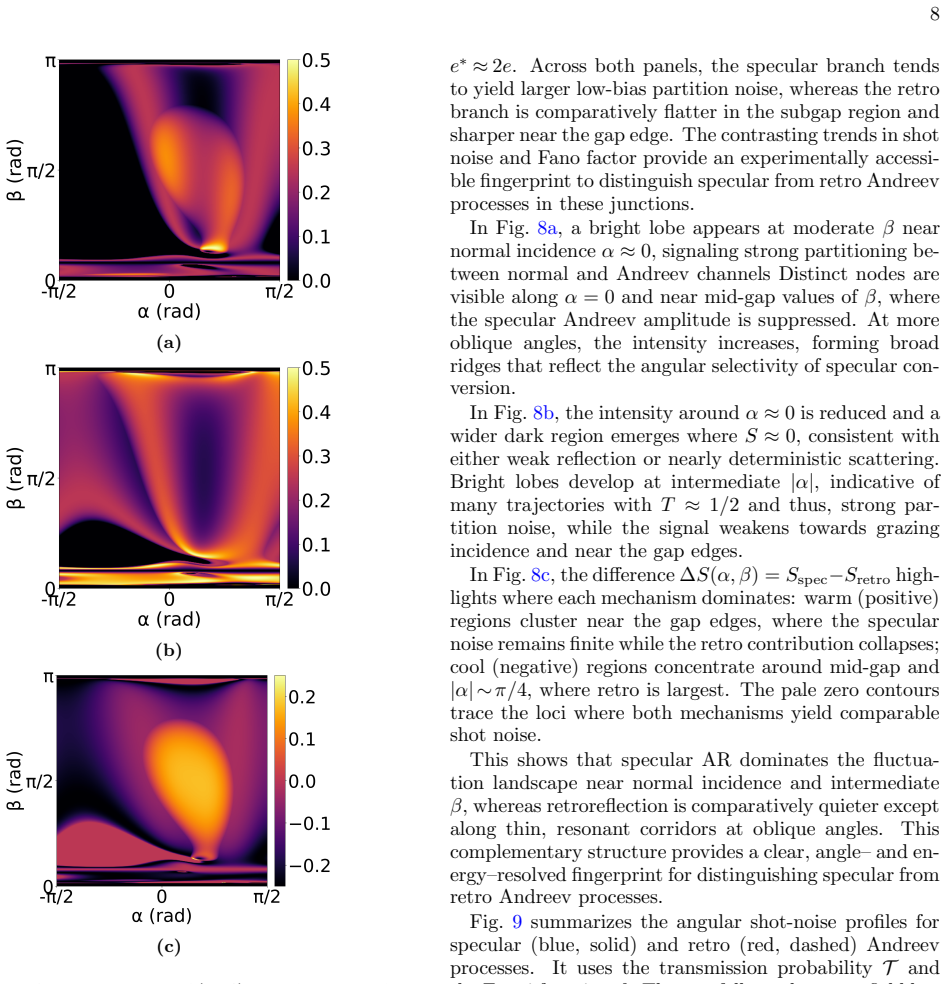
- In superconductor-graphene-superconductor junctions, the specular branch should show a zero-bias noise dome while the retro branch is flatter in the subgap; the difference map S_spec - S_retro is positive near the gap edges and negative at mid-gap and oblique angles.
- Temperature sweeps toward T_c should shrink the superconducting gap and erase the angular contrast; the paper itself notes that the apparent specular-only branch at high temperature is a modeling artifact, not a physical effect.
- The Cooper-pair-normalized Fano factor F_2e = S/(4eI) should track near-perfect 2e transfer in Andreev-dominated windows, giving an additional experimental handle on the transport mechanism.
Reading between the lines
- Beyond the paper: the predicted gate sweep can be tested in currently available hBN-encapsulated graphene with superconducting edge contacts; the cleanest test would measure both F and F_2e in the same sweep to isolate the effective transferred charge.
- Beyond the paper: because the two-interface results rest on transfer matrices taken from the authors' earlier work, an independent numerical BdG calculation of the same GSG and SGS junctions would be the decisive reproducibility check of those noise fingerprints.
- Beyond the paper: the angular structure of the noise maps suggests that an angle-selective graphene constriction could isolate retro-dominant and specular-dominant trajectories using noise alone, without requiring phase-sensitive measurements.
- Beyond the paper: applying a small magnetic field could test whether the specular noise signature survives Landau quantization, a regime the paper does not address and where the retro/specular distinction may acquire new features.
Editorial analysis
A structured set of objections, weighed in public.
Referee Report
Summary. The manuscript develops a BdG scattering framework for shot noise in graphene-superconductor (GS), graphene-superconductor-graphene (GSG), and superconductor-graphene-superconductor (SGS) junctions. The central claim is that the Fano factor provides a robust fingerprint distinguishing retro Andreev reflection (RAR) from specular Andreev reflection (SAR): RAR suppresses the Fano factor while SAR enhances it, leading to a gate-sweep signature in which F is minimized in the doped regime and rises toward charge neutrality. The paper derives reflection amplitudes for a single GS interface and imports transfer matrices for the two-interface geometries from the authors' earlier works.
Significance. If correct, the proposed noise fingerprints would be a valuable experimental tool for graphene-based superconducting devices. The analytic reflection amplitudes in Appendices A and B are concrete, and the attempt to unify three geometries is ambitious. However, the manuscript's own equations contradict its central qualitative claims, and the two-interface results are not independently verifiable from the text. The paper therefore currently does not deliver its advertised conclusion.
major comments (2)
- [Sections II.B-II.C] The GSG and SGS results are not self-contained. The transfer matrices M_GSG and M_SGS, which determine all scattering amplitudes and hence the noise for two of the three geometries, are not derived or even written down in the present manuscript; the text states that their explicit forms appear in the authors' earlier works [56] and [57]. This is a load-bearing gap: the reader cannot check the applicability of those matrices to the parameters used, nor reproduce the computed Fano factors. A self-contained derivation (at least in an appendix) or a detailed reproduction is required to support the central claims.
- [Section III, Eq. (7)] Eq. (7) is the Landauer formula for normal transmission of charge e. The manuscript sets T_n = |r_A|^2 without justifying that Andreev reflection obeys the same partition-noise statistics. While the Fano factors are later normalized with both e and 2e (e.g., Fig. 7), the substitution in Eq. (8) and the resulting numerical values need a clear derivation from the scattering-matrix formalism for a superconducting contact. The authors should state the assumptions (e.g., no normal transmission, subgap) and the relation between the Fano factor defined in Eq. (7) and the effective charge 2e.
minor comments (4)
- [Fig. 2a and Sec. IV.A] The dark ridge at β=π/2 is attributed to 'amplitude forces T→0', but according to Eq. (B2) the amplitude is finite (|r_A|≈1) at that point; the ridge is due to T(1-T)=0 with T=1. The physical interpretation should be corrected.
- [Notation] The symbol β is used both as the superconducting coherence angle (Appendix A) and as a phase variable in Fig. 8. The text should distinguish these uses to avoid confusion.
- [Fig. 7 caption] Typo: 'fucntion' should be 'function'. Also, the caption for Fig. 1 states a 'zero-bias minimum for the specular case' without clarifying whether this arises from T=0 or T=1; the text in Sec. IV.A suggests the former, but the underlying amplitude (B2) gives the latter.
- [Sec. IV.A and Figs. 6, 9] The temperature dependence of the noise is introduced via Δ(T)=Δ0 sqrt(1-(T/Tc)^2) only in the figure caption; the main text does not specify the thermal averaging kernel or the validity limits of the subgap approximations. Sec. IV.A partially acknowledges this in the discussion of Fig. 3c, but the same caveat should be applied consistently to the temperature-dependent figures.
Circularity Check
The single-interface GS derivation is self-contained, but the GSG and SGS predictions rest on transfer matrices imported from the authors' own prior papers [56,57] without derivation in this text; no definitional circularity or fitted-input prediction is present.
-
self citation load bearing
[Section II.B (GSG junction, after Eq. 4) and Section II.C (SGS junction, after Eq. 6), pp. 3–4]
"The explicit form of MGSG, together with the individual scattering amplitudes, appears in one of our earlier works [56]. ... The explicit form of MSGS and the derivation of the corresponding resonance and transmission coefficients appear in one of our earlier works [57]."
All GSG results (Figs. 4–6) and SGS results (Figs. 7–9) are presented as consequences of the transfer matrices M_GSG and M_SGS, but neither matrix is derived, written, or independently checked in this manuscript. The derivation chain is: Fano factor = function of scattering amplitudes; scattering amplitudes = M_GSG/M_SGS; M_GSG/M_SGS = 'one of our earlier works'. Thus the multi-interface noise predictions are not shown to follow from the stated BdG Hamiltonian or from an external benchmark; they reduce to an unverified self-citation. If [56,57] are incorrect or inapplicable to the plotted parameter ranges, the central GSG/SGS fingerprints collapse. This is not a fit-to-data circularity, but it is a load-bearing self-referential derivation gap.
full rationale
The paper's central single-interface claim is not circular: the reflection amplitudes in Eqs. (A5)–(B2) are obtained from explicit BdG wavefunction matching, and the Fano factor is computed from the standard scattering formula Eq. (7) with T = |r_A|^2. No parameter is fitted to the predicted noise, and no uniqueness theorem is imported. However, the GSG and SGS sections do not derive their transfer matrices; they refer to the authors' own earlier works [56,57]. This is a genuine reliance on self-citation for load-bearing inputs of two of the three geometries, raising the score to 4. It is not a definitional equivalence because the noise output is not identical to the matrix input. Separately, there is a serious internal inconsistency that is a correctness issue, not circularity: the text states that for the specular branch at E=0 (β=π/2) 'r_spec_A = 0 ⇒ T=0', but Eq. (B2) gives r_h = cosα e^{-iφ}/(i sinβ cosα) = e^{-iφ}/i, so |r_h|=1. This would invert the advertised gate-sweep fingerprint. Since circularity analysis concerns derivation equivalence rather than arithmetic errors, this is flagged here but not counted as a circular step.
Assumptions & free parameters
assumptions (4)
- domain assumption Single-valley massless Dirac model with no intervalley scattering
- domain assumption Step-like, atomically sharp, disorder-free pair potential profile
- domain assumption Shot noise given by the Landauer-Buttiker formula F = sum T_n(1-T_n)/sum T_n with T_n treated as the Andreev transmission probability
- ad hoc to paper Transfer matrices M_GSG and M_SGS taken from the authors' prior publications
Cite this review
Pith. "Pith review of Shot noise as a probe for Andreev reflection in graphene-based heterojunctions." pith.science (2026). https://pith.science/paper/HDION7KL
@misc{pith2026250900486,
  author       = {Pith},
  title        = {Pith review of: Shot noise as a probe for Andreev reflection in graphene-based heterojunctions},
  year         = {2026},
  howpublished = {\url{https://pith.science/paper/HDION7KL}},
  note         = {Machine review of arXiv:2509.00486}
}
read the original abstract
Shot noise emerges due to the discrete nature of charge transport and provides direct access to the underlying microscopic transport mechanisms governing current flow in mesoscopic conductors. In this work, we demonstrate that quantum shot noise offers a direct and robust fingerprint of Andreev reflection, distinguishing between retro and specular processes in graphene-superconductor, graphene-superconductor-graphene, and superconductor-graphene-superconductor junctions. At the graphene-superconductor interface, exact reflection amplitudes obtained from full wavefunction matching within the Bogoliubov-de Gennes formalism capture retro and specular regimes. The associated Fano factor exhibits distinct Fermi-level-dependent signatures, with retro Andreev reflection suppressing and specular Andreev reflection enhancing the shot noise. Extensions to graphene-superconductor-graphene and superconductor-graphene-superconductor configurations reveal how the transmission spectrum and, consequently, the noise profile are modified in the presence of multiple interfaces, coherent quasiparticle interference, and superconducting phase variations. Our findings establish shot noise spectroscopy as a potent and experimentally viable probe for differentiating Andreev reflection types in graphene-based quantum devices, providing complementary insights beyond conventional conductance measurements.
Figures


Figures from the paper (5 more)



Reference graph
Works this paper leans on
- [56]
- [57]
-
[1]
Y. M. Blanter and M. B¨ uttiker, Phys. Rep. (2000)
work page 2000
-
[2]
L. S. Levitov, H. Lee, and G. B. Lesovik, J. Math. Phys. (1996)
work page 1996
-
[3]
Y. V. Nazarov, Quantum Noise in Mesoscopic Physics (Springer, 2003)
work page 2003
- [4]
-
[5]
B¨ uttiker, Phys
M. B¨ uttiker, Phys. Rev. B46, 12485 (1992)
1992
- [6]
Show all 56 references
-
[7]
Oberholzer, E
S. Oberholzer, E. V. Sukhorukov, C. Sch¨ onenberger, T. Heinzel, K. Ensslin, and M. Holland, Phys. Rev. Lett. 86, 2114 (2001)
2001
-
[8]
Henny, S
M. Henny, S. Oberholzer, C. Strunk, T. Heinzel, K. En- sslin, M. Holland, and C. Sch¨ onenberger, Science 284, 296 (1999)
1999
-
[9]
G. B. Lesovik, JETP Lett. (1989)
1989
-
[10]
Reznikov, M
M. Reznikov, M. Heiblum, H. Shtrikman, and D. Mahalu, Phys. Rev. Lett. 75, 3340 (1995)
1995
-
[11]
C. W. J. Beenakker and M. B¨ uttiker, Phys. Rev. B 46, 1889 (1992)
1992
-
[12]
A. F. Andreev, Sov. Phys. JETP (1964)
1964
-
[13]
G. E. Blonder, M. Tinkham, and T. M. Klapwijk, Phys. Rev. B (1982)
1982
-
[14]
C. W. J. Beenakker, Phys. Rev. B (1992). 11
1992
-
[15]
P. G. de Gennes, Superconductivity of Metals and Alloys (Westview Press, 1999)
1999
-
[16]
Falci, D
G. Falci, D. Feinberg, and F. W. J. Hekking, Europhys. Lett. 54, 255 (2001)
2001
-
[17]
Beckmann, H
D. Beckmann, H. B. Weber, and H. v. L¨ ohneysen, Phys. Rev. Lett. 93, 197003 (2004)
2004
-
[18]
Russo, M
S. Russo, M. Kroug, T. M. Klapwijk, and A. F. Mor- purgo, Phys. Rev. Lett. 95, 027002 (2005)
2005
-
[20]
C. W. J. Beenakker, Rev. Mod. Phys. (2008)
2008
-
[21]
H. B. Heersche, P. Jarillo-Herrero, J. B. Oostinga, L. M. K. Vandersypen, and A. F. Morpurgo, Nature (2007)
2007
-
[22]
V. E. Calado, S. Goswami, G. Nanda, M. Diez, A. R. Akhmerov, K. Watanabe, T. Taniguchi, and L. M. K. Vandersypen, Nat. Nanotechnol. (2015)
2015
-
[23]
Mizuno, B
N. Mizuno, B. Nielsen, and X. Du, Nat. Commun. (2013)
2013
-
[24]
M. B. Shalom, M. J. Zhu, V. I. Fal’ko, A. Mishchenko, A. K. Geim, and K. S. Novoselov, Nat. Phys. (2016)
2016
-
[25]
A. H. C. Neto, F. Guinea, N. M. R. Peres, K. S. Novoselov, and A. K. Geim, Rev. Mod. Phys. (2009)
2009
-
[26]
C. W. J. Beenakker, Phys. Rev. Lett. (2006)
2006
-
[27]
Tinkham, Introduction to Superconductivity, 2nd ed
M. Tinkham, Introduction to Superconductivity, 2nd ed. (McGraw–Hill, 1996)
1996
-
[28]
A. V. Zaitsev, Sov. Phys. JETP (1984)
1984
-
[29]
M. Y. Kupriyanov and V. F. Lukichev, Sov. Phys. JETP (1988)
1988
-
[30]
Nilsson, A
J. Nilsson, A. R. Akhmerov, and C. W. J. Beenakker, Phys. Rev. Lett. (2007)
2007
-
[31]
Linder, T
J. Linder, T. Yokoyama, and A. Sudbø, Phys. Rev. B (2008)
2008
-
[32]
A. M. Black-Schaffer and S. Doniach, Phys. Rev. B (2008)
2008
-
[33]
D. K. Efetov, L. Wang, C. Handwerker, J. Shuang, and P. Kim, Nat. Phys. (2016)
2016
-
[34]
M. I. Katsnelson, K. S. Novoselov, and A. K. Geim, Nat. Phys. (2006)
2006
-
[35]
V. A. Khlus, Sov. Phys. JETP (1987)
1987
-
[36]
M. P. Anantram and S. Datta, Phys. Rev. B (1996)
1996
-
[37]
M. J. M. de Jong and C. W. J. Beenakker, Phys. Rev. B (1994)
1994
-
[38]
Y. V. Nazarov, Superlattices Microstruct. (1999)
1999
-
[39]
DiCarlo, J
L. DiCarlo, J. R. Williams, C. M. Marcus, and Y. Oreg, Phys. Rev. Lett. (2008)
2008
-
[40]
Danneau, F
R. Danneau, F. Wu, M. F. Craciun, S. Russo, M. Y. Tomi, J. Salmilehto, A. F. Morpurgo, and P. J. Hakonen, Phys. Rev. Lett. (2008)
2008
-
[41]
Cayssol, Phys
J. Cayssol, Phys. Rev. Lett. (2008)
2008
-
[42]
Rickhaus, R
P. Rickhaus, R. Maurand, M.-H. Liu, M. Weiss, K. Richter, and C. Sch¨ onenberger, Nat. Commun. (2015)
2015
-
[43]
Tanaka and S
Y. Tanaka and S. Kashiwaya, Phys. Rep. (2000)
2000
-
[44]
Cuevas and W
E. Cuevas and W. Belzig, Phys. Rev. Lett. (2003)
2003
-
[45]
Y. V. Nazarov and Y. M. Blanter, Quantum Trans- port: Introduction to Nanoscience (Cambridge Univer- sity Press, 2009)
2009
-
[46]
A. A. Golubov, M. Y. Kupriyanov, and E. Il’ichev, Rev. Mod. Phys. (2004)
2004
-
[47]
Titov and C
M. Titov and C. W. J. Beenakker, Phys. Rev. B (2006)
2006
-
[48]
K. K. Likharev, Rev. Mod. Phys. (1979)
1979
-
[49]
Bretheau, C ¸
L. Bretheau, C ¸ . ¨O. Girit, H. Pothier, D. Esteve, and C. Urbina, Nature (2013)
2013
-
[50]
Octavio, M
M. Octavio, M. Tinkham, G. E. Blonder, and T. M. Klap- wijk, Phys. Rev. B (1983)
1983
-
[51]
Averin and A
D. Averin and A. Bardas, Phys. Rev. Lett. (1995)
1995
-
[52]
Bardas and D
A. Bardas and D. V. Averin, Phys. Rev. B (1997)
1997
-
[53]
E. N. Bratus’, V. S. Shumeiko, and G. Wendin, Phys. Rev. Lett. (1995)
1995
-
[54]
J. C. Cuevas, A. Mart ´ ın-Rodero, and A. L. Yeyati, Phys. Rev. B (1996)
1996
-
[55]
J. C. Cuevas, A. L. Yeyati, and A. Mart ´ ın-Rodero, Phys. Rev. Lett. (1998)
1998
Reviewed August 5, 2026 · model on record in the stance chip above.
Discussion (0). Continue with ORCID to comment.