REVIEW 5 major objections 5 minor 124 references
Two-dimensional Disordered Projected Branes: Stability and Quantum Criticality via Dimensional Reduction
T0 review · 5 major / 5 minor · reviewed 2026-08-06 · deepseek-v4-flash
Pith's one-line read The paper argues that a two-dimensional slice of a three-dimensional disordered cubic lattice, built by Schur projection, reproduces the parent crystal's full disorder phase diagram—stable metal and semimetal phases, the Anderson…
desk verdict Solid numerics and honest presentation, but the static Schur complement is validated only at zero energy; the 'full phase diagram' claim needs a direct check of the brane-restricted spectrum before it is accepted. read the letter →
The pith
A machine-rendered reading of the paper's core claim, the machinery that carries it, and where it could break.
The reading
What carries the argument
The central object is the Schur-complement effective Hamiltonian for a 2D projected brane, $H_{\rm PB}(\kappa)=H_{11}-\kappa H_{12}H_{22}^{-1}H_{21}$, where $H_{11}$ acts on brane sites, $H_{22}$ on sites outside, and $H_{12},H_{21}$ couple the two sets; setting $\kappa=1$ gives the exact Schur complement, while $\kappa=0$ removes the integrated-out couplings and reduces to a conventional 2D nearest-neighbor model. The inverse of $H_{22}$ makes the effective hopping long-ranged, and the paper argues this long-ranged hopping effectively restores three-dimensionality, which is why stable metallic and semimetallic phases and 3D-like critical exponents appear. The diagnostics are the typical density of states at zero energy (an order parameter for both the Anderson and the semimetal-to-metal transitions) and the average density of states at zero energy (an additional order parameter for the semimetal-to-metal transition).
What would settle it
Recompute the brane phase diagram using the frequency-resolved Schur complement $(E-H_{22})^{-1}$ with $E$ small but nonzero, or vary the hyperplane offset $\eta$ and orientation; if the critical disorder $W_c$ or the exponents $\alpha$, $\beta$ move outside the reported error bars, the zero-energy static projection is not the right effective model and the claimed dimensional inheritance fails.
Extended reading notes
Core claim
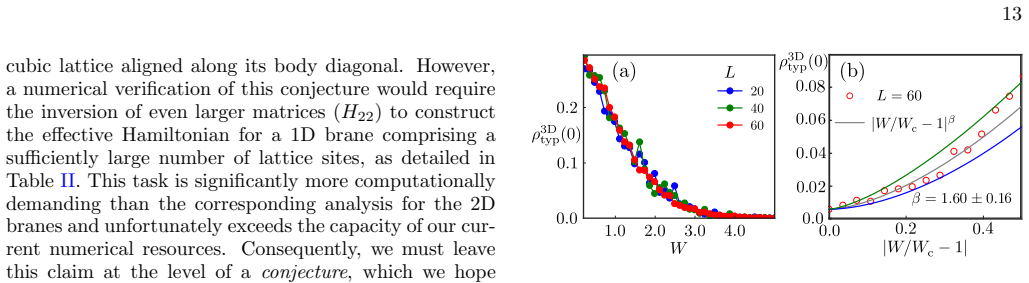
The central claim is that the projected-brane Hamiltonian $H_{\rm PB}=H_{11}-H_{12}H_{22}^{-1}H_{21}$, built from a parent cubic-lattice Anderson or Weyl model by removing all sites outside a 2D hexagonal hyperplane, is not just a generic 2D disordered model: it inherits the phase diagram of the 3D parent. For the Anderson parent, the brane shows a metallic phase up to $W_c=17.95\pm0.50$ with order-parameter exponent $\beta=1.55\pm0.10$, compared with $W_c=3.50\pm0.15$ and $\beta=1.60\pm0.14$ on the parent cubic lattice. For the Weyl parent, the brane shows a semimetal-to-metal transition at $W_c=0.70\pm0.02$ with $\alpha=1.01\pm0.05$ and $\beta=1.55\pm0.10$ (and $\alpha=0.98\pm0.05$, $\beta=1.50\pm0.05$ when the disordered Hamiltonian is projected directly), followed by an Anderson transition at $W_c=20.00\pm1.00$ with $\beta=1.60\pm0.15$, matching the 3D Weyl results within numerical accuracy. The same conclusions hold whether disorder is added after projection or inherited through projection, and the authors state that both procedures give the same critical disorder strength.
Load-bearing premise
The load-bearing premise is that integrating out the outside sites once, at zero energy, is the same as integrating them out at every energy; if that fails, the brane is just a different 2D model and the matching exponents are coincidental.
Editorial extensions
If this is right
- A 2D projected brane made from a 3D Anderson parent hosts a stable metallic phase up to $W_c=17.95\pm0.50$, then an Anderson transition with $\beta=1.55\pm0.10$; ordinary 2D lattices show no such phase.
- A 2D projected Weyl brane hosts a semimetal-to-metal transition at $W_c=0.70\pm0.02$ and a subsequent Anderson transition at $W_c=20.00\pm1.00$, reproducing the 3D Weyl phase diagram.
- The critical exponents $\alpha$ and $\beta$ on the branes agree with the 3D parent values within numerical accuracy, so the brane transitions belong to the same apparent universality class rather than a conventional 2D class.
- Projecting the clean Hamiltonian and then adding disorder, or projecting the disordered Hamiltonian directly, gives the same phase diagram; thus long-range correlated disorder inherited from projection does not change the critical behavior within numerical accuracy.
- Because the effective brane Hamiltonian needs only moderately long-ranged hopping, photonic lattices with tunable refractive-index disorder are proposed as experimentally accessible platforms to observe these 3D transitions in two dimensions.
Reading between the lines
- Beyond the paper, the same mechanism predicts that any 2D reduction with sufficiently long-ranged hopping—not only the Schur complement of a cubic lattice—should show 3D-like disorder criticality, so the result could be tested by truncating the hopping range in the brane Hamiltonian and watching the exponents drift between 3D and 2D behavior.
- Beyond the paper, the matching of density-of-states exponents leaves eigenfunction statistics untested; a direct calculation of level-spacing ratios or multifractal spectra on the brane at $W_c$ would show whether the full 3D Anderson universality class, not just the order parameters, is inherited.
- Beyond the paper, the choice of hyperplane orientation and offset $\eta=1/100$ is not varied; if future calculations show the critical exponents depend on the slice geometry, the dimensional inheritance would be a property of special slices rather than of projected branes in general.
Editorial analysis
A structured set of objections, weighed in public.
Referee Report
Summary. The manuscript studies two-dimensional 'projected branes' (PBs) obtained from three-dimensional cubic-lattice parent systems by integrating out degrees of freedom through the static Schur complement, Eq. (2). For parent Anderson and Weyl models, the authors compute the typical and average density of states on the PB by exact diagonalization (and on the parent by both ED and KPM), and report that the 2D PB hosts a stable metallic phase (Anderson model) as well as semimetal-to-metal and metal-insulator transitions (Weyl model), with critical exponents close to the corresponding 3D values. The central claim is that 2D PBs faithfully reproduce the full disorder phase diagram of their 3D parents, thereby acting as 'quantum holographic images'.
Significance. If the central claim holds, the result is conceptually striking: a two-dimensional effective Hamiltonian, despite the usual 2D localization orthodoxy, would exhibit 3D disorder universality, and the work would suggest concrete metamaterial realizations. The paper's numerical effort is substantial and well benchmarked: ED results for the 3D Anderson and Weyl models are cross-checked against KPM on larger lattices, two different disorder-implementation protocols (project-then-disorder vs. disorder-then-project) are compared, and the zero-mode contamination in Weyl systems is handled by a clearly described subtraction. These are genuine strengths. However, the central claim rests on the use of the static Schur complement as an energy-independent effective Hamiltonian, and that step is not validated against the exact brane-restricted dynamics of the parent. This is a load-bearing gap that prevents the manuscript from establishing its main conclusion as stated.
major comments (5)
- [§I.B, Eq. (2)] The static Schur complement H_PB = H11 - H12 H22^{-1} H21 is used as an energy-independent Hamiltonian, but the exact brane-restricted Green's function is G_brane(E) = (E - H11 - H12 (E - H22)^{-1} H21)^{-1}. The static H_PB coincides with the effective Hamiltonian only at E = 0 and only for the zero-energy spectral projection; the manuscript does not show that the TDOS/ADOS of H_PB reproduces the brane-restricted DOS of the parent, even at E = 0. Since both ED1 and ED2 diagonalize the same static H_PB (after projection), they cannot detect a failure of this static approximation. The central claim therefore requires a direct test, for example comparing the brane-restricted spectral function of the disordered parent with the DOS of H_PB at and near E = 0 for small L.
- [§III.A, §III.C, and Table I] The semimetal-to-metal transition on the PWB is characterized by two order parameters that give different critical disorder strengths: W_c = 0.70 ± 0.02 from ADOS (Fig. 6) and W_c = 0.75 ± 0.10 from TDOS (Fig. 8). The text notes these are 'strictly expected to be identical' but does not resolve the discrepancy. Since the paper's quantitative claim is that the PB reproduces the 3D phase diagram, this mismatch, if not traced to the zero-mode removal procedure or to finite-size systematics, weakens the quantitative conclusion and should be discussed with a concrete explanation.
- [§I.B, Eq. (2) and Table II] The construction requires H22 to be invertible, but the manuscript never reports the condition number or the smallest singular value of H22 for the system sizes listed in Table II. For odd L, the clean Weyl Hamiltonian has exact zero-energy modes (Appendix A); if any of these modes lies in the H22 block, the inverse in Eq. (2) is singular. The authors should verify invertibility for the systems used and demonstrate that the results are robust to a regularized inverse (e.g., H22 + δ I with small δ), or choose hyperplane configurations that avoid singular H22 blocks.
- [§I.B and §IV] The hyperplane orientation and offset dependence is not tested: the text fixes γ_j = 1 and η = 1/100 and states 'we believe that our conclusions are insensitive to the choice of orientation of 2D hyperplanes', deferring an explicit check to future work. Given that the claim is that 2D PBs in general reproduce the 3D phase diagram, at least one alternative orientation and offset should be tested for both the Anderson MIT and the Weyl SMMT to support this generality.
- [§III.B] The critical exponents α and β for the PWB are extracted from single-system-size data, and the data collapse in Fig. 7(f) and 7(i) is then performed with the same data and the same fitted exponents, so the collapse is not an independent validation of the scaling form. The 3D benchmarks are independently cross-checked with KPM on large lattices, but no such check is available for the dense H_PB. The authors should either include additional PB sizes in the scaling analysis or test the sensitivity of α and β to the chosen fitting window and to the inclusion of subleading corrections.
minor comments (5)
- [§I.B] The hyperplane coefficients are denoted γ_j in Eq. (3), but the text below Eq. (4) refers to 'α_j = 1 for j = 1, 2, 3'; the symbol α_j is not defined and conflicts with the DOS exponent α introduced later in Section III.B.
- [§II.A] There is a typo in the sentence 'the inverse of a spare matrix is generally non-sparse'; it should read 'sparse matrix'.
- [§III.A] The phrase 'This comperative analysis' in the paragraph following Fig. 6 should read 'This comparative analysis'.
- [§III.B] The text states that 'the effective dimensionality of the 2D PWB is, however, ambiguous' and then uses scaling forms with d = 3; the justification for mapping α and β to z and ν, or for reporting α and β as the independent exponents, should be stated more explicitly.
- [Appendix B] In the first paragraph of Appendix B, the sentence 'we further utilize KPM to determine Wc for the prototypical cubic lattice-based model Hamiltonian for 3D Weyl semimetal in terms of nearest-neighbor hopping amplitudes from Eq. (10)' is awkwardly phrased; the phrase 'in terms of nearest-neighbor hopping amplitudes' appears redundant.
Circularity Check
No significant circularity: brane order parameters and exponents are computed independently and compared with 3D values.
full rationale
The paper's central claim, that 2D projected branes reproduce the disorder phase diagram and critical exponents of their 3D parents, is a numerical comparison rather than a derivation from the compared quantities. The brane Hamiltonian HPB = H11 - H12 H22^{-1} H21 in Eq. (2) is constructed from the parent lattice, and the order parameters rho_typ(0) and Delta rho(0) are then computed by exact diagonalization or KPM. The critical Wc, alpha, and beta are extracted from independent scaling fits of the brane data; none of these fits uses the 3D parent exponents as input. The 3D reference values are recomputed within the same paper (Figs. 3, 5, 7, 9-11) or taken from external literature. The self-citations to Refs. [1-3] and [48] define the construction method and contextualize exponents, but they are not invoked to forbid alternatives or to supply the predicted values. The static Schur complement is an energy-independent approximation whose validity is a physical assumption and a possible correctness risk, but it is not circular: the claim would be falsified if the brane data did not match the 3D data. No load-bearing step reduces by construction to its own input.
Assumptions & free parameters
free parameters (5)
- kappa (kappa in Eq. (2)) =
1 (exact Schur complement; kappa = 0 used for comparison)
- hyperplane coefficients gamma_j =
1 for j = 1, 2, 3
- hyperplane offset eta =
1/100
- DOS broadening epsilon =
5e-4
- number of discarded eigenstates in TDOS =
2
assumptions (4)
- domain assumption The Schur complement H_PB = H11 - H12 H22^{-1} H21 is a valid effective Hamiltonian for the brane subspace at all energies.
- standard math Periodic boundary conditions on the parent cubic lattice are inherited by the projected brane.
- domain assumption The zero-energy modes identified in Appendix A are finite-size artifacts and can be removed or subtracted.
- domain assumption Finite brane sizes (up to ~2755 sites) are large enough for the linear scaling analysis in 1/N to the thermodynamic limit.
Cite this review
Pith. "Pith review of Two-dimensional Disordered Projected Branes: Stability and Quantum Criticality via Dimensional Reduction." pith.science (2026). https://pith.science/paper/QBBZPAMR
@misc{pith2026250723780,
  author       = {Pith},
  title        = {Pith review of: Two-dimensional Disordered Projected Branes: Stability and Quantum Criticality via Dimensional Reduction},
  year         = {2026},
  howpublished = {\url{https://pith.science/paper/QBBZPAMR}},
  note         = {Machine review of arXiv:2507.23780}
}
read the original abstract
The interplay of disorder and dimensionality governs the emergence and stability of electronic phases in quantum materials and quantum phase transitions among them. While three-dimensional (3D) dirty Fermi liquids and Weyl semimetals support robust metallic states, undergoing disorder-driven Anderson localization transitions at strong disorder and the later ones exhibiting additional semimetal-to-metal transition at moderate disorder, conventional two-dimensional (2D) non-interacting systems localize for arbitrarily weak disorder. Here, we show that 2D disordered projected branes, constructed by systematically integrating out degrees of freedom from a 3D cubic lattice via the Schur decomposition, faithfully reproduce the full quantum phase diagram of their 3D parent systems. Using large-scale exact diagonalization and kernel polynomial method, we numerically demonstrate that 2D projected branes host stable metallic and semimetallic phases. Remarkably, the critical exponents governing the semimetal-to-metal and metal-insulator transitions on such 2D projected branes are sufficiently close to those of their 3D counterparts. Our findings thus establish 2D projected branes as genuine quantum holographic images of their higher-dimensional disordered parent crystals, supporting stable semimetallic and metallic phases that are otherwise inaccessible in conventional 2D lattices. Finally, we point to experimentally accessible metamaterial platforms, most notably the photonic lattices with tunable refractive-index disorder, as promising systems to realize and probe these phenomena.
Figures


Figures from the paper (8 more)




Reference graph
Works this paper leans on
-
[1]
Panigrahi, V
A. Panigrahi, V. Juriˇ ci´ c, and B. Roy, Projected topo- logical branes, Commun. Phys. 5, 230 (2022)
2022
-
[2]
A. C. Tyner and V. Juriˇ ci´ c, Three-dimensionalZ topo- logical insulators without reflection symmetry, Sci. Rep. 14, 4288 (2024)
2024
-
[3]
D. J. Salib, A. J. Mains, and B. Roy, Topological insula- tors on fractal lattices: A general principle of construc- tion, Phys. Rev. B 110, L241302 (2024)
2024
-
[4]
Schur, ¨Uber potenzreihen, die im innern des einheit- skreises beschr¨ ankt sind, J
J. Schur, ¨Uber potenzreihen, die im innern des einheit- skreises beschr¨ ankt sind, J. reine u. angewandte Math- ematik 1917, 205 (1917)
1917
-
[5]
Chakravarty, L
S. Chakravarty, L. Yin, and E. Abrahams, Interac- tions and scaling in a disordered two-dimensional metal, Phys. Rev. B 58, R559 (1998)
1998
-
[6]
P. W. Anderson, Absence of Diffusion in Certain Ran- dom Lattices, Phys. Rev. 109, 1492 (1958)
1958
-
[7]
D. J. Thouless, Anderson’s theory of localized states, J. Phys. C: Solid State Phys. 3, 1559 (1970)
1970
-
[8]
Abrahams, P
E. Abrahams, P. W. Anderson, D. C. Licciardello, and T. V. Ramakrishnan, Scaling Theory of Localization: Absence of Quantum Diffusion in Two Dimensions, Phys. Rev. Lett. 42, 673 (1979)
1979
Show all 124 references
-
[9]
Wegner, The mobility edge problem: Continuous symmetry and a conjecture, Z
F. Wegner, The mobility edge problem: Continuous symmetry and a conjecture, Z. Phys. B 35, 207 (1979)
1979
-
[10]
P. A. Lee and D. S. Fisher, Anderson Localization in Two Dimensions, Phys. Rev. Lett. 47, 882 (1981)
1981
-
[11]
Hikami, Anderson localization in a nonlinear-σ-model representation, Phys
S. Hikami, Anderson localization in a nonlinear-σ-model representation, Phys. Rev. B 24, 2671 (1981)
1981
-
[12]
P. A. Lee and T. V. Ramakrishnan, Disordered elec- tronic systems, Rev. Mod. Phys. 57, 287 (1985)
1985
-
[13]
Belitz and T
D. Belitz and T. R. Kirkpatrick, The Anderson-Mott transition, Rev. Mod. Phys. 66, 261 (1994)
1994
-
[14]
Janssen, Statistics and scaling in disordered meso- scopic electron systems, Phys
M. Janssen, Statistics and scaling in disordered meso- scopic electron systems, Phys. Rep. 295, 1 (1998)
1998
-
[15]
Slevin and T
K. Slevin and T. Ohtsuki, Corrections to Scaling at the Anderson Transition, Phys. Rev. Lett. 82, 382 (1999)
1999
-
[16]
Slevin and T
K. Slevin and T. Ohtsuki, Numerical verification of uni- versality for the anderson transition, Phys. Rev. B 63, 045108 (2001)
2001
-
[17]
Klopp, Weak disorder localization and Lifshitz tails, Commun
F. Klopp, Weak disorder localization and Lifshitz tails, Commun. Math. Phys. 232, 125 (2002)
2002
-
[18]
Dobrosavljevi´ c, A
V. Dobrosavljevi´ c, A. Pastor, and B. Nikoli´ c, Typical medium theory of Anderson localization: A local or- der parameter approach to strong-disorder effects, Eu- rophys. Lett. 62, 76 (2003)
2003
-
[19]
Brndiar and P
J. Brndiar and P. Markoˇ s, Universality of the metal- insulator transition in three-dimensional disordered sys- tems, Phys. Rev. B 74, 153103 (2006)
2006
-
[20]
X. Jia, A. R. Subramaniam, I. A. Gruzberg, and S. Chakravarty, Entanglement entropy and multifractal- ity at localization transitions, Phys. Rev. B 77, 014208 (2008)
2008
-
[21]
Evers and A
F. Evers and A. D. Mirlin, Anderson transitions, Rev. Mod. Phys. 80, 1355 (2008)
2008
-
[22]
Rodriguez, L
A. Rodriguez, L. J. Vasquez, K. Slevin, and R. A. R¨ omer, Critical Parameters from a Generalized Multi- fractal Analysis at the Anderson Transition, Phys. Rev. Lett. 105, 046403 (2010)
2010
-
[23]
Fradkin, Critical behavior of disordered degenerate semiconductors
E. Fradkin, Critical behavior of disordered degenerate semiconductors. II. Spectrum and transport properties in mean-field theory, Phys. Rev. B 33, 3263 (1986)
1986
-
[24]
Shindou and S
R. Shindou and S. Murakami, Effects of disorder in three-dimensional Z2 quantum spin Hall systems, Phys. Rev. B 79, 045321 (2009)
2009
-
[25]
Goswami and S
P. Goswami and S. Chakravarty, Quantum Criticality between Topological and Band Insulators in 3 + 1 Di- 17 mensions, Phys. Rev. Lett. 107, 196803 (2011)
2011
-
[26]
Kobayashi, T
K. Kobayashi, T. Ohtsuki, and K.-I. Imura, Disordered Weak and Strong Topological Insulators, Phys. Rev. Lett. 110, 236803 (2013)
2013
-
[27]
Kobayashi, T
K. Kobayashi, T. Ohtsuki, K.-I. Imura, and I. F. Her- but, Density of states scaling at the semimetal to metal transition in three dimensional topological insulators, Phys. Rev. Lett. 112, 016402 (2014)
2014
-
[28]
Roy and S
B. Roy and S. Das Sarma, Diffusive quantum criticality in three-dimensional disordered Dirac semimetals, Phys. Rev. B 90, 241112 (2014)
2014
-
[29]
S. V. Syzranov, L. Radzihovsky, and V. Gurarie, Critical Transport in Weakly Disordered Semiconductors and Semimetals, Phys. Rev. Lett. 114, 166601 (2015)
2015
-
[30]
S. V. Syzranov, V. Gurarie, and L. Radzihovsky, Un- conventional localization transition in high dimensions, Phys. Rev. B 91, 035133 (2015)
2015
-
[31]
Altland and D
A. Altland and D. Bagrets, Effective field theory of the disordered weyl semimetal, Phys. Rev. Lett. 114, 257201 (2015)
2015
-
[32]
J. H. Pixley, P. Goswami, and S. Das Sarma, Anderson localization and the quantum phase diagram of three di- mensional disordered dirac semimetals, Phys. Rev. Lett. 115, 076601 (2015)
2015
-
[33]
S. V. Syzranov, P. M. Ostrovsky, V. Gurarie, and L. Radzihovsky, Critical exponents at the unconven- tional disorder-driven transition in a Weyl semimetal, Phys. Rev. B 93, 155113 (2016)
2016
-
[34]
J. H. Pixley, P. Goswami, and S. Das Sarma, Disorder-driven itinerant quantum criticality of three- dimensional massless Dirac fermions, Phys. Rev. B 93, 085103 (2016)
2016
-
[35]
Roy and S
B. Roy and S. Das Sarma, Erratum: Diffusive quan- tum criticality in three-dimensional disordered Dirac semimetals [Phys. Rev. B 90, 241112(R) (2014)], Phys. Rev. B 93, 119911 (2016)
2014
-
[36]
S. Bera, J. D. Sau, and B. Roy, Dirty weyl semimet- als: Stability, phase transition, and quantum criticality, Phys. Rev. B 93, 201302 (2016)
2016
-
[37]
E. V. Gorbar, V. A. Miransky, I. A. Shovkovy, and P. O. Sukhachov, Origin of dissipative Fermi arc transport in Weyl semimetals, Phys. Rev. B 93, 235127 (2016)
2016
-
[38]
B. Roy, V. Juriˇ ci´ c, and S. Das Sarma, Universal optical conductivity of a disordered weyl semimetal, Sci. Rep. 6, 32446 (2016)
2016
-
[39]
Roy and S
B. Roy and S. Das Sarma, Quantum phases of interact- ing electrons in three-dimensional dirty dirac semimet- als, Phys. Rev. B 94, 115137 (2016)
2016
-
[40]
Louvet, D
T. Louvet, D. Carpentier, and A. A. Fedorenko, On the disorder-driven quantum transition in three- dimensional relativistic metals, Phys. Rev. B94, 220201 (2016)
2016
-
[41]
Louvet, D
T. Louvet, D. Carpentier, and A. A. Fedorenko, New quantum transition in Weyl semimetals with correlated disorder, Phys. Rev. B 95, 014204 (2017)
2017
-
[42]
J. H. Wilson, J. H. Pixley, P. Goswami, and S. Das Sarma, Quantum phases of disordered three- dimensional Majorana-Weyl fermions, Phys. Rev. B 95, 155122 (2017)
2017
-
[43]
J. H. Pixley, Y.-Z. Chou, P. Goswami, D. A. Huse, R. Nandkishore, L. Radzihovsky, and S. Das Sarma, Single-particle excitations in disordered Weyl fluids, Phys. Rev. B 95, 235101 (2017)
2017
-
[44]
Goswami and S
P. Goswami and S. Chakravarty, Superuniversality of topological quantum phase transition and global phase diagram of dirty topological systems in three dimen- sions, Phys. Rev. B 95, 075131 (2017)
2017
-
[45]
B. Roy, Y. Alavirad, and J. D. Sau, Global Phase Dia- gram of a Three-Dimensional Dirty Topological Super- conductor, Phys. Rev. Lett. 118, 227002 (2017)
2017
-
[46]
Slager, V
R.-J. Slager, V. Juriˇ ci´ c, and B. Roy, Dissolution of topo- logical Fermi arcs in a dirty Weyl semimetal, Phys. Rev. B 96, 201401 (2017)
2017
-
[47]
J. H. Wilson, J. H. Pixley, D. A. Huse, G. Refael, and S. Das Sarma, Do the surface Fermi arcs in Weyl semimetals survive disorder?, Phys. Rev. B 97, 235108 (2018)
2018
-
[48]
Roy, R.-J
B. Roy, R.-J. Slager, and V. Juriˇ ci´ c, Global Phase Di- agram of a Dirty Weyl Liquid and Emergent Superuni- versality, Phys. Rev. X 8, 031076 (2018)
2018
-
[49]
Balog, D
I. Balog, D. Carpentier, and A. A. Fedorenko, Disorder- Driven Quantum Transition in Relativistic Semimet- als: Functional Renormalization via the Porous Medium Equation, Phys. Rev. Lett. 121, 166402 (2018)
2018
-
[50]
Brillaux, D
E. Brillaux, D. Carpentier, and A. A. Fedorenko, Mul- tifractality at the weyl-semimetal–diffusive-metal tran- sition for generic disorder, Phys. Rev. B 100, 134204 (2019)
2019
-
[51]
A. L. Szab´ o and B. Roy, Dirty higher-order Dirac semimetal: Quantum criticality and bulk-boundary cor- respondence, Phys. Rev. Res. 2, 043197 (2020)
2020
-
[52]
Brillaux, A
E. Brillaux, A. A. Fedorenko, and I. A. Gruzberg, Sur- face quantum critical phenomena in disordered dirac semimetals, Phys. Rev. B 109, 174204 (2024)
2024
-
[53]
Wegner, Four-loop-order β-function of nonlinear σ- models in symmetric spaces, Nucl
F. Wegner, Four-loop-order β-function of nonlinear σ- models in symmetric spaces, Nucl. Phys. B 316, 663 (1989)
1989
-
[54]
S. N. Evangelou and T. Ziman, The Anderson transition in two dimensions in the presence of spin-orbit coupling, J. Phys. C 20, L235 (1987)
1987
-
[55]
Ando, Numerical study of symmetry effects on local- ization in two dimensions, Phys
T. Ando, Numerical study of symmetry effects on local- ization in two dimensions, Phys. Rev. B40, 5325 (1989)
1989
-
[56]
S. N. Evangelou, Anderson Transition, Scaling, and Level Statistics in the Presence of Spin Orbit Coupling, Phys. Rev. Lett. 75, 2550 (1995)
1995
-
[57]
Asada, K
Y. Asada, K. Slevin, and T. Ohtsuki, Anderson Transi- tion in Two-Dimensional Systems with Spin-Orbit Cou- pling, Phys. Rev. Lett. 89, 256601 (2002)
2002
-
[58]
Asada, K
Y. Asada, K. Slevin, and T. Ohtsuki, Numerical estima- tion of the β function in two-dimensional systems with spin-orbit coupling, Phys. Rev. B 70, 035115 (2004)
2004
-
[59]
A. Chen, J. Maciejko, and I. Boettcher, Anderson Lo- calization Transition in Disordered Hyperbolic Lattices, Phys. Rev. Lett. 133, 066101 (2024)
2024
-
[60]
T. Li, Y. Peng, Y. Wang, and H. Hu, Anderson tran- sition and mobility edges on hyperbolic lattices with randomly connected boundaries, Commun. Phys. 7, 10.1038/s42005-024-01848-7 (2024)
2024 doi
-
[61]
A. B. Harris, Effect of random defects on the critical behaviour of Ising models, J. Phys. C 7, 1671 (1974)
1974
-
[62]
J. T. Chayes, L. Chayes, D. S. Fisher, and T. Spencer, Finite-Size Scaling and Correlation Lengths for Disor- dered Systems, Phys. Rev. Lett. 57, 2999 (1986)
1986
-
[63]
Nielsen and M
H. Nielsen and M. Ninomiya, Absence of neutrinos on a lattice: (I). Proof by homotopy theory, Nucl. Phys. B 185, 20 (1981)
1981
-
[64]
Nielsen and M
H. Nielsen and M. Ninomiya, Absence of neutrinos on a lattice: (II). Intuitive topological proof, Nucl. Phys. B 18 193, 173 (1981)
1981
-
[65]
A. P. Schnyder, S. Ryu, A. Furusaki, and A. W. W. Ludwig, Classification of topological insulators and su- perconductors in three spatial dimensions, Phys. Rev. B 78, 195125 (2008)
2008
-
[66]
S. Ryu, A. P. Schnyder, A. Furusaki, and A. W. Lud- wig, Topological insulators and superconductors: ten- fold way and dimensional hierarchy, New J. Phys. 12, 065010 (2010)
2010
-
[67]
P. M. Ostrovsky, I. V. Gornyi, and A. D. Mirlin, Quan- tum Criticality and Minimal Conductivity in Graphene with Long-Range Disorder, Phys. Rev. Lett. 98, 256801 (2007)
2007
-
[68]
J. H. Bardarson, J. Tworzyd lo, P. W. Brouwer, and C. W. J. Beenakker, One-Parameter Scaling at the Dirac Point in Graphene, Phys. Rev. Lett. 99, 106801 (2007)
2007
-
[69]
S. Ryu, C. Mudry, H. Obuse, and A. Furusaki, Z2 Topological Term, the Global Anomaly, and the Two- Dimensional Symplectic Symmetry Class of Anderson Localization, Phys. Rev. Lett. 99, 116601 (2007)
2007
-
[70]
Nomura, M
K. Nomura, M. Koshino, and S. Ryu, Topological Delo- calization of Two-Dimensional Massless Dirac Fermions, Phys. Rev. Lett. 99, 146806 (2007)
2007
-
[71]
Nandkishore, D
R. Nandkishore, D. A. Huse, and S. L. Sondhi, Rare region effects dominate weakly disordered three- dimensional Dirac points, Phys. Rev. B 89, 245110 (2014)
2014
-
[72]
J. H. Pixley, D. A. Huse, and S. Das Sarma, Rare-region- induced avoided quantum criticality in disordered three- dimensional dirac and weyl semimetals, Phys. Rev. X 6, 021042 (2016)
2016
-
[73]
J. H. Pixley, D. A. Huse, and S. Das Sarma, Uncovering the hidden quantum critical point in disordered massless dirac and weyl semimetals, Phys. Rev. B 94, 121107 (2016)
2016
-
[74]
Buchhold, S
M. Buchhold, S. Diehl, and A. Altland, Vanishing Den- sity of States in Weakly Disordered Weyl Semimetals, Phys. Rev. Lett. 121, 215301 (2018)
2018
-
[75]
J. H. Wilson, D. A. Huse, S. Das Sarma, and J. H. Pixley, Avoided quantum criticality in exact numerical simulations of a single disordered Weyl cone, Phys. Rev. B 102, 100201 (2020)
2020
-
[76]
Y. Fu, J. H. Wilson, D. A. Huse, and J. H. Pixley, Di- rect topological insulator transitions in three dimensions are destabilized by nonperturbative effects of disorder, Phys. Rev. B 109, 205106 (2024)
2024
-
[77]
Pixley and J
J. Pixley and J. H. Wilson, Rare regions and avoided quantum criticality in disordered Weyl semimetals and superconductor, Ann. Phys. (Amsterdam) 435, 168455 (2021)
2021
-
[78]
Weiße, G
A. Weiße, G. Wellein, A. Alvermann, and H. Fehske, The kernel polynomial method, Rev. Mod. Phys. 78, 275 (2006)
2006
-
[79]
Lanczos, An iteration method for the solution of the eigenvalue problem of linear differential and integral op- erators, J
C. Lanczos, An iteration method for the solution of the eigenvalue problem of linear differential and integral op- erators, J. Res. Nat. Bur. Stand. 45, 255 (1950)
1950
-
[80]
Herring, Accidental Degeneracy in the Energy Bands of Crystals, Phys
C. Herring, Accidental Degeneracy in the Energy Bands of Crystals, Phys. Rev. 52, 365 (1937)
1937
-
[81]
Jia, S.-Y
S. Jia, S.-Y. Xu, and M. Z. Hasan, Weyl semimetals, Fermi arcs and chiral anomalies, Nature Mater 15, 1140 (2016)
2016
-
[82]
C.-K. Chiu, J. C. Y. Teo, A. P. Schnyder, and S. Ryu, Classification of topological quantum matter with sym- metries, Rev. Mod. Phys. 88, 035005 (2016)
2016
-
[83]
Yan and C
B. Yan and C. Felser, Topological Materials: Weyl Semimetals, Annu. Rev. Condens. Matter Phys. 8, 337 (2017)
2017
-
[84]
N. P. Armitage, E. J. Mele, and A. Vishwanath, Weyl and Dirac semimetals in three-dimensional solids, Rev. Mod. Phys. 90, 015001 (2018)
2018
-
[85]
X. Wan, A. M. Turner, A. Vishwanath, and S. Y. Savrasov, Topological semimetal and Fermi-arc surface states in the electronic structure of pyrochlore iridates, Phys. Rev. B 83, 205101 (2011)
2011
-
[86]
Yang, Y.-M
K.-Y. Yang, Y.-M. Lu, and Y. Ran, Quantum hall ef- fects in a weyl semimetal: Possible application in py- rochlore iridates, Phys. Rev. B 84, 075129 (2011)
2011
-
[87]
Yamaji and M
Y. Yamaji and M. Imada, Metallic Interface Emerging at Magnetic Domain Wall of Antiferromagnetic Insula- tor: Fate of Extinct Weyl Electrons, Phys. Rev. X 4, 021035 (2014)
2014
-
[88]
Witczak-Krempa, G
W. Witczak-Krempa, G. Chen, Y. B. Kim, and L. Ba- lents, Correlated Quantum Phenomena in the Strong Spin-Orbit Regime, Annu. Rev. Condens. Matter Phys. 5, 57 (2014)
2014
-
[89]
Savary, E.-G
L. Savary, E.-G. Moon, and L. Balents, New Type of Quantum Criticality in the Pyrochlore Iridates, Phys. Rev. X 4, 041027 (2014)
2014
-
[90]
Goswami, B
P. Goswami, B. Roy, and S. Das Sarma, Competing or- ders and topology in the global phase diagram of py- rochlore iridates, Phys. Rev. B 95, 085120 (2017)
2017
-
[91]
Ladovrechis, T
K. Ladovrechis, T. Meng, and B. Roy, Competing mag- netic orders and multipolar Weyl fermions in 227 py- rochlore iridates, Phys. Rev. B 103, L241116 (2021)
2021
-
[92]
H.-H. Lai, S. E. Grefe, S. Paschen, and Q. Si, Weyl–Kondo semimetal in heavy-fermion systems, Proc. Natl. Acad. Sci. USA 115, 93 (2018)
2018
-
[93]
L. Chen, C. Setty, H. Hu, M. G. Vergniory, S. E. Grefe, L. Fischer, X. Yan, G. Eguchi, A. Prokofiev, S. Paschen, J. Cano, and Q. Si, Topological semimetal driven by strong correlations and crystalline symmetry, Nat. Phys. 18, 1341 (2022)
2022
-
[94]
Dzsaber, L
S. Dzsaber, L. Prochaska, A. Sidorenko, G. Eguchi, R. Svagera, M. Waas, A. Prokofiev, Q. Si, and S. Paschen, Kondo Insulator to Semimetal Transforma- tion Tuned by Spin-Orbit Coupling, Phys. Rev. Lett. 118, 246601 (2017)
2017
-
[95]
Hosur, S
P. Hosur, S. A. Parameswaran, and A. Vishwanath, Charge Transport in Weyl Semimetals, Phys. Rev. Lett. 108, 046602 (2012)
2012
-
[96]
Wei, S.-P
H. Wei, S.-P. Chao, and V. Aji, Excitonic Phases from Weyl Semimetals, Phys. Rev. Lett. 109, 196403 (2012)
2012
-
[97]
Isobe and N
H. Isobe and N. Nagaosa, Theory of a quantum crit- ical phenomenon in a topological insulator: (3+1)- dimensional quantum electrodynamics in solids, Phys. Rev. B 86, 165127 (2012)
2012
-
[98]
Wang and S.-C
Z. Wang and S.-C. Zhang, Chiral anomaly, charge den- sity waves, and axion strings from Weyl semimetals, Phys. Rev. B 87, 161107 (2013)
2013
-
[99]
Maciejko and R
J. Maciejko and R. Nandkishore, Weyl semimetals with short-range interactions, Phys. Rev. B 90, 035126 (2014)
2014
-
[100]
Lai, Correlation effects in double-Weyl semimet- als, Phys
H.-H. Lai, Correlation effects in double-Weyl semimet- als, Phys. Rev. B 91, 235131 (2015)
2015
-
[101]
Jian and H
S.-K. Jian and H. Yao, Correlated double-Weyl semimetals with Coulomb interactions: Possible appli- cations to HgCr2Se4 and SrSi2, Phys. Rev. B 92, 045121 (2015). 19
2015
-
[102]
R. E. Throckmorton, J. Hofmann, E. Barnes, and S. Das Sarma, Many-body effects and ultraviolet renor- malization in three-dimensional Dirac materials, Phys. Rev. B 92, 115101 (2015)
2015
-
[103]
Wang and P
Y. Wang and P. Ye, Topological density-wave states in a particle-hole symmetric Weyl metal, Phys. Rev. B 94, 075115 (2016)
2016
-
[104]
Laubach, C
M. Laubach, C. Platt, R. Thomale, T. Neupert, and S. Rachel, Density wave instabilities and surface state evolution in interacting Weyl semimetals, Phys. Rev. B 94, 241102 (2016)
2016
-
[105]
V. V. Braguta, M. I. Katsnelson, A. Y. Kotov, and A. A. Nikolaev, Monte Carlo study of Dirac semimetals phase diagram, Phys. Rev. B 94, 205147 (2016)
2016
-
[106]
B. Roy, P. Goswami, and V. Juriˇ ci´ c, Interacting weyl fermions: Phases, phase transitions, and global phase diagram, Phys. Rev. B 95, 201102 (2017)
2017
-
[107]
Roy and V
B. Roy and V. Juriˇ ci´ c, Optical conductivity of an inter- acting weyl liquid in the collisionless regime, Phys. Rev. B 96, 155117 (2017)
2017
-
[108]
Gonz´ alez, Competition between disorder and interac- tion effects in three-dimensional Weyl semimetals, Phys
J. Gonz´ alez, Competition between disorder and interac- tion effects in three-dimensional Weyl semimetals, Phys. Rev. B 96, 081104 (2017)
2017
-
[109]
Carlstr¨ om and E
J. Carlstr¨ om and E. J. Bergholtz, Strongly interacting Weyl semimetals: Stability of the semimetallic phase and emergence of almost free fermions, Phys. Rev. B 98, 241102 (2018)
2018
-
[110]
Malav´ e, R
G. Malav´ e, R. Soto-Garrido, V. Juriˇ ci´ c, and B. Roy, Ax- ionic quantum criticality of generalized Weyl semimet- als, Phys. Rev. B 111, L121115 (2025)
2025
-
[111]
P. W. Anderson, The question of classical localization A theory of white paint?, Phil. Mag. B 52, 505 (1985)
1985
-
[112]
Segev, Y
M. Segev, Y. Silberberg, and D. N. Christodoulides, Anderson localization of light, Nature Photon. 7, 197 (2013)
2013
-
[113]
S. S. Abdullaev and F. K. Abdullaev, On light propaga- tion in a system of tunnel-coupled waveguides, Izv. Vuz. Radiofiz. 23, 766 (1980)
1980
-
[114]
John, Electromagnetic Absorption in a Disordered Medium near a Photon Mobility Edge, Phys
S. John, Electromagnetic Absorption in a Disordered Medium near a Photon Mobility Edge, Phys. Rev. Lett. 53, 2169 (1984)
1984
-
[115]
De Raedt, A
H. De Raedt, A. Lagendijk, and P. de Vries, Transverse Localization of Light, Phys. Rev. Lett. 62, 47 (1989)
1989
-
[116]
Schwartz, G
T. Schwartz, G. Bartal, S. Fishman, and M. Segev, Transport and Anderson localization in disordered two- dimensional photonic lattices, Nature 446, 52 (2007)
2007
-
[117]
P. Wang, Q. Fu, V. V. Konotop, Y. V. Kartashov, and F. Ye, Observation of localization of light in linear pho- tonic quasicrystals with diverse rotational symmetries, Nat. Phot. 18, 224 (2024)
2024
-
[118]
Lahini, A
Y. Lahini, A. Avidan, F. Pozzi, M. Sorel, R. Morandotti, D. N. Christodoulides, and Y. Silberberg, Anderson Lo- calization and Nonlinearity in One-Dimensional Disor- dered Photonic Lattices, Phys. Rev. Lett. 100, 013906 (2008)
2008
-
[119]
Lahini, R
Y. Lahini, R. Pugatch, F. Pozzi, M. Sorel, R. Moran- dotti, N. Davidson, and Y. Silberberg, Observation of a localization transition in quasiperiodic photonic lat- tices, Phys. Rev. Lett. 103, 013901 (2009)
2009
-
[120]
Szameit, Y
A. Szameit, Y. V. Kartashov, P. Zeil, F. Dreisow, M. Heinrich, R. Keil, S. Nolte, A. T¨ unnermann, V. A. Vysloukh, and L. Torner, Wave localization at the boundary of disordered photonic lattices, Optics Let- ters 35, 1172 (2010)
2010
-
[121]
S. E. Skipetrov and J. H. Page, Red light for Anderson localization, New J. Phys. 18, 021001 (2016)
2016
-
[122]
Yu, C.-W
S. Yu, C.-W. Qiu, Y. Chong, S. Torquato, and N. Park, Engineered disorder in photonics, Nat. Rev. Mater. 6, 226 (2021)
2021
-
[123]
H. Hu, A. Strybulevych, J. H. Page, S. E. Skipetrov, and B. A. van Tiggelen, Localization of ultrasound in a three-dimensional elastic network, Nat. Phys. 4, 945 (2008)
2008
-
[124]
S. H. Choi, S.-W. Kim, Z. Ku, M. A. Visbal-Onufrak, S.- R. Kim, K.-H. Choi, H. Ko, W. Choi, A. M. Urbas, T.- W. Goo, and Y. L. Kim, Anderson light localization in biological nanostructures of native silk, Nat. Commun. 9, 452 (2018)
2018
Reviewed August 6, 2026 · model on record in the stance chip above.
Discussion (0). Continue with ORCID to comment.