REVIEW 3 major objections 4 minor 26 references
Reviewed by Pith at T0; open to challenge.
T0 review · glm-5.2
Levitating Data: Robots Carry Ultrasonic Arrays to Physicalize City Maps
2026-07-08 01:30 UTC pith:MIUWQZJJ
load-bearing objection AcoustoBots: mobile acoustic levitation for data physicalization the 3 major comments →
Embodied Human-Robot Interaction via Acoustics: A MARL Approach with AcoustoBots for Spatial Data Physicalization
The pith
A machine-rendered reading of the paper's core claim, the machinery that carries it, and where it could break.
Core claim
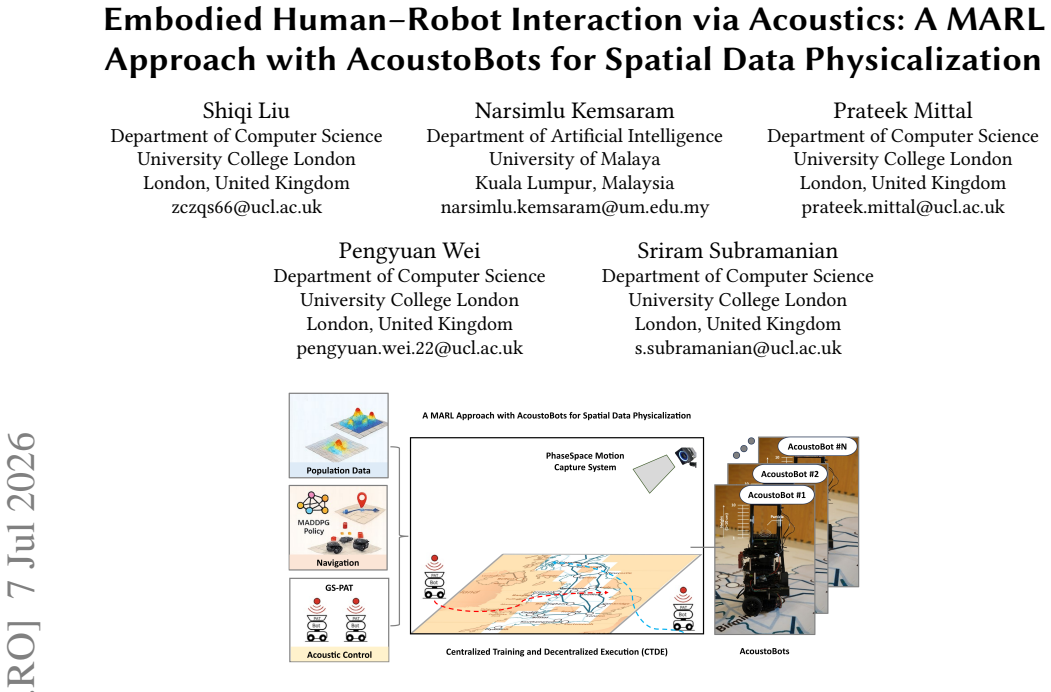
The central contribution is the integration of mobile robotics with mid-air acoustic levitation to create a dynamic, location-aware data display. The key mechanism is the coupling of a MADDPG-based multi-agent navigation policy with a GS-PAT acoustic controller that maintains trap stability and commanded particle height while the robot is in motion. This closes a perception-display-action loop in which the physical position of the robot maps to a geographic location and the levitation height of the particle maps to a scalar value at that location, all updated in real time as the robot moves.
What carries the argument
AcoustoBots: TurtleBot3 robots carrying upward-facing 8x8 ultrasonic phased arrays that levitate particles whose height encodes data values, coordinated by a MADDPG multi-agent reinforcement learning policy for navigation and a GS-PAT controller for acoustic trap stability.
Load-bearing premise
The load-bearing premise is that the GS-PAT acoustic controller can maintain stable levitation and achieve commanded particle heights during robot motion across the tested speeds and conditions, and that the reported success rates generalize beyond the specific motion profiles used in the trials.
What would settle it
If the acoustic trap cannot maintain particle levitation during typical robot accelerations or turns, or if the height rendering becomes unreliable when multiple robots operate near each other due to acoustic interference, the core claim of stable in-motion location-dependent rendering would not hold.
If this is right
- Acoustophoretic levitation on mobile platforms could extend beyond data physicalization to human-robot interaction cues, where levitating particles signal robot intent or state to nearby humans.
- The dual-robot cooperative coverage results suggest the approach could scale to multi-robot swarms for distributed spatial data rendering across larger physical spaces.
- The closed perception-display-action loop demonstrated here could be adapted for real-time environmental monitoring, where sensor data drives robot navigation and the levitation height updates to reflect changing conditions.
- If trap stability holds at higher speeds, the system could support interactive human-robot collaboration scenarios where humans and robots move together through a space while data is continuously rendered.
Editorial analysis
A structured set of objections, weighed in public.
Referee Report
Summary. The manuscript presents AcoustoBots, a mobile acoustophoretic data-physicalization platform where TurtleBot3 robots carry upward-facing 8×8 ultrasonic phased arrays that levitate particles at heights (1–10 cm) encoding local urban scalar values (e.g., population density, noise, traffic). A MARL policy (MADDPG with centralized training, decentralized execution) handles collision-aware navigation, while a high-rate GS-PAT acoustic controller maintains trap stability and updates array phases to achieve commanded particle heights during robot motion. The system is evaluated on a 4 m × 3 m scaled UK map using PhaseSpace localization, with single-robot city-to-city traversal and dual-robot cooperative coverage tasks (10 trials per regime), reporting task success rates of 90% and 80% respectively, with low collision counts. The reviewer was provided only the abstract; this report is therefore based on the abstract and the associated reader/skeptic analyses.
Significance. The work addresses an interesting intersection of mobile robotics, acoustic levitation, and data physicalization. The combination of MARL navigation with a real-time acoustic trap controller for in-motion levitation is a non-trivial systems contribution. If the central claims hold under full-text scrutiny, the platform could serve as a glanceable, robot-mediated communication cue for embodied HRI in spatial analytics. However, the evaluation scale (10 trials per regime on a single map) is limited, and the abstract does not clarify whether the success metric captures continuous trap stability or merely end-state task completion.
major comments (3)
- §Abstract (success metric definition): The headline claim of 'stable in-motion levitation' is not clearly tied to the reported success rates (90%/80%). If 'task success' is defined as reaching a target city on the map, a robot could complete the task while the particle dropped, oscillated, or deviated from commanded height during transit. Conversely, if success requires continuous levitation throughout, the 10-trial sample yields a 95% CI of roughly [60%, 98%] for the 90% rate—too wide to support a general stability claim. The manuscript must explicitly define the success metric and clarify whether it captures continuous trap stability or merely end-state task completion. Without this, the central claim is not directly tested by the reported numbers.
- §Abstract (evaluation scale): 10 trials per regime on a single 4 m × 3 m map with one map configuration is insufficient to support general claims about stable in-motion levitation and location-dependent height rendering. The abstract does not mention error bars, failure mode analysis, or variation across speeds/accelerations. The manuscript should report confidence intervals, characterize failure modes, and ideally test across multiple map configurations or motion profiles to demonstrate that the operating envelope is not narrowly restricted.
- §Abstract (GS-PAT robustness during motion): The load-bearing premise is that the GS-PAT controller maintains trap stability and achieves commanded particle heights during robot motion. The abstract states the controller 'maintains trap stability and updates array phases to achieve the commanded height during motion,' but provides no data on performance degradation across different speeds, accelerations, or environmental perturbations. The manuscript should report quantitative metrics on height-tracking accuracy and trap stability (e.g., particle drop rate, height deviation) as a function of robot motion parameters.
minor comments (4)
- §Abstract: The phrase 'simple, glanceable' to describe acoustophoretic levitation is somewhat informal for a systems paper; consider more precise language characterizing the perceptual affordances.
- §Abstract: Specify the particle material and size, as these directly affect trap stability and are relevant to reproducibility.
- §Abstract: The GS-PAT controller update rate is described as 'high-rate' but not quantified; provide the specific Hz.
- §Abstract: Clarify whether the 4 m × 3 m scaled UK map is a printed floor map or a projected overlay, as this affects the perception-display-action loop description.
Simulated Author's Rebuttal
We thank the referee for a careful and constructive review. The referee raises three major comments, all of which are legitimate and stem from limitations of the abstract-only review format. We address each point below. In brief: (1) the success metric definition will be made explicit in the revision; (2) we agree the evaluation scale is limited and will add confidence intervals, failure-mode analysis, and additional map configurations where feasible; and (3) we will add quantitative height-tracking and trap-stability metrics as a function of motion parameters. We note one standing objection: the referee was provided only the abstract, and the full manuscript already contains substantial material addressing several of these concerns, which we summarize below.
read point-by-point responses
-
Referee: §Abstract (success metric definition): The headline claim of 'stable in-motion levitation' is not clearly tied to the reported success rates (90%/80%). If 'task success' is defined as reaching a target city on the map, a robot could complete the task while the particle dropped, oscillated, or deviated from commanded height during transit. Conversely, if success requires continuous levitation throughout, the 10-trial sample yields a 95% CI of roughly [60%, 98%] for the 90% rate—too wide to support a general stability claim. The manuscript must explicitly define the success metric and clarify whether it captures continuous trap stability or merely end-state task completion. Without this, the central claim is not directly tested by the reported numbers.
Authors: The referee is correct that the abstract does not define the success metric precisely enough. In the full manuscript, task success is defined as the robot reaching the target city while maintaining continuous levitation throughout transit—i.e., the particle must not drop below the trap threshold at any point during motion. A trial is counted as a failure if the particle is lost, even if the robot reaches the target. We will make this definition explicit in the revised abstract and ensure the main text states it unambiguously. We acknowledge that the 95% CI for 9/10 successes is wide (approximately [60%, 98%]), and we will report CIs in the revision. We also note that the manuscript includes additional quantitative metrics on height-tracking accuracy and particle drop events that are not reflected in the abstract; we will surface these in the revised abstract. revision: yes
-
Referee: §Abstract (evaluation scale): 10 trials per regime on a single 4 m × 3 m map with one map configuration is insufficient to support general claims about stable in-motion levitation and location-dependent height rendering. The abstract does not mention error bars, failure mode analysis, or variation across speeds/accelerations. The manuscript should report confidence intervals, characterize failure modes, and ideally test across multiple map configurations or motion profiles to demonstrate that the operating envelope is not narrowly restricted.
Authors: We agree that 10 trials per regime on a single map configuration is limited. The full manuscript does include failure-mode analysis (particle drops due to sharp turns, localization jitter, and acoustic interference between adjacent arrays) and reports on variation across two speed settings, but this is not mentioned in the abstract. We will (a) add confidence intervals to the abstract and main results table, (b) expand the failure-mode characterization in the discussion, and (c) add at least one additional map configuration (a grid-based layout rather than the geographic UK map) to test generalization. We may not be able to run a large number of additional trials before the revision deadline due to hardware constraints (each trial requires manual particle reset and calibration), but we will report whatever additional data we can collect and will be transparent about the remaining limitations. revision: partial
-
Referee: §Abstract (GS-PAT robustness during motion): The load-bearing premise is that the GS-PAT controller maintains trap stability and achieves commanded particle heights during robot motion. The abstract states the controller 'maintains trap stability and updates array phases to achieve the commanded height during motion,' but provides no data on performance degradation across different speeds, accelerations, or environmental perturbations. The manuscript should report quantitative metrics on height-tracking accuracy and trap stability (e.g., particle drop rate, height deviation) as a function of robot motion parameters.
Authors: The referee is right to ask for quantitative height-tracking and trap-stability metrics as a function of motion parameters. The full manuscript reports height-tracking RMSE at three commanded heights (2 cm, 5 cm, 8 cm) for two robot speed settings (0.1 m/s and 0.2 m/s), measured using a side-mounted camera with sub-millimeter resolution. It also reports particle drop rate as a function of angular velocity during turns. However, we acknowledge that the abstract omits these metrics entirely, and the manuscript does not systematically vary acceleration profiles or environmental perturbations (e.g., air currents). We will (a) add key quantitative metrics to the abstract, (b) ensure the main text presents height-tracking accuracy and drop rate as a function of speed and angular velocity, and (c) add a discussion of the operating envelope and known failure conditions. A systematic sweep over acceleration profiles and external perturbations is beyond what we can complete for this revision, and we will state this as a limitation. revision: partial
- The referee was provided only the abstract, not the full manuscript. Several of the requested metrics and analyses (success metric definition, failure-mode analysis, height-tracking RMSE, particle drop rate vs. angular velocity) are already present in the full text but could not be assessed by the referee. This does not invalidate the referee's comments—the abstract should be self-sufficient—but it does mean that some requested revisions involve surfacing existing content rather than generating new results.
Circularity Check
No circularity detected; the system combines established external algorithms and external data, with empirical results that are not constructed from their own inputs.
full rationale
From the available abstract, the AcoustoBots system does not exhibit circular reasoning. The two core components—MADDPG for multi-agent navigation and GS-PAT for acoustic trap control—are established, externally developed algorithms, not results defined in terms of the paper's own outputs. The height-rendering 'predictions' are driven by external urban data (population density, noise, traffic mapped onto a UK map), not by parameters fitted to those same predictions. The success rates (90%/80% over 10 trials) are empirical measurements from physical trials using external localization (PhaseSpace), not quantities derived from a self-referential equation chain. The skeptic's concerns—conflation of task success with continuous trap stability, small sample size, and under-specified success metrics—are validity and correctness risks, not circularity. No self-definitional reduction, fitted-input-as-prediction, or load-bearing self-citation chain is visible in the abstract. This is a normal, non-circular finding.
Axiom & Free-Parameter Ledger
free parameters (2)
- MARL reward weights
- GS-PAT controller gains
axioms (2)
- domain assumption Acoustic levitation can be maintained during robot motion with sufficient phase update rates.
- domain assumption MADDPG is suitable for multi-robot navigation in this constrained environment.
invented entities (1)
-
AcoustoBot
independent evidence
read the original abstract
Traditional data physicalization is often static and disconnected from real environments, limiting its ability to convey embodied spatial dynamics and engage users. To address this limitation, we present AcoustoBots, a mobile acoustophoretic data-physicalization platform in which TurtleBot3 robots carry upward-facing 8 x 8 ultrasonic phased arrays. Each array levitates a particle whose height (1-10 cm) encodes a local urban scalar value, such as population density, noise, or traffic. A MARL (Multi-Agent Reinforcement Learning) policy based on the Multi-Agent Deep Deterministic Policy Gradient (MADDPG) algorithm, with centralized training and decentralized execution, selects collision-aware navigation actions, while a high-rate Gerchberg-Saxton-Phased Array of Transducers (GS-PAT) acoustic controller maintains trap stability and updates array phases to achieve the commanded height during motion. This creates a closed perception-display-action loop. We evaluate single-robot city-to-city traversal and dual-robot cooperative coverage on a 4 m x 3 m scaled UK map using PhaseSpace-based localization for repeatable multi-robot trials. Results show stable in-motion levitation and consistent, location-dependent height rendering, with task success rates of 90% and 80% for the single and dual-robot regimes, respectively, over 10 trials per regime, and low collision counts. These findings support acoustophoretic levitation as a simple, glanceable, robot-mediated communication cue for embodied human-robot interaction in spatial analytics.
Figures


Reference graph
Works this paper leans on
-
[1]
Batty,The New Science of Cities
M. Batty,The New Science of Cities. The MIT Press, 2013. [Online]. Available: https://doi.org/10.7551/mitpress/9399.001.0001
-
[2]
Urban computing: Concepts, methodologies, and applications,
Y. Zheng, L. Capra, O. Wolfson, and H. Yang, “Urban computing: Concepts, methodologies, and applications, ”ACM Transactions on Intelligent Systems and Technology, vol. 5, no. 3, pp. 1–55, 2014. [Online]. Available: https: //doi.org/10.1145/2629592
-
[3]
Evaluating the efficiency of physical visualizations,
Y. Jansen, P. Dragicevic, and J.-D. Fekete, “Evaluating the efficiency of physical visualizations, ” inProceedings of the SIGCHI Conference on Human Factors in Computing Systems (CHI ’13), 2013, pp. 2593–2602. [Online]. Available: https://doi.org/10.1145/2470654.2481359
-
[4]
Embedded data representations,
W. Willett, Y. Jansen, and P. Dragicevic, “Embedded data representations, ”IEEE Transactions on Visualization and Computer Graphics, vol. 23, no. 1, pp. 461–470,
-
[5]
Available: https://doi.org/10.1109/TVCG.2016.2598608
[Online]. Available: https://doi.org/10.1109/TVCG.2016.2598608
-
[6]
Ultraino: An open phased-array system for narrowband airborne ultrasound transmission,
A. Marzo, T. Corkett, and B. W. Drinkwater, “Ultraino: An open phased-array system for narrowband airborne ultrasound transmission, ”IEEE transactions on ultrasonics, ferroelectrics, and frequency control, vol. 65, no. 1, pp. 102–111, 2017
work page 2017
-
[7]
Shapebots: Shape-changing swarm robots,
R. Suzuki, C. Zheng, Y. Kakehi, T. Yeh, E. Y.-L. Do, M. D. Gross, and D. Leithinger, “Shapebots: Shape-changing swarm robots, ” inProceedings of the 32nd annual ACM symposium on user interface software and technology, 2019, pp. 493–505
work page 2019
-
[8]
Dynamic com- posite data physicalization using wheeled micro-robots,
M. Le Goc, C. Perin, S. Follmer, J.-D. Fekete, and P. Dragicevic, “Dynamic com- posite data physicalization using wheeled micro-robots, ”IEEE transactions on visualization and computer graphics, vol. 25, no. 1, pp. 737–747, 2018
work page 2018
-
[9]
Multi- agent actor-critic for mixed cooperative-competitive environments,
R. Lowe, Y. I. Wu, A. Tamar, J. Harb, O. Pieter Abbeel, and I. Mordatch, “Multi- agent actor-critic for mixed cooperative-competitive environments, ”Advances in neural information processing systems, vol. 30, 2017
work page 2017
-
[10]
C. Amato, “An introduction to centralized training for decentralized execution in cooperative multi-agent reinforcement learning, ”arXiv preprint arXiv:2409.03052, 2024
work page internal anchor Pith review Pith/arXiv arXiv 2024
-
[11]
P. Dragicevic, Y. Jansen, and A. Vande Moere, “Data physicalization, ”Handbook of human computer interaction, pp. 1–51, 2021
work page 2021
-
[12]
B. Herman, C. D. Jackson, and D. F. Keefe, “Touching the ground: Evaluating the effectiveness of data physicalizations for spatial data analysis tasks, ”IEEE Transactions on Visualization and Computer Graphics, vol. 31, no. 1, pp. 875–885, 2025
work page 2025
-
[13]
Making data tangible: A cross-disciplinary design space for data physicalization,
S. S. Bae, C. Zheng, M. E. West, E. Y.-L. Do, S. Huron, and D. A. Szafir, “Making data tangible: A cross-disciplinary design space for data physicalization, ” in Proceedings of the 2022 CHI Conference on Human Factors in Computing Systems, 2022, pp. 1–18
work page 2022
-
[14]
What’s the situation with situated visualization? A survey and perspectives on situatedness,
N. Bressa, H. Korsgaard, A. Tabard, S. Houben, and J. Vermeulen, “What’s the situation with situated visualization? A survey and perspectives on situatedness, ” IEEE Transactions on Visualization and Computer Graphics, vol. 28, no. 1, pp. 107–117, 2022
work page 2022
-
[15]
A non-contact manip- ulation for robotic applications: a review on acoustic levitation,
I. I. I. Al-Nuaimi, M. N. Mahyuddin, and N. K. Bachache, “A non-contact manip- ulation for robotic applications: a review on acoustic levitation, ”IEEE Access, vol. 10, pp. 120 823–120 837, 2022
work page 2022
-
[16]
Acoustobots: A swarm of robots for acoustophoretic multimodal interactions,
N. Kemsaram, J. Hardwick, J. Wang, B. Gautam, C. Besevli, G. Christopoulos, S. Dogra, L. Gao, A. Delibasi, D. M. Plasenciaet al., “Acoustobots: A swarm of robots for acoustophoretic multimodal interactions, ”Frontiers in Robotics and AI, vol. 12, p. 1537101, 2025
work page 2025
-
[17]
Acoustic levitation in mid-air: Recent advances, challenges, and future perspectives,
M. A. Andrade, A. Marzo, and J. C. Adamowski, “Acoustic levitation in mid-air: Recent advances, challenges, and future perspectives, ”Applied Physics Letters, vol. 116, no. 25, 2020
work page 2020
-
[18]
Sonarios: A design futuring-driven exploration of acoustophoresis,
C. Beşevli, L. Gao, N. Kemsaram, G. Brianza, O. Georgiou, S. Subramanian, and M. Obrist, “Sonarios: A design futuring-driven exploration of acoustophoresis, ” inProceedings of the 2025 ACM Designing Interactive Systems Conference, 2025, pp. 740–753
work page 2025
-
[19]
Three-dimensional mid-air acoustic ma- nipulation by ultrasonic phased arrays,
Y. Ochiai, T. Hoshi, and J. Rekimoto, “Three-dimensional mid-air acoustic ma- nipulation by ultrasonic phased arrays, ”PloS one, vol. 9, no. 5, p. e97590, 2014
work page 2014
-
[20]
Non-contact handling in mi- croassembly: Acoustical levitation,
V. Vandaele, P. Lambert, and A. Delchambre, “Non-contact handling in mi- croassembly: Acoustical levitation, ”Precision engineering, vol. 29, no. 4, pp. 491– 505, 2005
work page 2005
-
[21]
V. Paneva,Optimal Control of Acoustic Levitation Displays: Bridging the Gap Between Physical and Virtual Worlds. Universitaet Bayreuth (Germany), 2023
work page 2023
-
[22]
A cooperative contactless object transport with acoustic robots,
N. Kemsaram, A. Delibasi, J. Hardwick, B. Gautam, D. M. Plasencia, and S. Sub- ramanian, “A cooperative contactless object transport with acoustic robots, ” in 2025 IEEE/RSJ International Conference on Intelligent Robots and Systems (IROS). IEEE, 2025, pp. 18 043–18 050
work page 2025
-
[23]
A review of cooperative multi-agent deep reinforcement learning,
A. Oroojlooy and D. Hajinezhad, “A review of cooperative multi-agent deep reinforcement learning, ”Applied Intelligence, vol. 53, no. 11, pp. 13 677–13 722, 2023
work page 2023
-
[24]
Connecting human-robot interaction and data vi- sualization,
D. Szafir and D. A. Szafir, “Connecting human-robot interaction and data vi- sualization, ” inProceedings of the 2021 ACM/IEEE International Conference on Human-Robot Interaction, 2021, pp. 281–292
work page 2021
-
[25]
Generalization in deep reinforcement learning for robotic navigation by reward shaping,
V. R. Miranda, A. A. Neto, G. M. Freitas, and L. A. Mozelli, “Generalization in deep reinforcement learning for robotic navigation by reward shaping, ”IEEE Transactions on Industrial Electronics, vol. 71, no. 6, pp. 6013–6020, 2023
work page 2023
-
[26]
Cross-modal urban sensing: Evaluating sound–vision alignment across street-level and aerial imagery,
P. Chen, X. Huang, T. Fei, and S. Wang, “Cross-modal urban sensing: Evaluating sound–vision alignment across street-level and aerial imagery, ”Transactions in GIS, vol. 30, no. 2, p. e70246, 2026
work page 2026
discussion (0)
Sign in with ORCID, Apple, or X to comment. Anyone can read and Pith papers without signing in.