An Incentive Security Model to Provide Fairness for Peer-to-Peer Networks
Pith reviewed 2026-05-25 18:35 UTC · model grok-4.3
The pith
An incentive security model for peer-to-peer networks prevents betrayals between leechers and ensures seeders receive fair treatment.
A machine-rendered reading of the paper's core claim, the machinery that carries it, and where it could break.
Core claim
The incentive based security model leads to a network infrastructure that lightens the work of Seeders and makes Leechers to contribute more. This method is able to prevent betrayals in Leecher-to-Leecher transactions and more importantly, helps Seeders to be treated more fairly. This is what other incentive methods such as Bittorrent are incapable of doing. Additionally, by getting help from cryptography and combining it with our method, it is also possible to achieve secure channels, immune to spying, next to a fair network.
What carries the argument
The incentive security model that enforces contributions from leechers and uses cryptography to secure channels.
If this is right
- Prevents betrayals in leecher-to-leecher transactions.
- Seeders receive fairer treatment than under BitTorrent.
- Overcomes the free-riding issue.
- Provides an appropriate level of fairness for users.
- Decreases download time.
Where Pith is reading between the lines
- The model could be tested by implementing it as an extension to existing protocols and measuring contribution rates in controlled trials.
- Widespread use might reduce user abandonment in file-sharing networks by addressing perceived unfairness.
- It might combine with other decentralized systems to improve overall resource sharing sustainability.
- The security aspect could be evaluated separately by checking resistance to eavesdropping in simulated attacks.
Load-bearing premise
Users will behave rationally in response to the incentives and the simulation accurately reflects real-world P2P dynamics and adoption.
What would settle it
Deploying the protocol in a live network and measuring whether free-riders still dominate or seeders still report unfair treatment would test the claim.
Figures
read the original abstract
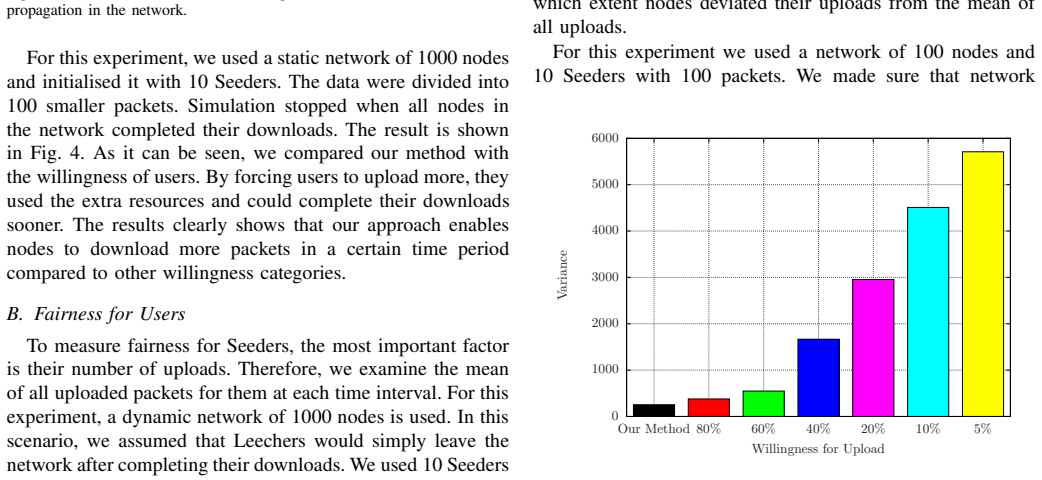
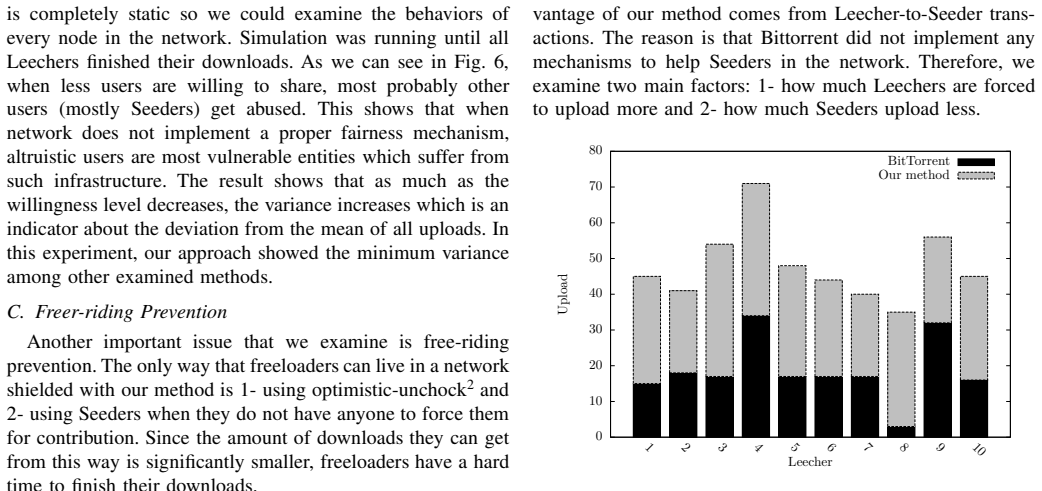
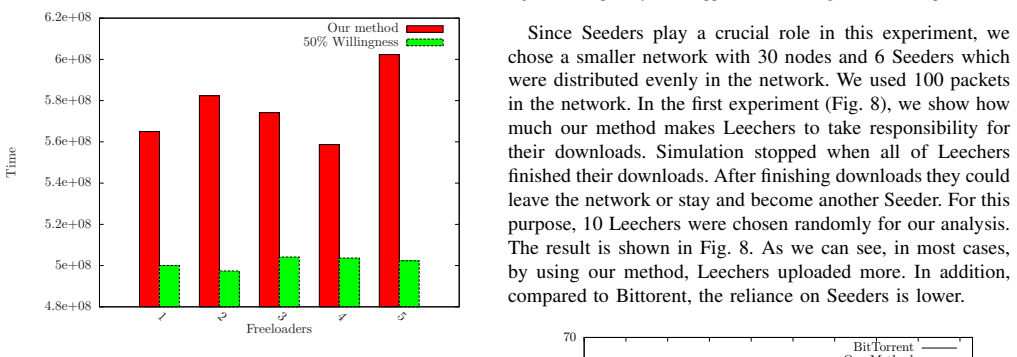
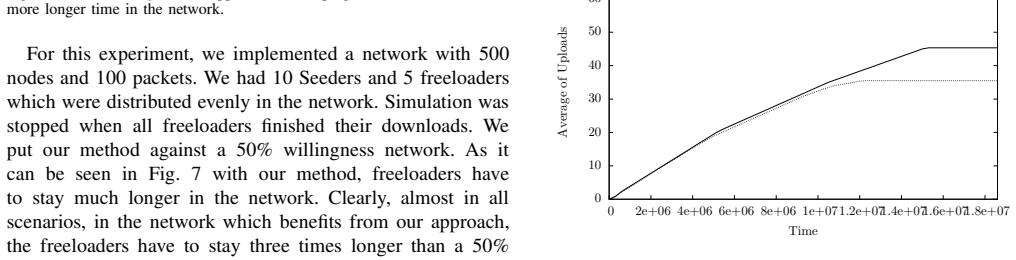
Peer-to-Peer networks are designed to rely on resources of their own users. Therefore, resource management plays an important role in P2P protocols. Therefore, resource management plays an important role in P2P protocols. Early P2P networks did not use proper mechanisms to manage fairness. However, after seeing difficulties and rise of freeloaders in networks like Gnutella, the importance of providing fairness for users have become apparent. In this paper, we propose an incentive based security model which leads to a network infrastructure that lightens the work of Seeders and makes Leechers to contribute more. This method is able to prevent betrayals in Leecher-to-Leecher transactions and more importantly, helps Seeders to be treated more fairly. This is what other incentive methods such as Bittorrent are incapable of doing. Additionally, by getting help from cryptography and combining it with our method, it is also possible to achieve secure channels, immune to spying, next to a fair network. The simulation results clearly show that how our proposed approach can overcome free-riding issue. In addition, our findings revealed that our approach is able to provide an appropriate level of fairness for the users and can decrease the download time.
Editorial analysis
A structured set of objections, weighed in public.
Referee Report
Summary. The paper proposes an incentive-based security model for peer-to-peer networks to reduce free-riding, prevent betrayals in leecher-to-leecher transactions, ensure fairer treatment for seeders (unlike BitTorrent), provide overall fairness, and decrease download times. It suggests combining the model with cryptography for secure channels and claims that simulation results demonstrate these benefits.
Significance. If the simulation results hold under scrutiny and the model proves robust, the approach could contribute to P2P resource management by addressing free-riding more effectively than existing methods. However, the lack of any reported details on the model, parameters, baselines, or validation against strategic behaviors substantially weakens the potential impact.
major comments (2)
- Abstract: the central claims of reduced free-riding, prevented betrayals, fairer seeder treatment, and lower download times rest entirely on unspecified simulation results, yet the abstract (and per the provided context, the manuscript) supplies no details on model implementation, simulation parameters, baselines, or data, preventing verification.
- Simulation results section: no formal game-theoretic analysis or adversarial model is supplied to show that the incentive mechanism remains dominant-strategy or Nash when users can deviate strategically (e.g., selective uploading, Sybil attacks, or collusion), which is load-bearing for the fairness and free-riding claims.
minor comments (2)
- Abstract: repeated sentence ('Therefore, resource management plays an important role in P2P protocols.') should be removed.
- The model references 'incentive contribution thresholds' as free parameters; if the paper claims any parameter-free property, this should be clarified or removed.
Simulated Author's Rebuttal
We thank the referee for the constructive feedback on our manuscript. We address each major comment below and indicate the revisions planned for the next version.
read point-by-point responses
-
Referee: Abstract: the central claims of reduced free-riding, prevented betrayals, fairer seeder treatment, and lower download times rest entirely on unspecified simulation results, yet the abstract (and per the provided context, the manuscript) supplies no details on model implementation, simulation parameters, baselines, or data, preventing verification.
Authors: We agree that the manuscript lacks explicit details on the simulation setup. In the revised version we will expand the abstract with a brief mention of key parameters and add a new subsection to the simulation results section that fully describes the model implementation, simulation parameters, baselines (including standard BitTorrent), and data sources used. revision: yes
-
Referee: Simulation results section: no formal game-theoretic analysis or adversarial model is supplied to show that the incentive mechanism remains dominant-strategy or Nash when users can deviate strategically (e.g., selective uploading, Sybil attacks, or collusion), which is load-bearing for the fairness and free-riding claims.
Authors: The current work relies on simulation-based evaluation rather than formal game theory. We will add a discussion subsection addressing potential strategic deviations (selective uploading, collusion) observed in the simulations and their impact on the reported outcomes. A complete formal proof of dominant-strategy or Nash equilibrium properties is outside the scope of this paper and would constitute new theoretical work. revision: partial
Circularity Check
No significant circularity detected
full rationale
The paper proposes an incentive model for P2P fairness and supports its claims (preventing betrayals, reducing free-riding, improving seeder treatment) via simulation results rather than any closed-form derivation. No equations, parameter fits presented as predictions, self-definitional constructs, or load-bearing self-citations appear in the provided text. The simulation is offered as external validation of the model's behavior under the stated assumptions, not as a tautological restatement of the model's inputs. The central claims therefore remain independent of the validation step.
Axiom & Free-Parameter Ledger
free parameters (1)
- incentive contribution thresholds
axioms (1)
- domain assumption Users respond rationally to incentives
invented entities (1)
-
incentive security model
no independent evidence
Reference graph
Works this paper leans on
-
[1]
Trust based incentive in P2P network,
Y . Tang, H. Wang, and W. Dou, “ Trust based incentive in P2P network,” in Proceedings of the IEEE International Conference on E-Comm erce Technology for Dynamic E-Business , China (2004)
work page 2004
-
[2]
Naghizadeh, A., & Shahbahrami, A. (2017). Binary search routing equiv- alent (BSRE): a circular design for structured P2P networks . Transactions on Emerging Telecommunications Technologies, 28(4), e301 2
work page 2017
-
[3]
Naghizadeh, A., Berenjian, S., Meamari, E., & Atani, R. E . (2016). Structuralbased tunneling: preserving mutual anonymity f or circular P2P networks. International Journal of Communication Systems , 29(3), 602- 619
work page 2016
-
[4]
Naghizadeh, A., Berenjian, S., Razeghi, B., Shahanggar , S., & Pour, N. R. (2015, January). Preserving receiver’s anonymity for ci rcular structured P2P networks. In 2015 12th Annual IEEE Consumer Communicati ons and Networking Conference (CCNC) (pp. 71-76). IEEE
work page 2015
-
[5]
A performance study o f incentive schemes in peer-to-peer file-sharing systems,
D. Guo, Y . Kwok, X. Jin, and J. Deng, “A performance study o f incentive schemes in peer-to-peer file-sharing systems,” T he Journal of Supercomputing, vol. 72, no. 3, 1152–1178 (2016)
work page 2016
-
[6]
Free riding on gnutella revisited: The bell tolls?,
D. Hughes, G. Coulson, and J. Walkerdine, “Free riding on gnutella revisited: The bell tolls?,” IEEE Distributed Systems Onli ne, vol. 6, no. 6 (2005)
work page 2005
-
[7]
An efficient inf rastructure based service discovery in vehicular networks using P2P str uctures,
N. Balouchzahi, M. Fathy, and A. Akbari, “An efficient inf rastructure based service discovery in vehicular networks using P2P str uctures,” The Journal of Supercomputing, vol. 72, no. 3, 1013–1034 (2016)
work page 2016
-
[8]
An Eigentrust dynamic evolutio nary model in P2P file-sharing systems,
K. Lu, J. Wang, and M. Li, “An Eigentrust dynamic evolutio nary model in P2P file-sharing systems,” Peer-to-Peer Networking and A pplications, vol. 9, no. 3, 599–612 (2016)
work page 2016
-
[9]
Incentives build robustness in BitTorrent,
B. Cohen, “Incentives build robustness in BitTorrent,” in Proceedings of P2PEcon (2003)
work page 2003
-
[10]
Naghizadeh, A., Razeghi, B., Radmanesh, I., Hatamian, M., Atani, R. E., & Norudi, Z. N. (2015, April). Counter attack to free-rid ers: Filling a security hole in BitTorrent protocol. In 2015 IEEE 12th Int ernational Conference on Networking, Sensing and Control (pp. 128-133 ). IEEE
work page 2015
-
[11]
Improving the BitTorrent protoco l using different incentive techniques,
R. R. Izhak-Ratzin, “Improving the BitTorrent protoco l using different incentive techniques,” Ph.D. dissertation, Dept. CS., UCL A, USA (2010)
work page 2010
-
[12]
Improving performance of BitTorrent network th rough incentive mechanism,
M. Li, “Improving performance of BitTorrent network th rough incentive mechanism,” M.Sc. thesis, San Jose State University, USA, ( 2011)
work page 2011
-
[13]
Free riding in peer-to-peer ne tworks,
M. Karakaya, I. Krpeog, “Free riding in peer-to-peer ne tworks,” Com- puter Networks, vol. 52, no. 3, 675–694 (2008)
work page 2008
-
[14]
Cooperating with free rid ers in unstructured P2P networks,
Y . Joung, T. H. Chiu, S. Chen, “Cooperating with free rid ers in unstructured P2P networks,” Computer Networks, vol. 56, no . 1, 198–212 (2012)
work page 2012
-
[15]
Repeated public goods game mode for trust based P2P networks,
S. Kim, “Repeated public goods game mode for trust based P2P networks,” Wireless Personal Communications, vol. 79, no. 1, 473–485 (2014)
work page 2014
-
[16]
Th e Eigentrust algorithm for reputation management in P2P networks,
S. D. Kamvar, M. T. Schlosser, and H. Garcia-Molina, “Th e Eigentrust algorithm for reputation management in P2P networks,” in Proceedings of the 12th International Conference on W orld Wide W eb, Hungary, 640–651 (2003)
work page 2003
-
[17]
Razeghi, B., Hatamian, M., Naghizadeh, A., Sabeti, S., & Hodtani, G. A. (2015, April). A novel relay selection scheme for multi-use r cooperation communications using fuzzy logic. In 2015 IEEE 12th Interna tional Conference on Networking, Sensing and Control (pp. 241-246 ). IEEE
work page 2015
-
[18]
Berenjian, S., Shajari, M., Farshid, N., & Hatamian, M. (2016, Septem- ber). Intelligent automated intrusion response system bas ed on fuzzy decision making and risk assessment. In 2016 IEEE 8th Intern ational Conference on Intelligent Systems (IS) (pp. 709-714). IEEE
work page 2016
-
[19]
Hatamian, M., Barati, H., Movaghar, A., & Naghizadeh, A . (2016). CGC: centralized genetic-based clustering protocol for wi reless sensor networks using onion approach. Telecommunication systems , 62(4), 657- 674
work page 2016
-
[20]
Naghizadeh, A., Razeghi, B., Meamari, E., Hatamian, M. , & Atani, R. E. (2016). C-trust: A trust management system to improve fai rness on circular P2P networks. Peer-to-Peer Networking and Applic ations, 9(6), 1128-1144
work page 2016
-
[21]
Predicting the level of cooperation in a Peer-to-Peer live streaming ap plication,
G. D. Gonalves, . Cunha, A. B. Vieira, and J. M. Almeida, “ Predicting the level of cooperation in a Peer-to-Peer live streaming ap plication,” Multimedia Systems, vol. 22, no. 2, 161–180 (2016)
work page 2016
-
[22]
Naghizadeh, A. (2016). Improving fairness in peer-to- peer networks by separating the role of seeders in network infrastructures. Turkish Journal of Electrical Engineering & Computer Sciences, 24(4), 2255 -2266
work page 2016
-
[23]
A method for obt aining digital signatures and public-key cryptosystems,
R. L. Rivest, A. Shamir, and L. Adleman, “A method for obt aining digital signatures and public-key cryptosystems,” Commun ications of the ACM, vol. 21, no. 2, 120–126 (1978)
work page 1978
discussion (0)
Sign in with ORCID, Apple, or X to comment. Anyone can read and Pith papers without signing in.